Archives for category: chickens

We’ve never had three cats before. We didn’t plan on it. I’ve always taken my lead on cats from the Crosby, Stills, Nash & Young song, “Our House.” (“with two cats in the yard….”) Two cats makes perfect sense, especially if you get them together, as kittens. They keep each other company and they romp, tussle and roll.

2024 was another tough year. My Mum passed away in the Spring. A week later, a neighbor dog killed one of our cats, Milt. We mourned. Our other cat, Ollie, mourned. There was nothing we could do for him. After a few weeks he seemed to recover some—at least he resumed eating, and he even reveled in attention and grooming. I cannot say that we’d recovered, but it was good to see Ollie being more of himself. We were resigned to being a single cat household.

Then, three weeks after Milt was killed, Ollie disappeared. We assumed it was the standard Spring “got caught in someone’s shed” deal, and that he’d be home in a week.  And then he wasn’t. We talked to the neighbors. Where we live is pretty rural—there aren’t a lot of neighbors. We did the usual missing cat things—walked the roads, checked with animal control. It’s an unfortunate part of country living—lots of things can take out a cat. Dogs, coyotes, owls and raptors can all turn your fluffball into dinner. After a month I was despondent. At two months, my sister gave me ‘the talk.’

If you love cats in the country, you either have to keep them in, or you have to be prepared for losses. It just comes with the territory. We don’t want to keep them in. We spend a lot of time outside, in the garden, in the woods. Our cats have always followed us. They are indoor and outdoor companions.” Cats,” my sister said, “Are a renewable resource.”

At just over two months I started checking the ads for rescue kittens. I resolved not to get hung up on looks—that all cats need homes and I’d take the first set of brothers I could find. And so we got Maki and Red. Maki looks shockingly like Milt. He’s a long-bodied, short legged, medium hair tabby—clearly some Maine Coon in him—tufted ears, neck ruff, thick racoon-like tail. His littermate, Red, is the complete opposite. He’s a long-legged, short necked, short-haired, ginger tabby, with a long, narrow striped tail. 

When they arrived, Maki was much smaller, the runt of the litter. They came infested with fleas and ear mites. We’re old hands at cat care, we started combing and treating the ears. We held off a month on their first vet visit, to get them cleaned up a bit, and stabilize them. At this stage they were strictly indoor kitties. I have a nine pound rule. Kittens do not go outside unsupervised until they’re bigger than the average appetizer. We draw the line at nine pounds.

An aside, starting in early September, we had chicken troubles. Our chickens were happy free-range girls. But a recent addition to the neighborhood changed that. We now have a bobcat! Of course, its arrival gave me nightmares over Ollie’s fate, especially when one of the chickens was found as a loose pile of feathers, just steps from our back door. It brought an abrupt end to free range. Now the chickens were locked into their run all day. That’s not a bad gig—it’s a large chain-link enclosure about 50 feet across. The chickens were not impressed. You’d think they’d get it—after the loss of one of their own, but no. They squabbled and separated into rival groups. Since we have two coops, we left them both open and let the chickens sort it out. One night, noise from the chicken pen called us out with flashlights—a ruckus—which we assumed was yet another squabble. Dazed chickens were wandering around the pen—with some loose feathers in the air. We searched the entire area—but could not find anything amiss. We shrugged threw them back in their respective coops (minus one who wouldn’t go) and went back to bed. In the morning, two chickens were dead, their throats torn out. It took some research and a little detective work, but we determined that the culprit was a weasel. Weasels literally go for the neck. Their jaws limit how wide they can open their mouths—so on chickens—the neck is it. We dusted the area with flour and baited one of the coops with chicken necks and a strong rat trap. All chickens, regardless of personality squabbles, were locked into the large coop at night. The first effort at trapping was unsuccessful—the weasel took the bait but wasn’t caught in the trap. But, we did confirm through the footprints in the flour that it was a weasel—and a big one, at that. The remaining chickens were all pretty flipped out by then—first the bobcat, then the weasel. We were down to the point where we were concerned that the remaining three chickens wouldn’t have enough body mass to keep them warm for the winter. We started advertising for folks to take the chickens. No luck. After numerous unsuccessful attempts to trap the weasel, we decided the safest bet was to move the chickens to the small coop, as it was more defendable. Or so we thought. That weasel was still trying, every night. Maybe the smaller coop would be warm enough for our three survivors. Until one morning, two more chickens were dead. The damn weasel had torn part of the roof off of the small coop to get them. We were left with one, highly traumatized chicken. One chicken cannot survive the winter alone. Thankfully we found a chicken angel who invited our poor solo chicken to live in her flock. Frankly, it was beginning to seem that our year was about losses. We have plans for a new, impervious, coop, come spring. We sure miss the eggs.
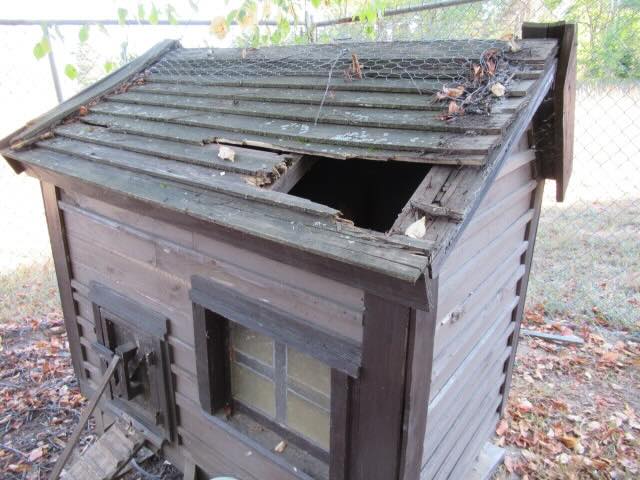
Damned Weasel

Back to the kitties. By their first vet visit, Maki had surged ahead, size-wise. Red seemed timid and delicate by comparison. They received their first round of vaccines and were scheduled for the next round, two weeks later. 

That two weeks was harrowing. Red became ill—his belly distended, but he wasn’t eating much, or using the cat box. Then, he had a high fever…for days. We were orally rehydrating him, and feeding him kitty-soup with a syringe. Of course this happened on the weekend, so we hoped he’d make it to the following Monday to see the vet. We didn’t know if it was related to the vaccine, or if there was some other problem. We made it through the weekend, and brought him in. The vet was not reassuring. She suspected that Red had FIP—which, in 55 years of cat care, I’d never heard of. She sent us home with everything we needed to keep him hydrated subcutaneously and told us to keep it up with the kitty soup. Their appointment for the second round of vaccines was later in the week. She told us to bring him in for a check-up—but that he probably would not be up for the vaccine round 2, just yet.

I went home and looked up FIP. It wasn’t good news. Feline Infectious Peritonitis is a lethal mutated coronavirus. Cats do not recover. Kittens catch the coronavirus when they’re little and then, in some kittens, the virus mutates in the kitten, turning its own immune defenses into a viral replicator of the mutated virus. One of the triggers for the mutation is vaccination. The mutated form is not contagious—but once it mutates in a kitten the results are always deadly for the kitten. My research showed that there was some promising research for treatment, but nothing had FDA approvals. 

The morning of their appointment, we were loading the two kitties into the carrier when there was a noise at the front door. I looked over and there, looking in the window, was Ollie. A very fat Ollie. We let him in—shocked. At this point he’d been gone for over four months. He’d obviously been more than well cared for—but given a chance, Ollie came home. We were thrilled to see him. He was not happy to see kittens in his home.

At the vet’s, a robust and healthy Maki got his second round of vaccines. Red was examined, the vet shaking her head. He’d improved from earlier in the week, but he was not a healthy cat. She made an appointment for the following week—either to complete his vaccine cycle, or to consider euthanasia.

It was a rough week. We doted. We spoiled. We coaxed. We hydrated and force fed. But Red was not rallying. On the day of his appointment, I asked Rick to stay home, to dig his grave.

The vet confirmed our worst fears. Red was failing. As we prepared for his final injection, I tearfully said that I couldn’t believe that, with all the corona virus research coming out of Covid that there wasn’t some coronavirus treatment for FIP. Our vet, whom we have trusted for a decade of cat care, made a strange face. “Well,” she said, “There’s nothing… unless you’re willing to go on the black market.” Behind her, her assistant was nodding vigorously—silently signaling to re-think putting Red down. Our vet continued, “There are treatments out there, but they’re not yet approved. There are no guarantees, here and I cannot be involved because this isn’t yet a legal treatment. Her assistant gave me a website to contact. It was all pretty sketchy—but it gave us a chance for Red. Our year had seen enough losses—we were willing to give Red a chance.

That night I checked out the site, and was assigned an Administrator to guide me through the FIP treatment. Because he was in such rough shape, she said we had to start with injections, and switch to pills when he’d improved. The next step was to find a source of the serum as soon as possible. They hooked me up with a woman a couple of hours from me who had leftover vials of the serum. I drove there, and met up with her. Her kitty had completed the treatment and survived! It was like a drug deal with angels. I took the vials home and we started the treatment that night.

Some people report miraculous results—within hours. Our Red was too far along for that kind of magic. But we stuck with it—along with the forced kitty soup and regular subcutaneous hydration. Poor Red was a feline pin cushion. So many injections on so little a kitty! He started treatment at 3.2 pounds—and then dropped below three pounds for the first week or so. His care took hours, every day. We weren’t sure he would make it—but he was willing, and affectionate, even if he could barely walk and only ate when forced. After a week, there was some small improvement—his balance was better, and he started to eat on his own. It was a long, slow, haul.

By week three, there was sudden, visible improvement. Red turned back into a kitten. Even wobbly, he was making an effort to play. He resumed grooming. On day 21, he was well enough to switch from injections to pills. The treatment calls for 84 days of treatment (with bloodwork along the way to check progress), followed by 84 days of observation—to make sure he doesn’t relapse. Red has completed the full treatment protocol, and has graduated to the observation phase.

During this whole treatment process, we’ve also been dealing with integrating our senior cat with these kittens. It was touch and go at the beginning. Ollie was not happy with kittens, but the kittens were infatuated with Ollie. They followed him everywhere. Ooooh—it’s BIG CAT. WE LOVE BIG CAT. They were relentless in their affection. And it’s working. Ollie is finally adjusting to having two rambunctious kittens in his sphere. Sometimes, he’ll even play with their toys, or let them groom his ears and face.

That’s how we ended up with three cats. I’ll have to look for a new song, because it’s beginning to look like we’ll be lucky enough to have three cats in our future. We’re starting the New Year with hope and crossed fingers.

Red, on graduation day

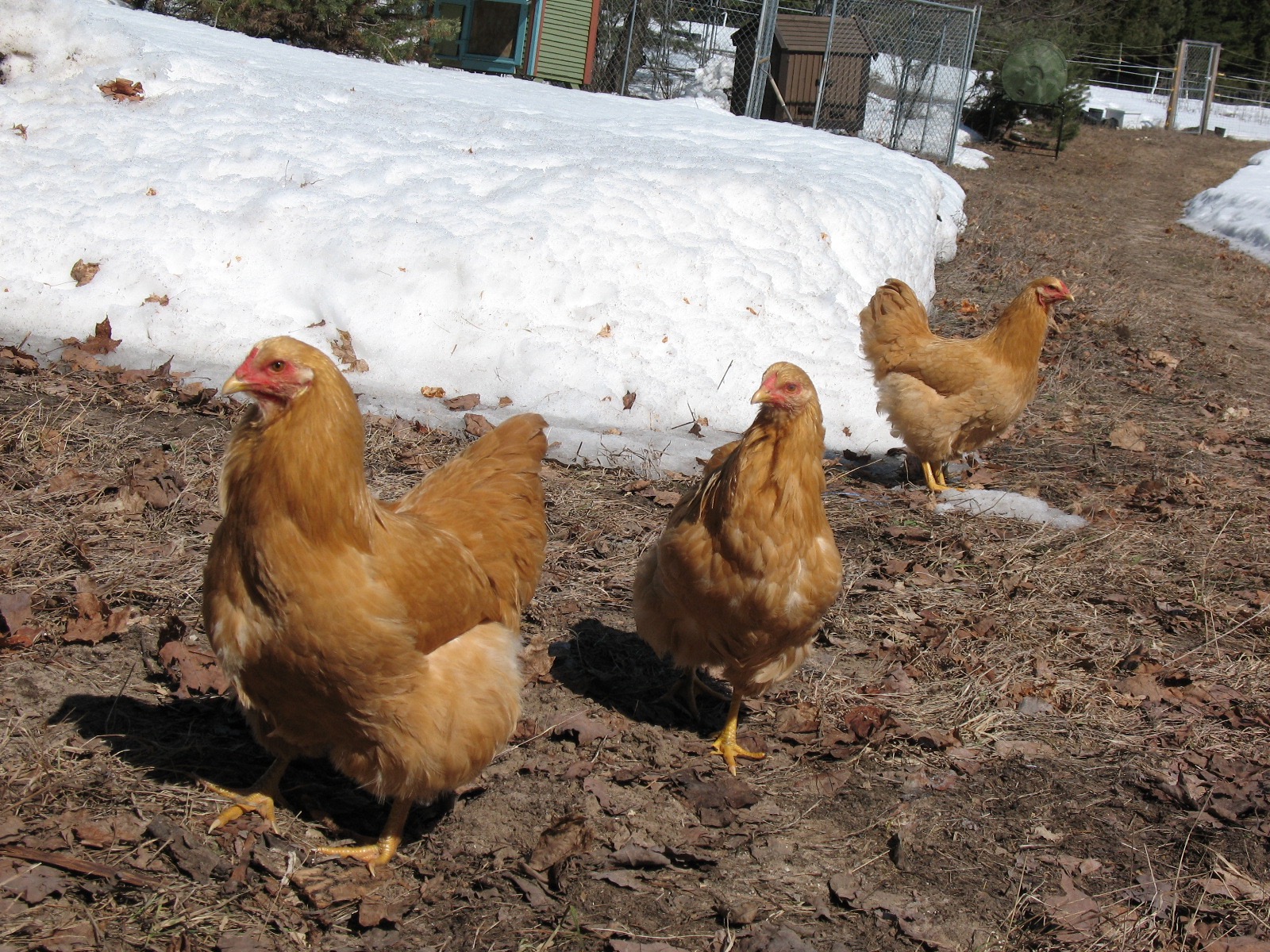
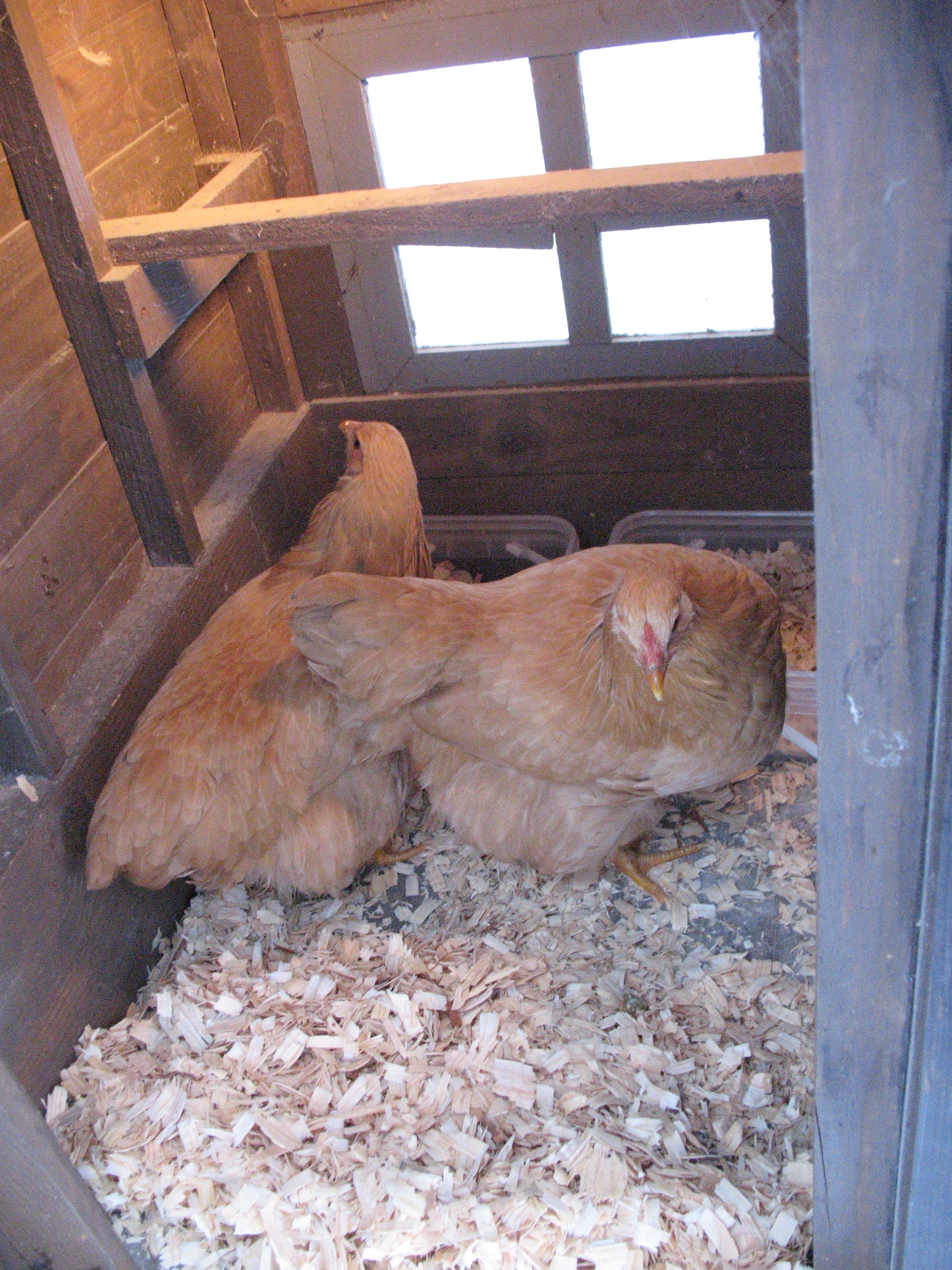
It’s always something with chickens. We have added to our chicken flock (which had dwindled to two). We have the two original Buff Chanteclers, two Wyandottes, and an Easter-Egger. These new chickens have proved to be prolific layers–and I cannot help wondering if that isn’t the source of the problem.

The Chanteclers were never great layers. They are extremely hardy–and they’re not big eaters. I’m not sure if “cheap to keep” is enough. Alpha, the top dog of the chicken yard has never laid an egg so far as we can tell. We contemplated retiring her, early on (read “soup”), but my sister warned that the top chicken of the pecking order often doesn’t lay. She is, after all, a supervisor. If we retired her, there was the risk that any new top chicken would, in turn, cease to lay. So we kept her. She’s a bitch, but she’s our bitch.

The new chickens have upped the game. We are at the point where we produce more eggs than we can consume. Our neighbors thank us. But all this production seems to have rattled Alpha.

Alpha is no spring chicken. She must be five, and remember, she does not lay. But she’s gone broody on us! A broody chicken is one who goes through a hormonal shift, such that she seeks to develop a clutch of eggs to hatch. She’ll hang out in the brood box all day, sitting on any eggs she can find. Her temperature rises, and she goes into an uncharacteristic, driven mode. You can kick her out of the coop– but she goes right back. Some broody hens become aggressive. I suppose it works in the larger context–where a chicken could actually hatch a family, but we have no rooster. There will be no chicks.

Given that this is all in vain, we have to consider the cost to the chicken. It wears the hen out–all this obsessive behavior and the elevated temperatures, they’re bad for the chicken. It is in everyones’ interest to break the broody cycle.

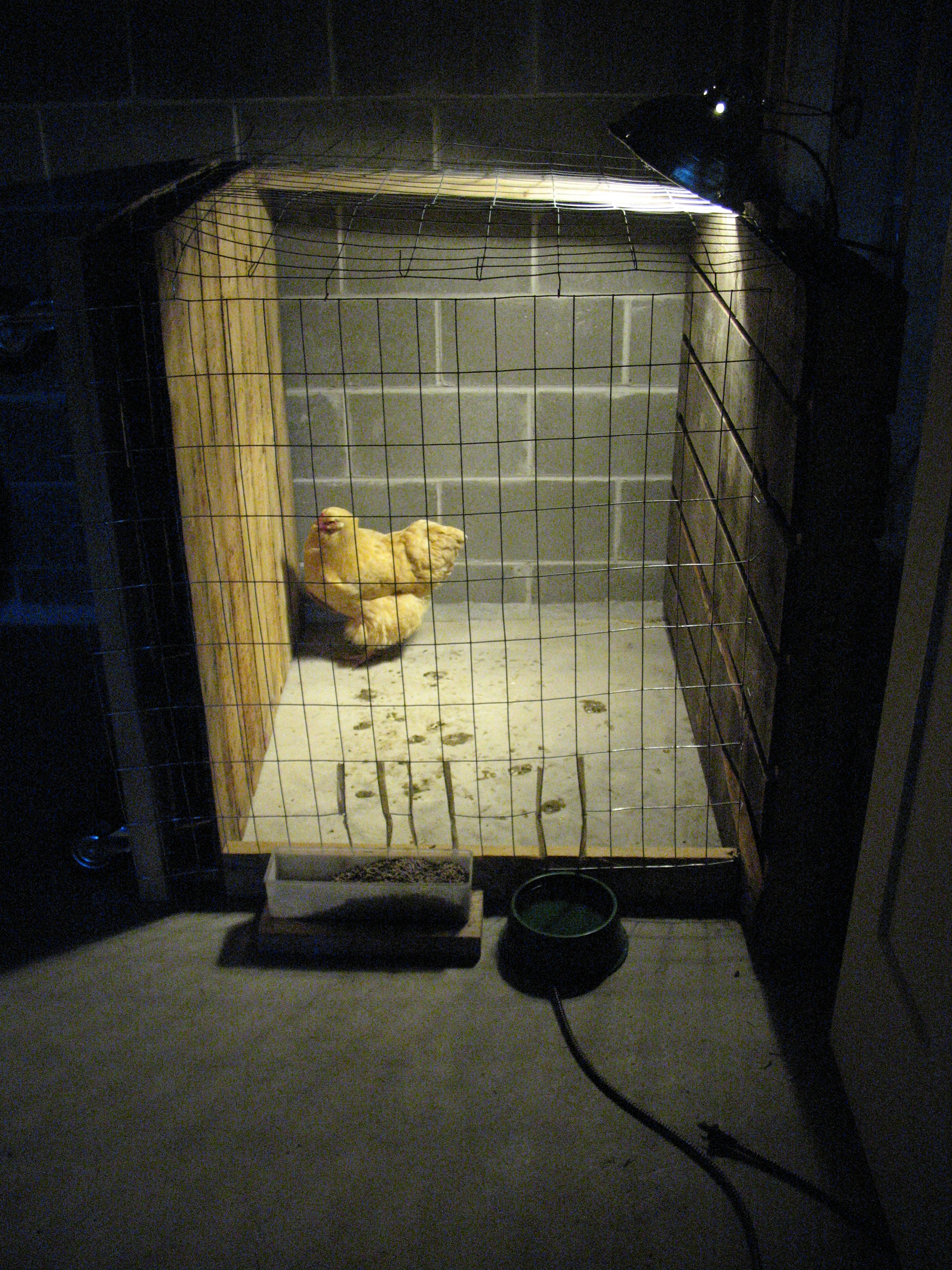
We never had a broody hen before, so I called my sister for help. “You have to cool her down to break the broody cycle.” Just how does one chill a chicken? Apparently, you can either dunk her repeatedly in icy water (which sounds like torture to me), or you can isolate her in a cool location–with no nesting materials for insulation. This slower, but more humane method can take days.

So Alpha is in solitary. Our barn stays cool in the lower level–in the low 50s on the concrete floor. So Alpha is doing time, chilling. The other chickens don’t seem to miss her. As you can imagine, she’s pacing the floor, like the inmate that she is. Rick put the food and water outside the enclosure–he didn’t want any rattling of the tin cup against the bars of her cell. So far, I don’t see her getting any reduction in sentence for good behavior.

In a couple of days, we put her back out with the others, and hope that she is broody no more.

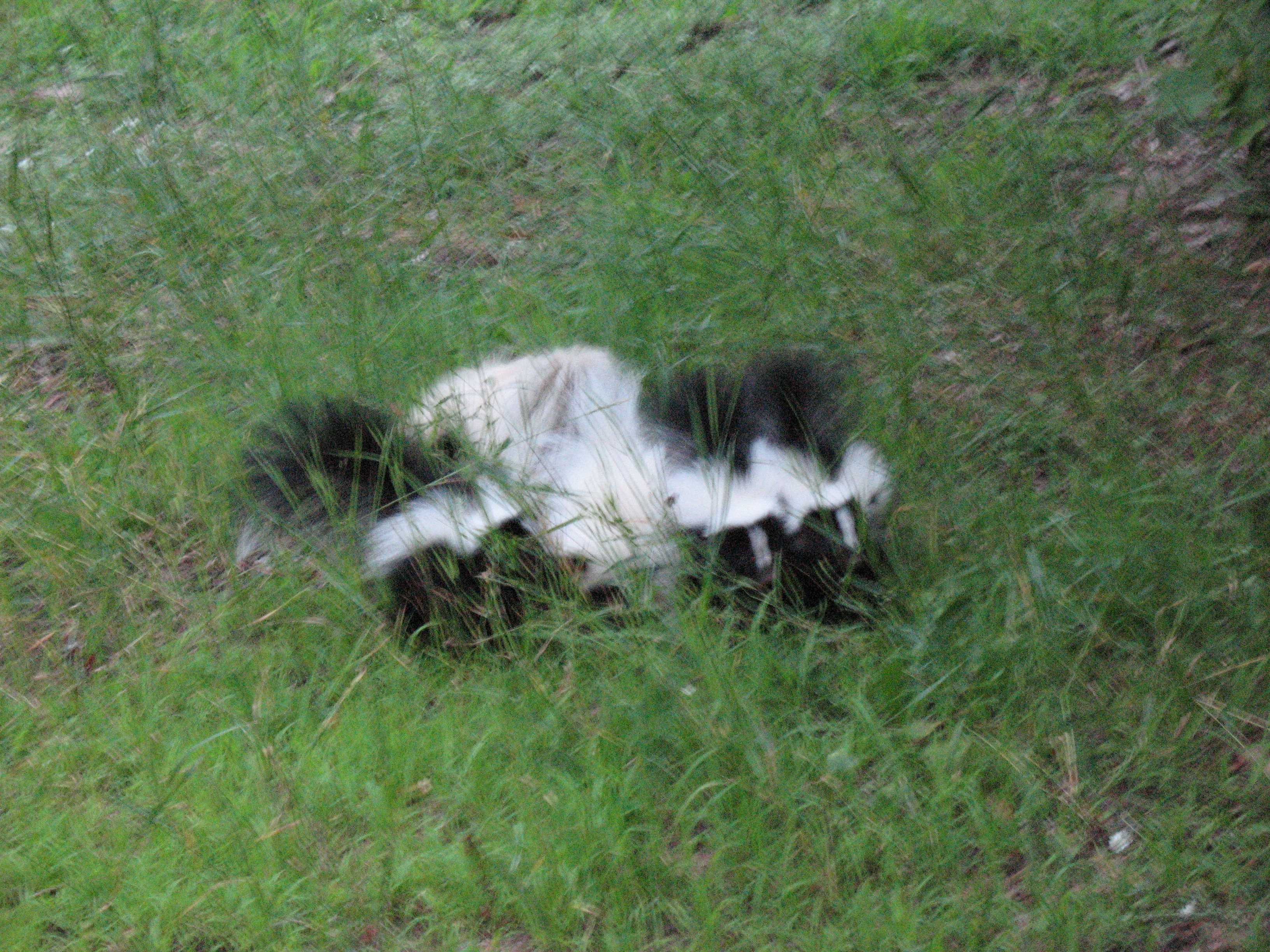
We knew they were around, you’d catch a whiff from time to time. And, comet or no, we haven’t been wandering around outside in the evening. Last night, just before dusk, we saw clear evidence supporting our caution.

IMG_2667

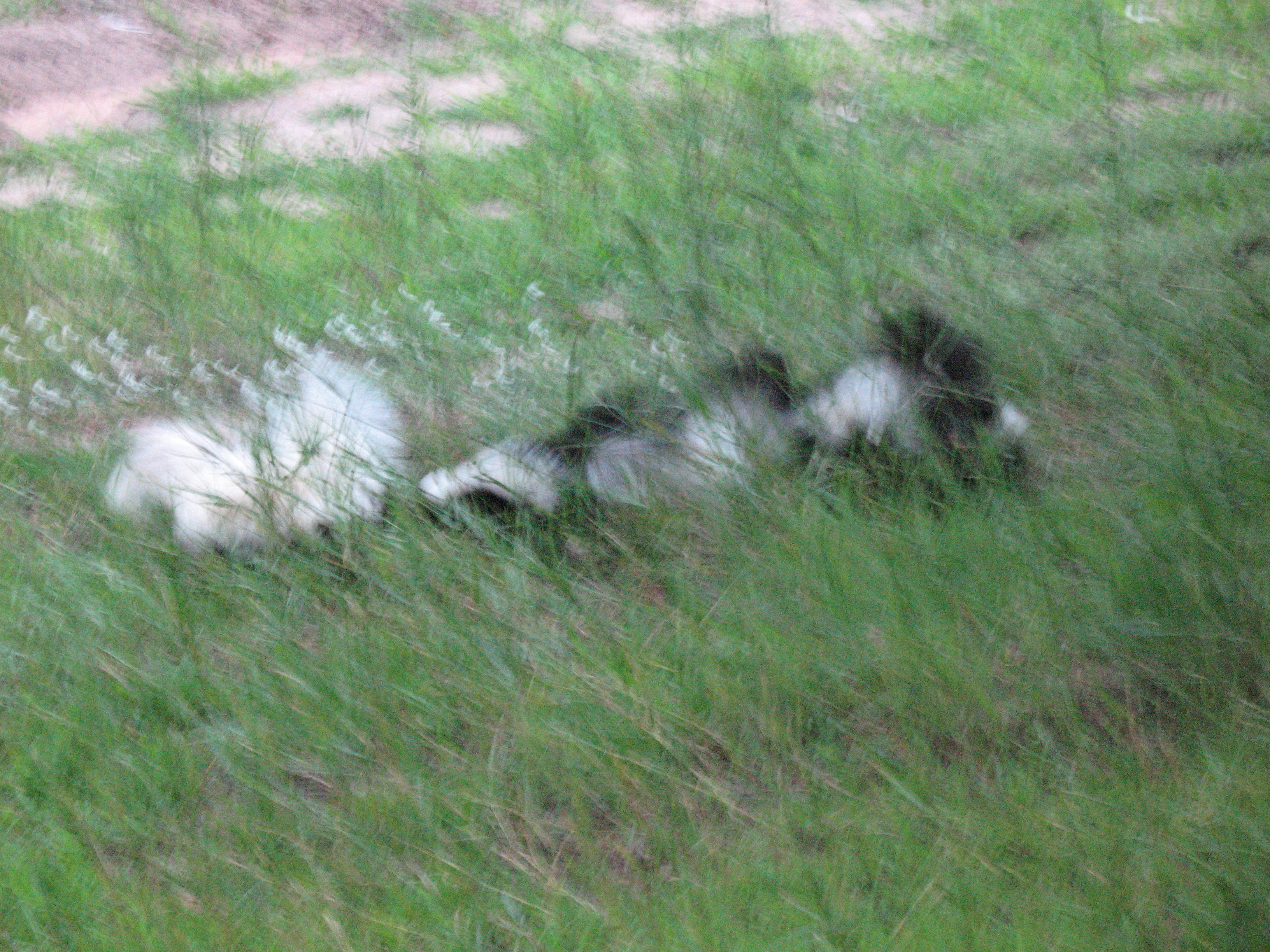
There are five of them. Mamma and four baby skunks. Mamma and two of the kits have all white backs. The other three are the more standard black and white. We keep our watching from a distance. This expains some of the digging–but not the attack on the chickens. That critter was far taller.

We couldn’t get a better picture–low light and playing defense. These little guys run around shoulder to shoulder. You cannot tell when one starts and the other ends. It’s a wiggling ball of fur. The cats aren’t interested at all, and that’s a relief. So, we’ll be careful not to surprise anybody and we’ll enjoy watching their antics, from a distance. Pretty soon they’ll grow up and move away.

IMG_2666IMG_2665IMG_2663

IMG_2648

Last night something tried to get our chickens. It was late, into the wee hours and we’d been up reading. Rick opened the windows before climbing into bed, because it was a little on the warm side. We often use the night’s cool to keep the house comfortable. If it hadn’t been for the open window…

I heard a strange cry–I thought it might be the cats, downstairs. I walked to the top of the stairs–and it happened again, clearly from outside and from the chicken pen. It was far more of a wail, than a cluck. And if you know chickens, you know that they are near comatose at night. Something was very wrong.

I cried out to Rick–something’s after the chickens–and headed downstairs at a clip. I stopped in the kitchen long enough to grab a flashlight, and hurtled out into the night. I flipped on the flashlight as I stepped out on the path, and its beam reflected back a set of eyes in the dark. I couldn’t see the critter, but I saw it’s eyes glowing back at me. Then they disappeared.

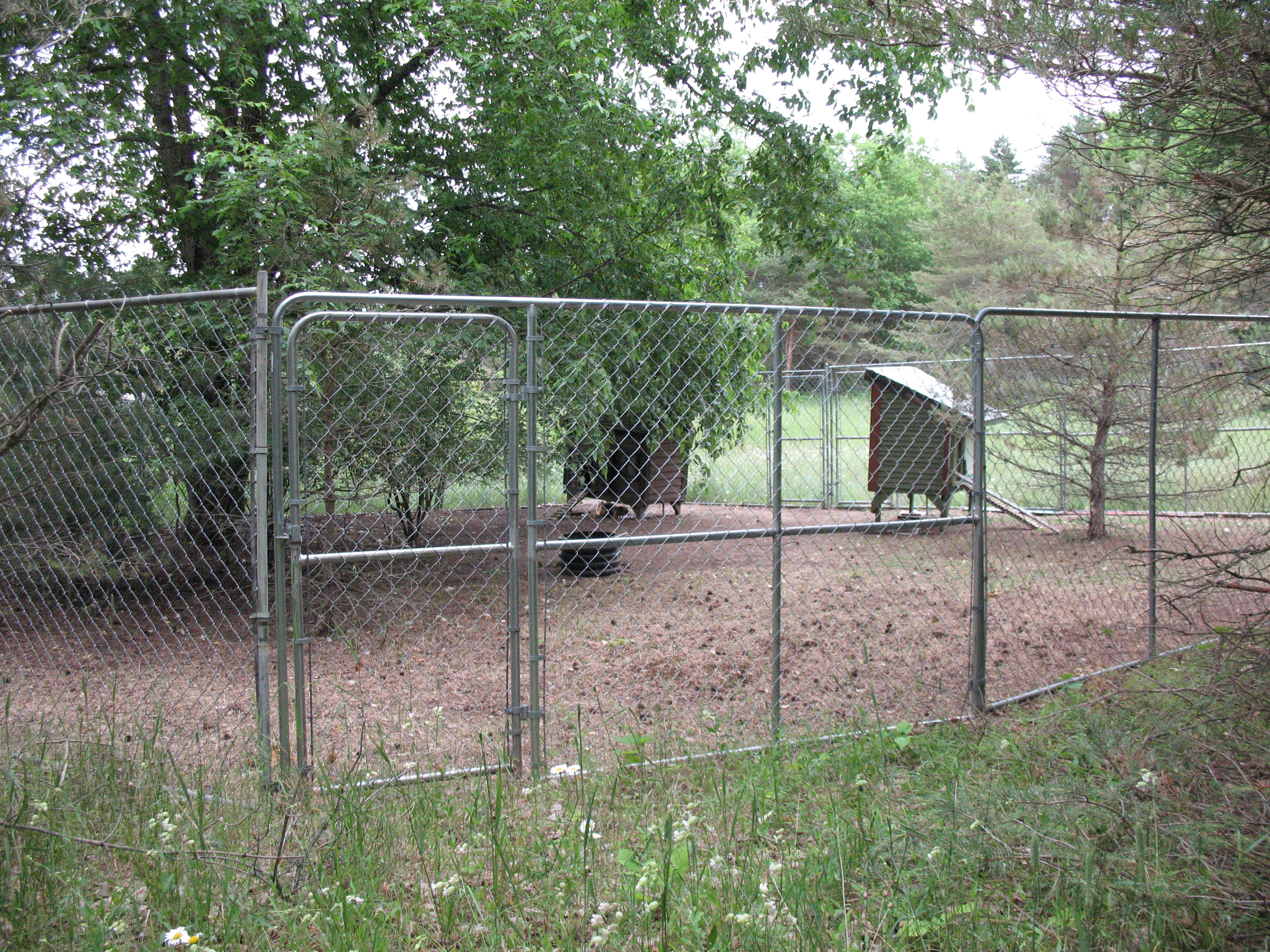
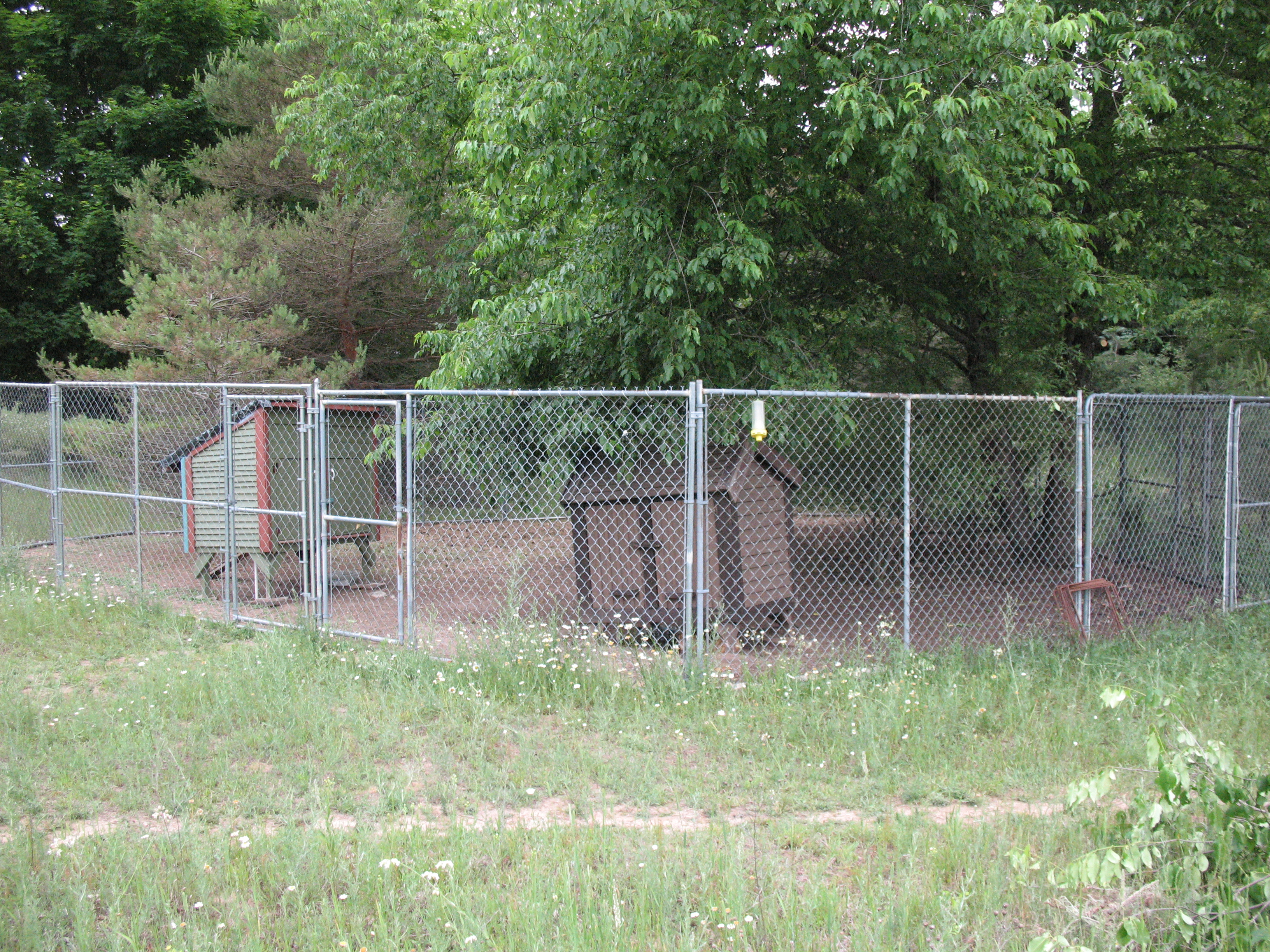
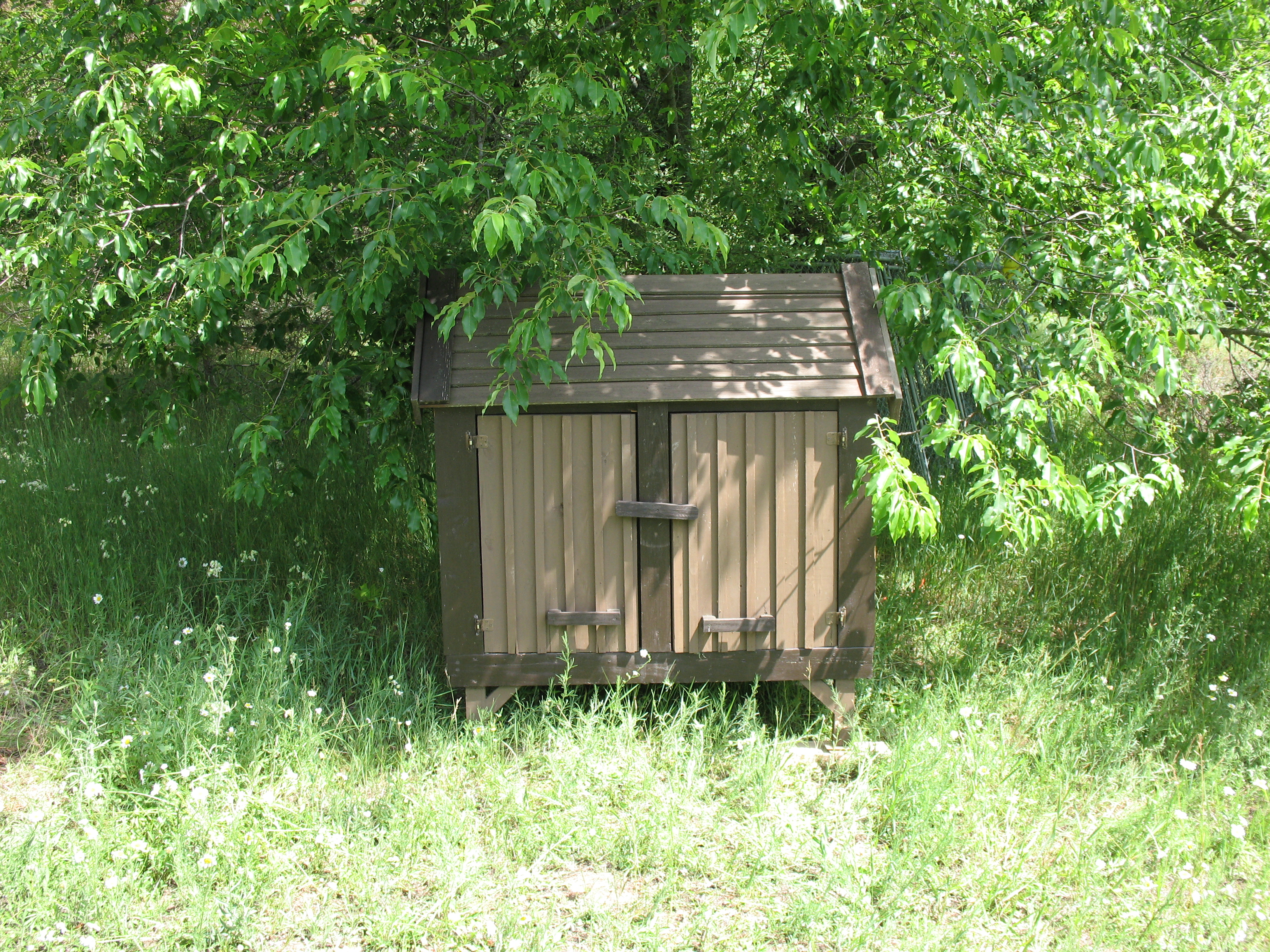
I ran to the chicken pen. It’s a six foot chain link fence, about a 30 foot circle–the coop is a small wooden house, inside the pen. We’ve never had any problems with predators, and we’d become sloppy about security. We regularly left the coop door open at night. Einstein was on the west side of the pen–she’d been the wailing chicken. She seemed okay, so I played the light across the pen. Feathers, everywhere. A chicken lay prone a few feet from the coop. I assumed it was dead, and continued scanning for the third chicken. None in sight.

I opened the coop door–and there she was, still up on the roost. The inside of the coop was littered with feathers. One down, two okay. I closed and locked the chicken entry and turned to grab Einstein to return her to the coop. I’d deal with the dead one after the survivors were secured. While I retrieved Einstein, the “dead” chicken staggered over to stand next to me. It was our largest chicken, Alpha. She’d lost a lot of feathers, but I couldn’t see any blood. I popped both of them into the coop and locked it up tight.

By now, Rick was up and on the front porch barking questions. The whole animal neighborhood was alerted, and the night was peppered with unidentified weird night noises–and the call of a barred owl. I scanned the perimeter, but couldn’t see any sign of a critter having dug under the fence. I didn’t know what it was, or if it might be in the tree, above me. With the chickens secured, the rest could wait until morning.

Bright and early, I cut up some apple treats and went out to release the chickens. They seemed fine–and gobbled up the apple bits. Observing through the day, though, Alpha is a little worse for the wear. It’ll be a few days for her to recover.

We made several mistakes here. The chicken door to the coop was open, that’s obvious. Less so, though, is that we installed the pen several years ago. At the time, we were very careful to make sure that there were no overhanging branches that could give  predator access or egress. Things have grown. We can only assume that the predator came over the top–either jumping or climbing trees. We were lucky.

Rick spent today pruning and resecuring the pen. In addition to locking the coop, we’ll dust the area with flour tonight–just in case ‘it’ returns, maybe we can get some prints to identify it. Racoon? Fisher? Bobcat? We just don’t know. And until we know what we’re up against, we won’t know what strategy to follow.

I didn’t sleep much. Adrenalin will do that. And guilt.

IMG_2649

All trimmed up now, for safety. They sleep in the brown coop.


IMG_2575

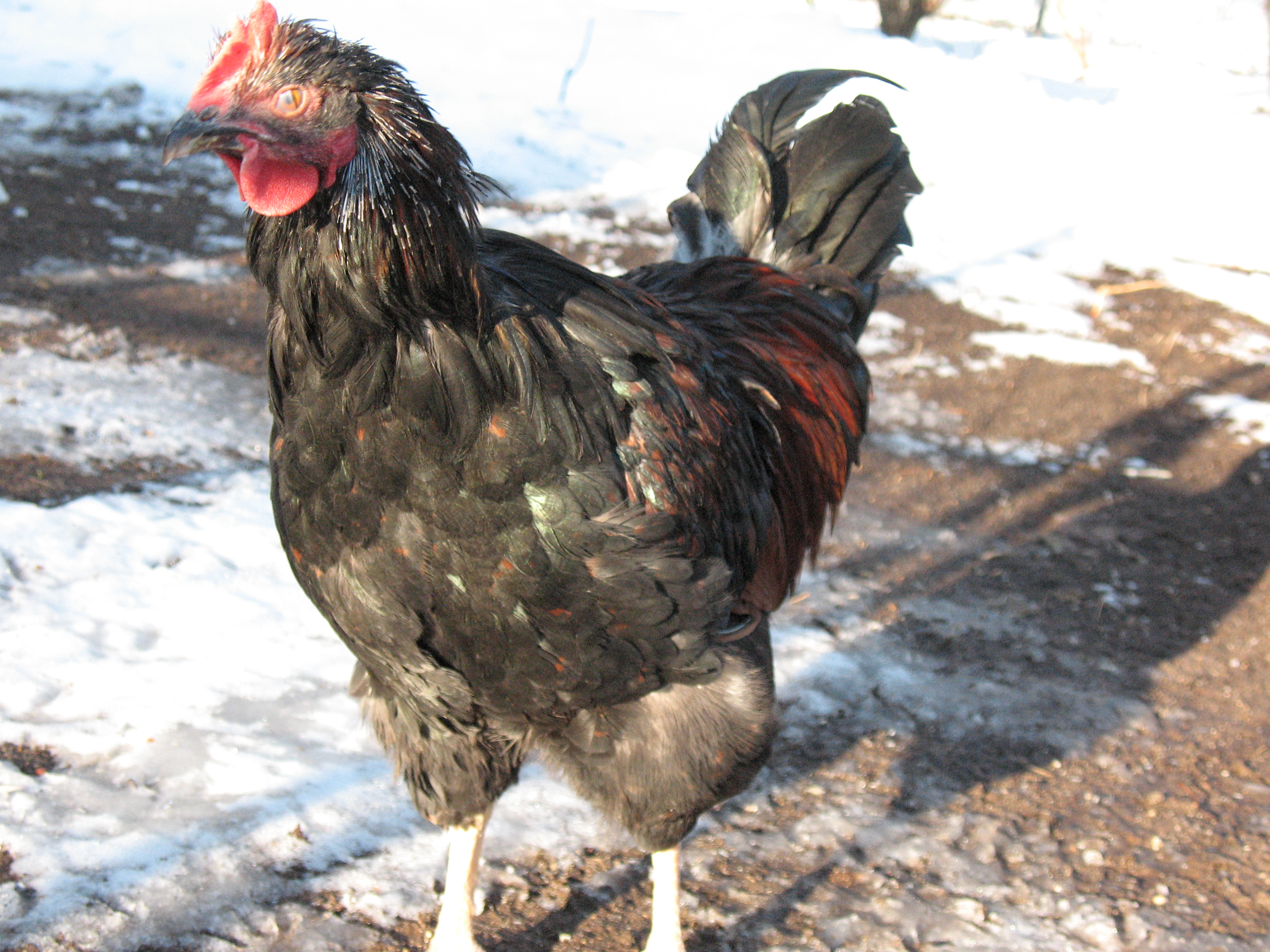
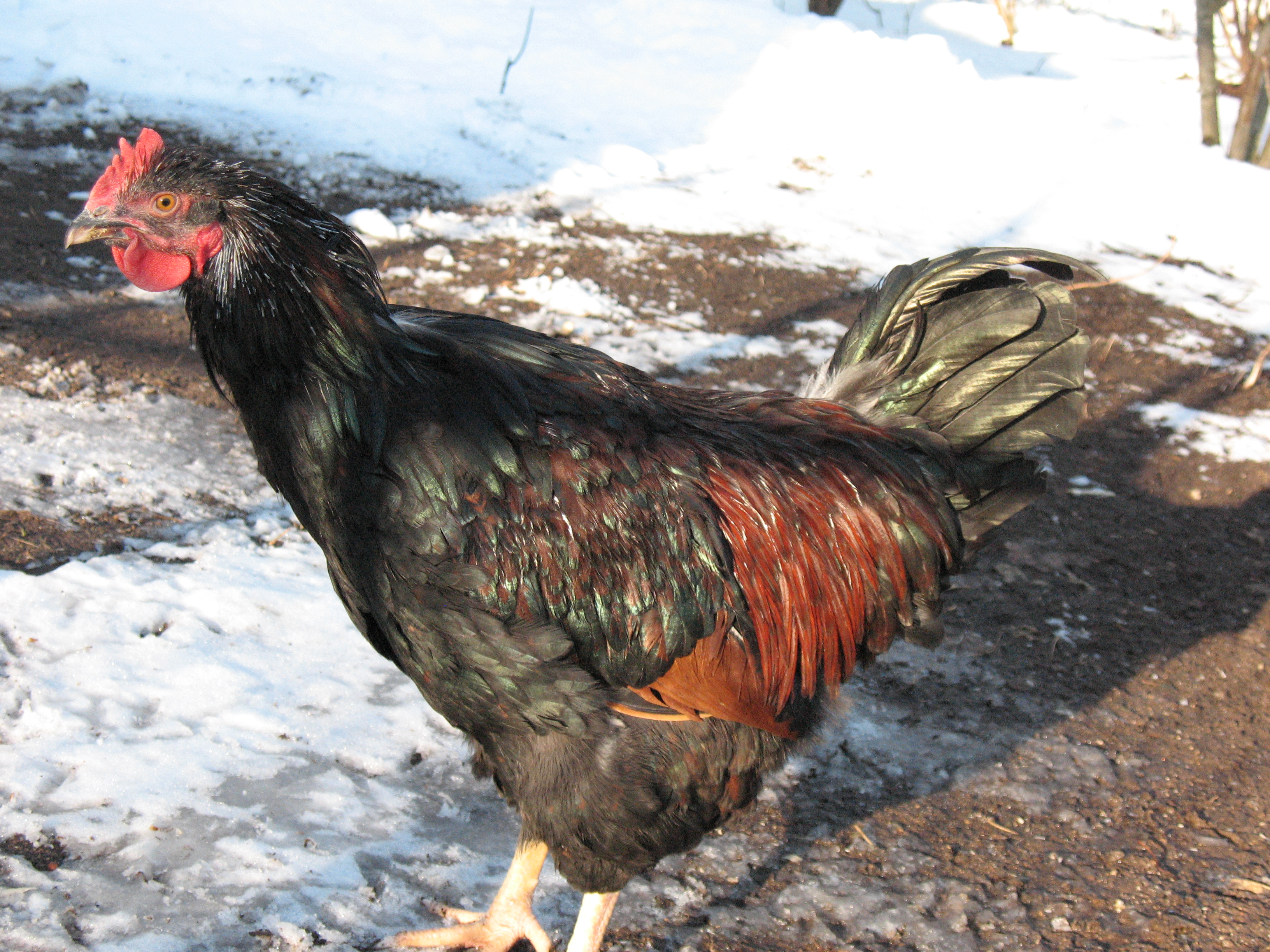
We have dispatched the rooster. It was always a possibility–since we made the discovery after Christmas that he was a rooster. He was supposed to be a hen–but anyone can make a mistake. We keep chickens for the eggs. They are not pets. Roosters do not help in the eggs department.

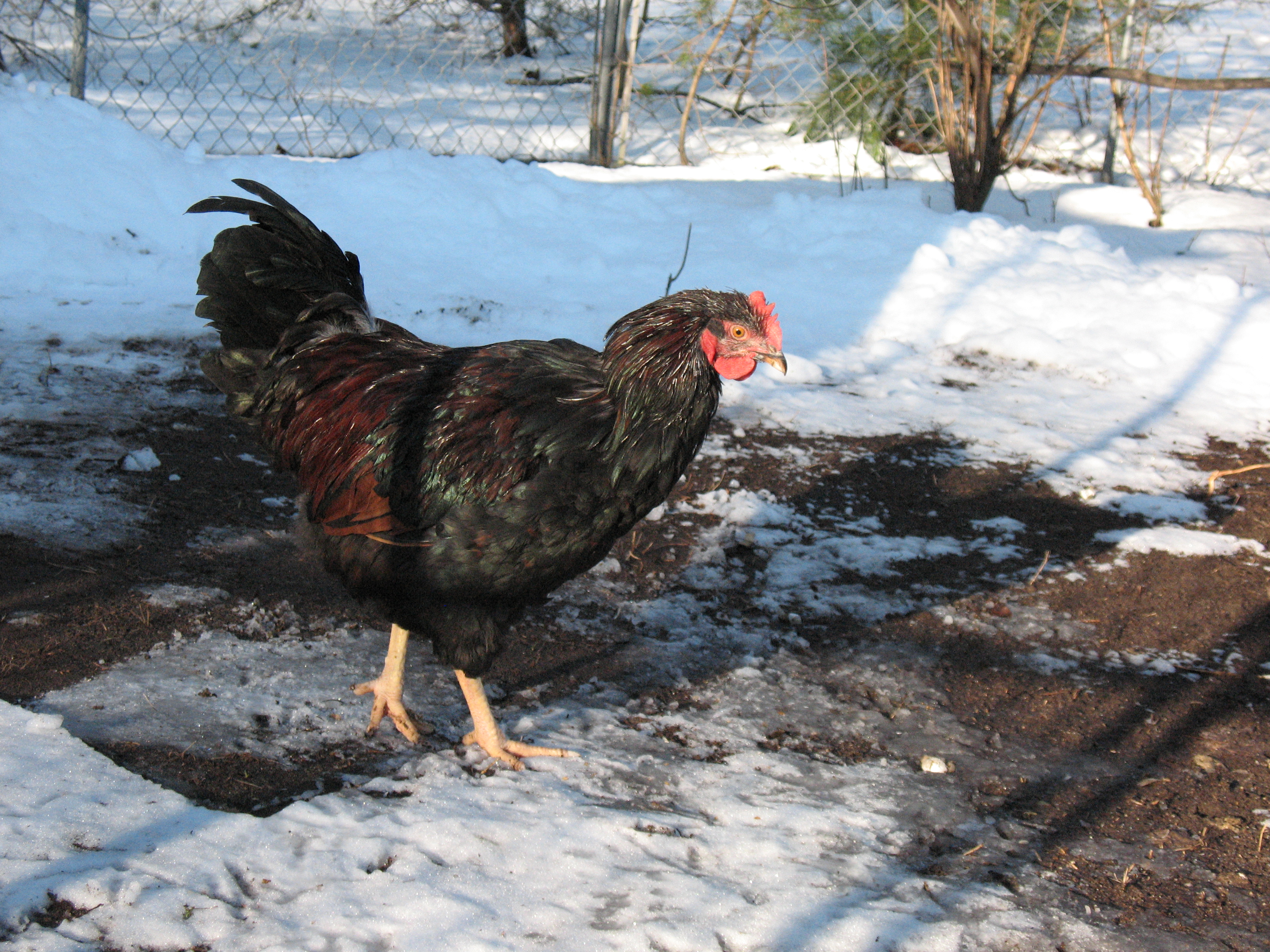
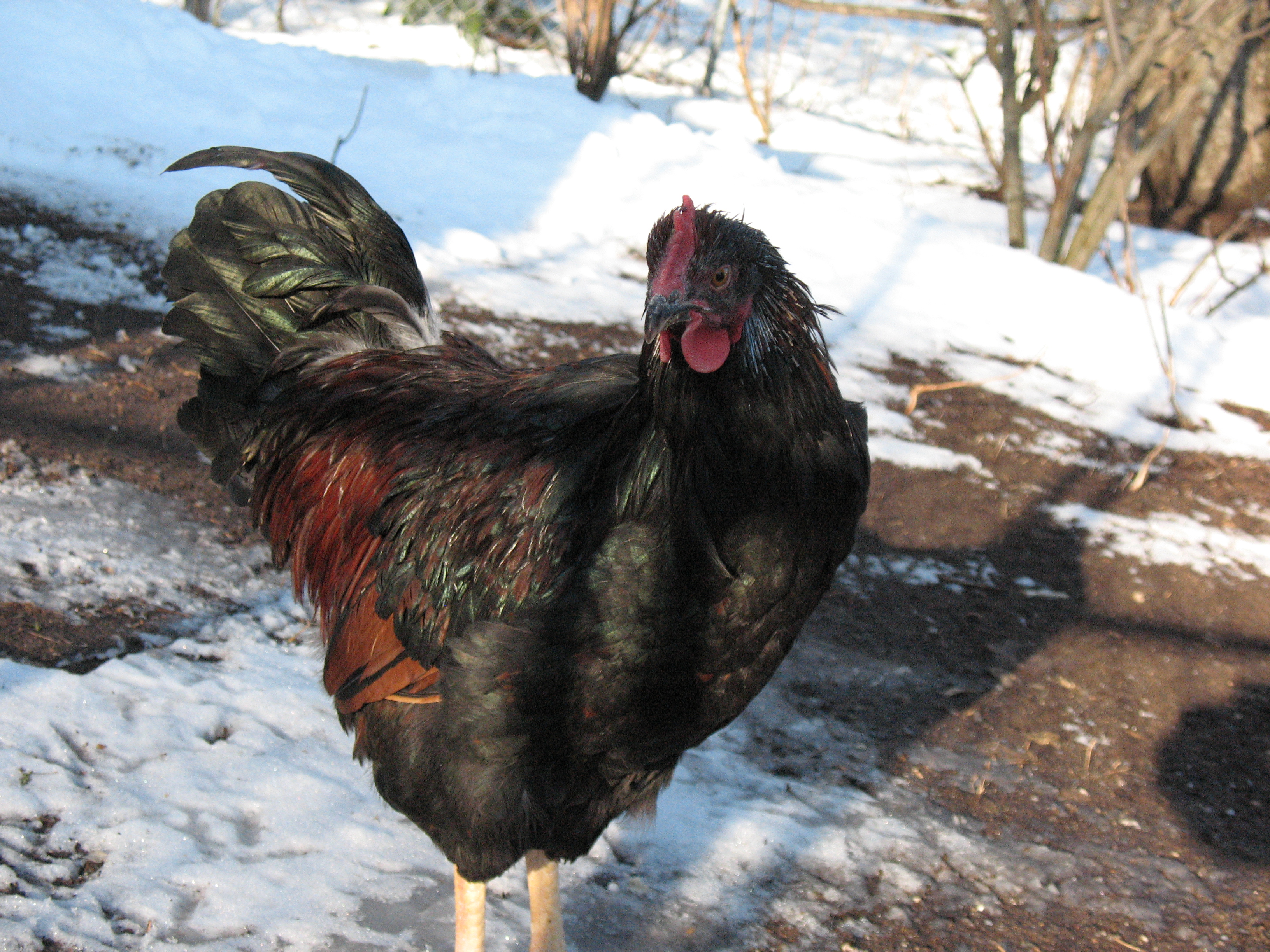
The rooster was beautiful. A Barnevelder, a heritage breed. He had dark feathers, black to cinnamon, with an irridescent green cast. I marvelled at how exquisite he was. Rick was less taken with his appearance. We let it go, to observe whether our rooster might be good for the chickens. I’ve read that chickens are happier–and potentially more productive, with a rooster in the coop. And, we had one chicken who’d assumed the dominant position–and, we suspected, didn’t lay. We wanted to see if adding a rooster to the mix would change the hen dynamics.

But the rooster was a hefty food consumer. Unlike the chickens, he didn’t take his free range opportunities to forage. In the summer months, when the chickens spend a lot of time roaming, their feed consumption drops significantly. The rooster was unimpressed with free food.

And our egg production didn’t change. So the rooster wasn’t exactly carrying his weight. (It was interesting though, to see the female alpha get her comeuppance.) Rick would shake his head about that rooster, though. They are not pets.

It’s hard to tell if chickens are happier in one configuration over another. To me, the rooster seemed overbearing…even a bit neurotic. The chickens, who were older and had developed patterns before his arrival, seemed to endure and accommodate him. Still, to his frustration, they stuck with their old patterns. He had other ideas about how things should run, and they ignored him. The rooster spent his time corralling the chickens, and trying to keep them bunched together. This was not their way. I suppose he thought he was protecting them, in his preening and elegant sort of way. His energies–especially during free range times–were spent fussing over the chickens, and not foraging. For their part, the chickens were far more interested in foraging, than they were in the rooster.

Economically, the rooster was not pulling his weight, but that was not what led to his demise. Quite abruptly, the rooster developed a bad attitude. He began to harass the chickens. And then he began to threaten us. Rick does most of the chicken care, and he noticed it first. How could he not? That damn rooster started to attack him, every time he turned his back on it. He wanted to show me, so we headed out to the chicken yard (even though they were out, because they’ll always follow if they think treats are involved.) Rick took the lead and I was behind by a step or so. That damn rooster came up from behind and attacked me. Good looking only goes so far! The decision was made.

Beauty may be skin deep, but nasty goes all the way through.

IMG_2646

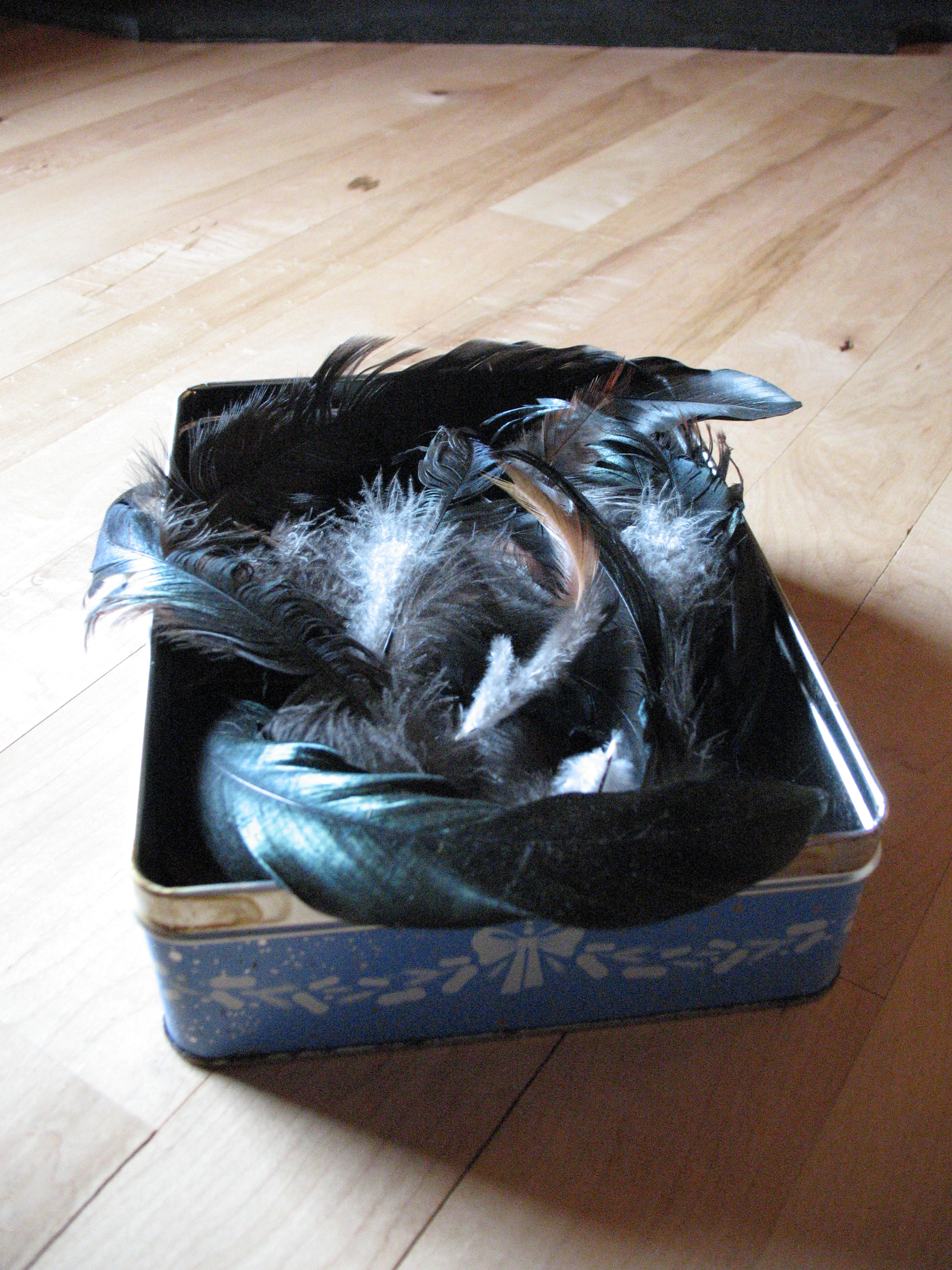
Got some nice feathers, though. Might be good for a hat.


IMG_2607

“Did you hear that?” I called from the kitchen.

“What?”

“The chickens are squawking. It’s not the rooster, it’s the chickens.”

“Hmmm. Haven’t heard that in a while…do ya think?”

We don’t use lights on our chickens in the winter. We could, and then they’d lay during the dark months. Of course, unless we invested in equipment and did a lot of experiments…those eggs would freeze, and be of no use. And, it cannot be good to have that output of extra energy for egg laying, when it takes so much to just keep warm all winter. So we don’t. We think of winter as chicken sabbatical.

After a bit, the squawking resumed.

“You hear that?”

“I’m going.” He pulled on his boots and jacket.

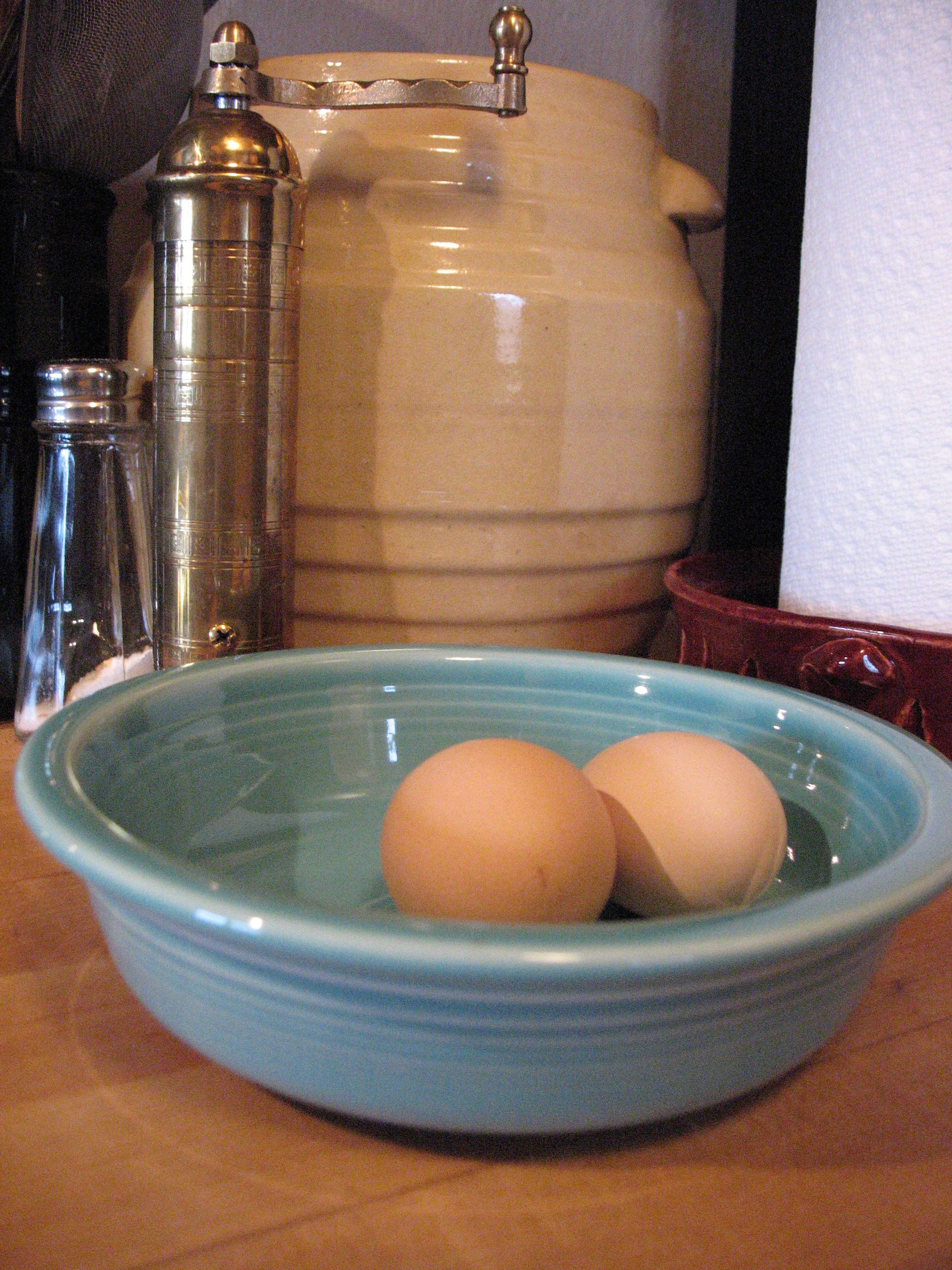
Sure enough, his investigation was rewarded with two fresh eggs, the first of the season.

He came in and proudly displayed the bounty.

I nodded. “Makes perfect sense.”

“Yeah, with the longer days…”

“Well, and the extra light from Day Light Savings.”

He had to squint, eyeing me, to see if I was kidding.


IMG_2579We were only gone for five days. The weather was mild, so the chickens had full access to their outdoor pens. And we had a chicken-sitter checking in on them–water and food and all that.

So, there was nothing to prepare us for the surprise when we arrived home. The first indication of a reality shift was that Einstein, our docile runt chicken, was marching the fence line, desperate to return to the company of the other two Chanteclers–her former tormenters. We’d put her in with the Barnevelder, with the idea that two lonelies might do better together–and at first, it seemed to work.

Rick went down to check on the chickens–and opened the gate between the pens. Einstein made a bee line for her Chantecler buddies. So much for trying to mediate chicken disputes. He noticed something else different…but didn’t say anything.

IMG_2573

I went down later, just to check things out on my way to the compost. It was subtle, but something was different. That Barnevelder seemed to have developed an attitude. It was patrolling its territory, with a decided swagger — even, I’d go so far to say, a strut. Head high and eyes bright…this was new.

“Rick, did you notice anything odd about the Barnevelder?”

He looked at me funny, nodding. “A little on the aggressive side. I saw her go after one of the Chantclers, talons first.”

“Do you think…”

“Yeah, I wondered. Maybe we have a rooster on our hands.”

The signs are there. There’s that upright posture, and the start of more pronounced tail plumage. Even new wattle and comb growth. (We’d selected our chicken varieties for low comb and no wattle, because there’s less chance of freezing in a cold climate. But, course, all bets are off if we’re talking roosters.) We’re pretty sure.

IMG_2574

The other chickens want nothing to do with it (him?)

We weren’t banking on roosters. So far, no crowing, at least we haven’t heard it. But then, we’re late-risers.

What to do with a rooster? Soup? We cannot have him annoying the neighbors. (Though a mean rooster would be an interesting match for those goddamn dogs.)

If it’s not one thing, it’s another.

IMG_2577

IMG_2562

Sorry for the poor photo–they didn’t like the big door open in the cold, and were not cooperative about posing.

At first blush, you might think it smacks of racism. But that’s ridiculous; they are, after all, chickens. But looking for the deeper meaning, there could be something equally sinister in play.

We keep chickens for the eggs. They are not pets. (Admittedly, though, we do get fond of them and their antics.) Originally, we had four chickens. You may recall that our neighbor’s dog ate one, leaving three. You’d think three would be enough.

Not all chickens lay an egg, every day. And, it turns out, in the absence of a rooster, some hens will ‘self-designate’ as the leader, and, with this elevated status, will not lay. We have such a self-important hen. (Though we try not to name our chickens, we call this one, Alpha.) One would think the solution would be to dispense with the narcissist chicken; but we’ve learned that another chicken is likely to just take her place. Better the devil you know….

So, this summer we obtained three more chickens. We have chicken selection parameters, they must be winter-hardy, dual use, and generally healthy. Our existing chickens are Chanteclers, a French-Canadian variety known for success in cold climates. Ours are Buff colored–easy to locate in the landscape–winter or summer. At the time we decided to expand our flock, I couldn’t find any Chanteclers, so we settled on Barnevelders, another heritage variety. The Barnevelders are beautiful, black and cinnamon colored, with a hint of iridescent green on their necks and heads. (I’m normally not impressed with ‘good-looking,’ but I have to admit, they’ve grown on me.)

You cannot introduce chickens easily. They have established pecking orders, and will fight with new chickens, and kill chicks. There’s a whole process to the merging of unfamiliar chickens. These Barnevelders were babies, so we set them up in their own coop, in an adjacent, fenced chicken pen.

Disaster struck. Some chicken ailment hit the babes. One day, one looked wobbly, then the next, two, dying within a day, leaving only one lonely chick! Chickens cannot thrive as solitary creatures. We were left with a dilemma–what to do with a very lonely solo chick, who had to be in quarantine for a week? She survived, and I drove back to my chicken-lady mentor/breeder, to fetch a replacement buddy. It all worked. The new chicken was a tad older and bigger, just what the lonely solo needed. They bonded immediately. And so we continued–hoping that we could combine the two flocks before the weather got really cold. (More chickens equals more body heat.)

We did all the right things. We started treating them, generously along the fence. Then, when they were accustomed to that, we opened the gate between the coops, for supervised visitation. They seemed to get along–without too much squabbling. When a particularly cold night was predicted, we waited for later in the day, and locked the Chanteclers out of their coop. To our relief, when evening fell, all the chickens retired for the night into the into the remaining, larger of the two coops. It seemed to go well. Or so we thought.

Then next morning we checked. The littlest chicken (the original survivor of the scourge)  was dead! Drowned in the water dish! Bastards! We felt terrible. Of course there’s the possibility that, drowsy, she fell in and drowned during the night. (Yeah, right.) Her buddy Barnevelder was nudging her–to get her back up. It broke our hearts.

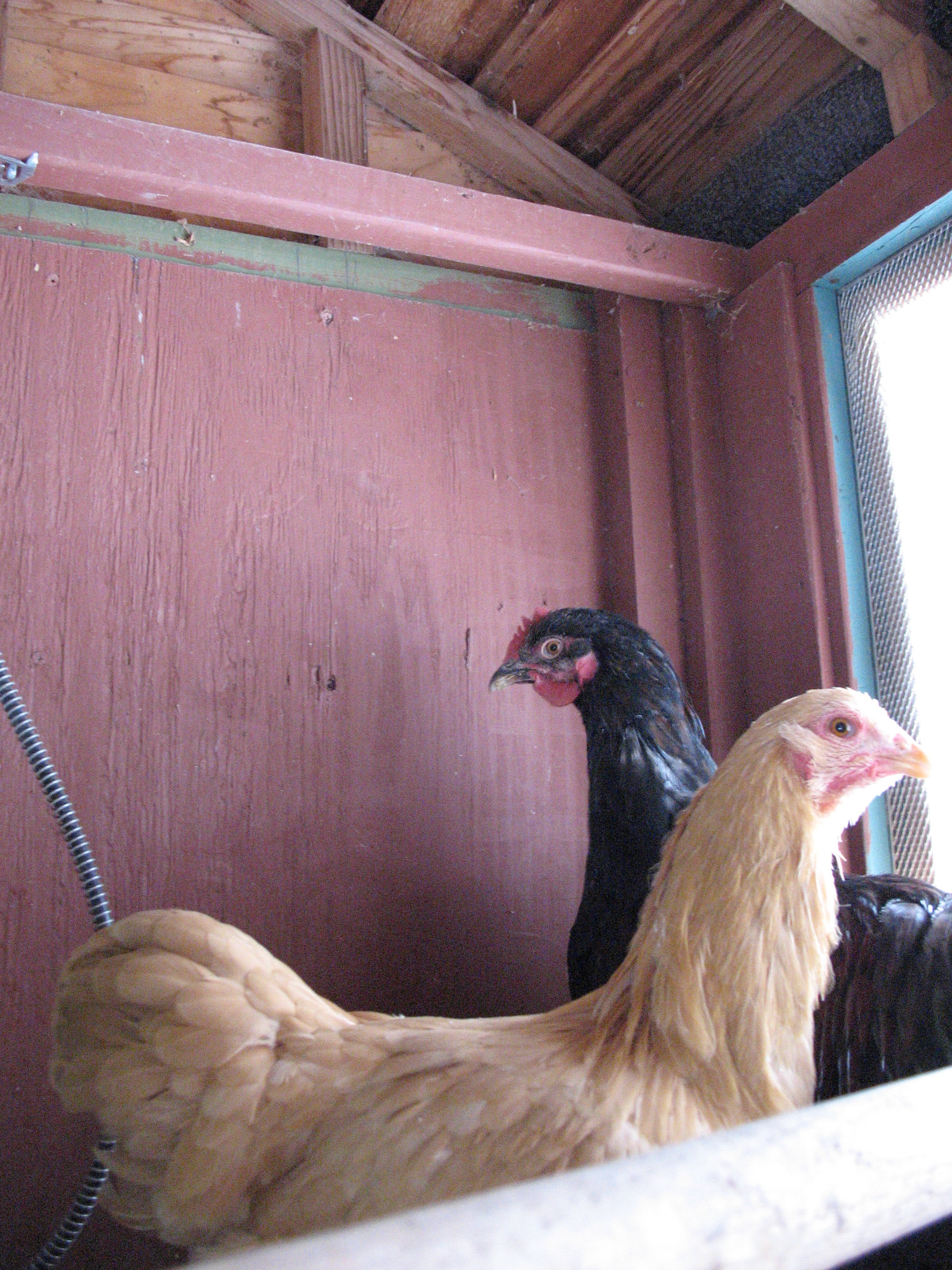
What a conundrum! Obviously, the surviving Barnevelder was not safe with the other three. Neither would she be able to survive cold winter nights on her own. We needed to find the right chicken combination. It took a couple of tries, when finally we put Einstein (the Chantecler runt) together into the same coop as Big (the surviving Barnevelder). It’s a working match, black and buff.

It’s not about color. It’s about pecking order, and social standing within the flock. We are up against deeply ingrained genetic rules of socializing and tribalism. When it works, you’re looking at combinations that shelter and nurture each other. When it doesn’t, it’s ugly, fowl play and even murder.

We won’t try to mix the two groups until spring. Perhaps, with the added freedom of free-ranging, they’ll make it work. In a larger context, I read the news, shake my head, and wonder if we can.

IMG_2486

The Pips

It’s not that I hate dogs. I don’t. I’m not a dog person, largely because I am allergic to them. I’m probably allergic because I was mauled by a cocker spaniel as a tiny child, which naturally gave me a healthy respect for bad dogs, and no respect for bad-dog-owners.

Because that’s the real problem, isn’t it? Bad dog owners. People who think their dogs are just fine, and don’t understand that it’s up to them to keep their dogs in check.

For several years we’ve had issues with a neighbor about her dogs. They aren’t malevolent, but she has never trained them. She believes that her dogs should be allowed to run and bark all night. She says she’s doing the neighborhood a favor to let her dogs “run deer.” She bemoans the loss of the good old days, when one let one’s dogs run loose without recriminations.

The neighborhood does not agree. Despite efforts to deal with her personally (to no avail) almost every neighbor in a half mile radius has had her cited. Her dogs bark incessantly. Her dogs chase cars and bicyclists. They’ve been known to menace pedestrians. Her dogs spook the deer at one neighbor’s hunting camp. She once complained to me that, if she kept the dogs on her yard all the time, there was too much clean-up to do. (Read, I prefer if my dogs crap in your yard.) So you see, it’s not really the fault of the dogs.

A couple of years ago I had a problem because one of her dogs took an interest in digging up my freshly planted orchard trees. After all, the soil was freshly worked and made for easy digging. I informed her that if I caught the dog digging on my property (which is literally pockmarked with its regular digging efforts), I would call the Sheriff. I did, and did. I also told her that, since she was enamored of “the old days of dogs running free,” she should well remember that in those old days, a loose dog doing agricultural damage was usually shot on the spot.

My neighbor didn’t appreciate my straight forward approach. And that was all before Blondie.

You may recall that last year we got chickens. We named them, based on recognizable features they had as chicks. Only one, Blondie, retained her chick coloration into adulthood, so we had Blondie and “the chickens.” I know, it sounds like a 90s punk band.

Blondie was an excitable and flighty chicken. She would try to take to the air with the slightest provocation–a person approaching with treats, a crow overhead. But she lived, safely we thought, behind a six foot fence. Not that chickens cannot fly, they can, and do. But chickens are like bumblebees–curiously designed when it comes to sustained flight. All of Blondie’s impulsive bolts for freedom ended when she hit the fence.

Late one afternoon, I decided to check the coop for eggs. Winter egg production is sporadic anyway, and if you’re not timely, the eggs will freeze. Approaching the chicken yard, I was dismayed by the sight of countless dog prints in the snow, endlessly circling the fence. Apparently those dogs had been harassing the chickens the night before. I collected the one egg, and then looked around to see how the chickens had fared. There were only three chickens. It was like the Pips, without Gladys.

I checked all around the fence–no Blondie, only feathers. I knew. It was getting dark, so my sleuthing would have to wait until morning.

Saturday morning, bright and early, I revisited the scene of the crime. Obviously the intensity of the dogs’ engagement had set Blondie airborne. For the first, and last time, Blondie was free. Direct into the mouth of the waiting dog. I checked the tracks (against my handy-dandy little animal track identification chart. Clearly dogs, not coyotes. I followed the feather-trail, which was clearly limited to one set of dog tracks, as it made a beeline for my neighbor’s property. The trail ended at the road, separating the two parcels. On her side, I found no feathers. There were many human footprints in the snow, though–and my neighbor is not usually one to wander around outdoors in the winter. I surmised that she’d cleaned up the feathers. My evidence was, at best, circumstantial.

After the weekend, I called Animal Control. They know us–after all we’ve been dealing with them over the dogs for years. I recounted my story and my observations. As I’d suspected, they could not issue a citation based on anything other than an eyewitness account. (Really? Don’t they know the research on how flawed eyewitnesses can be?) I warned that if I saw either dog near my chickens, I would just shoot it, as is my right.

Our friendly Animal Control Officer implored me not to take justice into my own hands. “Use the system,” he said. “It’s better for the neighborhood.” I’m not sure about that. My neighbors might arrange a hero’s parade if I dispatched those dogs. Still, I want to work with them. So, since then, we’ve been watching. If we see the dogs on our property, we call it in.

And such was the case this week. The snow is melting, giving the critters of the world easier access. Rick looked out one morning and saw the dogs on the property. He called Animal Control. When the officer arrived, he took the complaint. He also acknowledged that the day Blondie last flew the coop, there’d been a welfare check on my neighbor. In that report, the Deputy had noted that there was a dead chicken in her yard, which he pointed out to her. I was right. She’d cleaned up the evidence. After taking our report, the Officer headed across the way to talk to the neighbor. I yelled after him, “Tell her the chicken’s name was Blondie.”

IMG_2470

Snow Forts for Chickens

I’m new to chickens. I did live on a chicken farm for seven years–but I was not responsible for the chickens. And, in Two Rock, they don’t really have winter. Here we have winter, and it’s a tad early this year. If not early, I’d suggest that it is earnest. We have a solid 6 inches–and that’s after the first two or three melted immediately upon landfall. It’s not when snow first falls that makes for winter; it’s when it sticks.

Anyway, three of the four chickens are reluctant in snow. The fourth has been roosting all over the chicken pen. We’re not sure if she’s a fan of winter, or if the other chickens are giving her the cold shoulder. The chicken coop stands up on legs. Before the snow fell, the chickens liked to hang out under the coop–out of the sun or rain. Without that breezeway, the chicken territory gets pretty small if the chickens won’t do snow.

So far, we haven’t heated the coop. We’re contemplating a low wattage bulb for heat and light (so as to encourage egg laying.) But when we open the coop doors for feeding, it’s not really cold in there. Or so it seems.

Today was the first day that the chickens’ water was frozen solid. I’ve ordered a thermostatically controlled water dish–and now I’m even more anxiously awaiting its arrival. In the meantime, I’ll have to be more dilligent about making sure they have fresh water.

I’m not sure if this is a normal Northern chicken strategy, but today I built them a snow fort. The snow is the perfect consistency for snowmen, or fort building. So I built walls along the edge of the coop–essentially banking it in to create a snow wall. This will keep the area under the coop clear–and warmer. It’ll also help keep the coop itself warmer.

IMG_2471

Thus far, it’s a complete success. I put the chicken scraps under there and two chickens followed those treats into the fort. They haven’t left yet. The other two chickens, upstairs, are making a racket, redistributing their fresh bedding. Chicken Nirvana. I don’t think this will keep the water from freezing, but it seems to be making for happy chickens. Has anyone else out there built snow forts for chickens?

IMG_2472

Just Us Chickens

A.V. Walters

IMG_2417

I’m not one much given to ‘cute.’ Never have been. We got chickens because we prefer the taste of fresh eggs, and we like to be able to ensure the quality of the food we eat. Our chicks eat organic.

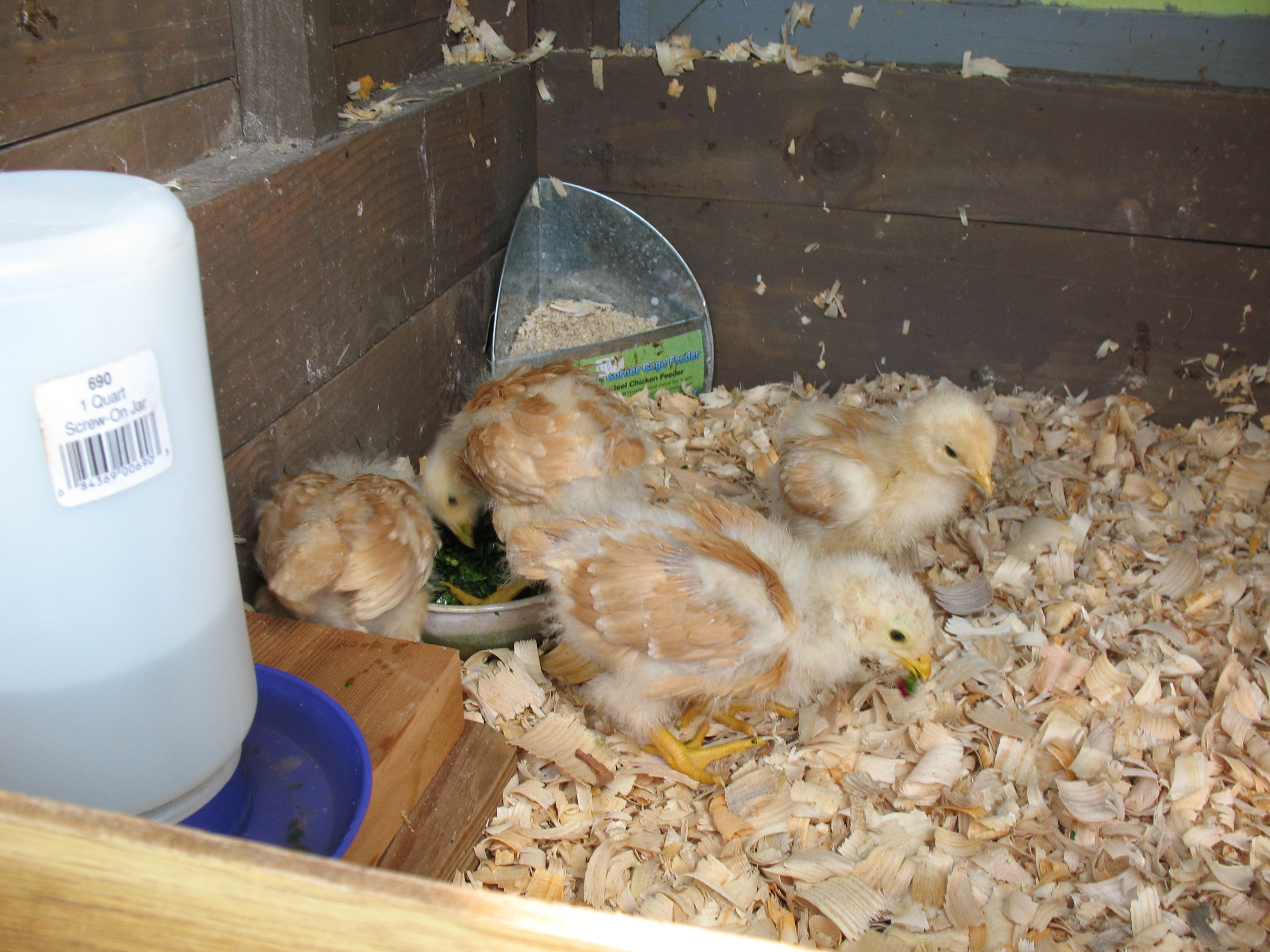
I resisted the idea of naming them. However, they have earned descriptives–if only because we need to be able to identify them in conversation. When they first arrived, there were two very small chicks and two larger chicks. Then, one of the small chicks (whom we identified as “Yellow-head”) had a burst of development. She is now the largest. The other smaller chick is still well behind all of the others, both in size and feather development. Despite being the runt, she’s no dummy, and has strategies for compensating for her size. I’ve been calling her Einstein. The middle two have been neck and neck in their growth–and sometimes it’s hard to tell them apart. One walks taller–and so I refer to her as ‘Upright,’ while the remaining mid-sized chick moves about with a sort of nervous, crouched, posture. Perhaps it’s wrong, but I call her ‘McNugget.”

My sister has chickens. They have them for the eggs–and because the spent chicken litter is a great way to speed your compost and build high quality soils. But her chickens are pets. They have proper names. She fully speaks chicken.

Chicks are a lot of work. They are filthy little creatures. I should have remembered from when we raised emu chicks, but I am at a loss to understand how an animal that will spend hours preening its feathers will also shit in its food bowl. Perhaps it’d be easier if the “cute” factor resonated for me. Oh well. After just two weeks, they’re looking moth-eaten, and teenage scruffy. They not fuzz-balls anymore, but neither do they have their full plumage. Only a mother hen (type) would find them attractive at this point. They are, however, psychologically interesting.

IMG_2418

Even at this stage, they clearly demonstrate the concept of “pecking order.” Yellow-head is the dominant and lets them all know that she’s in charge. After the first week we gave them a perch. It belongs to her, the queen of the roost. She won’t let anyone else on it. The others get it. They stay on the floor–except for the occasional hop up to try it out–when Yellow-head is asleep.

At first, the three larger birds would crowd Einstein out of food bowl access. Now she just pushes in between them. And if the rest are asleep, Einstein takes advantage and fills up when there’s no competition. I don’t know if this is intelligence, or just survival. Einstein does not challenge the pecking order. Nor does she spend much of her time socializing–grooming or cuddling together for naps. The two middle sycophants are forever nestling together, grooming each other or Yellow-head. That must be chicken bonding. So far I don’t see any outright pecking of the little one–though I’m watching for it. Chickens can be vicious. Maybe she can continue evasive maneuvers and avoid that particular bit of chicken ugly.

Yesterday we moved them from the basement to their coop. They’d outgrown their cardboard box. Seeing them in larger digs is a relief–they look much better. Relief from overcrowding seems to have minimized aggressive behaviors.

IMG_2420

Watching their interactions reminds me of our current social order. As a species, we need to move beyond bullying and ass-kissing. We need to foster resilience, independence and courage. As much as I’m impressed with little Einstein, it isn’t enough to keep your head down and mind your own affairs. We need to stand up for our convictions. Maybe we can find strength together. Otherwise, we’re just a bunch of chickens.

IMG_2416

Emus in Absensia

A.V. Walters

Elmer called the other night—they have emu chicks. Mr. and Mrs. Emu are at it again and, with all the food we gave them over summer, and the mild winter, they now have a sizable clutch of eggs. Or had. Out of the original twelve, two chicks have already hatched and died. Stretched so thin, Mr. Emu has difficulty watching the new little ones—he’s still nest-bound.

So Elmer and his daughter kidnapped the one little guy they found still alive and plan to remove the rest as they hatch. Between cold nights and predators, little emu chicks have a rough go of it in Northern California. Hence, the call. Rick and I are the only ones on the farm who have successfully hand-raised the little guys, and they need help.

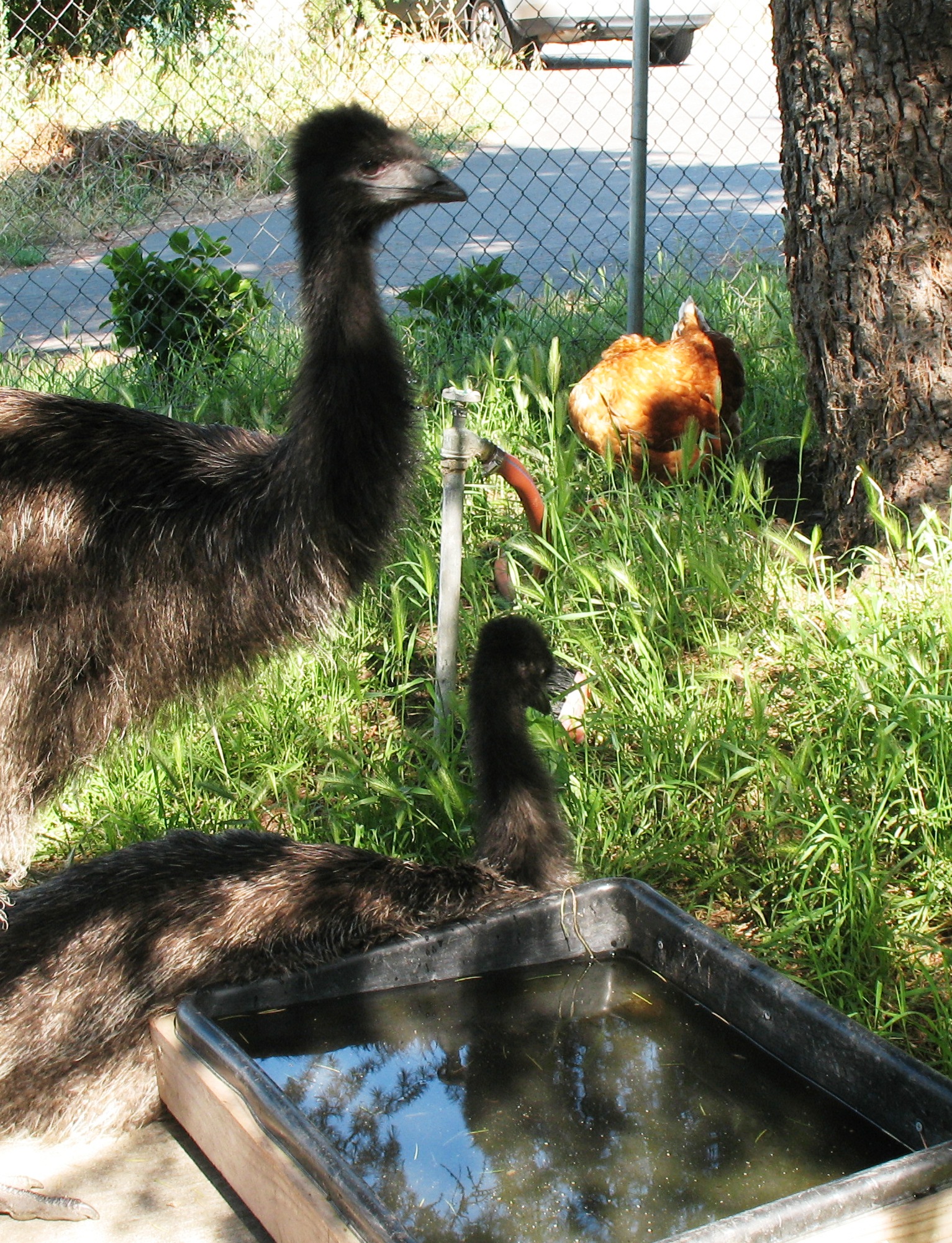
They’ve decided that more emus would be just the ticket to guard over their new venture in organic duck eggs. (You should see all the ducks, it’s pretty impressive.) Emu guards are not a bad idea. We learned, the hard way, that the emus in our front yard were, in fact, protecting the chickens.  And so, the questions begin. What do we feed them? (Finely chopped kale and apples, to start.) Can we give them chicken feed? (No, chickens are seed eaters. Emus are grazers and need green fodder.) How warm do they need to be? (94 degrees F for the first two weeks, tapering off 5 degrees a week, after that.) What about water? (Not for about a week, until they’ve mastered balance and eating.) Those, and more, are all questions that we had to find the answers to, a year ago—either through trial and error, or what we could find on the net. As it turned out, we did okay. We had no losses from the five we raised. I guess that makes us emu experts. (And, given some of the so-called “expert” advice we found on the net, we are!)

We haven’t been homesick since our relocation. We miss some of the people, but we are caught up in the possibilities of our new lives. This, though, gave us pause. We definitely miss the emus—and raising them was an adventure we really enjoyed. So, we stand ready to be emu emissaries. We’ll provide all the information we can. And, of course, we’ll worry.


Rick’s Hat-Trick

A.V. Walters

It’s a season of firsts for us. Rick’s first set of snow tires (I get mine on Wednesday,) and our first snow shovel. These are all steps in acclimatizing ourselves to winter. Of course, I think that I have the advantage, having grown up with it. But thirty-five years is a long time to be away, and I’m not so sure whether the old memories can help to thicken blood that’s been made weak by extended, California living. Our friends and family are on the edge of their seats, watching Rick. Really, can a born and bred California boy survive the challenge?

When I was a teen, up in Copper Harbor, the test for new residents was whether they stayed for (and survived) the winter. Like many summer-tourist towns, we had plenty of summer-people. The Cottage Crowd may return, year after year, even generation after generation, but they are never locals until they’ve stayed for the winter. I think the same is true in Empire. I watch the locals take note of our progress. We are new AND we came specifically for the winter. I see their lips purse in expectation.

It is a friendly town, and not unlike my old haunts in Copper Harbor. Our first Thanksgiving there included a young couple whose car had broken down. Far from their own families, they were out for a Thanksgiving ride when they found themselves on the side of the road. Ours was the first house they came to. There was no question about it; we insisted that they join us for dinner and, later, the men went out to fix the car so they could return safely to Houghton.

Empire has a similar welcoming feel. People at the little grocery store in town greet us like locals. People we meet on our walks have introduced themselves—told their life stories and now wave when they see us. We knew that we had arrived, last time we were at the hardware store. We buy our eggs from the hardware lady—she keeps chickens. Last time we were there, just before Thanksgiving, she asked us if we had plans for the holiday. I told her we were headed to my brother’s, downstate. She looked concerned—they were expecting some snow, did we know that? I nodded, and said we had new snow tires and were happy to check them out. She looked unconvinced. Finally she took a business card and wrote her number on it.

“If there’s too much snow, you be sure to come over to my house for the holiday. It would be terrible to miss out on Thanksgiving dinner, because of the weather.”

That was that. We’d been invited to dinner. I guess that means you’ve arrived in a small town. The weather was lovely and we did make it to our appointed holiday plans. Still, it was nice to know…

As a kid, I never wore glasses—so despite my deep bench of winter experience, I’d never had to deal with the cursed annoyance of the instant blindness when your eyeglasses fog over the second you step inside from the cold. Rick showed me his trick for this; he laps the edge of his knit-hat over the top of his eyeglass frames, and it minimizes the fog-over when coming back indoors. So, even a California Boy can teach me a new trick for winter.

That’s Rick’s hat-trick. And you thought it was going to be about hockey, didn’t you? We haven’t got to that, yet!

Two Chickens, Two Eggs

A.V. Walters

In the best of circumstances, a healthy chicken will produce an egg a day. From time to time, or if under stress, a chicken will occasionally miss a day or two. When winter darkness comes, egg-laying goes. (It’s why commercial egg operations use artificial lighting.) Chickens will usually try to lay in a protected area. The chickens in our front yard have each picked a hollowed out spot under the redwood tree. We collect the eggs everyday. In fact, it’s one of the tasks that Rick especially likes.

What you don’t see, is extra eggs.

Yesterday, Rick found an egg just out in the grass, a yard or two in from the fence–no hollowed out nest–just an egg, sitting there. He picked it up and carefully set it aside. It wasn’t an especially good looking egg; it was a little dirty and mottled looking. Later, he quizzed me about the egg numbers over the past few days.

You see, we’ve been collecting two eggs a day. Rick figures we’ve been set up for another round of Farm Humor. That egg is a rotten-egg-bomb. Our front yard chickens couldn’t have laid it. The numbers don’t work.

We have a suspect. One Bad Egg. We don’t yet have a plan. We could just carefully dispose of this suspicious egg…or we could keep the joke going……


Remember, The Gift of Guylaine Claire and the award-winning The Emma Caites Way, are free ebook downloads through July 4, on Amazon.

Coop d’État

A.V. Walters

“Meet the new boss
Same as the old boss”

These chickens are aggressive. They made it absolutely clear who’s in charge in our front yard. Because the emus are so much bigger, we forget that they are still little kids. If ever there was a lesson that you’re as big as you think you are, this is it. Right from the get-go, the chicken-bully (as we call the more aggressive of the two) started harassing the emus. When they’d bend over to eat, she’d rush over and peck the emus right on the top of their heads! The message was clear—the chickens are in charge!

The emus have learned to steer-clear, and give the chickens a wide berth. At times, they can eat together, (if I make sure there’s ample chicken food.) But, in their meanderings, the two species have a different agenda, and don’t choose to keep company. They’ve made their peace, but it’s not friendly.

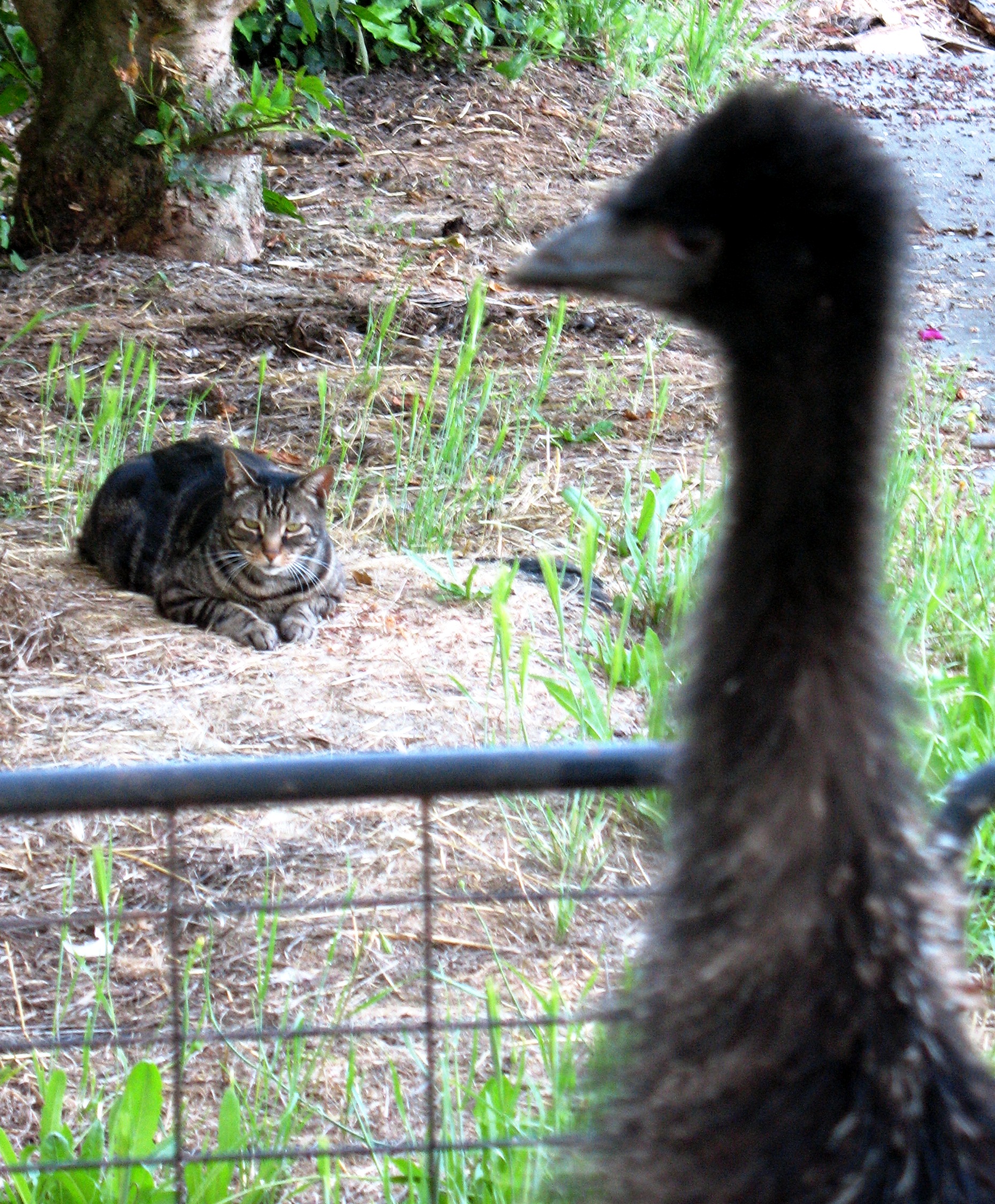
Bob, the cat, was hiding under the lower, redwood branches. He’d crept in, to check-out the chickens. The emus spied him and took off in hot pursuit. They split up and triangulated their attack. The poor cat nearly didn’t make it over the fence, in time. And that was Bob, a cat they know and like! (Well, like may be a bit strong, but they know he’s not a threat.) Were the emus defending the chickens? Or, having been demoted in their own yard, merely defending their dignity against an unsuspecting target? And, just what was Bob doing in the redwoods, anyway?

Bob, from a safe distance.

Bob, from a safe distance.

Rick had it in his head that he could solve the underlying animosities by swapping out the bully-chicken for a more self-possessed, well-mannered chicken. (We live on a chicken farm, so we have access to spare chickens.) My sister shook her head. Even from 2,500 miles away I could hear her tight-lipped nonresponse. (The woman has her own chicken issues, I tell ya.) Finally, not one to hold her tongue, she cryptically said, “Won’t do any good; it’s about pecking order.”

I hate to admit it, but I’m enough of a political Pollyanna that I actually like the idea that deposing one bully could solve the problem of tyranny. Apparently Rick does, too. We’re not naïve. We read the papers. Has there ever been any coup that didn’t just install the next bully? I was in no hurry to do the chicken swap but yesterday Rick put chicken replacement on our to-do list.

We stuffed the chicken-bully in a box, and walked over to the chicken barn. We let her out and she immediately blended into the crowd. As for the replacement, how do you pick? What do you look for? Essentially, it comes down to who you can catch.

Not as easy to catch as it looks

Not as easy to catch as it looks

We returned with the replacement chicken and put her in the nighttime cage, to let the two chickens get to know each other through the safety of the bars. The squawking started almost immediately. The emus perked up—trouble in Chicken World could only be good news for them.

It’s official. The new chicken is the “low hen on the totem pole” resident of our front yard. The formerly docile chicken has stepped up to bully role. She doesn’t much like the new chicken and she’s loud about it. We’ve gone from nasty to noisy. She woke me up this morning, at sunrise.

The emus seem to like it. With the Chickens occupied with their own disputes, the emus are left, more or less, in peace. And actually, it looks like the emus are enjoying spectator status. I feel like I should serve popcorn. Funny how I can hear my sister’s “I told you so,” loud and clear, from across the miles.

Post-script:

Not so easy, this chicken swap. The new chicken was just too…well… chicken. She sat cowering in the corner of the porch all day.

Chicken chicken.

Chicken chicken.

Rick decided that it wouldn’t do. Another chicken swap was needed. We captured her and returned her to the barn. Rick rounded up a bunch of chickens, and then, using portable fence panels, thinned until he had just the chicken! The Goldilocks of chickens, not too bold, not too chicken. This one is just right. We brought her back to the yard and she settled in immediately, friendly, without being deferential. I think this chicken combo will work. Who knew it would be so involved? Now we need to see how the emus react.

Relaxing by the pool.

Relaxing by the pool.

Don’t forget, The Emma Caites Way and The Gift of Guylaine Claire are available as free Kindle downloads on Amazon–July 1 thru July 4.