

We’ve never had three cats before. We didn’t plan on it. I’ve always taken my lead on cats from the Crosby, Stills, Nash & Young song, “Our House.” (“with two cats in the yard….”) Two cats makes perfect sense, especially if you get them together, as kittens. They keep each other company and they romp, tussle and roll.
2024 was another tough year. My Mum passed away in the Spring. A week later, a neighbor dog killed one of our cats, Milt. We mourned. Our other cat, Ollie, mourned. There was nothing we could do for him. After a few weeks he seemed to recover some—at least he resumed eating, and he even reveled in attention and grooming. I cannot say that we’d recovered, but it was good to see Ollie being more of himself. We were resigned to being a single cat household.
Then, three weeks after Milt was killed, Ollie disappeared. We assumed it was the standard Spring “got caught in someone’s shed” deal, and that he’d be home in a week. And then he wasn’t. We talked to the neighbors. Where we live is pretty rural—there aren’t a lot of neighbors. We did the usual missing cat things—walked the roads, checked with animal control. It’s an unfortunate part of country living—lots of things can take out a cat. Dogs, coyotes, owls and raptors can all turn your fluffball into dinner. After a month I was despondent. At two months, my sister gave me ‘the talk.’
If you love cats in the country, you either have to keep them in, or you have to be prepared for losses. It just comes with the territory. We don’t want to keep them in. We spend a lot of time outside, in the garden, in the woods. Our cats have always followed us. They are indoor and outdoor companions.” Cats,” my sister said, “Are a renewable resource.”
At just over two months I started checking the ads for rescue kittens. I resolved not to get hung up on looks—that all cats need homes and I’d take the first set of brothers I could find. And so we got Maki and Red. Maki looks shockingly like Milt. He’s a long-bodied, short legged, medium hair tabby—clearly some Maine Coon in him—tufted ears, neck ruff, thick racoon-like tail. His littermate, Red, is the complete opposite. He’s a long-legged, short necked, short-haired, ginger tabby, with a long, narrow striped tail.
When they arrived, Maki was much smaller, the runt of the litter. They came infested with fleas and ear mites. We’re old hands at cat care, we started combing and treating the ears. We held off a month on their first vet visit, to get them cleaned up a bit, and stabilize them. At this stage they were strictly indoor kitties. I have a nine pound rule. Kittens do not go outside unsupervised until they’re bigger than the average appetizer. We draw the line at nine pounds.
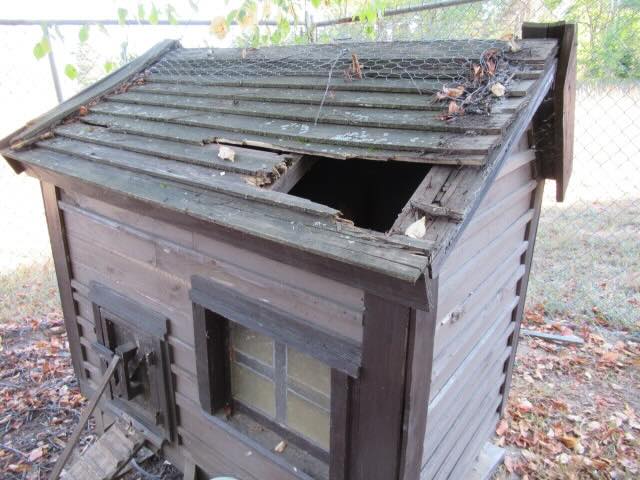
An aside, starting in early September, we had chicken troubles. Our chickens were happy free-range girls. But a recent addition to the neighborhood changed that. We now have a bobcat! Of course, its arrival gave me nightmares over Ollie’s fate, especially when one of the chickens was found as a loose pile of feathers, just steps from our back door. It brought an abrupt end to free range. Now the chickens were locked into their run all day. That’s not a bad gig—it’s a large chain-link enclosure about 50 feet across. The chickens were not impressed. You’d think they’d get it—after the loss of one of their own, but no. They squabbled and separated into rival groups. Since we have two coops, we left them both open and let the chickens sort it out. One night, noise from the chicken pen called us out with flashlights—a ruckus—which we assumed was yet another squabble. Dazed chickens were wandering around the pen—with some loose feathers in the air. We searched the entire area—but could not find anything amiss. We shrugged threw them back in their respective coops (minus one who wouldn’t go) and went back to bed. In the morning, two chickens were dead, their throats torn out. It took some research and a little detective work, but we determined that the culprit was a weasel. Weasels literally go for the neck. Their jaws limit how wide they can open their mouths—so on chickens—the neck is it. We dusted the area with flour and baited one of the coops with chicken necks and a strong rat trap. All chickens, regardless of personality squabbles, were locked into the large coop at night. The first effort at trapping was unsuccessful—the weasel took the bait but wasn’t caught in the trap. But, we did confirm through the footprints in the flour that it was a weasel—and a big one, at that. The remaining chickens were all pretty flipped out by then—first the bobcat, then the weasel. We were down to the point where we were concerned that the remaining three chickens wouldn’t have enough body mass to keep them warm for the winter. We started advertising for folks to take the chickens. No luck. After numerous unsuccessful attempts to trap the weasel, we decided the safest bet was to move the chickens to the small coop, as it was more defendable. Or so we thought. That weasel was still trying, every night. Maybe the smaller coop would be warm enough for our three survivors. Until one morning, two more chickens were dead. The damn weasel had torn part of the roof off of the small coop to get them. We were left with one, highly traumatized chicken. One chicken cannot survive the winter alone. Thankfully we found a chicken angel who invited our poor solo chicken to live in her flock. Frankly, it was beginning to seem that our year was about losses. We have plans for a new, impervious, coop, come spring. We sure miss the eggs.
Back to the kitties. By their first vet visit, Maki had surged ahead, size-wise. Red seemed timid and delicate by comparison. They received their first round of vaccines and were scheduled for the next round, two weeks later.
That two weeks was harrowing. Red became ill—his belly distended, but he wasn’t eating much, or using the cat box. Then, he had a high fever…for days. We were orally rehydrating him, and feeding him kitty-soup with a syringe. Of course this happened on the weekend, so we hoped he’d make it to the following Monday to see the vet. We didn’t know if it was related to the vaccine, or if there was some other problem. We made it through the weekend, and brought him in. The vet was not reassuring. She suspected that Red had FIP—which, in 55 years of cat care, I’d never heard of. She sent us home with everything we needed to keep him hydrated subcutaneously and told us to keep it up with the kitty soup. Their appointment for the second round of vaccines was later in the week. She told us to bring him in for a check-up—but that he probably would not be up for the vaccine round 2, just yet.
I went home and looked up FIP. It wasn’t good news. Feline Infectious Peritonitis is a lethal mutated coronavirus. Cats do not recover. Kittens catch the coronavirus when they’re little and then, in some kittens, the virus mutates in the kitten, turning its own immune defenses into a viral replicator of the mutated virus. One of the triggers for the mutation is vaccination. The mutated form is not contagious—but once it mutates in a kitten the results are always deadly for the kitten. My research showed that there was some promising research for treatment, but nothing had FDA approvals.
The morning of their appointment, we were loading the two kitties into the carrier when there was a noise at the front door. I looked over and there, looking in the window, was Ollie. A very fat Ollie. We let him in—shocked. At this point he’d been gone for over four months. He’d obviously been more than well cared for—but given a chance, Ollie came home. We were thrilled to see him. He was not happy to see kittens in his home.
At the vet’s, a robust and healthy Maki got his second round of vaccines. Red was examined, the vet shaking her head. He’d improved from earlier in the week, but he was not a healthy cat. She made an appointment for the following week—either to complete his vaccine cycle, or to consider euthanasia.
It was a rough week. We doted. We spoiled. We coaxed. We hydrated and force fed. But Red was not rallying. On the day of his appointment, I asked Rick to stay home, to dig his grave.
The vet confirmed our worst fears. Red was failing. As we prepared for his final injection, I tearfully said that I couldn’t believe that, with all the corona virus research coming out of Covid that there wasn’t some coronavirus treatment for FIP. Our vet, whom we have trusted for a decade of cat care, made a strange face. “Well,” she said, “There’s nothing… unless you’re willing to go on the black market.” Behind her, her assistant was nodding vigorously—silently signaling to re-think putting Red down. Our vet continued, “There are treatments out there, but they’re not yet approved. There are no guarantees, here and I cannot be involved because this isn’t yet a legal treatment. Her assistant gave me a website to contact. It was all pretty sketchy—but it gave us a chance for Red. Our year had seen enough losses—we were willing to give Red a chance.
That night I checked out the site, and was assigned an Administrator to guide me through the FIP treatment. Because he was in such rough shape, she said we had to start with injections, and switch to pills when he’d improved. The next step was to find a source of the serum as soon as possible. They hooked me up with a woman a couple of hours from me who had leftover vials of the serum. I drove there, and met up with her. Her kitty had completed the treatment and survived! It was like a drug deal with angels. I took the vials home and we started the treatment that night.
Some people report miraculous results—within hours. Our Red was too far along for that kind of magic. But we stuck with it—along with the forced kitty soup and regular subcutaneous hydration. Poor Red was a feline pin cushion. So many injections on so little a kitty! He started treatment at 3.2 pounds—and then dropped below three pounds for the first week or so. His care took hours, every day. We weren’t sure he would make it—but he was willing, and affectionate, even if he could barely walk and only ate when forced. After a week, there was some small improvement—his balance was better, and he started to eat on his own. It was a long, slow, haul.
By week three, there was sudden, visible improvement. Red turned back into a kitten. Even wobbly, he was making an effort to play. He resumed grooming. On day 21, he was well enough to switch from injections to pills. The treatment calls for 84 days of treatment (with bloodwork along the way to check progress), followed by 84 days of observation—to make sure he doesn’t relapse. Red has completed the full treatment protocol, and has graduated to the observation phase.
During this whole treatment process, we’ve also been dealing with integrating our senior cat with these kittens. It was touch and go at the beginning. Ollie was not happy with kittens, but the kittens were infatuated with Ollie. They followed him everywhere. Ooooh—it’s BIG CAT. WE LOVE BIG CAT. They were relentless in their affection. And it’s working. Ollie is finally adjusting to having two rambunctious kittens in his sphere. Sometimes, he’ll even play with their toys, or let them groom his ears and face.
That’s how we ended up with three cats. I’ll have to look for a new song, because it’s beginning to look like we’ll be lucky enough to have three cats in our future. We’re starting the New Year with hope and crossed fingers.



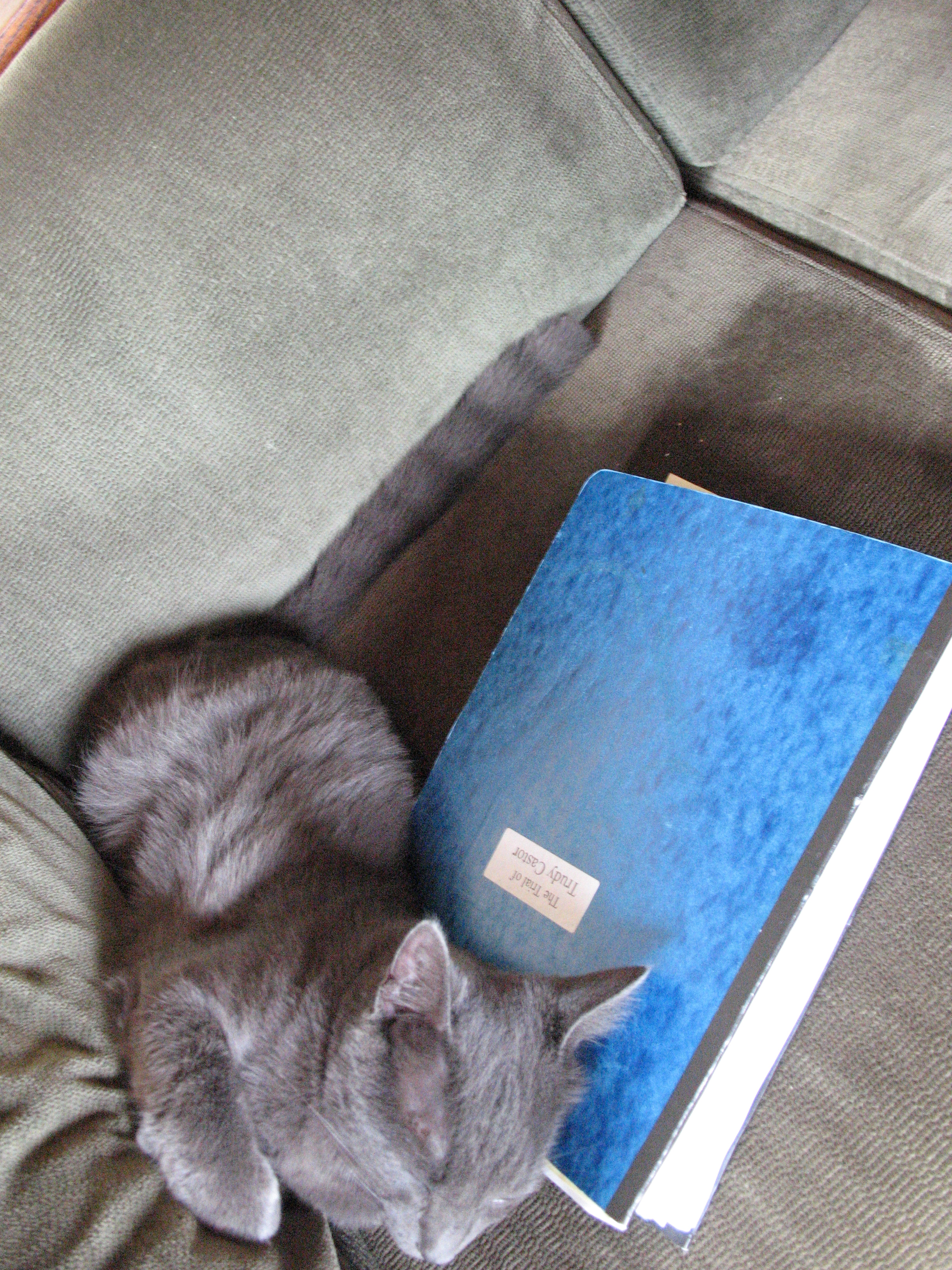 Stanley has decided to help write the novel.
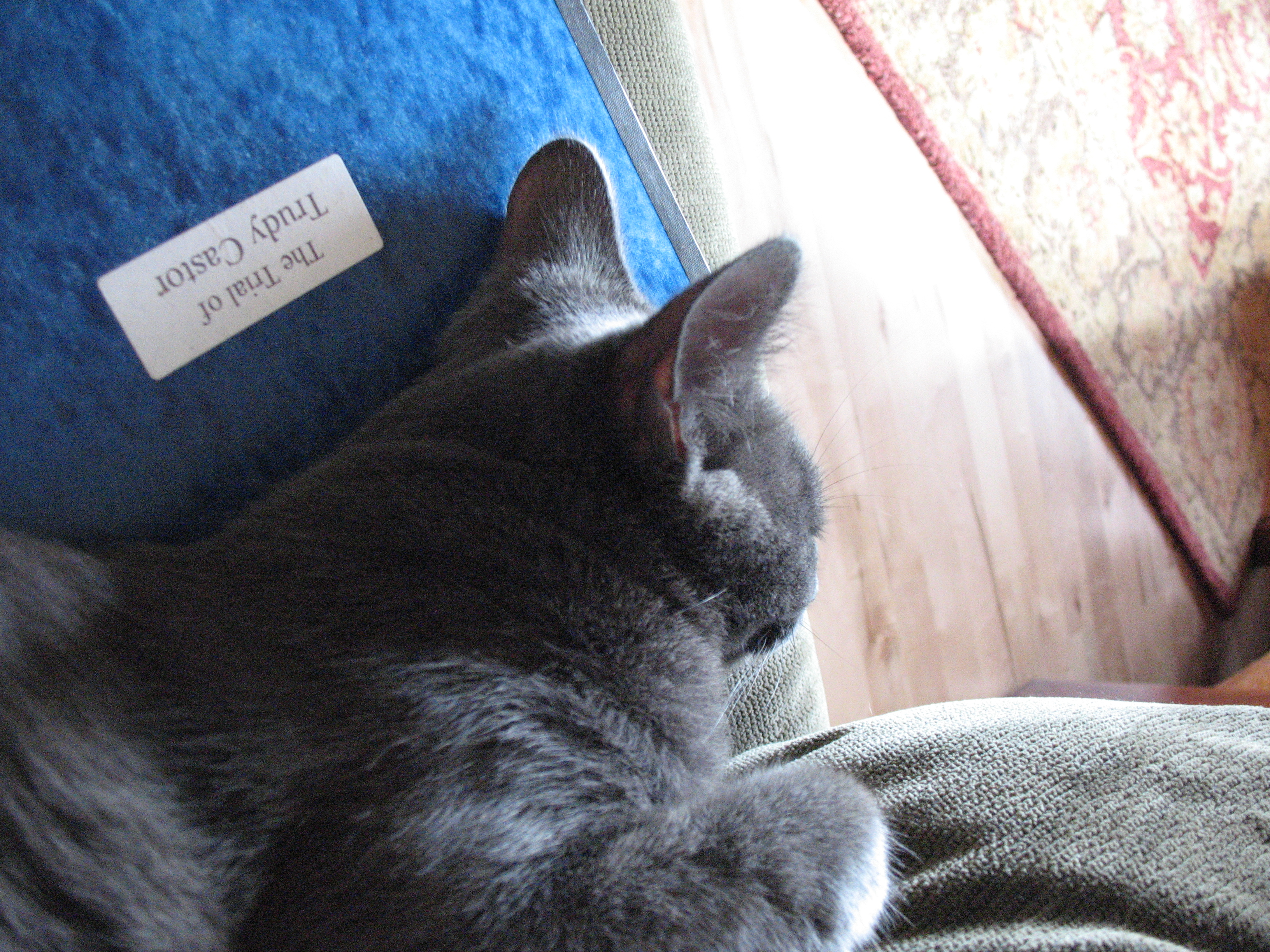 He’s no help, though, with the working title. Sometimes I wonder about his priorities.




 tworockchronicles