Archives for category: chores

A.V. Walters

The rains have come. Those first showers over a week ago, have worked their magic. At first it was just a blush–a wisp of color if you caught it at the right angle. Now there’s no question, our hills are turning green. It’s a funny dynamic that our gardening season is the opposite of our green season. Still, after months of dead brown hills it’s a relief to the eye to see this transformation. There are still goodies from the garden, they’ll go on until the hard frosts hit. This is the seasonal pause, the green relief in still fine weather, before the storms and cold come. It’s a pleasure to work outside in the cool, sometimes grey days.

I’ll be posting a little less frequently this month. I am, after all, fully committed to NaNoWriMo. It could be that Editor Rick picks up the slack. He’s undertaking those end-of-season projects, readying for winter, seed-saving (he’s so organized), tool management, and soon, pulling buckets. All that stuff that I let lag until the storms force my hand. My head is miles and decades away, weaving the fabric of a 1931 speakeasy in Detroit. Outside, the creeping green is putting me in the mood with the intense colors of my childhood. While California is lovely, it is difficult to go without green for five or six months of the year. I’m not saying I miss snow (though sometimes, I do) but I do welcome the return of green.

It’s less than a week to the election–don’t forget to vote. If you’re here in California, and if you value good food and informed choice, remember to vote for Proposition 37. Let’s get those GMO foods labeled.

I’ll pull my head out of fiction at least once a week, to give you the what’s up in Two Rock.

A.V. Walters

Last week I said it was a race with the first hard frost, to get the tomatoes in. I was wrong. When you live somewhere where rain doesn’t happen for seven or eight months of the year, it’s easy to forget. If your tomatoes are ripe (or almost) there’s another thing that can be devastating–RAIN.

A growing tomato has the ability to expand its skin. But ripe tomato, having reached its full size, shifts its internal workings to focus on seed maturation, not growth. We take advantage of this by cutting back on watering in the late weeks of the garden–it protects the tomatoes and enhances their sweetness. A ripe tomato, if it gets a heavy dose of water, can suck up the long awaited drink, split its skin, and rot on the vine. So, Sunday’s forecast of rain got my attention–not just a little rain, either, they forecast days of the wet stuff.  So we got busy, stripping the plants of all the ripe or near ripe fruit.

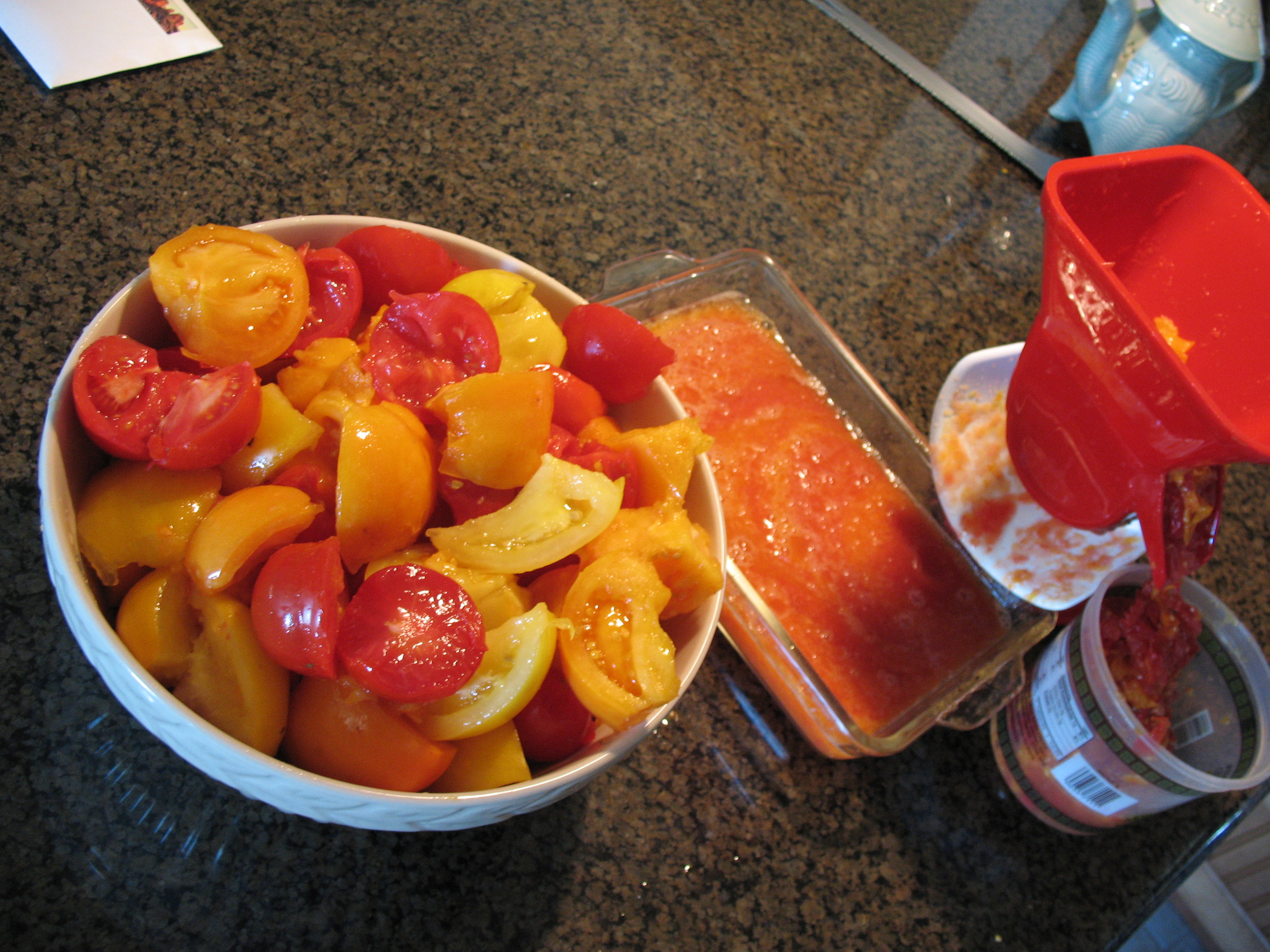
We had to harvest in five-gallon buckets and when those were full, used the largest bowls and pots we had. One hundred forty pounds of tomatoes later, I made another delivery of fresh tomatoes to everybody on the farm, and then we confronted a kitchen that was already being held hostage by our previous efforts.  We canned whole romas (some in yellow tomato sauce), diced tomatoes and sauce, lots of sauce. A year’s worth of tomatoes. Tomatoes in every imaginable color, shape and size–reds, pinks, goldens, bright yellows, oranges, brunos, stripes (both green zebras and chocolate stripes), those multicolored “pineapple” tomatoes, you name it, a veritable rainbow of tomatoes. To make sauce that has enough heft you have to reduce the volume of liquid by more than half. Every large pot we own was simmering away on the stove. There were tomato seeds and spatters, everywhere. I had to stop regularly to clean my eyeglasses. Two days later, we’d canned this year’s quota — 63 quarts of various, tomato products. Another day to clean everything and we are finished. Whew.

We’re picky about this, we taste and blend–making sure that there’s a uniformity of color and flavor. Why else would we go to all this work? After all, store-bought canned tomatoes are cheap, you can buy them by the case at Costco–even organics. Needless to say, it’s not an economic choice we’re making here. We’re opting for taste and an alliance with a rural lifestyle from a bygone era of self-sufficiency. It’s one of the signs that summer is over and that we’re ready for winter. The wood pile is under cover, and the kindling barrel full. Tomatoes and jam are labeled and lining the pantry. So, we’re ready.

There is still a lot of fruit on the vines (our growing season starts late and finishes late) so the garden will continue to produce ripe, fresh tomatoes until frost hits. We’ll continue to use them fresh for salads or tossed in pasta–and deliver them to our friends and neighbors, until then. If they get ahead of us, we’ll take them to the food bank. But, I don’t think we’ll can any more. It starts to get silly at some point, and over sixty quarts is that point, for us.

NaNoWriMo– Cheaper Than Therapy
A.V. Walters

So, what finally got me writing? I’d meant to do it, literally for decades. I had outlines, ideas, concepts…you name it. Two things finally turned the corner for me. The first was the complete unraveling of my life. Convinced that there had to be more–maybe even something in it for me–I walked out of a twenty-eight year marriage. I moved to the middle of nowhere, in part because I sought to recover the rhythms of my rural childhood and in part because I was broke and couldn’t afford to stay in the city where I was. And there I was. If ever you thought that you were held back by the cloying demands of a relationship, freedom comes with the hefty realization that if you don’t do it now, you have no excuse. If you don’t do it now, you might just as well have stayed, stayed to dedicate your every breath to the needs of someone else and let the creative spark within you suffocate and die. So there’s a pretty good incentive.

But, how do you start? Admittedly, for a little while, drinking helped. But the real impetus was NaNoWriMo.

What the hell is that? National Novel Writing Month. (NaNoWriMo.org) It’s a nonprofit group on the net that sets aside the month of November to challenge anyone brave enough to try, to write a novel in thirty days. A friend turned me on to it. The goal is to write every day with the objective of completing 50,000 words by the end of the month. There is no prize, only a lot of support, nagging, wonderful and dreaded email updates and writing for the sake of it. Really, check it out. Honestly, I never finished the 50,000 words in a month. Too much for me–but I got far enough in that I couldn’t stop and the end result of that first NaNoWriMo effort was The Emma Caites Way, an award-winning 400+ page novel. My second attempt–still without being able to finish the challenge of 50,000 words–was The Gift of Guylaine Claire, the novel I just published (though that one took two NaNo cycles to complete, even though it’s shorter.)

I’m gearing up again for November–and I hope to substantially complete my current manuscript, The Trial of Trudy Castor (again, a second time around Nano effort.) If you’ve ever dreamed of trying your hand at writing, I totally recommend it. It’s a maniac vacation (especially if, like most of us, there’s still the day job and Thanksgiving to distract you) into a self-inflicted world of angst, release, charging on–regardless and losing oneself totally in the story. It’s wonderful and hell, all in one. Its pressures (about 1,700 words per day) shake you free of the inclination to dither and sharpen your pencils relentlessly. You have to just do it.

For me, it came at just the right (write?) time. I was phenomenally depressed. I didn’t know where my life was going. I did know that I could weave stories and thus it started. Now, this is not the best option if you’re thinking that becoming an author is the path to wealth and fame. (That’s really fiction.) Writing is worthy in and of itself. It lets you explore the you of you. It helps you sort out your story and your characters and gives you insight into the you who created them. It is centering and terrifying. Here I am, five years later and I still don’t know where my life is going. Don’t expect NaNoWriMo to solve all your problems. But I have written two perfectly acceptable novels. I am a writer. I find that in a lifetime of experience, the only place you can really tell the truth is in fiction. I will continue with this, because I enjoy it, and because it allows me to explore and express. It turns out there was more to the me of me.

And so, if you ever thought that there was a story in you, I invite you to give it a try. November is coming. Sharpen your pencils. Breathe deep and ….. go!

A Busy Week

A.V. Walters

It’s been a busy week. Not only is this high season for the garden (and gophers) we are preparing for the print release of The Gift of Guylaine Claire.  We had to enter the last of the edits and then check to see that the ebook and the print version were both fully edited, and textually identical. After that, those last details, editing the new Acknowledgements, getting the ISBN and Library of Congress numbers in, and the bar codes ready, the final tweaking on the front and back covers, and I’m sure that even now I’m forgetting things. Editor Rick is the technical guy, and he wrestles with that end of it—getting the Smashwords final version through the dreaded auto-vetting process (again!) and finessing the cover colors and interior images—hopefully in a way that Lightning Source won’t overly darken the cover images this time. He takes his graphic responsibilities very seriously and the end results show it. Yesterday the files went off to be printed, and now we’ll nervously await that exciting proof copy. It will be a relief to have it finally finished, and listed for sale with the POD retailers.

Late summer has extra chores as well. The other day we re-stacked the firewood (from a loose drying stack to a tight, ready to go for winter, stack), checking for winter readiness. (We think we’re set with two solid cords of walnut, some apple and pine for kindling.) This could have waited, but it’s cool in August. September is traditionally our hottest month, so it’s nice to do the heavy lifting in the cool. We picked up a load of pine, for kindling, and I started splitting it. A little each day and it’ll be done in a week or so. Meanwhile, the temperatures are heating up and I’m wiping my brow in relief that the heavy lifting is complete.

And, of course, there’ll always be the day job.

Unlike most of the country, where mid-summer is the hottest, many areas of Northern California have a searing September. The lag has to do with ocean currents and how their “season” is a step slower to shift. The result is that in September we lose the fog that pours in from the coast, morning and evening, filling the valley, with moist, cool air. When that natural air conditioning shuts down, we get a glimpse of what they see all summer in the inland valleys.

That’s why I’m not sweating the myriad of still-green tomatoes, peeking out from under their leaves. If the butternuts are still blooming—well, let them take their shot. I’ve been in this valley long enough to know that September will turn it around. Even with this year’s late start, I’m sure we’ll bring in the crop. Don (whose advice has devalued since he abandoned his zucchini/pumpkin patch) is trying to spook me. “What you need is them floating, row covers. Winter’s just around the corner. Could happen any day, ya know!” Right.

Not that I’m against row covers as an experiment in lengthening our already long late season. In a mild year I can harvest tomatoes well into November. With row covers, maybe we could go to December or even into January. But I’m not buying into the fear factor. The season is what it is, and there’s still much to do.


Lessons from the Garden

A.V. Walters

It’s harvest time. One of the strangest things I find about gardening is how many gardeners plant and tend, but never harvest. For me, harvesting is the whole point, so those non-harvesters leave me scratching my head. If you don’t want to harvest, why not go with flowers? I’ve seen it often enough that it no longer surprises me. I think they fall into three categories: Those who plant for the visual payback (see my earlier post, “Gardeners/Florists”); those who like the idea of fresh from the garden food, but who, when push comes to shove, don’t like to cook; and finally those who overplant, and can’t possibly keep up with it when the garden starts to mature. (I think we’ve all been there from time to time—at the moment I’m having a little trouble keeping up with the crookneck.) Occasionally, you’ll get hit with a heat wave and things will bolt—and it’s a mad dash to eat up before it all goes bitter.

I’ve said before that one of my favorite things is to walk in the garden in the late afternoon to let what’s ripe determine my menu. More than once, since I’ve been here, the garden has been my salvation—funds were tight and having this amazing bounty took the pressure off the budget. And, if you can, the bounty continues through the winter months. New polls, released yesterday, revealed that far more Americans, than one would expect in this land of plenty, have gone hungry in this past year. I worry that that may continue, given the drought-parched fields in the Midwest this season. Food prices will have to respond and that will put the pinch on family budgets. I wish more people found the kind of solace and pleasure in gardening that I do. There is no down side, it’s food at its freshest and healthiest, it’s relaxing and enjoyable and it brings us closer to our most basic connections to the planet. What’s not to like?

Yesterday, I was poking around and I noted what should be obvious, but now that we’re in full season, is proven out by the garden. We have just over a dozen pepper plants. There are seven green/red bell peppers (depending on how long you wait) and the rest are a variety of sweets and hots. Some of them came to the garden late, refugees from too long in too small pots. Now, at mid-season, despite many weeks of equal treatment, you can still tell which was which, with some very real impact on output. Those that were put in young, and early, have filled out with many branches and leaves (which shade the peppers and prevent sunburn.) They are bearing peppers now, but they are also putting out new blossoms, promising a long pepper-bearing season. The ones who came in spindly and late, never developed a full canopy. They, too, are bearing but some of those peppers have their shoulders burned from the sun. They need extra water, since their more sparse foliage doesn’t shield them from the sun, and the soil in their buckets bakes. And, those plants didn’t branch out as much, leaving less foliage and fewer end buds for new blossoms. So our leggy, late arrivals will end up producing less than half the peppers as their somewhat pampered brethren.

There’s a potent argument for taking care early for a good crop. That requires knowing your climate, and timing your starts. (Especially peppers and eggplants which are soooooooo finicky about germination temperatures.) If you start too early, the garden isn’t ready when your starts are, and you risk leggy, root-bound transplants or plants that can be shock-dwarfed by a chilly transplant home. Taken beyond the garden, the message is that any new endeavor fares best if its needs are met early on. It’s a pretty common sense concept, but one too often lost in the throes of gardening, and rushing around harried in life generally. Still, as a gardener I’m sometimes surprised by the unexpected. Last year, some sorry cabbages, spindly and finally rescued late in the season, ended up delicious, their flavor piqued by the frost that nipped at their necessarily late harvest. This is tough territory for me, and many gardeners, who have trouble giving up on any little plant. But this year’s peppers have convinced me to be more orderly in my starting and planting practices. I’m still left with the problem of having to turn away orphans from well-meaning friends and neighbors though, and I’m not sure I’m up to it.

There’s another lesson in the garden. It’s a comeuppance for me. I did my second round of starts for peppers and eggplants a little late. My first set took forever, which I later learned was because they are particular about temperatures. The second set was a mad dash to try to fill in the buckets. In my rush, I wasn’t so organized about labeling. They sprouted early and I got them into their bucket homes as soon as the sprouts were strong enough. Now that it’s midseason, I see that some of the plants in the eggplant buckets are peppers and vice versa. Not a real problem, but a bit of an embarrassment. Those little label-sticks are important.

I’ve been gardening in a serious way for over thirty years now and still, every year, the garden teaches me something new.

Patience in Small Batches

A.V. Walters

This is the time of year when, as a kid, we picked berries and fruit and my mother made jam and preserves. Mornings were for picking and, after lunch, it was time to do the canning—the already hot, summer kitchen sweating with the aroma of fresh fruit, sugar and paraffin. (Yes, paraffin. We did it the old way.) We’re a large family and a successful summer could be counted in the Mason jars lining the pantry—enough to tide us over until the days lengthened and we’d be at it again.

With so many pickers (there were seven of us and that probably equaled five actual pickers) we brought in gallons of fresh fruit. You could count the season’s progression as the jars filled—strawberry, plum, blackberry, raspberry, thimbleberry, blueberry, peach, pear, and finishing up with apple. . My version of summer includes the bubbling of veritable cauldrons of jam and the jiggling rattle of jars and lids boiling on top of the stove. There were enough of us that we needed to do jam in quart jars.

My dad was in charge of paraffin. As the steaming jars were filled, each got a thin coat of paraffin, followed, after it cooled and turned translucent, with a thicker coat that filled in the deep well that formed in the cooling wax cap. He melted the paraffin in bent tin can, simmering in a pot of water. When he wasn’t looking, we’d quickly dip in our fingers in the hot wax, making perfect, inverted copies which my mother would find later. Canned goods, other than jam, actually still got glass lids with rubber gaskets and bails—the way my great-grandmother did it. When we modernized using the fresh, new, gummed caps and screw top lids, my father’s paraffin job was displaced. He resisted some, until he found out that the post-canning plunk, as the jar cooled,was the sign of yet another perfect seal.

My grandmother dragged us on the annual tour of her old, Finn lady-friends—them all exclaiming at us; a swarm of towheads, lined up in stair-step, chronological order. All of the old Finn ladies baked and canned—it being a measure of one’s housekeeping prowess. When one of them died, the others would assemble to grieve and compare notes. No funeral gathering was complete until they’d made an accounting of preserves in the decedent’s larder. (The old men, when they passed, were judged by the size of their woodpiles—winter’s warmth, split and stacked, ready for the widow.) So summer canning runs deep in my bloodline.

My adult life demanded smaller yields—there was no way that my smaller family could consume at that level. Still, there were gifts to consider and enough to get the two of us through winter, with enough to remember the flavor of summer, but nothing compared to the cornucopia of jars from my childhood. My parents continued to make big batches of jam, especially thimbleberry, which they shipped across the continent (and even across the ocean) to those of us far away from our childhood berry patches.

Eighteen months ago my dad passed away. True to tradition, he left an impressive wood pile, but the loss left a huge hole in our lives and my mom cut way back on her canning. Picking and putting foods by is, in large part, a social experience. Last year she hardly made any jam at all. This year, her berry season came early. It’s been happening a little earlier every year. Climate change isn’t fiction. It’s here—with Northern berries in mid-July, and ticks! (There weren’t ticks back home when I was a kid because the winters were too cold and too long. Now, they have to worry about Lyme disease.) Nobody believed that those early berries were really “the season.” Just some fluke—a smattering of early. My mother went out for just a few minutes, every day, and made small batches of jam, a couple of half pints at a time. Each day she’d report on her progress—she had set herself a summer quota. It worried me, a bit. It was not our normal, marathon method. I was afraid she’d lost heart in it. I thought she might be getting too old. Then, at the end of July, the berries dried up. (Usually that’s peak season!) The annual vacationers came, looking to recharge their own larders, but the berries were already gone! My mother sat smug—she’d reached, and then surpassed, her quota—all in small batches. I had to set aside my concerns. There’s more than one way to fill the pantry.

Thinking of her, I’ve been making small batches of peach jam as they come ripe on the tree (great peaches by the way—this is the tree from which we stripped all the leaves back in May.) But, they’re coming faster now, so I anticipate a large batch of peaches, any day now. Today I made 11 pints of plum jam. Our friend’s tree was laden, and so it all came at once. I still have blackberries to go and of course there’ll be tomatoes to can if they ever decide to ripen. (Still paying the price for our late start.)

I feel as though my dad is there with every jar, hovering— just in case we need paraffin.


Training Tomatoes

A.V. Walters

Okay, so I lied. While the watchwords of this particular phase of the garden are weed, water and wait, that’s not all that goes on. There are regular, if not daily inspections for pests and varmints. (We call it gopher patrol.) There is the usual round of reseeding for those rotating plants that we do all summer, like lettuce and beans, along with occasional reseeding where the cutworms get to the sprouts. And, there is the constant need to train the tomatoes.

Tomatoes are vines. Sure there are determinate varieties, more likely to stand upright, but the underlying, genetic predisposition of a tomato plant is much like that of a teenager—an inclination towards messy, outward sprawl. The cages provide structure, but like rules, you’ve got to be nipping at their heels (roots?) to make the program work. Given the option, your tomatoes will ignore your well-meaning cages, take the path of least resistance, and sunbathe willy-nilly all over the garden.

There are reasons why upright is better. (We didn’t get to be Homo-erectus for nothing!) I’m not just an uptight adult raised by an army-brat parent with a fixation on order.  While I understand that it wouldn’t necessarily work for a farmer (many of you already know the ugly truth about the commercially produced variety), tomatoes that are caged are less subject to moisture and ground-carried diseases, they provide more shading for the developing fruits, you don’t step on them as you try to water and harvest, and they’re easier to tend. I’m not old, but I am old enough and smart enough to avoid needless stooping.

So, everyday I try to tour the tomatoes to train them into upright, garden citizens. It’s just nudging, if you do it right. (Stand up straight! Have you done your homework?) You have to be regular about it, or they’ll get away from you. Up is not their natural inclination (especially those cherry tomatoes that always stick out at odd angles.) This week I missed two days and came back to tomatoes bent on escape. When that happens, you need to wrestle them back into place, sometimes resulting in the heartbreak of snapped branches.

Despite late planting, many of our tomatoes (especially the vinier ones) are reaching the tops of their cages. The others aren’t far behind. It’s impressive to see over thirty, four-foot tomato plants standing in formation. When I tuck those wayward branches back into position, I can see bunches of green globes hiding in the foliage, protected there from sunburn. Sometimes, if it gets too dense within the cage-column, I do a little pruning for better air circulation and harvesting access. I’m mindful of the danger of spreading disease with all this handling. If any tomato looks less than healthy, I tend to it last, or wash my hands and tools thoroughly before touching another tomato plant. So far, with the exception of one plant, the tomatoes this year are all remarkably vigorous. Without the cages, we’d be in tomato anarchy by now.

That one problem plant doesn’t have any particular symptom of disease. It’s just failed to thrive. It’s scrawny, without explanation. I’m at the point when I’m probably going to pull it out, sterilize everything in sight and replant with a new tomato plant. (I still have some orphans who’d be thrilled with the opportunity to be in first-string placement.) I hate to give up on it but the memory of last year’s blight is still fresh in my mind—then, in one foggy week the blight that came with the romas spread to more than half of the other tomatoes, turning them black and leafless, almost overnight. This year I’m being more cautious. (I’ve even planted the romas in an entirely separate garden, just in case.) Romas in exile—nice digs, but segregated confinement, nonetheless. (“It’s for their own good!”) It’s probably over-reacting but it’s working out. Those risky Romas are in the backyard where I can keep an eye on them.

All the tomatoes have fruit now, along with an outer crown of yellow blossoms. We’re looking at a steady harvest that will start by mid-August and, hopefully, run well through October. I may even have to stake those tomato cages. Even though I bought the beefiest ones on the market, this year’s tomatoes are coming in pretty big and heavy.

A.V.Walters

We have settled into our normal summer weather pattern. That’s warm (80s) days and cool nights, fueled by ocean fog. It slows down the garden some, but makes this valley extremely livable. You can watch its magic, just before dusk when the winds from the west sweep in a low ‘cloud’ layer, that’s really high fog. Some evenings the sunlight streams in, below the fog, and its raking light illuminates the fields, revealing things you never see in mid-day.

This pattern lets us reap the benefit of old-fashioned air conditioning—we open the windows at night and close them in the morning before the first glimpse of sunshine. It keeps the house in the 60s and 70s, regardless of the daytime highs. Each day the overcast, fog really, clears by about 10:00 am. This gives us marginally shorter daylight exposures, and, sure, that makes for a slightly longer number of days to harvest. It’s worth it. Because our daytime temperatures are also mediated by the ocean, we don’t get the blistering summer temperatures of the inland valleys. It keeps the grapes away. The grapes like really hot days.

Now, doesn’t that sound catty? The NorthBay area, famous for it’s stellar wines and acres of rolling vineyards, has agricultural flair, but sometimes lacks the depth of real farming. It is boutique and/or corporate. Throughout the north bay counties our organic farmers and Farm Trail participants keep it real. It’s only my opinion, but to keep the farm atmosphere, I think the investment side needs to have a stake in the game. Put simply, I like to see dirt under the fingernails. Elmer doesn’t do dirt, but, at an age when most would’ve retired, he still sweats the details of chickens and sheep. If the coyotes yip and howl at night, he wakes up to listen—are his flocks at risk? And he’ll roll out of bed to pull on his jeans and shoes if there’s something to be done about it.

I’m not against vineyards, but when I head inland and see those valleys covered with endless rolling fields of vines, I wonder just who is going to drink all that wine? And, from a gardener’s perspective, monoculture often means too much of a good thing. I believe in diversity.

These past four years have been telling for the grape growers. In this economy, who can afford twenty-dollar bottles of wine? It’s been a boon to cheap wine drinkers, but has put the squeeze on the vineyards. As the high end wines lost market share and reduced their ouptut, the quality vineyards have been forced to sell their grape juice to some of the lower end producers. For the savvy shopper, that spells pretty damn good wines at very reasonable prices. (She smiles as she licks her lips.)

Still, I like that our valley’s climate has kept us in more traditional agriculture. Even though we have great soils, our cooler climate makes real crop/vegetable farming a challenge. So these rolling hills are still host to chicken farmers, rangeland for beef cattle, and dairies.

A dairy is a strange kind of range. Around here we see old-fashioned dairies, where the cows primarily eat grass and the size of the operation is limited to how far a cow can walk twice a day. The dairy next door rotates its fields, and has extra land for harvesting hay. That hay feeds the cows once our dry summer hits and the green drains out of the landscape. We watch out the windows as the cows move from field to field, and every night and morning head in for milking, like city commuters. Right now the only green grass in sight is in the very bottom of the valley, which currently is crowded with cows.

The garden is in. Now we just water, weed and wait. We are behind, but I’m not worried about it. It’s not like last summer, when the fog lasted through the days and the garden just didn’t mature. Even with our late start, things are perking along nicely. We’ve had a couple of crook neck squash, tomatoes and cucumbers so far, with the promise of many more—copious flowers and many many baby green vegetables in sight. It’s a nice time to pause, count our blessings and catch our breath. After all, in a few short weeks we’ll be starting in with some of the winter vegetables, and there’s harvesting and canning to come. For now, we can let the bees do the work.

The Proper Planting of Buckets

A.V. Walters

Recently, I’ve come across some not-so-clear-on-the-concept plantings, and so, perhaps, we need some clarification on the bucket farm issue.

As usual, if one first defines the objectives, and communicates (and here I may have failed), the implementation will be more successful.

So, the objectives of Bucket Planting are:

1)   The bucket directs watering directly to the root zone and thus saves water;

2)   If the plant is placed low in the bucket, the top unused area (3”- 6”) serves as a reservoir for watering;

3)   Properly planted (see above), the bucket serves as a wind shield for seedlings;

4)   The top of the exposed bucket serves as a hose curb to protect the plants;

5)   By watering only into the bucket, you keep the area (walkway and unplanted areas) weed free (Since even weeds need water–granted in areas that get ample summer rainfall this is less helpful, but it will still reduce your weeding chores.);

6)   Most weeding is limited to the interior of the bucket, and once your plants are established, they’ll shade that area, further minimizing weeds and reducing water losses;

7)   And finally, properly prepared buckets prevent gophers from eating your plants!

Of course, there are limitations. Buckets can’t protect truly long-rooted plants, whose roots navigate through the bucket’s bottom holes and beyond—but they do buy them time to get established. That way they’re more likely to survive if they get nibbled on.

Here are some basic guidelines to proper bucketification:

I prefer the black, semi-pliable nursery buckets. They last for several seasons, and they don’t get all brittle in the sunshine. Plus, most people just throw them away when they bring their nursery plants home. Sometimes you can get them free from recycling (and even neighbors, “Hey, I got a bunch of them!”) They’re pliable and drill out nicely. A bucket must have enough drainage. If you use just the holes that come with it, your vegetables will have “wet feet” and they’ll suffer rot or fungal problems. We drill three-quarter inch holes (using a sharp “spade” bit) every couple of inches, or so, across the bottom and a row or two around the bottom of the sides. (That’s an editorial ‘we,’ as I am not in the drilling department.) Our hole size is specific to the size of gophers, larger holes can be used if you don’t share this risk. (Indeed, for things gophers don’t like, we sometimes use bottomless buckets, which are much easier to pull out at the end of the season.)

When you ‘set-in’ a bucket, dig a hole as close as possible to the size of the bucket (up to its ‘shoulders’ so you leave a lip above the ground surface—2”- 3”.) Loosen the dirt in the area below the bucket, so the migrating roots don’t hit a solid barrier of compacted earth. Place the bucket in the hole and fill in around it, packing the dirt firmly. Now, refill the bucket, leaving the 3”- 6” inch area, I mentioned before (depending on the level of compaction) at the top of the bucket. You need at least three inches to be a decent reservoir. At the time you refill the bucket, this is a good opportunity to add any amendment. We use well-composted chicken manure because, well, we’re on a chicken farm.

When you plant a bucket, (especially if you’re using starts) make sure you’re not filling in your reservoir area. Take out some of the soil, if necessary. (Your start may look lost, deep in the bucket, but that also helps protect it from the wind—and we’ve got a fair amount of that, here.) If using starts, as with any other transplant, remember to loosen the root ball! I recently had to re-plant some peppers that had been put in too high by a neighbor and discovered that, though the soil in the bucket appeared properly damp, she’d set the whole start in as a root-bound block, and little of the moisture was getting in to the roots through that block.

When watering, especially initially, use a soft, slow watering method. The bucket contains the water’s energy, and if you’re not careful you can erode all around your poor baby vegies! And yes, this is a good opportunity for even more water savings, if you use drip irrigation.

These simple steps should ensure buckets of success.

Tomatoes in Bondage

A.V. Walters

There’s a debate, heated sometimes, about whether tomatoes should be allowed to sprawl or whether they should be restrained in cages. This is a true measure of the farmer-gardener divide. Obviously, tomatoes grown in the field couldn’t be effectively caged. (It would interfere with all that mechanized equipment.) Here, on our farm, there’s no question. Elmer likes a tidy garden. When I came, I decided to solve that with a few cages, and now he’s a convert. (Well, an armchair convert, since it’s us doing the work.)

The garden stores offer a wide, and wild, variety of vegetable restraints. I’ve tried most of them. Any such restraint system must be analyzed in terms of ease of use, strength, durability (season to season), visual impact (yes, it matters), accessibility (if you can’t get your hand in, nothing’s coming out) and cost. Since it’s an investment, the repeat gardener wants something that will give years of use. Back in the city, over the years I tried those wooden stacking cages, standard wire cages, lattice fencing, and these lovely, but expensive, aluminum spiral stakes. Part of the consideration is just how many tomatoes do you have? With just a couple of pampered urban vines you can afford the high end stylish systems. These days, though, with thirty-three bucketed tomatoes, we have to go with industrial strength cages

We made the investment last year. We’d been monkeying around with “tomato-cage-lite” for a couple of years and they kept collapsing under the weight of the plants. So last year, we bit the bullet and bought thirty, heavy-duty, welded-wire, 54 inch cages. (That’s the gardener part of me.) They were on sale, and since I was buying so many of them, I negotiated an even better price. There was no way I’d have paid the original sticker price of over nine bucks a cage. (That’s the farmer part of me.)

Our cages are the envy of the farm. I’m not sure why, because it’s a community garden—so everyone enjoys the tomatoes. But both years that we’ve had them, they’ve elicited comments of admiration and envy. I don’t think it’s a come on—Hey honey, them’s fine restraints you got there—this is real equipment admiration, with just a touch of covetousness. They just are nice sturdy industrial strength cages and everyone who sees them, notices.

I suppose you could put in the cages when the tomatoes were just little sprites. But, that would be too easy. It’s not just that, though, in the early garden, when you’re digging in, there’s so much to do to catch the early season. You do what’s needed so you can get it all done. Then, when there’s a breather between establishing the garden and the onset of weeds, you can worry about the extras, cages, structures for pole beans and cucumbers, etc. Some years I’ve been caught short, wrestling undisciplined, sprawling, teenage tomatoes into cages. It can take up to three people to do it if you wait too long. This year was just right. I needed to sterilize the cages in bleach-water after last year’s blight, so that caused a little delay, but otherwise the timing was perfect. For the most part, the tomato plants were less than a foot tall, so the cages slid over them easily

The installation of the cages brought out the neighbors. It’s a sign; the garden is in. (Hopefully it’s also a sign that there’s no room for any more tomatoes.) We all stood out in the early evening rays, enjoying beers and garden talk. One of the neighbors nodded at how good they look and added, “You know, I’ve got a bunch of beans started…” She doesn’t know if they’re bush beans or pole beans. More buckets to dig in….beans, fit to be tied.

A.V. Walters

Garden Starts

I don’t know why I’m surprised by it; it’s the same every year. It’s as though someone pulled the plug and then all the green runs out of the landscape. It starts at the top of the hills, and in just a few weeks, we go from spring green to that golden-straw color that says summer in California.

Last week when we got home it was still green here, but flying in, over the Central Valley, I could see that the hills and everything east of us was already dry. We usually get a longer run of it in Two Rock—through June, usually. But this year’s dry winter is leaving its mark. Between last week and now, our hilltops have turned from green to gold. Where they’ve cut hay has gone gold. Yesterday there were deep ridges of cut hay, showing the contours of the hill. We wanted a photo of it—in the elongated evening light—but before that could happen, they’d bailed it and now the hill is punctuated with lines of square dots like a computer punch-card.

The bottom of the valley is still green, and near the creek it’s even lush. The pond is shrinking by the day, and only a few, stubborn egrets remain.

Today, with our head-colds in check, we finally started putting the garden in. We’d dug in the buckets the first week of May, so I was surprised that the soil in them was still loose and soft. It made planting a breeze. We put starts in 38 buckets—about half tomatoes and then some squash (more to come), peppers, eggplant (more of these too), and cucumbers. The rest will filter in over the next couple of weeks, and then there’s just watering and weeding.

Since we have the advantage of being pre-plowed, it’s odd to be planting and weeding simultaneously. But, the interval of absence, since the early May plowing was enough for weeds and (and quite a few, volunteer squashes) to get going so, Rick hoed the long garden. I have trouble eradicating vegetable volunteers but he’s an editor, amongst other things, so cutting things out (except being a smart-ass) doesn’t bother him at all. We’re not sure what kinds of squashes these were—last year, we turned out a bumper crop of four kinds of summer squash and at least twice that number of varieties of winter squash. But the plow spreads the seeds and there’s no telling what’s what but, judging by general location, we think most were yellow, patty-pans—they weren’t too popular, so a lot were left where they stood. (Won’t be planting them again, anytime soon.)We’ll let the “escaped” potatoes stay to see how they fare with the gophers. They were planted in bins, with bottoms, but in the early plowing this spring, Don wasn’t watching where he was going and he mangled the bins, spreading potatoes throughout that whole corner of the main garden. So, we shall see.

This year’s garden is a bit of a cheat. Usually we start a lot of our own seeds. This year, however, the trip away interrupted that, and we couldn’t rely on folks here to make sure that starts would be watered while we were gone. I know that sounds odd—well intended farm people not taking care of the garden—but, I speak from experience. (I think I’ve mentioned that this is not a dirt farm.) We decided we’d put in store-bought starts on our return. That’s a much more expensive garden approach than that to which I’m accustomed, but there it is. We’ll fill in with seeds—lettuces, radishes, beets and such.

We were running errands the other day and came upon an innocuous sign reading, “Vegetable Starts” with an arrow pointing down a rutted country lane. “Turn there!” I said, but, too late. So, we circled around and came back. We carefully worked our way down a terrible road in a borrowed car with bad shocks. (My car’s not back from the shop yet and, beggars can’t be choosers.) Finally, like a breath of fresh air, there it was. Senk Farms.

It’s a wonderful little operation, many kinds of vegetables, at very reasonable prices, lavender, honey, pick-your-own strawberries, home made jams.  Their starts are healthy, appropriately sized in their containers (not root bound) and lush. They had the widest variety of heirloom tomatoes I’ve seen this year! They had everything except pony rides for the kids. The women running it were very, very nice and helpful. Who knew that that unpretentious little sign would lead to the solution to this year’s garden dilemma? We gathered up the little pots and she came over with boxes. I went to write her a check—and, pointing, she told me just to put in the slot in the wall. They run on the honor system! Did I fall into a time warp? It makes me want to spend my money there. Later, I checked them out online—and they list their vegetable selection for the year, complete with what’s low and what’s gone already. I think I’m in love. We were going to finish the garden up from seeds, but now I think I’ll go back to Senk Farms for one more round.

A.V. Walters
Home from the holiday. While I’m not one for hauling souvenirs post vacation, I did manage to bring home one whopper of a cold. And like out-of-focus pix of treasured monuments, I’m sharing this with my traveling companions, friends and family. Next time I’ll send postcards. This has put a crimp in my post-vacation style (Well, this and the pre-vacation collision with a suicidal deer that’s disabled my car.) I was supposed to be putting in the garden over the last couple of days, but have opted for ibuprofen and Benadryl cocktails instead.
The purpose of the trip, aside from, well, a vacation, was to snap pictures of relevance to The Emma Caites Way, for the website. Wait a week or so, until this cold clears up (for both me and photographer/editor/book designer extraordinaire, Rick) and then check to see the results on the website (TwoRockPress.com.) Maybe we will even have garnered some shots worthy of a cover for the upcoming release of The Gift of Guylaine Claire. It’s tough to tell such things when rambling in an anti-histamine fog. On the home front, something must have died out in the valley, because the buzzards have been circling. It makes me nervous, having a cold and all. In the meantime, the garden (and Rick’s weeds) wait…

Late Rains

May 6, 2010

I live in Northern California, where our sunny summers are the envy of gardeners and farmers everywhere. We can grow things here that, in ways,  make our country’s eastern and northern brethren sigh, and reach for chemical solutions.

Decades ago, one of my sister purchased a home on ten rural acres in Northern Michigan. Of that, several acres were planted in peach trees. She was excited to include canning peaches, as part of her repertoire.

Already an urban farmer myself, I was excited for her—wow, an orchard! (Though, I’ll confess that I’m not much of a peach fan, even less so if they’re cooked.) I had my own sorry, little, peach tree next to my kitchen window— badly planted in the worst light in the yard, and sandwiched between two houses in poor clay soil. It was all I could do to keep the poor thing alive.

After my sister and her husband closed escrow, they trouped down to the local agricultural extension office to learn all about peaches. The the good news was—the extension agent was already familiar with their orchard. The bad news—the same; it had a history. It was planted on a north facing slope—in his dealings with the former owners, the agent had recommended against its planting—poor light, and in that climate, the peaches needed a warm, southern exposure to do well. Beyond that, my sister’s new farmette had poor soils—too much sand. Had there been any rich soil mixed with it that it wouldn’t have been a problem, but with just sand, the rains drained right through with no organic soils components to hold the water. As a result, the trees were spindly, required near-constant irrigation and frequently suffered from diseases.

The agent sent them off with a long list of all the sprays and fertilizers needed to compensate for their poor location. Chagrined, but by no means dissuaded, they were still eager to grow their own organic peaches. The first season was not stellar, but the proud owners harvested enough to can and send quarts of peaches to all the relatives. My husband loved them. Cooked peaches, eh? Still, it’s exciting to produce your own food and we discussed it frequently—me with my spindly single tree and her with a spindly orchard. They resisted the chemical approach.

Well, their trees got worse every year. With peaches, the biggest and most obvious problem is peach-curl. They had it—and once you have it, there’s not much you can do that year. The treatment is a noxious, dormant spray that is applied in the winter. On the organic side, it’s important to clean up the leaf litter, the disease spreads from the infected leaves to the soil, and then re-infects the following year when warm conditions and rains release the blight into the air—to once again attack the trees. If you catch it early enough, you can strip all the affected leaves off the tree and hope that the rain holds off when the new leaves appear. Then there are peach-borers that leave your trees peppered with holes and oozing sap like a drive-by victim. I was learning on my own what a pain it is to nurse a plant along in an environment where it didn’t belong in the first place.

The following year, after a beautiful blossoming season, she called to announce that the new baby leaves were curling—again! She was near tears and announced that they were going to breakdown and spray that winter. I was sympathetic. I was in my own battle with borers. The nurseryman warned me that the real problem was that my tree didn’t belong where it was, and so there would always be problems. She and I were in the same peach boat.

With little else to offer, I suggested to my sister that she could try stripping all the leaves.

“Two acres? There’s a couple of hundred trees out there!” She was not comforted. They didn’t spray—and the following year, she started pulling out the peach trees and got sheep instead. I finally cut down my peach tree and landscaped the narrow set back with some appropriate plants.

So, three years ago my brother’s town was hit by a tornado, late in June. The fierce winds stripped every leaf from the trees . It looked like winter! And yet, those trees were able to re-leaf and still create a lush, summer canopy on which the Midwest relies for relief from its hot muggy summers. I was reminded of that sorry peach orchard all those decades ago.

As a tenant here, I now find myself the guardian of another spindly-ass peach tree. To maximize the tree’s visual impact, it was planted on a little knoll behind the house, in a rock garden, with a “water feature” (an old, buried claw-foot tub.)  It’s a treacherous way to plant a tree that’s going to need a lot of tending, pruning and regular maintenance.  (Never put a water feature under a peach tree!) Over the years I’ve been fighting to bring this tree back to health—pruning and trying to rake-up the leaves (in between the rocks and the tub and the ground-cover.) Some years are better than others. This winter I finally got it pruned back to a healthy shape and proportion. With this year’s dry weather, cold nights and strange warm days, it bloomed early. I worried about it freezing and whether there’d be any bees around to pollinate. Still it did very well and the leaves looked pretty good—until the late rains came.

I can’t complain about any rain. We got so little this winter that it’s just bad form to whine about “bad weather.” Whenever it rained, we’d all congratulate each other. Every drop was needed and welcome, except that in the back of my mind, I was worried about my susceptible little ward, the peach tree. And I was right to be worried. Soon, those shiny, spring-green, baby leaves began to pucker. They picked up that weird rosy color and ballooned into thick, twisted, cabbagey-looking shapes. The tree looked terrible. Nothing about peach curl looks healthy. Those leaves cannot possibly photosynthesize the food needed to support the tree. It’s heartbreaking. What could I do? There was no point in attempting anything until the rains stopped—any new leaves would surely succumb all over again in the wet. So finally, it’s clearly the end of the rainy season. And about time, too. That little bit of late rain wasn’t enough to help our soils but it sure did a number on that little peach tree. Too bad, too, since this year it’s laden with little fruit.

So, today, I walked my peach talk. I hand-stripped all the damaged leaves from the tree and hauled them away. Rick helped. I only fell into that damn, claw-foot tub once. The tree looks very spindly, but all the deformed leaves are gone, leaving only the few fresh spring green baby leaves that the tree was already sprouting to compensate for the blight. So, we shall see, what we shall see. I’ll report back in a month or so to say whether it’s worked.

Hard Pan

A.V. Walters

The blessing and curse in this area of Sonoma County, is the ubiquitous, clay layer in the soil. There’s a reason that there’s an Adobe Road in Petaluma. During the rainy season it’s not a problem but starting around June, about six inches down, we get a really hard, clay layer. You plant early here, or not at all. (Oh, I suppose you could use dynamite and break up the soil, and get a handle on the gophers, in one step.) The good news is, that once the garden is in, that subsurface clay layer locks the moisture down in the root zone—making for lovely gardening conditions. No rain in the summer means very little weeding. Since we plant in buckets, we water into the well of the bucket and don’t waste any water where there aren’t vegetables. The soil otherwise is lush and fertile.

Since we will be away for the early part of May, Rick and I started early yesterday, digging in some of the buckets. It’s still too cool at night to put our starts in but daytime temperatures soared into the eighties, for a blistering day of digging (It takes extra planning to be sure you’ll be digging on the hottest days.)  I’ve been worried about the soil. All winter I’ve been commenting about how little rain fell this season. We need it to recharge the soils—and the supply for well water. And, if yesterday was any indication, we’re in for a very dry summer. Already the clay layer has started to harden—in May! We dug in about fifty buckets, about half of what we’ll do for the season. Usually we wouldn’t see these conditions for another four or five weeks. It makes for slower going, because the buckets go in deeper than that hard clay and because you need to break through it, or you risk having a “perched” layer, where any water you add follows the clay shelf and doesn’t sink down into the root zone. We dig in each bucket with a shovel-full or two of Elmer’s finest, eight-year-old manure.

It’s a community garden, sometimes in The Little Red Hen, sense. Though everyone this year is excited about the garden, only one neighbor stepped up to the plate with a shovel, yesterday. I guess we must have looked pretty rough—sweating up a storm with our grunting and digging—not exactly an ad for Fun with Gardening. At least we didn’t need to pull out the adze.

I’m particularly fond of “The Claw” for this kind of work. Yep, The Claw, (As seen on TV!) I used to scoff at those ads, but my nephew set me straight. It was years ago, during a time when I was disabled from a car accident. My nephew was visiting and had been directed by his mother to help me put in the garden. He asked me where my Claw was. Eh? What’s that?

He went on to say that his mum couldn’t garden without it. He turned up his nose at my trusty spade and garden fork. So, off he went to the hardware store to get The Claw. I was dubious. Then I watched, and tried, and became a convert. It’s the perfect tool for breaking down through our cursed, clay layer. Real men scoff at it, it looks like a girl-tool. But when push comes to dig, I noticed that even they reach for The Claw.

So, it’ll be a dry summer in the garden. Thank god for buckets. I noticed how strange my priorities have become when our new neighbor offered some really lovely, black buckets to the cause. I was almost drooling. Testing the waters I inveigled, “You know, we’ll have to drill holes in these for drainage?”

“Sure, do whatever. I was going to take them to the recycling-center, anyway.”

Nirvana! Lovely, choice buckets, heavy-duty, wide, but not too deep (think grueling, clay layer, here) perfect for winter squash or cooking-pumpkins. (This ain’t no Jack-O-Lantern garden!) You know you’ve gone a little batty when you covet someone’s used, nursery buckets. What a garden-gal won’t do…. Rick drilled them (adding additional, drainage holes—large enough for fast drainage but still too small for a gopher!) and we had them in the ground within an hour. A rolling stone gathers no moss.

Now, we’re ready for whatever weather comes our way.

Tomato-land is ready to go into its new digs, in the long garden. This is our warmest, sunniest garden and I’m expecting great results this year. Today I’ll sterilize the tomato cages and get them in. We have the super-sturdy, delux, 42-inch tomato cages. That part of the garden always looks impressive. Elmer likes a tidy garden. I accommodate by planting with plenty of space between the tomato buckets. I’ve done square-foot gardening with great results, but here we have room to spare, so we spread out some. We put in twenty-two tomato buckets, (plus six in our back yard for those troublesome Romas.) Hopefully, this year we’ll keep the tomatoes plants to less than thirty. (I know, I’ve said that before.)

Rebuilding
A.V. Walters

It’s become somewhat of a seasonal ritual. It started way back in school when we’d cripple ourselves training for track and field. Later, when that idiocy abated, my spring enthusiasm would takeover and I’d break out of my winter lethargy with a ten-hour day of heavy digging, in preparation for planting the garden. Of course, over the next few days, my body would pay for it. It’s always the same, and I never learn. But like I said, it’s a ritual.

Here in Two Rock, it stays cooler longer, so we have a late planting date, and the worst of the digging gets done by Elmer’s plow. (Granted, digging in the buckets later is still no cakewalk, but I’m always up for it.) So, I’ve managed to substitute my disabling, spring digging ritual with an equally disabling, spring volunteering ritual. And, like the Garden, it’s all well worth it.

Petaluma has a local chapter of Rebuilding Together—an organization that helps our low-income, elderly or disabled neighbors. We make repairs and improvements that helps make it possible for them to continue living in their own homes. It’s a great organization. There are two main workdays each year– in the spring the volunteers help individuals and in the fall, we plant trees around town or work on our public parks. I’ve been at it for five years now; it’s a ritual that has stepped in to fill the void left by track and field practice. Usually I’m put on a crew that works to tame out-of-control gardens. (Though, I’ve done everything from painting and laying floors to installing a garbage disposal.) It’s an all-day work-fest with a score or more of other volunteers per work site. We all work like crazy people, and at the end of the day a life and home are transformed. There’s enormous satisfaction in it. (A couple of days later, when I can bend over again to tie my shoes, I feel even better about it.)

You should see our volunteers. Our crew, this spring, included a guy in his eighties. He had his work gloves on and was manning a wheelbarrow, delivering mulch. There were a handful of septuagenarians, and then the rest of us, mostly in our forties and fifties. It’s incredible to see all these strangers (and some familiar faces from past Rebuilding days) come together and, without any kind of rehearsal and surprisingly, little direction, fall into a comfortable and steady work rhythm. We’re like bees—each busy and productive, compounded by the activities of the whole group. You can’t believe how much work can be accomplished with so many hands pulling together! If you would like to participate in that kind of community, I can highly recommend you contact your local Rebuilding Together chapter. Spring is a lovely time to help in a positive transformation.

So, now I’m broken in for the season. This weekend I can start digging in my buckets, getting ready for a late, but frost-free, planting. I can hardly wait. (We’ve even talked about adding a fourth garden plot!)Winter has faded and my neighbors on the farm are coming out of their homes, rubbing the winter out of their eyes like bears emerging from hibernation. And what’s on their minds? “Where are we going to put the tomatoes this year?” “Did you know the Seed Bank has organic vegetable starts?” We’ve managed to cultivate a crop of eager gardeners. It’s exciting.

My only question about all of this is, where are the young people? Clearly, we’re not reaching out to share and nurture the values that connect us to our community, the seasons, our bountiful gardens and, most of all, each other. Suggestions, anyone?

Gopher Control, Revisited

A. V. Walters


Today was a day to catch up in the yard. The lawn was entirely out of hand. I had to use the weed whacker to get it down to a level where the lawn mower could be used. (We’re talking push-mower, here.) Calling it a ‘lawn’ is laughable, anyways. Really, it’s just an assortment of weeds, kept shorn. I tell Elmer, it’s not mowing, it’s “weed control”–sounds more agricultural that way. But when you keep on top of it, it looks downright passable. I’d planted the back corner, and suddenly the rest of the yard screamed for attention. Thus the Weed-Whacking-Extravaganza. (Good seats are still available!)

Once trimmed down to a tidy “level,” it became apparent that the gophers have really gone to town. The lawn is riddled with gopher holes (and valleys). Really, what’s up with that cat? He stayed out of sight for the noisy, weed wacking part but came out to investigate when I’d raked up and gone back to gardening. Now, he was peering down a gopher hole and looking pretty smug.

“Hey you, cat, what’s up with all these darn gophers? I thought we had an understanding here–you’re in charge of gopher control.” He smiled and yawned. “Really, look at this, there’s more gophers than ever!”

“Yes,” he nodded and began washing his face.

“Well, what are you going to do about it?”

“Do about it, what’s to do? These gophers are under control. I’m supervising.”

My jaw dropped. “Gopher control, butterball, means you’re supposed to hunt and kill these pesky gophers!”

The cat sat up and stared. “Excuse me? You never said that. You just said gopher control. Your instructions weren’t very specific, so I handled it my way.” He turned his attention back to the hole.

Damn cat. “I’m glad we’ve finally had a chance to clear up this little misunderstanding. Perhaps with this clarification, you can now do something about all these gophers.”

“Not so fast,” the cat looked up, “You can’t just go changing the rules, willy-nilly.”

“And why not? What’s the problem? Now that you know what’s expected, you could just get rid of the gophers, right?”

“It’s not as simple as that.” He stood up and turned his back to me. “It’s a question of trust. I’ve formed relationships.”


A.V. Walters

Henrietta

When I first moved to the farm I’d been in the city for 29 years. I was viewed with gentle humor as a kind of exotic transplant. You know, Big-City professional with a ‘tude. It took the garden as a way for me to earn my chops. In the meantime, I was an avid observer of the dynamics of this small farm. I have come to believe that everything in life is personal.

Shortly after I arrived, the farm took in thousands of “used” chickens. (“That’s right, folks, these babies have had only one owner and only laid on Sundays!”) Elmer had a chicken-farmer friend who was retiring. These days that usually means that a small farm is going out of production. The college-educated children of farmers have little interest in farming. More and more, farming is being relegated to agribusiness, by default.

So, the chickens were transferred to one of our empty chicken houses. More often than not, I don’t understand the movements of livestock around farms. Cows, sheep and chickens are on the move all the time around here and, aside from the obvious management of grass length, I understand little of it. But this chicken transfer was a simple move; as a recent transferee to the farm myself, I understood it very well. It was a busy day, trucks with trailers stuffed with chickens in cages, rolling up the lane for most of the day, then deadheading back down the road to the retiree’s farm, empty cages bouncing and clattering, to collect more chickens. As I’ve since learned is often the case with a big transfer, a number of chickens usually escape. It takes a few days to round them up and get them back into cages.

That same day I was having a water problem. I didn’t want to bother Elmer in the middle of so big an operation, so I laid low until after the trucks had made their last run. Things go from full speed to dead pretty quick on a farm. When the work is done, the day is pretty much done. By the time I went looking for Elmer, the place was deserted. I checked the house, several of the chicken barns, even Number Four—but no Elmer.

Finally, I peeked into the chicken barn where the new chickens should have been settling in. Hardly. Chickens don’t like changes to their habitat and the barn was a cacophony of poultry, with feathers flying as chickens reestablished the pecking-order in their new digs. The cages in the chicken house hang about hip-height, and another tier above that. Now, below that, scores of the escaped chickens were roaming the floor, clucking up at their caged compatriots. Some jumped, wings flapping, in vain attempts to get back into the cages! I stood in the opening of the barn’s rolling door, flummoxed. If ever I thought chickens were smart—this cured me of that notion. Other than the escapees, there was not a soul in sight. I watched those loose chickens in their desperate antics, crestfallen. It flew in the face of my own recent flight to the country. Those dumb chickens wanted back into their familiar confines! (And let me tell you, the familiar for an egg-producing chicken is not a pretty thing.) Still, there is that old saying, “The devil you know is better than the devil you don’t.” I recoiled from any message that might lurk there, for me.

Peering into the darkening expanse of feathers and dust, I yelled out, “Run Chickens! Now’s your chance, make a break for it while you can!” It fell on deaf ears. Mostly.

Out from behind a rack of tall cages, stepped Elmer, his eyebrows knitted quizzically. “What are you telling my chickens?” he laughed. I blushed, relieved that the cool, dark of the barn kept this secret. Elmer shook his head, still chuckling. I decided to pretend that the only words I spoke in that chicken barn were about my water problem. He nodded and said he’d get up to the tank-house to fix it.

Most of the chickens were retrieved and repatriated over the next few days. All but one—a feisty little hen that eluded capture. Apparently, she’d taken heed of my message, made a run for it and wouldn’t let anyone near her. On a farm that houses tens of thousands of chickens, no one is going to waste a lot of time and effort pursuing just the one. Over the following weeks she grew fat and bold, feeding on spilled chickenfeed and bugs. Over time, her feathers filled out. She preened in the sun on the apron of the barn. We saw her frequently as she made her rounds. She became the talk of the farm, as one tenant after another alerted Elmer, or the farmhands, that there was a chicken on the loose. They’d nod, “Yup.” A loose chicken will usually fall prey to any number of hazards. There are dogs, foxes, hawks and coyotes around here, any one of which will gladly make a meal of a fugitive chicken. Still, she survived.

After about a month, this hen settled in the garden area around Elmer’s house. It became sport to spot and collect her eggs. Emboldened by freedom and the realization that no one was after her, she started hanging around the farm shop, especially when the farmhands took their breaks. They fed her treats from their lunches. They took a poll to name her. Some of the suggested names were getting crazy. Well, after debate, Elmer took the farm-owner’s prerogative and put his foot down on the matter. The chicken would be Henrietta.

I watched this unfold with some measure of mirth. Here this one chicken had, by force of stubborn personality, managed to elevate her status from escapee to pet. She made it personal. One of the farm hands brought her raw sunflower seeds. They argued such things at break-time like whether it would be okay to feed her popcorn—you know, because of the salt. They were teaching her to catch treats tossed in the air. The best of it was that everyone saw the humor (not to mention the irony) in it—a chicken farm with a pet chicken.

One day Henrietta mysteriously disappeared. Not a trace, no evidence of “foul” play. Folks would ask each other if they’d seen Henrietta.  Everyone kept an eye out. This really shouldn’t have been a surprise; we all knew the risks. But still, nary a feather to be found. And it did seem odd, since she generally stayed so close to where people were. As you would expect, her absence sounded louder than her presence ever had. Break-time talk lapsed back into the work at hand and any funny story of the day. (Farmers are such gossips!)

We have a guy on the farm, Bill, who works the chicken houses. He mostly keeps to himself and doesn’t come down and hang with the other hands at break-time. He’s developmentally disabled and is more comfortable taking his breaks in his quarters, or out wherever he’s working that day. He’s nice enough, but shy, and uncomfortable trying to keep up with the ribald conversations in and around the shop. Well, about a week after Henrietta’s disappearance Elmer mentioned it to Bill. He nodded, “That loose chicken? Yeah, I finally got her.”

“What? You caught her? What did you do with her?” Maybe Elmer’s tone was a little too strident. Bill, who thought he was just doing what he was supposed to, got defensive and flustered. “I put her back in the cages.” “Which cage?”

“I dunno—over in Number Six, somewhere.”

Elmer couldn’t exactly be angry. A farm hand had put a loose chicken into a chicken cage. It’s what’s supposed to happen. How was Bill to know that this was no ordinary chicken? It had never been explained to him that Henrietta was now a pet chicken. I know that Elmer spent some time looking, walking the aisles between the cages in Number Six. I think most of us did. You’d think she would have been easy to spot, but it’s difficult to tell one brown hen from all the other brown hens, in a barn with thousands of other chickens. Whatever it was that was special about her, she didn’t stand out when you were peering through the wire.

A.V. Walters

Farmer/Gardener?

I’m a gardener. Still, it’s an interesting question and not one so easily answered. I don’t think that it’s just a question of quantity. Measured by quantity alone, I border on farmer. Last season, the first where I had any meaningful and steady help, we produced (and gave away) at a rate that compared favorably to any farmer’s-market vender. One stellar week I distributed grocery bags of vegetables every day, at a rate that would have easily filled any market booth to overflowing. Indeed, an appraisal of the garden by visitors frequently elicited comments about how we could “do the market.” I like it the way it is. I know that some of our garden’s recipients would not have eaten so well without the garden’s bounty. With the economy flailing last year a good many hard working folks found themselves out of work. Here, we had plenty to share. Sharing food, quality food that I’ve grown, is one of the most satisfying and meaningful parts of rural living.

And then there’s the exchange of produce between folks who themselves have gardens or orchards. I call it the Petaluma Salute. I once met a woman from a craigslist ad, in a parking lot in town, where we stood talking politics and gardening as we exchanged zucchinis for pears, tomatoes for eggplants from the trunks of our respective cars. We haven’t seen each other since, but the experience of complete understanding remains a solid memory, as she bemoaned a recent infestation of white flies and I offered her my full repertoire of organic solutions. This summer we were walking down to the mailbox when our closest neighbor came up on a mule with boxes full of zucchini and peppers. He stopped and said he was on his way over to give Elmer some vegetables. We looked at each other and laughed. “It’s coals to Newcastle,” I said. “We’re full to our ears with these and more.” He nodded, and turned the mule around, calling out behind him, “I’ll just have to go find other homes for these.” I live in a world where neighbors leave bags of produce on your back porch, and I respond in kind.

Still, I am just a gardener. Farming is honest work, but it is work for pay, or at least the hope and expectation that the season will pay at the end. It is food as commodity. So far, I’m in it for the very real and sensory gratification I get from working with the soil and season. I note some other subtle differences between farmers and gardeners—which I find akin to the differences between the idea of livestock and pets. We gardeners sweat over the lives of our individual plants. It’s personal. We worry and try different solutions to plant troubles. We water and weed and coax. Dinner conversation can include concerns about what’s up with that last row of peppers. Bugs? Gophers? Or perhaps the long reach of the shadow of the tree-line. (Indeed, this season one whole garden will be repurposed because trees have grown and early afternoon shade dictates that that area will become the home of leafy greens.) Our gardens speak to our hearts.

One gardener/farmer test is how well one handles culling the excess plants that seed-starts yield. Farmers plant the best and dump the rest. It’s a healthy approach but one that eludes many gardeners. Every year I vow to keep the tomato crop down to no more than 24 plants. But there are always extra seedlings—what is one to do? And then there’s the problem of orphan seedlings. Elmer’s cousin starts a plethora of tomatoes every year. Come planting time she gives him the culls—leggy, pale babies. Whether or not I’ve kept to my own limits, these orphan tomatoes always manage to find homes in one of my garden plots. So I am doubly challenged; I have my own difficulties dispatching the less than hardy and I adopt the culls of other gardeners (who themselves cannot bear to waste even the most bedraggled of seedlings.) I have garden space. I take them. I give them their own buckets and water and even manure tea, until they are robust and productive. In my five seasons here I’ve never ended up with less than 36 tomato plants. Good thing for canning, eh? Now, it’s March and we’re still eating tomato sauce and whole, canned romas from the garden.

Farmers, out of necessity, have to deal in numbers. Plants are crops. It’s not the eggplants next to the potatoes–it’s the cornfield, it’s acres. They suffer the same indignities of weather and drought, of predation, but without the personal relationship. They do so on a huge scale, and with the highest of stakes. Still, the financial rewards are often slim and success is never guaranteed, regardless of how much you put into it. Nothing is guaranteed, until the crop is in, or the herd sold—and even then there are the unpredictable vagaries of price. A farmer requires some measure of armor. He cannot afford a personal relationship with his plants or animals. Sometimes, and especially with livestock, this comes off as callous. I have a little trouble with it at times–I bristle at the chickens in their crowded cages. Yet that scale and approach is what’s needed to feeds us all.

And so, I remain a gardener. I enjoy the bounty, but, beyond my pride, I don’t have skin in the game in the end result. I joke at the distinction, but my hat is off in respect to the farmer.

Elmer, my favorite farmer, has chickens and sheep. When it comes to plants, he’s no more farmer than me. When it comes to garden-starts, he has the opposite problem. He goes to the nursery and picks the largest starts he can find. You know the ones, nursery fed on fertilizers, the junkies of agriculture; these baby vegies are literally climbing out of their four-inch pots. They’re bushy, precocious, already sporting blossoms, or even small fruit. They boast of success and productivity. It’s too good a deal to be true! And so it is. These spoiled, root-bound prima-donnas don’t transplant so well. They, too, get their own buckets but the damage has been done; their growth is invariably stunted by their over-ambitious early beginnings. We coddle them, but as yet I don’t know the cure for root bound. It shows that once we’re out of our fields of specialty, we are all gardeners. It’s always personal. For the root-bound, I carefully separate and spread the roots out at replanting time. For the scrawny ones, there’s always the hope of recovery.  I think of this as a lesson, in and out of the garden. I was myself (and remain) a late bloomer.


A. V. Walters

Musings on Spring

It’s Saint Patrick’s Day and, with this week’s heavy rains, our corduroy hills have taken on that Irish, emerald green.  I call them corduroy because the ranchers cut the hay and leave it in rows on the hillside. The hills across from us are so steep that a tractor can only go strait up and down–any turn on the steep part of the slope and they’ll tumble. On that steep terrain they cut, but don’t bother to bail or collect the hay. So the cut hay lays on the hillside in stripes–stripes that echo, season after season, on the landscape. The week’s rains have washed the cows and today they stand out starkly–black and white, against the green. With the intense green and the equinox next week, we can’t help but think of spring.

In my Michigan hometown, up on Lake Superior, they’re thinking of spring, too. My mother, even in her mid-seventies, is a rabid gardener. As soon as the snow retreats she hustles to rake up the garden in preparation for spring planting. It’s a big job, one she tackles in stages that are measured by the progress of the snow’s melt. She races against time, knowing that when late May fades into June, it’ll be blackfly season–and she’ll want to be indoors for that. It’s been a mild winter in the North, too mild. This week they’re having a false spring. It was eighty degrees in the Harbor today–a record breaker by all accounts. Most of the snow is gone, or nearly so. I can picture my brother-in-law standing in the parking lot of their general store, broom in hand (his excuse for being outside) face tipped to the sun. In fact I’ll bet all the inhabitants of the Harbor were out today, drinking in the summer-like weather.

It’s not necessarily a good thing and they all know it. In separate calls to my family today, three of them mentioned the obvious danger of too early a spring. The trees can be fooled, lulled into an early bloom. Flowers have the same risk. When that happens, winter reaches her icy fingers back to what March should be and the bloom will fail, taking next summer’s fruit with it. And nothing is quite as winter-numbing as the sight of a daffodil in it’s crystal sheath, after a freezing rain. Still, standing outside in shirtsleeve weather has its own hooks, after months of cold and grey.

Today in Two Rock the rains gave way to blustery winds. The clouds have been chased away and the sun shines on new hills. The grass is growing faster than the sheep and cows can eat. Walking out to the road, to get the mail, I spooked a huge flock of black birds–invisible in the tall grass until the moment they launched, en masse, into the sky. I was startled and laughed out loud at the surprise of it.

During the worst of the rains I was scheduled to collect signatures for California’s referendum to require foods with genetically modified ingredients to be labeled as such. We were positioned at the door to Whole Foods. (Yes, I know–shooting fish in a barrel.) Still, it was interesting. The signatures flowed easily between cloudbursts but when the rains really came down, the shoppers hunched their backs, scrunched up their faces, avoided eye contact and ran for their cars. I can’t blame them, it was cold and wet. Some people stopped to say they’d already signed, and to thank us for being there. One well-dressed man shook my hand and told me he hoped it wasn’t too late already. I couldn’t help but agree.

It’s an early spring here, too. To a lesser extent we have a similar problem as my family back home. We’re not clear of the danger of frost, not until May. But the equinox is a milestone. I can start hardy seedlings indoors next week. Then, in the weeks after that I can start some of the more delicate vegetables. I struggle with the temptation to rush the process. I’m no different than the folks back home, who sweep parking lots in the sun, where only a week or so ago there was snow. We all yearn for spring, for planting and the promise of summer’s warmth. And that’s what’s up in Two Rock.

A. V. Walters

Manzanita!!!

Just a quick update to Snobs–we’ve run out of almond! Even with beautiful days, our cold nights have completely drawn down our store of seasoned firewood. It’s not that we’re wasteful; we keep the house at about 62 degrees. I’ve reached the point where I find a normal home’s (say 68 degrees) stifling.

I called my supplier and he couldn’t help us. Apparently the almond growers have been lured out of the firewood market by guaranteed sales to the biomass buyers. When they pull an orchard for rotation, these new buyers will immediately grind the entire lot for the co-generation of electric power. The growers recover a little less, but they don’t have to store the wood for seasoning. They can almost immediately re-plant with new trees. That is, after all, their business. They’re almond growers and the focus is on the nuts, not firewood.

However, my supplier did slyly indicate that he’d scored some manzanita–hot burning, dense, with as many BTUs as our favorite, almond. It’s a rare opportunity; he’s never seen it before in  quantity. I checked it out on the net and, sure enough, manzanita has the same BTU rating as almond. And it is beautiful wood. The interior looks like cherry. The smooth bark ranges from rust to burgundy. And it is heavy. We got a sample–a third of a cord to carry us until it warms up at night. So, this evening we’re sampling our new, exotic firewood. It’s lovely and it’s hot! The listings on the internet warned us not to overload the wood stove and they weren’t kidding. So, for those who thought we were firewood snobs before, eat your hearts out! We’ll finish out the season with manzanita and do next year with a blend of Walnut and what manzanita we have leftover from this season. Hopefully, beyond that, we’ll be able to get more almond.

A. V. Walters

Better Living Through Chemistry

The other day I woke to the sound of gas-fired weed whackers. It was a relief. We’ve had strange weather this winter. No rain. We rely on seasonal rains to recharge the wells and this season has been dry. Here in Two Rock it’s green; we get a lot of fog coming in from the ocean. The fog (and in this year’s weather, frost) provides enough moisture to keep the ground green, especially in the low-lying areas where the fog settles. Looking across the landscape you can see the contours of where the fog flows by the trail of green it leaves on the hills. But that moisture doesn’t go deep. If you dig, it’s damp down only a few inches. It’s green, but it’s not growing and that makes the farmers nervous. I know on our farm they’re working to keep the sheep moving, rotating from field to field so the sheep don’t damage the grass down to the roots. Sheep can do that. Usually in the winter I have to mow my lawn every week—or at least every ten days. This season I think we’ve mowed only three times.

And then there’s the cold. It’s been really cold here at night, for months now. Really cold for us is low thirties and high twenties. With nights like that the sheep need extra nourishment to keep warm. The days are lovely, with temperatures climbing sometimes well into the sixties. Even with those warm days though, the cold nights and low moisture keeps the plant growth rate down.

There’s a funny thing I learned about cows (and even some sheep) when I moved here. They sometimes suffer from a “the grass is greener on the other side” syndrome. Even if a cow is surrounded by lush pasture, it will lean out through a fence if there’s greenery on the other side. You need to keep grass at the edge of the fence-line short and groomed. If you don’t, the cows will cut their necks on the barb-wire fences trying to lean out for the grass on the outside of the fence. I live next to a dairy, so even though we don’t do cows here, we get to observe what is done in the world of cows. We share an access road and some fences.

A year ago last autumn, somebody decided not to mow (or more correctly, weed-whack) the fence lines along the dairy side of our single lane driveway. I guess someone figured it was faster and cheaper to spray with herbicides. They were certainly effective. Late that autumn they sprayed and everything green along the lane shriveled and died. Stripped of its protective vegetation, the shoulder of the lane soon began to crumble. The seasonal rains fell on that naked dirt and what little roots remained were not enough to hold the soil. Freed up from roots, the gophers made the little gully along the lane their alley and churned the soil mercilessly. More soil eroded into the gully and washed away with every rain. By mid-winter, our undermined road began to crumble at the edges.  To save the lane, they dug the gully deeper to funnel the water away. The gophers dug deeper, too.  The edge was hardpan, barren, clay; its organic matter had flushed away so no new grasses would grow there. Grasses have a fine and broad stabilizing root system. Weeds grew there though, but their long tap roots did little to hold our road edges.

Through our long dry summer the grasses did not return along the lane. A few weeds sprouted, but not many. Last fall they chopped down the weeds. The farmers had to dig another ditch, inboard fifteen feet or so from the fence, to divert the water away from the lane’s edge. The gully along the road edge was eroded and jagged. It could no longer carry excess water along the side of our lane, without causing further road damage. Like I said, it’s been a dry winter and so far the new diverter ditches have not been tested. Here and there, along the lane there are some patches of fog-fed green. We’re hoping they’ll spread, their roots working through the soil to rebuild that mat of living material that holds all that’s good in the soil.

So, in this case the annoying drone of weed-whackers is a relief. It means somebody’s learned a lesson and we won’t be spraying anytime soon. With any luck, the rains expected next week will be gentle and will nurture the right kind of growth to re-stabilize the soil and return our lane to its former secure state.

A.V. Walters

Spring?

I may have spoken out of turn when I announced it was Spring in Two Rock. It’s something, but I’m not sure just what. Northern California seasons can be a little confusing, especially if, like me, you’re from areas that have real winter. I’ve been here over thirty years and I still get caught short by faux seasons.

So we’ve had gorgeous days in the 60s and 70s. We walk up to feed the emus and, from the vantage up the hill, the valley is beautiful. The daffodils are in bloom, even in Two Rock. (I say even because Two Rock is always a couple weeks behind Petaluma–and more when it comes to frost free nights.) The grass is lush, mostly from melting frost or fog, because we’ve had so little rain this season. I just barely got the peach tree pruned before the buds started to swell. A few of the blossoms have popped open like popcorn. Plum trees are in full bloom throughout the valley. Over the weekend we drove to Santa Rosa and saw them pruning the grape vines in the vineyards. The most dramatic and confusing thing is the mustard. Farmers put it in as a cover crop, sometimes mixed with rye grass. The mustard is in full bloom now. Whole fields of yellow, sloping with the contours of our rolling hills, take your breath away as you crest the hill and come down into the valley. How could it not be Spring with that display of yellow?

Three nights of sub-thirties temperatures is how. We still need to keep the fire burning to keep the house from slipping into the 50s. I’ve always thought that this mid-winter hesitation was a feature in the California winter. It’s too early to plant but you can still clean up the garden, prune (though you best hurry up on that at this point), plan, divide bulbs and generally get things ready. If you’re really old fashioned, you can clean and sharpen all the garden tools. (I always wished I could be that dedicated. Instead I sharpen on the fly, as needed, and almost never clean a shovel or spade.) My first Spring here I was chomping at the bit to plant. Elmer said, “No. We see frost until the first week of May.” Every year he’s been proved right. So I wait, leaf aimlessly through the seed catalogues and peer anxiously at the dwindling wood pile.

I worry about the weather. Though the surface is damp from the dew and frost-melt, too little rain has left the soil dry any deeper than that. I worry about the well and about whether the dry soils will be a challenge for the garden through the summer. Will this cold weather kill off the blossoms and spoil the fruit tree harvest? Can the peaches and plums pollinate so early–when the cool days and nights impede the bees? But I’m a worrier. Probably it’ll all be fine. By April I’ll be planting seed starts for transplanting when the soils warm up. In May we’ll be digging in buckets, and it will fall into place, like it does every year. In the meantime, I’d better throw another log on the fire.

Rick Edwards

Weed-Wacky

As a kid, my primary job on weekends was to get on my bike and put as much distance between myself and home as possible. I’d be out the door, after a hearty breakfast of Froot Loops, and wouldn’t return until sunset. (All without parental notification, or an approved safety helmet.)

It wasn’t just about the open road, the call of vacant lots or feeling the wind blowing through my crew-cut. There was a penalty on weekends for not getting out early and under the radar—unpaid over-time. Beyond the daily chores and the generous compensation package, “Froot Loops don’t grow on trees, ya know.” (Amazingly, when I was growing up, nothing grew on trees, according to my mother), one of the more dreaded weekend employment opportunities to broaden one’s skill-set, was pulling weeds.

Some call it a chain-gang or a forced-labor camp but on the inside, we called it, “The Backyard.” Though the word is thrown around a lot these days (mostly for comic effect and as the ultimate exclamation point), my dad really was a weed-Nazi. To his credit, he never used weed-killers (other than his children), which may be why my kids were born with the desired number of fingers and toes. A friend of mine I call Agent Orange, thinks weed control comes from a container, the contents of which are “only to be used in a manner consistent with its labeling.”  (Preferably wearing a Haz-Mat suit and a respirator.)

When it came to weeding, there was only one rule in The Yard (besides, “Stop whining!”) and it was, (if you like you can use a German accent) “You must remove all of the root!”  Even as a child I, begrudgingly, understood the importance of that rule. I understood that a weed could grow back, even if only a tiny piece of its root was left behind. I really got that! And what kid doesn’t want to make the old-man proud. But looking back, I can’t help but wonder if it was all just a cruel joke or one of the ways parents like to remind us of who is really in charge. Let’s look at the facts: Weed season means it’s hot, the ground is hard, I’m just a little kid and I don’t even remember getting any kind of gardening tools or gloves. I mean, I’m living off Froot Loops and riding around who-knows-where without a helmet―what the hell do I care whether the weeds grow back, or not? I’m lucky to be alive! Needless to say, I “dutifully” removed the tops of the weeds, even when I tried to get all the root. But, I figured if I kept my nose clean, and didn’t fight with the other detainees, I’d get time-off for good behavior.

I’m living on a chicken farm now, (of course there’s a story of how this came about, but that’s not why I asked you all here) and last spring my partner and I put in what’s called the community garden. It’s actually three gardens, covering over 4,000 square feet and as you can imagine, that’s a lot of weeds. Given my history, you’d be right to guess that I had a visceral response when the late rains brought forth a bumper-crop of weeds. But I didn’t run, screaming, in the opposite direction. I’d swear that, off in the distance, I heard a bugle playing a call to arms. I didn’t sow those weeds but, by God, I’m certainly reaping them now, roots and all! Given that watering is usually done by others on the farm and there’s little else that needs tending to, except weeding, it has become my obsession.

I guess when it comes to weeds, after all that’s said and done; I am my father’s son. Most of the weeds here, live (briefly) in fear of me, and those that choose to remain are learning to stay on the outside of the garden, looking in. (Under the radar, you might say.) I think my dad would be proud if he saw the gardens and even more so because he was the kind of parent who hoped that his children learned more than he did. And if there’s one thing I’ve learned (that he didn’t), it’s that you never, ever ask your kids to pull weeds. (Oh, and don’t let them eat Froot Loops!)