Archives for posts with tag: farm life

A.V. Walters

I know I said I was finished canning for the season. And then, there was the threat of frost, so we decided to do one last harvest before the more delicate items perished. We brought in peppers, the last eggplant, basil (but unfortunately, not enough of it), a bunch of late-maturing winter squash (spaghetti, moschata, butternut and one lone delicata that was hiding in the foliage) and then we took a hard look at the tomatoes. Sure enough, many had split and rotted after the rains. But looking closer, there were still a lot of really lovely tomatoes in there, so we harvested.

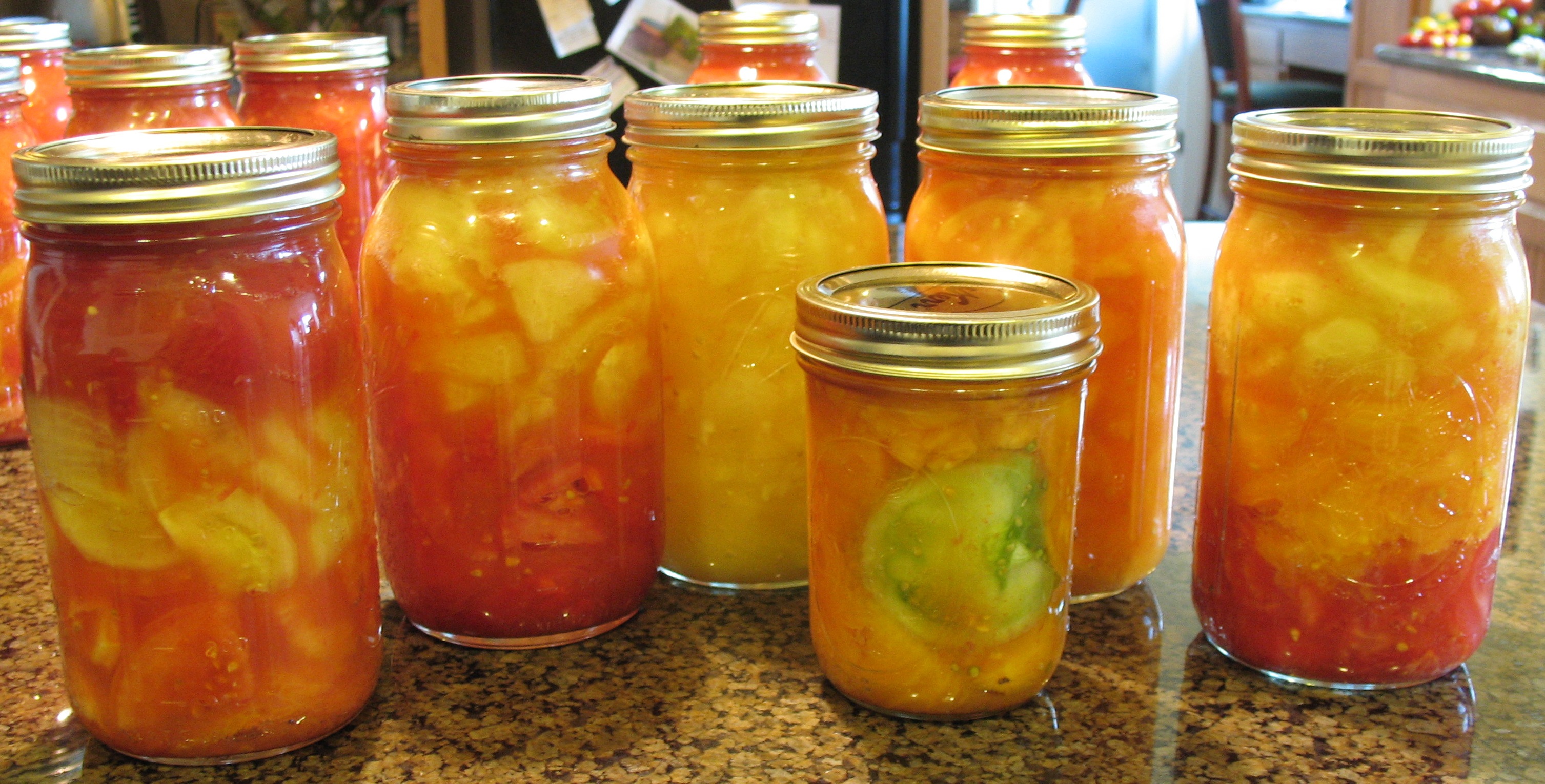
And harvested, and harvested. We made an ample last harvest delivery to everyone on the farm and still there were over three five-gallon buckets of tomatoes. Eighty-eight pounds of tomatoes—in November, no less. So we pulled out the canning equipment, from its brief rest in storage and set up for one last (no, really) run. Twenty-three quarts later, we are finished. We did extra thick sauce infused with basil (for pizza or spaghetti); we did tomato pieces, most sorted by color—red, orange or yellow, which will be lovely for stews or soups; and we did some fancies—mixed colors in patterns—which are almost too pretty to eat and will probably be gift items. (So if you’re family and you’re reading this, close your eyes on this part.) Then we washed up and put all the gear away again.

It was a welcome reprieve from regular life, which has had some twists of late. Anyone who is the parent of a teenager can relate—a runaway with issues and attitude. As much as you ache for their safety and mental state, you also wish you could can them, too, safely into tidy jars, tucked into the pantry until they’re ready for real life. Once we’d done all that we could do, a little tomato therapy of peeling and dicing and canning was just the ticket. And by the end of the weekend, she was home, safe, and probably already gearing up for her next snit. You wonder, was I ever that young and clueless?

By last evening, the kitchen was clean, the jars in neat rows, cooling, and we relaxed in front of the fire. Winter is coming and the early mornings are decked out in frost. Stupidly, I left a lot of the basil in the garden and the cold burned it to a blackened, limp mess. A day earlier and I could have dried it for winter. Oh well. In the daytime it’s too warm for a fire, but by night the chill is in the air and it’s time for some heat. This morning, I noticed that more tomatoes are ripe. No way. I’m not canning them. I’ve already put the canning stuff away twice. But, I may take some and dehydrate them. I heard from an old Italian friend that the secret of great cooking with canned tomatoes was to dry some too, and then snip bits of the dried tomatoes into the pot twenty minutes before the meal is ready. Supposedly the dried ones bring back the aroma of summer.

Last night, friends called. Their neighbor has an excess of apples—did we want any? Plenty for applesauce or the emus. Applesauce is always a lovely treat in the winter. Oh, on second thought don’t go too far with all that canning equipment; we still have some empty jars. And, more emu news, next time.

A.V. Walters

The rains have come. Those first showers over a week ago, have worked their magic. At first it was just a blush–a wisp of color if you caught it at the right angle. Now there’s no question, our hills are turning green. It’s a funny dynamic that our gardening season is the opposite of our green season. Still, after months of dead brown hills it’s a relief to the eye to see this transformation. There are still goodies from the garden, they’ll go on until the hard frosts hit. This is the seasonal pause, the green relief in still fine weather, before the storms and cold come. It’s a pleasure to work outside in the cool, sometimes grey days.

I’ll be posting a little less frequently this month. I am, after all, fully committed to NaNoWriMo. It could be that Editor Rick picks up the slack. He’s undertaking those end-of-season projects, readying for winter, seed-saving (he’s so organized), tool management, and soon, pulling buckets. All that stuff that I let lag until the storms force my hand. My head is miles and decades away, weaving the fabric of a 1931 speakeasy in Detroit. Outside, the creeping green is putting me in the mood with the intense colors of my childhood. While California is lovely, it is difficult to go without green for five or six months of the year. I’m not saying I miss snow (though sometimes, I do) but I do welcome the return of green.

It’s less than a week to the election–don’t forget to vote. If you’re here in California, and if you value good food and informed choice, remember to vote for Proposition 37. Let’s get those GMO foods labeled.

I’ll pull my head out of fiction at least once a week, to give you the what’s up in Two Rock.

Tomato Thieves

A.V. Walters

Here it is, October, and the tomatoes are beginning to yield in a big way. Finally, the season catches up. Most all the regular summer vegies are gone, a few lingering summer squash, some cucumbers and then–the tomatoes. It’s October canning again. Last weekend I set the kitchen up for canning, prepped my jars, counted my lids and rings and then headed out to the garden with a three gallon bucket. When I got there, there were hardly any ripe tomatoes. Just the day before those vines looked like Christmas trees and then–next to nothing. I blamed Don. It’s not fair, because I had no evidence. But Don has a reputation for pulling jokes on people–I figured it had to be him. I picked what there was, and plotted my revenge.

Yesterday, I got a call from one of my neighbors. She said that there were strangers in the tomato patch. I threw on my clothes and bolted out after them. Sure enough, a friend of one our residents was there, picking a grocery sack full of tomatoes! This is a tough call. It is a community garden. Granted Rick and I provide most of the plants and almost all of the work, but all summer we regularly deliver the harvest to each of the residents on the farm. We encourage “the community” to help themselves to the bounty from the garden. And, we’ve never had a problem before with having enough to share and to can.

This interloper was accompanied by one of our kids from the farm, a human shield, in my mind. That’s a despicable tactic–to use children as cover in your fiendish plot. I know these kids, they’re good kids, but for the life of me, I cannot get them to eat tomatoes. I held my tongue, that is, until she went after the corn. She pulled several ears from the stalks, pulled back the husks and, determining that they were not yet ripe–threw them to the ground. That was it. I approached her, my eyes fixed on that paper grocery sack near filled with lovely heirloom tomatoes. She had a nervous smile. I initiated the conversation, “So, you know that this is a community garden–for the folks who live here on the farm.” She shifted the weight of the bag in the crook of her arm, nodding. The kid asked about the corn. I explained that it wasn’t ready yet–told her how to tell–and explained that we didn’t get full pollination, so some of those ears would have gaps, like missing teeth where the kernels didn’t fill in. And I told her that the ears they’d thrown down should be fed to the pigs, and not wasted. The kid and the tomato thief nodded.

They didn’t meet my gaze. It wasn’t clear that I’d made my point. “It’s fine,” I said, “As long as the stuff you pick is for farm residents, for consumption here on the farm.”

She paused, “Of course, these are for the kids, here.” She nodded at the kid. The kid nodded, too.

Sheesh, I’ve been trying for three years to get these kids to even try the tomatoes. You couldn’t pry their mouths open with a crowbar. And now this woman is lying and including the kid in the lie. Great training, eh? I sighed, turned and walked back over to my conversation with the woman who’d placed the call. She shook her head. Then she advised me that on Sunday morning there’d been a couple of folks here she didn’t even recognize, picking tomatoes. And I’d blamed poor Don!

I don’t know the solution to this problem. While I’m more than happy to share with my farm neighbors, I also want to get in my winter supply of canned sauce and canned whole romas. Who are these people who would show up at harvest and help themselves, when they’ve not participated in the garden–and who are strangers to the farm? I just don’t get it. My sister tells me I’m the little red hen.

When I came home this morning, I found lovely printed signs which Rick had made.


THIS GARDEN WAS

PLANTED BY AND IS FOR THE USE OF

FARM RESIDENTS

PLEASE RESPECT THIS

I don’t know if the signs will have any effect on the tomato pilferers, but already they’ve done wonders for me.


AV. Walters

And no rain, in even a normal year, for at least a month. We’re not getting our usual heat wave this month–and with the fields like tinder, that’s a good thing. We are all wary of the risk of wild fire. In most years I take the advice of ’30 feet of defensible space’ seriously–I clear everything away from the house diligently. This year there’s no need. Not even the weeds grew in this dry season. There was a fire yesterday–somewhere between here and town in the other end of the valley. It was a grass fire–it’s a different smell and taste than a more serious structure or forest fire. Smoke lite. Apparently they got it out, because the air cleared and the lingering haze made for a lovely sunset.

I’ve been following fire and emergency news these days because I’ve become more involved as a volunteer with our local fire department. Not fighting fires–I think I’m a little long in the tooth (and clumsy to boot) for that. But I can chip in with administrative stuff, or selling T shirts for fundraising. It’s a small community, everybody does what they can. It’s so dry that our new firefighters have to train on the hoses without water. Don’t laugh. Nobody has excess at the wellhead these days, so they learn to man the hoses dry–with the seasoned volunteers pulling and pushing at the back end of the hose to simulate the force of real water. Consider it a dry run, in the most real sense of the term. They revel at the chance to share training programs with nearby departments that have city water.

Our wells are low and that intensifies the mineral salts–leaving a cloudy blush on the glasses, if you use the dishwasher. When canning, I have to put vinegar in the water with the bottles, or they’ll come up clouded and gritty feeling. Some of this is normal at this time of the year. The rest has us seriously conserving and sniffing now and then for smoke when outdoors. It’s a good thing that the rainy season runs during the same time as the winter heating season. By the time I put a fire in the stove, it’s cold and wet out.

I buy bottled water for coffee–not because of contamination (our well is high up on the hill) but because I’m a coffee nut, and I like the flavor of a less–gritty–source of water. In the low part of the valley the wells are contaminated. It’s a fact of rural living–nitrates in the water. Those folks must drink bottled water, especially kids. It’s a reminder that , even here in rural county, we need to be aware of our footprint on the planet. Nitrates are a common form of contamination in areas with heavy livestock concentrations, especially where, like here, people rely mostly on shallow wells. This is a dairy area, with chickens and beef cattle thrown in for good measure.

Many years ago the county put in a dump, (now called a transfer station and refuse disposal area) about a mile from here. The runoff from the site runs into our local creek. There’s a debate in the valley, not too seriously entertained, that the county dump is the source of the contamination. Folks who’ve been spreading manure on these hills for generations wince–and don’t point too many fingers, except occasionally, for sport.


A Busy Week

A.V. Walters

It’s been a busy week. Not only is this high season for the garden (and gophers) we are preparing for the print release of The Gift of Guylaine Claire.  We had to enter the last of the edits and then check to see that the ebook and the print version were both fully edited, and textually identical. After that, those last details, editing the new Acknowledgements, getting the ISBN and Library of Congress numbers in, and the bar codes ready, the final tweaking on the front and back covers, and I’m sure that even now I’m forgetting things. Editor Rick is the technical guy, and he wrestles with that end of it—getting the Smashwords final version through the dreaded auto-vetting process (again!) and finessing the cover colors and interior images—hopefully in a way that Lightning Source won’t overly darken the cover images this time. He takes his graphic responsibilities very seriously and the end results show it. Yesterday the files went off to be printed, and now we’ll nervously await that exciting proof copy. It will be a relief to have it finally finished, and listed for sale with the POD retailers.

Late summer has extra chores as well. The other day we re-stacked the firewood (from a loose drying stack to a tight, ready to go for winter, stack), checking for winter readiness. (We think we’re set with two solid cords of walnut, some apple and pine for kindling.) This could have waited, but it’s cool in August. September is traditionally our hottest month, so it’s nice to do the heavy lifting in the cool. We picked up a load of pine, for kindling, and I started splitting it. A little each day and it’ll be done in a week or so. Meanwhile, the temperatures are heating up and I’m wiping my brow in relief that the heavy lifting is complete.

And, of course, there’ll always be the day job.

Unlike most of the country, where mid-summer is the hottest, many areas of Northern California have a searing September. The lag has to do with ocean currents and how their “season” is a step slower to shift. The result is that in September we lose the fog that pours in from the coast, morning and evening, filling the valley, with moist, cool air. When that natural air conditioning shuts down, we get a glimpse of what they see all summer in the inland valleys.

That’s why I’m not sweating the myriad of still-green tomatoes, peeking out from under their leaves. If the butternuts are still blooming—well, let them take their shot. I’ve been in this valley long enough to know that September will turn it around. Even with this year’s late start, I’m sure we’ll bring in the crop. Don (whose advice has devalued since he abandoned his zucchini/pumpkin patch) is trying to spook me. “What you need is them floating, row covers. Winter’s just around the corner. Could happen any day, ya know!” Right.

Not that I’m against row covers as an experiment in lengthening our already long late season. In a mild year I can harvest tomatoes well into November. With row covers, maybe we could go to December or even into January. But I’m not buying into the fear factor. The season is what it is, and there’s still much to do.


Furry Ground-Blight

A.V. Walters

We do the garden walk everyday. It’s a way to check how things are doing, see what’s ripe and do a little weeding along the way. Admittedly, after last year’s debacle, I’m constantly checking the tomatoes for any sign of (I’m afraid to even say it) blight. By August, you expect a little bit of yellowing or leaf curl, but a true blight is a sight to behold. It can wipe out whole patches in a matter of days. The best you can do is to quickly dig out the affected plants and dispose of them—far away. Do not compost a blighted plant, especially towards the end of the summer season. It can infect your compost pile, which, if it doesn’t get hot enough thereafter, will spread the disease with every innocent looking shovel full of black gold. (By this time of year I don’t have enough high nitrogen materials to keep the compost cooking—especially this year when it’s so dry that even the weeds are gray.) Bottom line: Don’t ever risk composting blighted plants. ‘Taint worth it!

So, it was with some angst that yesterday’s walk revealed a tomato plant in full wilt. A Black Crim, too, one of my favorites. Blight? Too early to tell and it didn’t really have the signs. Was its drip emitter plugged? No. And then, the big question, any sign of gopher? We’ve never had a gopher problem with tomatoes. Last year, a friend of ours said gophers were going after his tomatoes, big time, and we could only wonder if different gophers might have different food preferences. Gophers—picky eaters?) In fact, some of the tomatoes are planted in bottomless buckets—ones that were cut in the early days of bucket farming, before I was aware of the dangers of that Furry Ground-Blight.

Our tomato plants are not small. Most of them are taller than me. They’re held up by our super sturdy, tomato cages but, by this time of the year, they’ve extended well beyond the perimeter of the cage. Rick has had to stake some of them because the weight of the plants has even the super-sturdy cages listing. And, it’s tough to find the cage in that jungle, let alone the bucket. There’ve been no major gopher signs in the immediate environs. So, yesterday afternoon, we did a triage watering to see if it had any effect. Sure enough, by evening the patient had perked up considerably. That’s a good sign.

First thing this morning I went back out to check. I’d left my morning schedule open, just in case I needed to quarantine that wilted tomato. Sadly, it had wilted again. I pushed my way through the foliage to get a look at the bucket and the drip emitter. And, AHA! There it was. The evidence. The loose pile of loamy soil was directly in the bucket. Damn gopher!!!

It is a relief that it’s not a viral problem. But, I don’t remember if this particular tomato plant is in a bottomless bucket. That’s a big issue. Following this morning’s revelation, we resolved to retire all of the bottomless buckets, next season. But, if this was a drilled-out bucket, we’ll need to worry about gophers that have learned to go in from the top!

Next season, we could have a serious problem. Don’s little, field-farming venture (the squash and pumpkin plot) has failed. Undone by gophers, is the official reason. And it is true that his “crop” has been hit hard by gophers. We include his pumpkin patch on our garden walks, and the ground is perforated with gopher holes. Every week we could count more and more of his plants, succumbing. There’s more to it, though. Don wasn’t really ready, or geared up, to harvest and market the produce. That may be okay for the pumpkins—we still have time before the Halloween, pumpkin season, and I’m sure he’ll harvest what pumpkins he has left. Pumpkins will endure enormous levels of neglect, but the other things, zucchinis, crooknecks and cucumbers, require attention and harvesting. Don never stepped up to the plate on this. There are zucchini’s over there the size of Buicks! And the crooknecks look like ancient gourds. He’s given up, and the field is now, Gopherland. He’s got a major case of the Furry Ground-Blight.

From our perspective, this is a debacle. He’s essentially breeding gophers over there and, next season, there will be more of them fur balls and they’ll be my problem. (Thank God for buckets.) So we’ll need to determine whether our poor Black Crim was the victim of a subterranean attack, or whether we need to worry about gophers mounting the ramparts of our defenses. I watered the patient again this morning. With extra water, it may be able to limp to the finish line. It’s a shame, that plant must have a bushel of tomatoes on it—beautiful green ones. During my inspection this morning I got the first two and hopefully, not the last, ripe tomatoes from that plant. We shall see. And, as usual, in Two Rock, we have a late season for tomatoes.

Rick is fuming. (Well, as fuming as Rick gets.) He’s determined to get this varmint, though he’s had limited luck with his trapping efforts in the past. Last I saw, he was muttering under his breath, “Rodenator.”

As I mentioned in a previous blog, the Rodenator is an expensive, propane fed device that explodes, frying underground varmints in their burrows. (“Hold my beer… watch this!”)

Patience in Small Batches

A.V. Walters

This is the time of year when, as a kid, we picked berries and fruit and my mother made jam and preserves. Mornings were for picking and, after lunch, it was time to do the canning—the already hot, summer kitchen sweating with the aroma of fresh fruit, sugar and paraffin. (Yes, paraffin. We did it the old way.) We’re a large family and a successful summer could be counted in the Mason jars lining the pantry—enough to tide us over until the days lengthened and we’d be at it again.

With so many pickers (there were seven of us and that probably equaled five actual pickers) we brought in gallons of fresh fruit. You could count the season’s progression as the jars filled—strawberry, plum, blackberry, raspberry, thimbleberry, blueberry, peach, pear, and finishing up with apple. . My version of summer includes the bubbling of veritable cauldrons of jam and the jiggling rattle of jars and lids boiling on top of the stove. There were enough of us that we needed to do jam in quart jars.

My dad was in charge of paraffin. As the steaming jars were filled, each got a thin coat of paraffin, followed, after it cooled and turned translucent, with a thicker coat that filled in the deep well that formed in the cooling wax cap. He melted the paraffin in bent tin can, simmering in a pot of water. When he wasn’t looking, we’d quickly dip in our fingers in the hot wax, making perfect, inverted copies which my mother would find later. Canned goods, other than jam, actually still got glass lids with rubber gaskets and bails—the way my great-grandmother did it. When we modernized using the fresh, new, gummed caps and screw top lids, my father’s paraffin job was displaced. He resisted some, until he found out that the post-canning plunk, as the jar cooled,was the sign of yet another perfect seal.

My grandmother dragged us on the annual tour of her old, Finn lady-friends—them all exclaiming at us; a swarm of towheads, lined up in stair-step, chronological order. All of the old Finn ladies baked and canned—it being a measure of one’s housekeeping prowess. When one of them died, the others would assemble to grieve and compare notes. No funeral gathering was complete until they’d made an accounting of preserves in the decedent’s larder. (The old men, when they passed, were judged by the size of their woodpiles—winter’s warmth, split and stacked, ready for the widow.) So summer canning runs deep in my bloodline.

My adult life demanded smaller yields—there was no way that my smaller family could consume at that level. Still, there were gifts to consider and enough to get the two of us through winter, with enough to remember the flavor of summer, but nothing compared to the cornucopia of jars from my childhood. My parents continued to make big batches of jam, especially thimbleberry, which they shipped across the continent (and even across the ocean) to those of us far away from our childhood berry patches.

Eighteen months ago my dad passed away. True to tradition, he left an impressive wood pile, but the loss left a huge hole in our lives and my mom cut way back on her canning. Picking and putting foods by is, in large part, a social experience. Last year she hardly made any jam at all. This year, her berry season came early. It’s been happening a little earlier every year. Climate change isn’t fiction. It’s here—with Northern berries in mid-July, and ticks! (There weren’t ticks back home when I was a kid because the winters were too cold and too long. Now, they have to worry about Lyme disease.) Nobody believed that those early berries were really “the season.” Just some fluke—a smattering of early. My mother went out for just a few minutes, every day, and made small batches of jam, a couple of half pints at a time. Each day she’d report on her progress—she had set herself a summer quota. It worried me, a bit. It was not our normal, marathon method. I was afraid she’d lost heart in it. I thought she might be getting too old. Then, at the end of July, the berries dried up. (Usually that’s peak season!) The annual vacationers came, looking to recharge their own larders, but the berries were already gone! My mother sat smug—she’d reached, and then surpassed, her quota—all in small batches. I had to set aside my concerns. There’s more than one way to fill the pantry.

Thinking of her, I’ve been making small batches of peach jam as they come ripe on the tree (great peaches by the way—this is the tree from which we stripped all the leaves back in May.) But, they’re coming faster now, so I anticipate a large batch of peaches, any day now. Today I made 11 pints of plum jam. Our friend’s tree was laden, and so it all came at once. I still have blackberries to go and of course there’ll be tomatoes to can if they ever decide to ripen. (Still paying the price for our late start.)

I feel as though my dad is there with every jar, hovering— just in case we need paraffin.


Water Wars

A.V. Walters

Have you ever noticed how folks are at their very best in times of scarcity? I don’t mean hard times generally, but true (or perceived) commodity scarcity, just warms their little hearts. It’s good to watch it on a small scale because it gives you a better understanding of it on a global level—“Worry globally, obsess locally.” So, I’ll tell this tale, but you must remember that I, too, have a dog in this fight. I can rationalize that my bucket garden is already a water-saver, and that the produce I’m growing is for the benefit of everyone on the farm—it’s all true, but I’m sure that everyone who’s got a pony in this show, has good reasons, too.

So, I’ve said, several times, that it’s been a dry year and that we’ve all been concerned about the wells running dry. It hasn’t happened yet, and we’re all trying to avoid that, but it’s in the air. We’ve all seen the news—the record temperatures and drought back east, the fires in Colorado.

I remember when I lived in the city during one of California’s recurring droughts. We were on water restrictions and it became almost a point of pride to drive a dirty car. Everyone was eager to show that they were conserving water. The lawns on our block were dead and our yards all looked like hell. When things start to get really tight though, it degenerates quickly to backbiting and finger-pointing. I had a little flower garden in my front yard then, mostly santolina, rosemary and lavender (all drought resistant), which I watered exclusively from the cold water that ran in the shower before the hot water arrived. I collected it in a bucket and used it judiciously in the garden.  One woman, whose peonies didn’t survive the watering restrictions, rebuked me for having my lovely, little garden. It didn’t matter that it was already a Xeriscape, or that it was watered with gray water, what mattered was that my garden had survived and hers had not. So, I come to this with some history. It’s why I started bucket gardening in the first place.

The landlord has been cautioning us to conserve. One neighbor has a nice garden—not a thirsty one, but she keeps it up. Elmer has complained to me several times (and to her) that she waters too much. She doesn’t really—she chose good plants and now they’re well established and deep rooted. Those comments have left her feeling defensive, so much so that if there’s any interruption in the water—she makes the point, to me, that “It wasn’t me!” By comparison, my yard looks parched. I water a couple of hydrangeas at my front gate, but I let the “lawn” die every summer and only the truly determined yard plants survive the neglect. I stated from the start that my landscaping water goes to the vegetable garden. Since last year there was produce that went to waste, this year we cut back the size the garden. The garden’s total, water consumption runs about 200 gallons per week. So far, I’ve avoided Elmer’s evil eye. In the house, we’ve always tried to conserve water—such as, fewer showers, fewer flushes. We live in California and that has, for some of us, become a permanent, lifestyle adjustment.

Don, with his field of pumpkins and squashes, keeps telling me I water too much. He says he’s keeping an eye on me. Right, like my little bucket garden compares, in any way, with a field full of water-loving squash! His is watered with drip-irrigation but, even then, just one of his waterings drops the level in the big tank by 8 to 12 inches. (He told me so, I didn’t check.) He asked me not to water on weekends, because that’s when most of the tenants are home—using water. I agreed, but said that I’d still have to water new seedlings or transplants. He wagged his finger at me. Last weekend I transplanted the last of the corn—and of course I watered it. Monday morning he commented, revealing that he knew I’d watered. (I’m not sure if he’s got spies or was bluffing!) I felt I had to defend myself—“Only the transplants!” Really, scout’s honor.

Added to the drought-anxiety is that they’ve been working on the water system (again.) Ever since this spring’s debacle with the pop-up tank, Elmer has been working to “upgrade” and add extra storage to the system. This past week, they took one of the older, concrete tanks (it’s more like a cistern) out of service to repair and upgrade it. As tenants, we never know what’s up with the water. (There have been more interruptions to water service this year than in the previous five that I’ve been here.) We are nervous every time the pressure drops—is this it? Did we run the system dry?

Invariably, the problem is with the switching system. It’s supposed to be an automatic changeover—when one tank gets low it should seamlessly switch to another tank. More often, something fails and, because my house is highest on the property, I’m the first to turn on the tap and… nothing! Then, I get to call and report that there’s no water, which only gets everybody started again—finger-pointing and defensive. We’ve offered, but nobody will teach us, (or permit us) to step in and pinch-hit when the system goes down, so we’re always having to call Elmer, or Don, at a family picnic or dinner out. Of course, they grumble and ask, “Well, you been watering today… was So-and-So…?” It makes us all feel a little guilty. (Which is probably the point of it.) The fact is, we’re in better shape than in earlier years because of the added storage. Don tells me that there’s an extra 10,000 gallons, but damned if he can figure out how to get it fed into my system. Only Don and Elmer understand the system and, more often than they’d like to admit, not even them. The system goes back to Elmer’s dad, parts of it at least seventy years old.

It grates on tenants that Elmer harps about conservation and then pressure-washes everything in sight. Spotless trucks and tractors shine, parked next to the shop, while tenants’ gardens wither. Well, that is the landlord’s prerogative, but I don’t think it’s wise social policy. So, the sniping goes in all directions. (Unlike the water!)

I watered Friday night—everything—all three gardens, because I’d committed not to water on the weekend. The pressure was low (don’t ask), so it took longer than usual—hours actually. Rick finally came out looking for me, wondering where I’d got to.  (He doesn’t much like the water-sniping and chafes a little with the scheduling requests and unannounced shut-downs, for repairs. We don’t use that much water!) Saturday morning the pressure was still low but there’s little we could do—Elmer was called away to a family funeral and Don’s on vacation.

Rick and I did “the garden walk” just to see how things were doing. (The garden looks great, except something’s messing with the beet greens—looks like a virus, probably carried by those little light green beetles with the dark spots.) We walked over to check on Don’s squash field. We do that from time to time—mostly because he’s got quite a gopher problem there, and we’re watching to see what, if anything, in his anti-gopher arsenal, might be working. Sometimes we just go and pull weeds there. Lo and behold, Don’s zucchinis have taken off. He has baseball bat sized squash. Don, who last year scolded me for letting the zucchinis get too big, has a field full of them. Apparently eight inches is the commercial standard (insert your own joke, here)—or so he chided me last summer. All of these squash will have to become animal feed. Partly, this is because Don’s on vacation, but it’s also because he planted a crop for which he didn’t secure a market. (I can see Rick’s blood pressure rising.) We’ve been conserving water so that Don could plant a crop that he’s now letting go to waste. (Insert your own profanities, here.)

Well, that night, the taps ran dry. Of course, nobody who knew the system (you know, the members of the secret, Only We Know the Water System Club) could be summoned—I called Don on the cell phone, cutting into his vacation, and he walked me through a manual switching to a reserve tank. As you know, I’m not supposed to know how this is done, and Don commented that he’d catch hell for letting out water secrets. (He may have to kill me.) What’s goofy is that there’s all this secrecy and water paranoia. There’s no shortage. We have an extra 10,000 gallons more than in previous years—we’re just working out the bugs on delivery. Still, there’s a perceived shortage and it’s bringing out the worst in everyone. Tenants bridle because they think Elmer is cowing them into a ridiculous level of water conservation (one man invited Elmer to live with his wife when she hadn’t showered in days.) We’ve come to the conclusion that the bee in Elmer’s bonnet is probably not the amount water being used, but the amount of electricity he’s paying, to pump it.

What’s really worrisome is how badly people behave when there’s a shortage—even when it’s not a real shortage. What happens if the wells really do run dry? Not just here, but everywhere. We really need to look at water issues in this country—nothing is more important, to keeping our world safe and sane, as a sound water policy. (So, why on earth are they permitting “fracking” without safeguards for critical, aquifer protection? We can survive without oil for a lot longer than we can live on poisoned water.)

Anyway, not everyone behaves badly. Sunday morning, Rick got up and installed drip irrigation in the long garden. Smart use of resources is half the battle.

The Question of Corn

A.V. Walters

It’s a tough call, especially if space and/or water are limited. Yet, what summer is complete without that incredible, mid-season jolt of fresh sweet corn?

At this point, I have to disclose that I grew up in The Valley of the Jolly (Ho, Ho, Ho) Green Giant. No, I’m not kidding. I lived just a little over a mile from the Green Giant canning plant where they processed Niblets corn. It was a rich agricultural area—Green Giant grew corn, Heinz grew tomatoes there, and it was generally considered the market-garden, banana belt of Southwestern Ontario. We weren’t farmers, but we knew farmers. When I was really little, the fields behind our house were strawberry fields. Time passed and the area eventually filled in with houses. Still, farming was an ever-present part of the economy. In high school I de-tasseled corn for Funk’s Hybrid during the summer.

While I never much liked canned, store-bought vegetables, Niblets corn was one of the better options. But fresh, their corn was incredible. If you found yourself driving behind a Green Giant corn truck (piled high with fresh cobs), you’d follow it and, occasionally, a bump or sharp turn would jostle free some sweet bounty. Sometimes we’d ride our bikes out into the county to nab a few ears from the fields. Some of the farmers were known to shoot rock-salt at anyone they saw pilfering. But finally, the cannery got smart and opened a fresh corn stand during the season. Cars would line up for it. We’d ride our bikes two miles along the highway to get it, and then hightail it home with a dozen corn ears strapped to our backs. It was well worth the effort.

I tell you this because, in the corn department, I have street cred. Growing corn is the toughest calling for the home gardener, and most don’t do it right. For years my city, square-foot garden didn’t include corn. I couldn’t justify the space. Each cornstalk requires about one square foot of garden space. Also, corn must be rotated in the garden, or else serious amendment is in order to replace the nitrogen that it strips out of the soils. And, it’s thirsty. Good corn requires a lot of water. So, if you have a good, local source, growing your own doesn’t make much sense. Local is important, because the secret of great corn is freshness.

This is so much so that there’s an American mystique about garden corn. Almost all home gardeners feel compelled to throw in a row or two of sweet corn. It’s often an exercise in disappointment.  I’ve learned some about how corn grows that makes me laugh at the memory of all those suburban gardens backed with a lonely, green line of cornstalks.

Corn pollinates by wind and gravity. The tassels, up high on the plant, release the pollen needed to make up those corn kernels. The pollen falls and hits the corn silk, which transports it, one silk at a time, to each kernel. It requires a lot of pollen to populate a full ear of corn. That’s why it’s pointless to plant a single row of corn. You just can’t get adequate pollination, and so you end up with spotty, incomplete corn ears. The Native Americans knew this; they planted their corn grouped together in mounds, combined with beans and squash. But somewhere along the way the agricultural concept of corn in rows took hold and that practice was imported into the backyard garden. In a field of corn, there’s no problem, there’s plenty—rows and rows—of cornstalks to create a deep enough bench for pollination. But in the urban or suburban garden, it can be a problem. If you want to plant in rows, you need at least four of them to consolidate enough pollen.

Here, we grow our corn in circles, hemmed in by a low border of corrugated roofing material. The edging holds in the water—or at least keeps it in the vicinity of the corn. The circles are about 6 feet across and hold about 18 stalks of corn. Unlike our buckets, there’s no bottom. Corn has deep roots, so there’s no easy way to protect them from gophers. (Though last year, they left it alone.) We just plant more than we need and hope it works out. Using circles, we use less water and get more complete pollination. When I first arrived here I was hesitant about planting corn, but Elmer looked so disappointed I changed my mind. We’ve had some great corn successes, except for last year.

Last year we used an heirloom corn variety. It was the tallest corn I ever planted, towering corn! The whole farm watched and waited. And then—the corn was tasteless. Really tasteless. (Which might also explain why we didn’t have any gopher losses.) I tried eating it twice, and then gave up. The sheep wouldn’t even eat it. What a waste! The most disappointing part was that we didn’t find out until after we’d put in all the work of raising it (120 stalks of it) only to be disheartened. I confronted the woman at the seed bank—this was really terrible corn, and they needed to know!

That one disaster has really damaged my gardening reputation. So this year, I’m trying two, tried and true, heirloom varieties—on separate sides of the farm. One is Golden Bantam, a perennial favorite, and the other is Country Gentleman a sweet, silver shoe-peg corn. We’ve put in 145 stalks in two shifts—early and late. I always try to stagger my corn to extend the corn-eating season. (Sometimes this doesn’t work, because if the two shifts are too close in age, they’ll “equalize” and come ripe all at once.) This weekend we transplanted the last round of starts. I was assured that these corns will be as tasty as some of the super-sweet hybrids.

I have another motivation for a good crop, this year. This year, the devil is releasing (from hell) the new, GMO, sweet-corn varieties. In the absence of labeling, there will be no way for the consumer to know whether the corn they buy will have been modified. So, suddenly home-grown takes on new significance. Also, with the heat and drought across the country—there may not be much sweet corn around this year. So, I’m counting on our water-saving, corn rings.

We’re also going to do an experiment to see whether it makes any difference whether or not you cut off the suckers. I’ve done the internet research that says it makes no difference, but our farm foreman, Don, swears that the suckers sap the plant’s strength. It’s a small sample, but we’re going to test it in a side-by-side study. (I’ll let you know about that one.) I may be overdoing it this year, but I have to try to rehabilitate my corn standing.

A.V.Walters

We have settled into our normal summer weather pattern. That’s warm (80s) days and cool nights, fueled by ocean fog. It slows down the garden some, but makes this valley extremely livable. You can watch its magic, just before dusk when the winds from the west sweep in a low ‘cloud’ layer, that’s really high fog. Some evenings the sunlight streams in, below the fog, and its raking light illuminates the fields, revealing things you never see in mid-day.

This pattern lets us reap the benefit of old-fashioned air conditioning—we open the windows at night and close them in the morning before the first glimpse of sunshine. It keeps the house in the 60s and 70s, regardless of the daytime highs. Each day the overcast, fog really, clears by about 10:00 am. This gives us marginally shorter daylight exposures, and, sure, that makes for a slightly longer number of days to harvest. It’s worth it. Because our daytime temperatures are also mediated by the ocean, we don’t get the blistering summer temperatures of the inland valleys. It keeps the grapes away. The grapes like really hot days.

Now, doesn’t that sound catty? The NorthBay area, famous for it’s stellar wines and acres of rolling vineyards, has agricultural flair, but sometimes lacks the depth of real farming. It is boutique and/or corporate. Throughout the north bay counties our organic farmers and Farm Trail participants keep it real. It’s only my opinion, but to keep the farm atmosphere, I think the investment side needs to have a stake in the game. Put simply, I like to see dirt under the fingernails. Elmer doesn’t do dirt, but, at an age when most would’ve retired, he still sweats the details of chickens and sheep. If the coyotes yip and howl at night, he wakes up to listen—are his flocks at risk? And he’ll roll out of bed to pull on his jeans and shoes if there’s something to be done about it.

I’m not against vineyards, but when I head inland and see those valleys covered with endless rolling fields of vines, I wonder just who is going to drink all that wine? And, from a gardener’s perspective, monoculture often means too much of a good thing. I believe in diversity.

These past four years have been telling for the grape growers. In this economy, who can afford twenty-dollar bottles of wine? It’s been a boon to cheap wine drinkers, but has put the squeeze on the vineyards. As the high end wines lost market share and reduced their ouptut, the quality vineyards have been forced to sell their grape juice to some of the lower end producers. For the savvy shopper, that spells pretty damn good wines at very reasonable prices. (She smiles as she licks her lips.)

Still, I like that our valley’s climate has kept us in more traditional agriculture. Even though we have great soils, our cooler climate makes real crop/vegetable farming a challenge. So these rolling hills are still host to chicken farmers, rangeland for beef cattle, and dairies.

A dairy is a strange kind of range. Around here we see old-fashioned dairies, where the cows primarily eat grass and the size of the operation is limited to how far a cow can walk twice a day. The dairy next door rotates its fields, and has extra land for harvesting hay. That hay feeds the cows once our dry summer hits and the green drains out of the landscape. We watch out the windows as the cows move from field to field, and every night and morning head in for milking, like city commuters. Right now the only green grass in sight is in the very bottom of the valley, which currently is crowded with cows.

The garden is in. Now we just water, weed and wait. We are behind, but I’m not worried about it. It’s not like last summer, when the fog lasted through the days and the garden just didn’t mature. Even with our late start, things are perking along nicely. We’ve had a couple of crook neck squash, tomatoes and cucumbers so far, with the promise of many more—copious flowers and many many baby green vegetables in sight. It’s a nice time to pause, count our blessings and catch our breath. After all, in a few short weeks we’ll be starting in with some of the winter vegetables, and there’s harvesting and canning to come. For now, we can let the bees do the work.

Farm Surprises

A.V. Walters

You just never know around here—something’s always up. We water the gardens by hand. I don’t mind, it’s a bucket by bucket meditation. We’ve got a couple of good watering wands—with off/on switches—that let you shut the flow between buckets. This saves water and minimizes spillover, which cuts down on weeds. I water each section twice a week, on different days for the three gardens. It takes me four to five hours each week. Usually, I get up early and try to get the watering done before the regular work day, and before the sun is high. I admit, after such a dry winter, the buckets look like little islands of green on a moonscape. The ground is very dry this summer.

Aside from the heightened fire risk, the dry doesn’t affect our garden operation. We are already operating on water conservation mode with the buckets. Elmer is concerned that, before the summer is out, we’ll be trucking water in, but he hasn’t said anything about cutting back in the garden.

That leads to the first farm surprise. About a month ago (while I was still down and out with the cold from hell) one of our pastures was plowed and planted! Not a big pasture, but it was usually occupied by 3 rams who have the thankless job of “servicing” the ewes. As I’ve said before, this is not a dirt farm, but the farm foreman convinced Elmer to let him put in a cash crop of pumpkins, zucchini, crookneck and cucumbers. Whatever possessed him to put in a field crop in the driest year in a decade is beyond me. (And, these crops are water suckers.) Don, the foreman, is conscientious, though; he set up the field with drip irrigation. At least we won’t be wasting water. I don’t know what kind of a deal he worked out with Elmer—we are all sharecroppers in one way or another.

Because of my head-cold, Don’s crop got a head start on my garden. His vegies, looking much more like a farm operation than my silly bucket brigade, are a half-foot taller than mine. Don has always had a quiet respect for my garden over the years, but now, with victory in sight, he’s ribbing me. He pulled up next to me while I was watering yesterday and asked how my midget garden was doing. I smiled and told him we had a long season and I intended to take full advantage of it. It’s a good thing, he said, because his corn is tasseling and chest high. Mine, of course, was only just transplanted from starts and is all of a strapping five inches. Okay, I know I got a late start. But, Don has to be nice to me—I have the tomatoes.

Don is giving me flack about why I don’t use drip irrigation. He sees all this hand watering as sheer insanity. Sure, it would be easier. And, for a cash crop it makes perfect sense. However, it’s a significant investment for the gizmos and tubing and a lot of work to install. I remind myself from time to time that I am a tenant here. I am a gardener, not a farmer. In five years, I’ve never had an offer of help for such a high-end investment of time and money. But for twenty bucks, I got this lovely switchable watering wand. And so I drag the hose behind me. I’m not complaining. I don’t begrudge one minute I spend in the garden. (Except for those two moments this summer, so far, when I stupidly went into the garden barefoot, and both times ended up getting stung by the wasps.)

It was the dragging hose that led to the discovery of the second farm surprise. We are not kidding when we call one of the gardens “the long garden.” It’s over 160 feet long and about 15 feet wide. There’s a hose spigot at one end. At the other end, across the lane there’s a hose spigot at a tenant’s house. I can use that. I have a 75 foot hose, which I don’t mind pulling along behind me. But I do object to having to undo the hose and haul the whole thing 160 feet to the next spigot. Rick suggested that we plumb in another spigot, halfway down the long garden, and then my hose will essentially cover the entire garden without having to move it. We consulted with Elmer, who said it was fine, just get the materials from Number Four.

Rick looked around, no pipe. He checked out the far reaches, behind the chicken barns, still no luck. Then he looked in, under and around Number 7 only to find oversized pipe and—pigs! Yes, surprise, surprise. There are now 4 pigs in a pen in the shaded area, under the far end of Number 7. Who knew? It turns out that one of the tenants approached Elmer about keeping a couple of pigs. The tenant works in a fancy high-end grocery store and brings home the gourmet, ‘unused’ produce—so essentially the pigs eat pretty well, and for free. Elmer said it was okay, but he’d buy two baby pigs, too (so we have four.) The tenant does the feeding and slopping and mucking, and at the end of the season they each get two grown up pigs. It’s a sweet deal, all the way around. I told you we were all sharecroppers in one way or another. Elmer gets his summer vegies from our garden (plus a load of winter squash) and we get to have a garden that exceeds any tenant’s dreams. Like I said, it’s a sweet deal all the way around.

So the surprises are pumpkins and pigs. But these things are supposed to come in threes, aren’t they? There’ll be one more surprise. Last year some wise guy (and we’re betting it was Don. “Who, me?”), planted carving pumpkins in the winter squash buckets.  So this year, somebody’s going to plant strange and exotic squash in his pumpkin patch. (“Who, us”?) It’ll be awhile until he figures it out. But, I can wait.


A.V. Walters

Garden Starts

I don’t know why I’m surprised by it; it’s the same every year. It’s as though someone pulled the plug and then all the green runs out of the landscape. It starts at the top of the hills, and in just a few weeks, we go from spring green to that golden-straw color that says summer in California.

Last week when we got home it was still green here, but flying in, over the Central Valley, I could see that the hills and everything east of us was already dry. We usually get a longer run of it in Two Rock—through June, usually. But this year’s dry winter is leaving its mark. Between last week and now, our hilltops have turned from green to gold. Where they’ve cut hay has gone gold. Yesterday there were deep ridges of cut hay, showing the contours of the hill. We wanted a photo of it—in the elongated evening light—but before that could happen, they’d bailed it and now the hill is punctuated with lines of square dots like a computer punch-card.

The bottom of the valley is still green, and near the creek it’s even lush. The pond is shrinking by the day, and only a few, stubborn egrets remain.

Today, with our head-colds in check, we finally started putting the garden in. We’d dug in the buckets the first week of May, so I was surprised that the soil in them was still loose and soft. It made planting a breeze. We put starts in 38 buckets—about half tomatoes and then some squash (more to come), peppers, eggplant (more of these too), and cucumbers. The rest will filter in over the next couple of weeks, and then there’s just watering and weeding.

Since we have the advantage of being pre-plowed, it’s odd to be planting and weeding simultaneously. But, the interval of absence, since the early May plowing was enough for weeds and (and quite a few, volunteer squashes) to get going so, Rick hoed the long garden. I have trouble eradicating vegetable volunteers but he’s an editor, amongst other things, so cutting things out (except being a smart-ass) doesn’t bother him at all. We’re not sure what kinds of squashes these were—last year, we turned out a bumper crop of four kinds of summer squash and at least twice that number of varieties of winter squash. But the plow spreads the seeds and there’s no telling what’s what but, judging by general location, we think most were yellow, patty-pans—they weren’t too popular, so a lot were left where they stood. (Won’t be planting them again, anytime soon.)We’ll let the “escaped” potatoes stay to see how they fare with the gophers. They were planted in bins, with bottoms, but in the early plowing this spring, Don wasn’t watching where he was going and he mangled the bins, spreading potatoes throughout that whole corner of the main garden. So, we shall see.

This year’s garden is a bit of a cheat. Usually we start a lot of our own seeds. This year, however, the trip away interrupted that, and we couldn’t rely on folks here to make sure that starts would be watered while we were gone. I know that sounds odd—well intended farm people not taking care of the garden—but, I speak from experience. (I think I’ve mentioned that this is not a dirt farm.) We decided we’d put in store-bought starts on our return. That’s a much more expensive garden approach than that to which I’m accustomed, but there it is. We’ll fill in with seeds—lettuces, radishes, beets and such.

We were running errands the other day and came upon an innocuous sign reading, “Vegetable Starts” with an arrow pointing down a rutted country lane. “Turn there!” I said, but, too late. So, we circled around and came back. We carefully worked our way down a terrible road in a borrowed car with bad shocks. (My car’s not back from the shop yet and, beggars can’t be choosers.) Finally, like a breath of fresh air, there it was. Senk Farms.

It’s a wonderful little operation, many kinds of vegetables, at very reasonable prices, lavender, honey, pick-your-own strawberries, home made jams.  Their starts are healthy, appropriately sized in their containers (not root bound) and lush. They had the widest variety of heirloom tomatoes I’ve seen this year! They had everything except pony rides for the kids. The women running it were very, very nice and helpful. Who knew that that unpretentious little sign would lead to the solution to this year’s garden dilemma? We gathered up the little pots and she came over with boxes. I went to write her a check—and, pointing, she told me just to put in the slot in the wall. They run on the honor system! Did I fall into a time warp? It makes me want to spend my money there. Later, I checked them out online—and they list their vegetable selection for the year, complete with what’s low and what’s gone already. I think I’m in love. We were going to finish the garden up from seeds, but now I think I’ll go back to Senk Farms for one more round.

(At) Loose Ends

A.V.Walters

So, the vacation cold from hell lingers on. I’ve turned the corner though, and whilst I’m not yet up to gardening, I am trying to putter about, being productive. I’m back to working and sneezing and coughing—those being my current forms of aerobic activity. This whole thing has landed me in a cranky mood—which I’m taking out on my number one enemy, those damn mourning doves.

This place is bird central. If I look out the window (the same view you see above in the blog header) I’m likely, in that moment, to see at least five kinds of birds. (No, I don’t include chickens in that mix—you can’t see them from here, anyway.) As often as not, at least one of the birds I usually see will be a mourning dove—those cloying, cooing agents of rural decay. Elmer loves them. I have never been a mourning dove fancier. Having spent thirty years in the city, I know a pigeon when I see one—and these, for all intents and purposes, are pigeons. If you didn’t recognize them visually, that telltale coo ought to be enough to correctly place these country cousins in their correct category—rats with wings.

And it’s not just the result of this damned cold, I am a curmudgeon when it comes to mourning doves. My friends are appalled. Here I am, Ms. Farm Fresh and Natural and yet, I hold a grim grudge against this hapless species.  They see it as out of character. And that’s the issue—they “see” it. I am a largely auditory person. Some sounds really get to me. There’s a particular tonal thing with the coo of a mourning dove that gets under my skin. It’s one of those fingernails-on-a-chalkboard things, the call of mourning doves actually grates on me. Sometimes I play music to escape that damning pitch.

And they never shut up. Before I installed the wood stove they used to sit on the top of my chimney and coo down at me, the whole house reverberating with their incessant coo. Even now, when they can no longer use the house as their sound chamber, all day I hear the constant coo of the mourning doves. There are at least four breeding pairs within a stone’s throw of my house. They are so damn chatty. Other people don’t hear it, until I point it out. And then they raise their eyebrows at my anti-dove vitriol. They think I’m nuts.

Really, I don’t mind the hoots and screeches of the owls, the high-pitched squeak of our occasional bat. The chickadees are just fine with me. I’m quite impressed with the goings on of the house finches and those little yellow guys I haven’t yet identified. I love to watch the constant swooping of the swallows (though I won’t allow them to build their mud nests under our eaves.) And you know how I feel about egrets. So I’m not just a general, bird hater. It’s just those damn doves. Perhaps they bother me just a little more when I’m under the weather.

On a lighter note… We have a farm rule about nesting birds. You can dissuade them all you like, but if they get to the point of a nest with eggs, they get to stay, unmolested, until the chicks are grown. Do you begin to understand now just how much of a softie Elmer is?

I’d hoped that our fledgling raptor would grow up to be a mourning dove devourer. Unfortunately, he’d completely flown the coop by the time we returned from our recent trip, so he will not live out my dove-eradication fantasy. We never even figured out who he was. He kept grooming and preening and pulling out all his baby-fuzz feathers. He was literally changing by the day. I’ve read stories and scientific explanations of the phenomena of “going grey overnight” because of some traumatic experience. It appears that it does occur, not because the hair changes color, but because the stress of the event causes hair loss—and that shedding occurs first in the older hair shafts—so the more-recent grey hair survives the trauma. Such is the case of the fledgling raptor. The baby-fuzz feathers conceal the bird-to-be, who, in his fledging phase, preens his way to a whole new self. Kind of like teenagers, if you know what I mean. Anyway…

The doves do drive me crazy and, like I said, it’s not about some dark, avian animosity. I guess I’ll just turn up the music until I’m feeling better.

Oh, while I’m addressing loose ends, and if you’re wondering, the peach tree’s forced-defoliation has been a complete success! While still a bit sparse, it has leafed out anew with only about 5% of the leaves still affected with peach curl. Like the garden, I’ll get to those last curled leaves when this damned cold abates.

Gadabout, TMI

A. V. Walters

I spend more time than most, watching cows. The view out my back window looks out over the valley–which is peppered with cows. My front window looks across the land to the  dairy paddock, next-door,  for birthing cows. It’s essentially a cow delivery room. So, I see a lot of cows.

Still, I don’t quite get cows. It may not look like it, but they’re always doing something–ambling along with a lumbering gait in some kind of quasi, synchronized cow ballet. When I first arrived I noticed that the cows all faced one direction in the morning and the other in the afternoon. I watched for several weeks until I’d confirmed that, in fact, cows (like most of us) don’t much like the sun in their eyes. (It was news to Elmer, too. He’d never noticed, being a chicken farmer, and all.)

Often cows at rest, without any apparent provocation, will suddenly all head off together as though something’s up. Maybe there’s a feed truck, or not. Sometimes the cows will just get it in their heads that right now is the time for all of them to move, suddenly (though lumberingly), en masse, to the other side of the pasture, where they’ll proceed to do–absolutely nothing. It defies comprehension.

One day I noticed that a single cow at rest, would suddenly kick-up and bolt across the pasture. It happened over and over. This was new. I asked Elmer about it. He shrugged, “Maybe it’s heel fly season.”

“Heel flies?”

“Yup. They bite and lay eggs, right here,” he pointed down, to his ankle.

“Yeah, and then…?”

“Oh, I don’t know. I don’t run cattle. But I know it’s not good for them, makes them cough. You watch’em, when they lay down and tuck their feet under, they’re protecting their feet. It’s not too bad here, real bad in the central valley.”

Of course, I had to look it up. Sure enough, there are heel flies. (Not that cows have much in the way of heels, mind you.) They’re also known as cattle grubs or warble flies. The story is, the eggs hatch and the larvae migrate through the body, feeding off the cow. Usually they mature in the chest cavity–making the cows cough. The parasite interferes with respiration and, in dairy cows, cuts down on milk production. With beef cattle (we have both around here) they fail to gain weight and, when the larva matures, it eats it’s way out, between the cows shoulders, ruining the hide. And I’m sure the cows aren’t too crazy about it, either.

This little, agricultural-science education was more gross than I was ready for. But wait, there’s more…

The term gadabout? It comes from gad, or gadding, which is “to be on the go, without a specific aim or purpose.” It describes the behavior of cattle taking evasive maneuvers from the damn heel flies. So a gadabout is a person who flits about socially. And a gadfly is either “any of various flies that bite or annoy livestock,” or, “a person who stimulates or annoys, especially by persistent criticism.”

And all that comes from the desperate sprints of righteously annoyed cows. More than you wanted to know, eh? Sometimes, that’s life on the farm. Makes ya kinda wanna settle in with your feet tucked underneath you…

Gopher Control, Revisited

A. V. Walters


Today was a day to catch up in the yard. The lawn was entirely out of hand. I had to use the weed whacker to get it down to a level where the lawn mower could be used. (We’re talking push-mower, here.) Calling it a ‘lawn’ is laughable, anyways. Really, it’s just an assortment of weeds, kept shorn. I tell Elmer, it’s not mowing, it’s “weed control”–sounds more agricultural that way. But when you keep on top of it, it looks downright passable. I’d planted the back corner, and suddenly the rest of the yard screamed for attention. Thus the Weed-Whacking-Extravaganza. (Good seats are still available!)

Once trimmed down to a tidy “level,” it became apparent that the gophers have really gone to town. The lawn is riddled with gopher holes (and valleys). Really, what’s up with that cat? He stayed out of sight for the noisy, weed wacking part but came out to investigate when I’d raked up and gone back to gardening. Now, he was peering down a gopher hole and looking pretty smug.

“Hey you, cat, what’s up with all these darn gophers? I thought we had an understanding here–you’re in charge of gopher control.” He smiled and yawned. “Really, look at this, there’s more gophers than ever!”

“Yes,” he nodded and began washing his face.

“Well, what are you going to do about it?”

“Do about it, what’s to do? These gophers are under control. I’m supervising.”

My jaw dropped. “Gopher control, butterball, means you’re supposed to hunt and kill these pesky gophers!”

The cat sat up and stared. “Excuse me? You never said that. You just said gopher control. Your instructions weren’t very specific, so I handled it my way.” He turned his attention back to the hole.

Damn cat. “I’m glad we’ve finally had a chance to clear up this little misunderstanding. Perhaps with this clarification, you can now do something about all these gophers.”

“Not so fast,” the cat looked up, “You can’t just go changing the rules, willy-nilly.”

“And why not? What’s the problem? Now that you know what’s expected, you could just get rid of the gophers, right?”

“It’s not as simple as that.” He stood up and turned his back to me. “It’s a question of trust. I’ve formed relationships.”


A.V. Walters

Henrietta

When I first moved to the farm I’d been in the city for 29 years. I was viewed with gentle humor as a kind of exotic transplant. You know, Big-City professional with a ‘tude. It took the garden as a way for me to earn my chops. In the meantime, I was an avid observer of the dynamics of this small farm. I have come to believe that everything in life is personal.

Shortly after I arrived, the farm took in thousands of “used” chickens. (“That’s right, folks, these babies have had only one owner and only laid on Sundays!”) Elmer had a chicken-farmer friend who was retiring. These days that usually means that a small farm is going out of production. The college-educated children of farmers have little interest in farming. More and more, farming is being relegated to agribusiness, by default.

So, the chickens were transferred to one of our empty chicken houses. More often than not, I don’t understand the movements of livestock around farms. Cows, sheep and chickens are on the move all the time around here and, aside from the obvious management of grass length, I understand little of it. But this chicken transfer was a simple move; as a recent transferee to the farm myself, I understood it very well. It was a busy day, trucks with trailers stuffed with chickens in cages, rolling up the lane for most of the day, then deadheading back down the road to the retiree’s farm, empty cages bouncing and clattering, to collect more chickens. As I’ve since learned is often the case with a big transfer, a number of chickens usually escape. It takes a few days to round them up and get them back into cages.

That same day I was having a water problem. I didn’t want to bother Elmer in the middle of so big an operation, so I laid low until after the trucks had made their last run. Things go from full speed to dead pretty quick on a farm. When the work is done, the day is pretty much done. By the time I went looking for Elmer, the place was deserted. I checked the house, several of the chicken barns, even Number Four—but no Elmer.

Finally, I peeked into the chicken barn where the new chickens should have been settling in. Hardly. Chickens don’t like changes to their habitat and the barn was a cacophony of poultry, with feathers flying as chickens reestablished the pecking-order in their new digs. The cages in the chicken house hang about hip-height, and another tier above that. Now, below that, scores of the escaped chickens were roaming the floor, clucking up at their caged compatriots. Some jumped, wings flapping, in vain attempts to get back into the cages! I stood in the opening of the barn’s rolling door, flummoxed. If ever I thought chickens were smart—this cured me of that notion. Other than the escapees, there was not a soul in sight. I watched those loose chickens in their desperate antics, crestfallen. It flew in the face of my own recent flight to the country. Those dumb chickens wanted back into their familiar confines! (And let me tell you, the familiar for an egg-producing chicken is not a pretty thing.) Still, there is that old saying, “The devil you know is better than the devil you don’t.” I recoiled from any message that might lurk there, for me.

Peering into the darkening expanse of feathers and dust, I yelled out, “Run Chickens! Now’s your chance, make a break for it while you can!” It fell on deaf ears. Mostly.

Out from behind a rack of tall cages, stepped Elmer, his eyebrows knitted quizzically. “What are you telling my chickens?” he laughed. I blushed, relieved that the cool, dark of the barn kept this secret. Elmer shook his head, still chuckling. I decided to pretend that the only words I spoke in that chicken barn were about my water problem. He nodded and said he’d get up to the tank-house to fix it.

Most of the chickens were retrieved and repatriated over the next few days. All but one—a feisty little hen that eluded capture. Apparently, she’d taken heed of my message, made a run for it and wouldn’t let anyone near her. On a farm that houses tens of thousands of chickens, no one is going to waste a lot of time and effort pursuing just the one. Over the following weeks she grew fat and bold, feeding on spilled chickenfeed and bugs. Over time, her feathers filled out. She preened in the sun on the apron of the barn. We saw her frequently as she made her rounds. She became the talk of the farm, as one tenant after another alerted Elmer, or the farmhands, that there was a chicken on the loose. They’d nod, “Yup.” A loose chicken will usually fall prey to any number of hazards. There are dogs, foxes, hawks and coyotes around here, any one of which will gladly make a meal of a fugitive chicken. Still, she survived.

After about a month, this hen settled in the garden area around Elmer’s house. It became sport to spot and collect her eggs. Emboldened by freedom and the realization that no one was after her, she started hanging around the farm shop, especially when the farmhands took their breaks. They fed her treats from their lunches. They took a poll to name her. Some of the suggested names were getting crazy. Well, after debate, Elmer took the farm-owner’s prerogative and put his foot down on the matter. The chicken would be Henrietta.

I watched this unfold with some measure of mirth. Here this one chicken had, by force of stubborn personality, managed to elevate her status from escapee to pet. She made it personal. One of the farm hands brought her raw sunflower seeds. They argued such things at break-time like whether it would be okay to feed her popcorn—you know, because of the salt. They were teaching her to catch treats tossed in the air. The best of it was that everyone saw the humor (not to mention the irony) in it—a chicken farm with a pet chicken.

One day Henrietta mysteriously disappeared. Not a trace, no evidence of “foul” play. Folks would ask each other if they’d seen Henrietta.  Everyone kept an eye out. This really shouldn’t have been a surprise; we all knew the risks. But still, nary a feather to be found. And it did seem odd, since she generally stayed so close to where people were. As you would expect, her absence sounded louder than her presence ever had. Break-time talk lapsed back into the work at hand and any funny story of the day. (Farmers are such gossips!)

We have a guy on the farm, Bill, who works the chicken houses. He mostly keeps to himself and doesn’t come down and hang with the other hands at break-time. He’s developmentally disabled and is more comfortable taking his breaks in his quarters, or out wherever he’s working that day. He’s nice enough, but shy, and uncomfortable trying to keep up with the ribald conversations in and around the shop. Well, about a week after Henrietta’s disappearance Elmer mentioned it to Bill. He nodded, “That loose chicken? Yeah, I finally got her.”

“What? You caught her? What did you do with her?” Maybe Elmer’s tone was a little too strident. Bill, who thought he was just doing what he was supposed to, got defensive and flustered. “I put her back in the cages.” “Which cage?”

“I dunno—over in Number Six, somewhere.”

Elmer couldn’t exactly be angry. A farm hand had put a loose chicken into a chicken cage. It’s what’s supposed to happen. How was Bill to know that this was no ordinary chicken? It had never been explained to him that Henrietta was now a pet chicken. I know that Elmer spent some time looking, walking the aisles between the cages in Number Six. I think most of us did. You’d think she would have been easy to spot, but it’s difficult to tell one brown hen from all the other brown hens, in a barn with thousands of other chickens. Whatever it was that was special about her, she didn’t stand out when you were peering through the wire.