Archives for category: agriculture

Good Enough Gardening

A.V. Walters–

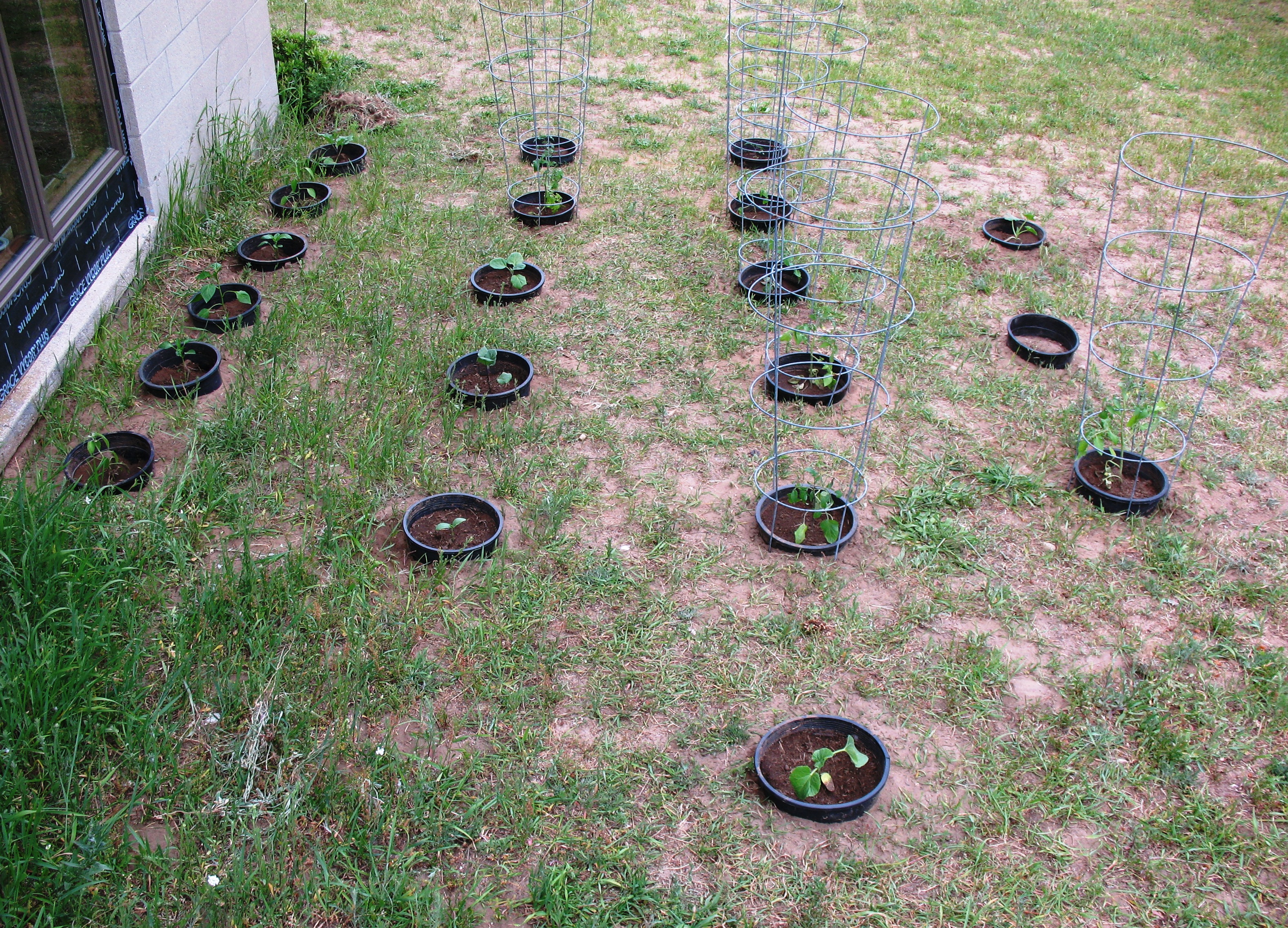
Now, a good gardener would have done things differently. A good gardener would have had the soil tested and would have amended accordingly. This year, I’m going to have to be a good-enough gardener. The plants went into their buckets in a flurry of enthusiasm, an unexpected last chance to see things growing, and enjoy them on my dinner plate through the season. What can I say; it’s a done deal.

I’ve heard that the soil here is alkaline. (And the water is hard.) I suppose you could say that this little bucket-garden is a test plot. We’ll just have to see how things go. I fully expect to test the soil on our property, next year, and amend accordingly. So far, we’ve been pretty lucky. We planted in a good spot, which I picked for the southern exposure. What I didn’t figure on was wind. Wow. Like Two Rock, this place has wind, and then some, to spare. (The wheels are turning and I’m thinking… a good spot for wind power.) My little southern exposure turned out to be perfect, because the house also offers the garden some shelter from the wind.

I’m not joking about the wind. It’s a beautiful day, so I hung out the laundry. It hangs horizontal. By the time I finished pinning up the first load, the first things up were already dry. Whipping in the breeze, even the towels dry soft and everything comes up lint free. There has to be another way to harness that energy for good.

Today was watering day for our little garden, too. In Two Rock I was able to satisfy watering by topping off the buckets, twice, once a week. In Two Rock, there was no rain during the growing season. But, there was more clay to the soil, and that helped to hold the moisture

Here, it is largely sand. Even with Michigan’s regular rainfall, I think I may have to water a little more frequently—especially with these winds. The plants, in the ground for about a week now, look healthy and have started to take off. Everything has sprouted a round of new leaves, and the peppers and tomatoes have started to flower. I was surprised at how little they suffered from transplant shock. I’m looking forward to the results of our experimental garden.

With today’s gardening finished, I decided to take advantage of the wind and do “extra” laundry. You know, the stuff you don’t usually do—the throw rugs and some blankets, even my winter coat and the winter’s down clothing. They’ll easily be dry by evening. I’m letting the wind do the rest of my day’s chores, and I’ll get the credit.

Garden Surprise

Michigan Meets the Bucket Garden

Another Bucket Garden

Another Bucket Garden

A.V. Walters–

I had resigned myself to not having a garden this year. There’s just too much going on. We have building to do—and that has to take the lead. In Empire, we had a late spring, and nowhere to start seeds. Now that we’ve moved, well, it’s a little late. Michigan has a shorter season—and, unlike Two Rock, it’s not forgiving on the harvest end. Besides, in a rural setting like this, a garden needs infrastructure. I don’t have time for infrastructure.

A garden, especially a vegetable garden, is an artificial environment. Its inhabitants have needs. In Michigan, they have some basic needs that exceed my Californian framework. Here, we have garden predators. And not just the usual gopher hazards (though we have those, which, like in Two Rock, we can solve with buckets.) Here, we have deer. Worse yet, the place is crawling with bunnies. That means we need a really tall fence (six feet or better) and it has to extend underground. Bunnies are not deterred unless you prevent them from burrowing under the fence. With their Bambi faces and cute eyes, these critters’ benign outward appearance hides a darker garden reality

Moreover, we don’t yet have water on the property. I’m no fool. I read French Dirt. Never plant a garden until you have a sure water supply. Our well is not yet in. No well, no water. No water, no garden. It’s as simple as that

Still, Monday I ran into town and stopped at my favorite grocer, Oryana (a local co-op). I was doomed, even before I stepped inside. There, at the entrance, were racks and racks of organic vegie starts. At good prices, too! Some of them even knew my name! I have no discipline—I quickly snagged a bunch and headed home. On the way I rationalized my decision. I could plant them just outside the window of our little, basement apartment. After all, my planting buckets are sitting idle. The landlady’s dogs, though pests in many other ways, allegedly keep the yard clear of deer and bunnies. (We’ll see.) Surely the landlady would enjoy fresh produce through the summer, too.

It won’t be a big garden—only twenty buckets. Eight tomatoes, five peppers (can’t find decent hot peppers in Michigan), an eggplant assortment, cucumbers, zucchini, crookneck, and a cantaloupe. We’ll skip the leafy things—I just picked through what was left at Oryana’s. It’s just a tad late in the season, but I’m happy to have something to grow.

I was sheepish on my arrival home. After all, we’d had the garden discussion. Rick knew something was up immediately. He laughed when I admitted to my impulse purchase. But, of course, he helped me dig-in the buckets.

Marshmallows or Popcorn

A.V. Walters–

marshpop

Surprisingly, it turns out that Rick is making the California to Michigan transition better than I am. I still have a foot in each world. I’m still on political and activist email lists for California and Sonoma County. I still check the weather for Two Rock.

I have an off-beat sense of humor. Sometimes it gets me into trouble. Sometimes it reveals an underlying sense of order that is just a little out-of-step with the “regular” world.

This was never more clear than, a decade or so ago, when I received a telephone call from my sister, whose home had just burned to the ground. (“Defective dryer wiring.”) She was near hysterical.

“It’s gone, everything…(sobbing)…”

“Everybody get out okay?”

“Yeah, we weren’t home—Bill was at the neighbors, when they saw the smoke…”

“Pets out, too?”

“Yeah.”

“What’s left… like, how high are the walls?

She broke down again, “Nothing. Nothing’s more than waist high. Just smoldering embers. (Sobbing) What am I going to do?”

Here, perhaps I should have paused to think. But I didn’t.

“I dunno. Got any marshmallows?”

Needless to say, it wasn’t well received.

From this, I’ve developed my theory of Marshmallows or Popcorn. It seems to me that any disaster has radiating circles of impact. If it’s your disaster, it’s Marshmallows. You are close enough to feel the heat; you’re the one feeling the loss. Someone else’s is Popcorn—you’re role is, essentially, an observer. It seems we humans make a spectator sport of disasters. Rick calls it the Rubbernecking Rule—you know, how you just can’t help but slow down and look at an accident. You read an obituary—and check the age. You hear that someone has cancer and the first thing you ask is, “Did he smoke?” It’s a way to handle loss that isn’t yours. Intellectualize. Engage from a safe distance. The psyche wants to understand and, at the same time, dissociate from the loss. That’s Popcorn. The news cycle essentially feeds on our addiction to Popcorn.

I read that there are very strong indications of an intense El Nino cycle, brewing in the Pacific. Ocean temperatures are significantly elevated. In any normal cycle, this could lead to drought conditions in California. Right now, though, California has already seen a number of abnormally dry years. Rick and I were discussing it, the double whammy of ocean warming and El Nino, and whether that fell into an underlying climate-change warming pattern.

Generally they report California’s water status in terms of snow-pack and reservoir levels. We know, though, that that doesn’t tell the whole story. It’s a short-sighted measurement that doesn’t reflect the impact on the environment, or what happens in rural areas, where folks and farmers rely on well-water. For them, annual rainfall is critical to recharge the aquifers. I thought about our lives in Two Rock and our life and friends back on the farm.

“What will we do with yet another year of drought?”

Rick looked over at me, “What do you mean, we?” He grinned. “I live in Michigan.”

So, we do the math: Time + Distance = Popcorn.


Who, us?

Who, us?


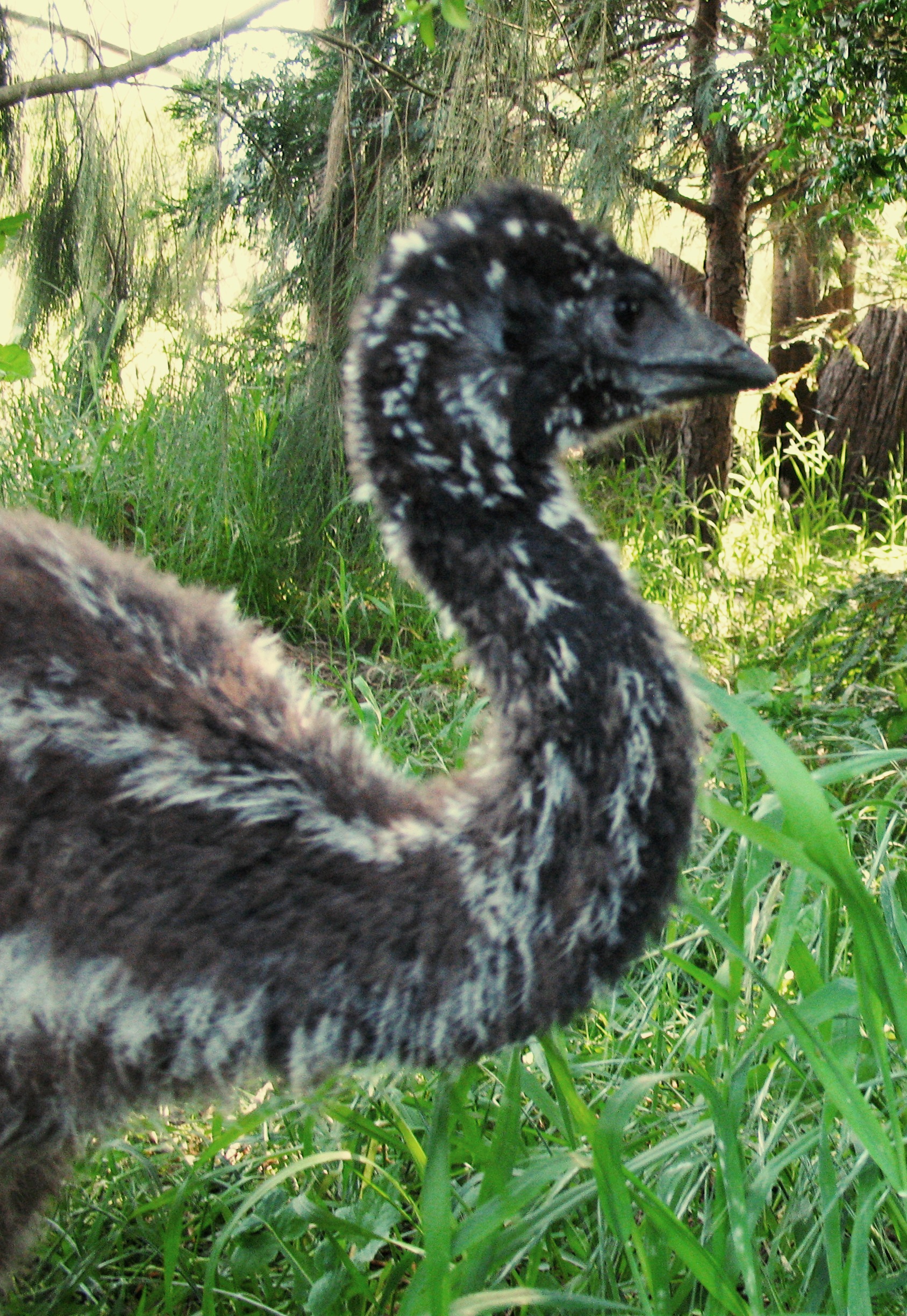
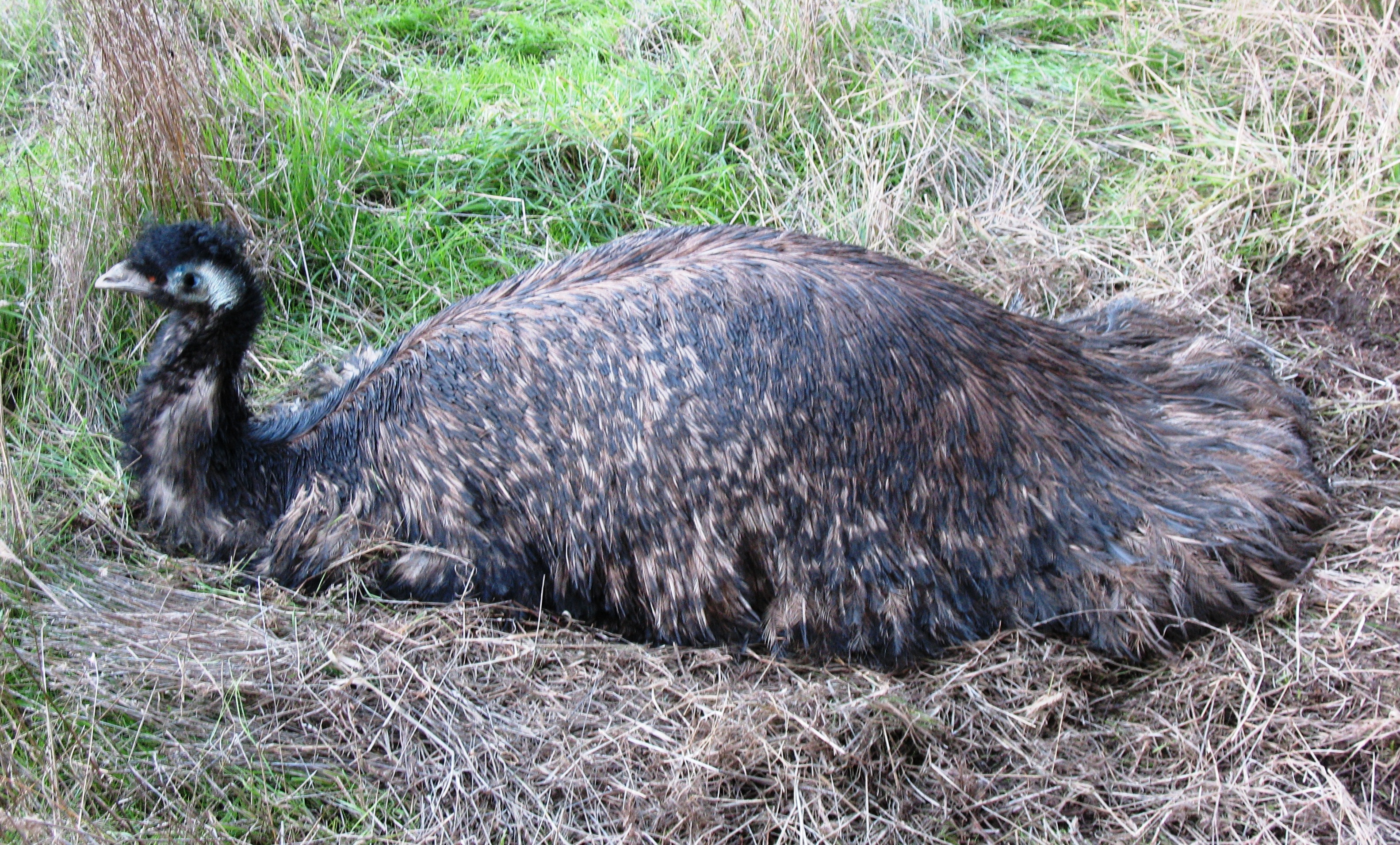
Emu Wet

For this post, I’m going to quote Deb’s last emu update, verbatim. Thanks to Deb for sharing the emu experience.

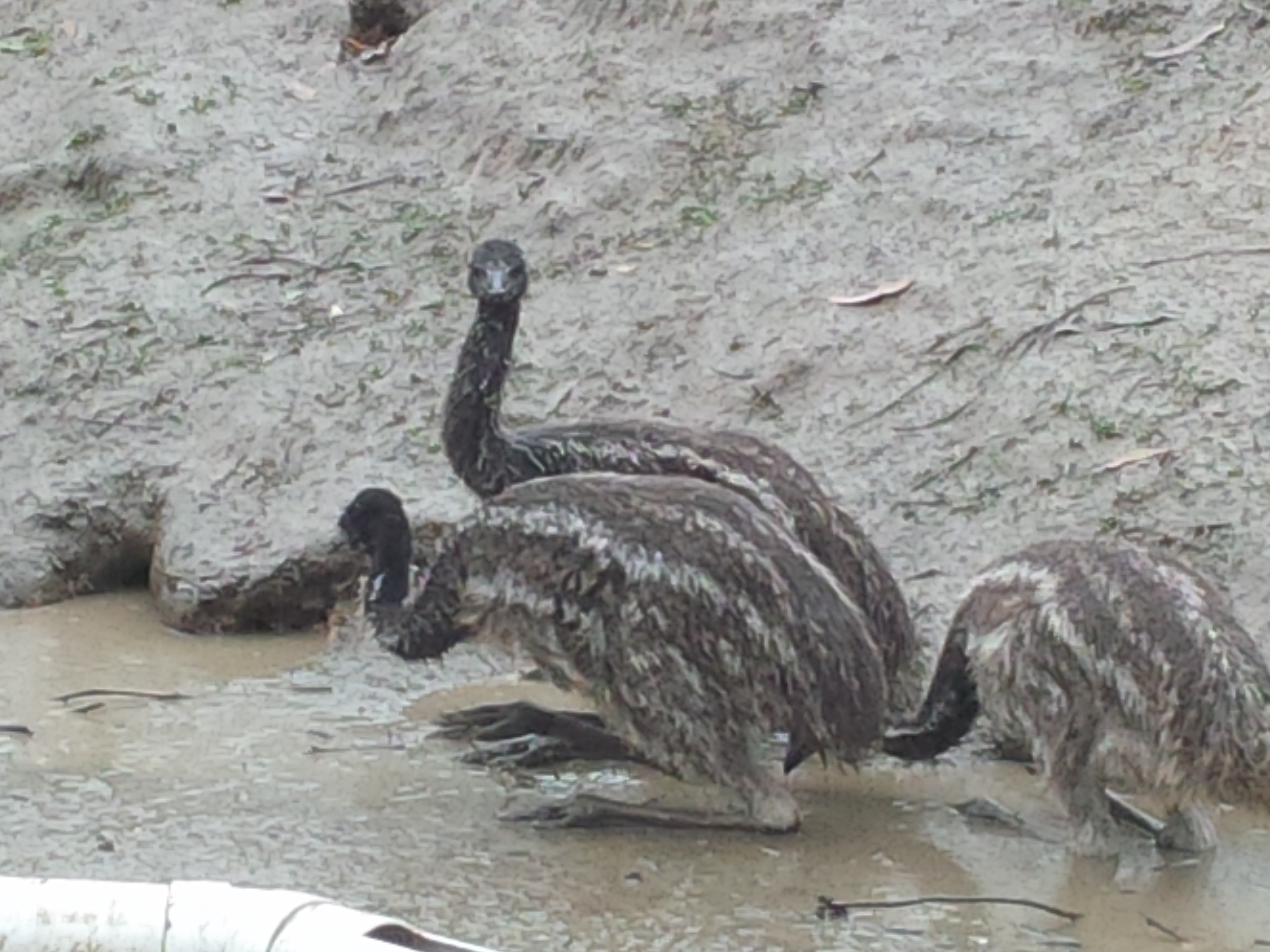
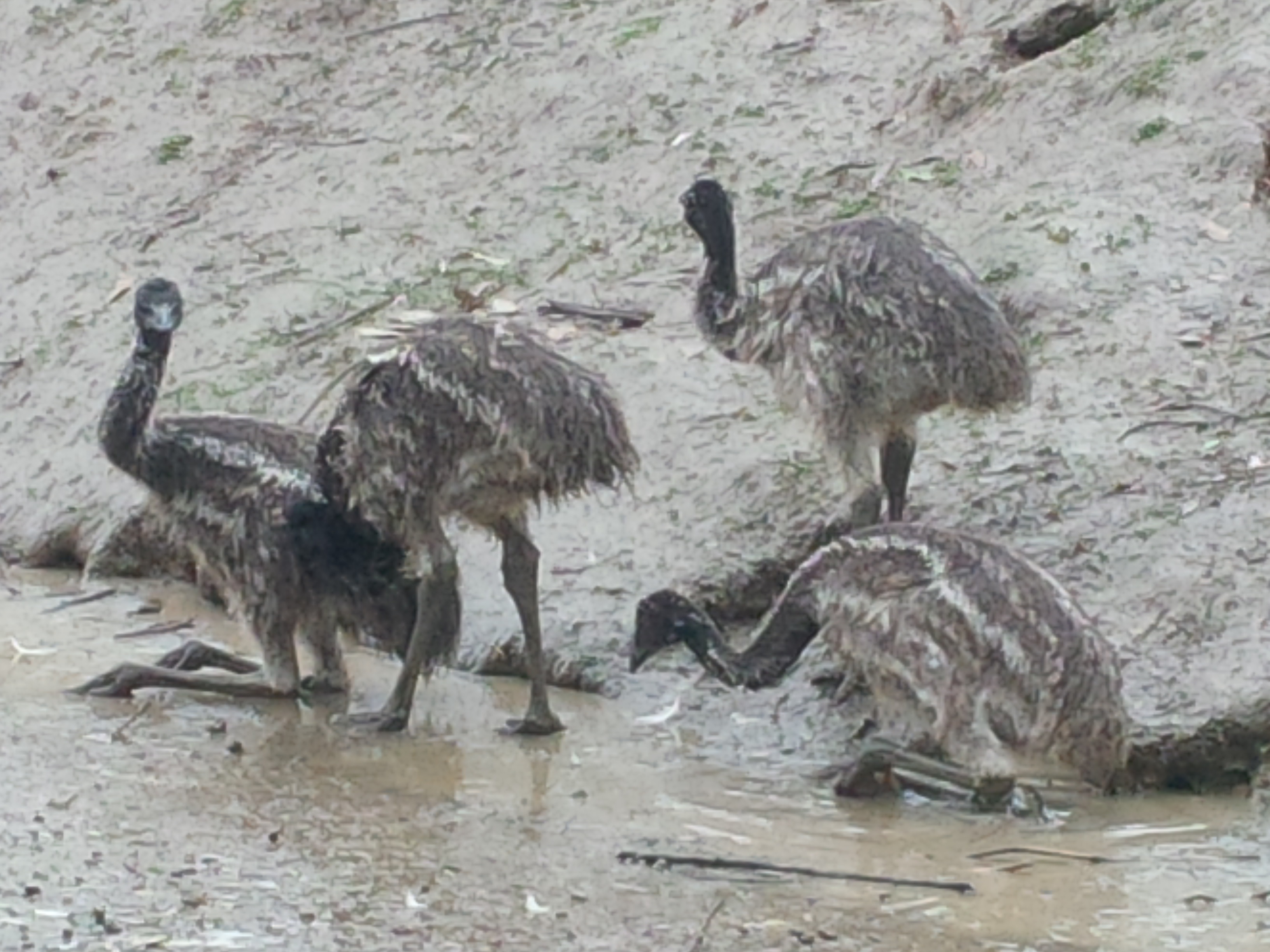
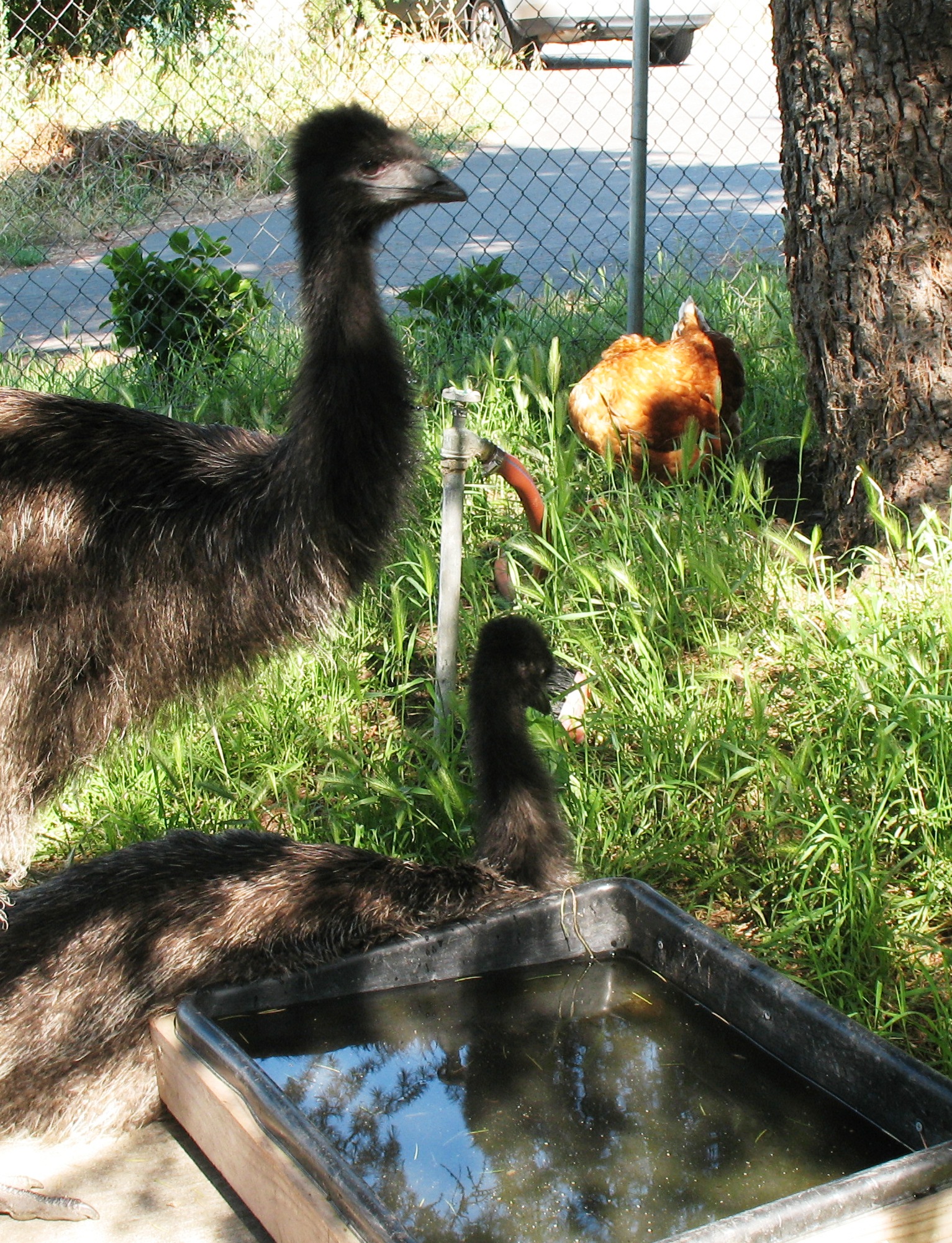
“Don’t they just match in with the land of mud. And they are loving the water puddles, but dancing and running crazy when it started to rain on them.

Funny fellers indeed.


They do love water.

They do love water.

Enjoy the Day!”

IMG_00000882

As my grandmother used to say, “Nice weather for ducks.”


Meanwhile, Back in California…

A.V. Walters —

This, we miss.

This, we miss.

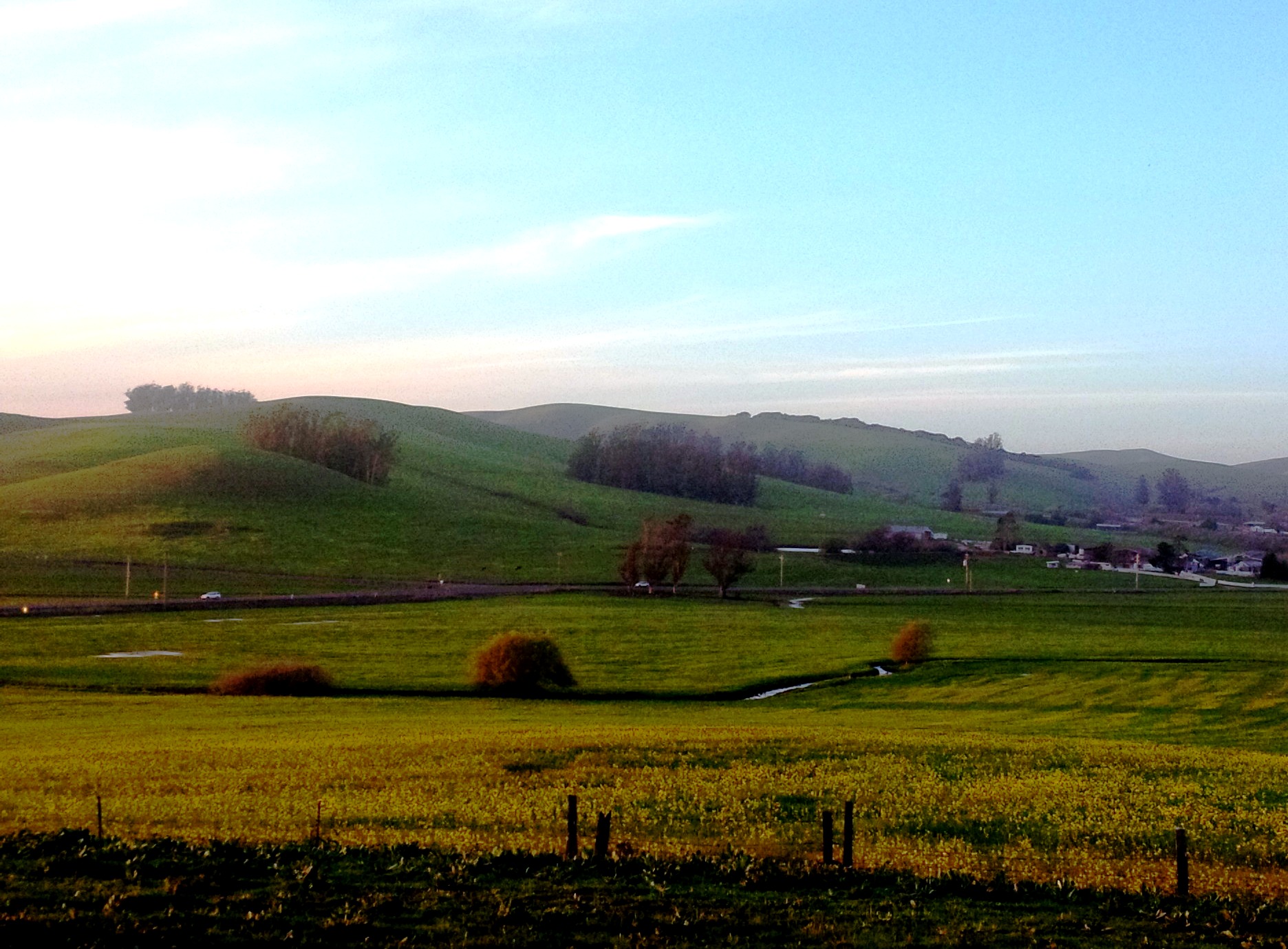
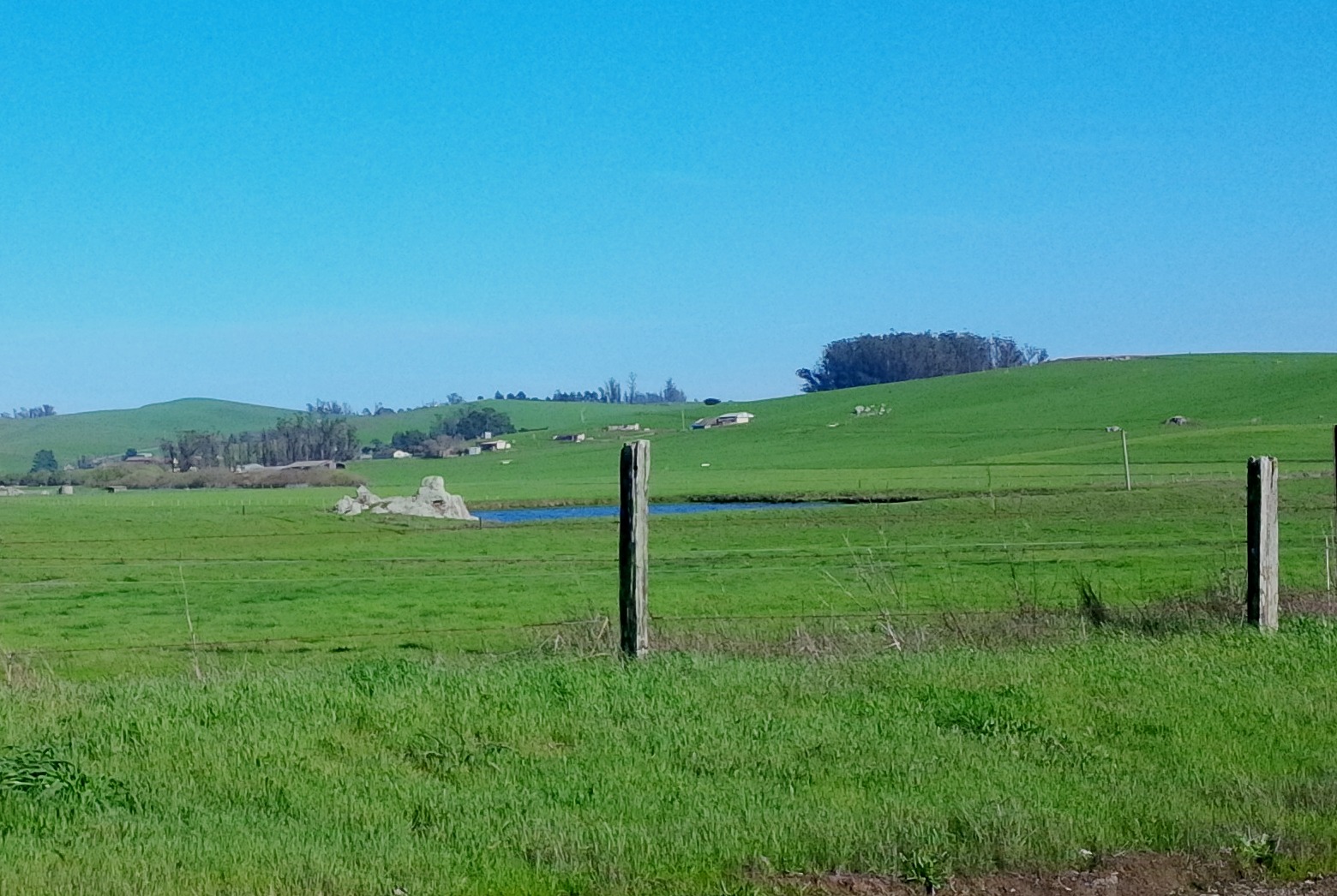
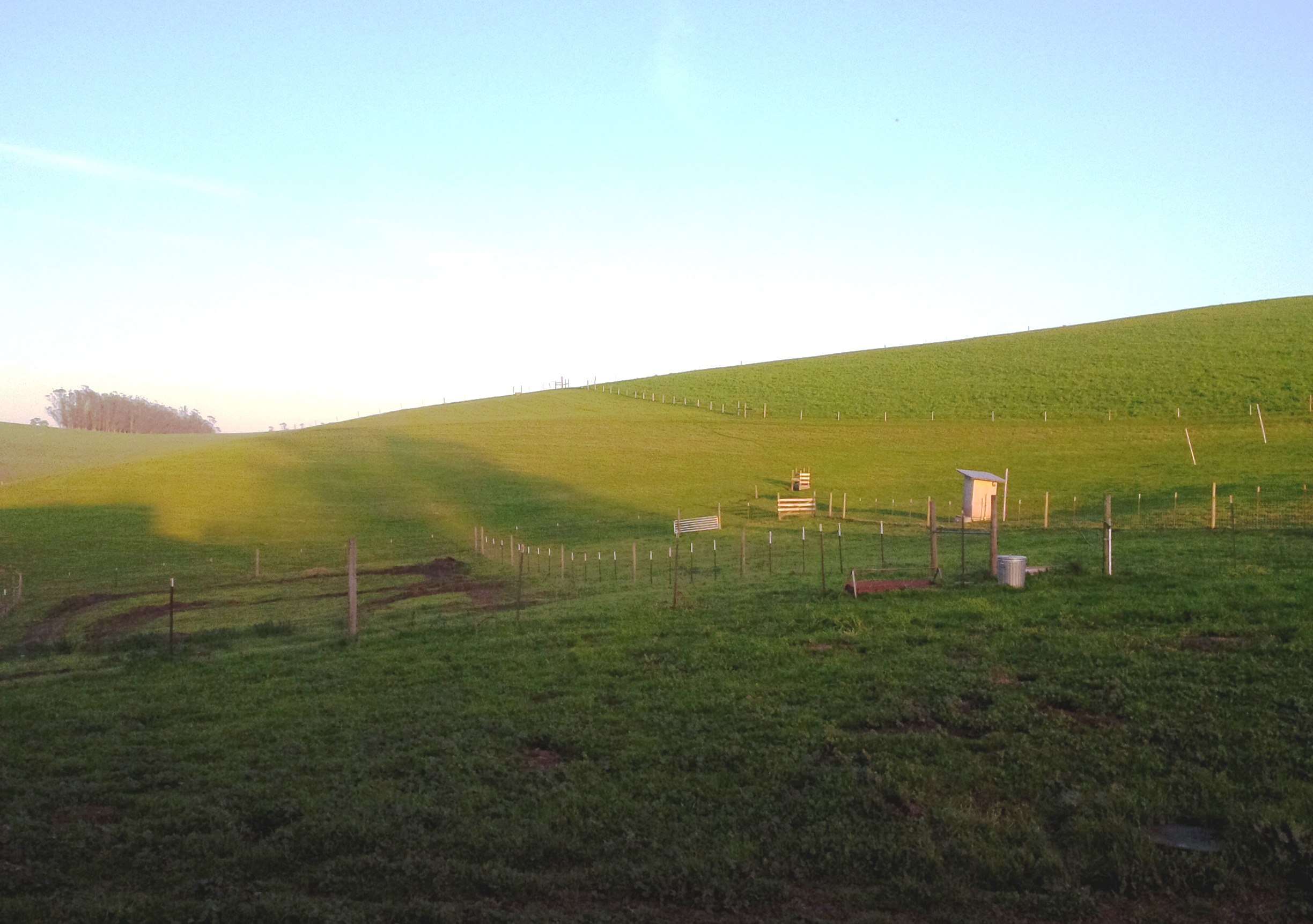
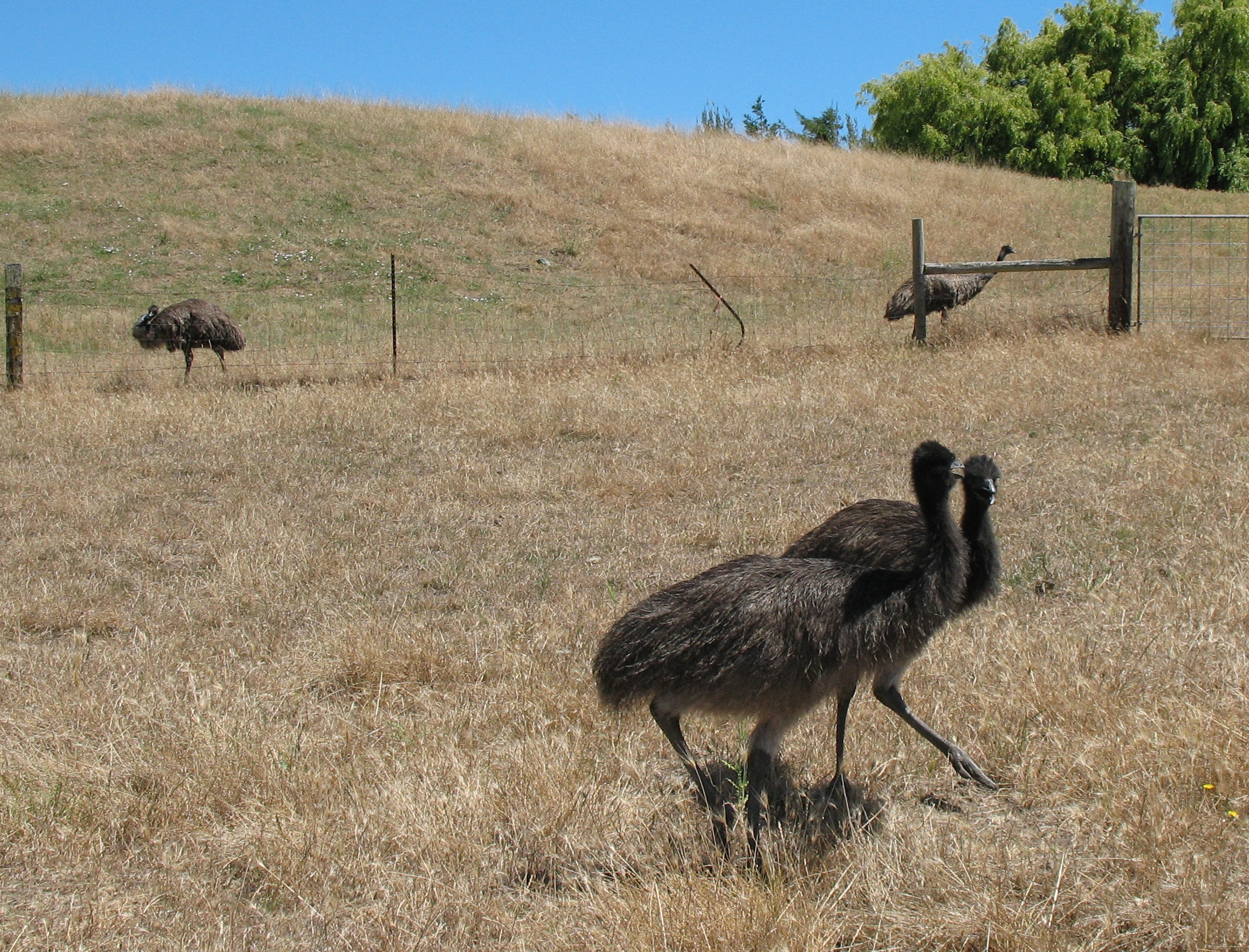
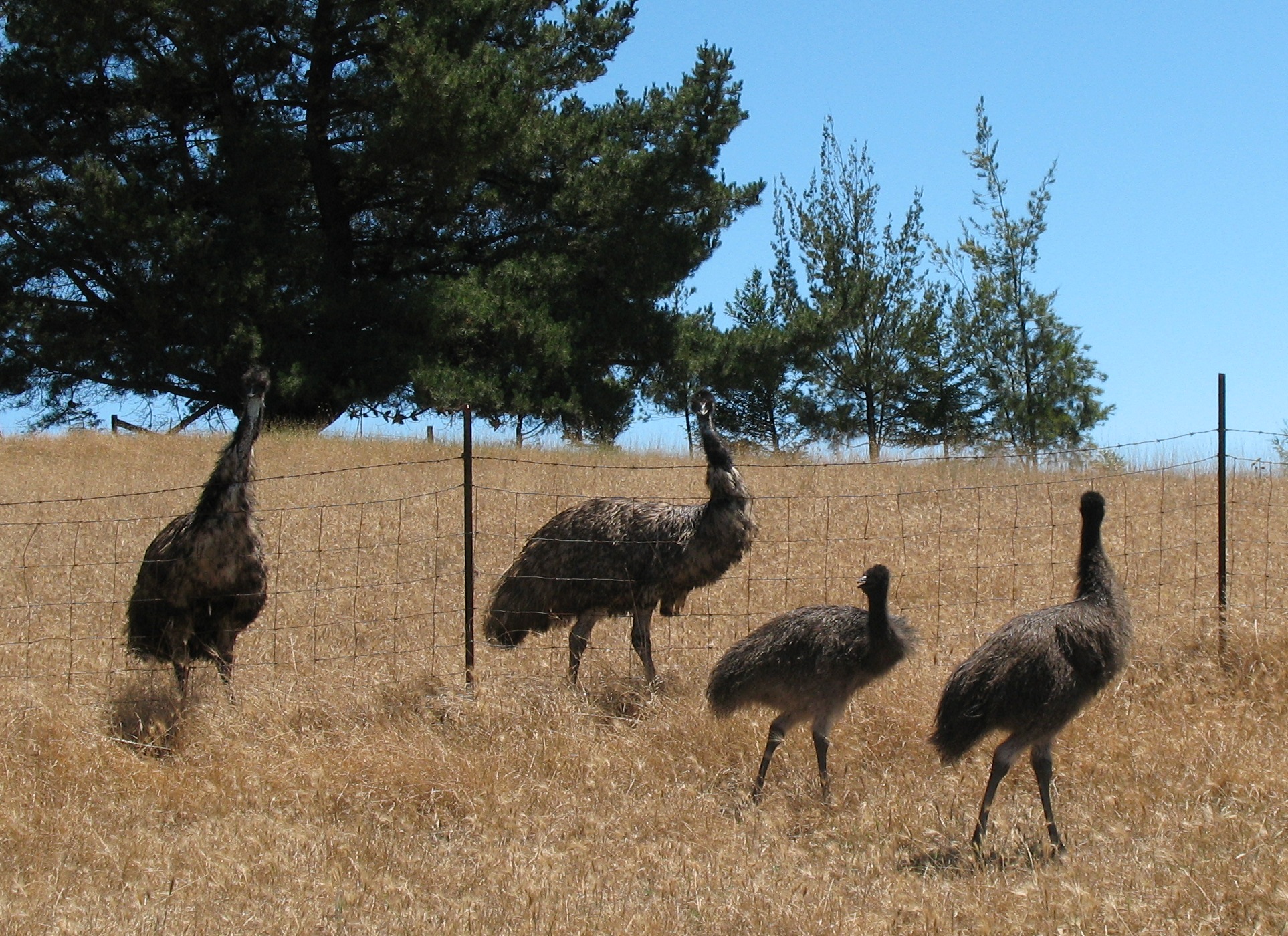
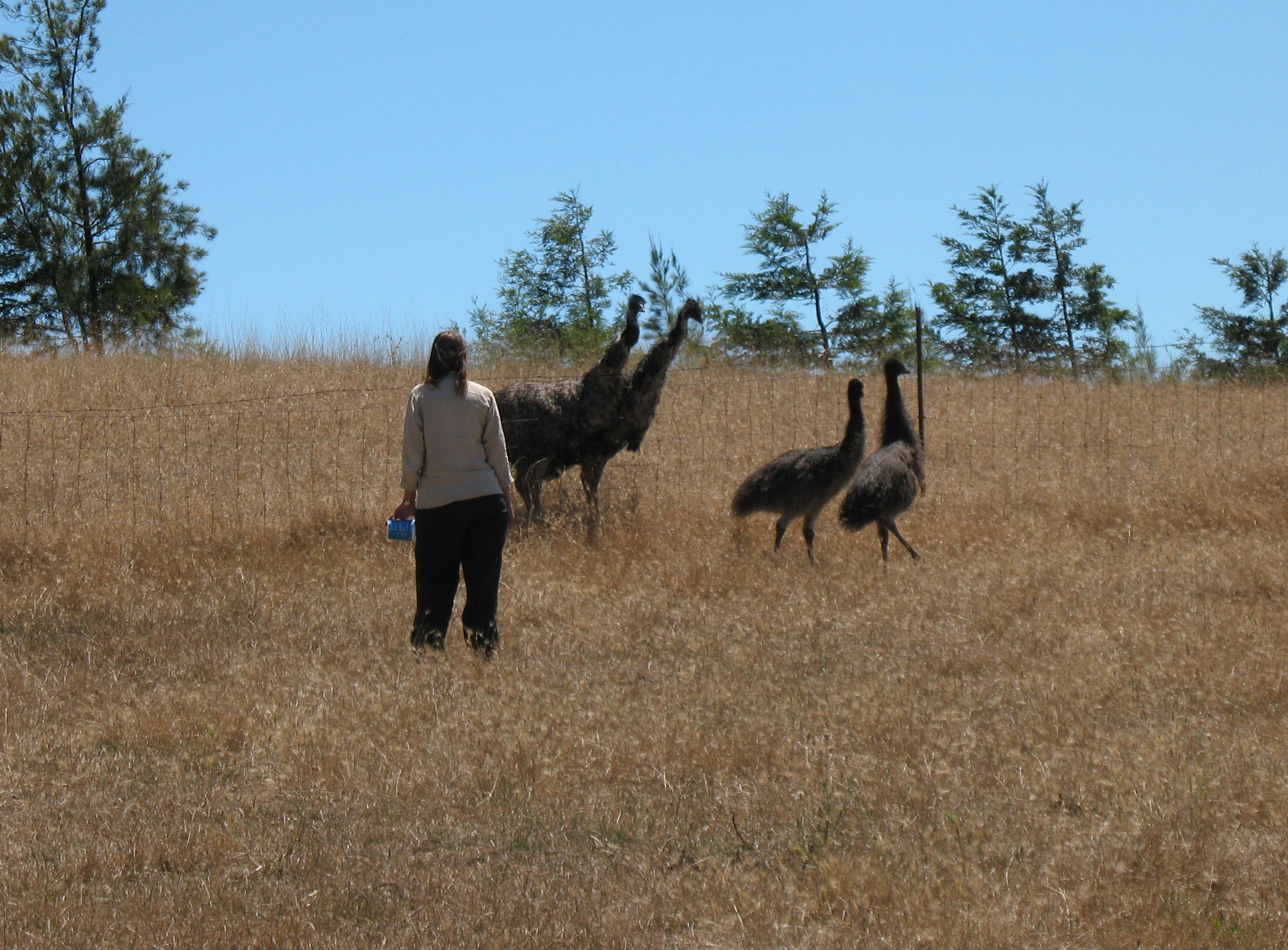
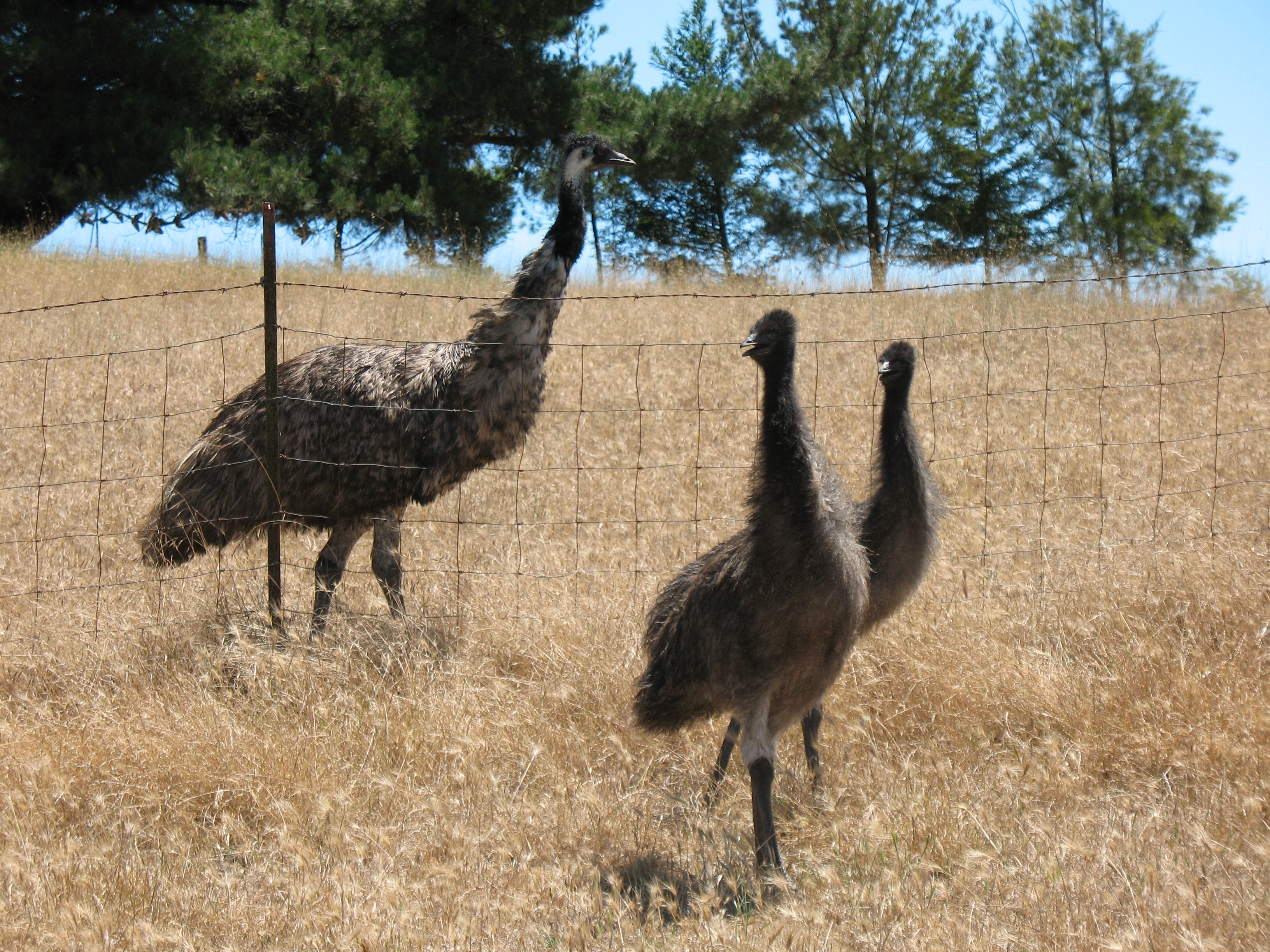
In California, they’ve had the warmest winter on record and the third driest. My California friends have raved about the weather (even while admitting that the drought is a problem. But hey, if you’re going to have a weather calamity, you might as well enjoy it!) Knowing I’m a gardener, they’ve sent photos of Spring, to tempt me from here, under my blanket of snow. Late rains finally brought the green back into the hills of Two Rock, and that’s good for—emus!

Green Hills for Grazing

Green Hills for Grazing

Emu Views

Emu Views

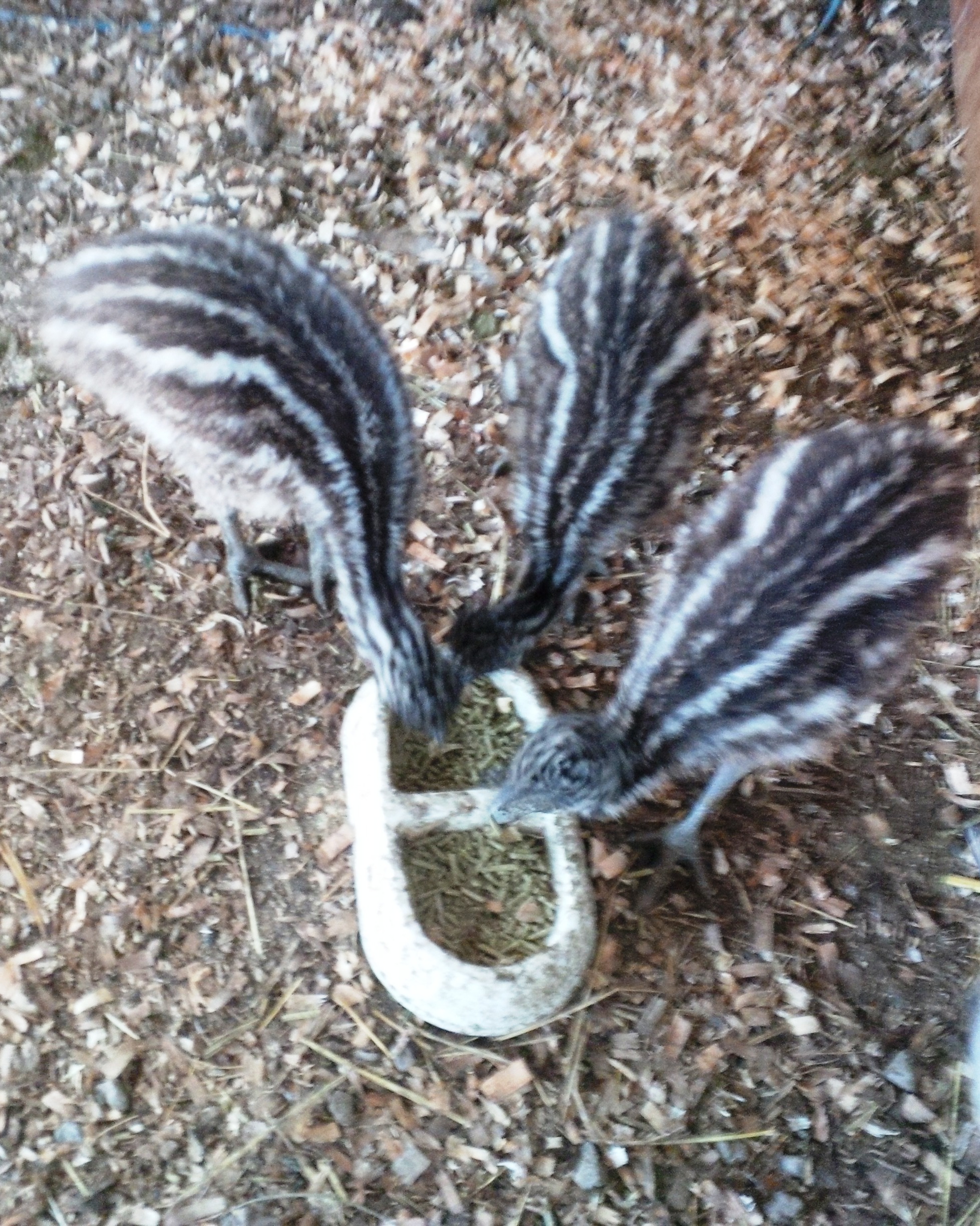
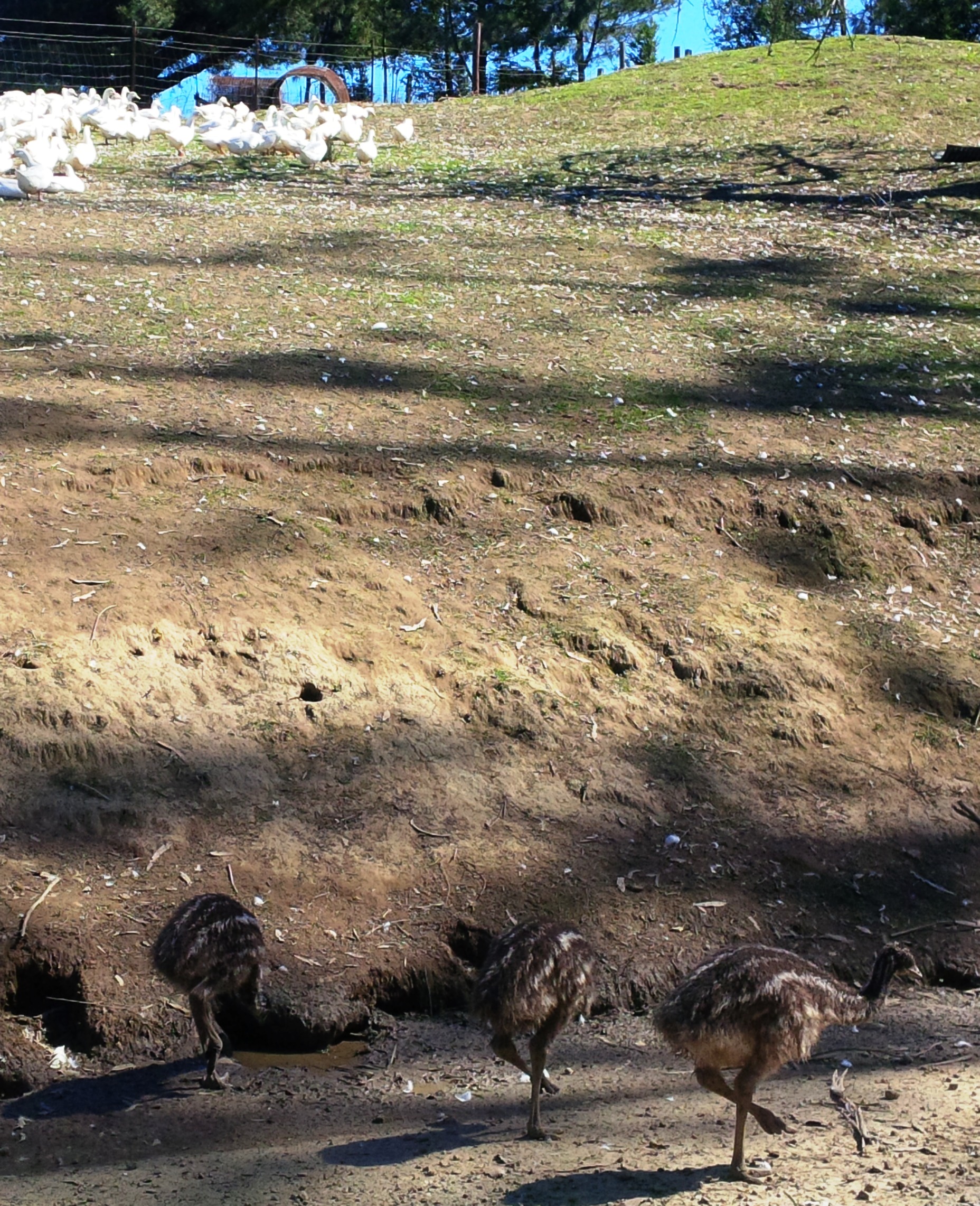
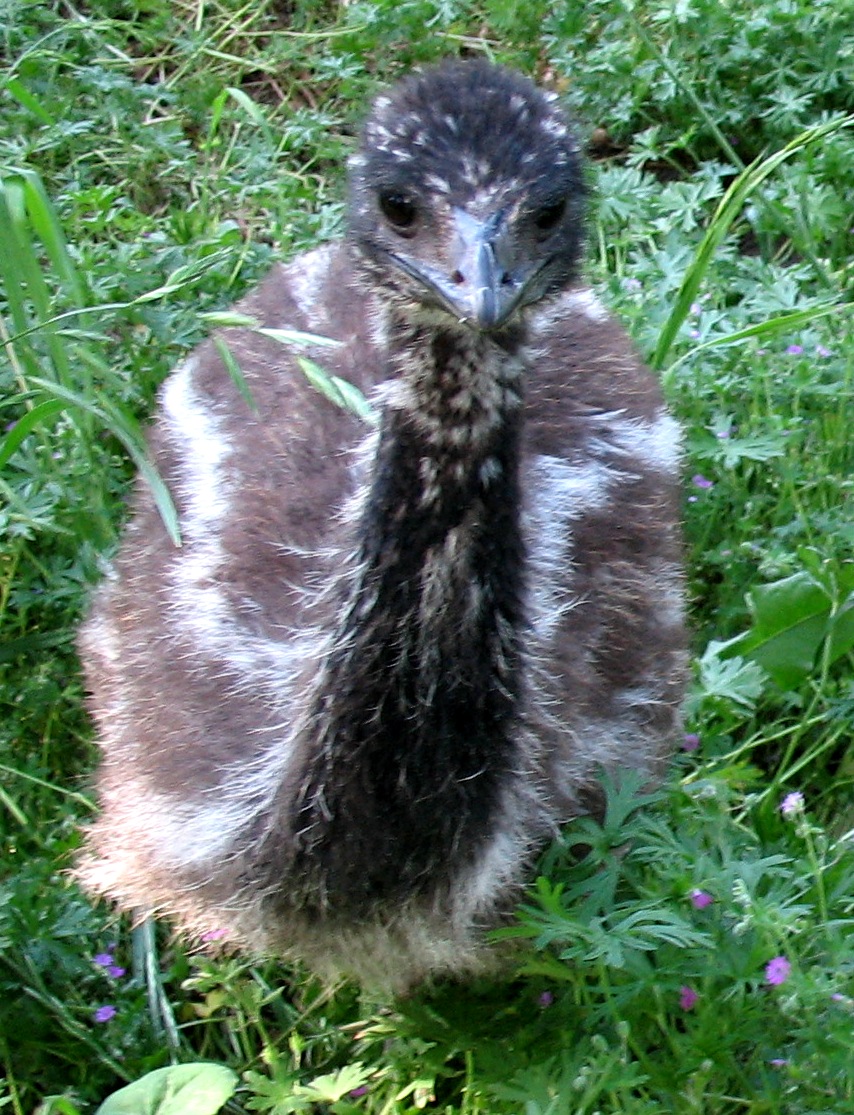
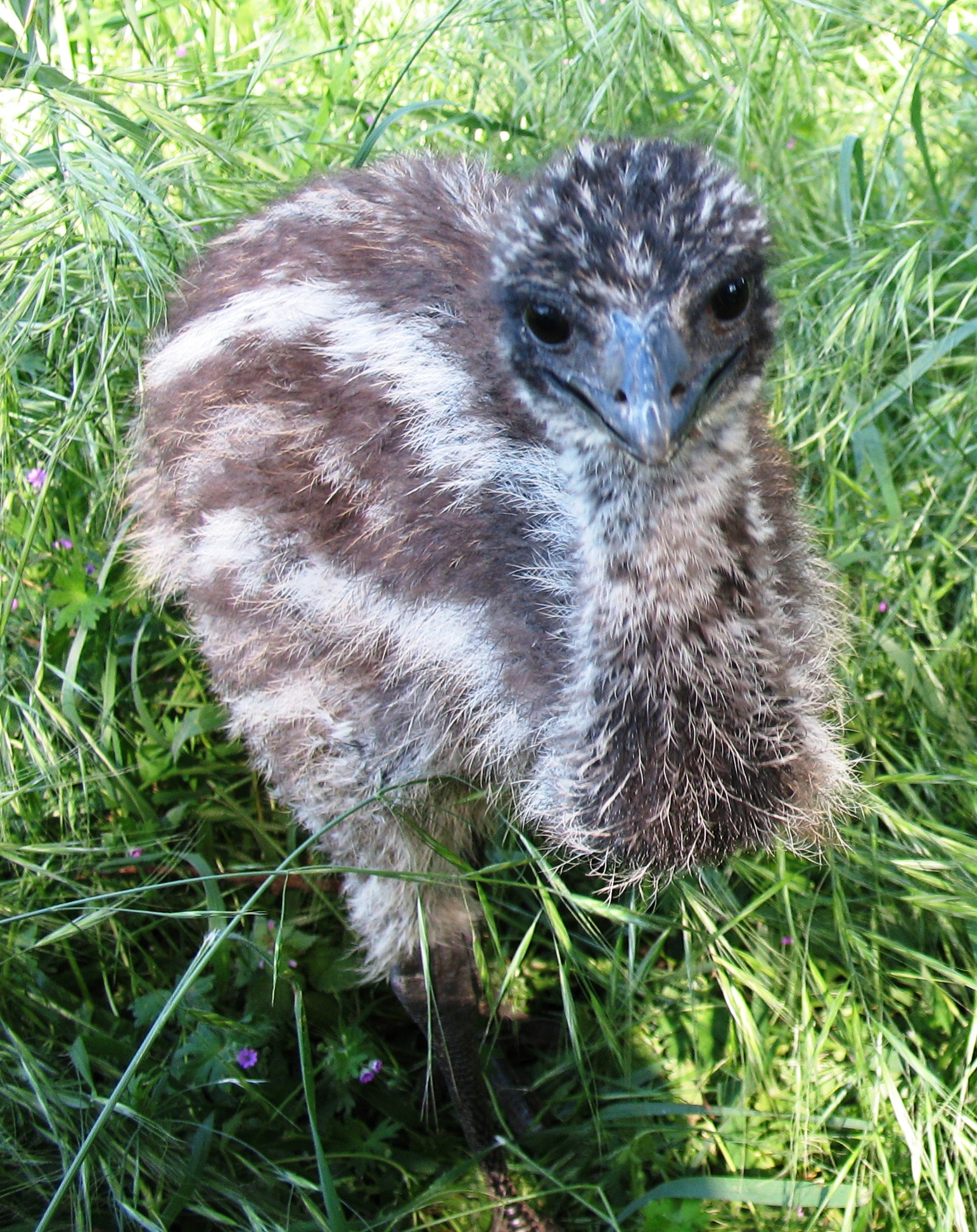
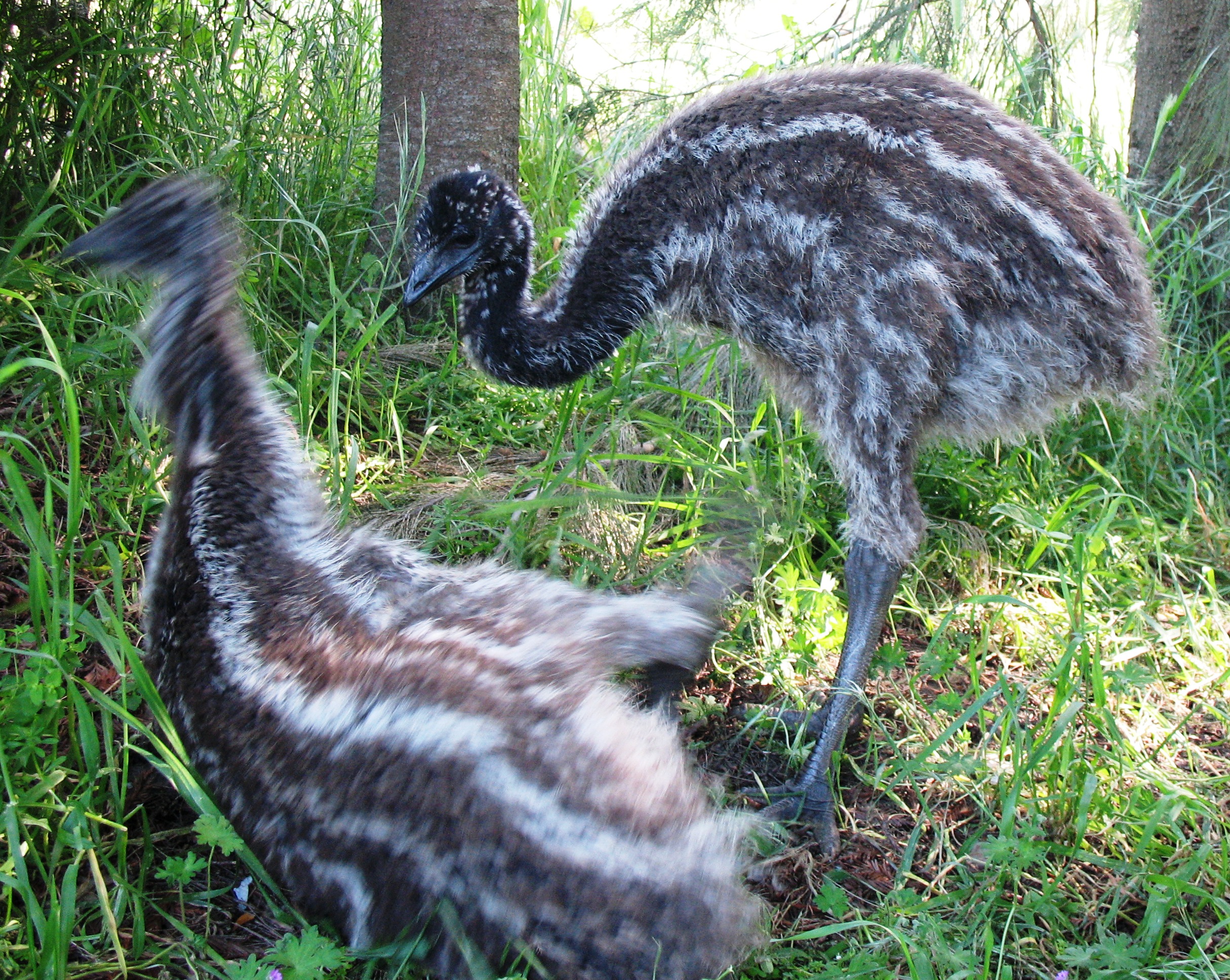
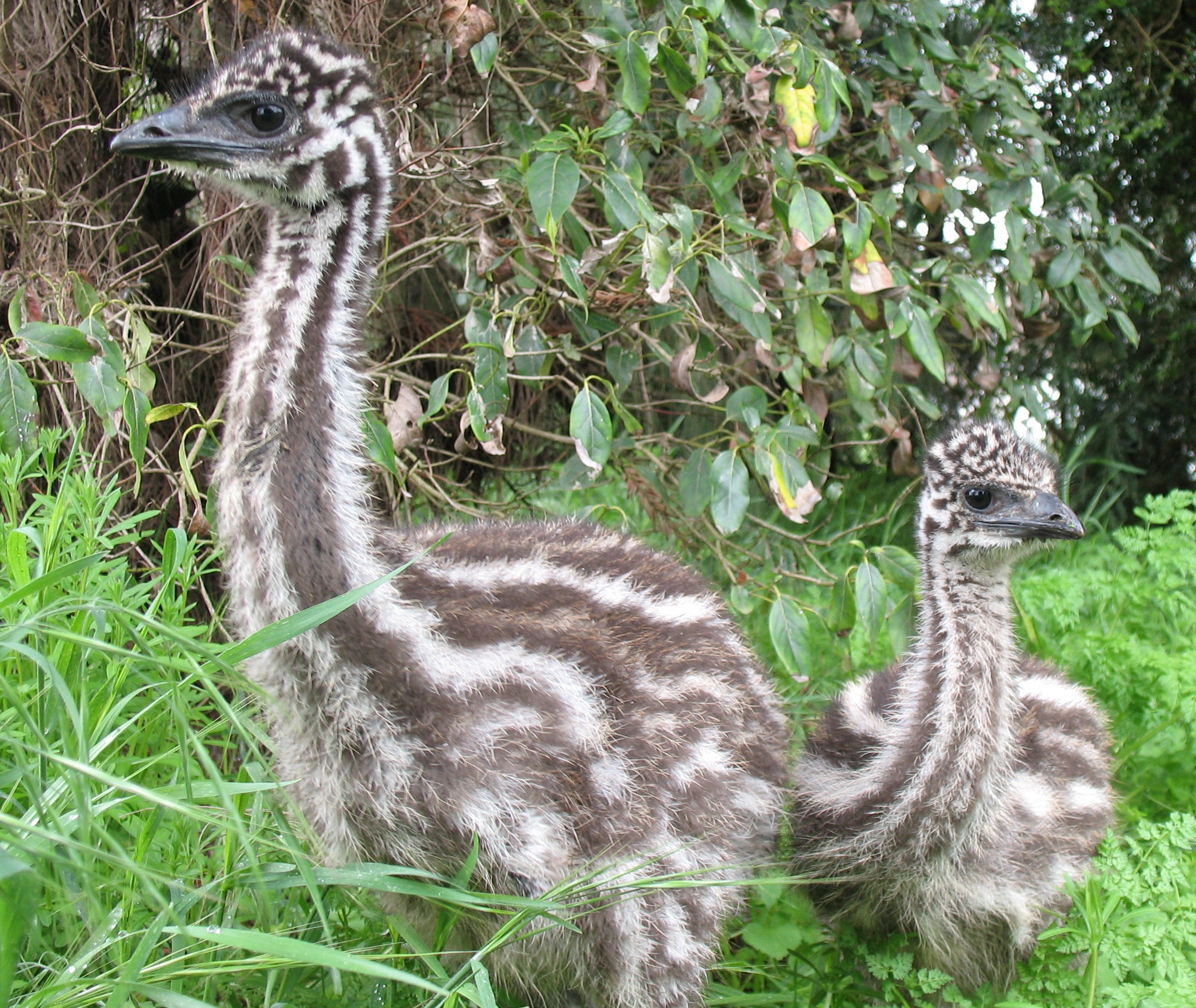
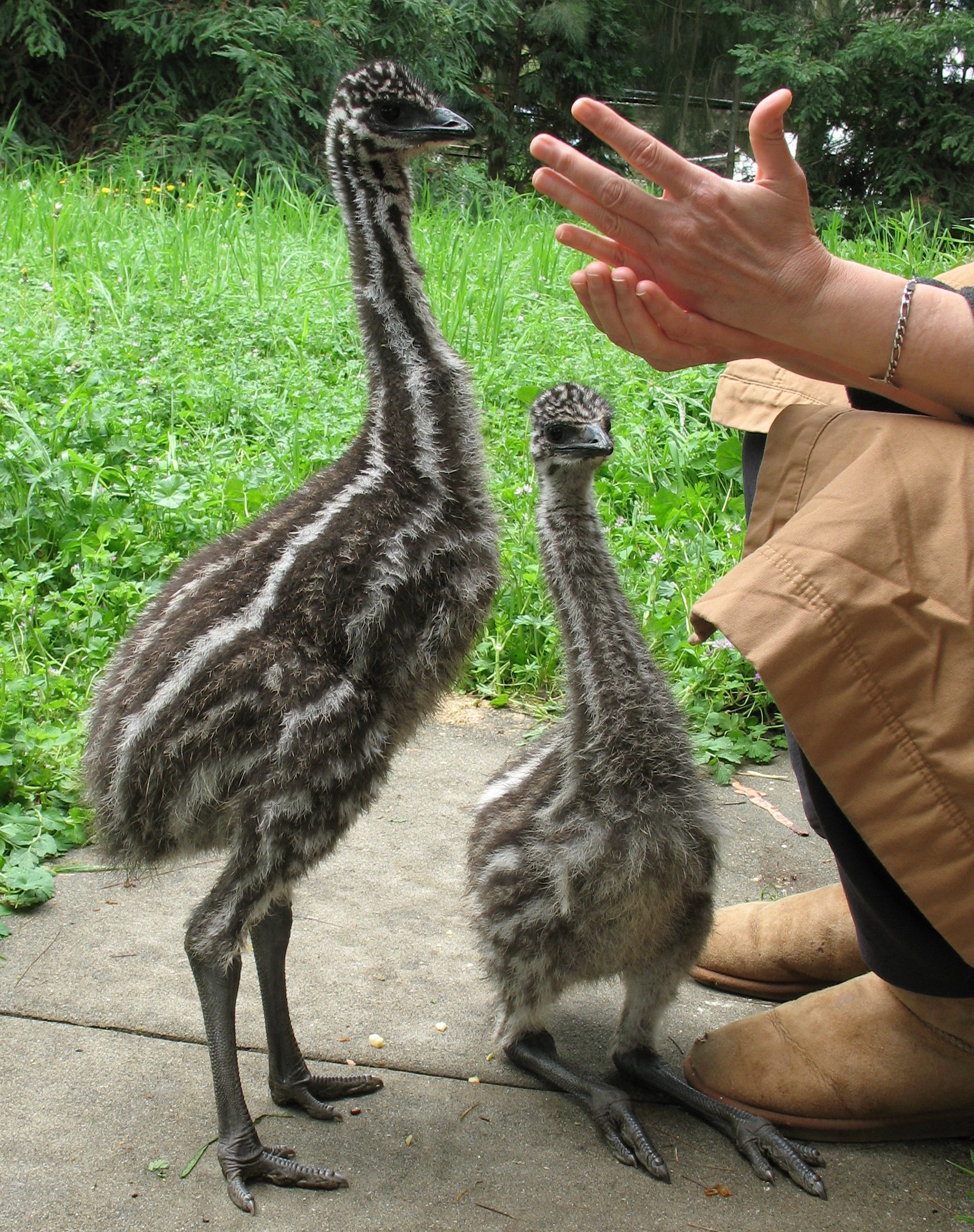
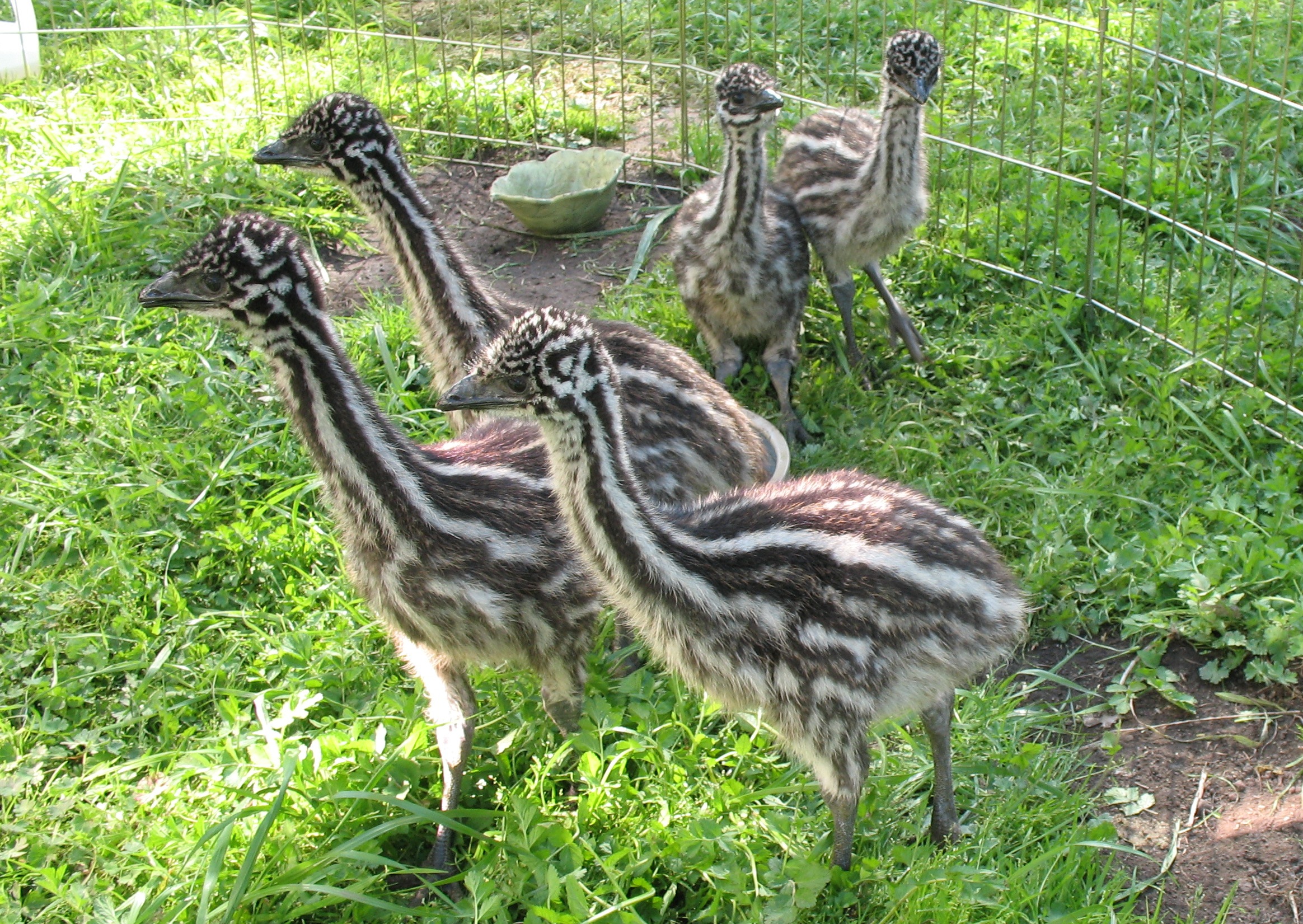
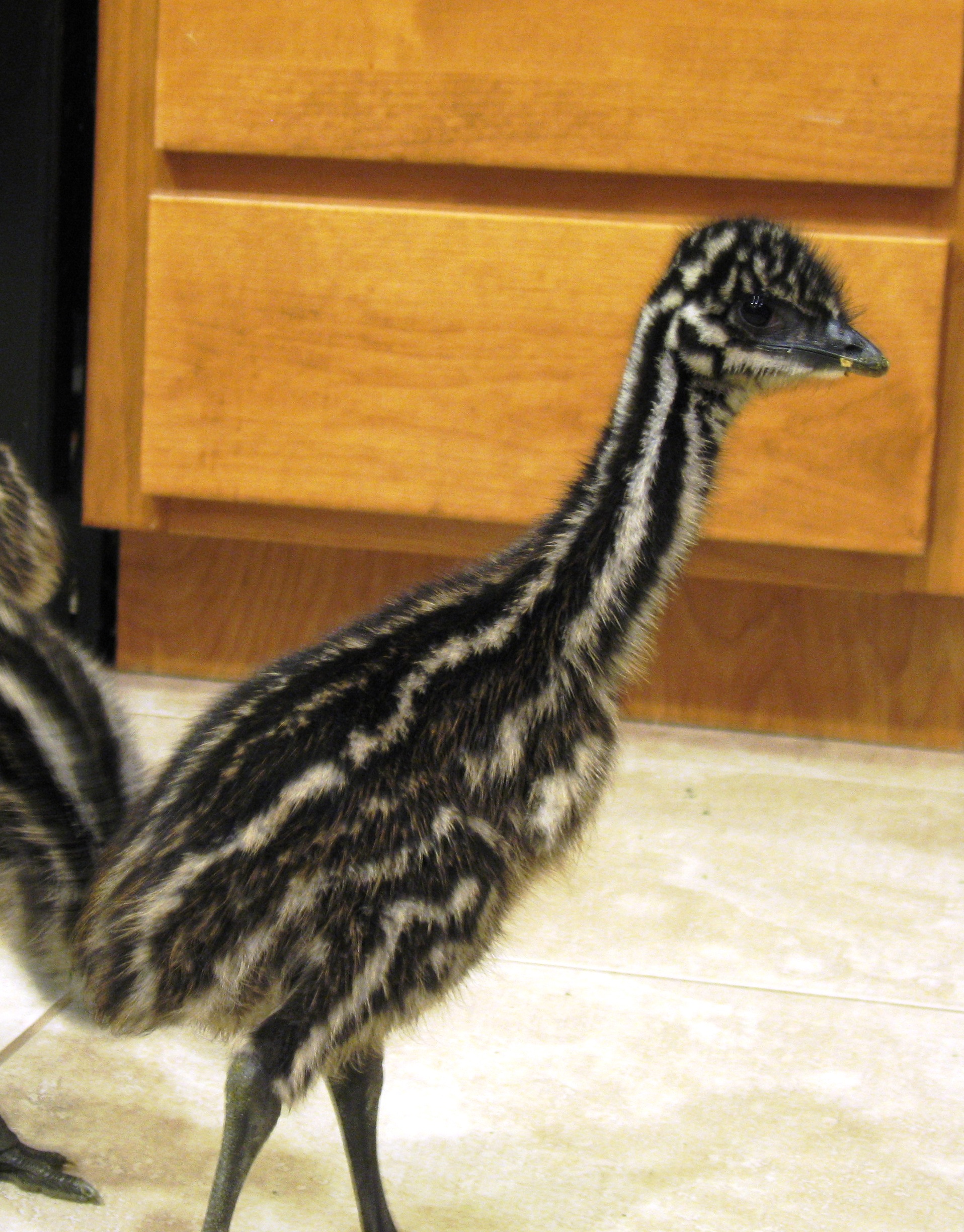
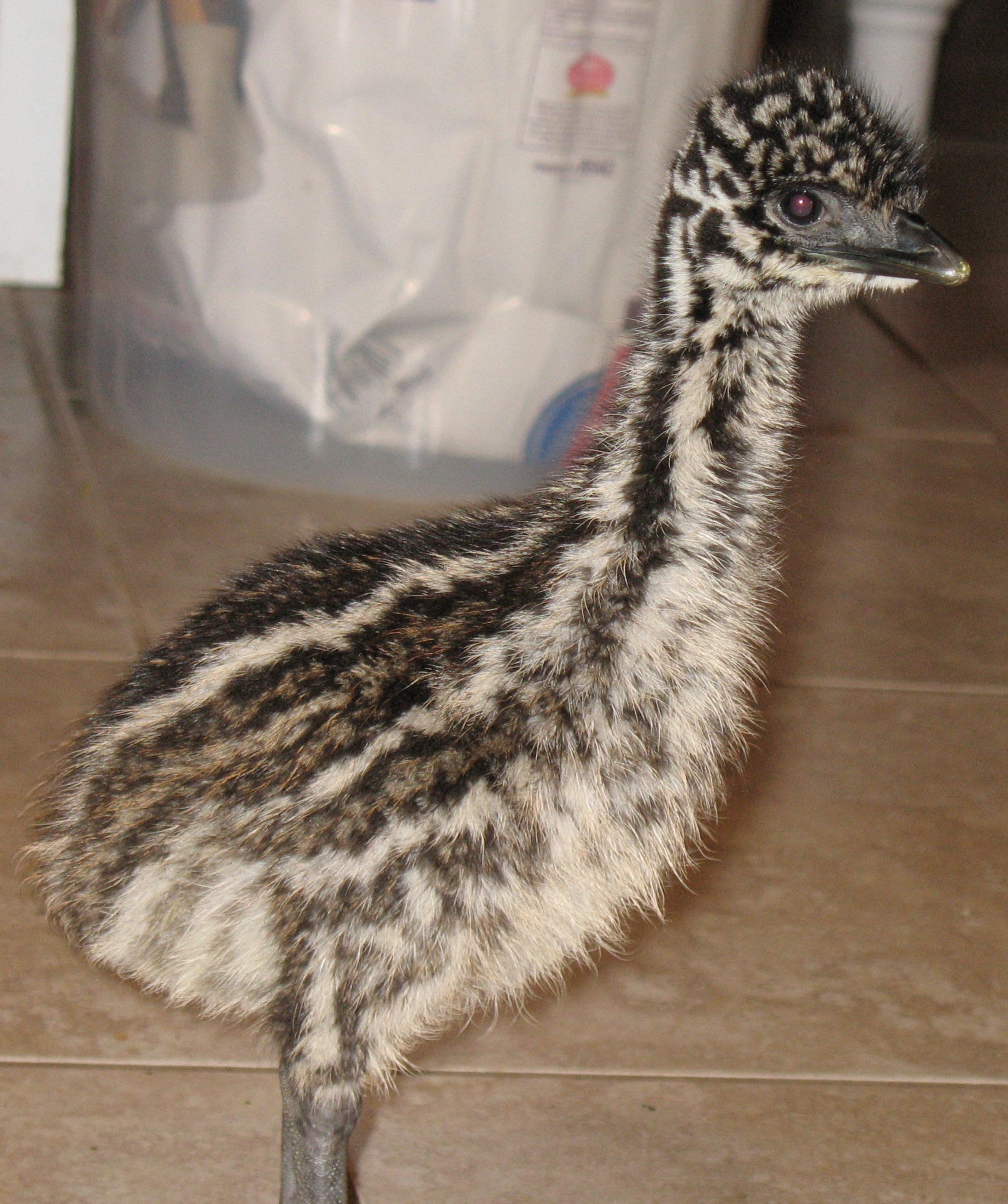
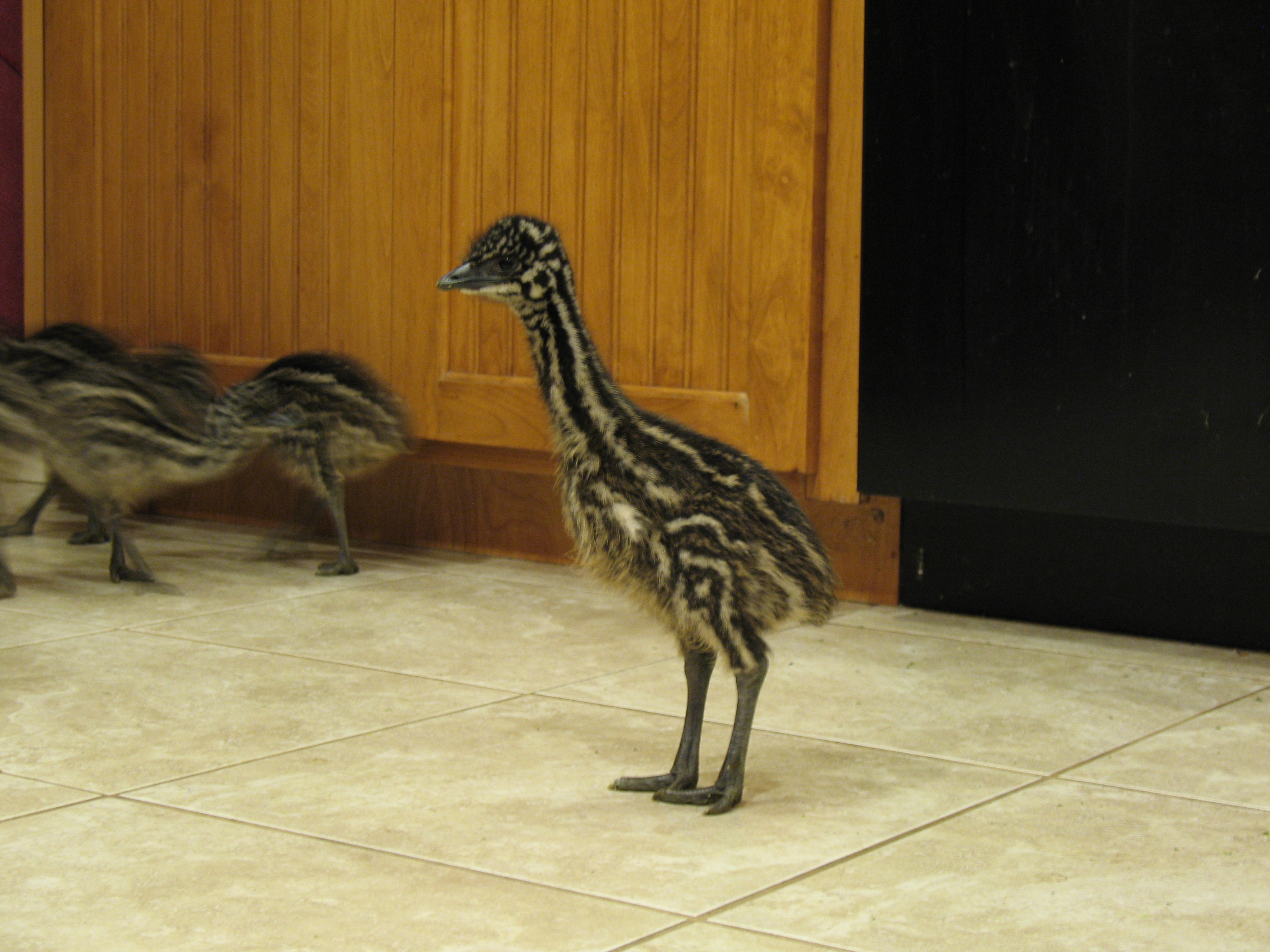
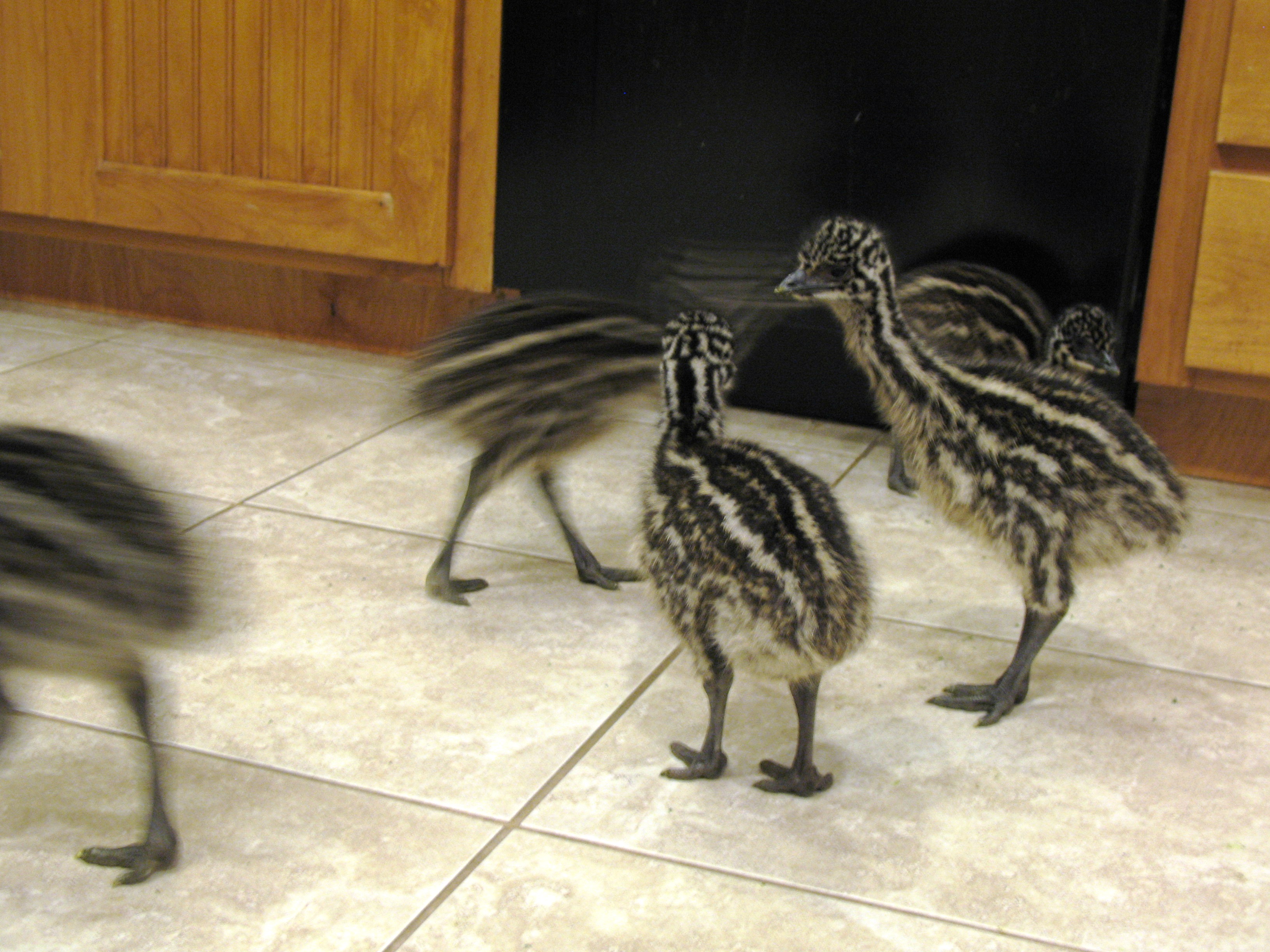
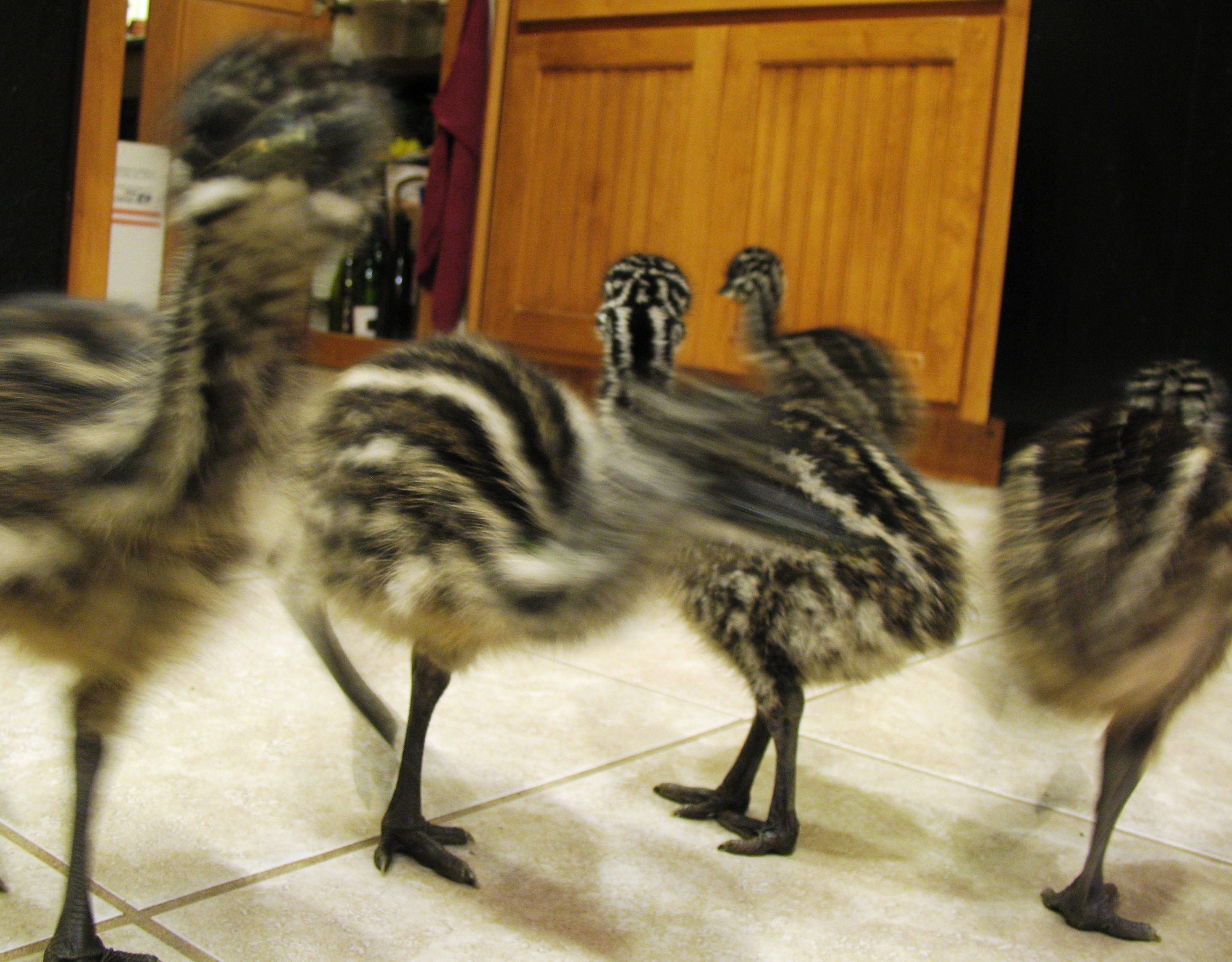
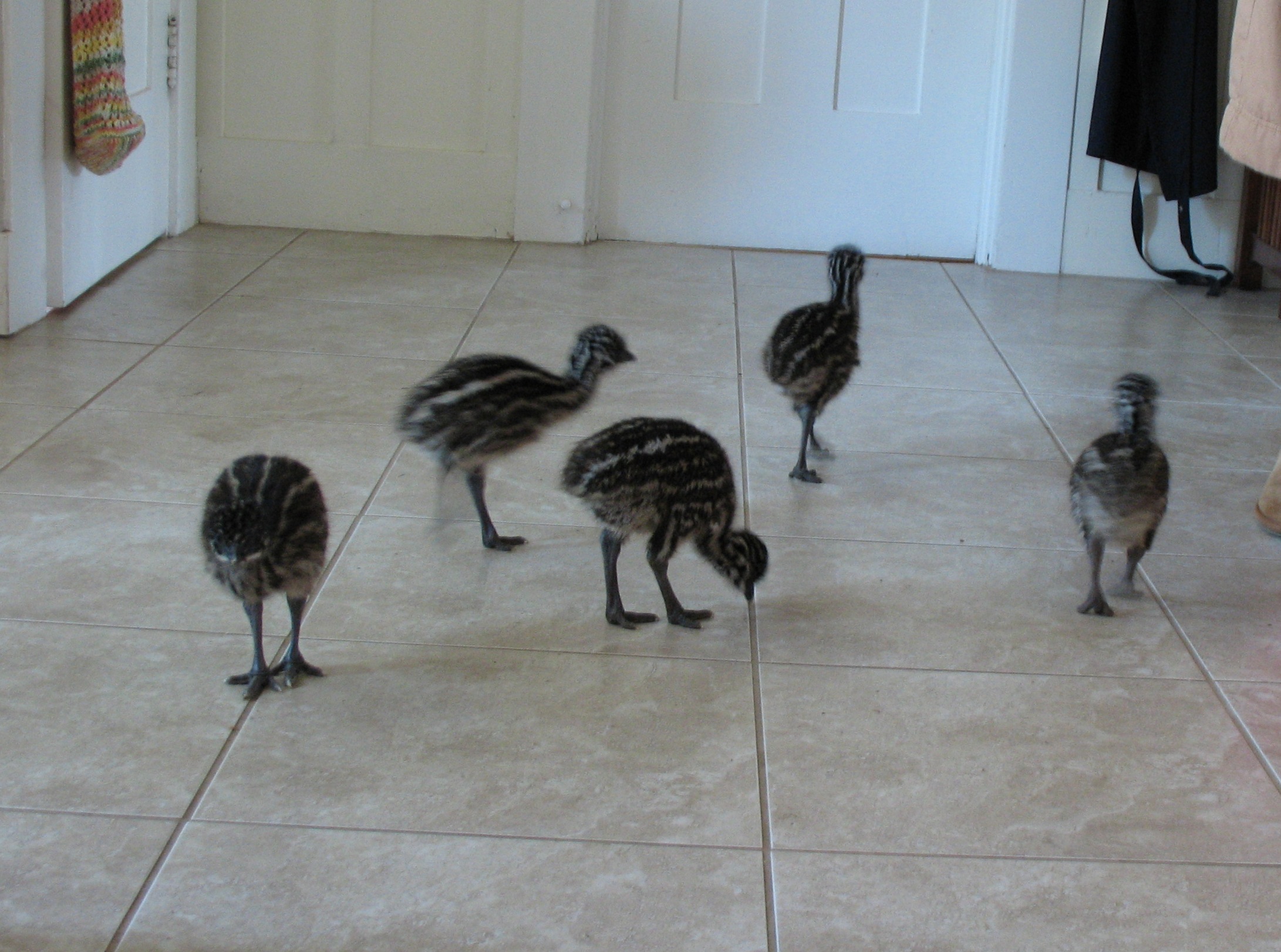
Yes, Emus! Back on the farm, Elmer’s daughter is raising four emu chicks. She wants them to be guards for her organic duck operation. The emus we reared last year are a little skittish around the ducks—and there were some duck injuries when raucous ducks agitated their delicate emu sensibilities. Ducks were stepped on. The solution is emus who have been raised with ducks. So that’s what Deb is doing.

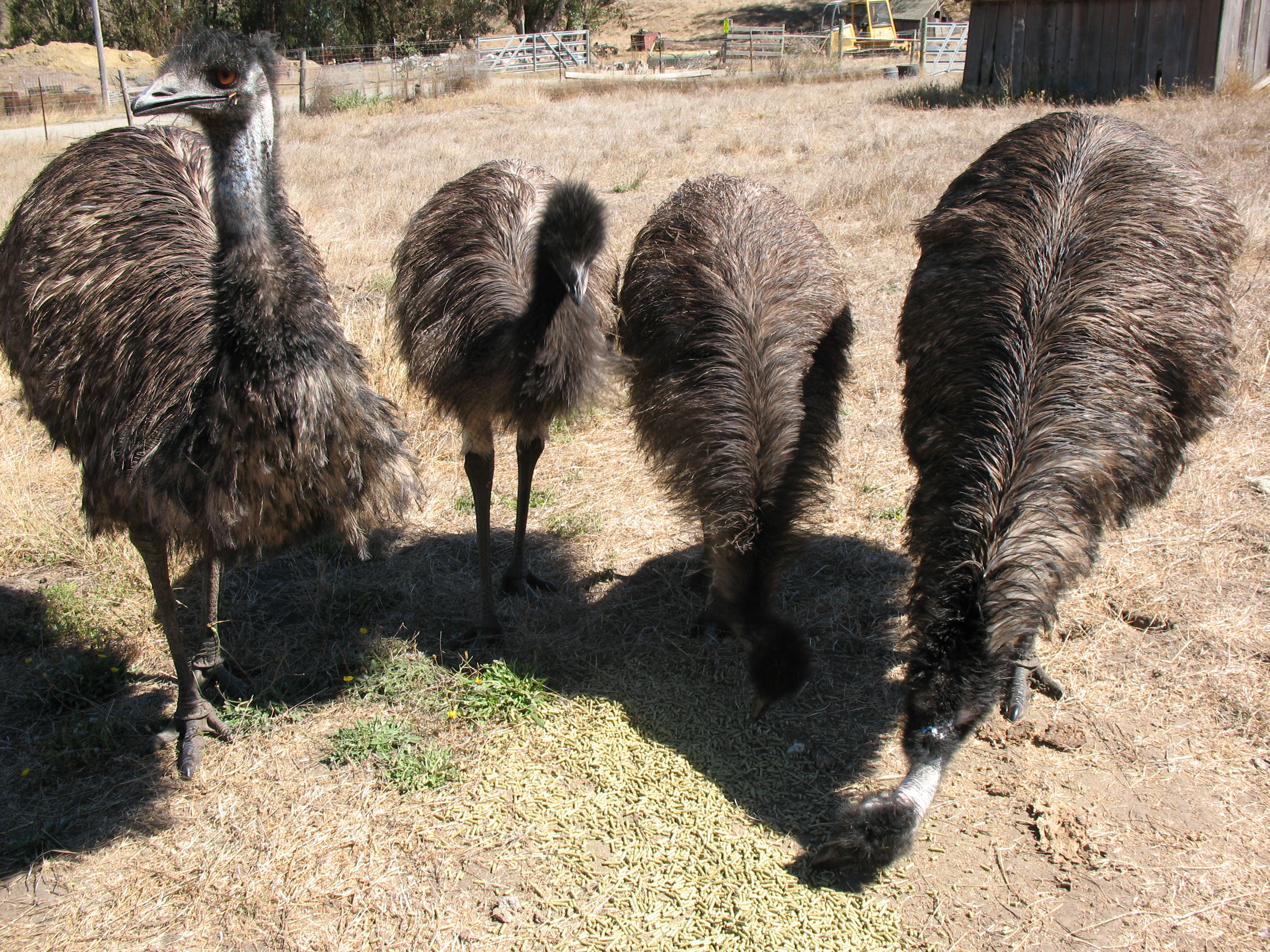
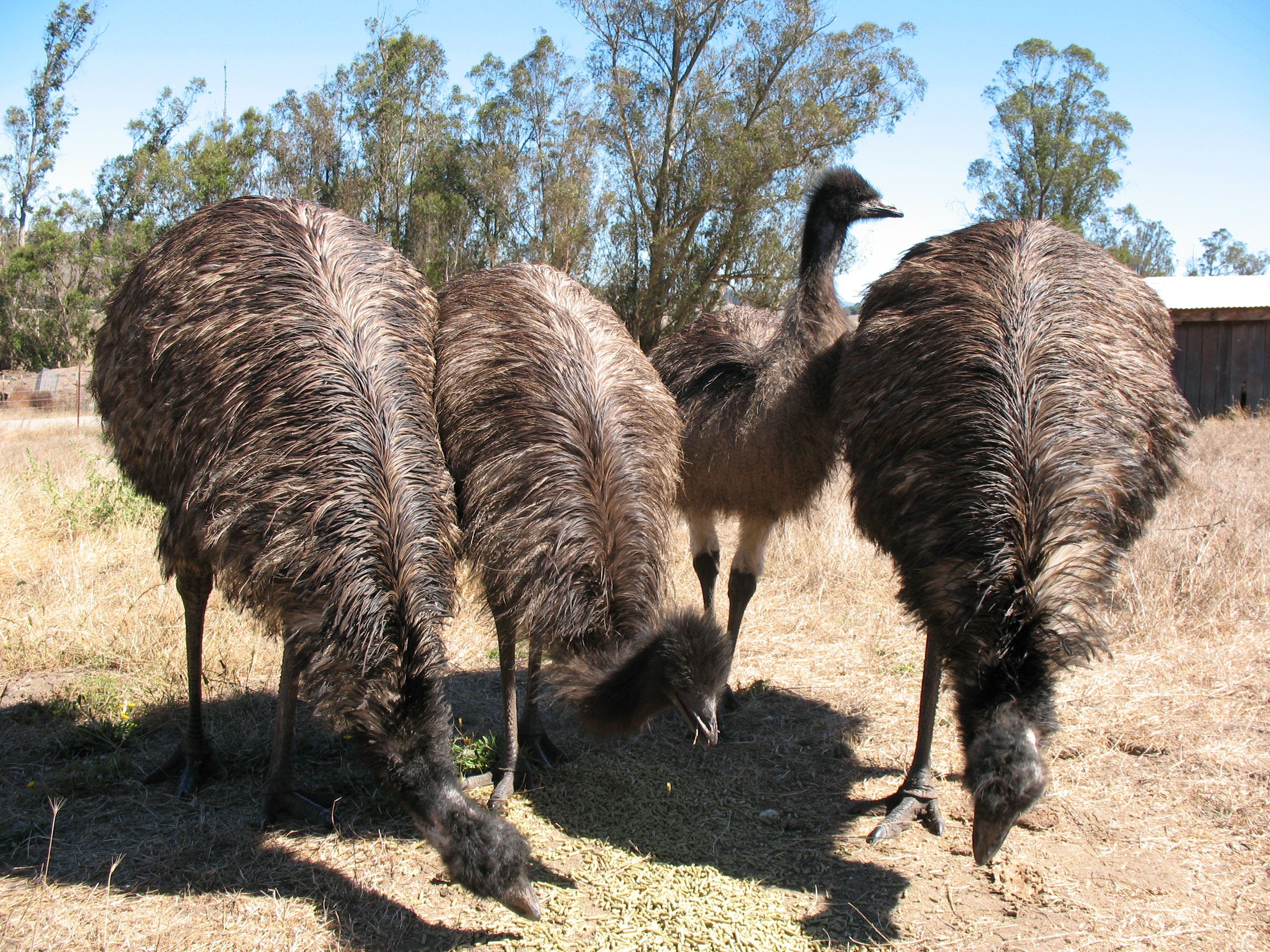
Emus at the Feeder

Emus at the Feeder

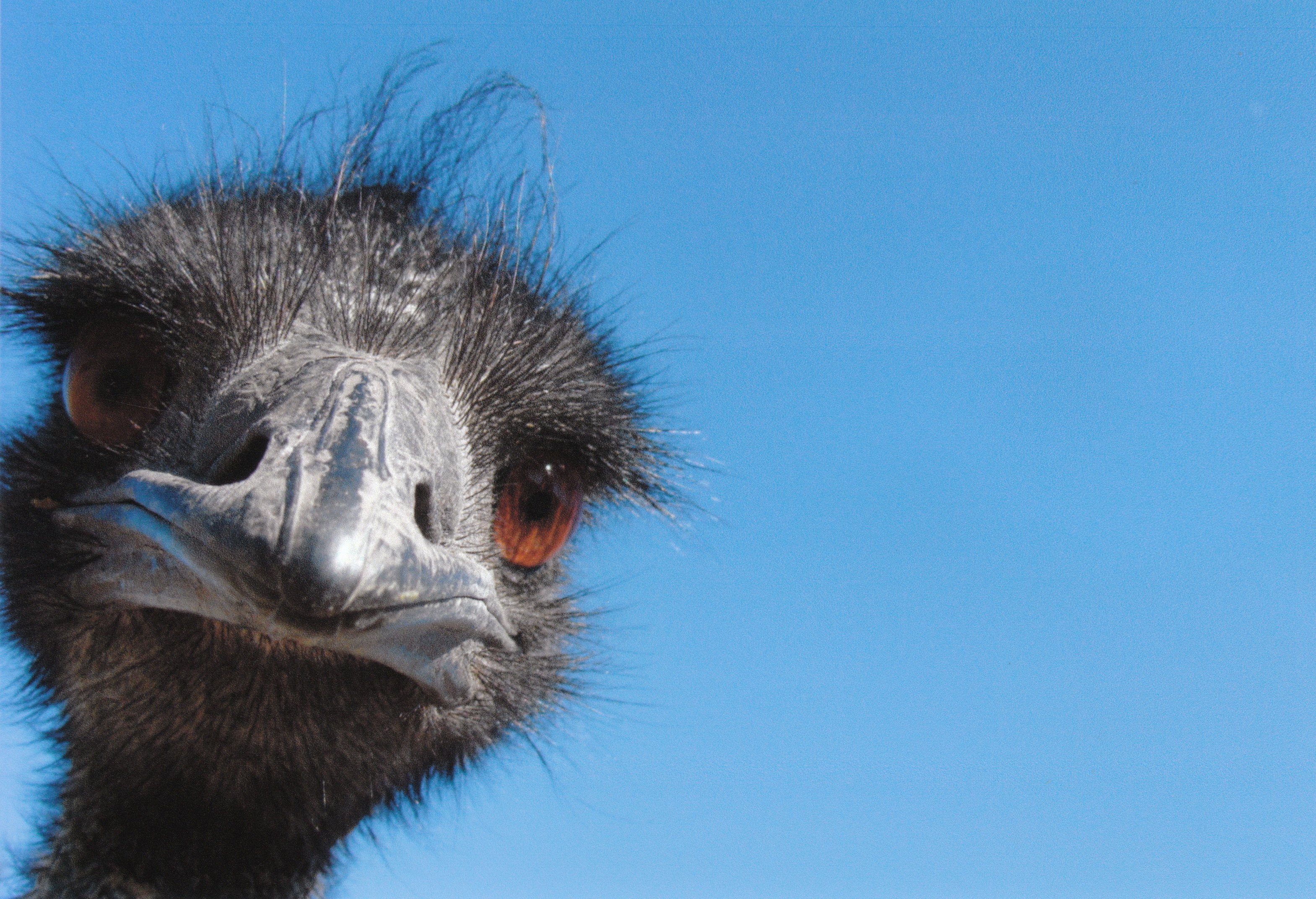
Up Close

Up Close

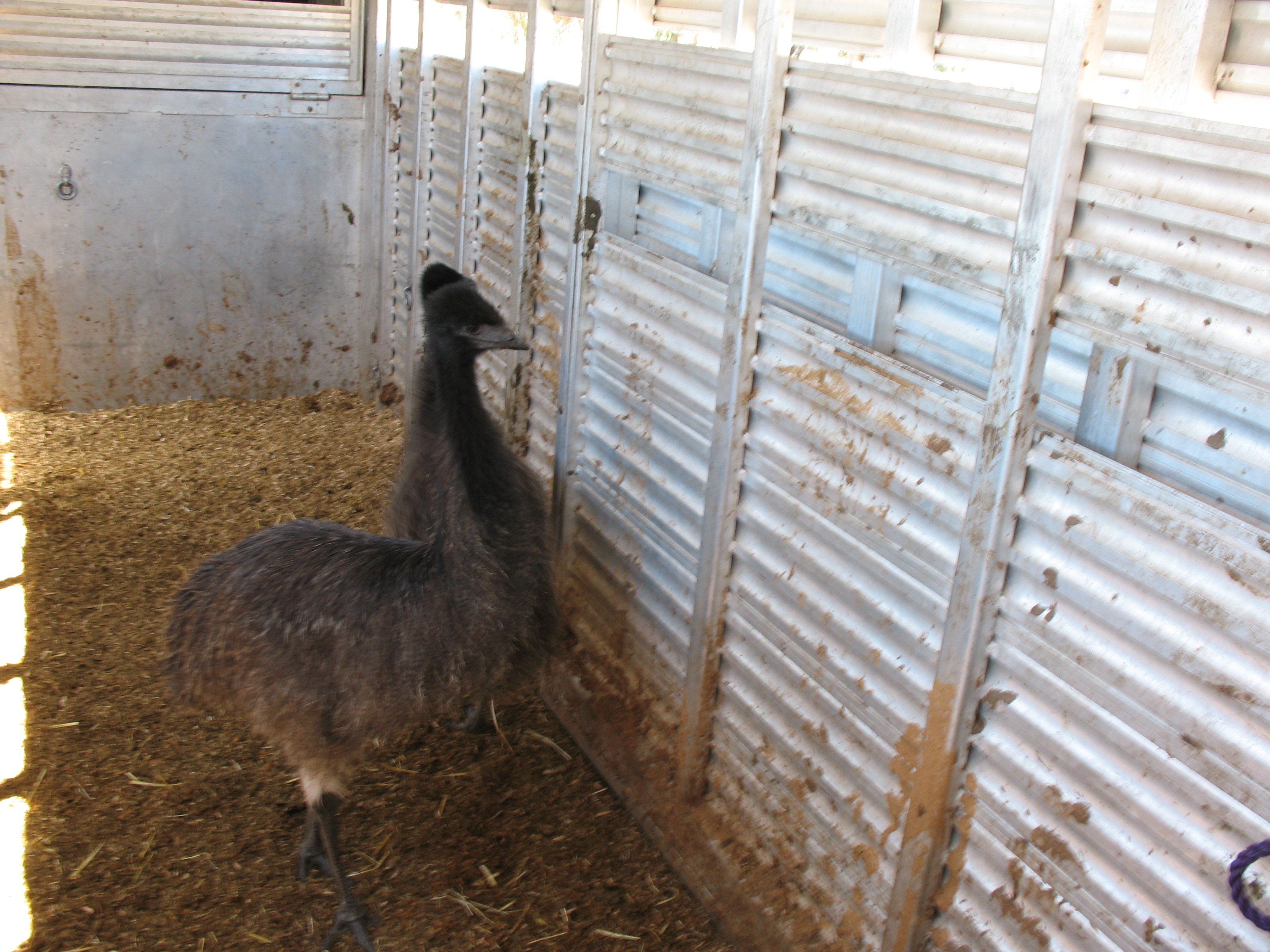
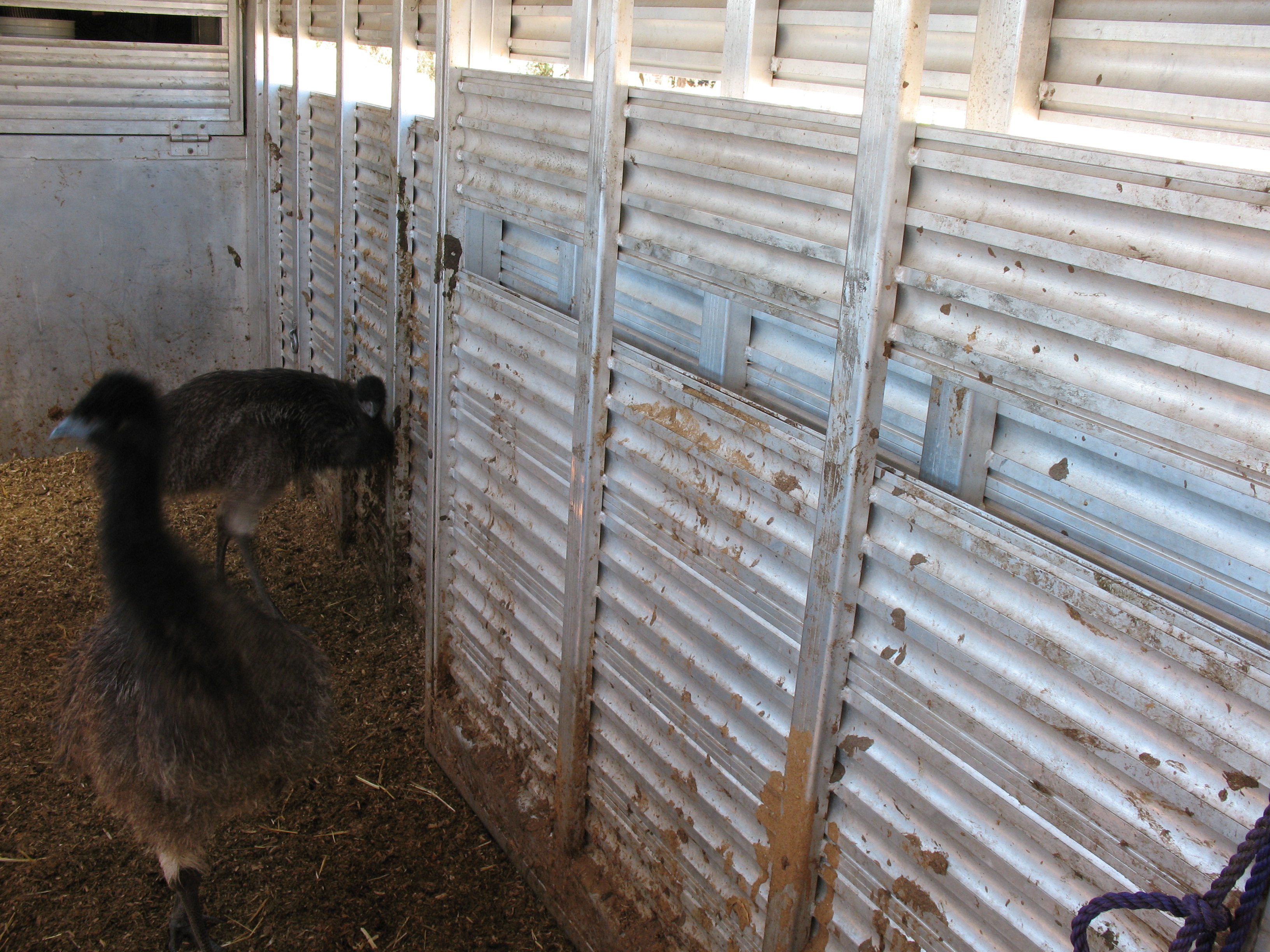
A Quiet Moment in the Pen

A Quiet Moment in the Pen

So, our teen emus, Kelvin and Gatsby, will be stuck with sheep duty. That’s not such a bad gig, more turf, more freedom, better view. Nice work, if you can get it.

Emu Teens. You have to wonder, is botching the job the way out of chores?

Emu Teens. You have to wonder, is botching the job the way out of chores?

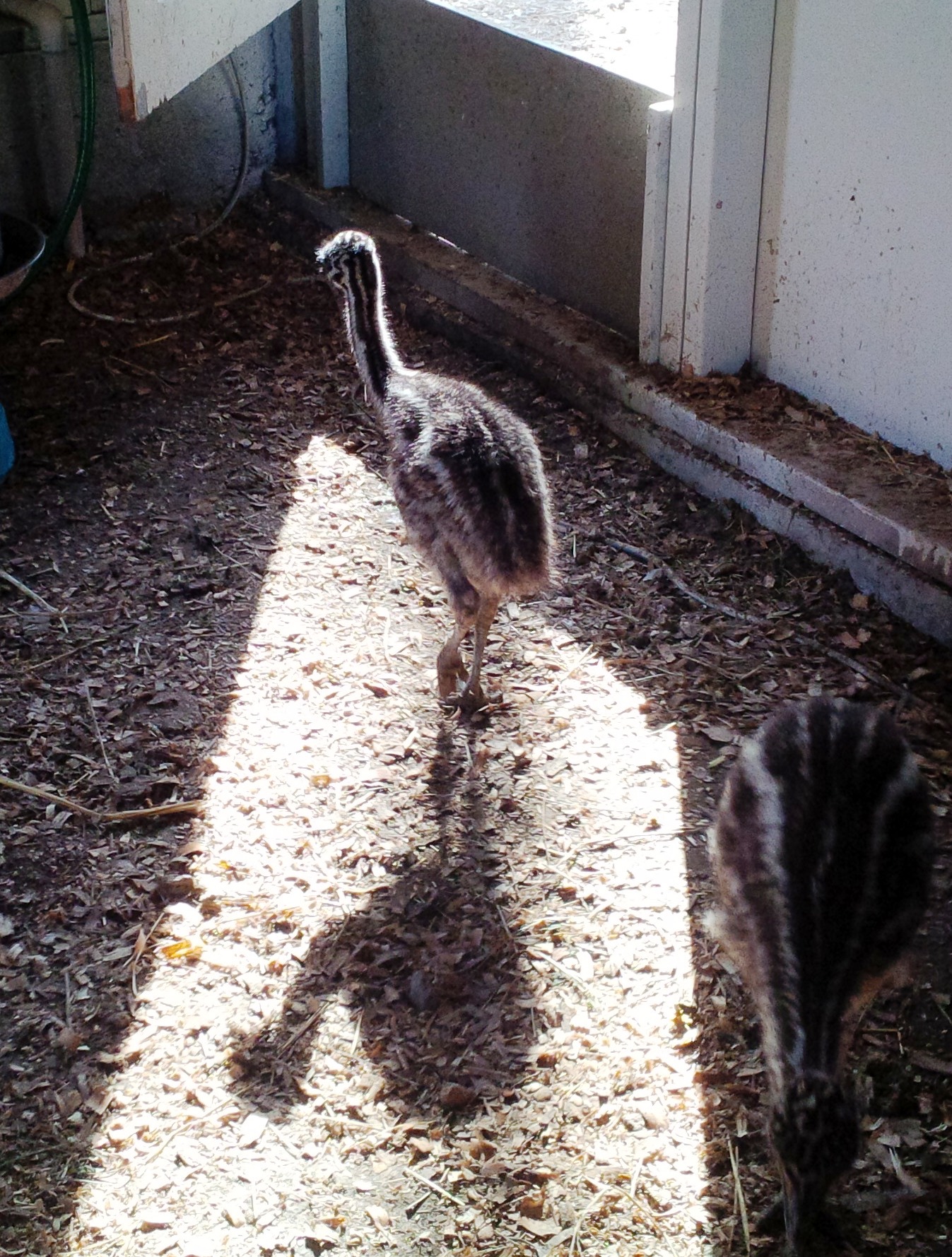
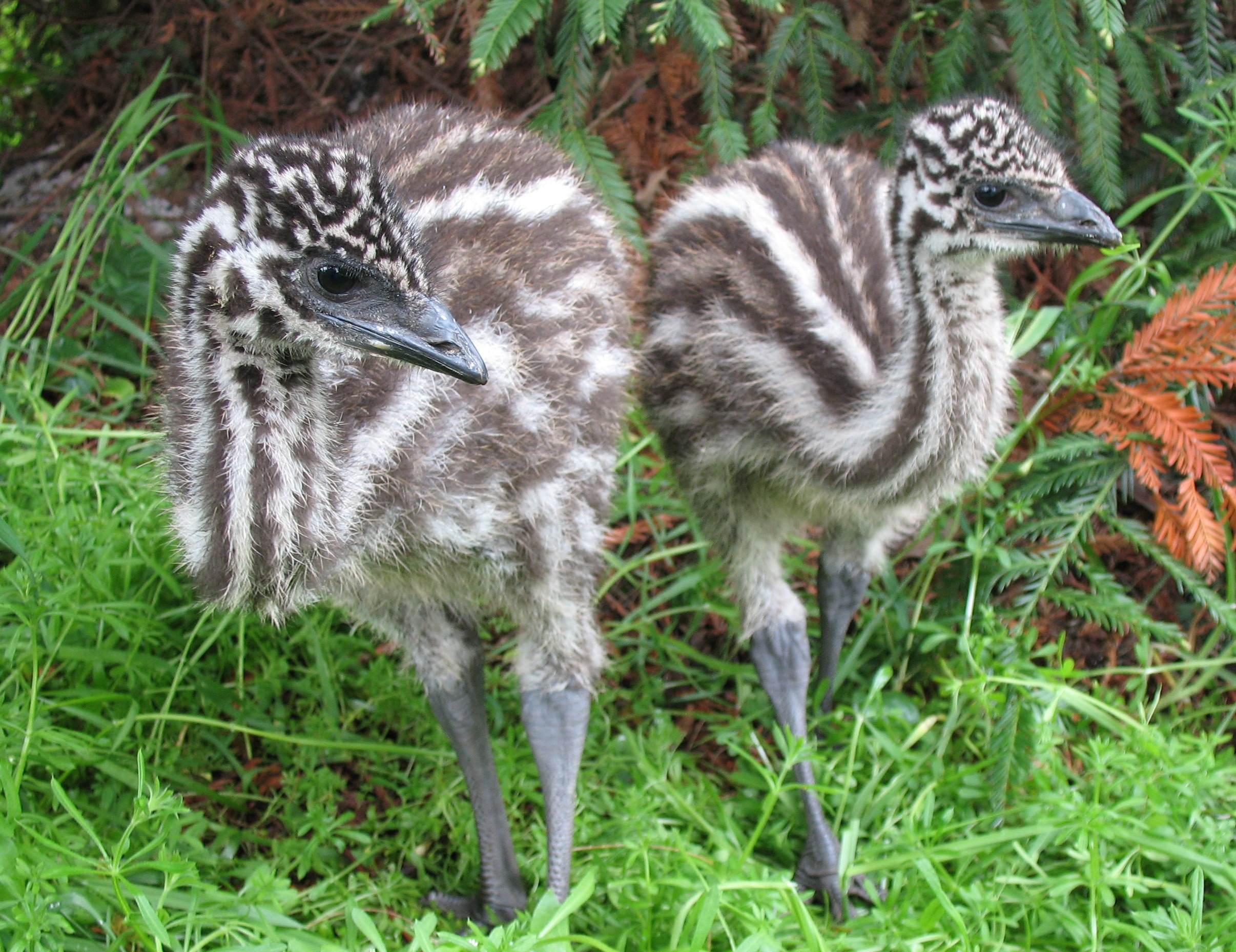
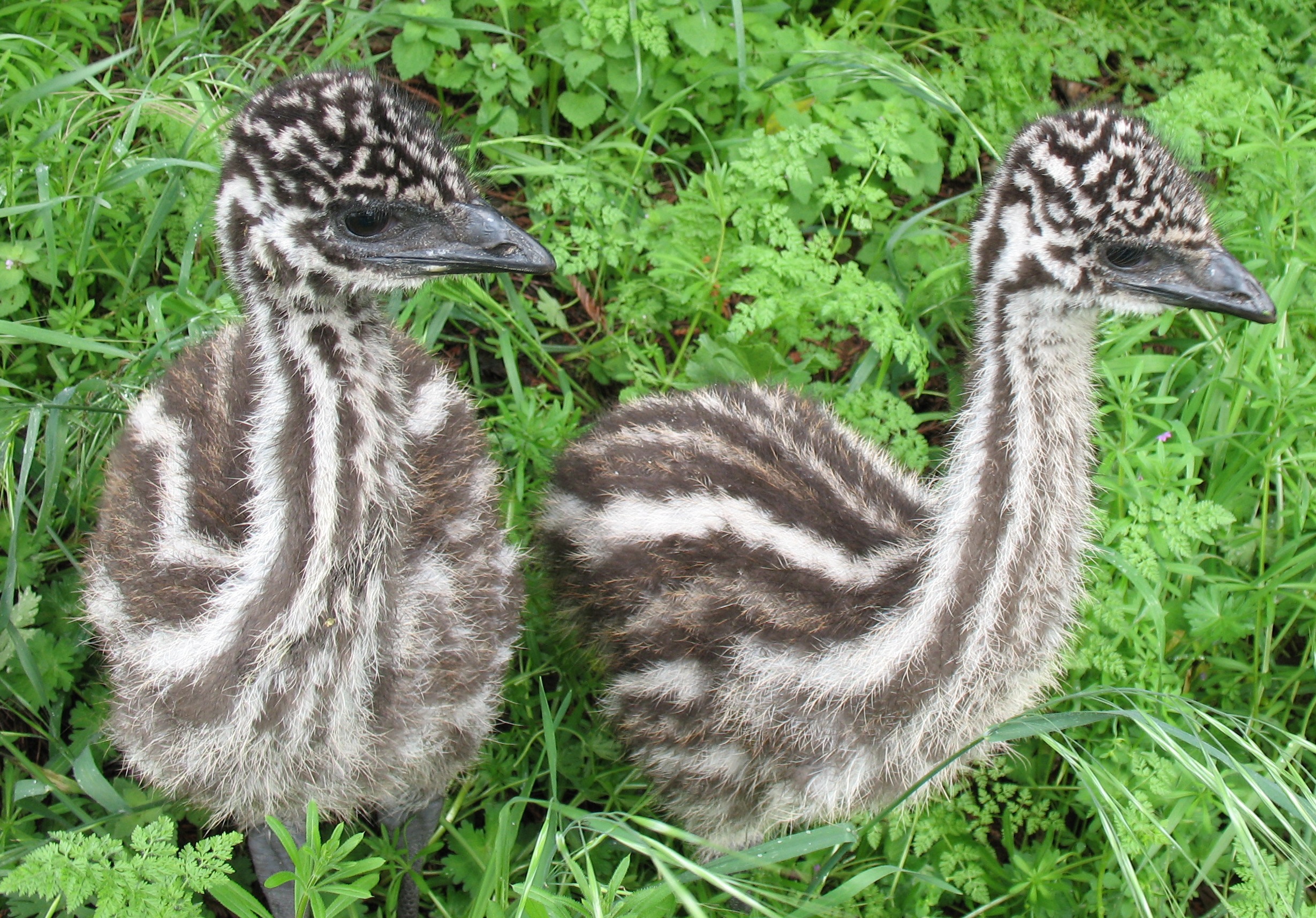
After some early garage and barn living, (Deb is not so crazy, as we were, to keep emus indoors) the new babies are settling in nicely.

Can we come out, yet?

Can we come out, yet?

Now, they stay with the ducks. Not that they socialize, but they are comfortable sharing space. Right now the emu babes are about the same size as the ducks. In the future, the emus will shoot up, no doubt surprising the ducks! They’ll serve as their guardians from predators. The teen emus were doing okay at the guardian job; during their tenure the duck losses stopped. Coyotes, foxes, and even hawks were discouraged by the emu presence. However, it wasn’t working because the emus themselves were injuring the ducks. Clumsy emus.

Ducks above, emus below.

Ducks above, emus below.

It’s nice to hear how things are back on the farm. We’re biding our time, waiting for the snow to melt. Then things will get very busy around here.

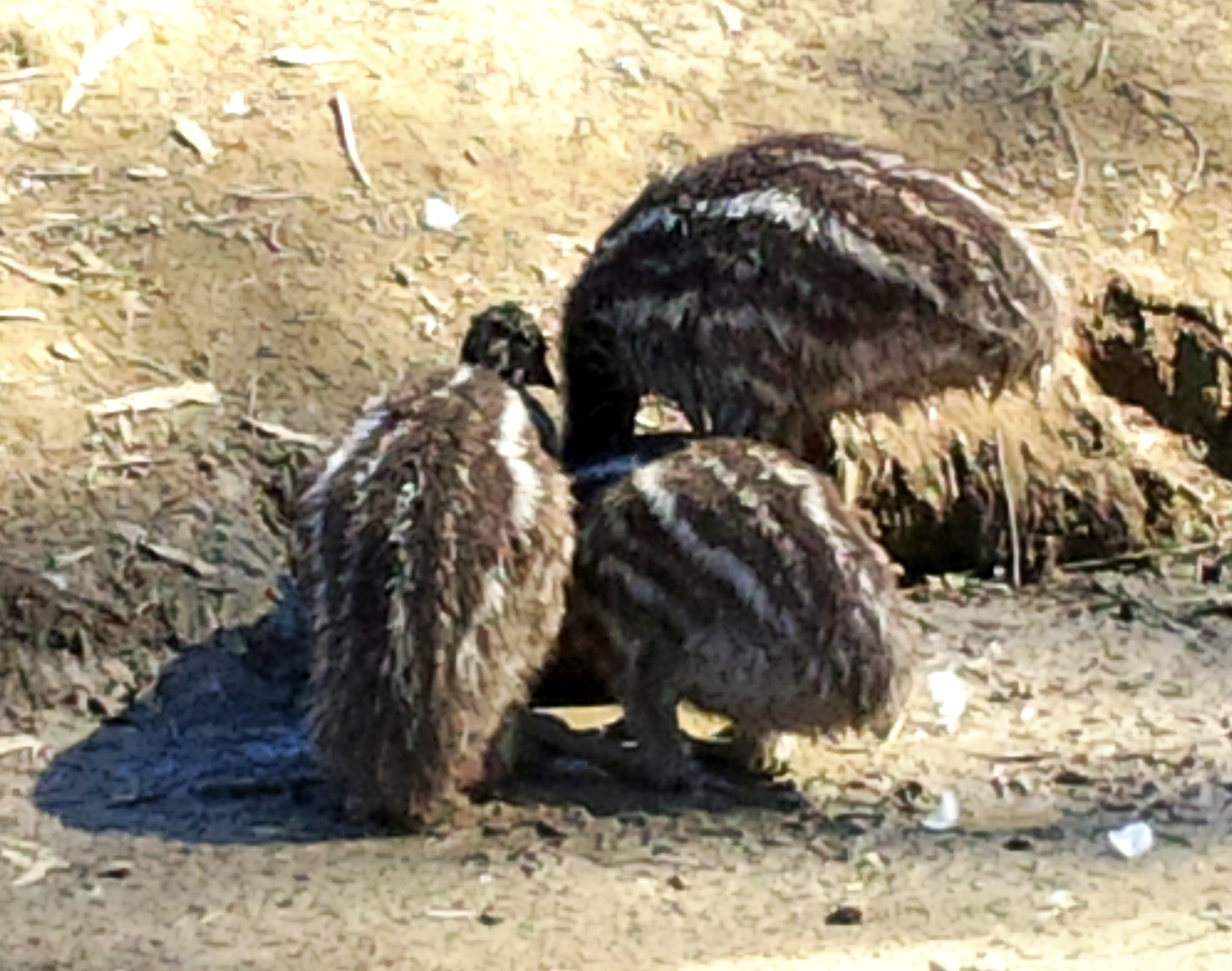
Emu Huddle--For these last pics, I asked Deb where the fourth emu was. Apparently, Number Four was occupied pecking at her red shoes!

Emu Huddle–For these last pics, I asked Deb where the fourth emu was. Apparently, Number Four was occupied pecking at her red shoes!

Emus in Absensia

A.V. Walters

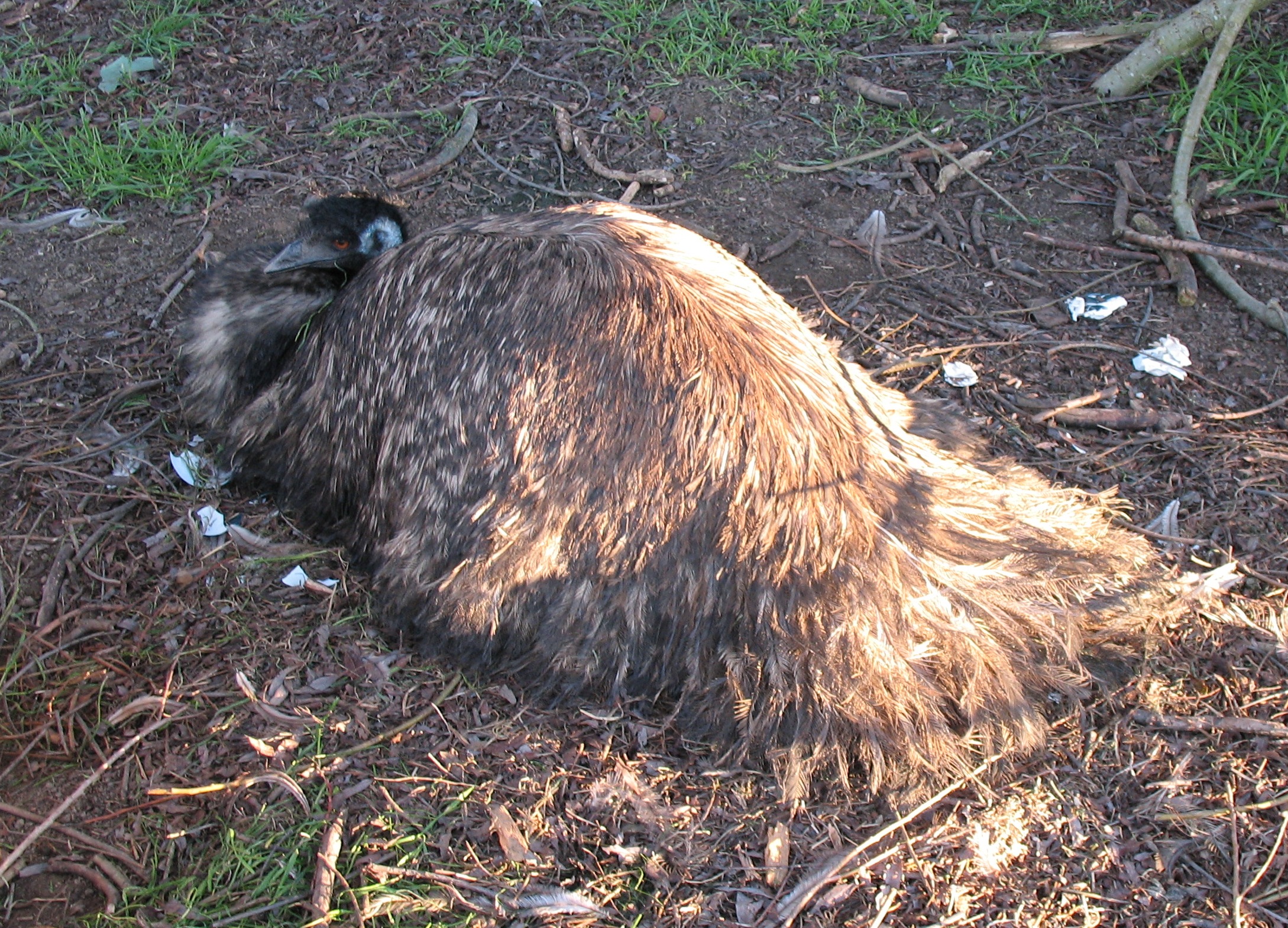
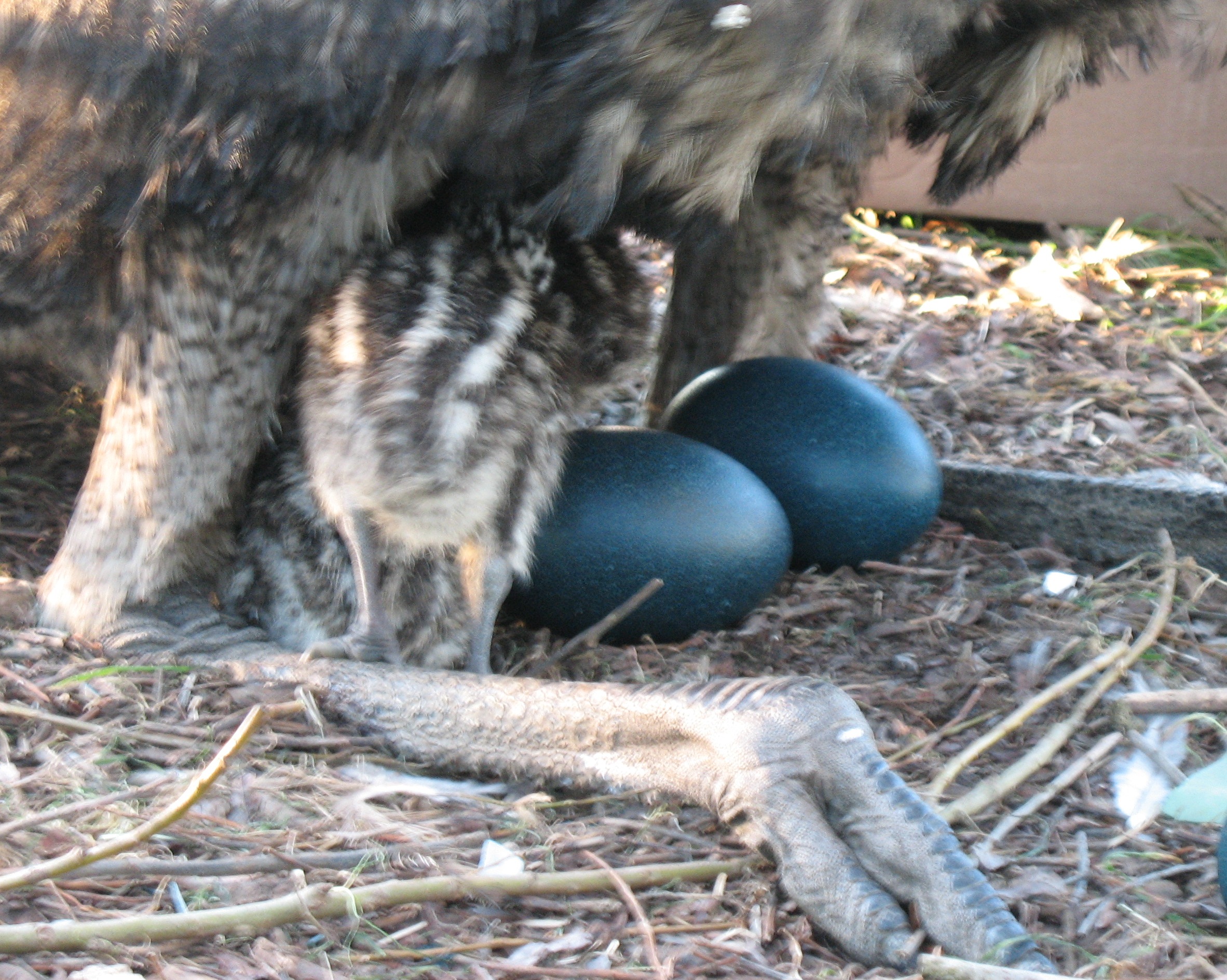
Elmer called the other night—they have emu chicks. Mr. and Mrs. Emu are at it again and, with all the food we gave them over summer, and the mild winter, they now have a sizable clutch of eggs. Or had. Out of the original twelve, two chicks have already hatched and died. Stretched so thin, Mr. Emu has difficulty watching the new little ones—he’s still nest-bound.

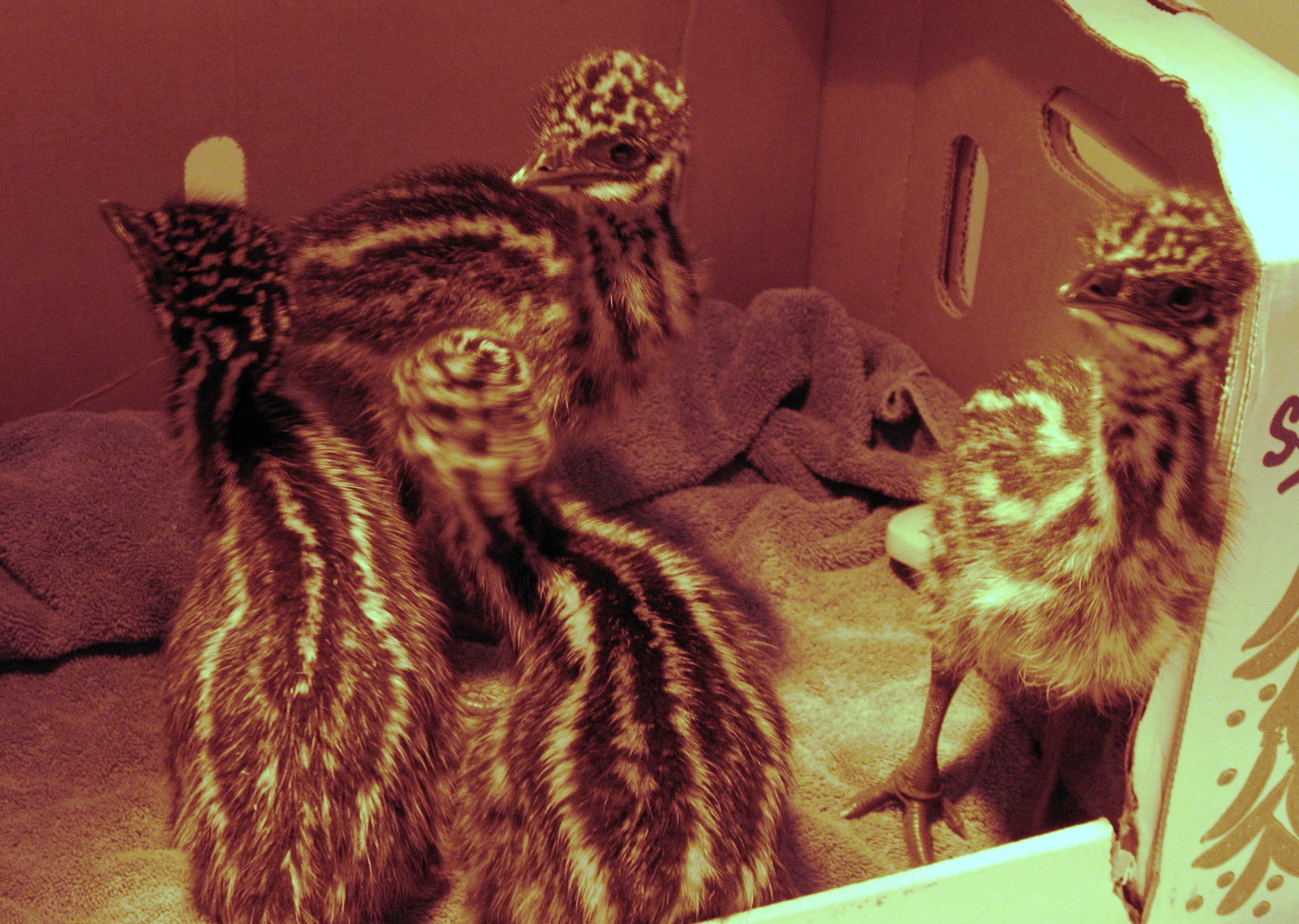
So Elmer and his daughter kidnapped the one little guy they found still alive and plan to remove the rest as they hatch. Between cold nights and predators, little emu chicks have a rough go of it in Northern California. Hence, the call. Rick and I are the only ones on the farm who have successfully hand-raised the little guys, and they need help.

They’ve decided that more emus would be just the ticket to guard over their new venture in organic duck eggs. (You should see all the ducks, it’s pretty impressive.) Emu guards are not a bad idea. We learned, the hard way, that the emus in our front yard were, in fact, protecting the chickens.  And so, the questions begin. What do we feed them? (Finely chopped kale and apples, to start.) Can we give them chicken feed? (No, chickens are seed eaters. Emus are grazers and need green fodder.) How warm do they need to be? (94 degrees F for the first two weeks, tapering off 5 degrees a week, after that.) What about water? (Not for about a week, until they’ve mastered balance and eating.) Those, and more, are all questions that we had to find the answers to, a year ago—either through trial and error, or what we could find on the net. As it turned out, we did okay. We had no losses from the five we raised. I guess that makes us emu experts. (And, given some of the so-called “expert” advice we found on the net, we are!)

We haven’t been homesick since our relocation. We miss some of the people, but we are caught up in the possibilities of our new lives. This, though, gave us pause. We definitely miss the emus—and raising them was an adventure we really enjoyed. So, we stand ready to be emu emissaries. We’ll provide all the information we can. And, of course, we’ll worry.


Rick’s Hat-Trick

A.V. Walters

It’s a season of firsts for us. Rick’s first set of snow tires (I get mine on Wednesday,) and our first snow shovel. These are all steps in acclimatizing ourselves to winter. Of course, I think that I have the advantage, having grown up with it. But thirty-five years is a long time to be away, and I’m not so sure whether the old memories can help to thicken blood that’s been made weak by extended, California living. Our friends and family are on the edge of their seats, watching Rick. Really, can a born and bred California boy survive the challenge?

When I was a teen, up in Copper Harbor, the test for new residents was whether they stayed for (and survived) the winter. Like many summer-tourist towns, we had plenty of summer-people. The Cottage Crowd may return, year after year, even generation after generation, but they are never locals until they’ve stayed for the winter. I think the same is true in Empire. I watch the locals take note of our progress. We are new AND we came specifically for the winter. I see their lips purse in expectation.

It is a friendly town, and not unlike my old haunts in Copper Harbor. Our first Thanksgiving there included a young couple whose car had broken down. Far from their own families, they were out for a Thanksgiving ride when they found themselves on the side of the road. Ours was the first house they came to. There was no question about it; we insisted that they join us for dinner and, later, the men went out to fix the car so they could return safely to Houghton.

Empire has a similar welcoming feel. People at the little grocery store in town greet us like locals. People we meet on our walks have introduced themselves—told their life stories and now wave when they see us. We knew that we had arrived, last time we were at the hardware store. We buy our eggs from the hardware lady—she keeps chickens. Last time we were there, just before Thanksgiving, she asked us if we had plans for the holiday. I told her we were headed to my brother’s, downstate. She looked concerned—they were expecting some snow, did we know that? I nodded, and said we had new snow tires and were happy to check them out. She looked unconvinced. Finally she took a business card and wrote her number on it.

“If there’s too much snow, you be sure to come over to my house for the holiday. It would be terrible to miss out on Thanksgiving dinner, because of the weather.”

That was that. We’d been invited to dinner. I guess that means you’ve arrived in a small town. The weather was lovely and we did make it to our appointed holiday plans. Still, it was nice to know…

As a kid, I never wore glasses—so despite my deep bench of winter experience, I’d never had to deal with the cursed annoyance of the instant blindness when your eyeglasses fog over the second you step inside from the cold. Rick showed me his trick for this; he laps the edge of his knit-hat over the top of his eyeglass frames, and it minimizes the fog-over when coming back indoors. So, even a California Boy can teach me a new trick for winter.

That’s Rick’s hat-trick. And you thought it was going to be about hockey, didn’t you? We haven’t got to that, yet!

This Is How It Goes–

A.V. Walters–

Up north, in the U.P. where my mother lives, folks are getting Lyme disease. These are hearty, out-doorsy people, who spend a lot of time in the woods. Lyme disease isn’t new—it’s been around for decades, just not up there. It’ll take a little time for people to wise up to the new reality—the ticks have moved north. Soon, folks will take precautions, recognize symptoms, and will have made the adjustment so that a bite doesn’t necessarily mean a long-term, debilitating illness. You adjust.

In Michigan, (and southwest Ontario) the forests have been devastated. A shipment from China apparently, and inadvertently, imported the Emerald Ash Borer. It’s a pretty, little bug. Here, we have plenty of ash trees, and no predators. Estimates are that, so far, 20 million trees have been infected and died. There is no cure—they offer some heavy-duty, toxic treatments that can hold it at bay, (if your favorite yard tree is at risk) but nothing can be done to protect the forests. Before it runs its course, we will lose about 80 million trees. Now that the seasonal leaves are gone, you can look into the woods, as you drive by, and see all the fallen trees. It’s heartbreaking. Ash naturally grows in a diverse forest—so there are still plenty of other trees standing but, like the elm before, this area can kiss its ash good-bye.

We have forested property. We walk its hills, shaking our heads. The ash are dying and falling. The tree has a distinctive bark, so even in the winter it’s easy to identify. As we walk, we see not only the downed victims of the blight, but every one of those standing trees, with that lovely deeply-grooved bark, is doomed. They say to expect 100% losses. There are timber restrictions on the movement of ash wood-products. Areas are quarantined to try and prevent the spread. Our quarantine area is Lower Michigan. It’s spread to some counties in the U.P. now, too. So far as I can figure, the only winners in this game, and it’ll be short term, are the woodpeckers, who eat the larvae.

Bat White-Nose Syndrome is spreading across North America. It’s caused by a fungus. In some bat populations, the mortality is 95%. Because it affects a wild species, and the primary transmission route is bat-to bat, there’s not much that can be done. It originated in Europe. Nobody knows how it arrived here, but human transmission is likely. The fungus can be transported by the movement of people and equipment, in the forest. That’s the likely way that it got here. Unlike the European bats, ours have no immunity to the disease. It thrives in cold temperatures, infecting bats during hibernation. Unfortunately, the close contact of bats cuddling in hibernation, speeds its transmission. People shrug. Too bad about the bats, eh? Well, it’s more serious than that. The bats eat the bugs. What are we going to do with the resulting bumper crop of bugs?

Dutch Elm, West Nile, Lyme disease, Emerald Borers, White-Nose. I could go on. (Don’t even get me started about the bees, who are primarily the victims of neonicitinoid pesticides.) These are pests that are spread beyond their borders by the impact of people. In some cases, it is simple relocation, like our Ash Borer. In others, because our climate is changing and so extending the range of existing critters.

Maybe, like Lyme in Northern Michigan, we can adjust to new threats. What about the bats, or the bees, or the ash trees? How will we adjust to a world without bats? What will we do with the resulting bonanza of bugs? More poisons like neonicitinoids? How can we know the rippling impact of these changes? It threatens to change the face of nature. Most Americans don’t live in nature and they won’t notice. They get their food—sprayed, plastic-wrapped and GMO’d. They fail to comprehend that diversity is a necessary component of a healthy environment and take no notice of the rapid level of extinctions all around us. Most Americans don’t know we have a bat crisis, or that the Ash trees are dying.

For my part, next spring I’ll put up bat houses and maybe purple martin condos. I’ll shun chemical interventions and try to live lightly on the planet. I’ll read and try to stay informed. Because this is how it goes.

At Home, With The Royals

A.V. Walters

Of our five emu chicks, two were adopted by a fancy, Napa Valley vineyard/winery. Those two little emus had been our favorites, the ones we named C3 and Sleepy. Their royal gig was to serve as guardian and companion animals in the vineyard’s menagerie. This place was not just a grape-growing operation, it was a full-blown winery castle. Castello di Amerosa is a noted tourist attraction between St. Helena and Calistoga.  They were adopted out as little bitty guys, in full baby-emu plumage. We wistfully watched them go off to a royal life at the castle, pleased that they’d fared so well.

Do you remember me?

Do you remember me?

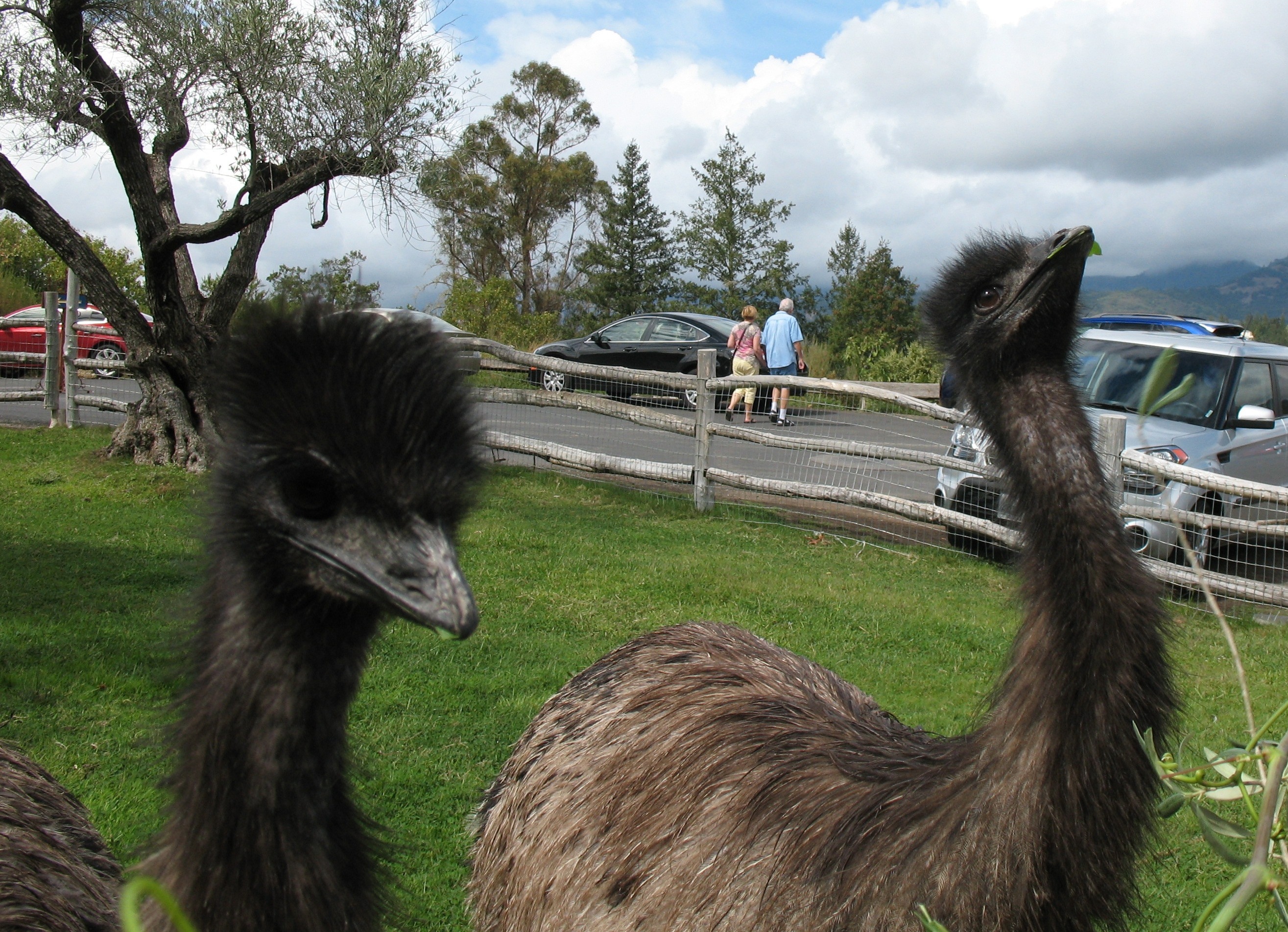
We always intended to visit. After all, how often does one get to see a full-sized medieval castle? (Really, check it out; it is really quite impressive— www.castellodiamorosa.com) As the time drew short for our own departure to the east, we finally decided to make the trip to see how our little, feathered, former wards were doing. We emailed our contact, Carlos, and asked if we could visit. He was thrilled, sent us photos and directions. But, the photos puzzled us—the Royal Emus were blonds! (What do they say? You can never be too thin or too blond?) Really, what could explain how different these emus were from their plebian siblings?

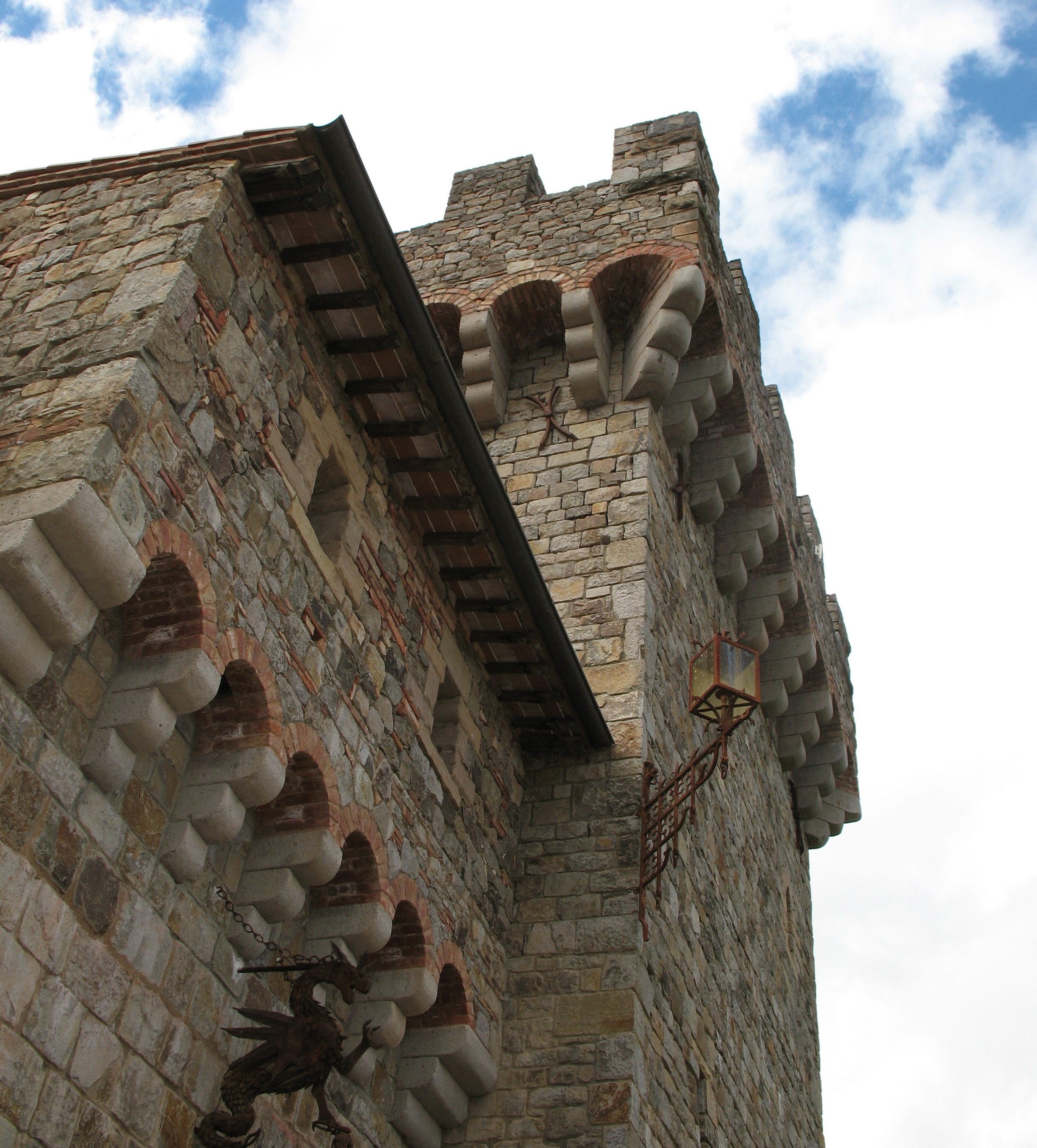
Castello Di Amerosa

Castello Di Amerosa

As we drove up the winding drive, the castle (and it really is a castle) peaked above the hill. We parked in the lot, and walked over to take a look at the grape vine encircled castle, complete with a moat and drawbridge. Carlos soon found us and brought us over to the area of the grounds with the emus. Along the way, he introduced his other charges—geese, guinea hens, goats, sheep, peacocks, and a wide variety of chickens. Finally, there they were, the emus. Blond.

Blonds?

Blonds?

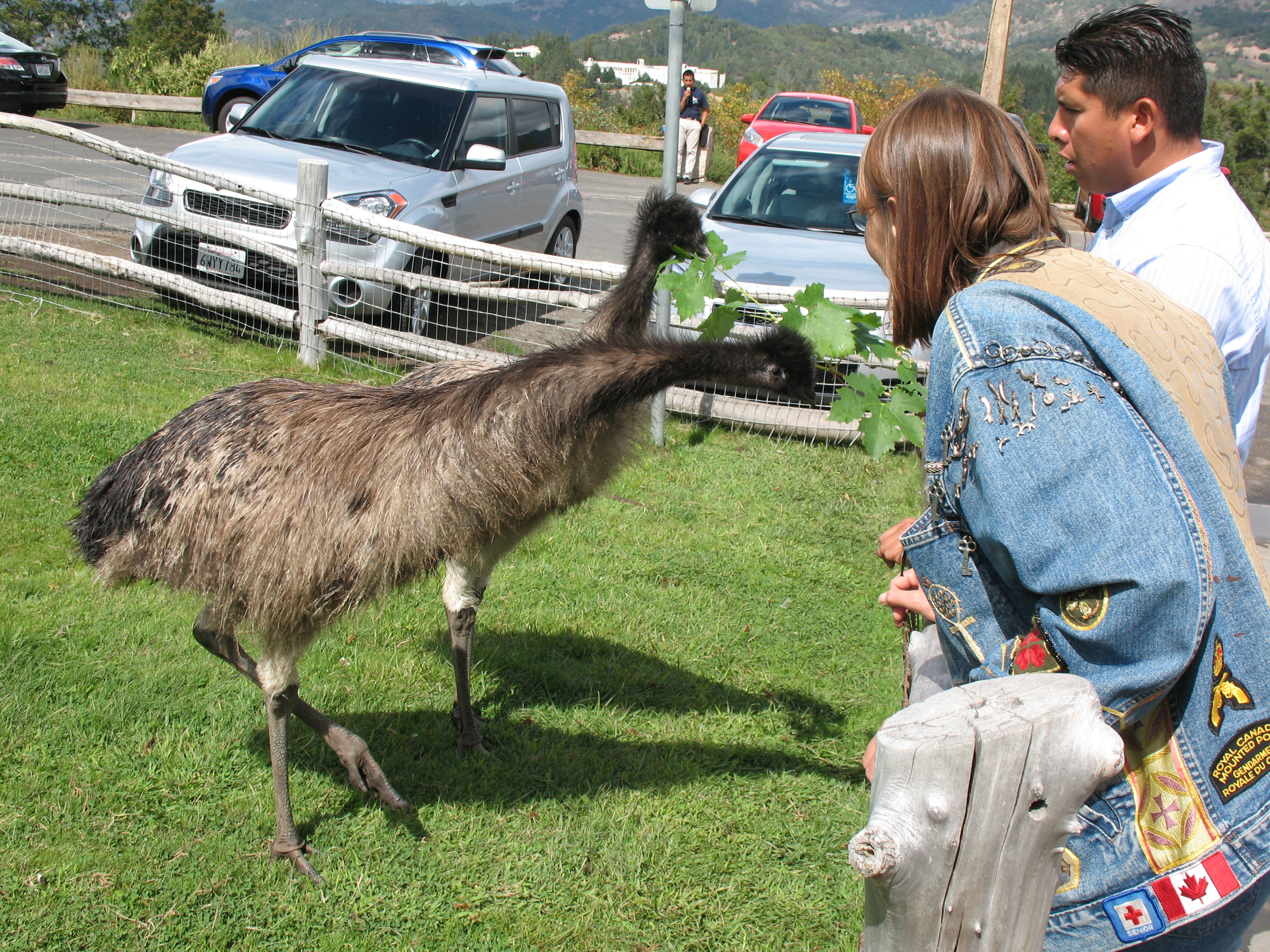
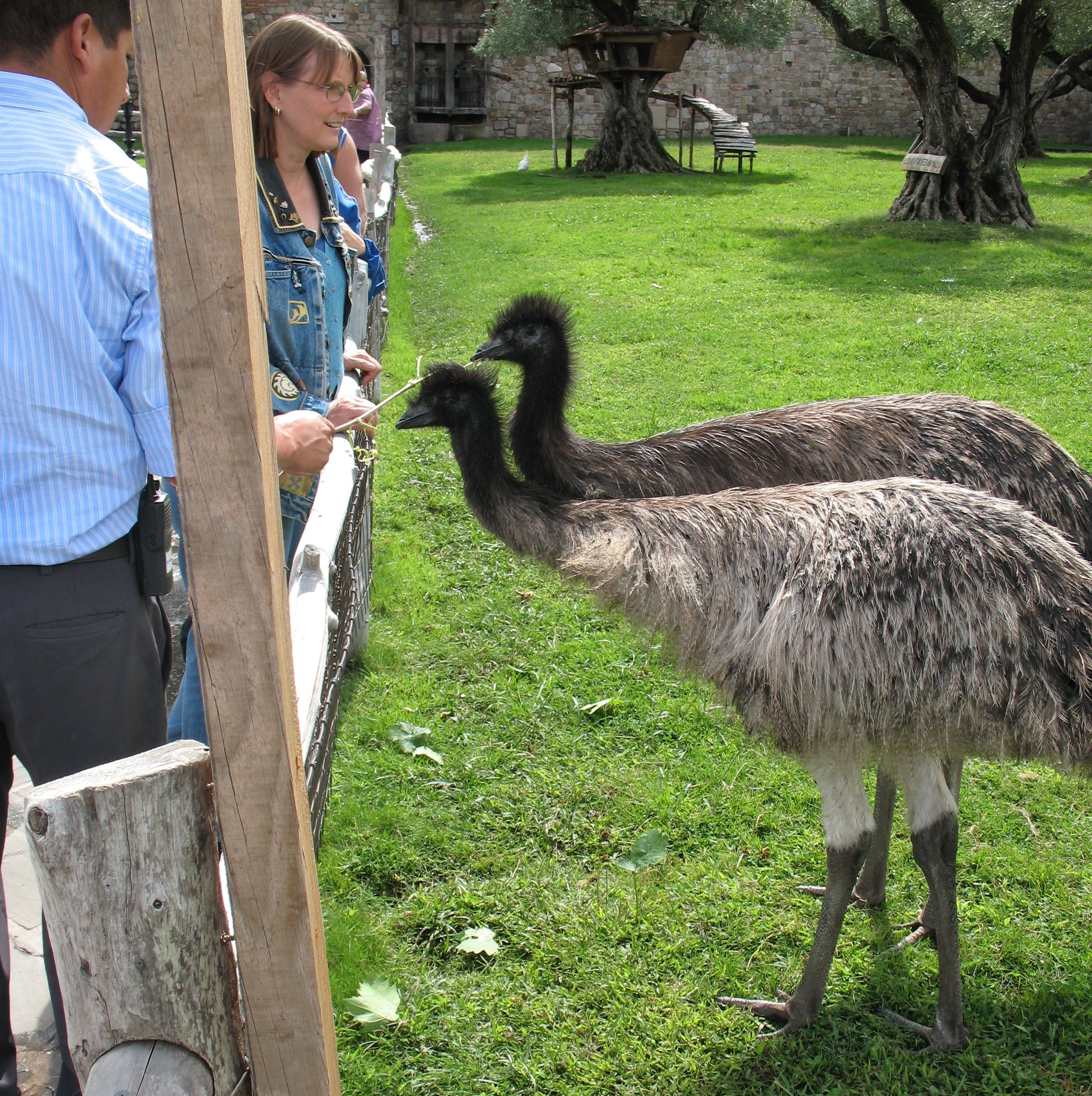
It wasn’t just the photos, these emus were decidedly lighter in color than their parents or siblings, back on the farm. We scratched our heads. While the emus didn’t recognize us, they clearly related to us as folks who know and handle emus. (Besides, we brought apple treats!) They let us rub the fronts of their necks and feel their feathers. And, therein was the secret…the feathers were brittle, bleached out and broken. Something was clearly wrong.

Where did they get those white knickers?

Where did they get those white knickers?

The kings and royals of yesteryear often suffered different ailments from the mundane health-hazards of the surrounding, peasant populations. Like modern folk everywhere, the Royals of the past suffered from diseases of excess—gout, heart disease, obesity. We decided to ask what it was these emus had been eating.

Sure enough, it turned out that they’d been feeding the emus the same special-mix they had for the peacocks. But, peacocks are seed-eaters and Emus are grazers. Their enclosure was too small to provide a normal, grass-eating diet. (And, like teenagers everywhere, they’ll gladly take the fast-food, rather than seek out the best nutritional options.) Emus need a feed mix that has a high proportion of roughage and greens. These royal emus had a diet that was too rich in calories and not high enough in essential vitamins and minerals.

We pointed it out to Carlos, the damaged, brittle feathers and explained. Nodding, he agreed and assured us he’d get the proper emu feed the very next day. And, not a moment too soon—those emus will need to rebuild their feathers to stay warm this coming winter.

A little snack of delicious grape leaves.

A little snack of delicious grape leaves.

Our visit was a complete success. We did look at the castle, a bit, but most of our time was spent with The Royal Emus.

Emus wandering off to their royal duties.

Emus wandering off to their royal duties.

So, Ya Takin’ Bob?

A.V. Walters

A Snaggle-toothed Bob

A Snaggle-toothed Bob

Among farmers, especially livestock farmers, I sometimes sense a certain… offhandedness—not quite callous, but a level of indifference, to the needs of animals that go beyond maintenance. I suppose one gets a thicker skin when you have to handle them all the time, in all kinds of circumstances—and they’re bound for the table, in any event. On our way out of Two Rock, I encountered this repeatedly in comments made about our move.

Granted, we were moving all the way across the country. And, that alone is an overwhelming enough undertaking. Still, repeatedly we fielded the question, “Ya takin’ Bob?”

Bob is what’s known as a barn cat, having been twice abandoned on our farm. Initially he was Don’s cat, but Don and his wife bought a house and moved into town. While residing here, they had acquired a little farm menagerie—two dogs and two cats. When they left, they picked one dog to take, and abandoned the rest. The other tenants absorbed Don’s leftovers. We shook our heads; even Elmer thought it wasn’t quite right. But, the critters all managed to find homes, of sorts, amongst the neighbors.

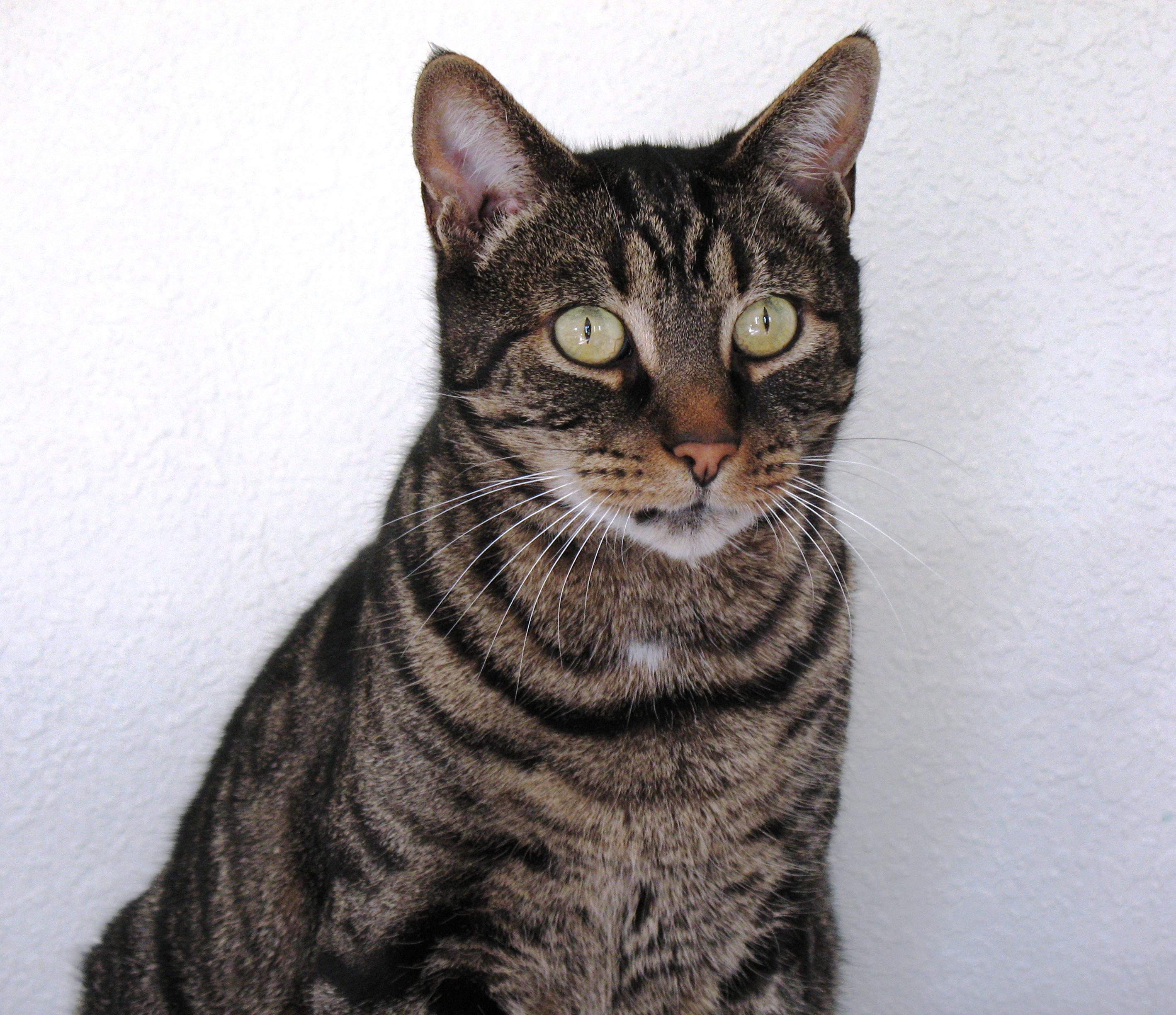
I’d have taken Bob in a heartbeat. After all, he had become Kilo’s best friend. My cat, Kilo (also a rescue cat), has a habit of finding feline playmates and inviting them in. I met Bob this way when I first moved to the farm—suddenly, I had two tabbies in my front yard, playing and hunting gophers, together. The two look alarmingly alike and, more than once, I’d opened the door for Kilo, only to find it was Bob I’d let in. Bob is a charming and social cat. He is sweet but dumb and, hey, good-natured and dumb isn’t so bad on a cat.

I was disappointed when another tenant beat me to the Bob adoption program. So, Bob moved to Stan’s, at the opposite end of the farm, and we saw less of him. For a while, we hosted Bella, Bob’s sister. She didn’t like Kilo, (or any other cat, for that matter) and took her leave to live with yet another tenant, so she could be an only-kitty. It was a matter of musical cats for a while. Then, Stan moved to another farm, taking Bob with him. I thought we’d seen the last of Bob.

Months later, Don alerted me to the fact that Bob was back on the farm! Don had seen Stan pull up in his truck and dump Bob at his old, former home. Elmer fleshed the story out more—he told me that Stan had called to see if he could return as a tenant. (When Stan’s new landlord learned he had a cat, he’d been given the option—leave or get rid of the cat.)  At the time, our farm had no housing available, so I guess the obvious solution was to abandon poor old Bob. (Personally, I think Stan’s landlord put the choice to the wrong critter.) The funny (not haha funny) part of this story was how incensed Don was about Stan’s treatment of Bob. Huh? If that ain’t the pot calling the kettle black.

Bob was traumatized by his sudden dislocation and disappeared for a few months. Then, one spring morning, a very skinny Bob was on the doorstep with Kilo. Bob had found a home. He’s been with us ever since. I suppose we shouldn’t have been surprised, or offended, when hearing that we were leaving, each of our neighbors asked that question, “So, ya takin’ Bob?”

Of course we’re taking Bob! One doesn’t just abandon a family member. And, maybe there’s the difference between farmer and non-farmer. We have pets. Farmers have animals.  And yes, I wish I could have taken the emus.

Bob, from a safe distance.

Bob, from a safe distance.

Maybe Too Much of a Good Thing

A.V. Walters

We all want our food to be safe. We all think that one of the roles of government is to ensure a safe food supply. And they are trying. (Take that any way you like.) There’s regulation pending that would make it hard for organic and small farmers to sell produce. You see, growing food isn’t a spotless operation. It’s done in dirt. Major producers can afford the equipment (and use the chemicals) that give you that pristine, scrubbed, (and not nearly as fresh) produce. Small farmers and roadside stands can’t. It’s as simple as that. Note that most of the outbreaks of food borne disease aren’t coming from small sustainable producers–they’re coming from Big Ag. We need to amend the proposed regulations to provide exemptions for sustainable producers. What looks like a good thing actually favors Big Ag over traditional farming. For more information or to make a comment supporting change to the proposed rules, click on the link. http://salsa3.salsalabs.com/o/50865/p/dia/action3/common/public/?action_KEY=12303

Reunited

A.V. Walters

We ran those two emu generations side by side, in adjacent fields for at least a month, wondering if and when it would be safe to put them together. The emu elders continued to be a bit pissy to the babes, reaching over the fence to nip and thwack them at every opportunity. But, earnest Gatsby wouldn’t give up; he was bound and determined to win those big emus over. When we came into the field to feed the adults, he’d run up to the fence line to greet them, only to be met with a hiss and a peck on the top of his head. We had to wonder, was there any recognition of kinship, at all? Not that I expected much of the Mrs., (After all, female emus have a cut and run approach to parenthood.) But the males are the nurturers, and will even adopt unrelated emu young. And, these were their own babies.

Maybe we waited too long to do the introductions. After all, Gatsby and Kelvin were now emu teens, complete with ‘tude’. (I know a great many parents who’d like to pretend that their teenagers aren’t related!) It wasn’t even essential that there be an emu reunion. Elmer has enough land and enough sheep (on both sides of the main road) to employ separate teams of guardian emus. My concern was that they meet, and be at least civil, so that if Elmer needed to put them together it could be done without fisticuffs.

By late July, the over the fence hostilities had lessened to the point where it was worth a shot. The adults were no longer starving—receiving daily rations with the babes since their move. They’d put a few pounds back on, and were much more relaxed. Still, mom and dad demonstrated clear interest in the lower pasture. You see, the baby emus were in an old orchard and the adults obviously coveted the easy availability of free, seasonal apple treats. Our emus had relaxed and learned, too. At least Gatsby had learned to visit at the fence line, just out of reach. Kelvin appeared to have lost interest in the big emus next door. We decided it was time.

One sunny day, we marched across the farm for the regular emu feeding. After everyone had finished their kibble and the apple treats had been generously distributed, Rick unceremoniously swung open the gate between them. It took a few minutes before they realized what was up.

Gatsby got it first. Emus! His head perked up with the recognition of this momentous change. Then, at full emu speed he headed directly for the grown-up emus.

Fearing violence, Rick and I stepped towards the fray, without any idea of what we’d do if there were an actual emu fight—wave our arms and shout, “Heel emus, heel?” I’ve been in the middle of an emu altercation—limping away with a broken toe, for my trouble, as a result. I had no interest in doing it again. At the last instant, Gatsby veered off and ran circles—what appeared to be joyous circles—around the adults. Emus! Gatsby was in his glory. Since the moment he first caught sight of the adults, he had wanted herd-status. And, here they were, at last!

For their part, the adults, while keeping an eye on that crazy Gatsby, had bigger plans. They headed straight for the apple trees that were now available to them. Kelvin hung back safely, and wisely, on the perimeter. Every now and then, Gatsby would cut a corner too tight and intrude on the personal space of the adults. He was rewarded with hisses and pecks—but, to our relief, no kicking. An emu’s kick is its best defense and offense. And, if an emu starts kicking, things are serious.

Dining in Peace

Dining in Peace

We stuck around for forty minutes, or so. Gatsby was still careening about the pasture. He was the happiest emu I’d ever seen. He’d run in big circles and then come back in to do smaller circles around the huddle of emus, who were quietly munching apples, under the trees. He didn’t even mind when one of the adults would mete out a hiss or nip, asserting who was, after all, in charge of this operation. Gatsby didn’t protest—he clearly wasn’t interested in dominance. He wanted unity.

Finally, after a protracted run, Gatsby quieted down and joined the adults. If he got too close, Mr. and Mrs. were quick to give him a whacking, so he’d temporarily join his sister, who was grazing in wide circles on the edge of the action. Kelvin appeared a little put out. She stayed close, but at a safe range from the group. They didn’t pay her any mind. Her best buddy, Gatsby, had completely thrown her over for the adults. She looked just a little lonely, but that was her choice.

Taking turns as lookout.

Taking turns as lookout.


Rick looked at me, “I think our work here is done.” And so it was. It was another step in the direction of emu autonomy. There’s the tug of parenthood, combined with the relief of demonstrated independence.  We stopped and picked some blackberries on our way back down the road.


Settling In

A.V. Walters

The trauma of the emu relocation is wearing off. It’s been four days now, and my suspicions are bearing out on the source of the emu hostility. After a couple of days of ravenous eating, Mr. and Mrs. have relaxed about scarcity. With that, Kelvin and Gatsby seem not to be such an imposition. The cross-fence pecking has dwindled in frequency and ferocity. (In part because Gatsby’s staying back, a bit.) Not that I’m going to open the gate just yet, but things have improved.

Up on the hill, the emus have a great view. I’m not sure if they appreciate it. It’s just more stimulus for their already overextended brains. There’s a lot more noise up there, too. You can hear traffic, even though the road’s almost a half mile away. The young emus are startled by every new noise—their heads darting from side to side trying to get oriented. Down in the bottomland, a bull is bellowing. It’s been going on for days, must be that time. It’s pretty loud and it has the emus wide-eyed and wary. And then there’s the sheep; they’re not shy either. That’s something they’ll just have to tolerate. They are, after all, sheep protectors.

Gatsby is still smitten with the adult emus. I guess that is as it should be. When I visit (because that brings Mr. and Mrs. down to the lower fence) he is torn between visiting with me, or hanging at the fence with the big guys (who still treat him with a certain level disdain.) Sometimes he stands, ten or fifteen feet from the fence, looking at them, then at me, repeatedly, frozen there, unable to decide. Kelvin has no such problem. She knows where the food comes from. She’ll even herd Gatsby over for dinner—she’s a very good big sister. And finally, he’s eating. I know that things are better, because today, for the first time since they moved, I saw them dance and play. It was brief, but there it was, a glimmer of fun. And when I walk up the hill, when they see me, they come running. Not for any particular reason except they like to run. (I can tell because if something catches their attention, they’ll change direction and head off that way. They’re still just big, dumb birds.) They are broadening their territory—occupying larger and larger areas of the lower pasture. The emus are finally settling in.

This emu move across the farm is actually good for me. I need the distance, figuratively speaking, so I can let them go. They have to be farm emus, not pets, and I’m not always going to be here. I’m such a softie, though—I’ll probably end up leaving bags and bags of emu food when we go. Just the idea that these little guys wouldn’t be fed, when they’re really still babies, is more than I can bear. That distance is good in another way, too. Back and forth across the farm at least twice a day, I’m hoofing almost four miles. I can use the exercise.

And, it makes me look around. I’ve discovered two hawk nests. The blackberries are getting ripe. They’ve just cut and bailed the grass in the bottom of the valley—the squared bails in crooked lines along the work trail of the tractor. Even with most of the valley dry as dust, it’s still picturesque. Tomorrow I’ll scout out the blackberries. Maybe I can find enough ripe ones for the pie I promised Rick.

Empty Nest

A.V. Walters

Our avian stalemate was short lived. One of the chickens decided to break ranks. I don’t know the dynamics of chicken-chicken relations, much less chicken-emu exchanges. In any event, chicken-number-two decided to change sides and hang with Gatsby and Kelvin. She followed them around, even slept on the ground near them, in their corner emu haven. That shift changed her routine and she stopped laying eggs in her usual spot. Every day we’d have to go searching for her egg. The egg hunt caught the attention of the emus (though I doubt they had any idea what was up.) I’d be stalking around the yard, poking here and there, with two emus following so closely behind that if I stopped suddenly, they’d bump into me like some Laurel and Hardy routine. Just behind them was the emu-friendly chicken (following the emus) and the regular chicken, not to be totally left out, brought up the rear. What a parade!

The emus are amazingly social. They tried to play and dance with their new chicken friend, but she didn’t get it. Just keeping company was enough for her.

Feeling their oats, the emus proceeded to try to engage with the antisocial chicken, and it resulted in a spirited emu/chicken chase. They could not win her over—so it was a three-to-one club in our front yard.


The Emu Transit Trailer

The Emu Transit Trailer

And things would have remained so, had it not been for the arrival of the trailer. I’d talked to Don and Elmer about transferring the emus across the road—for training with sheep at the tutelage of emu-dad. Being a softie, I’d requested that they use a fully enclosed trailer. Emus do not like travel and do not transfer well. I thought the experience would be less traumatic if the trailer didn’t offer the view of the world whizzing by at high speed. So, out of the blue, Elmer arrives with a perfect livestock trailer—not one of the ratty open trailers he uses to transport chickens, but a real, fancy trailer. Apparently he borrowed it for an extra large load of sheep he needed to haul, and thought he’d take the opportunity to move the emus. There we were, without notice, for the fateful emu moving day. It’s probably just as well, because I’d have fretted over it.


Not liking that trailer!

Not liking that trailer!

Hmmmph! Smells like sheep!

Hmmmph! Smells like sheep!

With a minimum of trauma, and only a few tears (mine), the emu-youths were loaded into the trailer and off to new pastures, literally. For their initiation, we decided not to mix the young with the adult emus—so as to let them get used to their new digs first. Good thing, too! Those little emus were in total, “Where-are-we-now, Toto?” shock. They stood in the middle of a large pasture, slack-jawed at the openness. The only thing that captured their attention were the almost equally curious emu parents, gawking from across the upper fence. Emus!


Look! EMUS!

Look! EMUS!

The little guys set off at a trot to explore these new relatives. But blood isn’t thicker than water. It doesn’t come close to being as thick as food. The deck was stacked against the youngsters.


Maybe not so friendly

Maybe not so friendly

You see, our dry summer has been so dry that the summer grasses have browned early. There’s little nutrition in grazing this season. Even up by the pond, where the emus have been kept, it is pretty brown. Elmer has cut back on the number of sheep he’s running—keeping only breeding stock. There’s little grass to feed them and the cost of hay and feed (grain) reflects the dry conditions and scarcity. Usually, if the emus are with the sheep, they’ll supplement summer’s slim pickings with the sheep mix. But this year the emus aren’t with the sheep. Nobody bothered to check on the emus up in the high pasture and they are hungry. So the kids were not visitors—they were competitors for scarce resources; the emu-babies’ homecoming was punctuated with hisses and grunts from mom and dad. If the little ones got too close to the fence, they were rewarded with pecks on the top of their heads (Just like the chickens!) Sadly, this hasn’t dissuaded the little ones. They are eager to commune with other emus. Gatsby, especially, runs to the fence whenever the adults are in view. I think this relationship may be forged on the enthusiasm of youth.


Perhaps a little supervision is in order

Perhaps a little supervision is in order

I also think we can fix this. I think a few days of ample rations all around will bring out the better natures of those cranky adult emus. So it’s been kibble and apples all around.  Yesterday, Mr. and Mrs. Emu scarfed down ten good sized apples in minutes. The solution is Food-Aid. We’ll use food as the social lubricant. Today I’m going to slip in some sweet mix (corn and other goodies used for lambs) for extra calories. While the special emu kibble is a better dietary choice, sometimes junk calories are in order. I’m walking across the farm—about a mile—to the back pastures several times a day to provide extra goodies for the parents and company and play for the kids until they settle in. I am hugely relieved that there are two of them, and that they are such good company for each other.


Hey, watch your back!

Hey, watch your back!

Meanwhile, on the home front, we have answered a burning question in a sad way. We decided to keep the two chickens for a few days. We like the eggs and, though chickens are no social substitute, we were missing the emus. The unanswered question was whether emus were guardian animals for chickens. The answer is that just the presence of emus helps to guard the chickens. The morning after the emu relocation, we woke to just one chicken, and a lot of feathers. It took the predatory critters less than twelve hours to figure out that those chickens were unprotected in the front yard. We hadn’t even thought of it—that maybe the chickens were at risk without the emus. We feel a little guilty. Chicken number one was eaten—by whom we couldn’t tell. That was it. The other chicken was quickly returned to the relative safety of the barn and our home is now bird free.

Rick spent that next day scrubbing the porch and walkway, removing the temporary fences and returning our yard to normal, residential habitation. The cats are happy. They’ve been going in and out the cat door and re-exploring the front yard. When I miss those emus, I hike across the farm for an emu fix. It’s not the same….but it was time. Nature abhors a vacuum. Territories quickly adjust. But the emus will always have a special place in our hearts.


The Orphan Garden

Good Enough

A.V. Walters

The garden this year is an orphan garden. Though we planted it, and we care for it, it’s not really ours. We didn’t do our usual big production garden. We cheated and used older seeds (some of which never did germinate.) We transplanted volunteers and moved things around—so much so that now I’m not sure what’s what. Then, late in the game, one of the farm tenants dropped off two orphan tomatoes—of course, root bound, and those went in, too.

Still, watering and weeding it has been a pleasure. It’s that quiet, steady, work that inspires why I garden in the first place.

There’s a chicken in the garden this year—it happens sometimes that a chicken escapes the barn and sets up housekeeping in some corner. Usually nobody goes looking for them and they forage and do pretty well. This one likes snails. If I see that shiny, post-slime evidence of a snail on one of the plants, I root around in the bucket and find the culprit. I’ve been giving the snails to the chicken, and now she follows me around the garden. Somewhere over there, there are eggs, but I’m not looking.

The tomatoes (even the stragglers) are doing well and have baby green tomatoes hiding in a lacework of yellow flowers. The peppers are in bloom and the various squashes are all growing gangbusters. I just wish I knew what they were. I know there are pumpkins, zucchini, acorn, delicatta (my favorite), butternut and maybe crookneck squashes. I’m uncertain about the rest. The cucumbers (3 lemon and one regular) are filling out and reaching up for the sun. I think there’s a French melon plant in there, but only time will tell.

Unfortunately our hot spells have made the spinach bolt. We’re eating it up quick, before it gets too bitter.  We’ve also had some of the basil, and some early sprigs of cilantro. The radishes are almost ready, though they’ve been beset by bugs, we’ll still eat them. Even if this is all it is, it is good enough.

We didn’t plant this garden with the intention of a harvest. We may never satisfy our curiosity about just what’s in those buckets. We know we’ll be moving, but we don’t know when (or exactly where, for that matter.) We’re packing and checking our plans, Plan A, Plan B and Plan C (even Plan C.5!) We’re selling things that don’t need to go with us. And we’re waiting. The waiting is the worst. We have business to finish here, and we’re not in charge of how quickly that will roll along.

In the meantime, there are emus and chickens to feed and gardens to tend…


Two Chickens, Two Eggs

A.V. Walters

In the best of circumstances, a healthy chicken will produce an egg a day. From time to time, or if under stress, a chicken will occasionally miss a day or two. When winter darkness comes, egg-laying goes. (It’s why commercial egg operations use artificial lighting.) Chickens will usually try to lay in a protected area. The chickens in our front yard have each picked a hollowed out spot under the redwood tree. We collect the eggs everyday. In fact, it’s one of the tasks that Rick especially likes.

What you don’t see, is extra eggs.

Yesterday, Rick found an egg just out in the grass, a yard or two in from the fence–no hollowed out nest–just an egg, sitting there. He picked it up and carefully set it aside. It wasn’t an especially good looking egg; it was a little dirty and mottled looking. Later, he quizzed me about the egg numbers over the past few days.

You see, we’ve been collecting two eggs a day. Rick figures we’ve been set up for another round of Farm Humor. That egg is a rotten-egg-bomb. Our front yard chickens couldn’t have laid it. The numbers don’t work.

We have a suspect. One Bad Egg. We don’t yet have a plan. We could just carefully dispose of this suspicious egg…or we could keep the joke going……


Remember, The Gift of Guylaine Claire and the award-winning The Emma Caites Way, are free ebook downloads through July 4, on Amazon.

Coop d’État

A.V. Walters

“Meet the new boss
Same as the old boss”

These chickens are aggressive. They made it absolutely clear who’s in charge in our front yard. Because the emus are so much bigger, we forget that they are still little kids. If ever there was a lesson that you’re as big as you think you are, this is it. Right from the get-go, the chicken-bully (as we call the more aggressive of the two) started harassing the emus. When they’d bend over to eat, she’d rush over and peck the emus right on the top of their heads! The message was clear—the chickens are in charge!

The emus have learned to steer-clear, and give the chickens a wide berth. At times, they can eat together, (if I make sure there’s ample chicken food.) But, in their meanderings, the two species have a different agenda, and don’t choose to keep company. They’ve made their peace, but it’s not friendly.

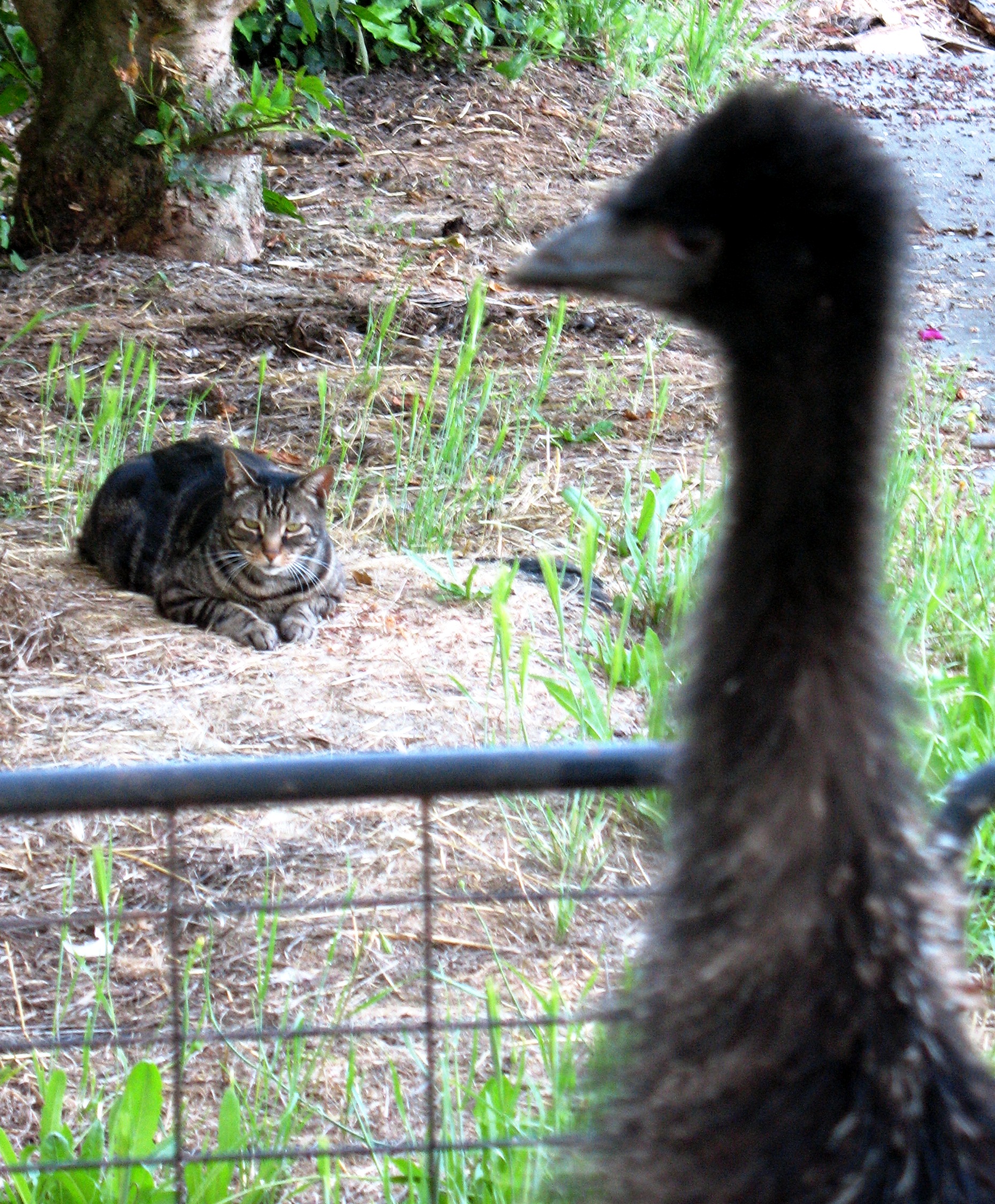
Bob, the cat, was hiding under the lower, redwood branches. He’d crept in, to check-out the chickens. The emus spied him and took off in hot pursuit. They split up and triangulated their attack. The poor cat nearly didn’t make it over the fence, in time. And that was Bob, a cat they know and like! (Well, like may be a bit strong, but they know he’s not a threat.) Were the emus defending the chickens? Or, having been demoted in their own yard, merely defending their dignity against an unsuspecting target? And, just what was Bob doing in the redwoods, anyway?

Bob, from a safe distance.

Bob, from a safe distance.

Rick had it in his head that he could solve the underlying animosities by swapping out the bully-chicken for a more self-possessed, well-mannered chicken. (We live on a chicken farm, so we have access to spare chickens.) My sister shook her head. Even from 2,500 miles away I could hear her tight-lipped nonresponse. (The woman has her own chicken issues, I tell ya.) Finally, not one to hold her tongue, she cryptically said, “Won’t do any good; it’s about pecking order.”

I hate to admit it, but I’m enough of a political Pollyanna that I actually like the idea that deposing one bully could solve the problem of tyranny. Apparently Rick does, too. We’re not naïve. We read the papers. Has there ever been any coup that didn’t just install the next bully? I was in no hurry to do the chicken swap but yesterday Rick put chicken replacement on our to-do list.

We stuffed the chicken-bully in a box, and walked over to the chicken barn. We let her out and she immediately blended into the crowd. As for the replacement, how do you pick? What do you look for? Essentially, it comes down to who you can catch.

Not as easy to catch as it looks

Not as easy to catch as it looks

We returned with the replacement chicken and put her in the nighttime cage, to let the two chickens get to know each other through the safety of the bars. The squawking started almost immediately. The emus perked up—trouble in Chicken World could only be good news for them.

It’s official. The new chicken is the “low hen on the totem pole” resident of our front yard. The formerly docile chicken has stepped up to bully role. She doesn’t much like the new chicken and she’s loud about it. We’ve gone from nasty to noisy. She woke me up this morning, at sunrise.

The emus seem to like it. With the Chickens occupied with their own disputes, the emus are left, more or less, in peace. And actually, it looks like the emus are enjoying spectator status. I feel like I should serve popcorn. Funny how I can hear my sister’s “I told you so,” loud and clear, from across the miles.

Post-script:

Not so easy, this chicken swap. The new chicken was just too…well… chicken. She sat cowering in the corner of the porch all day.

Chicken chicken.

Chicken chicken.

Rick decided that it wouldn’t do. Another chicken swap was needed. We captured her and returned her to the barn. Rick rounded up a bunch of chickens, and then, using portable fence panels, thinned until he had just the chicken! The Goldilocks of chickens, not too bold, not too chicken. This one is just right. We brought her back to the yard and she settled in immediately, friendly, without being deferential. I think this chicken combo will work. Who knew it would be so involved? Now we need to see how the emus react.

Relaxing by the pool.

Relaxing by the pool.

Don’t forget, The Emma Caites Way and The Gift of Guylaine Claire are available as free Kindle downloads on Amazon–July 1 thru July 4.

Not By The Hair of My Chinny-Chin-Chin

A.V. Walters

Today the goats got out. I don’t know how. I was on the back porch, talking on the phone to my mother, and looked up to see two goats staring at me. “Rick!” We rounded them up and brought them back to one of the old sheep barns where they’ve been staying, ever since one of Elmer’s tenants abandoned them. They herded pretty well over, but balked at going back in through the gate. One of them appears friendly, the other a little stand-offish. We were taking note of their demeanor, because these are the goats that have been recommended to us for our front-yard-emu-training efforts. These goats are full grown, but little.

There have been some strange goings on, of late, with gates and locks—and this goat fiasco fit right in. The gate was wide open. The gate peg had been laid neatly on top of the fence post, indicating that the goat escape was no accident. We need to get to the bottom of this, since there’ve been mysterious issues with our gate, and we don’t want the emus out on the road.

Getting the goats into their pen was a bit of a feat; once we got to the gate, they took one look and weren’t so interested in cooperating anymore. We had to trick them, with carrots as bait. (It turned out not the best goat treat. Who knew?) Once inside the pen I came to the conclusion that maybe these goats had been abandoned for a reason. Indeed, that was when “friendly” suddenly wasn’t. The more it became clear to them that they were being returned to the pen, the more aggressive she got.

Friendly Might Just Be Aggressive

Friendly Might Just Be Aggressive

She originally liked being patted on the face, but when confronted with a return to captivity, she started pawing and then butting. She’s only knee high, but a butting goat is no joke. You don’t dare turn your back on it. (Rick had noted the same behavior when he’d passed by their pen, about a week earlier.) Taking no chances, I decided to climb the fence to make my escape. Her shyer companion isn’t as friendly, but isn’t a butting problem either—she follows her more aggressive friend, but keeps her distance.

Shy Is Looking Good

Shy Is Looking Good

Finally we got them re-situated. It was a lesson learned. (No, not “Don’t look a gift goat in the mouth.”) We now know that we don’t want these goats in our yard. It’s enough that we have to watch out for emus and chickens (but not having to go down to the hen house for eggs, is a plus.) I really don’t want to have to defend myself from aggressive goats. The great goat escape was a minor annoyance but it’s one that will save us grief in the future. So, the verdict is in, No goats.

Who’s Chicken, Now?

A.V. Walters

Emus aren’t, by nature, guardian animals. They’re actually pretty skittish and, if you want them to guard a herd, they need a proper introduction. Emus are very social animals, but they need to learn who is part of their flock, so they’ll know who isn’t. Gatsby and Kelvin have been running-off anything that comes into the yard, such that we can’t always tell if they’re being nasty, or just overly-friendly. Sometimes, it’s hard to know the difference.

I once had a cat that seemed gregarious and friendly but, at that time, I didn’t have many visitors in my life. Then, when people would come over, the cat would disappear. It turned out that he was petrified of anyone but us. It’s taken years to get him to be comfortable around visitors and strangers. (Rick may argue this point because this cat will still scoot away from him, when he walks into the room.)

And so it is with the emus, they are very comfortable around us, and most of our friends. So, we thought that they were generally, friendly emus. And, well they are, but only within their comfort zone. When strangers come by, they can be a little nervous, and potentially dangerous. That’s the good news… and the bad news, about emus. If they know you, you’re family. If they don’t know you—you are a potential enemy.  As we’ve said before—they’re not real bright. It’s kind of a binary system, they’re either on, or off. If an emu is afraid, then you need to be a little afraid. You need to pay close attention if they start to hiss or huff. Because, not far behind that, is an instinctive, and potentially devastating, kick.

It’s not just with people. The emus are comfortable with our cats; they grew up with them. But they clearly make the distinction between ours and the feral cats from the dairy, next door. Those cats get run off (I suspect with some glee.) It occurred to me recently (when a visitor earned himself a solid hiss) that our emus needed finishing school, so to speak.  So, we decided to start small.

Since there is the possibility that the emus may be guarding chickens, it was a small enough place to start. First, we put an empty cage in the yard, for a few days—that garnered some interest—and soon enough, it became part of the landscape. Then, two days ago, we dropped a couple of chickens into the cage. The emus were wary, to say the least. They scooted around, wide-eyed at the new arrivals’ cackling. (They do seem to be particularly noisy chickens.) We gave it an overnight, and the following day, we opened the cage.

Here come the chickens

Here come the chickens

Now, these emus are teenagers. They’re not yet full sized, but they’re a lot bigger than a chicken. But when it comes to new experiences, they’re still just babies. The emus headed to the far side of the yard. Then, after watching from afar, they slowly inched closer to size-up the new invaders. The chickens are full-gown and about as bright as… well, chickens. They, in contrast, are totally nonplussed by the emus. The emus alternate between being cool about chickens, and being spooked. They walk around like it’s no big deal, but if a chicken corners them, Kelvin, in particular, reacts like her life is at risk. Even though she’s the bigger of the two, she is also the most jumpy. (Boy, does she take after her mother, or what?) For his part, after an initial nervous phase, Gatsby invited a chicken to “dance” (doing the characteristic, emu drop and roll.) The chicken was non-responsive—clearly ignorant of the emu rituals of engagement. I can only hope that the emus aren’t put-off. They’ve managed to share food dishes and yard without serious incident. So far, we’re calling it a success, in a measured sort of way.

Who's stalking whom?

Who’s stalking whom?

Clearly, it’s a good thing we recognized the need for this. These emus have some manners to learn before they head out into the world to take on their security work. We don’t want to raise thugs, after all. We’ll start here, quietly with chickens and, in a week or so, we’ll trade up to goats. Goats, you ask?  Well, Elmer has a couple of goats that were left behind by tenants (this is typical, Elmer) and they’d be perfect for hardening off a couple of flappable, emu trainees. In a few weeks, maybe they’ll be ready for sheep.

Breaking Bread

Breaking Bread

Rick nods to Elmer, noting that we have two cats, two emus, now, two chickens and soon, two goats. He says that if we start building a boat, anytime soon, people should pay attention to the sky.

chick-n-emu 4


Voters and Chickens:

Rights (or the lack of) and Repercussions

A.V. Walters

The Chickens have the floor…

Our emus may have to adjust to a different future that I’d imagined for them. It all goes back to a wacky election in 2008.

You see, in that year, animal rights activists put a referendum on the California ballot that would forever change the way chickens are kept on farms in our state. The measure was poorly defined, and the drafters were a million miles from anything in the world of chickens or eggs or economic realities. Still, the objective was to decrease the level of “cruelty” in livestock agriculture. Who could be against that? With some measure of bitterness, I note that that same election cycle produced another measure that stripped marriage rights from gay and lesbian couples in our state. Here we are, over four years later and to date we haven’t sorted out either one of these issues. Chickens given rights, people losing rights! Only in America!!

On the same-sex marriage issue, we are leaping into the future. In part because of the unfairness in the Proposition 8 law, the public dialogue has changed radically. One by one, states are stepping up (as well as the international community) to ratify human rights, ending discrimination in our antiquated, marriage laws. Sadly, in California the situation remains unsettled because actual law moves more slowly than public opinion (and that may be a good thing, sometimes.) This deplorable referendum has worked its way up through the appellate courts and into the highest court in the land. I can’t say the chicken situation is working out so well, either.

Everyone would love to know that the chickens (or eggs) they eat come from some warm and fuzzy, loving farm-home. Modern farming, especially livestock, isn’t warm and fuzzy. Large scale farming is even less so. Since the Chicken Rights referendum wasn’t specific about how chickens should be kept, litigation immediately ensued. (How ironic, a “what came first” thing—the rules or the legislation.) So, farmers waited for instructions. While we’re moving towards an ascertainable standard, the deadline for compliance looms, and many of the older farmers are just closing up shop. What is clear is that the chickens need more “personal space” and elevated wire cages may soon be a thing of the past.

Elmer’s been watching the issue since that election. He’s attended the poultry conferences and seen the new, demonstration equipment. He’s lived on a chicken farm for his entire life and has watched poultry and egg production methods come and go. “Cage free is the future,” he says, “And that’s what we had when I was a kid!” He shakes his head.

“When the cages came in, it was supposed to be the wave of the future. The elevated, wire cages solved a lot of the problems—the waste dropped through the cage for easy removal, the feed was delivered to the troughs along the cage and the eggs rolled forward on the wire chute for easy gathering. Since the chickens weren’t standing in their feces, a lot of the diseases we dealt with, in the past, just disappeared. It was clean and modern.”

The downside to the economy of scale was, well, the scale of it. The press for more production led to overcrowding, and some kinds of wire cages were harmful to the chickens’ feet. Now the consensus is that chickens should be back on the floor, they should be cage-free and should have material (greens, straw or shavings) for “scratch.”

The new law won’t solve the issues of scale and size, and disease becomes a bigger concern. Given the new (and still unclear) restrictions, and the high costs of labor, the commercial solutions offered are high tech and expensive. Nobody wants to see egg costs go to $6.00 a dozen—which we sometimes see here from organic “boutique” farms. The operations challenges remain the same, waste removal and disposal, food delivery and egg collection. The industry is pimping gorgeous equipment—rolling (conveyor) floor beds, automatic feed dispensers and egg collection, all the bells and whistles. And the cost for an operation the size of Elmer’s? Try a cool, half-million dollars. It’s so high, that the only way to make it work is to seriously expand production. So this law, while well-meaning, will drive small producers out of business, and create even bigger factory farms. Good news for chickens?

Elmer is experimenting. He could retire if he wanted but instead, he’s going back to “chickens on the floor.” He’s cutting and bailing his own hay and straw for scratch and bedding materials. He’s resurrected old brooder boxes from over sixty years ago (farmers never throw anything out.) He’s modifying his manure collection system, using bedding materials for absorption, and thus minimizing the frequency of full removal (as relocating the chickens for cleanup is stressful to the chickens.) In short, he’s going back to the kind of farming they practiced when he was a boy. He’s mindful that he’ll need to keep an eye out for any increase in disease and, even at this experimental stage, he’s seeing a increase in predation

Chickens in elevated cages are relatively safe from predators. Elmer’s barns are designed for cage operations, with open sides for ventilation. On the open floors, especially where the chickens are given some access to open-air yard areas, he’s seeing a return of raccoon losses and fox and coyote problems. Even with his small scale experimental operation, he’s losing a chicken a day. This too, is like the old days.

He asked me today if I thought emus could guard against raccoons. In an instant, I saw the writing on the wall (or the broad side of a barn door.) It burst my bubble— the image of our emus patrolling the open range with sheep. I don’t know how emus would react to raccoons—but they’d be good guards against foxes and coyotes. A quick online search reveals no firm information on the emu/raccoon dynamic. It makes me a little sad to think of Gatsby and Kelvin guarding a chicken barn. But, on a farm, we do the work that comes our way. So, we shall see.

Emu Cool

A.V. Walters

Emus Callilng

Emus Calling

Soon, it’ll be time for these emus to move on, literally, to bigger pastures. As is their nature, they’ve become cocky and territorial. No bird, nor cat, dare light in their yard—the emus are a patrolling force to be reckoned with. Of course we have no idea what they’d do if they caught one of these trespassers—and I doubt they know, either. I worry a little that they might be too possessive to admit sheep into their private club. But, sheep are their future, their raison d’être. It’s to protect the sheep that the fields need patrolling. That’s the way it’s going to be, and Gatsby and Kelvin are going to have to learn to loosen up a bit.

They remind me of teenagers, hanging out in front of the convenience store, trading the short ends of cigarette butts, harassing the littler kids, and sneering at the adults who might dare to look at them askance. They march around the yard with purpose, their pre-historic, long-legged gait almost a swagger. Of course, if I come out with apple treats, the veneer of cool peels away in a split second and they’re eager emu babes, again.

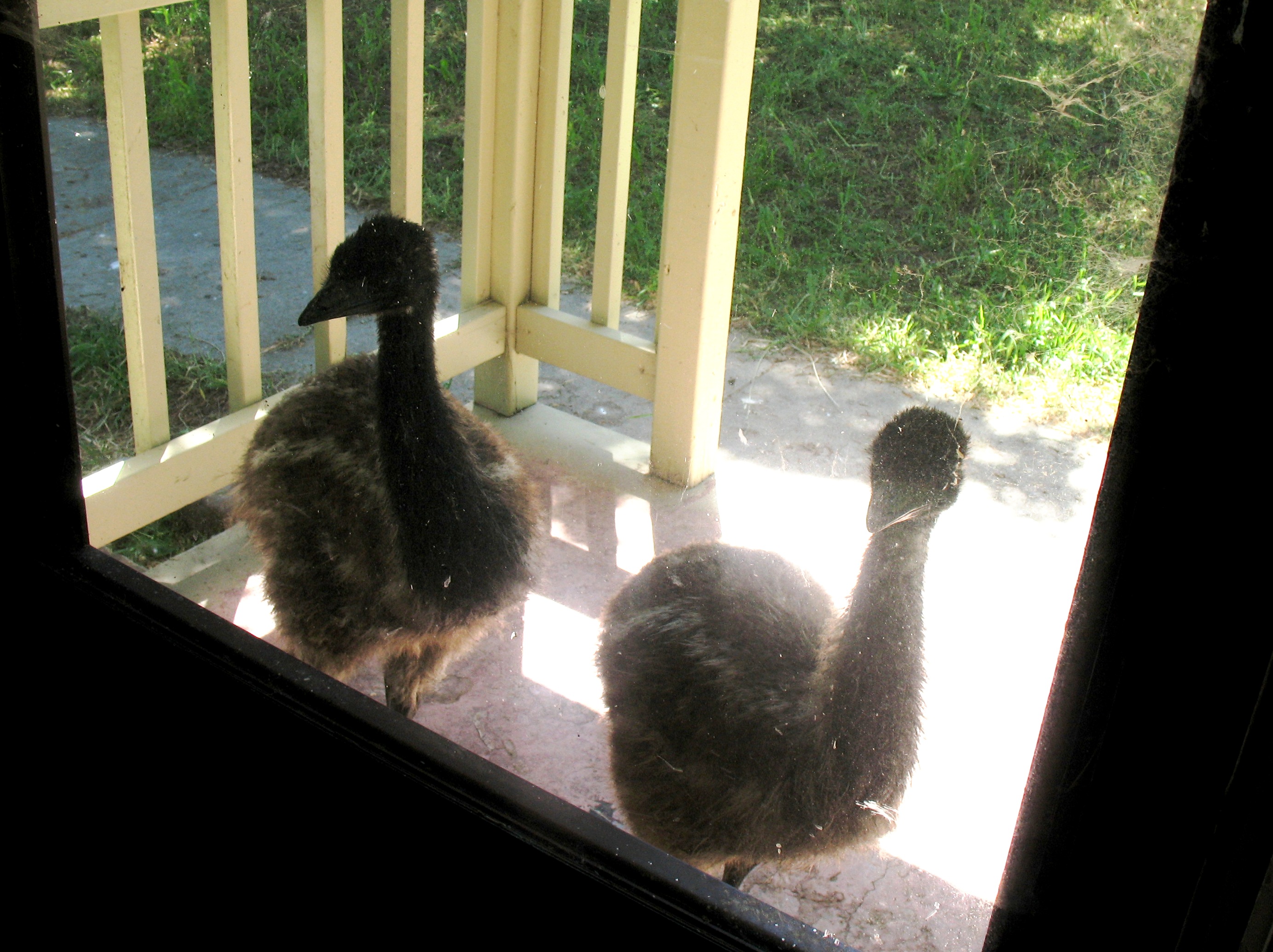
Today was just such an exercise. I decided to wash off the front porch and clean the sidewalks. (Dirty birds!) Rick came along to man the hose—and the emus’ curiosity revealed them for the eager children they are. They seem to love anything with water. Rick trained the spray into the yard and, with little encouragement, they dashed in and out of the shower like kids through a sprinkler on a hot, summer day. Even after the running stopped, they (Kelvin mostly) stood and let Rick hose them down. Dripping, they followed me as I broom-scrubbed, hopping and pecking at the push-broom like curling champions (sport, not hair.) Cool aplomb gave way to raw enthusiasm as they followed me, chirping at this fun, new adventure.

I decided to wash down the storm door and that brought a new round of chirps as they admired their reflections in the clean glass and then stooped close to peer into the house. They clearly remember that, once upon a time, the house was part of their domain. Someday, somebody is going to open a door, perhaps to call for a kitty-cat and, before they know it, two grown emus will be zipping across the threshold. What a shock it’ll be, and I’m sad that I’ll miss it.

I think I can hear them in there.

I think I can hear them in there.

Too soon, for Gatsby and Kelvin, the scrub-down was done. We shut off the water and put away the broom and bucket. Once we’d retreated indoors, back to work after the break, the emus remained at the door, beaks glued to the glass, hoping for an encore.

Hey, Come out to play.

Hey, Come out to play.

“Hey, can Rick and AV come out and play?”

A.V. Walters

Each year we have this same battle. The swallows arrive and want to build their mud-daubed nests under our eaves. I like them; they’re streamlined and beautiful, swooping in elegant arcs over the farm. I don’t fully understand the dynamic, but in their search for nesting sites, they’re attracted most to the protected areas just over our doorways. They’re almost as messy as emus (on a smaller scale) and, as beautiful as they are, I’m not inclined to duck and take cover whenever I enter or leave our home. One minute they’re endearing wildlife, and the next, they’re a strafing, dive-bombing hazard. They can nest anywhere on the farm except over my back door.

Elmer has a soft-hearted farm rule. Tenants are free to dissuade birds from building nests. (And so I’m out there like a maniac waving my arms, shouting, beating on the window and carrying on.) But if a bird pair builds a nest and lays eggs–they get to stay for the duration. We are not allowed to interrupt bird families.

Some years ago, Elmer was asked by some South American scientists if they could run DNA tests on the farm’s summer swallows. The scientists wanted to know if these Two Rock swallows were of the same family as their own Brazilian swallows.  Thrilled to be on the cutting edge of science, and to watch-first hand as the scientists captured, tagged and took blood samples, Elmer was the chief proponent of the Swallow Investigation. Sure enough, the DNA revealed that our summer swallows are the same ones that go all the way to Brazil.

It’s the same with most migratory birds. We think of them as our songbirds, swallows, warblers, hummingbirds or ducks, but really we share them with their winter neighbors. Even our Monarch butterflies are traveling visitors. The alarming part of that is that we cannot protect them. Habitat must be protected across half the globe to make the world safe for our migratory friends. That knowledge came as a shock to Elmer. The world got smaller with that knowledge. Elmer does his part with the nesting rule.

It’s that simple. One chicken farmer can make a difference with a rule, making it possible for the swallows to live and breed on the northern leg of their annual trek. We can decide to save a species by changing our behavior. Last year, Elmer put an owl house in the peak of one of the barns. Swallows, owls, a little information can go a long way to inform our decisions and how we move through the environment.

That doesn’t mean I’m going to let them build a nest over my door, but they are otherwise welcome visitors. They have as much claim to make a home as I do. And if they get ahead of me, build a nest and lay eggs, I’ll just swallow hard, and endure the inconvenience like I do for the emus. When it comes down to it, we’re all immigrants here and we can just make room.

(Oh, except for those noisy mourning doves–I don’t know what to do about them.)

Another Emu Day

A.V. Walters

The new garden is almost complete. Rick is working the last of the bugs out of the drip irrigation system. Three quarters of the plants are in, either as starts or as seeds. It’s a typical summer Two Rock day. It’s sunny and cool and the afternoon winds have whipped up. Over the weekend, in addition to the garden, Rick and I finished stripping the last of the diseased peach curl leaves from the peach tree. We’re in good standing with our spring/summer farm chores and it’s not yet Memorial Day.

With all our attentions elsewhere, the emus have been on their own. Their job at this point is to eat and grow into full size emus. If I sleep in, their chirping reminds me in the morning that it’s time for emu kibble. I wonder how long they’ll keep the chirping. I’ll miss it when they stop. They continue to lose their baby feathers and their striped markings. Rick and I can tell them apart, but nobody else can.

Elmer would like to tag them somehow, maybe with anklets—to tell their gender in the future. I’m not sure what kind of identification system would work, and still let them grow. I look at their dad’s feet and there’s a lot of growing to be done yet. I think they have a few weeks, if not a month more with us, before they’ll head out to learn the sheep trade. In the meantime they’ve become quite territorial about the front yard—keeping the feral critters at bay. They chase the dairy trucks, from the safe side of the fence. I wonder if the drivers notice…and wonder.

They’ll make good guardians, unless the predators come bearing apple treats.

The Last Garden

A.V. Walters

It’s hot in the valley. And dry. This has been on odd year. We had heavy rains in November and December—with an absolute deluge the first week of January. And that was it. Winter is our rainy season, but this year, it wasn’t. After that, we had a few light rains and one storm in the spring. The local farmers are nervous. Over all, the state isn’t experiencing water shortages. There was a heavy snow-pack early this year, so the reservoirs are full, but those that depend on local, well water may be pumping dust by the end of summer.

The past two weeks they’ve been cutting hay. Sometimes, especially here, where we can have drenching fogs, the farmers can get two cuttings, in the spring. Last year it was cool and very foggy—so, we saw three hay harvests. This year, they’ve cut the first time, and it’s dry and yellow underneath. One cut is all they might harvest this year. That means when the summer heat hits, and all the grass goes, (first to gold, then to brown) they’ll be using up the limited hay supply for the dairy and beef herds.

Like I said, the reservoirs are full. Water managers around the state got their snow-pack early so there’s no hew and cry over it being a drought year. In an odd twist of fate, the cities have water, but reservoirs that supply them don’t help the farmers. And, they don’t recharge local aquifers on which the rural areas rely for well water.

Changes in our lives have us wondering how long we’ll be here. I’ve loved Two Rock, and it’s been good to me. But it’s time to move on to build a different future. (Maybe somewhere where there’s water!) So I wasn’t sure this year whether I should put in a garden.

I have been in charge of the farm garden for going on seven years. If we plant it—and have to leave—would someone step up, and care for it? This year was to be a banner year. Over the past few years, the main garden has been shaded by a line of trees Elmer planted to stop erosion from the dairy next door. If ever there was evidence that livestock can damage the land—the field next door is a clear example. The land drops two feet at the edge of our garden—right at the fence. The cows line up and watch me while I garden, and because of the drop we’re nearly at eye level as I bend to dig or weed. It’s a little weird. In any event, late last season Rick spent a couple of weekends pruning and topping that line of trees. This year the garden finally enjoys as much sun as it did when I first arrived.

Early in the spring I asked Elmer how he felt about putting in a farm garden. He hemmed and hawed and finally said we should. We discussed the dry winter and I said that this year we were ready with the drip irrigation. (Rick set it up last year and it was a huge relief in the workload.) I told Elmer I’d get to the garden once he’d plowed. Usually he plows in April, and then again in the first week of May. That digs under any weed seeds that might flourish in the fresh, loose soil. This year he didn’t plow. And, I waited.

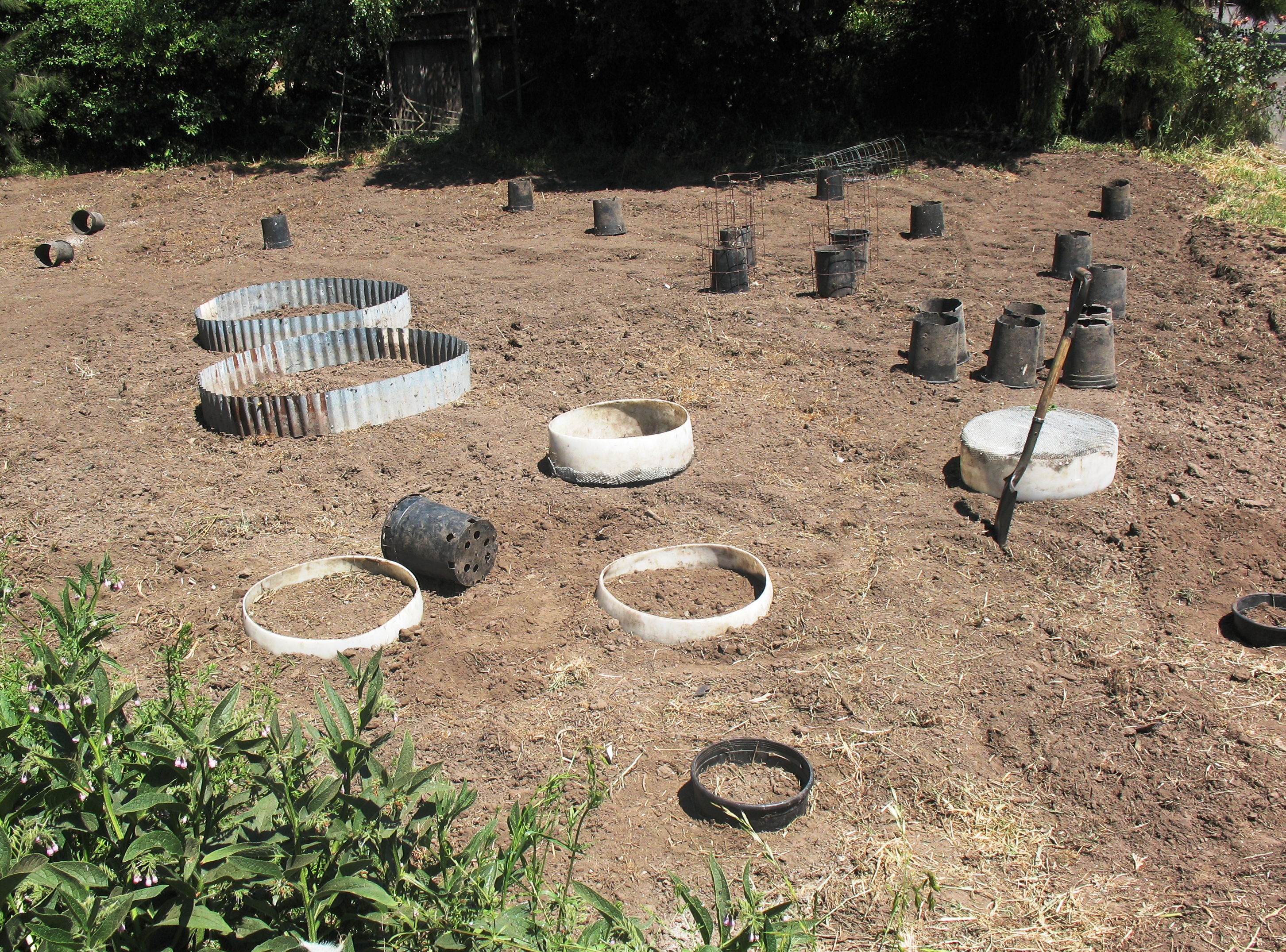
Finally, I figured he’d changed his mind. He did plow what we call the “orchard garden,” where he and his girlfriend plant their personal stuff, but he didn’t plow either the main garden or the long garden by the chicken barn. I saw that he’d plowed and tomatoes appeared by the orchard a couple of weeks ago. In the meantime, spring has rolled to summer. It’s hot and digging is getting difficult. With all this dryness, we are getting an early start on the hardpan layer in the soil. It’s a curse and a blessing, that hardpan. If you wait too long to put the garden in, the digging is near to impossible. But that same hardened layer keeps the soils underneath moist. If you water smart—you can do a garden with very little input. That’s the theory behind our bucket gardens. (See https://two-rock-chronicles.com/2012/07/04/the-proper-planting-of-buckets/)

Getting Ready

Getting Ready

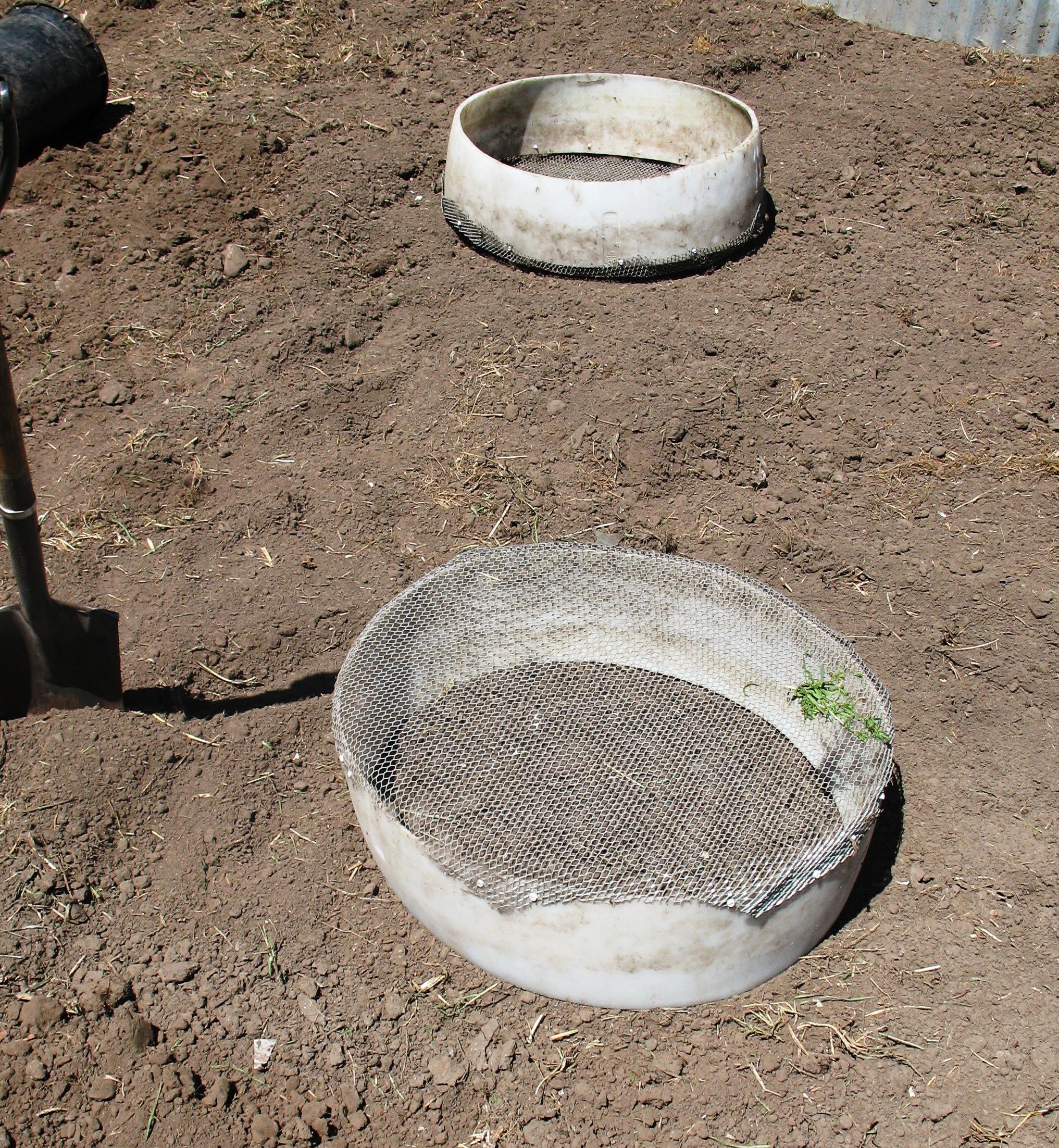
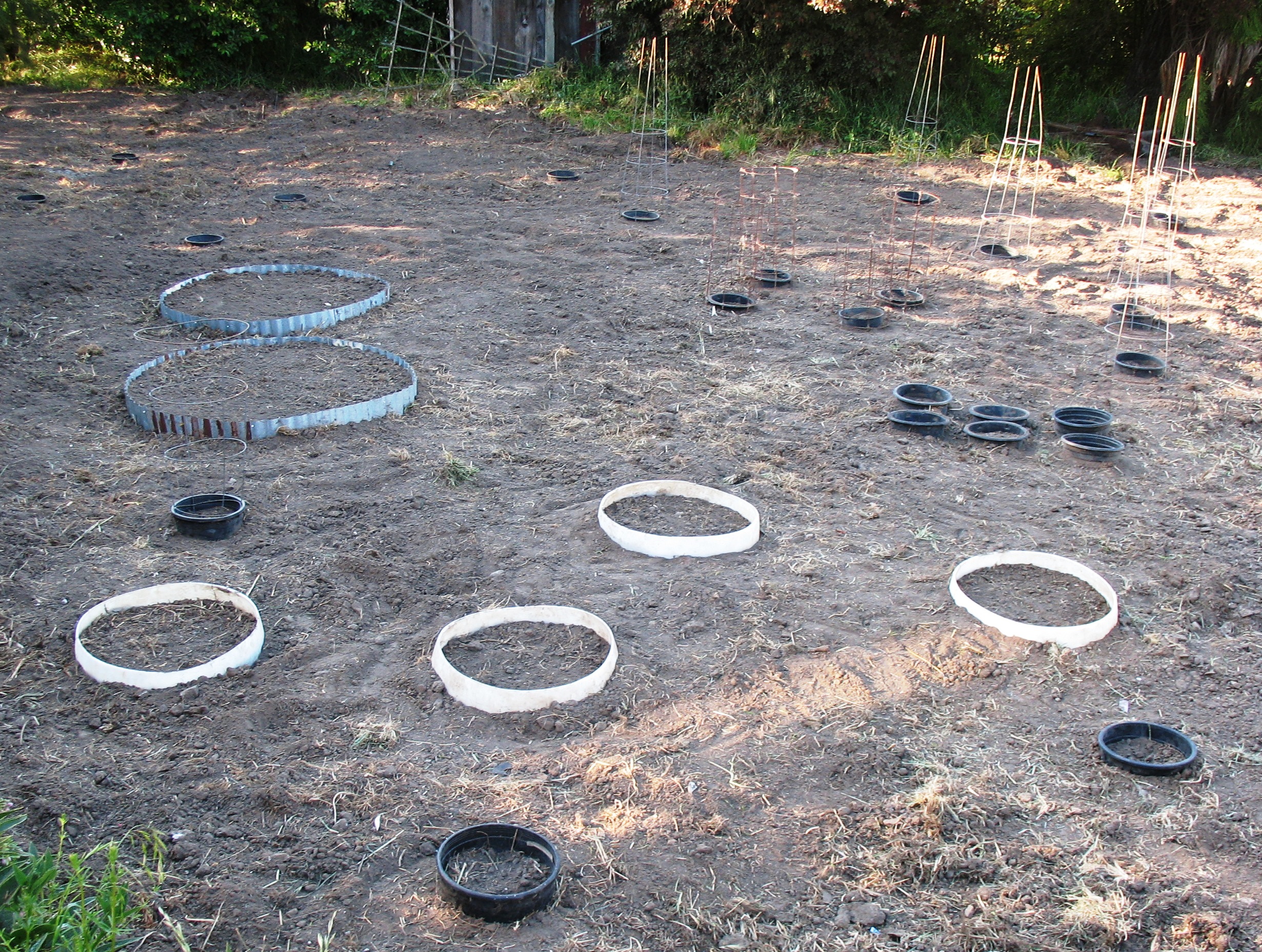
Without a word, Elmer plowed Friday night. Late. I woke up Saturday and realized that I needed to put in a garden. I’d already become accustomed to the idea of no garden, so this is an adjustment. The plow didn’t go deep enough to deal with the hardpan, so digging-in the buckets is a lot of work. If you don’t loosen the soil under the buckets, the roots won’t get beneath the hardpan into the moist earth below. So today I dug in enough buckets (and gopher-shielded rings and corn rings) for a modest garden. It’ll host eight tomato plants, half dozen peppers, four cucumbers, some zucchini and yellow crook-neck squash, a couple of winter squashes, beans, some lettuce, spinach and herbs, and corn. That’s enough for the farm tenants, since most don’t cook much and fewer avail themselves of the garden. I’ll plant with seeds and some starts, this week. I’m not planting the long garden this year.

Digging-in

Digging-in


Gopher proof rings

Gopher proof rings


I don’t know if we’ll be here for harvest. (But, we should be able to enjoy some of the early offerings.) With the drip system, the garden will trickle along, with or without Rick and me. It’ll be like a ghost garden. If that’s the case, I can only hope my farm neighbors will enjoy the harvest. (Assuming someone will water it, said The Little Red Hen.)

Ready for plants

Ready for plants

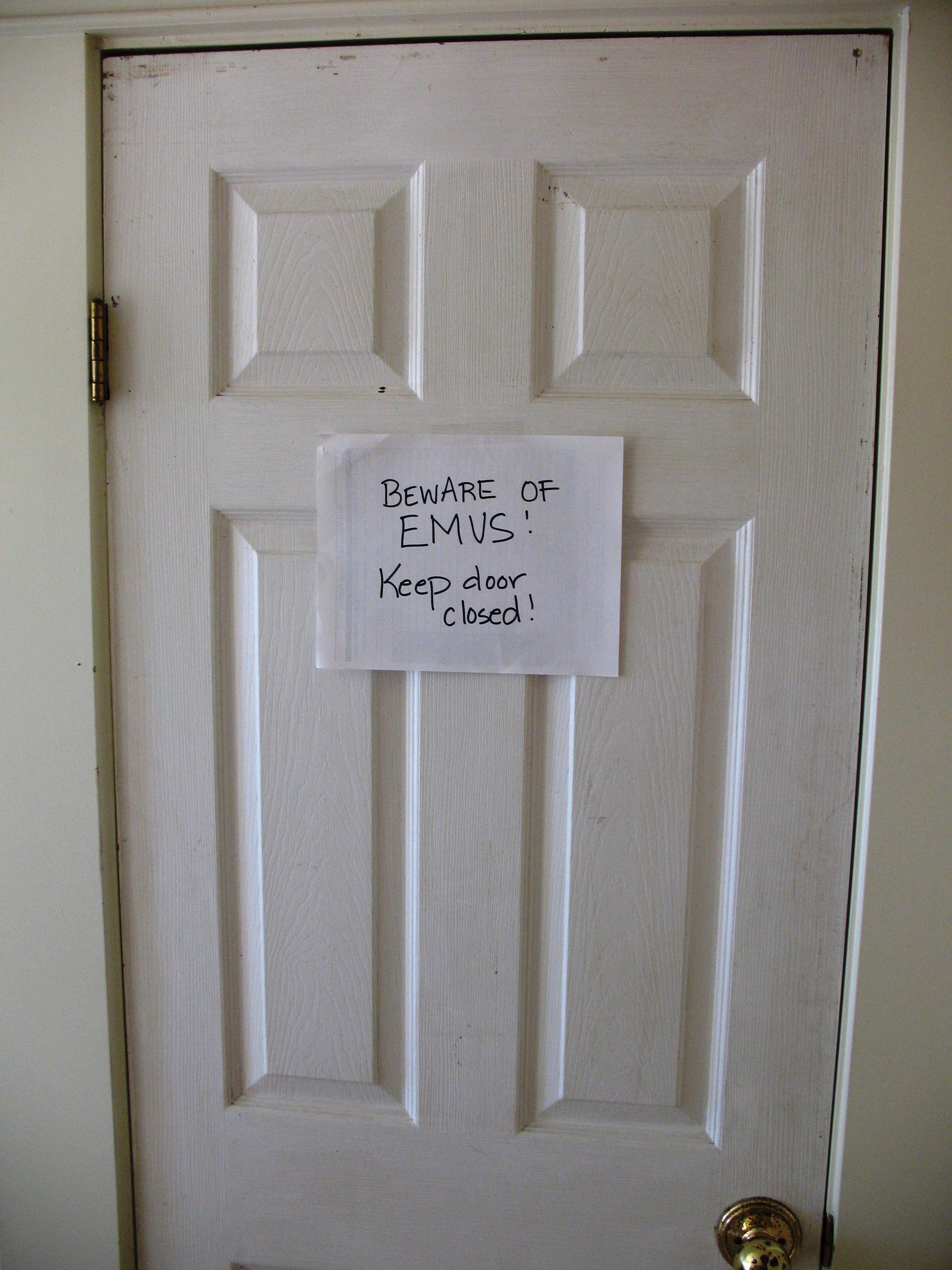
Beware of Emus!

Emus and The Great Outdoors

A.V. Walters

I have a friend who, when her last kid headed off to college, remodeled the newly vacant bedroom, making a sewing and project room for herself. After twenty-two years of putting every one else first, the house, and her life, underwent extensive renovation. It was a shock to the kid when Thanksgiving rolled around, and the room had been, as the French put it, “repurposed.”

Last weekend we came home from a grueling day of volunteering on a day that had started out nippy, but quickly warmed to blistering. The night was clear and warm, and the emus had spent the long day outside. I went into their little bathroom retreat to do the daily clean up before letting them in for the night. Needless to say, it was, as usual, filthy. We looked out at our frolicking prehistoric birds and decided it was time. I fed them outdoors, an odd ritual because they’re grazers. Outside they are surrounded by food, but it made me feel better to give them their kibble. They haven’t been inside, since.

Her neck has lost almost all markings

Her neck has lost almost all markings

Emus and The Great Outdoors

He still has his baby speckles

I spent a full day cleaning out their room. Rick vacuumed and mopped areas where they’d been and I washed out everything from the back entry clear through to the front door. Emus, no more! The final act was to take the sign down from the bathroom door. It was liberating to return the house to mammal-only occupation. I’m glad we did it, and we’d do it again, just not inside!

The emus seem very happy in the front yard. It’s a big area, and a perfect emu training ground for the open pastures with the sheep. Outside, they look smaller but every now and then I note the changes. (The effect is exaggerated because we haven’t weed-whacked since the birds have been out front.) Their heads can easily reach my waist (and curiously, pluck my neatly tucked-in shirt from my jeans.) Initially they cowered in fear at any new thing. Now, when the loud and lumbering dairy truck goes by, they chase it along the fence, as though their patrol activities had actually run it off. Yesterday a feral cat jumped over the fence and, with apparent glee, the emus gave chase. Nothing in that cat’s experience had prepared it for the charging birds. A possible dinner had now turned into two, possible diners! From the birds’ perspective, they’ve been hanging with cats for their whole lives, but none had ever been game enough to give them a real run for their money. Our cats are smarter than that. (Well, and a little intimidated.)

He goes into the emu roll!

He goes into the emu roll!

The emus still like to hang out with us humans. I sit and drink my morning coffee on the front steps. I give them kibble morning and evening, though they could really survive only on the greens out front. They hover, looking for treats, a stroke on the neck, or gently pecking at any speck or spot on our clothes. It’s emu grooming—I guess it means we’re family. They like to tug softly on the ends of my hair. They are particularly fond of pecking at the contrasting wrist-bands on one of Rick’s shirts. The other day one caught a glitter and, in a flash, snatched one of my earrings! Thank god it didn’t taste very good and she spat it right back out. I’d hate to consider the alternative retrieval methods.

Scruffy!

Scruffy!

These days, the emus are looking teenage-scruffy. They’re losing their baby feathers (and with them, the markings by which we’ve identified them.) Underneath we can glimpse the sleek dark feathers to come. As chicks they looked like Scandinavian rugs but now, they look a little moth-eaten. We can still tell them apart, though. The presumed female has gotten much larger. More than that, they have distinct personalities. The female is more assertive, while the presumed male is reserved and gentle. He eats constantly, a nibble here, a nibble there, and barely touches my hand when I give him treats. But, she wolfs down her food! (Just like her mother!) So much so, that sometimes she needs to go and get a drink of water to wash the bolus of kibble down that long neck. Our gender assumptions are based, in large part, on the personality traits of the emu gender reversal. We shall see, well down the road, if we are right.


Mr. Emu  (Dad)

Mr. Emu (Dad)

Sometimes I’ll look at my stats and see that someone has found my blog based on a particular search. Maybe I know the answer–but it isn’t really clear in my blog postings. Then I feel like I’ve let that searcher down. This morning there was a search “baby emu falls down, rolls and gets back up.” Where are you searcher? I imagine that you’re expressing concern about your baby emu, that maybe you think there’s some terrible neurological problem. Fear not! Come back, come back. I have the answer. Your baby emu is playing! Yes, that’s right, we call it the emu dance.

Have you ever noticed that when creatures play (including us) they mimic adult behaviors (behaviours if you’re a Brit or former colonial)? Kids build forts or play house. Kittens roll and tussle–chase things and pounce. Emus dance. After all, without arms there’s not a lot of variety in the play department. That “drop, roll, and run” is a prelude to an emu courting dance. If your baby emus is doing it, it means she/he is happy. They are playing in the only way an emu knows how. (Often, immediately afterward they’ll race around at high speeds–running is another emu talent used in play.) The really fun part is that sometimes, they’ll do it to music! It’s a sight to behold. They love music, especially if the music has whistling sounds or flute solos–high notes that sound like Papa emu’s whistling tones. Also, if you can whistle, it a great way to summon your emu, because they are already pre-wired for that sound.

I hope that emu questioner comes back–there’s no need to worry. (Next time, think about posing a question in the comments area.)


Now, for the meantime, I’m back to my volunteer work.


It’s that time of year again…that time when we roll up our sleeves to volunteer as amateur builders (well, I’m an amateur, but Rick’s a pro) and spend a couple of weekends fixing up the homes of seniors and those on fixed incomes, so that they can remain comfortably in their homes. Rick and I are House Captains on a big project this year–so for the next week or so, there may be scant activity on the blog. Bear with us and our aching muscles. We have an entire yard to transform, two porches to rebuild, a bathroom to remodel. wiring to upgrade, a chicken coop to build, a garden to put in, fences all the way around….it will be transformative for all. But don’t worry, it’s not just us. This organization (Rebuilding Together) recruits a zillion volunteers for the ‘big day.’ Our project alone will probably have 40 volunteers who show up, work gloves in hand, ready to pitch in. (And we’ll need them.) On a large project like this, one day isn’t enough, so Saturday we met with 15 volunteers to set the fence posts. We cleaned up a lot and cut down some out-of-control trees (so there can be sunlight in the garden.) One of our volunteers yesterday was 83! (He’s worked on several of our projects and he works so hard he puts the kids to shame.)

This week is planning and logistics. Then, next Saturday our army of fresh-faced, muscle-flexing, angels will descend on the site and, by days end, our exhausted crew will go home with amazing images of before and after dancing in their heads. It’s incredible what you can achieve with good will, doughnuts and coffee! See you soon when things are under control and Rick and I can return to our own dreams of building a future.

Don’t worry about the emus–they’re thigh high now and spending their days munching away on the greens in my front yard.

They Grow-up So Fast

A.V. Walters

When the two baby emus made their run for it, we realized that the small pen in the back yard was too small. Still, they could have said something, instead of just making a jail break and heading out for the highway. A growing emu needs room to stretch its legs. (And, we can appreciate that, because if there’s one thing a emu has, it’s legs.) There’s a balance; too little space and they get bored and nervous, too big a space and they are intimidated and cower in a corner.

IMG_0750

IMG_0740

So, with the help of some folding pen-panels from Elmer, we secured the front yard.  Now they have a forty by eighty foot area with trees and bushes, and grass almost as tall as they are—enough for any growing emu. They seem mollified and haven’t made any further escape efforts. (Not that we’re giving them much opportunity.) They roam about eating the greenery, and have decided on a favorite corner for their hangout. The new digs won’t eliminate fence running (that’s an emu fact-of-life) but it has stopped the neurotic pacing. Also, the emus seem very much in tune with the sounds of our voices (even when we’re inside the house) and that appears to give them some reassurance that they are not alone and unprotected. (I know, I’m anthropomorphizing again, and being an overly vigilant parent, but when I talk on the phone, in my office, they gather at the steps outside and munch away quietly. If I move to the living room, they munch away under the window, there.)

Huh?

Huh?

It’s still too cold at night for a complete outdoor lifestyle, though that’s coming soon. It might have happened this week, but I’ve been down with a bug. When I’ve got chills and fevers I’m less inclined to banish the babies to the elements. Now that they’re in the front yard—we need to parade them through the house, morning and evening to get them to their little emu warming station in the back bath for the night. It’s quite a production—much emu cheerleading banter—to get their enthusiasm up—followed by a mad dash to the destination (front door or back bath.) The emus will follow you if you walk fast or run. But they’re not smart. If they’re distracted along the way they’ll forget the objective and then wander around the house, which, given their messy proclivities, is not a good thing. Rick is much better at it than I am. They really get that cheerleading vibe from him and follow at a clip. I spend more time in emu roundup mode, rather than leading.

IMG_0728

They are destination happy. Once outside, they barrel around in circles at full speed.  And, full speed is impressive. Their legs have grown and they can really move. Standing around, they’re knee-high, but when they do their happy dance, they come up to mid-thigh. An adult emu can run 30 miles per hour. I haven’t clocked these little guys, but they outrun us.  The “lawn” is hip-high on them (shin-high on us) and, running, they look like they’re speed-swimming on a sea of green. All this cavorting and dancing I take as a sign of healthy, happy emus. In the evening, they’re eager to come back in and canter after us to settle in under their heat lamp to relax after a long day of emu vigilance.

IMG_0724

Most of their food now comes from grazing, putting a welcome end to the endless chopping of their early days. We still give them apples, as treats. It pays to have something they want, to get their attention. At some point we’ll have to move these guys to the pastures, where the sheep are—and we’ll probably need those treats as bait. There’s a tension to how much we handle them. There is one kind of contact they tolerate and, if they’re relaxed, actually seem to enjoy—they like having the front of their necks stroked. (We’re suspecting that neck contact is important to them. If the chicks are nervous, they’ll pace and crisscross each other with their necks. Also, the few times an adult emu has displayed what might be considered affection, it “caressed” with its neck.) But, we have to remember they are not pets. They need to develop a tolerance to human contact without making them dependent, so “training” is not an option. (Besides, they’re not that bright—think of the term ‘bird brain’ in the context of a 150 pound, flightless locomotive.) Still, it’s fun and gratifying to step out on the front porch and immediately have two emus hurtling in your direction to see what fun or treats are in store (and because they like to be near us.) In fact, I think I’ll go check on them, right now.

Apple treats, anyone?

Home Again, Home Again, Jiggity-Jig

R.R. Edwards

I had just turned onto our road, after a trip into town, and about half way down the half-mile stretch to the house, I spotted a couple of odd creatures standing in the road. As I got nearer, it became obvious that they were, in fact, some kind of bird. At first I thought they might be a couple of escaped chickens and, as I got closer I saw that, in fact, these were escaped birds. But, to my amazement, these weren’t chickens making a break for it—they were our adopted emu chicks, on the loose and halfway to the highway! The last time I’d seen them, they were in the yard, running around the enclosure we’d set up for them.

For a few seconds I just sat there, a bit stunned and unsure what my next move should be. They stood there, staring back, just as unsure about their next move. When I inched the car forward, the chicks answered the question for me—they started heading back down the road in order to put distance between themselves and the mysterious, iron beast that had blocked their path.  So, following their lead, I began my very own, emu round-up, behind the wheel of my trusty steed.

The emus were surprisingly “cooperative”—they kept scooting along at a relatively brisk pace and, only once, did one of them threaten to take off, across an adjacent pasture by squeezing through the fence. Fortunately, he kept moving in the right direction and, when the fence ahead of him ran out, popped back out, onto the road. When we arrived where the road split, (straight, the road took you to the neighboring dairy, and to the right was our place) I managed to steer them in the right direction. Now that we’d arrived at the house, the next trick was going to be getting them either back into their pen, or into the house.

At this point I had to hope that “Mother Nature” (in a twisted sort of way) would take over, and that the chicks’ bond to me was strong enough to overcome their confused and somewhat panicked state. I got out of the car and slowly approached our feathered charges, afraid that all my work would be for naught, and that they would bolt. But, as soon as I called to them, their little heads spun around and they came running up to me, cheeping away. They were clearly thrilled to have been found by a “parent” and would have happily followed me, anywhere. Since it was lightly raining, and they looked a little soaked from their adventure, I led them inside where they could huddle under the heat lamp to dry out.

After telling AV, “Guess what who I saw standing in the road,” I realized how lucky we were, in so many ways. Once they got out of their pen, they could have headed in any direction. We’re surrounded by miles of open pasture, and once out there, they would have been next to impossible to find. The fact that they’re “fence runners” kept them on the road, between fences, but they had covered a quarter-mile, in a relatively short amount of time, and had I been back much later, they might have made it to the main road and hitched a ride to just about anywhere. Or, when confronted by me on the road, they could have “flipped me the bird,” and taken off in any direction. (And, these little guys, at the tender age of 1-month, can out run me!) All kidding aside, we lucked out that our little birds are home safe. I would have assumed that, once out of their pen, they would have stayed around the house, looking for us or a way back inside. But like most youngsters the thrill of adventure dulled their sense of self-preservation, and down the road they happily trotted. Clearly, the trials and tribulations of parenting (and youth) are universal.


Easter Emus

A.V. Walters

It’d be quite a joke, wouldn’t it, to give someone an emu chick for Easter? Precious and cute and the size of a teacup, they’d have no idea what was coming. It’s Easter and our two remaining chicks are a month old. They’re the size of small geese. Cleaning up after them is quite a chore.

The good news is that they are gaining body mass at an amazing rate and soon they’ll be fully outdoor birds. Already they spend the bulk of their daytime hours outside in a kennel enclosure. They’d much prefer if we spent the day out there with them, but, after an initial panic, they settle in and spend their days munching on grass and doing the emu dance. At this point they’re too big to be prey for hawks, so I can relax, go inside and get some work done. We know that in the wilds, they’d be out and about already, but we are protective guardians and want them to be fox-proof before we put them out in the pasture.

Since they get so upset if we pick them up, this week we’ve reverted to herding them. Their first trip down the nine steps to the back yard was quite an adventure (it looked like emu snowboarding) but now they take the steps like pros—nothing to get excited about, just out for a stroll. We still run them in the kitchen at night (and give them apple treats.) Mostly I continue this because it’s so fun to see Rick do the “excite the emus” run. He’s raised kids, so he knows the universal language of baby talk. It is universal—even emus respond. I can’t tell who’s more adorable, the emus, or Rick with the emus.

For a few weeks we lined the interior of their little tiled room with newspapers. Not only was that a messy affair, but we don’t take a paper. We are fully digital in the news department. At first Elmer provided some, but country folk are stingy with their newsprint. Everybody uses newspaper to start their woodstove fires. When I found myself snitching the free papers from the stands in town—well, something had to be done. I’d started rating them by their absorbance—not the measure of print-worthiness to which most writers aspire.

Rick solved the problem. He bought a roll of heavy craft paper and cut numerous templates of the floor—emu carpet. Now I pick up—and then every couple of days just roll a layer off and dispose of it. Like I said in an earlier post, Kids, don’t try this at home.

And that emu dance! It’s quite a sight now that these guys are thigh high. (It’s even more impressive with the adults, because, as you might have guessed, this dance is the early training for emu courtship.) I know that we have happy emus when they do the emu kicking roll, dance steps and then hurtle around the enclosure at breakneck speeds. (I’m really understanding that expression, now.) I’m hoping for rain today because the emus love water, and I’ve heard that they dance in the rain.


Pictures later


Country Fresh

A.V. Walters

Even while I lived in the city, I hung onto my rural roots. I gardened and produced most of my summer fare from a postage stamp-sized back yard. I canned jams from the plum tree, and I hung my laundry out in the sun, to dry. So, it should come as no surprise that, when I moved to the farm, not only would I want to continue these patterns, but there’d be some room for expansion. But when I explained my plans to Elmer, he seemed a bit alarmed. Not at the gardening, that made perfect sense. And, like a lot of country folk, he fully supports canning. The problem arose when I asked Elmer to put up a clothesline, of all things!

He squirmed at the notion, “Why the heck would you want to do something like that?” I was ready with my environmentally friendly, power-of-the-sun, low-carbon-footprint, Pollyanna diatribe.

“Well, we have a lot of wind, you know. It whips up the dust, and all. So, you’d want to be sure to bring it in before the afternoon winds start up.” He didn’t sound convincing, and it seemed like a strange response—a little wind would be exactly the ticket. In what better environment could there be to dry laundry? (I’d failed to note the almost-complete absence of clotheslines, in the area.)

Elmer never did help out with getting that line up, and given his reaction, I didn’t press it. After a while, I bought the materials and installed it myself. And, he was right about the wind and the dust. If you left the laundry out, late in the day, you’d have to wash it, again. But our mornings were still, and my line was set up to take advantage of the morning sun.

One morning I pulled a fresh towel from the line and headed into town for a swim. (There’s nothing like a vigorous work-out in chlorinated water to clear your head.) As I walked back into the changing room, I caught the unmistakable stench of cow manure. I laughed to myself and thought, somewhere there’s a farmer in here, for sure.

I’ll have to admit, here, that when you’re exposed to something a lot, you become, well, desensitized and… I live next door to a dairy. So, when I grabbed my towel, I almost choked. That farmer was me! And that certainly explained why they don’t hang their laundry out. Oh my! And that was the end of my energy saving foray with country laundry.

Someday, I’ll live somewhere with a different background aroma—and I’ll go back to the clothesline. (Rick said he thinks he knows the perfect location.)

A Little Bit of Wild…

A.V. Walters

Emus are not domesticated creatures. They are ancient creatures, virtually unchanged for many millions of years. We cannot own them, though we may “keep” them. They are not really pets. Nowhere is this more clear than when one tries to transport them. Try to put them in a box, and they panic. They thrash. They can even fight to the point of injuring themselves. There is no such thing as a portable emu. They do not respond to the instruction, “Hey, just chill!”

Even carrying them from their indoor, night-time home, to the backyard is telling (and trying.) This should be routine by now, but every single time, they kick and fight and squawk. Our first emu pioneers, The Royals, made their trip in a big box. On arrival one had managed to kick himself into a royal limp. It’s minor, and will heal, but it speaks to the difference between a domesticated animal and a wild one. We can keep company with the wild but we cannot bend them to our will. Last night, when outbound emu number three was loaded into a kennel for his trip to its new home, he fought like a ninja (but without the grace.) It’s a little heartbreaking to see, and makes for a traumatic farewell, even when they’re off to the best of new homes.

In this case, the emu we knew as DotDash, will be a guardian/companion animal to a new flock of sheep. We were duly impressed with the new keeper, a diligent 16-year-old girl who is building a flock of prize sheep. She’d done her research and found that an emu guardian was a sustainable and viable way to protect her investment, both emotional and financial. She’s familiar with chickens and other livestock and I queried her about her commitment to an animal that will live about thirty years. She had considered it, and sees agriculture as a lifetime commitment for her. So, an emu fits the bill. I asked, “What if you go away to college, what of the emu then?” She was ready for it. Emus are low maintenance. Her parents (who have fifty acres nearby) are already committed to the sheep, so an emu actually helps that dynamic. And she won’t go far away.

I worry that we don’t have many young people interested in farm living. Almost all the farmers and ranchers I know are at an age when most people are talking about retirement. It’s not an easy life but one that comes with many rewards. In the absence of an investment by our youth, where will we get our food? From corporate farms? What kinds of stewards will they be of our precious farmland? What do they add to a farm community? So, how could I not honor this young lady’s venture into agriculture? She embodies everything I think we need in a new generation committed to the land, even if it puts her out-of-step with her social cohorts.

We spoke at length, and I think she understands the compact that we have with emus. She respects that her new emu charge is wild, and that in that wildness is a trait—protection from canine predators—that walks in step with her needs with sheep. So off he went, kicking and peeping to a new life. I think both of them—the emu and the girl, will do very well; there’s a little bit of wild in each of them.

Two Down…

Announcing, The Royal Emus

A.V. Walters

There are many considerations in the placement of an emu chick. One must determine the environment in which it will live, and its intended work, so as to match the temperament of the bird to the life it will enjoy. And so, today we bid a fond farewell to two emu chicks who will go on to a particularly cushy lifestyle. They will be The Royal Emus, who have actually gone off to live at a castle.

Soon to be 3

Soon to be 3

It was a tough call to make. Not the suitability of the placement, but which chicks to send away—one of the emu emissaries was our favorite. We called him C3, because of the markings on his head. He was not only the youngest, but also the most independent of the lot. He was the one always ready to stir up fun, in a very emu way. When emus play, they drop to the ground, roll over while kicking, and then jump up in a frisky dance followed by running in circles like maniacs. If any of the other chicks is up for it, they’ll repeat the performance and the bunch of them will run around—smashing into one another like bumper cars. C3 was the main instigator of the high-jinks. He was also one of the most gentle of the bunch. He (she?) and the other youngest (whom we called Sleepy) seemed like the best personality matches for this particular gig.

They will get menagerie duty—being visited and guarding the menagerie of animals at an upscale vineyard in Napa County. It’s a good gig, one I’d take in a heartbeat if it were offered to me. And they’ll get to live at a castle—and so, royal emus. We don’t know what their formal names will be (we’ll just have to wait for the coronation, like all the other commoners) but, once they’re grown, you can have an audience with Their Highnesses at Castello di Amorosa in Calistoga. You’ll find them ambling through the olive orchard, or looking regal amongst their subjects, the lesser critters—sheep, chickens and peacocks (who really think they’re special.) As for us, well, we took a discount on the price (an inducement to take two, instead of one) and got a bunch of wine thrown in, just the thing for celebrating our first (and probably only) successful emu raising and placement. (A lovely 2008 Cabernet, fitting to the occasion.)

This sure beats the assignment for one of the other inquiries we received. They wanted to know if our emus could guard their sheep from mountain lions. They’ve apparently lost 24 goats, this year, to lions. (I’d say there’s a very healthy, and growing, lion family there.) We quickly hit the internet to find that emus are no match for lions. At best, they’d maybe slow the process as the lions worked their way through the emus, before moving on the other animals. But the words, “Tastes just like chicken,” kept ringing in my ears, so we enlightened them as to the facts of nature, and declined their offer.

We’re now left with three. Elmer only wants two, but he says he’d keep three if the alternative meant having to send one off to a lonely life. (Of course, that’s easy for Elmer to say, he doesn’t have three emus in his bathroom!) Still, it made us feel better, because we felt the same way. We only want the best for our little emu chicks—even the ones who have gone off to a luxurious life of fame and fortune, leaving us peasants behind, to clean up after their three siblings.

Funny thing is, we’ll probably visit.

Indoor Emus?

Kids—Don’t Try This At Home

A.V. Walters

We really don’t have much in the way of options in this. We are renters. We don’t have easy access to a barn or a shed or other outdoor structures that we don’t mind being trashed by five of the messiest creatures on earth. Still, these emus are technically babies. They still need to have an environment that is heated until they reach a body mass that is large enough keep themselves warm. We put them outside now for several hours each day. It’s a shorter run if it’s cloudy, or if, like today, it’s raining. I’m watching to see when they start to tremble, at which point I’ll haul them back in and put them under the heat lamp.

While they’re out frolicking, I take the opportunity to clean their little room. I’m so relieved that it is a tiled bathroom. Even then, I line it with newspapers everyday, so that I can just roll up a day’s worth of filth, and dispose of it. You cannot believe how much “trash” is generated by five emu chicks! They’ve almost tripled in size since the first day we took them in, at the beginning of the month. They’re growing, eating and you-know-what, at a prodigious rate. It’s not surprising—an emu reaches adult size and weight in about a year. By comparison, it means they need to grow the human equivalent of a year’s worth, every month. They are now knee high, without much of a stretch. (And that means that their “mess” extends up the walls, that much higher now.)

It raises the issue of how one measures emu growth. Their flexible little necks complicate the equation. Extended? On tippy-toe? (And yes, they’ll stand on tip-toe to look into the trash bin, to peck at any odd spot, or over a low enclosure.) The knee-high average is just standing with no effort at extension. I suppose the best way would be to weight them, but they’re so wiggly that I can’t figure out how to get them back on the scale. Just weeks ago, when we weighed them in at teacup size, it was a relatively easy proposition. I can’t imagine doing it now.

And, fast! They can run. Together they move like fish in a school, (well, a school of kindergarteners) en masse with sudden, inexplicable and semi-choreographed changes in direction. They also dance and play—a series of hops, often preceded by rolling over and then followed by a group mad dash in every direction, knocking each other down if at all possible. It keeps up laughing.

With any luck, two will have a new home by week’s end. The first potential adoption fell through when the gentleman realized how fast they’d grow, and how hard it would be to relocate them for his scheduled move in eight months. “Maybe next year.” Ha! Do you think I’m going to do this again? But now, there’s a much better prospect in the works. Every now and then, when I worry about how to adopt-out emus, I realize that it’s not really my problem. (Yeah, I know. If it’s not my problem, then why am I up to my knees in emus?) I’m just a renter here, and these are Elmer’s emus, after all. Well, you know, I could just move away…

Tomorrow someone is coming to look at two emu chicks. We may be down to three! Elmer wants to keep two, so my emu responsibilities are quickly being resolved. It’s been a long and interesting adventure.

Posted: 2013-03-17, 3:03PM PDT

EMU CHICKS – $100 (petaluma)

Pets or as guardian animals for sheep or goats. They also make a great 4-H project.

Approximately 3 weeks since hatching, these critters are at a perfect age to bond with new owners–or to begin the orientation process for bonding with your herd. They still require some hand-raising but are now comfortable outside, unattended. The price will increase from here–to reflect the additional effort in hand-raising.

These are outdoor birds! They’ll grow to over five feet, and over one hundred pounds. They require a fully fenced enclosure. Properly raised they are affectionate and curious. They make good companion animals (horses, sheep, goats, etc., and have completely adjusted to one of my cats.) They are not generally dog friendly (as they see them as predators.)

When threatened, an adult emu can have a nasty kick–which is why they are so effective as guard animals for a herd. They are grazers–eating mostly grass and greenery. In the dry months you must supplement with ratite mix. As long as they have ample water, they make a low-maintenance outdoor pet. As pets they can live decades, a little less as roaming, working guardian animals.

If you are interested in an emu chick respond with your name and telephone number. Applicants will be screened and must have a stable, rural living situation with ample range area for an emu.

Available for pick-up only.

  • it’s NOT ok to contact this poster with services or other commercial interests


Nature Giveth, and Nature Taketh Away

R.R. Edwards

Life in rural Sonoma County can be an odd blend of nature at its best, and then a show of its harsher side. We’d arrived home yesterday at about 4:00 a.m. after a stressful couple of days, and an 11 hour drive. Awaking after only a few hours of sleep, we were beat, and decided it was a day to lie low. We owed Mr. Emu a visit—it had been about a week since we’d made off with his five chicks to give them a better chance at survival, and, after debating about dragging our tired asses out of the house and up the hill, nature’s perfect afternoon of sunshine and blue skies won out.

We made our way past the field where Mrs. Emu was grazing alongside the sheep, stopping only long enough to give her a few pieces of apple we’d cut up for Mr. E. She’s now in the habit of making her way over to the fence when she sees us walking up the road, looking for her share of apple. Further up the road are the two fields (divided by a fence with a gate) that Mr. E has been occupying along with about a dozen sheep and lambs. The upper field holds a pond that you can’t see from the road, and the emu’s nest was near the pond. When we arrived at the lower field, there was no sign of Mr. E. We thought this odd as he’s usually wandering along the fence, near the road, and even when he’s in the upper field, he can usually be seen. It was then that we noticed a lone buzzard, standing in the far corner of the field. I didn’t give it a lot of thought—normally, if there’s something a buzzard is interested in, they’re all interested. Any carrion meal of note is usually well attended. I was about to head to the upper area in search of our missing bird when AV says, “Let’s check it out.”  As we approached, the buzzard took off, abandoning what was clearly the remains of an animal. At first, the only thing I could see was a rib-cage, picked clean. Just as I was thinking it, AV said, “It’s Mister Emu!” My heart sank, and AV looked as if she were about to cry. I wandered closer, and it was then that I realized it wasn’t Mr. E, but the remains of a lamb. It’s not often that we’d be relieved to come across a dead lamb (especially one who was killed by a predator) but, in this case…

After recovering from our initial shock, we started looking for clues as to who the culprit might have been. We didn’t see any tracks or other evidence but concluded that it was most likely a coyote—even though a fox could take down a large lamb, and there are (be it rare) mountain lions about, coyotes are usually the biggest problem.

It was then that we noticed two lambs that were trapped between a pair of fences that ran between this and an adjacent field. (A 6’ wide strip was planted with trees to create a wind-break, and the fences protect the young trees from the sheep.) How the lambs got themselves trapped in there, or how long they’d been there was unknown, but before we took on this unexpected task, we still needed to solve the mystery of the missing emu.

We passed through the open gate, to the upper field, and came over the rise to an open area next to the pond. And there, sitting on his once-abandoned nest, was Mr. E.  Along with this discovery came the realization that he had returned to the nest with the intent of hatching the two eggs he’d walked away from, about a week earlier. In our haste to remove the last chick, we left the eggs he’d abandoned the day before, not imagining he would return to them. In the past, he’s pushed eggs out of the nest, or left them if he determined they weren’t viable, and we never saw him return or reclaim an egg, once he made the decision.  Needless to say, our relief at finding him alive and well was replaced by guilt. First, we’d taken his 5 chicks and then, carelessly left the eggs that he’d now brooded over, needlessly, for perhaps a week. Our learning curve on emus continues to be steep.

We were now left with a lot of questions, and few answers. First, did the predator’s attack on the lamb prompt Mr. E to return to the nest in a misplaced effort to protect his unborn? Or, was Mr. E pointlessly sitting on his nest rather than tending to his duty of protecting the lamb from a coyote? And, why were the two other lambs trapped in the fenced area? Were they fleeing from an attacking coyote by working their way through the fence? Were there originally three lambs stranded between the fences, cut off from the rest of the flock, their mothers and the emu—one falling victim and pulled out, into the open field and eaten? Or, were all these events totally unrelated, and it was just another day on the farm?

We removed the remaining emu eggs from the nest, and made our way back down the hill to the lower field.  We opened up the end of the fenced area, coaxed the two lambs out, and back into the field to join the ewes. We located the hole in the wire fence that gave the lambs access. Whether they wandered in, in search of greener grass, or were spooked by the coyote, we’ll never know. Oddly enough, it was in this same fenced-off area that two emu chicks fell victim to a fox, a couple of years ago. That event also raised similar questions—did the chicks wander in between the fences, where they couldn’t be protected, or did the fox pull them in, seeking protection from the emu parent? AV had come upon the scene, after the fact, where she found a highly agitated Mr. E, frantically pacing outside the fenced area.  There, just out of the emu’s reach, were the remains of one chick, and the other was nowhere in sight, most likely carried off by the fox. The fatal error may have been Mrs. Emu’s choice of a nesting sight next to this fenced-off “no man’s land.” (Though the male emu hatches and rears the young, the nest is established where the female chooses to lay her eggs.) AV returned the next day, with apple treats, and found Mr. E standing at the nest site, still dazed from the trauma of watching his chicks meet a violent end. A surprisingly, touching moment occurred while AV tried to console what was clearly a grieving parent—this oversized, prehistoric beast gently wrapped his long neck around AV’s shoulder, and embraced her.

Today, we headed back over and found Mr. Emu in one of his usual spots—walking the perimeter of the lower field, near the road. We fed him apple pieces and emu chow, and life (as if we can ever truly understand it,) seems to have returned to normal. That is, if you consider five emu chicks living in your bathroom, normal.


Naming Emus

A.V. Walters

Understand, these are not our baby emus. We are merely foster parents, keeping bodies and souls together until they’re big enough to handle things autonomously. (Read—until they are bigger than the things that want to eat them.) They are grazing animals; over their lifetimes, most of their dietary needs will be met by mowing the lawns or fields where they’ll live. In light of that, my relentless chopping of greens and worrying over nutritional requirements is downright silly. But, I’ve failed as an emu foster parent before, and this is looking like my last chance at it, so worry I will. These five babies are in our charge, and I will do the best that I can.

More upright, more stable on their feet!

More upright, more stable on their feet!

For now, I chop up kale and apples into miniscule pieces, toss in enough emu chow (can you believe they make such a thing?) to make sure that they get their vitamins, and feed them as often as they’re interested. Then, I clean up after them. They’re a lot of work.

It’s a good thing that they’re cute—which is my version of Darwin’s Law—survival of the cutest. It applies to all baby creatures (on a relative scale—have you ever seen a baby hyena?) It probably applies to all relationships—they work as long as cute lasts. By that I don’t mean the obvious attraction to physical attributes, I mean that inner essence of the self that shines through in those moments of unguardedness—that’s cute enough for me. I see it in these little emu babes already—the first signs of personality (emuality?) peeking through.

Close up cute.

Close up cute.

They are each very different, at about two weeks old. It may be birth order—just the developmental advantage that comes with hatching five or six days before the youngest of them, but I think it’s much more than that. Some are bold and curious, others find more comfort sticking with the pack. I understand that. I was the fourth out of five (in quick succession.) It’s not that I don’t credit my parents with raising us, but I think by the time you get to four, the younger ones just follow along, doing what the others do.

We are trying not to name these emus (at least, formal names.) They are not ours, and naming is the privilege of the ultimate, emu adopter. Some will be farm emus and never will have names. (You may have noticed that Mr. and Mrs. Emu don’t have specific monikers, just enough to identify gender.) Some will be pets. I can’t say whether emus will ever answer to names—other than perhaps a call to dinner. It’s not clear to me whether emus engage in that kind of pet/keeper intimacy. Though I’m fond of them, I don’t find any demonstrable intelligence in the emu behavior I’ve observed. Much of their actions appear to be hardwired—though I’ve not given them much opportunity to show higher learning.

You see their markings are distinctive.

You see their markings are distinctive.

Still, it’s helpful to be able to identify individual emu babes and so we’ve got nicknames for them based mostly on their individual markings. As they mature, the stripes and distinctive markings will fade, as will the titles they now carry: Two Dot, the oldest and boldest; Dot Dash, just as big but less likely to investigate or venture solo; Blondie, lighter colored than the others, independent and extremely gentle; Sleepy, well, that tells you; and C3, named for the markings on the back of his head—it looks like he was labeled. C3 is the baby. He struggles to keep up with the bigger guys and then immediately afterwards, crashes into a deep sleep. He’s the one I worry about.

Of course I use ‘he’ and ‘she’ loosely here. There is no clear way to identify emu gender at this age—except by inverting them and groping around in there—and even then, only if you know what you’re doing. I’ve looked it up on the net and haven’t decided whether I’m up for that, with this passel of squealing, kicking baby chicks. There are theories about identifying emu chick’s marking patterns and likely gender. They certainly do have distinctive patterns—however, ours don’t seem to match the patterns shown in the photos on the internet. Perhaps we have a tribe of chicks with some new gender form, but I doubt it. Your mileage may vary.

Also, they say that emu personalities are largely gender based. The females are more aggressive, though I don’t think I could separate that out from the effects of birth-order development, at this stage of the game. Gender does make itself clear down the road when they reach sexual maturity. The females’ throats develop in width and they vocalize in a deep thrumming, almost drum-like sound. It’s impressive. The males, I’m afraid, just grunt, snort and occasionally whistle. (Insert your own joke here.) That’s about two years down the road—we won’t be around when these emus can tell us more about who they are. Since we’re not promoting these emus for breeding purposes, I don’t know that gender matters. It certainly doesn’t if your job is to guard sheep. Still, it’s a very basic question, and most folks want to know—is it a boy or a girl? I think that that says something more about how we relate to the animal kingdom, than anything to do with the emus. We pick names to express gender, to tell more about the critter, or the person, even before we meet.

I’m no good with names, anyway. It runs in the family. We joke that names just don’t stick in a big family. When she calls your name, by the time your mother gets to using your name, she’s usually run through most of your siblings’ names anyway. (Jim, John, no… Bob, no, Bill….) So, names don’t stick easily in my head. To make a name stick, I need a voice or a story. I rarely remember faces—at least not without a voice.  But if I get to know your voice, the name will stick. Or, if you tell me your story, I’ll usually capture the name along with it. If I’m lucky, the face will come with the voice. Once my mother came to visit as a surprise for my birthday. I came home to find her and my sister in my kitchen. I didn’t recognize either of them! Granted, I had a bad head-cold, and it’d been several years since I’d seen them, but I didn’t recognize them until they spoke. Unfortunately, before that had happened, I’d turned to my husband and said, “There are strangers in our kitchen.”

There are strangers in our kitchen.

There are strangers in our kitchen.

So giving these little birds names isn’t high on my list of priorities. It’s more important that I keep them fed and safe. It’s fun to watch their antics and to see traits revealed that will tell you about the ‘who’ of who they’ll be in their future. Maybe that’s how it was for my mother, with five little kids within six years.  It must have been a blur, like five little emus slip sliding across the tile of my kitchen floor. It makes me wonder, is there a name for that?

What's the name for that?

What’s the name for that?

So, Here’s the Drill…

(And, this is only a drill.)

A.V. Walters

This must be what it’s like having triplets. We now have five emu chicks in our care. I swear, the older ones have developed a swagger. They are dominant, and clearly in charge. (As in charge as anyone can be, of emu chicks.) The two youngest struggle to keep up and are the first to nod off after exercise or a meal. (Sometimes nodding off while standing in the middle of the food dish.) In the past day or so, the volume of food they eat has quadrupled. They finally have the technique down and are eager to demonstrate their belly-stuffing proficiency. Their food (chopped kale and apple bits) must be finely minced. I feel like a cook at a high school cafeteria, all the work and none of the appreciation.

We’re trying to imitate what would be the normal emu-raising techniques of the average emu dad. (In the emu world, the female lays the egg, and that’s it. The male hatches them and raises the chicks.) At this stage they would need a lot of warming time (and, apparently sleeping time) underneath their dad’s umbrella of warm feathers, so we let them spend a lot of time under the warming lights in their “nest.” We take them out, four or five times a day to “run” them—they need practice walking (and also running.) Because they are enormously messy, (they eat a lot, and so…) they are confined to the tiled areas of the house. (In fact, for one or two of those exercise breaks, Rick has to watch them while I clean their nest and the area around it—you cannot believe the mess made by five, very tiny birds—weighing only about 14 ounces each.) While exercising, we have tissues at the ready. I swear, they must poop their body weight each day. Released to the kitchen area, they run from end to end. (Actually, they’re kind of led—being hard-wired to follow two, tall legs.) Their little emu feet are not designed for slippery tile floors, so once they pick up speed, there’s a good bit of rolling, sliding, and a little bit of crashing, in the mix. I’m convinced that the older ones are doing this on purpose. Yesterday one ran at full tilt, and then went into a high-speed slide, just as he reached the lower rungs of the chairs in the breakfast nook. He slid clear through, under the first chair, stopping squarely under the second.

Out for a walk.

Out for a walk.

I have to give them credit. In less than a week they have managed bipedal locomotion, even standing on one foot to scratch the occasional itch! They mostly eat standing (an entirely different balancing act.) They have (for the most part) mastered pecking at and snagging small food items and then getting the whole business down their gullets. This is quite impressive for creatures whose brains are smaller than an almond.

We look forward to the day that it’s warm enough to take them outside. Actually we need to get an enclosure before we try that (again!) The other day, we thought a little excursion would be good—it was warm enough and sunny. Before we could get the stragglers out the door, two of them had taken off, at high speed, in different directions. We rethought the whole deal and dashed to round-up the two speedsters. They’re quicker than we are—so now, fencing first.

With the little guy, straggling behind.

With the little guy, straggling behind.

They’re fed about four times a day, and that’s a lot of chopping. They have emu “kibble” available all the time, but prefer the fresh, so I chop. It feels as though regular life has been pushed to the wayside to make room for emus. It’s a lot like parenting, without the backtalk. (Well, there is a little peeping.) Already, we have one adoptive home waiting. Some of these emu-babes will find homes as sheep guardians. A couple will be pets and some will stay here on the farm to guard the sheep here.

Are we missing someone?

Are we missing someone?

This fostering gig will be short but intense. The emus will stay with people until they are big enough to have a fair shake with predators, (especially foxes.) They have to be too big for a hawk to carry away, and they will need to get to know the kinds of critters that they’ll be guarding. (Mostly sheep, but one family will have them to guard their free-range chickens.) It’s all in a day’s work for emu foster-parents. At least they’re not asking for the car keys… yet.

Emutude

Another Emu Adventure!

A.V. Walters

It was clear, as soon as we arrived, that something had changed with Mr. Emu. When he’s sitting on eggs, he is generally in a trance-like state. He is wary but once he recognizes me (aided by the apple treats he gets) he is friendly. Yesterday he started hissing as soon as we rounded the top of the hill. It took only a moment to discern the reason for his agitation—as a little emu babe popped out from underneath him. Then another. Mr. Emu is in protection mode.

Proud father

We changed the water and gave Mr. Emu an extra-generous helping of diced apples—emu candy. As soon as he’d relaxed, he stood up. He frequently does that—I think he’s showing off his eggs/babies. (Rick’s rolling his eyes as he reads this.) I’m anthropomorphizing again! Rick doesn’t put much stock in the depth or profundity of emu thinking. So, when Mr. Emu stood, he revealed four baby emus—stunned and blinking in the light. There are still three un-hatched eggs yet to go, though there are no guarantees. It was time to get busy on our plan to secure Mr. Emu’s household.

Five and Two

Emu adults have little to worry about in the predator department. At over five feet tall, and with a nasty kick, in this area the emus are sometimes used to protect sheep. They can (and do) easily prevail over coyotes. Some think that the emus bond to the sheep but I think it’s just more likely that they have an instinctive hatred for dingos/dogs/coyotes (well-intended adults)—anything in the predator category. Other than the occasional (but very rare) mountain lion, the area hasn’t any prey animals big enough to threaten an emu. Not so, though, for the chicks…

They are just little bitty guys, a tempting morsel for any number of our local small carnivores—hawks, coyotes… but mostly foxes. A fox is small enough to hide in our spring grasses, undetected by even a diligent emu dad. And besides, with so many chicks, dad’s attention is split and a fox could make off with a chick in a heartbeat. We have lost chicks to foxes before.The Emu Five

So, the plan was to install a fox-proof fence, with extra screening at the bottom (like crib-bumpers, since once an emu baby broke his neck in the fence.) This time we were going to cover our bases against all known emu baby hazards. We still had some time—Mr. Emu and his miniature charges are pretty safe in the immediate post-hatch period. A fox won’t stare down an adult emu, and at first the chicks need to stay warm underneath their daddy’s skirts.

Today was supposed to be the big fence building day. Except… I received an unrelated call from John, a former emu breeder. We addressed his concerns and then I announced that Mr. Emu had hatched four emu babies. John congratulated me/him/us and then launched into a barrage of questions—where was I keeping them, what was I feeding them, what did I plan for exercise… I stopped him. I explained that these were Mr. Emu’s babies, how he raised them was his business, and that they were where they belonged, under their dad. John was horrified. “But the foxes will get them!”

I explained that we were headed out to put up a new emu-perimeter. John was not convinced. “You don’t know—the foxes will get them. It was a real struggle for us with the baby emus. The foxes would climb fences. It’s a bad, fox year, I’ve lost several newborn lambs this spring.” John set me straight. Did I think a mere fence was going to outwit a fox? Our emus wouldn’t stand a chance—they were dinner. It was a short call after that. John would hear of no other solution but to kidnap and hand-raise. We had to “bring them in.” Anything else was just a feeding program for the foxes.

Hand raising these emus wasn’t quite what we had in mind. We have a very busy spring planned. But was hard to argue with John’s emphatic insistence. He was, after all, the local emu expert.

Baby emus require elevated temperatures for weeks after they hatch. Usually they’re warm and cozy under their dad. My house is hardly what you’d call warm (though I’m proud to say it’s cozy.) So I scrounged around for a heat lamp and scurried into town for a thermometer and a sack of ratite feed.

The feed store only had the adult emu food. The clerk said I could use it for the chicks if I supplemented with finely chopped kale and apples. I’ve done this before, you need to cut it all into teeny tiny pieces. Armed with supplies I headed home to outfit the nursery. It’s a good thing we don’t use that second bathroom. The shower stall is a perfect place to raise birds. Once we’d stabilized the temperatures (to emu temp—about 90 degrees F), we set out to steal the babies.

Mr. Emu was no more friendly, today—until—again— he got his apples. Emus are not smart (Rick’s rolling his eyes, again, at the obvious.) They can be dissuaded from the obligations of parenthood with just a handful of treats. As usual, he stood up, revealing that there are now five baby emus! One was so recently hatched, that he was wobbly and couldn’t stand very well. We quickly started with the apple barrage—distracting Mr. Emu’s attention with goodies as we deftly scooped up four of the chicks, placing them in a deep, cardboard box. Each chick squealed when grabbed and relocated to the carton. With each squeal, Mr. Emu hissed and lowered his head (a sign he may be getting ready to kick.) We decided to leave the new hatchling with his dad for another day. He was too vulnerable and his sibling chicks would literally walk all over him.

Our box now loaded with our squirming, chirping charges, we slunk back down the hill with Mr. Emu’s babies.

Well, it’s for their own good. Right? Even well armed with the specter of voracious foxes, I feel guilty stealing his family. (Even so, we’ll be back tomorrow for the straggler.) This time, we are determined to save those little emu babies.

new home

Now, safe and warm in the shower, the emus quickly pecked down their first meal. This was a huge relief to me, because sometimes you need to teach little emus to peck and eat. It’s one of the first skills that their dad demonstrates. We were lucky that our charges got some of the fundamentals down, before we made off with them.

Stay tuned for the next thrilling episode of, Operation Emu!

Emu Nuz

A.V. Walters

I’ve avoided this blog. It’s always easy to report upon our triumphs, another thing entirely when were called to task to account for our failures. This is a tragedy of errors and assumptions. I’ve been attempting to assist the farm’s emus in their unsuccessful bid at reproduction for five years. It may well be time to accept that emus out of place with their home climate are doomed to dwindle. We’ve tried emu-assist (providing additional shelter/protection) and outright egg-napping and incubation. The long and short of it is—humans aren’t any better at it than exiled emus. In hopes that this can assist other emu-dreamers, I’ll account for our shortcomings.

When last I reported, we had failed in the incubation effort. It was not for want of equipment—we had a professional (though tired and abused) commercial incubator at our disposal. Quite the operation—I was impressed. It took us a bit of tweaking to get the thing set at the right temperature range (94-99 degrees F). The machine has a humidity sensor and sprayer—but it is designed to add moisture to the system. Here, winter is our wet season. The machine doesn’t contemplate humidity that is too high—so we did what we could and ignored that parameter. The book said 32% was optimal. We never got below 44%, so we were relieved of having to experiment with working the spray unit. Emu eggs will tolerate some temperature changes—after all Mr. Emu has to stand up, stretch his legs and turn the eggs regularly—but if they go beyond a minor period of chill, the incubating chicks will die.

Enter power failures and electricians. Winter is our stormy season. In rural areas, storms are synonymous with power interruptions. We had several—mostly short outages that made us worry. We peered in at those eggs, our eyes squinting through the glass. The eggs just look like eggs—they don’t give up their secrets. We tried several times to listen for heartbeats—but without a proper stethoscope (and with my hearing loss) the effort never revealed anything. You could almost convince yourself you’d heard something, but…. well, maybe not. Then came the human induced power interruptions. Elmer had an electrician doing work on the farm and he repeatedly shut down the power in the barns. We about had fits over it. Still, it’s not our farm and we’re not in control. Electricians don’t give up their secrets either.

Just before we went off for the holiday we performed the eggtopsy on the nine eggs we’d been tending. As much as I just wanted to bury those failed emu babes, we had to know.

Four of the nine eggs showed no development at all. Either they were not fertilized or some other problem—they’d failed right out the gate. Two were just lumpy bits, not even recognizable as birds. These are the easy failures. One was clearly a little naked emu, but not fully ready for prime time. The last two were tough. They were perfect little emu miniatures, fully feathered with beaks and feet and claws. The last three had clearly survived our egg-napping and incubation—except for the chilling and killing power interruptions. It begs the awful question of whether they’d have done better left with Mr. Emu. To add insult to injury, Elmer was peeved about the power we’d consumed in the adventure (and then, at the eleventh hour, sends the electrician to work on the system!) We were anguished about all the effort (ours and emus)—wasted by stupid human errors (and also, folks meddling with the incubator, itself!)

Soon after, on a feeding excursion, we came upon Mrs. Emu, and Mr. E was nowhere in sight. And that usually means one thing—unburdened by childcare responsibilities, they’d laid another clutch of eggs. Five of them, this time. We decided to let the emus do their own thing. But given winter’s edge (nights below freezing and bitter rains) we moved the open-sided emu shelter, we’d built last year, over the new nesting site. It was quite a production, hauling that thing from one field, over the fence, to the new location. We hoped it wouldn’t prove so traumatic to Mr. Emu that he’d up-and-abandon the eggs. When last we saw him that evening, he’d settled back down on the eggs and all seemed right.

Causation is a tough concept. Really, most situations are just TDMV. (That’s Too-Damn-Many-Variables—a phrase I’ve coined that is far more useful and descriptive than I’d like to admit. It acknowledges that frustrating reality that sometimes, we never really get to know, for sure.) Just before our departure on a last minute, out of town trip, we visited Mr. Emu one last time. Well, there he was, prancing around the pasture with the Mrs. Our hearts sank. There it was. We were left to wonder—had our hopeful (and well-intended) intervention spooked him and spoiled the mood? We walked over to the nest at the far end of the pasture to find five cold eggs, covered delicately with grass. I was ready to pin the responsibility squarely on our heads, except something else was amiss there. Not forty feet from the nest we found the fresh remains of a wild turkey, spread about the field. Turkeys are pretty big. This one had been ripped to shreds, and picked near-bone clean—coyotes probably, or maybe a fox. So, did we interrupt the emu family or did Mr. Emu, witness to the carnage, decide this was not so good an idea after all? The grass covering struck me as poignant (if an emu can be so.) Mr. E had made the effort, either to keep them warm when he fled, or to “bury” his babies when he returned to them, and found them dead-cold. We shook our heads, and decided this would probably be our last involvement in emu family life. We don’t know if we’re helping or hurting, and it breaks our hearts.

On our return from the trip, we decided to go visit Mr. and Mrs. Emu. It’d been really cold and we thought surely they’d like some apples. Coming up the hill we saw the Mrs.—alone! We exchanged glances. Here we go again. Sure enough, Mr. Emu was, yet again, bedded down with another clutch of brand new eggs—seven of them this time. We did the calculations. They’ll hatch (with any luck) at the end of February. By then, there’s a good chance the cold will have broken. That’s spring in Two Rock, and perhaps a survivable time frame for a baby emu or two. We’re almost afraid to be hopeful. But this time, it’s Mr. Emu’s turn. Our only involvement is to bring him the occasional apple and some emu-kibble, to get him through some of these cold nights. Otherwise, we’re backing away to let nature have her shot at it. We’re humble enough, now, to know that it’s not our show.

I don’t usually stoop to political pandering, but here’s a message I truly value. As a gardener, and a lover of bees, this is an important message from Credo. Later today, I’ll get off my soapbox and post a regular Two Rock kind of post.

A.V. Walters

Subject: Tell the EPA: Immediately suspend the pesticide that’s killing bees!

Dear Friend,

A blockbuster study released this week by the European Food Safety Authority (EFSA), has for the first time labeled the pesticide clothianidin as an “unacceptable” danger to bees.

Scientists have long thought that clothianidin is at least partially to blame for the alarming rate that bees have been dying off in the U.S. – nearly 30% of our bee population, per year, has been lost to so-called colony collapse since 2006.

But the EPA has repeatedly ignored scientists’ warnings and Americans’ urgings to ban its use, citing lack of evidence.

Now, the EFSA study could be a major breakthrough to convince the EPA to take emergency action, and suspend the use of clothianidin to stop the precipitous decline in global honeybee populations.

I just signed a petition urging the EPA to take action. add you name here to speak out for the bees:

http://act.credoaction.com/campaign/efsa_bees/?r_by=53573-44197-rKQIoXx&rc=confemail

Old Business (something old, something new, something rotten, something phew!)

We’re headed out of town for a couple of weeks, and so it was time to take care of some things that had gone a little ‘long’ anyway. There’s something especially satisfying about getting rid of old garbage before the New Year. In this case, I mean that literally. Garbage.

There’s a funny thing on the farm; we have no trash service. It’s assumed that if you select a rural lifestyle, you’ll adopt a more hands-on approach to the nitty-gritty details of life, as do most rural residents. From time to time the tenants whine about it, but Elmer sticks to his guns. If he provided trash pick-up, there’d be no incentive for tenants to reduce their trash stream by composting and recycling. Elmer knows of what he speaks. He spends a lot on dump fees. Despite the fact that he’s a farmer, Elmer doesn’t separate or recycle, at all. He doesn’t even compost. As a widower, he buys more processed foods than most, and all that packaging ends up in the trash. Besides that, there’s a Re-Use store at the dump, where folks donate things that are still good. Often on hauling day, Elmer will come home with as much as he took!

I gloat over my low dump charges. If you go through and get your vehicle weighed in and out, the rate is ridiculously low. Today we paid $5.00 for sixty pounds of trash. That’s especially low when you consider that this is our first dump run in about eight months. We recycled at least four times that much—but hey, recycling is free. It’s been funny over the years to watch the strategies of the tenants in disposing of their household waste. One woman sneaks to a department store dumpster on a regular basis. Another used to bring her garbage to a friend in town—and stuff it into her curbside bin (or that of the friend’s neighbors.) Still another used to bring her trash into work, until she got caught! I note that guys never discuss their trash strategies. They just cross their arms and nod.

I’m another odd case. I don’t have much household trash. I compost the organic stuff, burn some of the paper and cartons to start the fire in the morning, and recycle everything that I can. The county dump is located conveniently only a few minutes away, so I don’t know why everyone avoids it so. Even with all my waste reduction efforts, some stuff just has to go into the trash. The clear plastic bags that my dried fruits come in, and some blister-packs (which I avoid buying whenever possible)—these things must be hauled off to the dump. It takes me six to eight weeks to collect a full bag of these things. They’re clean, don’t smell and don’t attract pests—so I don’t mind them building up. It used to be that I’d go about 3 months before I’d make a trip to our local land-fill—but that was before Rick. You see, Rick has a truck.

Nobody wants to stuff a passenger car to the gills with garbage, but a truck gives a whole new horizon of hauling avoidance. By the time we need to load up the truck for the trash, the recycling is at the point of ridiculous. Today we filled the entire truck bed with paper, cardboard, bottles, plastics and a little scrap metal. (We don’t eat much in the way of canned goods—other than what we can, ourselves.) The bottles… Well, that gets a little embarrassing—it must look like we’re drunks—but it’s really just an accumulation over a fair amount of time. Today I unloaded four big plastic bins of assorted, glass containers. I was glad the dump was deserted, (it being Christmas Eve Day and all) so I didn’t feel like I’d need to explain—“No, really, this is over 8 months worth!” Once I was unloading my glass containers and some wise guy commented, “That must have been some party… How do you get invited?” I suppose it was a pick up line (you’d be surprised how many guys will try to hit on you at the dump) but even then, it was a little embarrassing.

After all is said and done, it feels good to have all the trash gone. We can go into 2013 with a lighter step and an empty basement. And it clears up one New Year’s resolution, before the new year even starts.

The Bad News and the Good News

A.V. Walters

We were already pretty much resigned to it. Yesterday was the deadline. It was several days past the last possible date on which we could expect the emu eggs to hatch. With as many doubts as we had about Mr. Emu’s ability to incubate the eggs during the coldest days of the year, I can’t say that modern technology did any better. (And, it’s been cold, into the twenties at night, several times.) At the moment, the score is: emus—0, electricians—1. Sadly, it was not the much anticipated storm-driven power loss that did us in; as best we can tell, it was the inadvertence of renovation. So yesterday we walked down to the incubator and flipped off the switch.

When the storm clears we’ll remove the eggs and take them outside, to open and bury them. We feel compelled to do an ‘egg-topsy’ to determine whether they were ever viable, and if so, at what stage of development they failed. I’ve done this before, and believe me, you want to do it outside. If you’ve ever experience a rotten egg—think of that times six (for the size of the emu egg) and with an explosive force rivaling anything outside of a military application. One time, an egg exploded when I was burying it. I was enveloped in a cloud of shimmering, golden light—a halo about 12 feet across. It was beautiful—until I took a breath. OH-MY-GOD! The stink—I thought I would die. There I was, encased in a cloud of rotten egg, my clothing saturated in the stunning mist of it. It was breathtaking, literally, in every way. There was no escape. Quickly, I finished the burial and headed directly into the shower—clothing and all. So this time, we’ll be very careful.

I’m sad it didn’t work out. Before we went to do the deed, Rick chopped up a bunch of apples. We thought it would be nice to visit the emus, after pulling that plug—sort of an affirmation of the reason we made the effort, in the first place. We hadn’t been up to visit them in four days, which isn’t unusual. So, we crossed the highway and headed up the hill. That part of the farm is almost a mile from our side, and we chatted about whether we should intervene in the emus’ future efforts, at all. (It’s not like we get a lot of support with it, and we’re not sure anyone even wants more emus on the farm.) Still, those emus keep trying, so it’s hard to not want them to succeed.

Well, it’s lambing time. (I know, it seems odd to bring those baby lambs into the world at the coldest time of the year, but they are dressed for it—100% wool!) I have to admit, it’s fun to watch them cavorting about, in the sun. (I mean, They actually frolic!) Sheep are lumbering, dirty and dumb, but watching little lambs, though, is like watching children. They bounce and run. They form little bands of trouble, and then, at the slightest provocation, run lickety-split, back to their moms.

Anyway, when we got to the high fields, only Mrs. Emu was in sight. We exchanged nervous, knowing looks. Well, when we had removed the eggs, we’d predicted it. Emus will continue to breed until the days start to lengthen. A search of the field revealed what we already figured—Mr. Emu was bedded down with five new eggs. By week’s end, we’re sure there’ll be more. (Those darned emus—you turn your back for a minute…)  This time, we won’t take the eggs. If Mr. E can keep them alive over the next 55 days or so, they’ll hatch into a warmer, Sonoma County Spring, with a good chance of surviving. (It’ll just be a question of outsmarting the predators.) We decided their start date is December 15th, so we’re counting down. There’s some good in this, beyond winter timing—the earlier batch of eggs was conceived during the worst period for emu nutrition (the late fall is yucky, dry grass and a few treats from us), this later clutch comes after two months of green grass and plentiful water. So perhaps these new emu babes have a better start, out the gate. A door doesn’t close, but a window opens…


Playing Possum on the Bell Curve

A.V. Walters

It’s about nine miles into town and, at certain times of the year, it’s carnage. This is that time of the year. The hills are verdant. Our seasonal rains have started and the wild critters have come out, in force, to take advantage of the return of resources. That means they’re moving about and, unfortunately, they don’t understand the rules of the road. The only rule that should concern them (besides, RUN!!!) is that they cannot win in a faceoff with a motorized vehicle.

About a month ago, I noticed (what my partner calls) the annual, ‘Running of the skunks.’ All of a sudden, for just a couple of weeks, the skunks decide that they need to cross the road, now (and often fail.) Yes, of course, they’re trying to get to the other side, but why the sudden, yearly mass-migration, just to get there?

The steel-verses-fur imbalance is especially true of the possums. There were four of them on the shoulder today and they weren’t playing possum. Possums have an unusual survival strategy. When confronted with extreme stress—a life or death choice—they lose consciousness. That age old technique was a winner when their primary opponent was a predator. Some time ago, (say, a millennia) there was a survival advantage to fainting in the face of danger. (It worked for Victorian era women, too. Go figure!) Those oddball possums who developed this strategy, lived to see another day, and bred like rabbits.) It worked because many predators will only eat live prey, so the ‘play-dead’ strategy fooled them. Embedded deep in the predator instincts is the caution not to eat carrion—to protect them from illness borne by rotted or poisoned meat. (Oddly enough, that’s the strategy my partner used, growing up, while foraging through the family refrigerator.) But the possums don’t just ‘play’ dead, they actually go into a neurological overload, and completely shut down. They are literally, out cold.

When the threat at hand is a three-thousand pound, multi-wheeled projectile, hurtling directly at you, this passing out thing doesn’t quite cut it. Possums have failed to make the evolutionary connection to address this kind of threat. (On the other hand, they are such prodigious breeders, their niche in the ecosystem is safe— unfortunately, the predators don’t fare as well.)

In most species, a variety of coping mechanisms falls pretty evenly on a bell curve—some are aggressive, some passive (and in our species, some are passive-aggressive, but that’s another blog.) Someone once explained it to me this way: in an earthquake, some people will seize the moment and run outside the building at the first sign of a tremor. Others will hunker down in that “triangle-zone of safety” next to the kitchen counter or behind the sofa (or the I-beam tee-pee they had welded, ‘just in case.’) Nature can’t choose who will survive so she takes a Darwinian approach, and provides a range of personality types to address life’s risks. Maybe the guy who gets out, by running into the street, will be the lucky one (or maybe he’ll be crushed (inexplicably) by an I-beam tee-pee or cut to ribbons by the tons of falling glass from the skyscrapers above.) Perhaps the building won’t fall and the guy curled up behind a well-built sofa will brush himself off and go about his business. (Or, maybe he’ll die, trapped in his Ikea-built ‘cocoon of safety,’ before the rescue dogs can find him.) Since survival of the species appears to be nature’s objective, (okay, sometimes it‘s just a crap-shoot) she relies on variety to ensure that at least part of the team will make it to see another day.

Possums are failing that strategic variety test, and driving down the road, past the possums, makes me wonder how we’re doing in the strategic variety department. I wonder how the Walmart mentality of endless consumption ranks next to the possum’s self-induced anesthesia. Are we failing to diversify our options? From overreliance on fossil fuels, to the loss of species diversity, and the loss of knowledge of “the old ways,” (gardening, canning, cooking, building, animal husbandry and such) in the general populace, I worry that our culture is failing in its obligations to future generations (not to mention ourselves.) Politicians rail about preserving “the American way of life” without noting that it’s a recent phenomenon—and potentially unsustainable. What’s truly needed in our culture is a renewed diversification of talents , interests and, well, thinking.

I attended a party, last night, where the adults stood around chatting, wine glasses in hand, and the teenagers were in the next room, glued to the video games on the TV screen. I wondered, what kind of real, survival skills do video games develop. (Here’s a test you can do at home: Shut off the power, and see which kid gets up and looks for the fuse box, and which one just sits there in the dark.) In my narrow view electronic entertainment is a sorry waste of opposable thumbs. (Not that opposable thumbs would have done the skunks much good.) Still, the party was a holiday celebration for folks who’d volunteered all year to help fix up the homes of the poor and elderly. Those in attendance were builders, architects, tradespeople and genuinely nice people who volunteer their time for others. Wait a minute, there’s a survival strategy, altruism. On balance, I guess that helps a lot. That’s one area where we are ahead of the possums.

The Anxiety of Young’Uns (And, what thanks do we get?)

A.V. Walters

We’ve been in a tumult lately. My sweetie’s teenage daughter has been in a downward spiral. You know, the you-can’t-tell-me-what-to-do phase, only in a big way. From strictly a developmental point of view, this is entirely normal. (Well, to a point.) Parents need to learn that they have limited control, and the best that they can do, is their best. Beyond that you cross your fingers and fasten your seatbelt. I believe that psychology has failed to fully plumb the depths of all the various, developmental periods in our lives.  Oh, they have the early years pretty well mapped; it’s easy to check out this tortured teen. But they’re missing the point, these life stages continue to unroll, dependent upon our own circumstances. Once we hit adulthood, the shrinks roll their eyes and say, “That’s just life.” (“So, how does that make you feel?”)

Many of these developmental plateaus are linked with common-life events, a marriage, the birth of a child, divorces, the death of a parent. They all resonate at deep levels that challenge our interior balance and make us question how to move forward, from here. My dad passed away almost two years ago. I still miss him terribly, but we did the best we could and that’s all anyone can ask. It changed me. I feel protective towards my mom, and I find myself planning my life for a different kind of future—planning for the fruitful and productive end-game. Now, I’m next in line, as the older generation. Not a geezer yet, but it’s on the horizon. Another stage, waiting to be explored.

My landlord is retrofitting one of his barns. Around here, a lot older farmers just let their barns decay and collapse. It seems wasteful, but it turns out there are ordinances about being able to tear down a derelict barn. Sometimes it’s about preserving historical structures or, to hold the ‘country-estate’ developers at bay, rural counties have legislated protection for aging agricultural buildings. Elmer is a hold-out. Despite his advancing years, he’s still fixing and building. There’s always some construction project going on around here, usually several at once. They seem to drag on forever that way, but time ticks by differently if you’re busy. By remaining in a constant mode of renewal, I think Elmer is cheating time. His knees are trouble and he says he’s ‘semi-retired,’ but he may well be the busiest man I know. And I think there’s something to that. If you think retirement is your golden time to sit back and relax, I think you may be planning on checking out. The secret seems to be staying in the thick of it—being busy and engaged. (I know, this ain’t a news flash, but a lot of folks seem to forget it.) I can’t imagine anything better than being too busy to notice the passing of the years.

But, there’s a downside to this meditation, and well, nobody’s perfect. As part of the ongoing barn work, Elmer had an electrician come to test and redo some of the wiring. No one remembers how long the power was down (or at least they’re not owning up to it) but when Rick went to check on the emu eggs, the incubator they’re in was now fifteen degrees lower than it should be. How long that had been going on, or how low it had gone before that, who knows. There we were, all set with strategies for enduring a storm induced power outage and, without notice, inadvertence steps in. With any luck, these eggs should start hatching as early as next week, but now, we don’t know if they’ll make it. There’s nothing we can do now except wait, and see. I guess it’s no different than teenagers — we just do what we can, keep an eye out for ‘power outages,’ and hope for the best.

Paris rain

Between Seasons

A.V. Walters

The first serious storm of our winter rolled through last night. We were forewarned— forecasts of power losses and flooding in low lying areas made us tidy up and hunker down. It’s not cold though, and so, it doesn’t feel like real winter. The storm blew in from the southwest, with temperatures in the mid-50s (F). I went out to the garden for (yet another) last tomato harvest. I keep saying that, but the tomatoes aren’t listening, and keep ripening. I suppose only freezing will end the bounty. The garden looks bleak but tomatoes, scallions, peppers, beets and the occasional winter squash still make the garden walk worthwhile. No more canning though. These tomatoes go directly into daily meals, or into the dehydrator.

The idea of a power outage had us worried. It’s the downside of usurping nature in the incubation of emu eggs. Once undertaking the task, what do you do if the power goes out? It’s not like Mr. Emu will jump back into babysitting once we’ve disturbed his paternal, confinement trance. Now, we’re watching him, and the Mrs., to see if they go back into breeding mode. In the meantime, there are nine eggs in that incubator. What could we do to keep them viable if we go dark and the incubator goes cold? So, despite the fact that it wasn’t all that cold out last night, we fired up the wood stove to chase off the gloom and to test the temperature range to see if we could step in should the utilities fail. It turns out that the space under the stove, where Kilo usually sleeps, is exactly in the hatching range between 95 and 99 degrees, Fahrenheit. (What are the odds?!) As long as we don’t sleep through it, we’re covered for an emu power emergency. Of course, this morning the house was a toasty 68—about six degrees higher than our standard, indoor, winter norm. I should be happy to be within the range that most folks set as their low-normal, but I’m accustomed to my winter chill.

The winds have died, but it’s still raining.  A few small branches are down, the last of the fall leaves have been stripped from the trees and the valley below us is a new lake. That’s standard for winter, the pastures that frame our view, fill and drain to the rhythms set by the storms. The hills are a lush, eye-popping green. Now that the peach tree is leafless, we have our full-range view back. It’s not winter yet, but it’s coming. December will likely bring more high winds, rain and cold.

It’s also lambing season. I always thought it odd that the farmers’ timing ran opposite to what you’d expect. The calves and lambs here are born into our coldest weather, to take advantage of the free and healthy feed offered by our green hills. By spring, they’re ready for market (or nearly) and the farmers keep and feed only their breeding stock during the long dry summers. Good thing those lambs come in wearing sweaters! The baby emus (should we be so lucky they hatch) are a different story. We’ll need to keep them warm for about a month. We’re devising an emu-baby corral, out of straw bales, to be warmed by a heat lamp. Then, if the power goes out, we’ll really have a conundrum because they’re sure as heck not going to fit under the wood stove. What do you do with a passel of shivering emu-babes? Bring them in? A house full of them? Bedlam, I tell you. All we can do is cross our fingers and hope the power holds. We’re between seasons, autumn and winter, California and the emus’ native home of Australia.

Egg-Napping—The Quest for Emu Survival

A.V. Walters

Emus have lived on this farm much longer than I have. I didn’t even know they were here until after I’d been here for about eighteen months. Then, I walked into an unusual scenario—After visiting my family for the holidays, my return was delayed by a Midwestern snowstorm. Because Elmer was watching my house, I gave him a call to let him know about the delay. He told me to drop by his place when I got home—the farm had Christmas surprises! Well, it certainly did—Elmer had a new puppy, he’d learned he was expecting another new grandbaby and, in a corner of his kitchen, was the strangest little bird—a baby emu.

The little guy was clearly sick. I asked Elmer where he’d got this little critter. He responded that he was a chick from the emus. Apparently, years earlier a friend had gone into (and quickly out of) the emu business, and he’d given Elmer some of the leftover emus. It turns out that ranchers here use them as guard animals for their sheep. It’s not so much that the emus like sheep, but that they really hate coyotes. So these emus have been living quietly across the road where most of the sheep are kept.

The emus on the farm have never bred successfully. Emus come from Australia, where the winter climate is more forgiving than in Two Rock. Their breeding cycle is triggered when the days start to shorten, and while that’s fine for Australia, here, our emus end up with vulnerable little (figure of speech) eggs and chicks at our coldest time of year. The chick in Elmer’s kitchen was the only survivor of the clutch–the rest all froze. So here was Elmer, in early January, with a living, but very sick little bird. I asked him what he was going to do with it.

“Hand raise it, I guess.”

“Yeah, what do you feed it?”

“Dunno, I’ve been giving it milk.”

Elmer, it’s a bird! Whatever made you think to give it milk?”

“Well, it’s a baby.”

And this from a chicken farmer! With that, I sat down in front of his computer and Googled “Baby emu feed.”

“Elmer, it says here to feed them kale and finely diced apples. And they need to be kept warm, really warm for a couple of weeks.” I was still busy peering at the screen when he handed me the box, emu baby and all.

“Here, you take him. You’re better at the computer research stuff.” (I should have seen the obvious connection, myself–computer research and raising baby emus.)

And so, I’ve been the Emu Lady ever since.

I set up at home with the first emu baby. He was pretty sick, and only lived a couple of days. But by then, I’d become the patron saint of baby emus. I did the research and we decided on a strategy of “emu assistance.” That is, trying to help the emus to raise their own.

One of our strategies was to delay breeding until later in the season, so that the babes would come at a warmer time. Unfortunately this required separating the randy couple. With sheep to move from pasture to pasture, farmhands (with good intentions) can’t seem to remember about the emus. The fence and gate protocols were a bit much–the process was like trying to chaperone teenagers. Let’s face it–emus may be dumb, but they’re faster than we are. Well, so much for that tactic.

It’s been three years now, with no luck. We’ve gone from no live young at all, to achieving success in viable chicks, only to have them succumb to coyotes, foxes, freezing cold, and just plain stupidity. (Like the emu baby who hatched and promptly hung himself on the fence of his enclosure that we put up to keep it safe! Who knew you had to baby-proof an emu pen?) So this season we had a new strategy. We were going to combine delayed breeding with a time-honored tradition—incubation. A friend of Elmer’s gave him emu incubating equipment. He’s all concerned that it’ll use too much power, but the tide is against him and we’ve fired up and tested the incubators.

So, earlier this month we decided to check on those wily birds, figuring it was about time to get them on opposite sides of the fence. Too late. When we walked up to the pasture we saw only one emu. Mrs. Emu. That’s a sure sign that Mr. Emu is off sitting on a clutch of eggs! (With emus, the male is the caretaker parent. The female is basically a nervy, promiscuous hussy.) Sure enough, we walked up the hill to the pond to find Mr. Emu happily sitting on his new clutch of nine eggs. (The photo was taken just before we grabbed the goods.) They were early this year. By weeks. Well, that’s when we knew it was time to fire up the incubator.

Today was the big day. After a series of delays—real teenagers, neck injuries, late tomato harvests and elections—we were finally ready. It was anticlimactic, really. Mr. Emu was his usual genial self. I plied him with apple treats and, while he was snacking, I reached under him and removed the eggs, one by one. Rick wrapped them in a Mylar space-blanket and towel, and we stole off with his family! When we left, he was oblivious to what had happened, and was still gobbling down the apples. (Did I mention that emus weren’t real bright?)

So, the eggs are now safely stashed in the incubator—calibrated and set. (In the other photo, you can see some of them sitting in the rack.) We numbered and weighed them. (Weight is one method of observing chick progress—during the process they lose weight as they lose water mass.) They weighed in at 20 to 23 ounces, each. Emu eggs are big. We’ll have to do some guessing about the “due date” as those sneaky emus got ahead of us. The normal egg gestation is 53 days, but who knows when they got started. Taking their eggs will likely result in a second effort by the emus and, a second clutch of eggs. We’ll try to keep our eyes open, this time. If it’s late enough, we’ll let them try it on their own. Otherwise, they’ll be more eggs bound for the incubator. Sometime around Christmas we’ll know if we succeeded with any of the emu babies, on this first batch.

But then what will we do?

A.V. Walters

I know I said I was finished canning for the season. And then, there was the threat of frost, so we decided to do one last harvest before the more delicate items perished. We brought in peppers, the last eggplant, basil (but unfortunately, not enough of it), a bunch of late-maturing winter squash (spaghetti, moschata, butternut and one lone delicata that was hiding in the foliage) and then we took a hard look at the tomatoes. Sure enough, many had split and rotted after the rains. But looking closer, there were still a lot of really lovely tomatoes in there, so we harvested.

And harvested, and harvested. We made an ample last harvest delivery to everyone on the farm and still there were over three five-gallon buckets of tomatoes. Eighty-eight pounds of tomatoes—in November, no less. So we pulled out the canning equipment, from its brief rest in storage and set up for one last (no, really) run. Twenty-three quarts later, we are finished. We did extra thick sauce infused with basil (for pizza or spaghetti); we did tomato pieces, most sorted by color—red, orange or yellow, which will be lovely for stews or soups; and we did some fancies—mixed colors in patterns—which are almost too pretty to eat and will probably be gift items. (So if you’re family and you’re reading this, close your eyes on this part.) Then we washed up and put all the gear away again.

It was a welcome reprieve from regular life, which has had some twists of late. Anyone who is the parent of a teenager can relate—a runaway with issues and attitude. As much as you ache for their safety and mental state, you also wish you could can them, too, safely into tidy jars, tucked into the pantry until they’re ready for real life. Once we’d done all that we could do, a little tomato therapy of peeling and dicing and canning was just the ticket. And by the end of the weekend, she was home, safe, and probably already gearing up for her next snit. You wonder, was I ever that young and clueless?
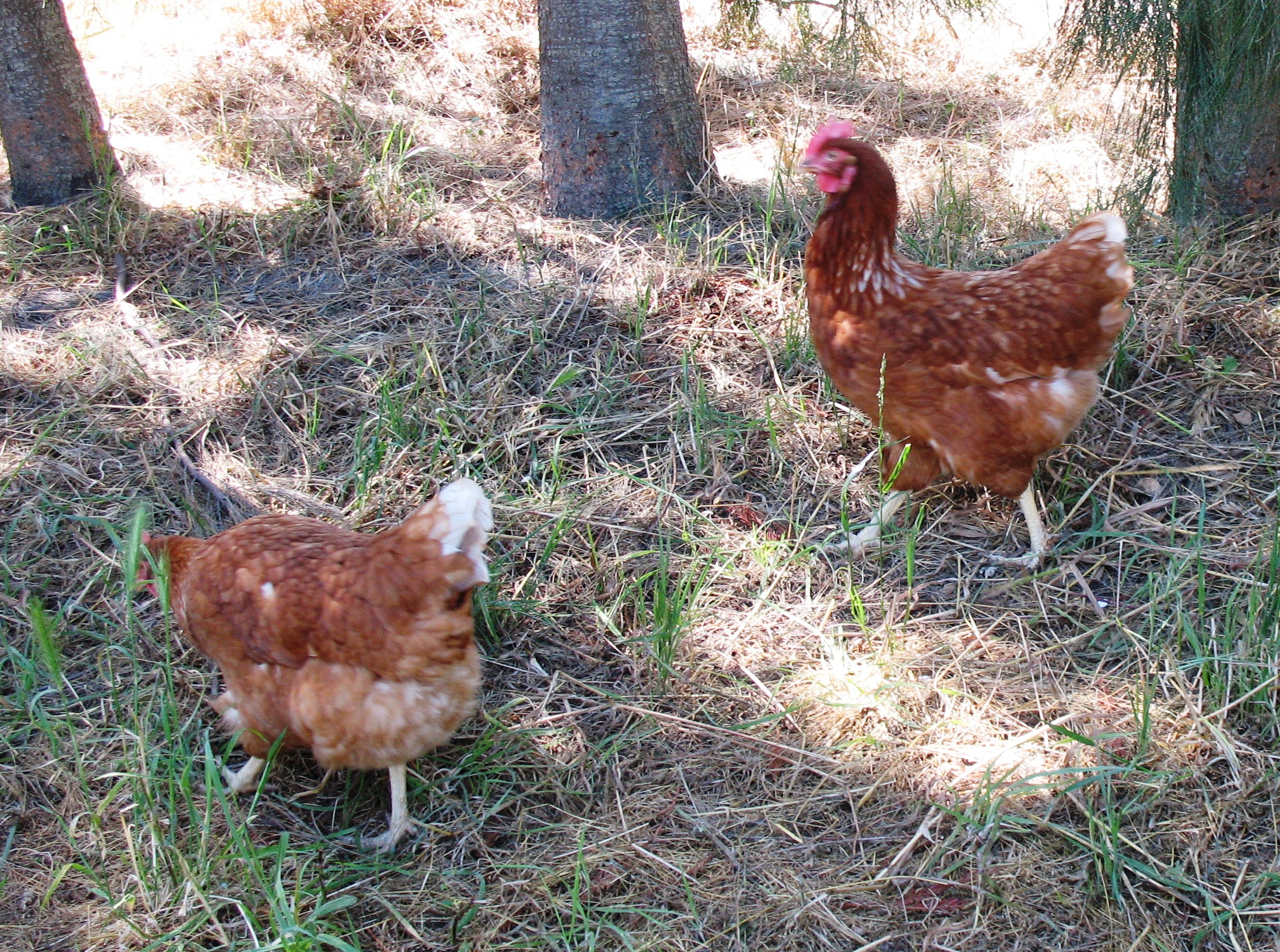
By last evening, the kitchen was clean, the jars in neat rows, cooling, and we relaxed in front of the fire. Winter is coming and the early mornings are decked out in frost. Stupidly, I left a lot of the basil in the garden and the cold burned it to a blackened, limp mess. A day earlier and I could have dried it for winter. Oh well. In the daytime it’s too warm for a fire, but by night the chill is in the air and it’s time for some heat. This morning, I noticed that more tomatoes are ripe. No way. I’m not canning them. I’ve already put the canning stuff away twice. But, I may take some and dehydrate them. I heard from an old Italian friend that the secret of great cooking with canned tomatoes was to dry some too, and then snip bits of the dried tomatoes into the pot twenty minutes before the meal is ready. Supposedly the dried ones bring back the aroma of summer.

Last night, friends called. Their neighbor has an excess of apples—did we want any? Plenty for applesauce or the emus. Applesauce is always a lovely treat in the winter. Oh, on second thought don’t go too far with all that canning equipment; we still have some empty jars. And, more emu news, next time.

Who Knew?

A.V. Walters

My last blog addressed the issue of produce theft. Who knew it was a trend? I discovered that community gardens all over the country have been vexed with this garden pilfery. And I thought gophers were bad! Friends sent me the following links.

http://kstp.com/news/stories/s2712848.shtml

http://www.chicagonow.com/chicago-garden/2010/08/please-do-not-steal-the-vegetables/#image/1

http://www.tcdailyplanet.net/news/2012/07/27/tomato-thieves-plague-st-paul-minneapolis-community-gardens

Since then, they’ve hit the corn and more tomatoes. Not that I’m left without; I’m still canning and at this rate it’s a question of what will happen first–the last of the tomatoes ripening or the first hard frost. Still, it’s a shock that garden theft is so common. It never occurred to me that the old organic maxim “And a third for the pests,” meant people.

We’re having one of those hot and muggy residual summer weeks. I’m not complaining, it will help to ripen tomatoes (who, so far have kindly not come ripe all at once.) I can only can so much at a whack–earlier this week my stove was simmering at capacity–a pot of sauce on every burner. Fifty pounds of them cooks down to about nine quarts of sauce and whole canned tomatoes. So the rest of October looks like tomatoes–and then NaNoWriMo in November. (What’s that? Oh, next blog I’ll explain and encourage.)

AV. Walters

And no rain, in even a normal year, for at least a month. We’re not getting our usual heat wave this month–and with the fields like tinder, that’s a good thing. We are all wary of the risk of wild fire. In most years I take the advice of ’30 feet of defensible space’ seriously–I clear everything away from the house diligently. This year there’s no need. Not even the weeds grew in this dry season. There was a fire yesterday–somewhere between here and town in the other end of the valley. It was a grass fire–it’s a different smell and taste than a more serious structure or forest fire. Smoke lite. Apparently they got it out, because the air cleared and the lingering haze made for a lovely sunset.

I’ve been following fire and emergency news these days because I’ve become more involved as a volunteer with our local fire department. Not fighting fires–I think I’m a little long in the tooth (and clumsy to boot) for that. But I can chip in with administrative stuff, or selling T shirts for fundraising. It’s a small community, everybody does what they can. It’s so dry that our new firefighters have to train on the hoses without water. Don’t laugh. Nobody has excess at the wellhead these days, so they learn to man the hoses dry–with the seasoned volunteers pulling and pushing at the back end of the hose to simulate the force of real water. Consider it a dry run, in the most real sense of the term. They revel at the chance to share training programs with nearby departments that have city water.

Our wells are low and that intensifies the mineral salts–leaving a cloudy blush on the glasses, if you use the dishwasher. When canning, I have to put vinegar in the water with the bottles, or they’ll come up clouded and gritty feeling. Some of this is normal at this time of the year. The rest has us seriously conserving and sniffing now and then for smoke when outdoors. It’s a good thing that the rainy season runs during the same time as the winter heating season. By the time I put a fire in the stove, it’s cold and wet out.

I buy bottled water for coffee–not because of contamination (our well is high up on the hill) but because I’m a coffee nut, and I like the flavor of a less–gritty–source of water. In the low part of the valley the wells are contaminated. It’s a fact of rural living–nitrates in the water. Those folks must drink bottled water, especially kids. It’s a reminder that , even here in rural county, we need to be aware of our footprint on the planet. Nitrates are a common form of contamination in areas with heavy livestock concentrations, especially where, like here, people rely mostly on shallow wells. This is a dairy area, with chickens and beef cattle thrown in for good measure.

Many years ago the county put in a dump, (now called a transfer station and refuse disposal area) about a mile from here. The runoff from the site runs into our local creek. There’s a debate in the valley, not too seriously entertained, that the county dump is the source of the contamination. Folks who’ve been spreading manure on these hills for generations wince–and don’t point too many fingers, except occasionally, for sport.