Archives for posts with tag: rural living

Cabin Fever Paranoia

A.V. Walters

Police Blotter

Police Blotter

For most of the locals, this winter is a little long in the tooth. They’re tired of it, and getting a little crabby. It’s showing in the local paper. At last report, the snow total was 228 inches, just three shy of breaking the county record, to date. Since then, we’ve probably had at least three inches. That means that this year will be a record double header—in both temperature and snowfall.

You’d think everyone would be excited. Where’s their pride in being here, and witnessing this little bit of weather history? Noooooo, people are ready for Spring and are tired of all this. The headlines are revealing: “COLDEST, SNOWIEST—Winter to Break Records; Man and Wildlife Cope.” The deer and wild turkeys are suffering with the cold and deep drifts. The wildlife guys, at the DNR, have suspended the rules against harboring ducks and waterfowl. They need open water on our rivers and inland lakes so they can take off, and it’s not easy to find. People are finding, and rescuing downed ducks. So, if officials catch you harboring a duck, they won’t prosecute. They’re even giving out information on where you can find open water to release them.

Even the snow plow drivers, are weary. “It’s starting to wear on all of us… It’s always fun in the fall, to start plowing, but by now, it’s not fun anymore.” (According to their supervisor.)

A week or so back, a couple warmer days and fierce winds broke up the ice on the Lake Michigan. Suddenly the lake, which had reached over 80% ice coverage, was once again a wild and thrashing deep blue. It was impressive. I mentioned it to the guy in the local grocery store. He nodded, acknowledging the really awesome power of a Great Lake.

“Plus,” I continued with some enthusiasm, “With the Lake open again, you know what that means?”

He just looked puzzled.

“We’ll get more lake-effect snow.”

He just groaned and put his face in his hands.

We’re in another cold snap, now—you know, Polar Vortex, the sequel. We hiked up to the bluffs to see the lake. It’s starting to fill in again—frozen out almost to the visible horizon. They say it’s back up to 50 %– in just days. And, it’s snowing. The paper says that, with all this snow, there are concerns about Spring flooding.

We love the local paper. It covers all the small town stuff, high school sports, ice-fishing events, bowling, that kind of stuff. Rick loves the police Dispatch Blotter. This week though, the police blotter showed that winter is taking its toll. A paranoid caller complained. “…the Road Commission [snowplow] is purposely placing snow at the end of his driveway.” (Rick had a good laugh, at that one.)

Winter Mix

A.V. Walters

Winter Mix?

Winter Mix?

Sounds to me like something you’d serve as an appetizer at a holiday gathering. In reality, it’s not so friendly—it was today’s weather report. Winter mix is unsettled weather that serves up a mishmash of rain, sleet and snow. We’ve had gorgeous February weather for a couple of days, bright sunshine and upper thirties to low forties. I consider February to be the seventh-inning-stretch of winter. The sun comes back, for whole days, not just the cameo appearances of December and January. The cats have been sprawled-out, on floor, in the sunshine streaming into the living room.

It’s been especially delicious, since there’s so much snow. We’ve been skiing (albeit badly) and hiking. The sun and snow are so nice that I broke down and ordered snowshoes. (Don’t worry, there’ll still be plenty of winter left by the time they arrive. We have a couple of innings to go, yet.) Tonight brought a decided end to our reprieve. This will be the first real “storm” of the season. Sure we’ve had snow, (lots of it—217 inches, so far) and the occasional travel advisory, but nothing that came with storm warnings. Today’s snow/rain mixture will freeze tonight as temperatures drop back to more wintery levels and we usher in high winds and more snow. Tomorrow, winds are expected to gust up to 55 mph. On fresh slick ice, that should be loads of fun. I ran into town today and picked up groceries and coffee. We can hunker down for the duration. (Or, we can suit up and put on spikes to go see what happens at the lake in such winds!)

We’re only 14 inches shy of breaking the all-time, county snow record. It’s still only February, so we’ve got a good chance of doing it. I find myself rooting for snow and season. My first winter, back in Michigan, and a record-breaker! I can’t complain; it’s been an adventure. My mother says it may all be my fault. She’s remembering that the year I moved to California, 1978, was one of the last record-breakers. (And, just for good measure, I left California with what might be a record drought.)

Training Cats

A. V. Walters

Who, me?

Who, me?

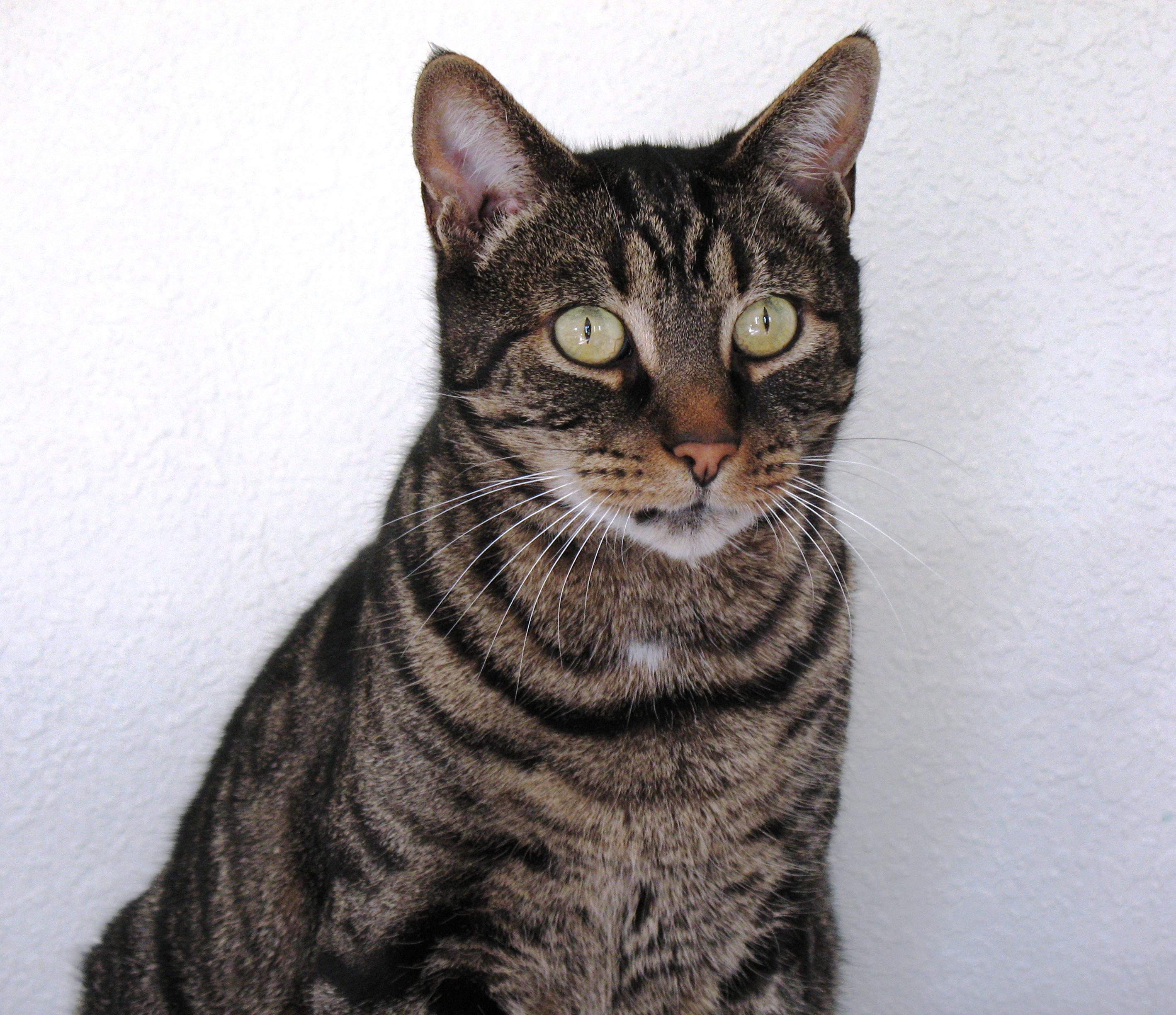
I’ve always had well-behaved cats. I train them as kittens. That’s right, trained cats. I’m from a large family where good behavior wasn’t optional. With kittens, I use a squirt gun to enforce the House Rules. It’s about boundaries. Some places are okay for cats and some are verboten.

Bob came to us as an adult stray. He is a genial cat, not bright but friendly. In fact, he is clueless. As a kid, I had a school teacher who, when confronted with less-than-perfect indoor etiquette, would demand, “Where were you raised, in a barn?!” In fact, it was a slur on the agricultural kids—the farmers and the French-Canadians. But I try to remember it as a cautionary guideline, with Bob. After all, he’s a twice-abandoned farm cat. And, as a matter of fact, he was raised in a barn.

When he first arrived on my door-step, Bob had no boundaries. He felt fully entitled to get up on the kitchen counters or the table, and help himself to whatever goodies were there. Well, something had to be done about that! I used a spray bottle and Bob learned. What he learned was that he could not go on the counters if somebody was around! Bob learned to be a sneak. So, we redoubled our efforts. To reduce temptation, we made a concerted effort not to leave anything out. Butter went into a covered dish. The dishes were mostly washed after a meal. Meat scraps went into the freezer (not the garbage) for disposal later. And we watched, like hawks, to catch him in the act. That was the tough part, because, as a sneak, Bob was good at quietly committing his mischief. The only notice we got was the thump of his feet hitting the floor, after his forays. He had a well-practiced innocent look. “Who me?” (Though, there were clear Bob prints on the countertop.)

For the most part, he’s well-trained, now, though there are the occasional lapses. The most egregious of his sins is his propensity to lick the cream-cheese frosting off of the carrot cake. After icing the cake, it needs to sit out for a bit to set up. Bob did it again, last night. Rick came in to a freshly iced, and licked, cake. We’ll need to be more diligent about putting the cake away—or covering it. And, well, it’s back to training… We can’t have cats mixing with cakes.

I’m glad that we’ve had such success with him. Most people think you cannot train a cat.

Dry-Run–

A.V. Walters–

We’re learning. It turns out that this little rental has taught us many valuable things about living with season. We’ve learned that ice dams are common in older homes (and inexcusable in new ones.) We’ve learned that it’s really important that one’s water supply lines be buried deep enough. It’s the coldest, snowiest year in decades; so, it is a good test for us. We’re holding up, and we’re learning.

Oh, we have no water.

Even back in sunny California, there would be cold snaps from time to time and many people would have their pipes freeze up. I remember, when I first moved there, I was aghast that many (especially older) homes ran their pipes on the outside! When I lived in Oakland, our water supply line entered the house on the front—above grade! In the winter, I wrapped that pipe—first with foam pipe insulation, and then with towels and plastic. We never had our pipes freeze. Here, water supply lines are buried deep (hopefully below the frost-line– about 48 inches, around here.) Sometimes, it’s not deep enough.

Did I mention we have no water?

If it’s any comfort, it’s not just us. A couple of other properties in the village have come up dry. There’s a whole triage routine to this, first you root around under the house to see whether the pipes under the house are frozen solid. You check the meter (if it’s running wildly, you have a burst pipe—if it’s not running at all (even with open faucets) you likely have a frozen pipe. This little cottage has heat tape on the pipes. We learned that after the water stopped, when Rick was running his diagnostics. Once you’ve identified that the problem isn’t under you, you need to find out what it is. If it’s in the Village water main—they need to fix it. If it’s in the line between the main and the meter—you need to fix it. This is where it’s good to be renting. The standard solution (after you call the landlord) is to call in a welding company who will essentially use jumper-cables to melt the ice in the line. Not many companies will do this kind of work—they say the liability is too high. Huh? Wow, that’s not the kind of response you want to hear…

So, we’re still waiting for water.

Today is day three. We’re carrying water, by bucket, from the neighbors. We’re starting to look a little scruffy and the dishes are piling up in the sink. The company that still does this kind of work is in high demand right now. Take a number.

And, there’s some small-town humor in it. I went to the Village office to start the “who’s side of the line” investigation. Our friendly clerk took down the information. When I gave my name, she looked up, “Oh, you’re the one that got married last week.” It was a statement, not a question. They run all the vital statistics info in the local paper. I have a distinctive first name.

“Yup, that’s me.” Yup, that’s us. Geezer newlyweds. Later, the village crew came down to investigate the problem. You just know that they’d all been told. Later, a neighbor from down the block dropped by to assure us that we could come get water at his house. Small towns talk. It’s not a bad thing. People in town see the construction cones. They read the paper. They hear that some folks got married, and some are froze-up. It’s about community.

Our future building plans keep adjusting. We are now serious about adequate insulation and ventilation in the roof, in order to fend-off ice dams. And now, you know we will bury our water lines—deep. This little cottage has been our dry-run for winter living. We just didn’t know how dry.


Postscript:

Finally, they came to free up our lines. That freed me up to run to the store for dinner groceries. At the checkout, the clerk (who lives around the corner from us) nodded, “I hear your pipes are froze up.”

I smiled, “Not anymore, the guy’s there now, fixing it.”

“Runs down the driveway, does it?”

“Yeah.”

He nodded knowingly, “You folks keep a tidy driveway, could be part of the problem.”

“What’s that?”

“You know, you could leave some snow in the driveway—for more insulation.”

I howled. “I’ll tell him.”

So it’s a small town. They talk, they notice. They hear about troubles and they have opinions.


The Other Side of Winter II

A.V. Walters

Too windy even to bury the car!

Too windy even to bury the car!

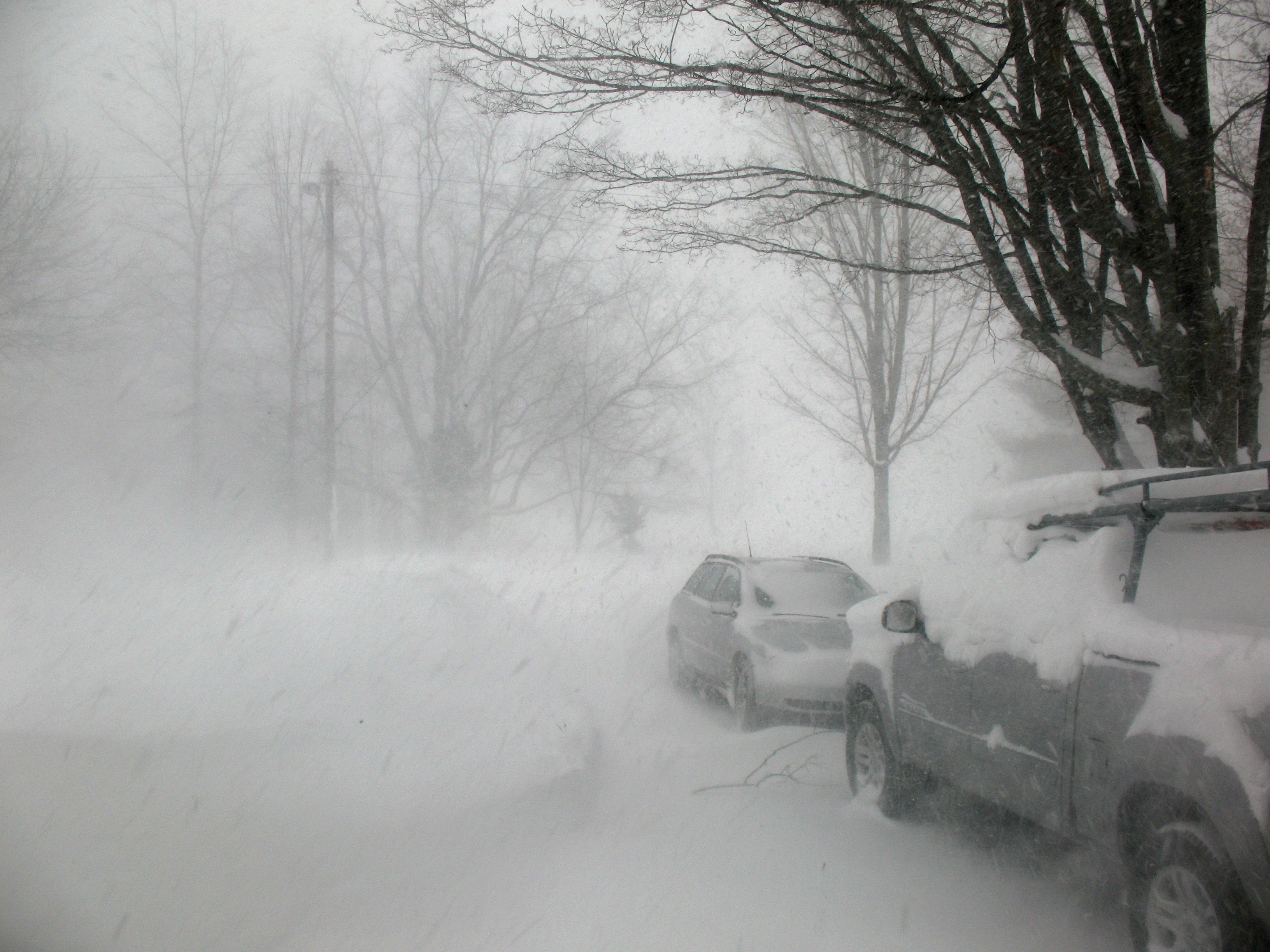
It’s blowing and cold out there. It is snowing, but the wind is so strong, that it’s tough to tell what’s new snow, and what’s just being whipped around and redistributed. The usual storm pattern swoops across from the west or northwest. We look out and the snow is horizontal. We’ve noted from the national weather maps that in the center of the county, near where we’ll be living come spring, there’s a pocket of particularly heavy snow accumulation. One look at the winds today tells the story. All the snow from here ends up there. I see a Kubota in our future.

Without appreciable new snowfall (indeed some areas now have less than before) the driveway has drifted over and needs another shoveling. Rick has taken the laboring oar on snow removal. He maintains a beautiful driveway and paths through the yard. He’s learning to sculpt them so that the wind helps keep them clear, though in some places, drift, it will. I’d love to brag about his efforts, but since much of my family lives far north of here (and with really heavy snow) they’d just scoff. My niece reported on her facebook page the other day that she and her children are tobogganing off their roof. We just can’t compete with that.

Still, some things are universal. No matter where you are, everyone complains that, shovel as they may, they just hate it when the plow comes and negates their hours of work, filling in their driveways with road accumulations. Rick bemoans that it isn’t just more snow, plow snow is heavier and crustier. If you let it sit it will turn to a driveway-blocking wall of lumpy ice. It’s not an observation; it’s a conviction.

This past week our local weekly paper did a feature article on ‘the snow plow drivers of Leelanau County.’ It’s appropriate. Those guys (and they seem to be all guys) are doing a hell of a job keeping the roads clear in this record-breaking year. Now, in mid-January, our to-date snow-fall total is 152 inches, which exceeds the usual seasonal total. Only two weeks ago the paper quoted a local meteorologist as saying that we’d hit our 150 and then it would stop. Think again. Anyway, I had to laugh when the veteran snow plow driver stated that his pet peeve was when homeowners would push their snow into his road. (Apparently it makes for a rough ride.)

Emus in Absensia

A.V. Walters

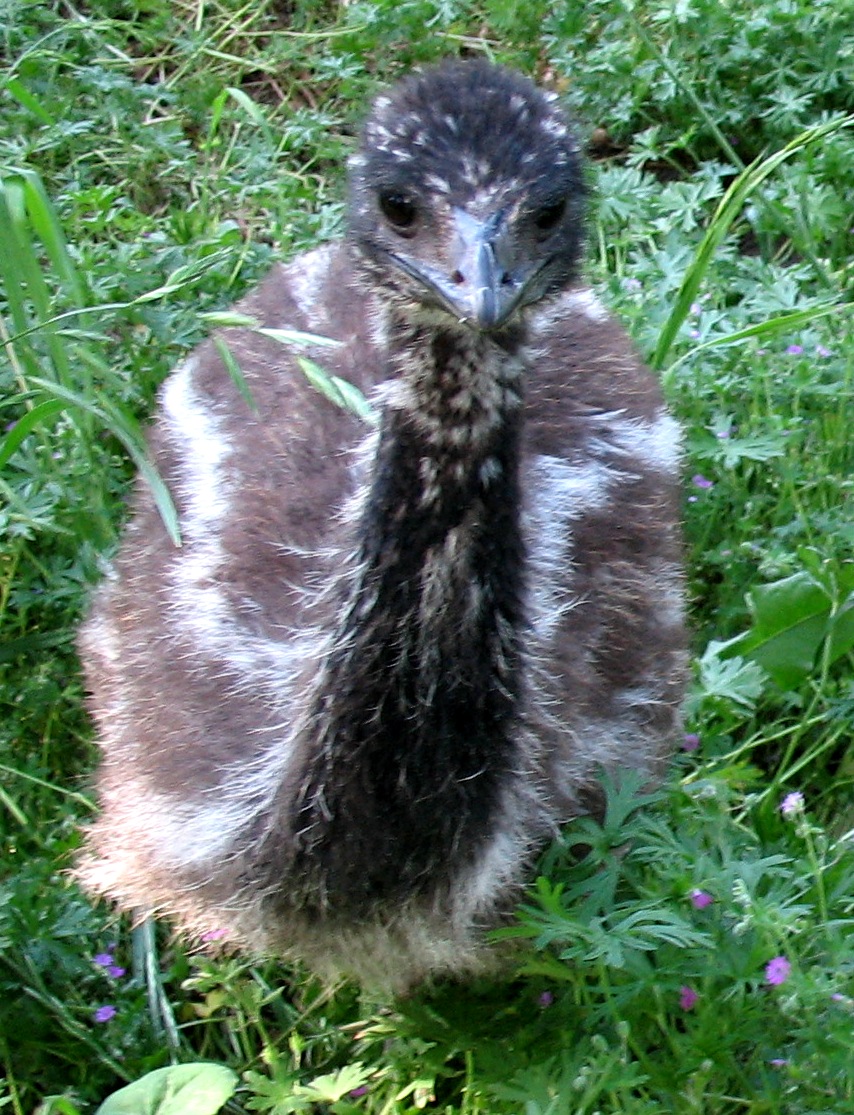
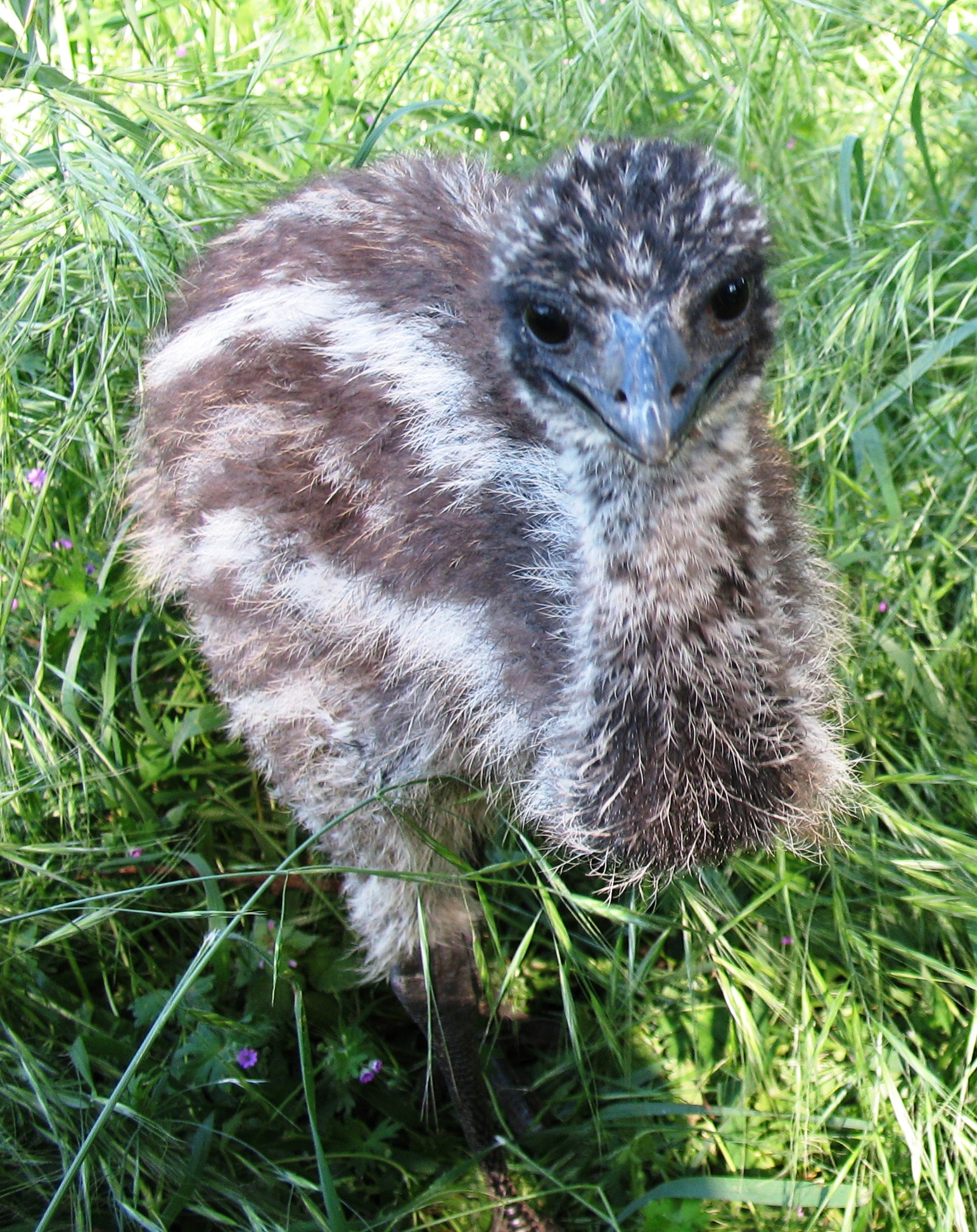
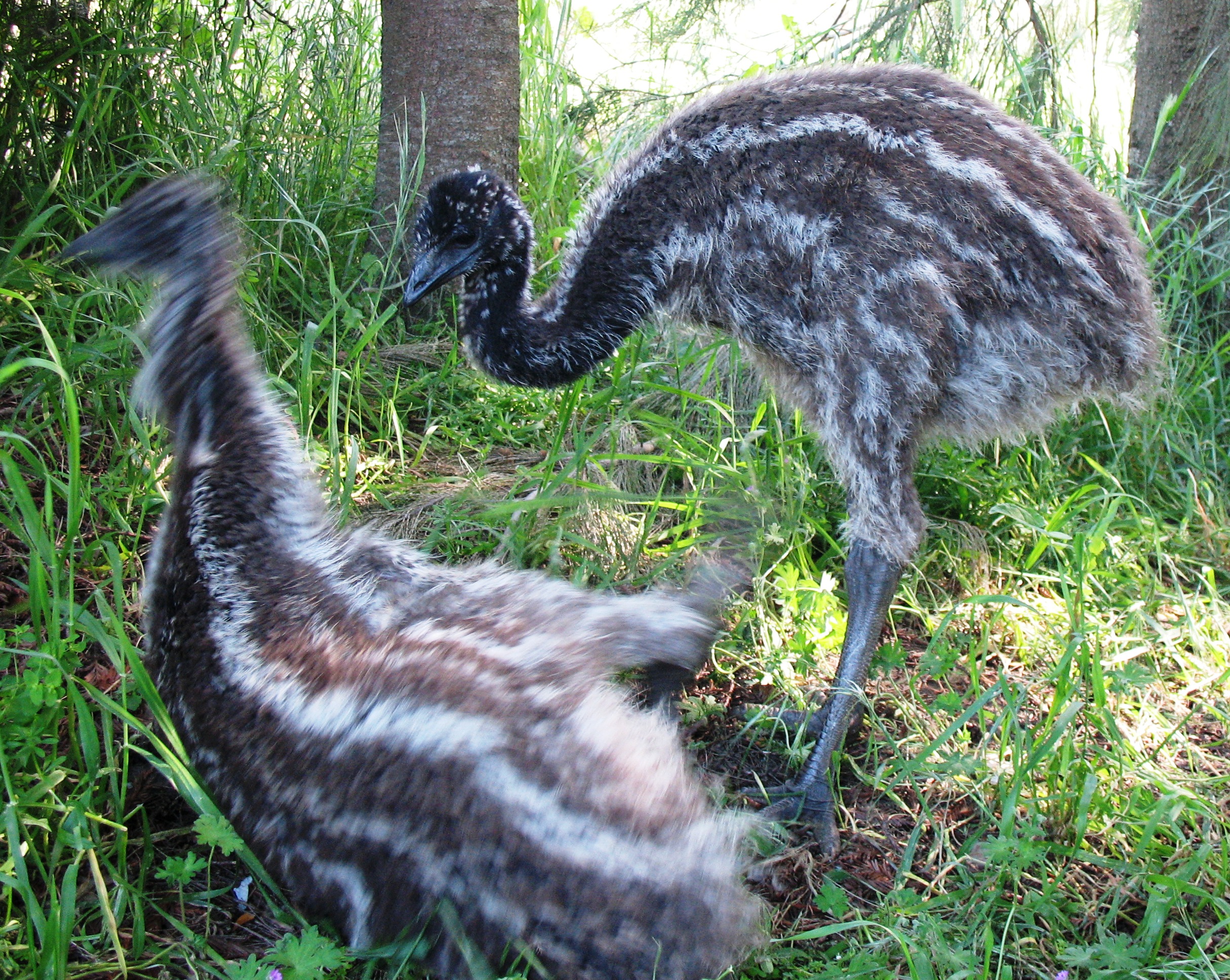
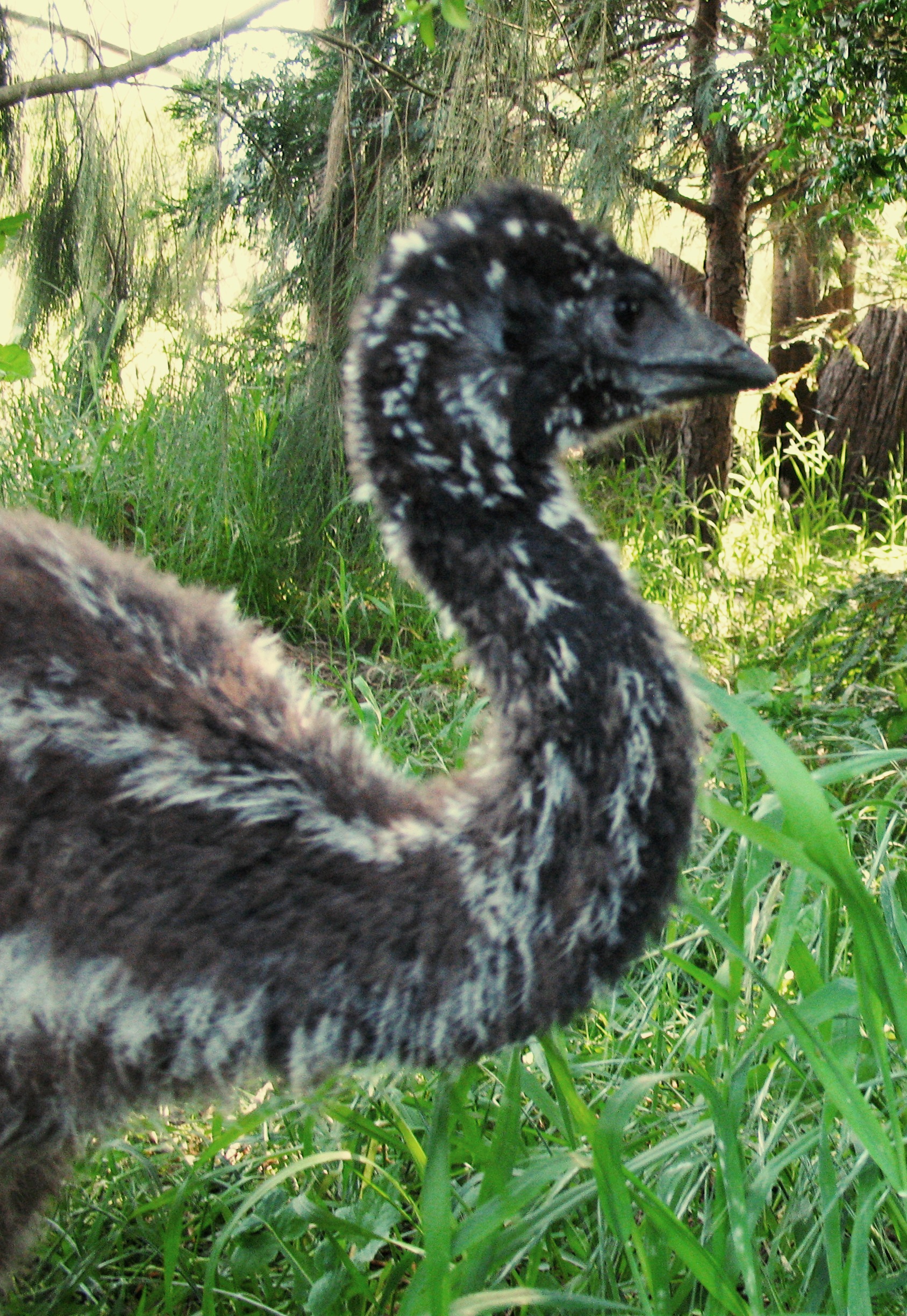
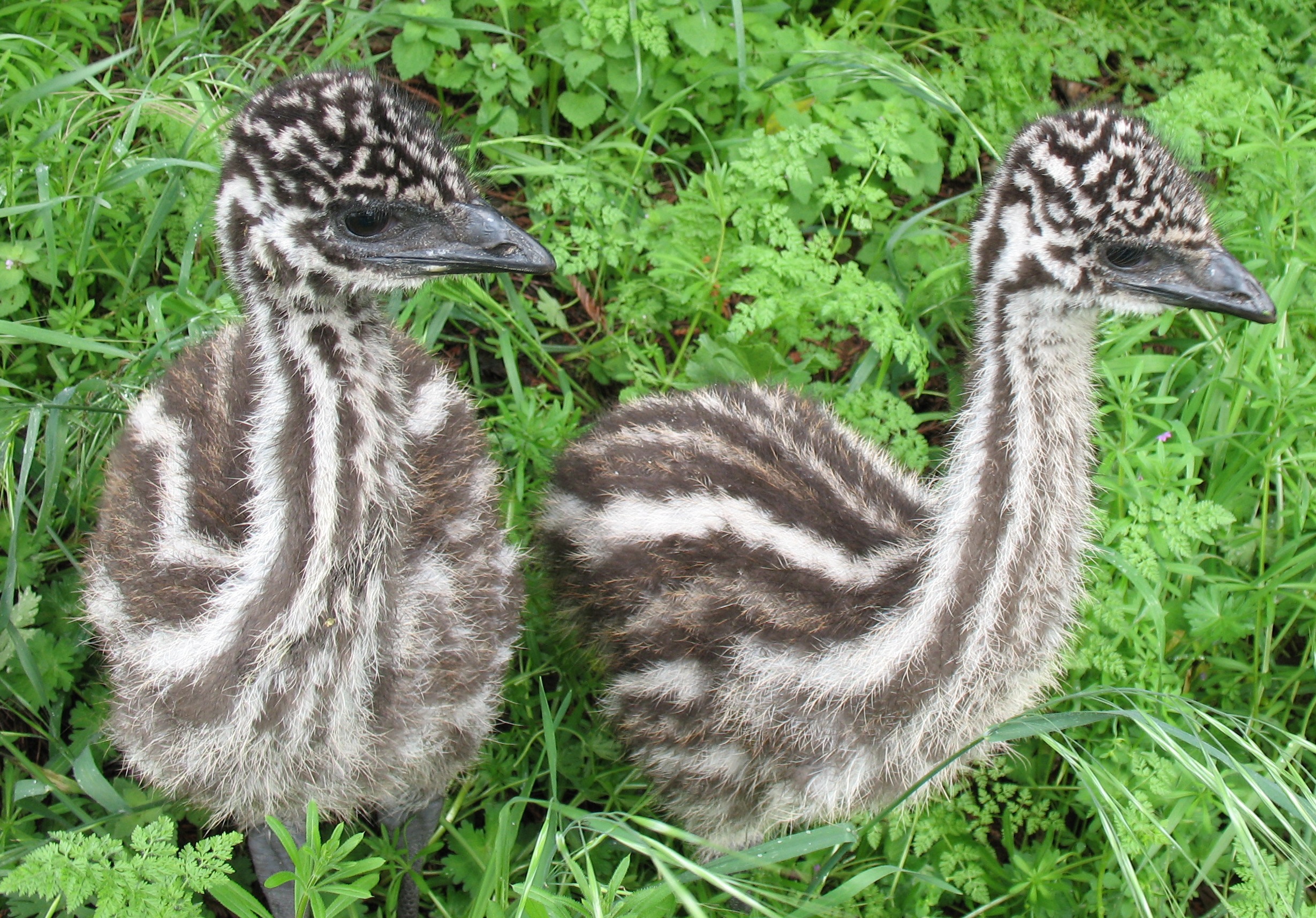
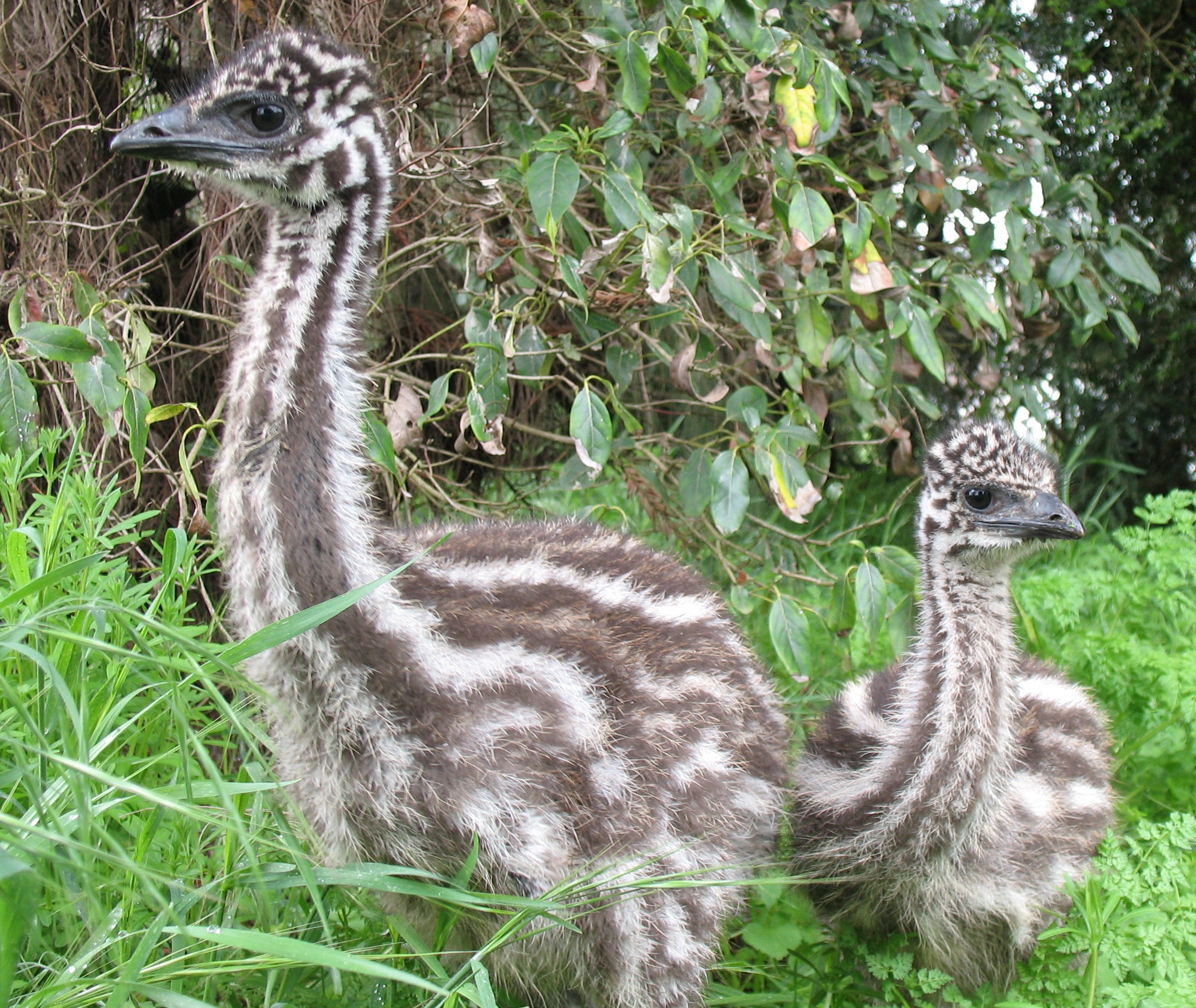
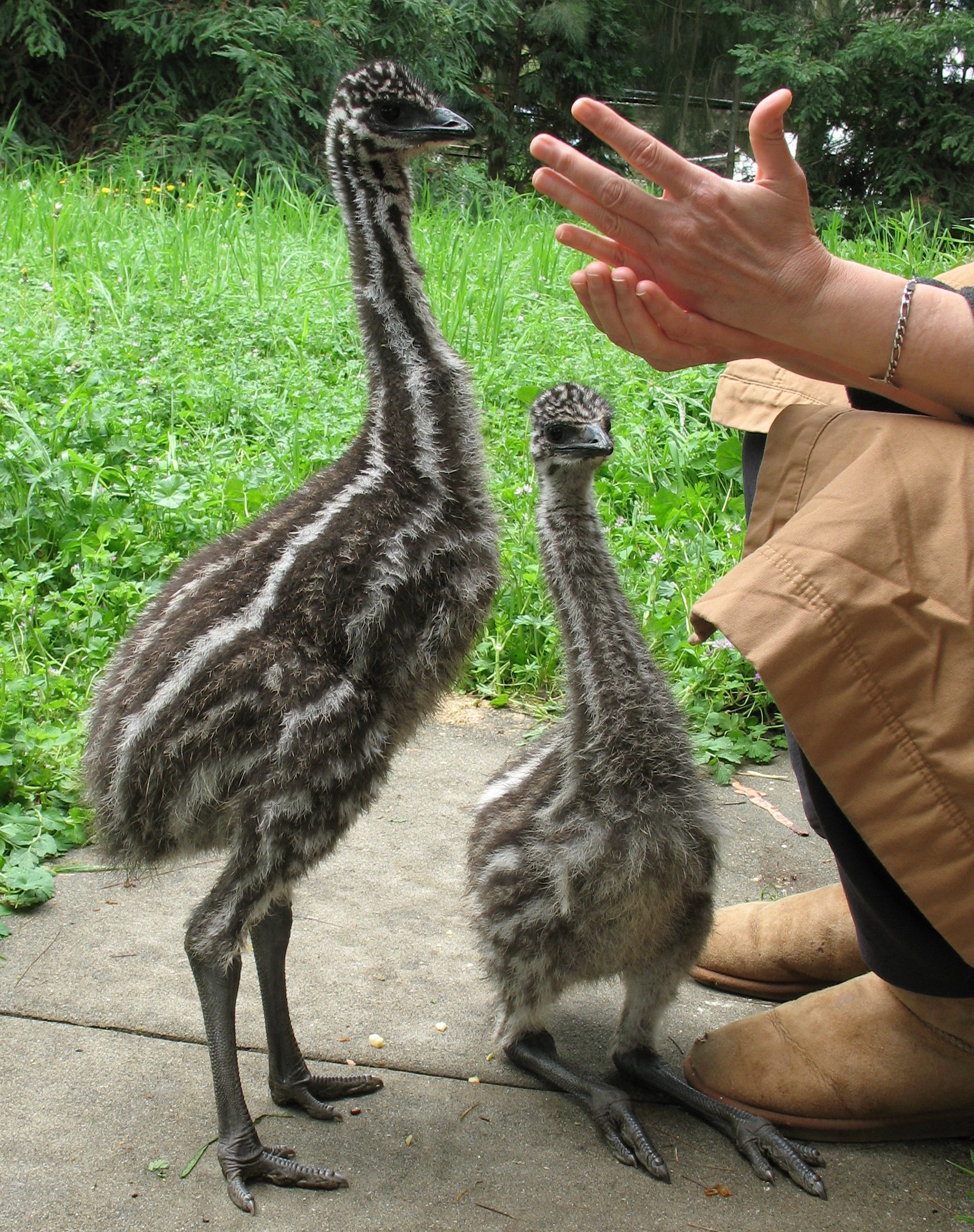
Elmer called the other night—they have emu chicks. Mr. and Mrs. Emu are at it again and, with all the food we gave them over summer, and the mild winter, they now have a sizable clutch of eggs. Or had. Out of the original twelve, two chicks have already hatched and died. Stretched so thin, Mr. Emu has difficulty watching the new little ones—he’s still nest-bound.

So Elmer and his daughter kidnapped the one little guy they found still alive and plan to remove the rest as they hatch. Between cold nights and predators, little emu chicks have a rough go of it in Northern California. Hence, the call. Rick and I are the only ones on the farm who have successfully hand-raised the little guys, and they need help.

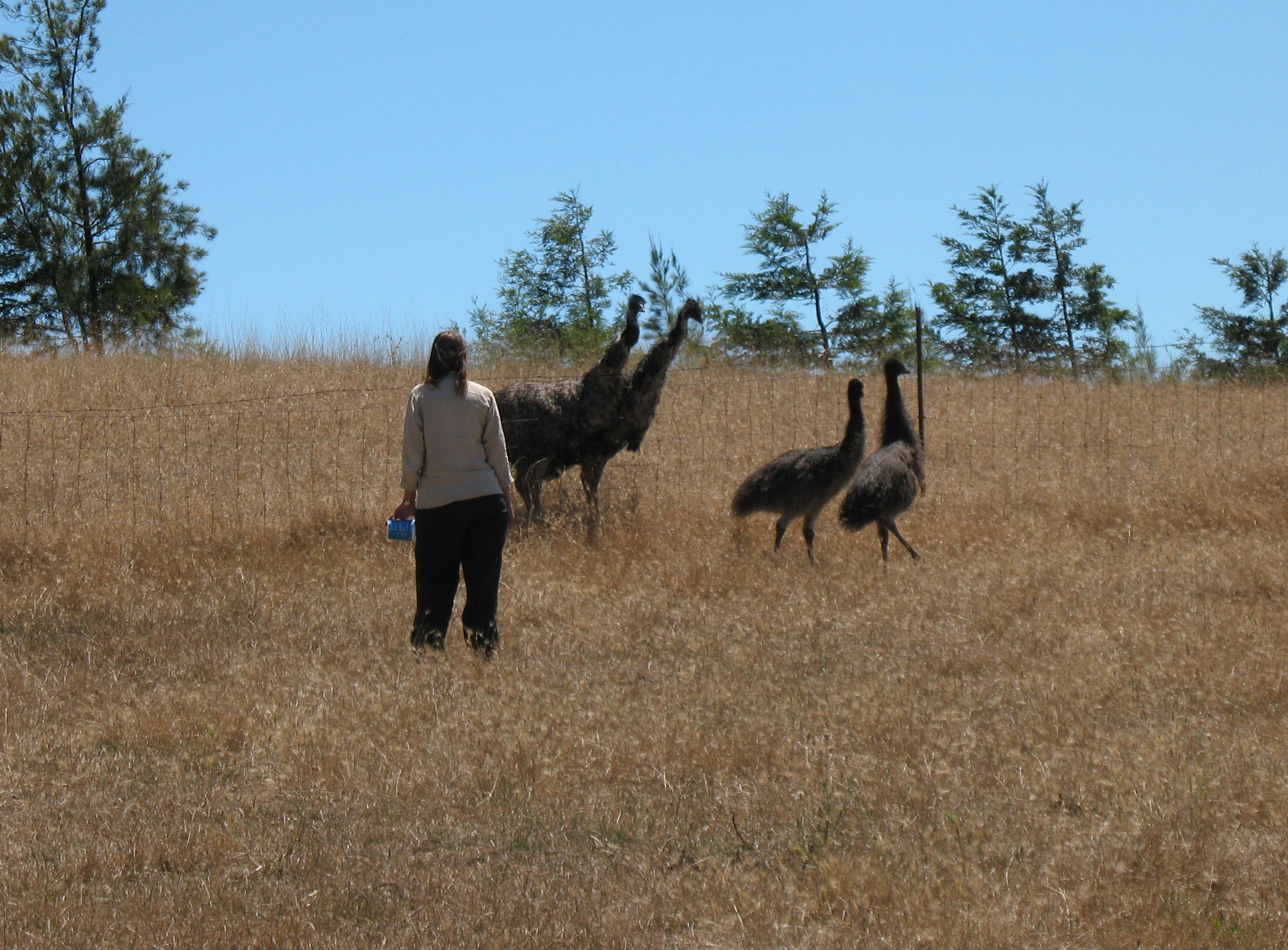
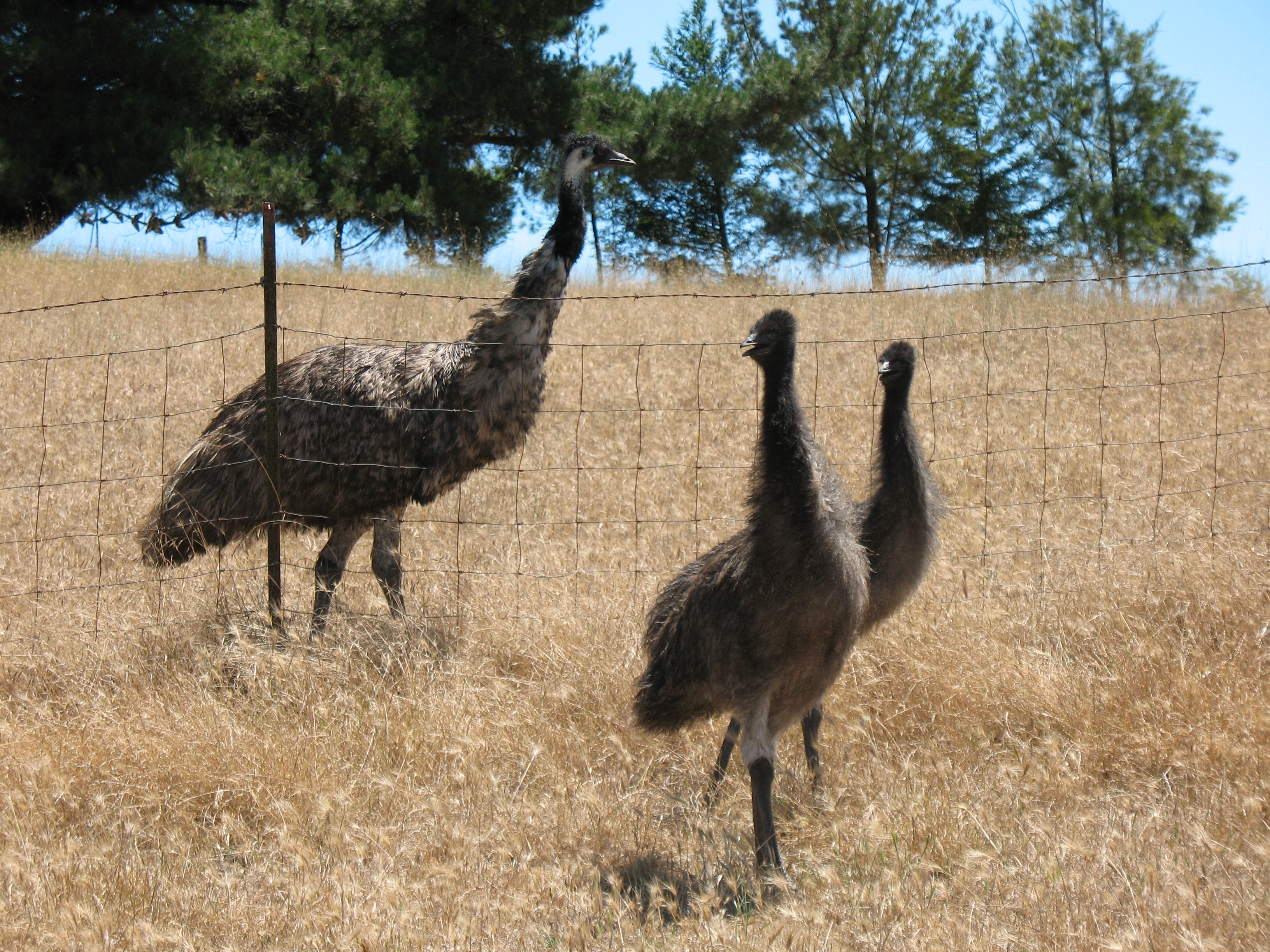
They’ve decided that more emus would be just the ticket to guard over their new venture in organic duck eggs. (You should see all the ducks, it’s pretty impressive.) Emu guards are not a bad idea. We learned, the hard way, that the emus in our front yard were, in fact, protecting the chickens.  And so, the questions begin. What do we feed them? (Finely chopped kale and apples, to start.) Can we give them chicken feed? (No, chickens are seed eaters. Emus are grazers and need green fodder.) How warm do they need to be? (94 degrees F for the first two weeks, tapering off 5 degrees a week, after that.) What about water? (Not for about a week, until they’ve mastered balance and eating.) Those, and more, are all questions that we had to find the answers to, a year ago—either through trial and error, or what we could find on the net. As it turned out, we did okay. We had no losses from the five we raised. I guess that makes us emu experts. (And, given some of the so-called “expert” advice we found on the net, we are!)

We haven’t been homesick since our relocation. We miss some of the people, but we are caught up in the possibilities of our new lives. This, though, gave us pause. We definitely miss the emus—and raising them was an adventure we really enjoyed. So, we stand ready to be emu emissaries. We’ll provide all the information we can. And, of course, we’ll worry.


Musings from the Polar Vortex–

A.V. Walters–

Just enough snow.

Just enough snow.

Now there’s a new phrase for you, eh? The only vortex part of it is the rushing-in from the void of all the misinformation about weather, generally, and climate change, specifically. Oh, how the reality-based wonks among us rue the day that somebody started calling it “global warming.” It so distorts the opportunity to study the facts, and create meaningful policy, (or dialogue) in an atmosphere of an anti-science witch-hunt.

Now, the cold snap has subsided, leaving us in the more normal seasonal range of temperatures in the 20s. This weekend they’re predicting a warming trend—one that will bring us sunshine and above-freezing, nighttime temperatures. You’d think we’d be happy about that. In fact, it creates just another set of problems.

First, there’s the leaking roof. In winter’s cold, it’s not a problem. But when things warm up, the leaking roof, in combination with ice dams (damns?) makes this little rental an interesting place. (Buckets and mopping up.) The landlord knows, but it was a bad roofing job and now there’s nothing he can do until spring. At the same time, he plans on putting in new windows—which will be a big improvement, though we’ll be long gone, by then.

That kind of freeze/thaw cycle also creates treacherous roads. The thaw provides the fodder, in the freeze period, for black ice and other hazards of navigation—both pedestrian and vehicular. It means we’ll be strapping on yet another layer of winter gear (spikes) onto our boots. I used to think that these were for old folks. However, my mom swears by them and she insisted that they become part of our new, winter wardrobe. I’m a regular Yeti fashion-plate. At least it’s safe.

And, finally, I don’t want our snow to melt. I’m just about to get cross-country skis. I like look of winter. I love roads with a nice, thick, white, base. (I’m not a fancier of salt or the dirty slush it brings.) So my fingers are crossed that the snow stays through the warming spell.

There are northern things that will take some adjustment. The winter tap water is frigid. My California roots say, “Don’t waste water—use it cold and straight from the tap.” My fingers say, “Skip the frostbite, run it ‘til warm.” The water is so cold that it hurts your teeth to drink it. Northern living takes longer to get anything done, whether it’s the time suiting-up, or shoveling-out, life has to be a little more… intentional. And, the butter is too damn hard to spread on toast. (I can hear my sisters, “Turn up the heat, goofball. Good Lord,” shaking their heads, “They live like a couple of Eskimos.”) This might be solved when we have our own place, and it has insulation. For now, unless I’m baking, the kitchen is chilly. Otherwise, our winter redoubt suits me fine, for now. If only someone could convince the cats.


The Other Side of Winter

A.V. Walters

I get comments, (mostly by email) from friends and family when I post a blog. They’re usually supportive but, occasionally, they’re smart-assed. There was a range of comments on my last post. Apparently everyone wants to know–how are these two transplants doing with winter? It makes me wonder if bets have been placed. One friend thanked me for posting a positive perspective on the season. This is, after all, one of the most intense winters in decades (which is why everyone is so curious as to how Rick and I will handle it. Of course, to us, it’s all new.) My sister set me straight.

I guess my warm and fuzzy “snow dusting” blogs are pissing her off. She lives waaay up north, and they’ve had so much snow, that they’re running out of places to put the stuff. My mom reports that the snow banks are between 10 and 12 feet high. My mom is delighted; but she’s not doing the plowing. For many, they have to get up early to deal with the snow before they go put in a full day at work. For my sister, Kelly, lately that’s been three or four hours of extra work each day, hand shoveling out her entry and the path to her chicken coop. Today she was especially heroic—she snow-shoed over to my mother’s satellite dish, to clear it, so my mom could get reception. (Poor mum, last night she missed Downton Abbey!) Kelly’s husband also puts in several hours each day with the plow—besides their home and store, he keeps a number of other families clear.

Kelly is not alone in her frustration. She runs the town’s general store, so she hears about it from everyone. Over the weekend a colorful, but not particularly volatile local came into the store, stomping the snow from his boots and railing, “I’ve had it. Snow just isn’t fun anymore! I’d suck someone’s cock if the bastard would just blow out my driveway!” He hand-shovels, and has run out of places to put the snow. Now, he’s loading it into a wheelbarrow, then carting it across the highway, where he shovels it again, mostly up over the existing banks and into the woods. He hopes the Road Commission doesn’t notice that some of it strays onto the highway. (You’re not supposed to shovel your snow into the roadway, though the plows feel free to fill your driveway with road snow.) Keweenaw County checked in earlier this week at 167 inches for the season, and that was before the most recent foot, or so. I guess this all helps to keep the northerners fit.

So here I am, singing the praises of the beauty of winter. Add to that, I work from home—I don’t need to shovel out everyday—and Rick has taken up most of that duty, in any event. My family and I talk, everyday. Discussions about the weather are sometimes charged. There’s a fierce one-upsmanship to even the most casual comparisons. My mother called first thing this morning, and demanded to know, “What’s your temperature?!” (“Oh, hi mom. It’s 9.”) “Yeah, well it’s minus 7, here. Visibility is so low, I can’t see the mountain!” Really, it’s much milder here; I can’t compete.

Yesterday, my brother called to warn me about “wind chill.” (We’ve actually had a Wind Chill Warning.) We’re in a cold snap—it’ll put us in the single digits and negatives for the better part of the week. Really, though I’ve been in California for thirty-five years, I didn’t slip into a coma. I do remember wind chill. It seems that everywhere, but here, it is really snowing. My brother (a few hours south of us) has seen 14 inches in the last two days. My mother (well north of us) has seen even more. Us? A dusting, maybe five inches over the past four days, barely enough to shovel every day. Today, we are seeing the beginnings of the “big storm”. We check the radar by keeping an eye on the weather websites.

Critters here are challenged, too. It’s tough when, everyday, you have to dig deeper for your food supply. The last two nights, rabbits have come to clean up what’s left of the birdseed we threw out for our jays, juncos and chickadees. We get squirrels, too, and that makes me nervous. The squirrels can get into the engine compartment of your car. Sometimes they’ll even eat the insulation on the wiring. I mentioned it to Rick, who noticed that the squirrels seemed particularly interested in hanging out under and around his truck. (He went out to check the engine compartment—just to make sure there weren’t any rodent condos going in. Believe me; you don’t want to tangle with squirrel HOAs!)

Inside, (though I don’t think it’s any gotten any colder) the cat has taken to snuggling up all day on the electric baseboard heater. It hasn’t the charm of a good woodstove, that’s for sure. It’s a little pathetic, but we all do what we can.

Our local papers are full of weather reports and snow records, too. Our year-end snow count topped 100 inches. The local Meteorologist promised that the colder temperatures would slow the snow. Also, he points out, if the Lake freezes over, it will lessen the “Lake Effect” snow. If the Lake freezes over? Look at a map. See how big Lake Michigan is? They don’t call it a Great Lake for nothing. When a Great Lake hits 90% ice cover, it’s said to have “frozen over.” (Normal winters usually see a 50% cover.) How often does a freeze over happen? Well, in the last 110 years, only four times (1904, 1976-1978.) His report is otherwise scientifically problematic, saying (and I quote), “Northern Michigan only gets 140 to 150 inches of snow each year. We’ve already had 100 inches, so that leaves January, February and March to get an additional 50 inches.” What? So, if we reach our statistical norm, someone’s going to turn off the snow?

We’re lucky. Nestled next to the lake like this, we get the snow, but not so much of the cold. Inland areas can get bitterly cold. And, we have great winter gear. My oldest sister abandoned the state a couple of years ago, saying she never wanted to be cold again. When we decided to move east, she gave us all her winter gear—coats, hats, scarves and mittens by the bin-full. (We’ve got so much down, we’re up!) We have no excuse for being cold, or for staying in. In fact, as soon as I finish this, Rick and I are headed off for a walk. We thought we’d go take a look and see what the Lake is doing.

Winterizing

(from November 1, 2013)

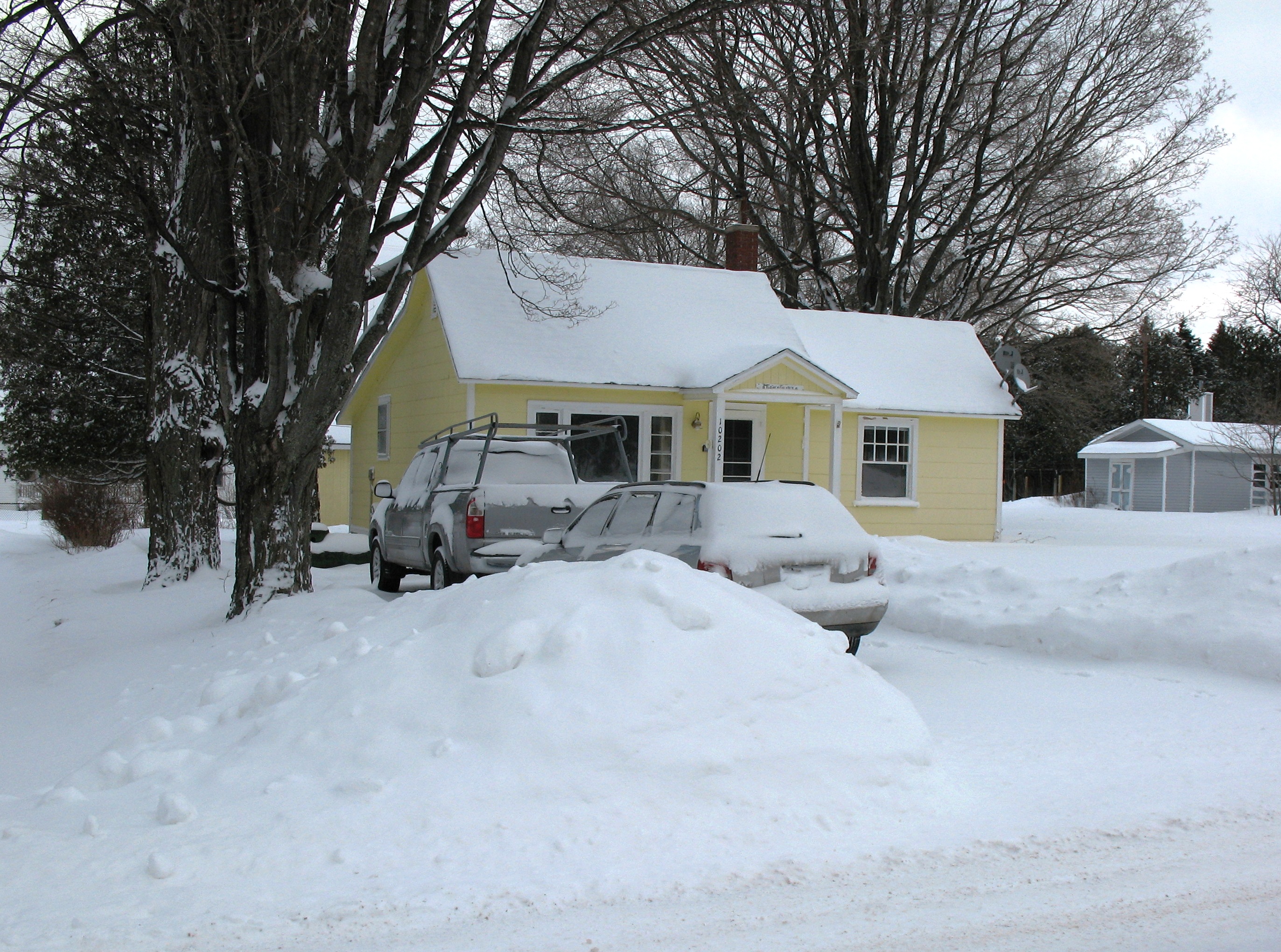
I haven’t done this since I was in college, renting cheap housing and doing everything I could to make it habitable for the cold months. We didn’t move in time to get building underway, so we’re hanging close so we can get a jump on spring, when it comes. We’re in a “vacation” rental—read “summer.” It’s a very cute, little cottage, in a charming, little village on the shores of Lake Michigan. It’s a beautiful destination location for summer tourists. We’ll see how it fares for a Michigan winter. The landlord says that it’s insulated. We’ll see about that, too. What is clear is that it has single-pane windows.

Some of the windows have storms, that is, storm-windows, and they’ll help. Growing up, I remember the semi-annual ritual—spring and fall—washing the windows and taking down the storms to put up screens, followed six months later with more window-washing and taking down the screens to put up the storms. It marked the seasons and was the 1960’s version of energy efficient.

But these storms leak like sieves and even with them, in the cool evenings, the glass radiates cold and drafts. Closing the curtains helps, but with winter coming, we’re resorting to the old college trick of covering the windows with heat-shrink plastic. In the 1970s, especially after the oil shocks of 1973, everyone started to install dual-pane windows. Even today, upgrading windows and installing weather-stripping is one of your best bets for saving on heating costs.

Like most people, I grew up with single pane windows. They fogged over whenever anyone showered, or when my mother made dinner. I remember waking to elaborate, frosty patterns on the windows—lacy fractal beauties that would melt as soon as the sun hit.

Nostalgia is a wonderful thing. It is not energy efficient, though, and so we’re battening down the hatches for the winter, ahead. Right now, it’s windows and doors first—later we can consider more drastic measures, if needed. If we can figure out the wind patterns, we can build snow-walls to slow drifting over the driveway and front entry. If memory serves, I expect we’ll do a fair measure of shoveling. It’s one way to get fit (and stay warm.) If the weather is brutally cold, we can always try “banking”—piling snow around the house for a wind-break and extra insulation. I remember that being helpful in my college days.

Maybe we’ll need these things… or, maybe I’m just scaring Rick. He was born and raised in the Los Angeles area and this relocation, (even from Northern California) is an exercise in bravery, for him. Bravery or foolhardiness! When they heard his plans, friends all raised their eyebrows, “Michigan? Well… it gets pretty cold there. And, it snows, ya know.”  He’d nod. He’s heard it all. Back in Two Rock, they’re probably still harvesting the tomatoes and squash, that’s if they remember the garden. Here, it’s in the thirties.

Like I said, we shall see. We’ve been here three days.

Update: It’s winter, now. It’s that time of year when instead of reporting the likelihood of snow as a percentage, they report what percentage of the day it will snow. Rick has sealed us up as tight as possible and we bought our first snow shovel. We’re looking for used, cross-country skis and snow-shoes. For the most part, we have great winter gear and we’re trying to use these short days and long nights for creative ventures. There is that long standing, winter temptation though… hibernation.

We Are Not Alone

A.V. Walters–

Over Thanksgiving, about 8 inches of snow fell in Western Michigan. If, up to then, we’d had any doubts about winter, or where we’d moved, that white blanket made it clear where we were. This isn’t Two Rock, anymore, Toto.

The snow was lovely; we’ve walked in it every day, here around town and in the trails along the dunes. I was reminded how snow records comings and goings. Here in our cozy cottage, we could remain oblivious to what’s going on outside. We see deer in the field, across the way, but we’re otherwise not privy to the wild world.

Not so with the snow. Whether you see them or not, the critters leave their marks. Just in this little yard of ours, we see deer tracks, many different birds, a zillion squirrels, big rabbits, little rabbits, a raccoon in the back alley and something we can’t recognize—it appears to be feline (with bigger feet than our cats.) We don’t actually see these things in the yard, (except the squirrels) but they are here, their trails are clear evidence of their comings and goings. There are a lot of deer. We see them often in the field and even on our “town walks.” The yards here in the village are peppered with well-stomped deer trails—everywhere where there aren’t dogs. A garden could never make it here without a substantial fence. We have to remember that, when we finally settle and start planting.

One of the funniest things is that people have yard décor here, including fake deer. Go figure. Stepping out to take out the trash in the evening you’re likely to bump into the real thing—so, what’s with the statues? I note that one of our neighbors has deer statues, (well, they’re actually flat, metal deer) and it is in the direct path of many deer tracks. Do the deer feel compelled to check it out, or is it just coincidentally placed where the deer go? In Two Rock we didn’t have fake cows or sheep (but, I shiver to recall, Elmer did have a fake deer.) The whole garden statuary thing is lost on me. Lighthouses, ship anchors, wagonwheels, windmills, gnomes (lake freighters!)—I just don’t get it. Instead I look out to the field and count the real critters.

Yesterday we took the bluffs trail. It pleases me that the trails are heavily used, even in winter. There’s still snow in the woods, so we can count the tracks of hikers, dogs and snow-shoers. The trail is a bit treacherous—a brief thaw glazed over the compacted hikers’ tracks and re-froze it all into a slick, lumpy ice-field. We neglected to wear our spikes, so we found ourselves walking in the deeper snow on the edges. It’s a workout, picking your way on the safe untrodden and crunchy parts, but it’s better than landing on your ass. It gives depth to the word, trudge—with its combined onomatopoeia and connotation of hard going.

I looked back at the trail and laughed to see that other hikers were also sidestepping the beaten path—our tracks mixed with theirs on the edges, making for a very wide trail—the equivalent of eight hikers, abreast. It looks as though we came through together—a crowd of belligerent nature lovers—when in reality we rarely see one another. We only know that other hardy souls are out in the woods, because of their tracks.

Rick’s Hat-Trick

A.V. Walters

It’s a season of firsts for us. Rick’s first set of snow tires (I get mine on Wednesday,) and our first snow shovel. These are all steps in acclimatizing ourselves to winter. Of course, I think that I have the advantage, having grown up with it. But thirty-five years is a long time to be away, and I’m not so sure whether the old memories can help to thicken blood that’s been made weak by extended, California living. Our friends and family are on the edge of their seats, watching Rick. Really, can a born and bred California boy survive the challenge?

When I was a teen, up in Copper Harbor, the test for new residents was whether they stayed for (and survived) the winter. Like many summer-tourist towns, we had plenty of summer-people. The Cottage Crowd may return, year after year, even generation after generation, but they are never locals until they’ve stayed for the winter. I think the same is true in Empire. I watch the locals take note of our progress. We are new AND we came specifically for the winter. I see their lips purse in expectation.

It is a friendly town, and not unlike my old haunts in Copper Harbor. Our first Thanksgiving there included a young couple whose car had broken down. Far from their own families, they were out for a Thanksgiving ride when they found themselves on the side of the road. Ours was the first house they came to. There was no question about it; we insisted that they join us for dinner and, later, the men went out to fix the car so they could return safely to Houghton.

Empire has a similar welcoming feel. People at the little grocery store in town greet us like locals. People we meet on our walks have introduced themselves—told their life stories and now wave when they see us. We knew that we had arrived, last time we were at the hardware store. We buy our eggs from the hardware lady—she keeps chickens. Last time we were there, just before Thanksgiving, she asked us if we had plans for the holiday. I told her we were headed to my brother’s, downstate. She looked concerned—they were expecting some snow, did we know that? I nodded, and said we had new snow tires and were happy to check them out. She looked unconvinced. Finally she took a business card and wrote her number on it.

“If there’s too much snow, you be sure to come over to my house for the holiday. It would be terrible to miss out on Thanksgiving dinner, because of the weather.”

That was that. We’d been invited to dinner. I guess that means you’ve arrived in a small town. The weather was lovely and we did make it to our appointed holiday plans. Still, it was nice to know…

As a kid, I never wore glasses—so despite my deep bench of winter experience, I’d never had to deal with the cursed annoyance of the instant blindness when your eyeglasses fog over the second you step inside from the cold. Rick showed me his trick for this; he laps the edge of his knit-hat over the top of his eyeglass frames, and it minimizes the fog-over when coming back indoors. So, even a California Boy can teach me a new trick for winter.

That’s Rick’s hat-trick. And you thought it was going to be about hockey, didn’t you? We haven’t got to that, yet!

This Is How It Goes–

A.V. Walters–

Up north, in the U.P. where my mother lives, folks are getting Lyme disease. These are hearty, out-doorsy people, who spend a lot of time in the woods. Lyme disease isn’t new—it’s been around for decades, just not up there. It’ll take a little time for people to wise up to the new reality—the ticks have moved north. Soon, folks will take precautions, recognize symptoms, and will have made the adjustment so that a bite doesn’t necessarily mean a long-term, debilitating illness. You adjust.

In Michigan, (and southwest Ontario) the forests have been devastated. A shipment from China apparently, and inadvertently, imported the Emerald Ash Borer. It’s a pretty, little bug. Here, we have plenty of ash trees, and no predators. Estimates are that, so far, 20 million trees have been infected and died. There is no cure—they offer some heavy-duty, toxic treatments that can hold it at bay, (if your favorite yard tree is at risk) but nothing can be done to protect the forests. Before it runs its course, we will lose about 80 million trees. Now that the seasonal leaves are gone, you can look into the woods, as you drive by, and see all the fallen trees. It’s heartbreaking. Ash naturally grows in a diverse forest—so there are still plenty of other trees standing but, like the elm before, this area can kiss its ash good-bye.

We have forested property. We walk its hills, shaking our heads. The ash are dying and falling. The tree has a distinctive bark, so even in the winter it’s easy to identify. As we walk, we see not only the downed victims of the blight, but every one of those standing trees, with that lovely deeply-grooved bark, is doomed. They say to expect 100% losses. There are timber restrictions on the movement of ash wood-products. Areas are quarantined to try and prevent the spread. Our quarantine area is Lower Michigan. It’s spread to some counties in the U.P. now, too. So far as I can figure, the only winners in this game, and it’ll be short term, are the woodpeckers, who eat the larvae.

Bat White-Nose Syndrome is spreading across North America. It’s caused by a fungus. In some bat populations, the mortality is 95%. Because it affects a wild species, and the primary transmission route is bat-to bat, there’s not much that can be done. It originated in Europe. Nobody knows how it arrived here, but human transmission is likely. The fungus can be transported by the movement of people and equipment, in the forest. That’s the likely way that it got here. Unlike the European bats, ours have no immunity to the disease. It thrives in cold temperatures, infecting bats during hibernation. Unfortunately, the close contact of bats cuddling in hibernation, speeds its transmission. People shrug. Too bad about the bats, eh? Well, it’s more serious than that. The bats eat the bugs. What are we going to do with the resulting bumper crop of bugs?

Dutch Elm, West Nile, Lyme disease, Emerald Borers, White-Nose. I could go on. (Don’t even get me started about the bees, who are primarily the victims of neonicitinoid pesticides.) These are pests that are spread beyond their borders by the impact of people. In some cases, it is simple relocation, like our Ash Borer. In others, because our climate is changing and so extending the range of existing critters.

Maybe, like Lyme in Northern Michigan, we can adjust to new threats. What about the bats, or the bees, or the ash trees? How will we adjust to a world without bats? What will we do with the resulting bonanza of bugs? More poisons like neonicitinoids? How can we know the rippling impact of these changes? It threatens to change the face of nature. Most Americans don’t live in nature and they won’t notice. They get their food—sprayed, plastic-wrapped and GMO’d. They fail to comprehend that diversity is a necessary component of a healthy environment and take no notice of the rapid level of extinctions all around us. Most Americans don’t know we have a bat crisis, or that the Ash trees are dying.

For my part, next spring I’ll put up bat houses and maybe purple martin condos. I’ll shun chemical interventions and try to live lightly on the planet. I’ll read and try to stay informed. Because this is how it goes.

So, Ya Takin’ Bob?

A.V. Walters

A Snaggle-toothed Bob

A Snaggle-toothed Bob

Among farmers, especially livestock farmers, I sometimes sense a certain… offhandedness—not quite callous, but a level of indifference, to the needs of animals that go beyond maintenance. I suppose one gets a thicker skin when you have to handle them all the time, in all kinds of circumstances—and they’re bound for the table, in any event. On our way out of Two Rock, I encountered this repeatedly in comments made about our move.

Granted, we were moving all the way across the country. And, that alone is an overwhelming enough undertaking. Still, repeatedly we fielded the question, “Ya takin’ Bob?”

Bob is what’s known as a barn cat, having been twice abandoned on our farm. Initially he was Don’s cat, but Don and his wife bought a house and moved into town. While residing here, they had acquired a little farm menagerie—two dogs and two cats. When they left, they picked one dog to take, and abandoned the rest. The other tenants absorbed Don’s leftovers. We shook our heads; even Elmer thought it wasn’t quite right. But, the critters all managed to find homes, of sorts, amongst the neighbors.

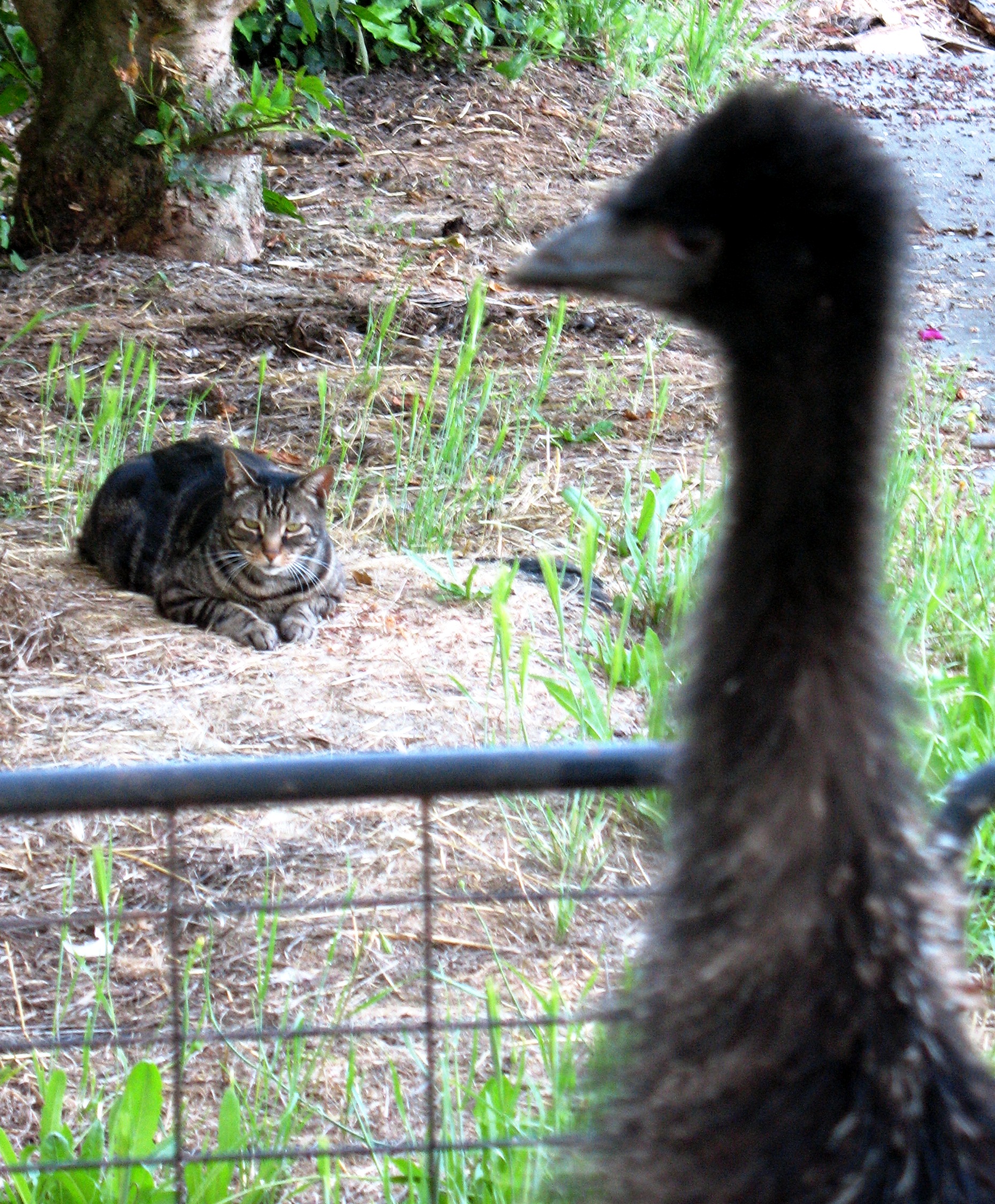
I’d have taken Bob in a heartbeat. After all, he had become Kilo’s best friend. My cat, Kilo (also a rescue cat), has a habit of finding feline playmates and inviting them in. I met Bob this way when I first moved to the farm—suddenly, I had two tabbies in my front yard, playing and hunting gophers, together. The two look alarmingly alike and, more than once, I’d opened the door for Kilo, only to find it was Bob I’d let in. Bob is a charming and social cat. He is sweet but dumb and, hey, good-natured and dumb isn’t so bad on a cat.

I was disappointed when another tenant beat me to the Bob adoption program. So, Bob moved to Stan’s, at the opposite end of the farm, and we saw less of him. For a while, we hosted Bella, Bob’s sister. She didn’t like Kilo, (or any other cat, for that matter) and took her leave to live with yet another tenant, so she could be an only-kitty. It was a matter of musical cats for a while. Then, Stan moved to another farm, taking Bob with him. I thought we’d seen the last of Bob.

Months later, Don alerted me to the fact that Bob was back on the farm! Don had seen Stan pull up in his truck and dump Bob at his old, former home. Elmer fleshed the story out more—he told me that Stan had called to see if he could return as a tenant. (When Stan’s new landlord learned he had a cat, he’d been given the option—leave or get rid of the cat.)  At the time, our farm had no housing available, so I guess the obvious solution was to abandon poor old Bob. (Personally, I think Stan’s landlord put the choice to the wrong critter.) The funny (not haha funny) part of this story was how incensed Don was about Stan’s treatment of Bob. Huh? If that ain’t the pot calling the kettle black.

Bob was traumatized by his sudden dislocation and disappeared for a few months. Then, one spring morning, a very skinny Bob was on the doorstep with Kilo. Bob had found a home. He’s been with us ever since. I suppose we shouldn’t have been surprised, or offended, when hearing that we were leaving, each of our neighbors asked that question, “So, ya takin’ Bob?”

Of course we’re taking Bob! One doesn’t just abandon a family member. And, maybe there’s the difference between farmer and non-farmer. We have pets. Farmers have animals.  And yes, I wish I could have taken the emus.

Bob, from a safe distance.

Bob, from a safe distance.

Maybe Too Much of a Good Thing

A.V. Walters

We all want our food to be safe. We all think that one of the roles of government is to ensure a safe food supply. And they are trying. (Take that any way you like.) There’s regulation pending that would make it hard for organic and small farmers to sell produce. You see, growing food isn’t a spotless operation. It’s done in dirt. Major producers can afford the equipment (and use the chemicals) that give you that pristine, scrubbed, (and not nearly as fresh) produce. Small farmers and roadside stands can’t. It’s as simple as that. Note that most of the outbreaks of food borne disease aren’t coming from small sustainable producers–they’re coming from Big Ag. We need to amend the proposed regulations to provide exemptions for sustainable producers. What looks like a good thing actually favors Big Ag over traditional farming. For more information or to make a comment supporting change to the proposed rules, click on the link. http://salsa3.salsalabs.com/o/50865/p/dia/action3/common/public/?action_KEY=12303

Empty Nest

A.V. Walters

Our avian stalemate was short lived. One of the chickens decided to break ranks. I don’t know the dynamics of chicken-chicken relations, much less chicken-emu exchanges. In any event, chicken-number-two decided to change sides and hang with Gatsby and Kelvin. She followed them around, even slept on the ground near them, in their corner emu haven. That shift changed her routine and she stopped laying eggs in her usual spot. Every day we’d have to go searching for her egg. The egg hunt caught the attention of the emus (though I doubt they had any idea what was up.) I’d be stalking around the yard, poking here and there, with two emus following so closely behind that if I stopped suddenly, they’d bump into me like some Laurel and Hardy routine. Just behind them was the emu-friendly chicken (following the emus) and the regular chicken, not to be totally left out, brought up the rear. What a parade!

The emus are amazingly social. They tried to play and dance with their new chicken friend, but she didn’t get it. Just keeping company was enough for her.

Feeling their oats, the emus proceeded to try to engage with the antisocial chicken, and it resulted in a spirited emu/chicken chase. They could not win her over—so it was a three-to-one club in our front yard.


The Emu Transit Trailer

The Emu Transit Trailer

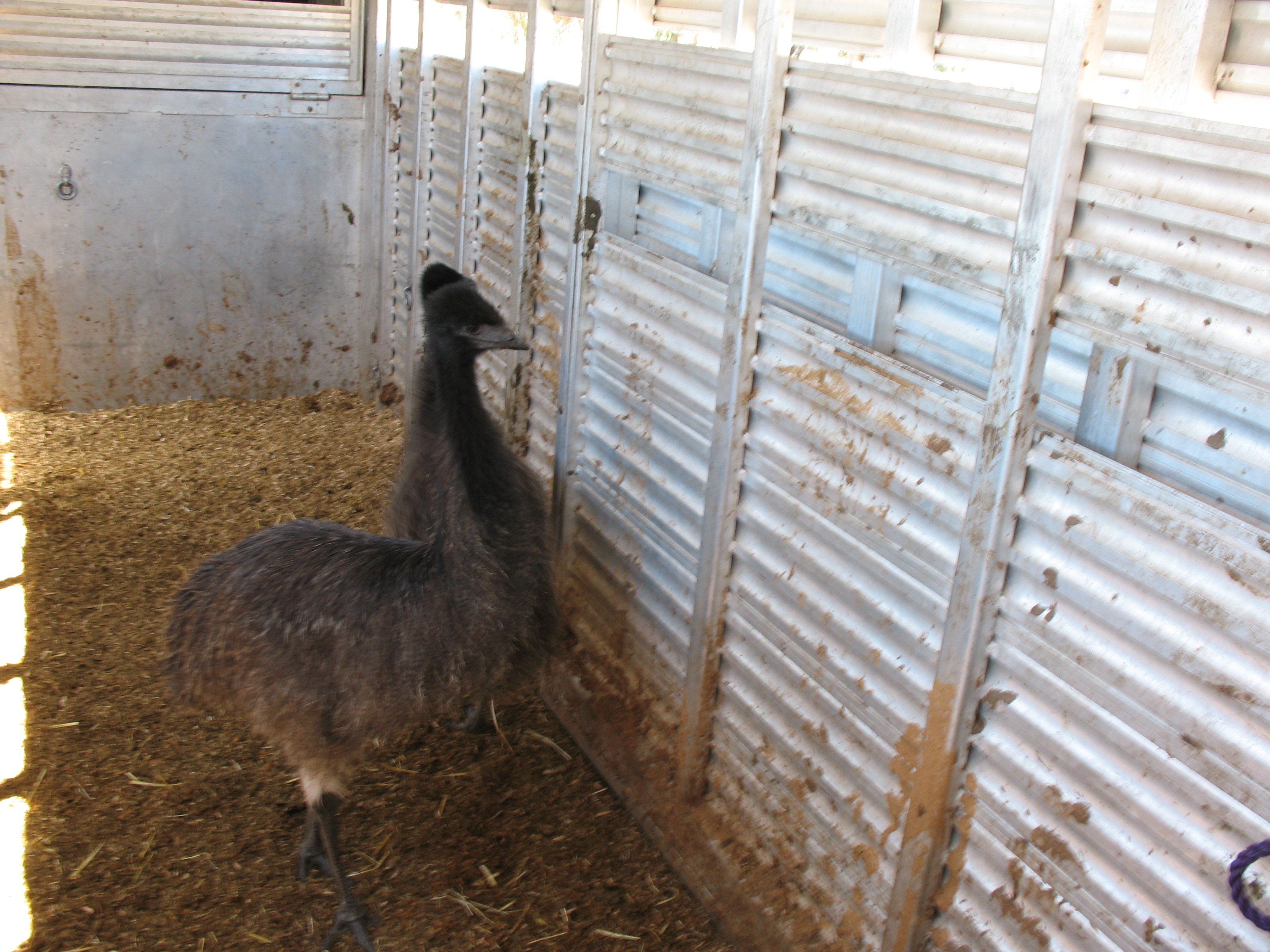
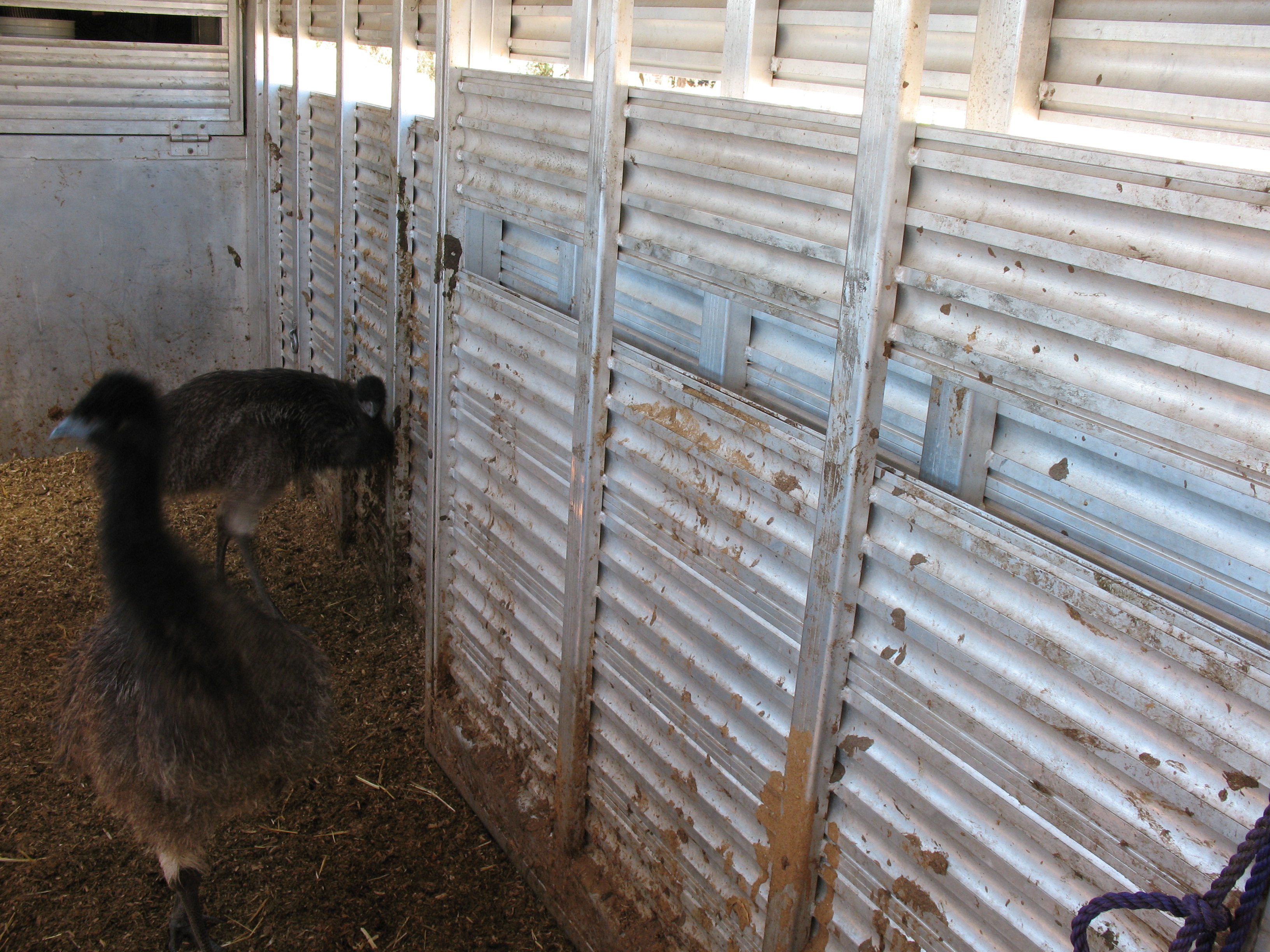
And things would have remained so, had it not been for the arrival of the trailer. I’d talked to Don and Elmer about transferring the emus across the road—for training with sheep at the tutelage of emu-dad. Being a softie, I’d requested that they use a fully enclosed trailer. Emus do not like travel and do not transfer well. I thought the experience would be less traumatic if the trailer didn’t offer the view of the world whizzing by at high speed. So, out of the blue, Elmer arrives with a perfect livestock trailer—not one of the ratty open trailers he uses to transport chickens, but a real, fancy trailer. Apparently he borrowed it for an extra large load of sheep he needed to haul, and thought he’d take the opportunity to move the emus. There we were, without notice, for the fateful emu moving day. It’s probably just as well, because I’d have fretted over it.


Not liking that trailer!

Not liking that trailer!

Hmmmph! Smells like sheep!

Hmmmph! Smells like sheep!

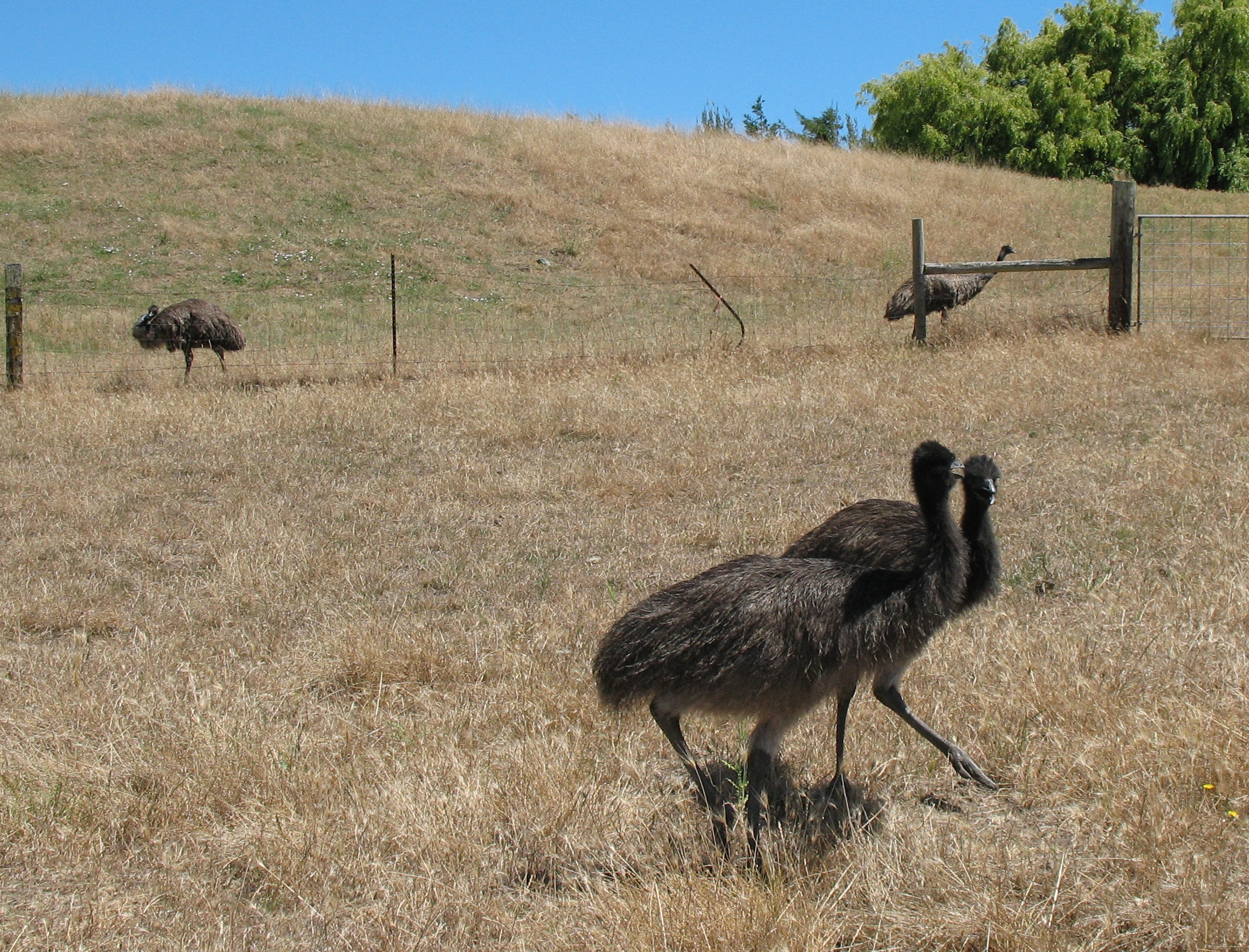
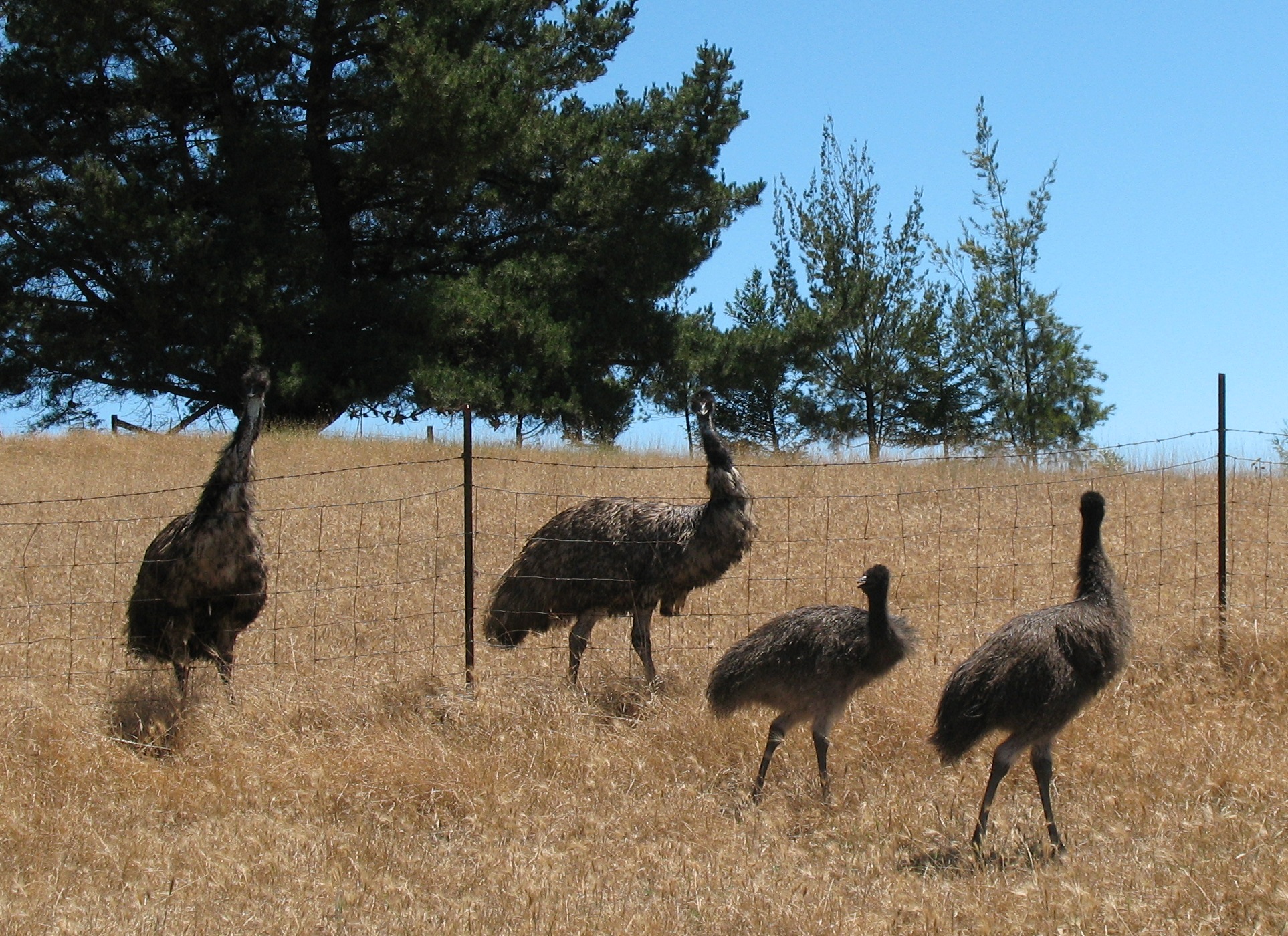
With a minimum of trauma, and only a few tears (mine), the emu-youths were loaded into the trailer and off to new pastures, literally. For their initiation, we decided not to mix the young with the adult emus—so as to let them get used to their new digs first. Good thing, too! Those little emus were in total, “Where-are-we-now, Toto?” shock. They stood in the middle of a large pasture, slack-jawed at the openness. The only thing that captured their attention were the almost equally curious emu parents, gawking from across the upper fence. Emus!


Look! EMUS!

Look! EMUS!

The little guys set off at a trot to explore these new relatives. But blood isn’t thicker than water. It doesn’t come close to being as thick as food. The deck was stacked against the youngsters.


Maybe not so friendly

Maybe not so friendly

You see, our dry summer has been so dry that the summer grasses have browned early. There’s little nutrition in grazing this season. Even up by the pond, where the emus have been kept, it is pretty brown. Elmer has cut back on the number of sheep he’s running—keeping only breeding stock. There’s little grass to feed them and the cost of hay and feed (grain) reflects the dry conditions and scarcity. Usually, if the emus are with the sheep, they’ll supplement summer’s slim pickings with the sheep mix. But this year the emus aren’t with the sheep. Nobody bothered to check on the emus up in the high pasture and they are hungry. So the kids were not visitors—they were competitors for scarce resources; the emu-babies’ homecoming was punctuated with hisses and grunts from mom and dad. If the little ones got too close to the fence, they were rewarded with pecks on the top of their heads (Just like the chickens!) Sadly, this hasn’t dissuaded the little ones. They are eager to commune with other emus. Gatsby, especially, runs to the fence whenever the adults are in view. I think this relationship may be forged on the enthusiasm of youth.


Perhaps a little supervision is in order

Perhaps a little supervision is in order

I also think we can fix this. I think a few days of ample rations all around will bring out the better natures of those cranky adult emus. So it’s been kibble and apples all around.  Yesterday, Mr. and Mrs. Emu scarfed down ten good sized apples in minutes. The solution is Food-Aid. We’ll use food as the social lubricant. Today I’m going to slip in some sweet mix (corn and other goodies used for lambs) for extra calories. While the special emu kibble is a better dietary choice, sometimes junk calories are in order. I’m walking across the farm—about a mile—to the back pastures several times a day to provide extra goodies for the parents and company and play for the kids until they settle in. I am hugely relieved that there are two of them, and that they are such good company for each other.


Hey, watch your back!

Hey, watch your back!

Meanwhile, on the home front, we have answered a burning question in a sad way. We decided to keep the two chickens for a few days. We like the eggs and, though chickens are no social substitute, we were missing the emus. The unanswered question was whether emus were guardian animals for chickens. The answer is that just the presence of emus helps to guard the chickens. The morning after the emu relocation, we woke to just one chicken, and a lot of feathers. It took the predatory critters less than twelve hours to figure out that those chickens were unprotected in the front yard. We hadn’t even thought of it—that maybe the chickens were at risk without the emus. We feel a little guilty. Chicken number one was eaten—by whom we couldn’t tell. That was it. The other chicken was quickly returned to the relative safety of the barn and our home is now bird free.

Rick spent that next day scrubbing the porch and walkway, removing the temporary fences and returning our yard to normal, residential habitation. The cats are happy. They’ve been going in and out the cat door and re-exploring the front yard. When I miss those emus, I hike across the farm for an emu fix. It’s not the same….but it was time. Nature abhors a vacuum. Territories quickly adjust. But the emus will always have a special place in our hearts.


The Orphan Garden

Good Enough

A.V. Walters

The garden this year is an orphan garden. Though we planted it, and we care for it, it’s not really ours. We didn’t do our usual big production garden. We cheated and used older seeds (some of which never did germinate.) We transplanted volunteers and moved things around—so much so that now I’m not sure what’s what. Then, late in the game, one of the farm tenants dropped off two orphan tomatoes—of course, root bound, and those went in, too.

Still, watering and weeding it has been a pleasure. It’s that quiet, steady, work that inspires why I garden in the first place.

There’s a chicken in the garden this year—it happens sometimes that a chicken escapes the barn and sets up housekeeping in some corner. Usually nobody goes looking for them and they forage and do pretty well. This one likes snails. If I see that shiny, post-slime evidence of a snail on one of the plants, I root around in the bucket and find the culprit. I’ve been giving the snails to the chicken, and now she follows me around the garden. Somewhere over there, there are eggs, but I’m not looking.

The tomatoes (even the stragglers) are doing well and have baby green tomatoes hiding in a lacework of yellow flowers. The peppers are in bloom and the various squashes are all growing gangbusters. I just wish I knew what they were. I know there are pumpkins, zucchini, acorn, delicatta (my favorite), butternut and maybe crookneck squashes. I’m uncertain about the rest. The cucumbers (3 lemon and one regular) are filling out and reaching up for the sun. I think there’s a French melon plant in there, but only time will tell.

Unfortunately our hot spells have made the spinach bolt. We’re eating it up quick, before it gets too bitter.  We’ve also had some of the basil, and some early sprigs of cilantro. The radishes are almost ready, though they’ve been beset by bugs, we’ll still eat them. Even if this is all it is, it is good enough.

We didn’t plant this garden with the intention of a harvest. We may never satisfy our curiosity about just what’s in those buckets. We know we’ll be moving, but we don’t know when (or exactly where, for that matter.) We’re packing and checking our plans, Plan A, Plan B and Plan C (even Plan C.5!) We’re selling things that don’t need to go with us. And we’re waiting. The waiting is the worst. We have business to finish here, and we’re not in charge of how quickly that will roll along.

In the meantime, there are emus and chickens to feed and gardens to tend…


Two Chickens, Two Eggs

A.V. Walters

In the best of circumstances, a healthy chicken will produce an egg a day. From time to time, or if under stress, a chicken will occasionally miss a day or two. When winter darkness comes, egg-laying goes. (It’s why commercial egg operations use artificial lighting.) Chickens will usually try to lay in a protected area. The chickens in our front yard have each picked a hollowed out spot under the redwood tree. We collect the eggs everyday. In fact, it’s one of the tasks that Rick especially likes.

What you don’t see, is extra eggs.

Yesterday, Rick found an egg just out in the grass, a yard or two in from the fence–no hollowed out nest–just an egg, sitting there. He picked it up and carefully set it aside. It wasn’t an especially good looking egg; it was a little dirty and mottled looking. Later, he quizzed me about the egg numbers over the past few days.

You see, we’ve been collecting two eggs a day. Rick figures we’ve been set up for another round of Farm Humor. That egg is a rotten-egg-bomb. Our front yard chickens couldn’t have laid it. The numbers don’t work.

We have a suspect. One Bad Egg. We don’t yet have a plan. We could just carefully dispose of this suspicious egg…or we could keep the joke going……


Remember, The Gift of Guylaine Claire and the award-winning The Emma Caites Way, are free ebook downloads through July 4, on Amazon.

Not By The Hair of My Chinny-Chin-Chin

A.V. Walters

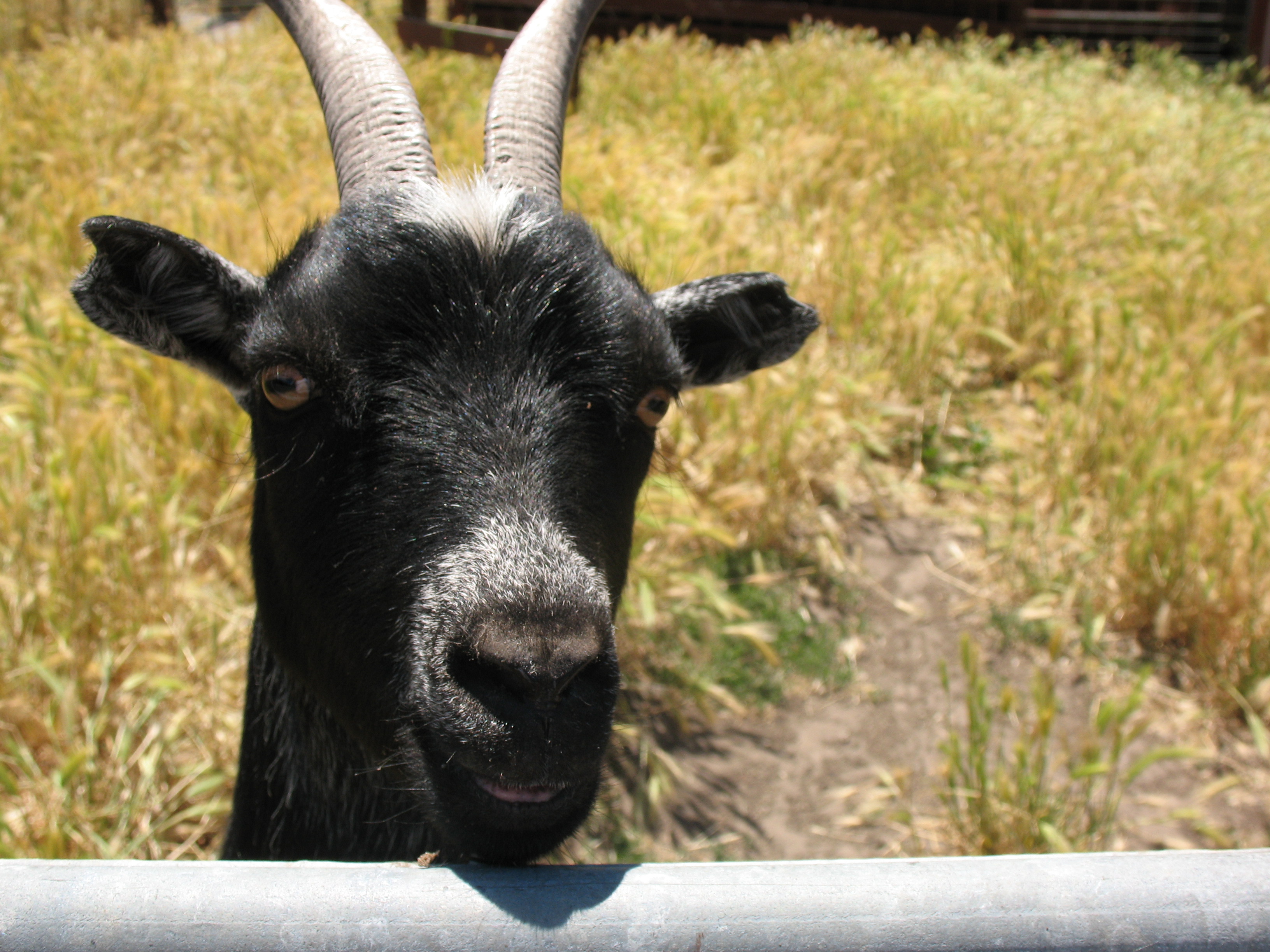
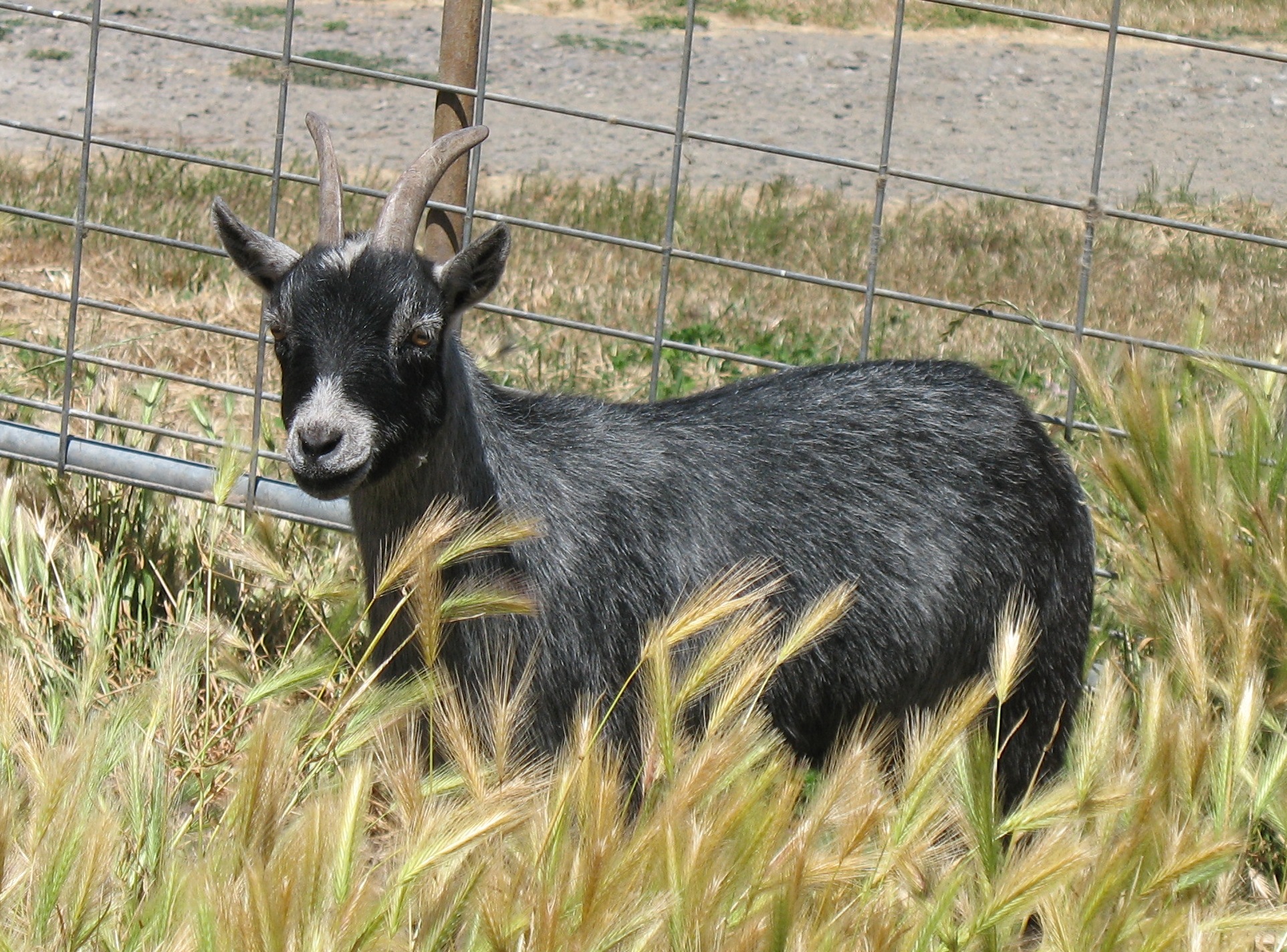
Today the goats got out. I don’t know how. I was on the back porch, talking on the phone to my mother, and looked up to see two goats staring at me. “Rick!” We rounded them up and brought them back to one of the old sheep barns where they’ve been staying, ever since one of Elmer’s tenants abandoned them. They herded pretty well over, but balked at going back in through the gate. One of them appears friendly, the other a little stand-offish. We were taking note of their demeanor, because these are the goats that have been recommended to us for our front-yard-emu-training efforts. These goats are full grown, but little.

There have been some strange goings on, of late, with gates and locks—and this goat fiasco fit right in. The gate was wide open. The gate peg had been laid neatly on top of the fence post, indicating that the goat escape was no accident. We need to get to the bottom of this, since there’ve been mysterious issues with our gate, and we don’t want the emus out on the road.

Getting the goats into their pen was a bit of a feat; once we got to the gate, they took one look and weren’t so interested in cooperating anymore. We had to trick them, with carrots as bait. (It turned out not the best goat treat. Who knew?) Once inside the pen I came to the conclusion that maybe these goats had been abandoned for a reason. Indeed, that was when “friendly” suddenly wasn’t. The more it became clear to them that they were being returned to the pen, the more aggressive she got.

Friendly Might Just Be Aggressive

Friendly Might Just Be Aggressive

She originally liked being patted on the face, but when confronted with a return to captivity, she started pawing and then butting. She’s only knee high, but a butting goat is no joke. You don’t dare turn your back on it. (Rick had noted the same behavior when he’d passed by their pen, about a week earlier.) Taking no chances, I decided to climb the fence to make my escape. Her shyer companion isn’t as friendly, but isn’t a butting problem either—she follows her more aggressive friend, but keeps her distance.

Shy Is Looking Good

Shy Is Looking Good

Finally we got them re-situated. It was a lesson learned. (No, not “Don’t look a gift goat in the mouth.”) We now know that we don’t want these goats in our yard. It’s enough that we have to watch out for emus and chickens (but not having to go down to the hen house for eggs, is a plus.) I really don’t want to have to defend myself from aggressive goats. The great goat escape was a minor annoyance but it’s one that will save us grief in the future. So, the verdict is in, No goats.

Who’s Chicken, Now?

A.V. Walters

Emus aren’t, by nature, guardian animals. They’re actually pretty skittish and, if you want them to guard a herd, they need a proper introduction. Emus are very social animals, but they need to learn who is part of their flock, so they’ll know who isn’t. Gatsby and Kelvin have been running-off anything that comes into the yard, such that we can’t always tell if they’re being nasty, or just overly-friendly. Sometimes, it’s hard to know the difference.

I once had a cat that seemed gregarious and friendly but, at that time, I didn’t have many visitors in my life. Then, when people would come over, the cat would disappear. It turned out that he was petrified of anyone but us. It’s taken years to get him to be comfortable around visitors and strangers. (Rick may argue this point because this cat will still scoot away from him, when he walks into the room.)

And so it is with the emus, they are very comfortable around us, and most of our friends. So, we thought that they were generally, friendly emus. And, well they are, but only within their comfort zone. When strangers come by, they can be a little nervous, and potentially dangerous. That’s the good news… and the bad news, about emus. If they know you, you’re family. If they don’t know you—you are a potential enemy.  As we’ve said before—they’re not real bright. It’s kind of a binary system, they’re either on, or off. If an emu is afraid, then you need to be a little afraid. You need to pay close attention if they start to hiss or huff. Because, not far behind that, is an instinctive, and potentially devastating, kick.

It’s not just with people. The emus are comfortable with our cats; they grew up with them. But they clearly make the distinction between ours and the feral cats from the dairy, next door. Those cats get run off (I suspect with some glee.) It occurred to me recently (when a visitor earned himself a solid hiss) that our emus needed finishing school, so to speak.  So, we decided to start small.

Since there is the possibility that the emus may be guarding chickens, it was a small enough place to start. First, we put an empty cage in the yard, for a few days—that garnered some interest—and soon enough, it became part of the landscape. Then, two days ago, we dropped a couple of chickens into the cage. The emus were wary, to say the least. They scooted around, wide-eyed at the new arrivals’ cackling. (They do seem to be particularly noisy chickens.) We gave it an overnight, and the following day, we opened the cage.

Here come the chickens

Here come the chickens

Now, these emus are teenagers. They’re not yet full sized, but they’re a lot bigger than a chicken. But when it comes to new experiences, they’re still just babies. The emus headed to the far side of the yard. Then, after watching from afar, they slowly inched closer to size-up the new invaders. The chickens are full-gown and about as bright as… well, chickens. They, in contrast, are totally nonplussed by the emus. The emus alternate between being cool about chickens, and being spooked. They walk around like it’s no big deal, but if a chicken corners them, Kelvin, in particular, reacts like her life is at risk. Even though she’s the bigger of the two, she is also the most jumpy. (Boy, does she take after her mother, or what?) For his part, after an initial nervous phase, Gatsby invited a chicken to “dance” (doing the characteristic, emu drop and roll.) The chicken was non-responsive—clearly ignorant of the emu rituals of engagement. I can only hope that the emus aren’t put-off. They’ve managed to share food dishes and yard without serious incident. So far, we’re calling it a success, in a measured sort of way.

Who's stalking whom?

Who’s stalking whom?

Clearly, it’s a good thing we recognized the need for this. These emus have some manners to learn before they head out into the world to take on their security work. We don’t want to raise thugs, after all. We’ll start here, quietly with chickens and, in a week or so, we’ll trade up to goats. Goats, you ask?  Well, Elmer has a couple of goats that were left behind by tenants (this is typical, Elmer) and they’d be perfect for hardening off a couple of flappable, emu trainees. In a few weeks, maybe they’ll be ready for sheep.

Breaking Bread

Breaking Bread

Rick nods to Elmer, noting that we have two cats, two emus, now, two chickens and soon, two goats. He says that if we start building a boat, anytime soon, people should pay attention to the sky.

chick-n-emu 4


Voters and Chickens:

Rights (or the lack of) and Repercussions

A.V. Walters

The Chickens have the floor…

Our emus may have to adjust to a different future that I’d imagined for them. It all goes back to a wacky election in 2008.

You see, in that year, animal rights activists put a referendum on the California ballot that would forever change the way chickens are kept on farms in our state. The measure was poorly defined, and the drafters were a million miles from anything in the world of chickens or eggs or economic realities. Still, the objective was to decrease the level of “cruelty” in livestock agriculture. Who could be against that? With some measure of bitterness, I note that that same election cycle produced another measure that stripped marriage rights from gay and lesbian couples in our state. Here we are, over four years later and to date we haven’t sorted out either one of these issues. Chickens given rights, people losing rights! Only in America!!

On the same-sex marriage issue, we are leaping into the future. In part because of the unfairness in the Proposition 8 law, the public dialogue has changed radically. One by one, states are stepping up (as well as the international community) to ratify human rights, ending discrimination in our antiquated, marriage laws. Sadly, in California the situation remains unsettled because actual law moves more slowly than public opinion (and that may be a good thing, sometimes.) This deplorable referendum has worked its way up through the appellate courts and into the highest court in the land. I can’t say the chicken situation is working out so well, either.

Everyone would love to know that the chickens (or eggs) they eat come from some warm and fuzzy, loving farm-home. Modern farming, especially livestock, isn’t warm and fuzzy. Large scale farming is even less so. Since the Chicken Rights referendum wasn’t specific about how chickens should be kept, litigation immediately ensued. (How ironic, a “what came first” thing—the rules or the legislation.) So, farmers waited for instructions. While we’re moving towards an ascertainable standard, the deadline for compliance looms, and many of the older farmers are just closing up shop. What is clear is that the chickens need more “personal space” and elevated wire cages may soon be a thing of the past.

Elmer’s been watching the issue since that election. He’s attended the poultry conferences and seen the new, demonstration equipment. He’s lived on a chicken farm for his entire life and has watched poultry and egg production methods come and go. “Cage free is the future,” he says, “And that’s what we had when I was a kid!” He shakes his head.

“When the cages came in, it was supposed to be the wave of the future. The elevated, wire cages solved a lot of the problems—the waste dropped through the cage for easy removal, the feed was delivered to the troughs along the cage and the eggs rolled forward on the wire chute for easy gathering. Since the chickens weren’t standing in their feces, a lot of the diseases we dealt with, in the past, just disappeared. It was clean and modern.”

The downside to the economy of scale was, well, the scale of it. The press for more production led to overcrowding, and some kinds of wire cages were harmful to the chickens’ feet. Now the consensus is that chickens should be back on the floor, they should be cage-free and should have material (greens, straw or shavings) for “scratch.”

The new law won’t solve the issues of scale and size, and disease becomes a bigger concern. Given the new (and still unclear) restrictions, and the high costs of labor, the commercial solutions offered are high tech and expensive. Nobody wants to see egg costs go to $6.00 a dozen—which we sometimes see here from organic “boutique” farms. The operations challenges remain the same, waste removal and disposal, food delivery and egg collection. The industry is pimping gorgeous equipment—rolling (conveyor) floor beds, automatic feed dispensers and egg collection, all the bells and whistles. And the cost for an operation the size of Elmer’s? Try a cool, half-million dollars. It’s so high, that the only way to make it work is to seriously expand production. So this law, while well-meaning, will drive small producers out of business, and create even bigger factory farms. Good news for chickens?

Elmer is experimenting. He could retire if he wanted but instead, he’s going back to “chickens on the floor.” He’s cutting and bailing his own hay and straw for scratch and bedding materials. He’s resurrected old brooder boxes from over sixty years ago (farmers never throw anything out.) He’s modifying his manure collection system, using bedding materials for absorption, and thus minimizing the frequency of full removal (as relocating the chickens for cleanup is stressful to the chickens.) In short, he’s going back to the kind of farming they practiced when he was a boy. He’s mindful that he’ll need to keep an eye out for any increase in disease and, even at this experimental stage, he’s seeing a increase in predation

Chickens in elevated cages are relatively safe from predators. Elmer’s barns are designed for cage operations, with open sides for ventilation. On the open floors, especially where the chickens are given some access to open-air yard areas, he’s seeing a return of raccoon losses and fox and coyote problems. Even with his small scale experimental operation, he’s losing a chicken a day. This too, is like the old days.

He asked me today if I thought emus could guard against raccoons. In an instant, I saw the writing on the wall (or the broad side of a barn door.) It burst my bubble— the image of our emus patrolling the open range with sheep. I don’t know how emus would react to raccoons—but they’d be good guards against foxes and coyotes. A quick online search reveals no firm information on the emu/raccoon dynamic. It makes me a little sad to think of Gatsby and Kelvin guarding a chicken barn. But, on a farm, we do the work that comes our way. So, we shall see.

Another Emu Day

A.V. Walters

The new garden is almost complete. Rick is working the last of the bugs out of the drip irrigation system. Three quarters of the plants are in, either as starts or as seeds. It’s a typical summer Two Rock day. It’s sunny and cool and the afternoon winds have whipped up. Over the weekend, in addition to the garden, Rick and I finished stripping the last of the diseased peach curl leaves from the peach tree. We’re in good standing with our spring/summer farm chores and it’s not yet Memorial Day.

With all our attentions elsewhere, the emus have been on their own. Their job at this point is to eat and grow into full size emus. If I sleep in, their chirping reminds me in the morning that it’s time for emu kibble. I wonder how long they’ll keep the chirping. I’ll miss it when they stop. They continue to lose their baby feathers and their striped markings. Rick and I can tell them apart, but nobody else can.

Elmer would like to tag them somehow, maybe with anklets—to tell their gender in the future. I’m not sure what kind of identification system would work, and still let them grow. I look at their dad’s feet and there’s a lot of growing to be done yet. I think they have a few weeks, if not a month more with us, before they’ll head out to learn the sheep trade. In the meantime they’ve become quite territorial about the front yard—keeping the feral critters at bay. They chase the dairy trucks, from the safe side of the fence. I wonder if the drivers notice…and wonder.

They’ll make good guardians, unless the predators come bearing apple treats.

The Last Garden

A.V. Walters

It’s hot in the valley. And dry. This has been on odd year. We had heavy rains in November and December—with an absolute deluge the first week of January. And that was it. Winter is our rainy season, but this year, it wasn’t. After that, we had a few light rains and one storm in the spring. The local farmers are nervous. Over all, the state isn’t experiencing water shortages. There was a heavy snow-pack early this year, so the reservoirs are full, but those that depend on local, well water may be pumping dust by the end of summer.

The past two weeks they’ve been cutting hay. Sometimes, especially here, where we can have drenching fogs, the farmers can get two cuttings, in the spring. Last year it was cool and very foggy—so, we saw three hay harvests. This year, they’ve cut the first time, and it’s dry and yellow underneath. One cut is all they might harvest this year. That means when the summer heat hits, and all the grass goes, (first to gold, then to brown) they’ll be using up the limited hay supply for the dairy and beef herds.

Like I said, the reservoirs are full. Water managers around the state got their snow-pack early so there’s no hew and cry over it being a drought year. In an odd twist of fate, the cities have water, but reservoirs that supply them don’t help the farmers. And, they don’t recharge local aquifers on which the rural areas rely for well water.

Changes in our lives have us wondering how long we’ll be here. I’ve loved Two Rock, and it’s been good to me. But it’s time to move on to build a different future. (Maybe somewhere where there’s water!) So I wasn’t sure this year whether I should put in a garden.

I have been in charge of the farm garden for going on seven years. If we plant it—and have to leave—would someone step up, and care for it? This year was to be a banner year. Over the past few years, the main garden has been shaded by a line of trees Elmer planted to stop erosion from the dairy next door. If ever there was evidence that livestock can damage the land—the field next door is a clear example. The land drops two feet at the edge of our garden—right at the fence. The cows line up and watch me while I garden, and because of the drop we’re nearly at eye level as I bend to dig or weed. It’s a little weird. In any event, late last season Rick spent a couple of weekends pruning and topping that line of trees. This year the garden finally enjoys as much sun as it did when I first arrived.

Early in the spring I asked Elmer how he felt about putting in a farm garden. He hemmed and hawed and finally said we should. We discussed the dry winter and I said that this year we were ready with the drip irrigation. (Rick set it up last year and it was a huge relief in the workload.) I told Elmer I’d get to the garden once he’d plowed. Usually he plows in April, and then again in the first week of May. That digs under any weed seeds that might flourish in the fresh, loose soil. This year he didn’t plow. And, I waited.

Finally, I figured he’d changed his mind. He did plow what we call the “orchard garden,” where he and his girlfriend plant their personal stuff, but he didn’t plow either the main garden or the long garden by the chicken barn. I saw that he’d plowed and tomatoes appeared by the orchard a couple of weeks ago. In the meantime, spring has rolled to summer. It’s hot and digging is getting difficult. With all this dryness, we are getting an early start on the hardpan layer in the soil. It’s a curse and a blessing, that hardpan. If you wait too long to put the garden in, the digging is near to impossible. But that same hardened layer keeps the soils underneath moist. If you water smart—you can do a garden with very little input. That’s the theory behind our bucket gardens. (See https://two-rock-chronicles.com/2012/07/04/the-proper-planting-of-buckets/)

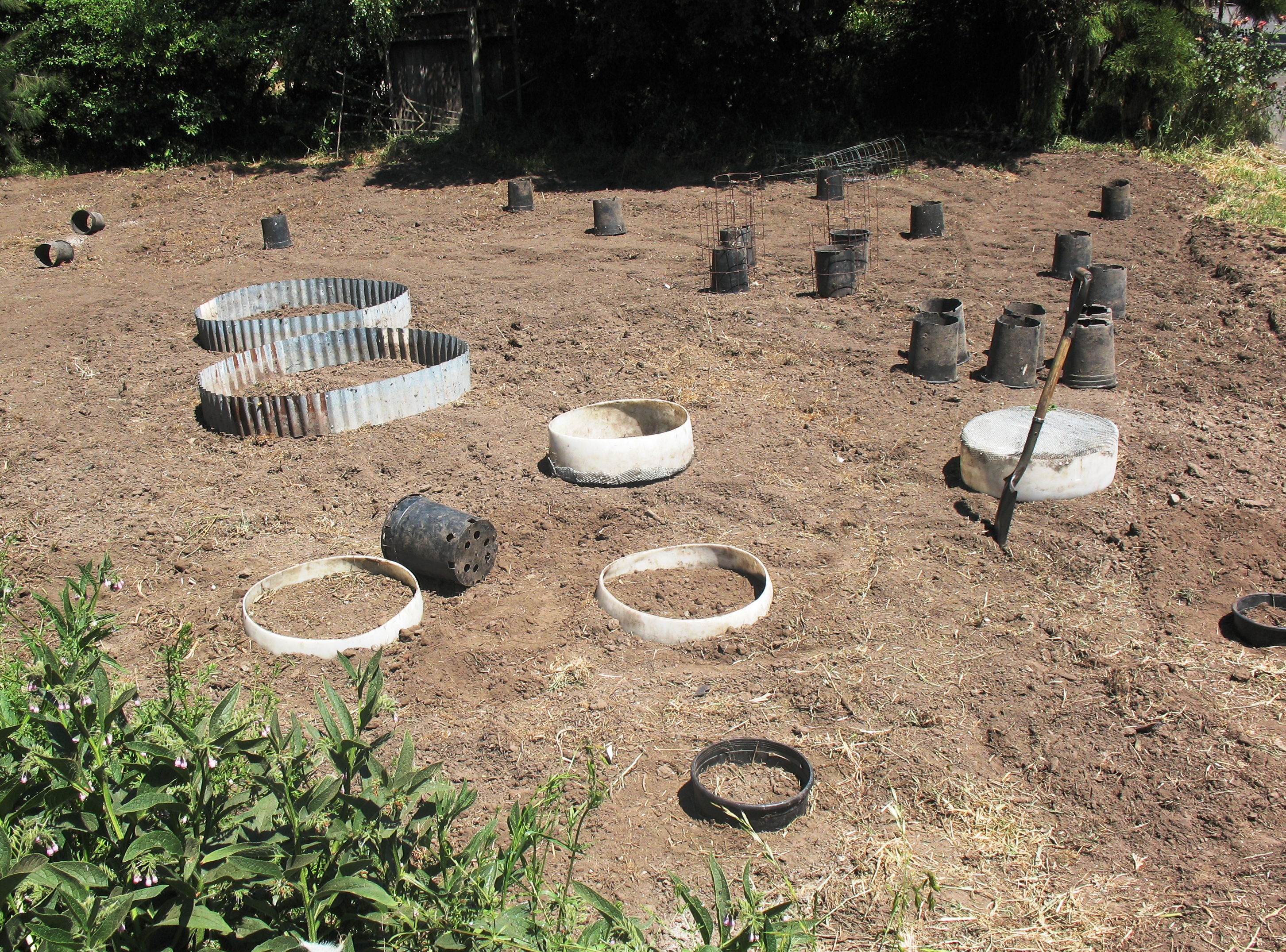
Getting Ready

Getting Ready

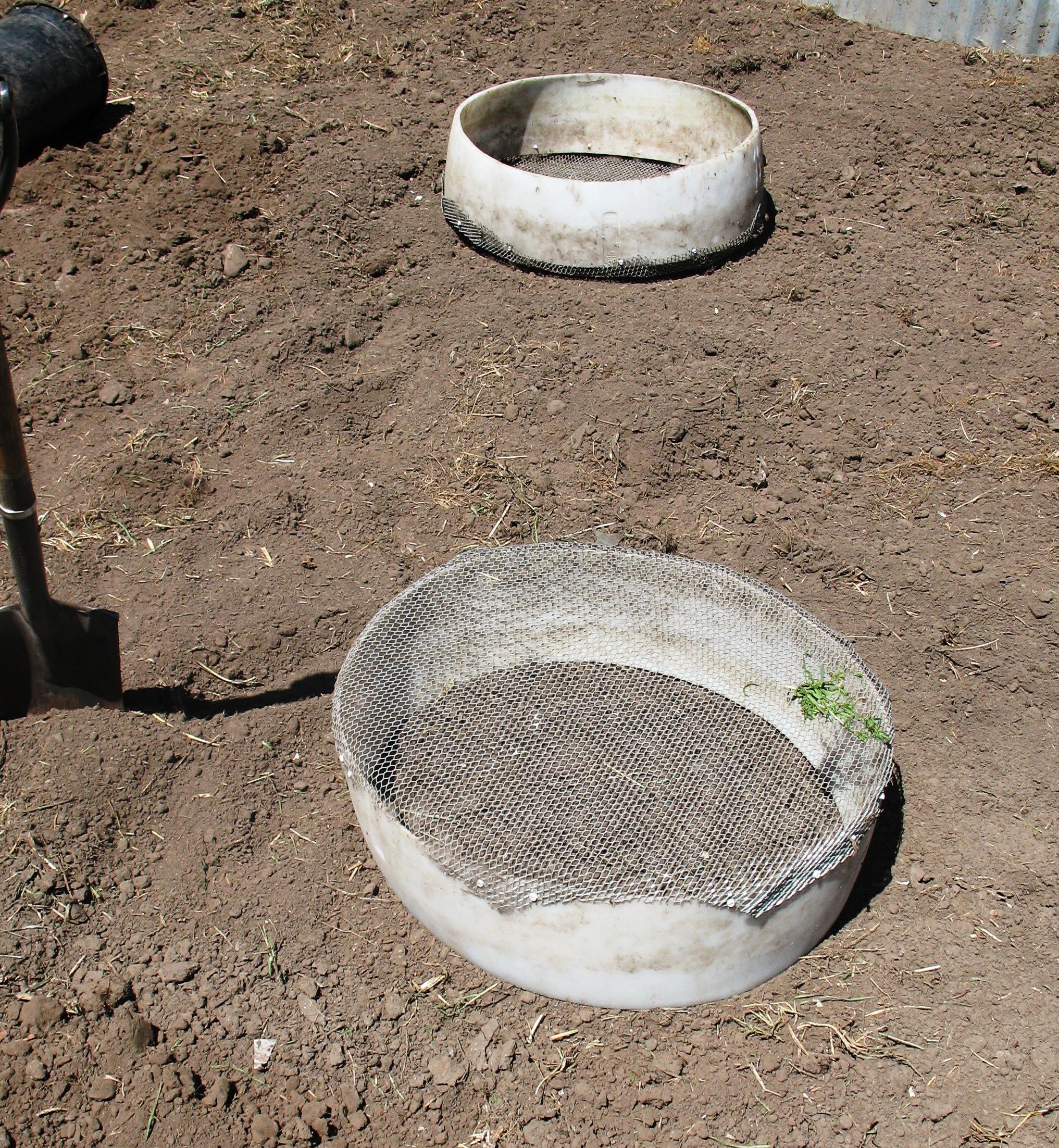
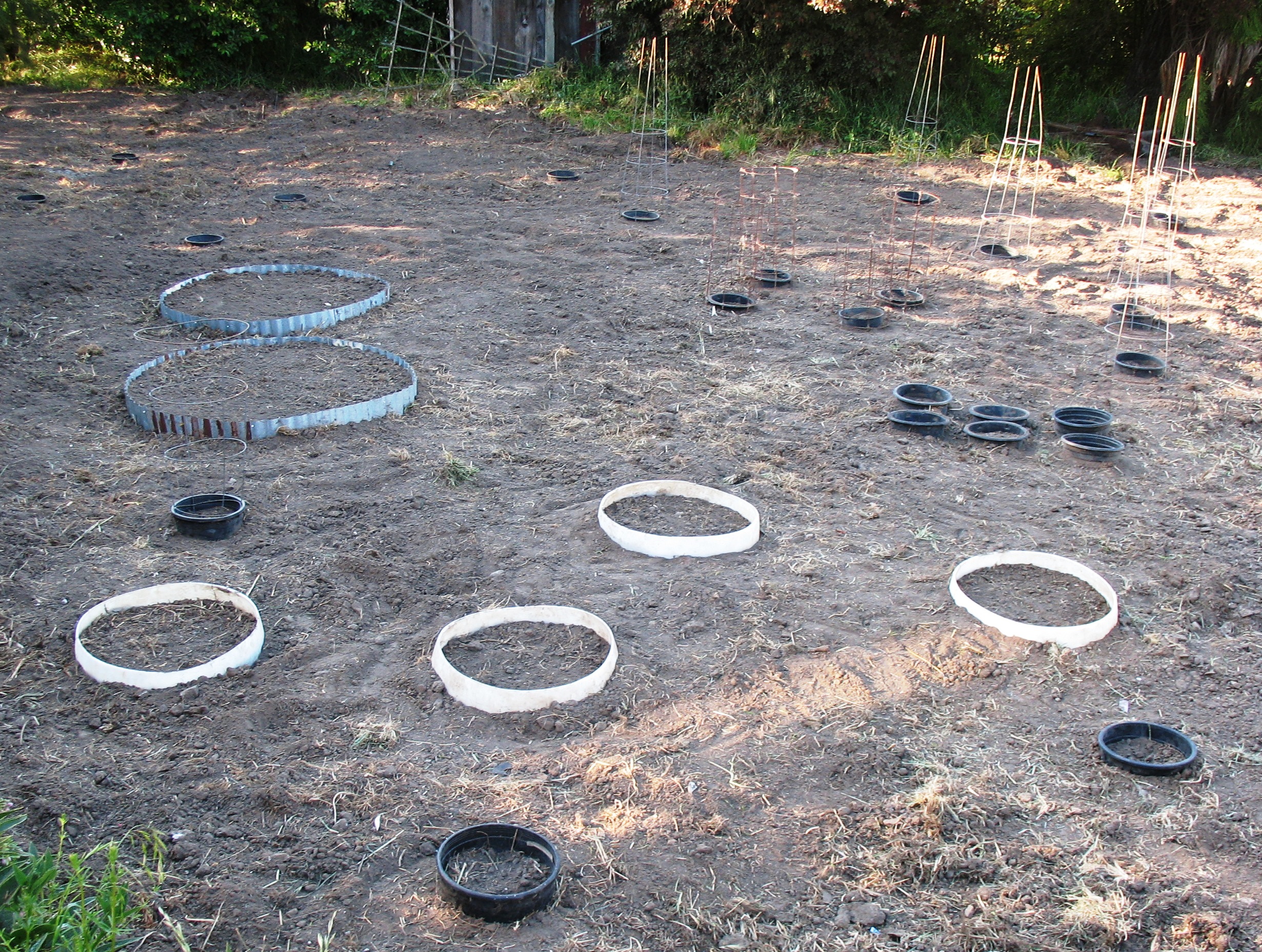
Without a word, Elmer plowed Friday night. Late. I woke up Saturday and realized that I needed to put in a garden. I’d already become accustomed to the idea of no garden, so this is an adjustment. The plow didn’t go deep enough to deal with the hardpan, so digging-in the buckets is a lot of work. If you don’t loosen the soil under the buckets, the roots won’t get beneath the hardpan into the moist earth below. So today I dug in enough buckets (and gopher-shielded rings and corn rings) for a modest garden. It’ll host eight tomato plants, half dozen peppers, four cucumbers, some zucchini and yellow crook-neck squash, a couple of winter squashes, beans, some lettuce, spinach and herbs, and corn. That’s enough for the farm tenants, since most don’t cook much and fewer avail themselves of the garden. I’ll plant with seeds and some starts, this week. I’m not planting the long garden this year.

Digging-in

Digging-in


Gopher proof rings

Gopher proof rings


I don’t know if we’ll be here for harvest. (But, we should be able to enjoy some of the early offerings.) With the drip system, the garden will trickle along, with or without Rick and me. It’ll be like a ghost garden. If that’s the case, I can only hope my farm neighbors will enjoy the harvest. (Assuming someone will water it, said The Little Red Hen.)

Ready for plants

Ready for plants

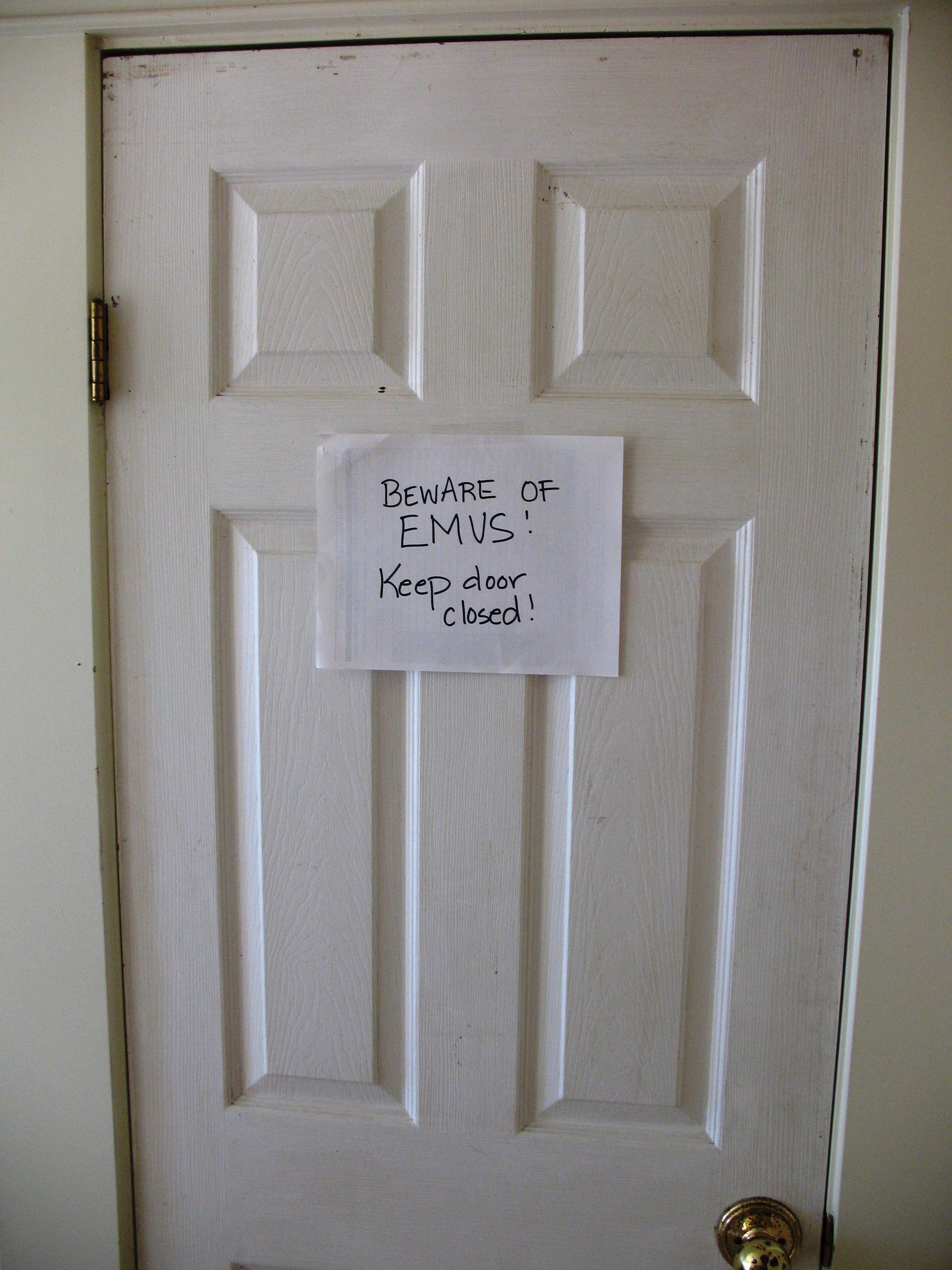
Beware of Emus!

Emus and The Great Outdoors

A.V. Walters

I have a friend who, when her last kid headed off to college, remodeled the newly vacant bedroom, making a sewing and project room for herself. After twenty-two years of putting every one else first, the house, and her life, underwent extensive renovation. It was a shock to the kid when Thanksgiving rolled around, and the room had been, as the French put it, “repurposed.”

Last weekend we came home from a grueling day of volunteering on a day that had started out nippy, but quickly warmed to blistering. The night was clear and warm, and the emus had spent the long day outside. I went into their little bathroom retreat to do the daily clean up before letting them in for the night. Needless to say, it was, as usual, filthy. We looked out at our frolicking prehistoric birds and decided it was time. I fed them outdoors, an odd ritual because they’re grazers. Outside they are surrounded by food, but it made me feel better to give them their kibble. They haven’t been inside, since.

Her neck has lost almost all markings

Her neck has lost almost all markings

Emus and The Great Outdoors

He still has his baby speckles

I spent a full day cleaning out their room. Rick vacuumed and mopped areas where they’d been and I washed out everything from the back entry clear through to the front door. Emus, no more! The final act was to take the sign down from the bathroom door. It was liberating to return the house to mammal-only occupation. I’m glad we did it, and we’d do it again, just not inside!

The emus seem very happy in the front yard. It’s a big area, and a perfect emu training ground for the open pastures with the sheep. Outside, they look smaller but every now and then I note the changes. (The effect is exaggerated because we haven’t weed-whacked since the birds have been out front.) Their heads can easily reach my waist (and curiously, pluck my neatly tucked-in shirt from my jeans.) Initially they cowered in fear at any new thing. Now, when the loud and lumbering dairy truck goes by, they chase it along the fence, as though their patrol activities had actually run it off. Yesterday a feral cat jumped over the fence and, with apparent glee, the emus gave chase. Nothing in that cat’s experience had prepared it for the charging birds. A possible dinner had now turned into two, possible diners! From the birds’ perspective, they’ve been hanging with cats for their whole lives, but none had ever been game enough to give them a real run for their money. Our cats are smarter than that. (Well, and a little intimidated.)

He goes into the emu roll!

He goes into the emu roll!

The emus still like to hang out with us humans. I sit and drink my morning coffee on the front steps. I give them kibble morning and evening, though they could really survive only on the greens out front. They hover, looking for treats, a stroke on the neck, or gently pecking at any speck or spot on our clothes. It’s emu grooming—I guess it means we’re family. They like to tug softly on the ends of my hair. They are particularly fond of pecking at the contrasting wrist-bands on one of Rick’s shirts. The other day one caught a glitter and, in a flash, snatched one of my earrings! Thank god it didn’t taste very good and she spat it right back out. I’d hate to consider the alternative retrieval methods.

Scruffy!

Scruffy!

These days, the emus are looking teenage-scruffy. They’re losing their baby feathers (and with them, the markings by which we’ve identified them.) Underneath we can glimpse the sleek dark feathers to come. As chicks they looked like Scandinavian rugs but now, they look a little moth-eaten. We can still tell them apart, though. The presumed female has gotten much larger. More than that, they have distinct personalities. The female is more assertive, while the presumed male is reserved and gentle. He eats constantly, a nibble here, a nibble there, and barely touches my hand when I give him treats. But, she wolfs down her food! (Just like her mother!) So much so, that sometimes she needs to go and get a drink of water to wash the bolus of kibble down that long neck. Our gender assumptions are based, in large part, on the personality traits of the emu gender reversal. We shall see, well down the road, if we are right.


Mr. Emu  (Dad)

Mr. Emu (Dad)

Sometimes I’ll look at my stats and see that someone has found my blog based on a particular search. Maybe I know the answer–but it isn’t really clear in my blog postings. Then I feel like I’ve let that searcher down. This morning there was a search “baby emu falls down, rolls and gets back up.” Where are you searcher? I imagine that you’re expressing concern about your baby emu, that maybe you think there’s some terrible neurological problem. Fear not! Come back, come back. I have the answer. Your baby emu is playing! Yes, that’s right, we call it the emu dance.

Have you ever noticed that when creatures play (including us) they mimic adult behaviors (behaviours if you’re a Brit or former colonial)? Kids build forts or play house. Kittens roll and tussle–chase things and pounce. Emus dance. After all, without arms there’s not a lot of variety in the play department. That “drop, roll, and run” is a prelude to an emu courting dance. If your baby emus is doing it, it means she/he is happy. They are playing in the only way an emu knows how. (Often, immediately afterward they’ll race around at high speeds–running is another emu talent used in play.) The really fun part is that sometimes, they’ll do it to music! It’s a sight to behold. They love music, especially if the music has whistling sounds or flute solos–high notes that sound like Papa emu’s whistling tones. Also, if you can whistle, it a great way to summon your emu, because they are already pre-wired for that sound.

I hope that emu questioner comes back–there’s no need to worry. (Next time, think about posing a question in the comments area.)


Now, for the meantime, I’m back to my volunteer work.


It’s that time of year again…that time when we roll up our sleeves to volunteer as amateur builders (well, I’m an amateur, but Rick’s a pro) and spend a couple of weekends fixing up the homes of seniors and those on fixed incomes, so that they can remain comfortably in their homes. Rick and I are House Captains on a big project this year–so for the next week or so, there may be scant activity on the blog. Bear with us and our aching muscles. We have an entire yard to transform, two porches to rebuild, a bathroom to remodel. wiring to upgrade, a chicken coop to build, a garden to put in, fences all the way around….it will be transformative for all. But don’t worry, it’s not just us. This organization (Rebuilding Together) recruits a zillion volunteers for the ‘big day.’ Our project alone will probably have 40 volunteers who show up, work gloves in hand, ready to pitch in. (And we’ll need them.) On a large project like this, one day isn’t enough, so Saturday we met with 15 volunteers to set the fence posts. We cleaned up a lot and cut down some out-of-control trees (so there can be sunlight in the garden.) One of our volunteers yesterday was 83! (He’s worked on several of our projects and he works so hard he puts the kids to shame.)

This week is planning and logistics. Then, next Saturday our army of fresh-faced, muscle-flexing, angels will descend on the site and, by days end, our exhausted crew will go home with amazing images of before and after dancing in their heads. It’s incredible what you can achieve with good will, doughnuts and coffee! See you soon when things are under control and Rick and I can return to our own dreams of building a future.

Don’t worry about the emus–they’re thigh high now and spending their days munching away on the greens in my front yard.

They Grow-up So Fast

A.V. Walters

When the two baby emus made their run for it, we realized that the small pen in the back yard was too small. Still, they could have said something, instead of just making a jail break and heading out for the highway. A growing emu needs room to stretch its legs. (And, we can appreciate that, because if there’s one thing a emu has, it’s legs.) There’s a balance; too little space and they get bored and nervous, too big a space and they are intimidated and cower in a corner.

IMG_0750

IMG_0740

So, with the help of some folding pen-panels from Elmer, we secured the front yard.  Now they have a forty by eighty foot area with trees and bushes, and grass almost as tall as they are—enough for any growing emu. They seem mollified and haven’t made any further escape efforts. (Not that we’re giving them much opportunity.) They roam about eating the greenery, and have decided on a favorite corner for their hangout. The new digs won’t eliminate fence running (that’s an emu fact-of-life) but it has stopped the neurotic pacing. Also, the emus seem very much in tune with the sounds of our voices (even when we’re inside the house) and that appears to give them some reassurance that they are not alone and unprotected. (I know, I’m anthropomorphizing again, and being an overly vigilant parent, but when I talk on the phone, in my office, they gather at the steps outside and munch away quietly. If I move to the living room, they munch away under the window, there.)

Huh?

Huh?

It’s still too cold at night for a complete outdoor lifestyle, though that’s coming soon. It might have happened this week, but I’ve been down with a bug. When I’ve got chills and fevers I’m less inclined to banish the babies to the elements. Now that they’re in the front yard—we need to parade them through the house, morning and evening to get them to their little emu warming station in the back bath for the night. It’s quite a production—much emu cheerleading banter—to get their enthusiasm up—followed by a mad dash to the destination (front door or back bath.) The emus will follow you if you walk fast or run. But they’re not smart. If they’re distracted along the way they’ll forget the objective and then wander around the house, which, given their messy proclivities, is not a good thing. Rick is much better at it than I am. They really get that cheerleading vibe from him and follow at a clip. I spend more time in emu roundup mode, rather than leading.

IMG_0728

They are destination happy. Once outside, they barrel around in circles at full speed.  And, full speed is impressive. Their legs have grown and they can really move. Standing around, they’re knee-high, but when they do their happy dance, they come up to mid-thigh. An adult emu can run 30 miles per hour. I haven’t clocked these little guys, but they outrun us.  The “lawn” is hip-high on them (shin-high on us) and, running, they look like they’re speed-swimming on a sea of green. All this cavorting and dancing I take as a sign of healthy, happy emus. In the evening, they’re eager to come back in and canter after us to settle in under their heat lamp to relax after a long day of emu vigilance.

IMG_0724

Most of their food now comes from grazing, putting a welcome end to the endless chopping of their early days. We still give them apples, as treats. It pays to have something they want, to get their attention. At some point we’ll have to move these guys to the pastures, where the sheep are—and we’ll probably need those treats as bait. There’s a tension to how much we handle them. There is one kind of contact they tolerate and, if they’re relaxed, actually seem to enjoy—they like having the front of their necks stroked. (We’re suspecting that neck contact is important to them. If the chicks are nervous, they’ll pace and crisscross each other with their necks. Also, the few times an adult emu has displayed what might be considered affection, it “caressed” with its neck.) But, we have to remember they are not pets. They need to develop a tolerance to human contact without making them dependent, so “training” is not an option. (Besides, they’re not that bright—think of the term ‘bird brain’ in the context of a 150 pound, flightless locomotive.) Still, it’s fun and gratifying to step out on the front porch and immediately have two emus hurtling in your direction to see what fun or treats are in store (and because they like to be near us.) In fact, I think I’ll go check on them, right now.

Apple treats, anyone?

Home Again, Home Again, Jiggity-Jig

R.R. Edwards

I had just turned onto our road, after a trip into town, and about half way down the half-mile stretch to the house, I spotted a couple of odd creatures standing in the road. As I got nearer, it became obvious that they were, in fact, some kind of bird. At first I thought they might be a couple of escaped chickens and, as I got closer I saw that, in fact, these were escaped birds. But, to my amazement, these weren’t chickens making a break for it—they were our adopted emu chicks, on the loose and halfway to the highway! The last time I’d seen them, they were in the yard, running around the enclosure we’d set up for them.

For a few seconds I just sat there, a bit stunned and unsure what my next move should be. They stood there, staring back, just as unsure about their next move. When I inched the car forward, the chicks answered the question for me—they started heading back down the road in order to put distance between themselves and the mysterious, iron beast that had blocked their path.  So, following their lead, I began my very own, emu round-up, behind the wheel of my trusty steed.

The emus were surprisingly “cooperative”—they kept scooting along at a relatively brisk pace and, only once, did one of them threaten to take off, across an adjacent pasture by squeezing through the fence. Fortunately, he kept moving in the right direction and, when the fence ahead of him ran out, popped back out, onto the road. When we arrived where the road split, (straight, the road took you to the neighboring dairy, and to the right was our place) I managed to steer them in the right direction. Now that we’d arrived at the house, the next trick was going to be getting them either back into their pen, or into the house.

At this point I had to hope that “Mother Nature” (in a twisted sort of way) would take over, and that the chicks’ bond to me was strong enough to overcome their confused and somewhat panicked state. I got out of the car and slowly approached our feathered charges, afraid that all my work would be for naught, and that they would bolt. But, as soon as I called to them, their little heads spun around and they came running up to me, cheeping away. They were clearly thrilled to have been found by a “parent” and would have happily followed me, anywhere. Since it was lightly raining, and they looked a little soaked from their adventure, I led them inside where they could huddle under the heat lamp to dry out.

After telling AV, “Guess what who I saw standing in the road,” I realized how lucky we were, in so many ways. Once they got out of their pen, they could have headed in any direction. We’re surrounded by miles of open pasture, and once out there, they would have been next to impossible to find. The fact that they’re “fence runners” kept them on the road, between fences, but they had covered a quarter-mile, in a relatively short amount of time, and had I been back much later, they might have made it to the main road and hitched a ride to just about anywhere. Or, when confronted by me on the road, they could have “flipped me the bird,” and taken off in any direction. (And, these little guys, at the tender age of 1-month, can out run me!) All kidding aside, we lucked out that our little birds are home safe. I would have assumed that, once out of their pen, they would have stayed around the house, looking for us or a way back inside. But like most youngsters the thrill of adventure dulled their sense of self-preservation, and down the road they happily trotted. Clearly, the trials and tribulations of parenting (and youth) are universal.


Country Fresh

A.V. Walters

Even while I lived in the city, I hung onto my rural roots. I gardened and produced most of my summer fare from a postage stamp-sized back yard. I canned jams from the plum tree, and I hung my laundry out in the sun, to dry. So, it should come as no surprise that, when I moved to the farm, not only would I want to continue these patterns, but there’d be some room for expansion. But when I explained my plans to Elmer, he seemed a bit alarmed. Not at the gardening, that made perfect sense. And, like a lot of country folk, he fully supports canning. The problem arose when I asked Elmer to put up a clothesline, of all things!

He squirmed at the notion, “Why the heck would you want to do something like that?” I was ready with my environmentally friendly, power-of-the-sun, low-carbon-footprint, Pollyanna diatribe.

“Well, we have a lot of wind, you know. It whips up the dust, and all. So, you’d want to be sure to bring it in before the afternoon winds start up.” He didn’t sound convincing, and it seemed like a strange response—a little wind would be exactly the ticket. In what better environment could there be to dry laundry? (I’d failed to note the almost-complete absence of clotheslines, in the area.)

Elmer never did help out with getting that line up, and given his reaction, I didn’t press it. After a while, I bought the materials and installed it myself. And, he was right about the wind and the dust. If you left the laundry out, late in the day, you’d have to wash it, again. But our mornings were still, and my line was set up to take advantage of the morning sun.

One morning I pulled a fresh towel from the line and headed into town for a swim. (There’s nothing like a vigorous work-out in chlorinated water to clear your head.) As I walked back into the changing room, I caught the unmistakable stench of cow manure. I laughed to myself and thought, somewhere there’s a farmer in here, for sure.

I’ll have to admit, here, that when you’re exposed to something a lot, you become, well, desensitized and… I live next door to a dairy. So, when I grabbed my towel, I almost choked. That farmer was me! And that certainly explained why they don’t hang their laundry out. Oh my! And that was the end of my energy saving foray with country laundry.

Someday, I’ll live somewhere with a different background aroma—and I’ll go back to the clothesline. (Rick said he thinks he knows the perfect location.)

A Little Bit of Wild…

A.V. Walters

Emus are not domesticated creatures. They are ancient creatures, virtually unchanged for many millions of years. We cannot own them, though we may “keep” them. They are not really pets. Nowhere is this more clear than when one tries to transport them. Try to put them in a box, and they panic. They thrash. They can even fight to the point of injuring themselves. There is no such thing as a portable emu. They do not respond to the instruction, “Hey, just chill!”

Even carrying them from their indoor, night-time home, to the backyard is telling (and trying.) This should be routine by now, but every single time, they kick and fight and squawk. Our first emu pioneers, The Royals, made their trip in a big box. On arrival one had managed to kick himself into a royal limp. It’s minor, and will heal, but it speaks to the difference between a domesticated animal and a wild one. We can keep company with the wild but we cannot bend them to our will. Last night, when outbound emu number three was loaded into a kennel for his trip to its new home, he fought like a ninja (but without the grace.) It’s a little heartbreaking to see, and makes for a traumatic farewell, even when they’re off to the best of new homes.

In this case, the emu we knew as DotDash, will be a guardian/companion animal to a new flock of sheep. We were duly impressed with the new keeper, a diligent 16-year-old girl who is building a flock of prize sheep. She’d done her research and found that an emu guardian was a sustainable and viable way to protect her investment, both emotional and financial. She’s familiar with chickens and other livestock and I queried her about her commitment to an animal that will live about thirty years. She had considered it, and sees agriculture as a lifetime commitment for her. So, an emu fits the bill. I asked, “What if you go away to college, what of the emu then?” She was ready for it. Emus are low maintenance. Her parents (who have fifty acres nearby) are already committed to the sheep, so an emu actually helps that dynamic. And she won’t go far away.

I worry that we don’t have many young people interested in farm living. Almost all the farmers and ranchers I know are at an age when most people are talking about retirement. It’s not an easy life but one that comes with many rewards. In the absence of an investment by our youth, where will we get our food? From corporate farms? What kinds of stewards will they be of our precious farmland? What do they add to a farm community? So, how could I not honor this young lady’s venture into agriculture? She embodies everything I think we need in a new generation committed to the land, even if it puts her out-of-step with her social cohorts.

We spoke at length, and I think she understands the compact that we have with emus. She respects that her new emu charge is wild, and that in that wildness is a trait—protection from canine predators—that walks in step with her needs with sheep. So off he went, kicking and peeping to a new life. I think both of them—the emu and the girl, will do very well; there’s a little bit of wild in each of them.

Two Down…

Announcing, The Royal Emus

A.V. Walters

There are many considerations in the placement of an emu chick. One must determine the environment in which it will live, and its intended work, so as to match the temperament of the bird to the life it will enjoy. And so, today we bid a fond farewell to two emu chicks who will go on to a particularly cushy lifestyle. They will be The Royal Emus, who have actually gone off to live at a castle.

Soon to be 3

Soon to be 3

It was a tough call to make. Not the suitability of the placement, but which chicks to send away—one of the emu emissaries was our favorite. We called him C3, because of the markings on his head. He was not only the youngest, but also the most independent of the lot. He was the one always ready to stir up fun, in a very emu way. When emus play, they drop to the ground, roll over while kicking, and then jump up in a frisky dance followed by running in circles like maniacs. If any of the other chicks is up for it, they’ll repeat the performance and the bunch of them will run around—smashing into one another like bumper cars. C3 was the main instigator of the high-jinks. He was also one of the most gentle of the bunch. He (she?) and the other youngest (whom we called Sleepy) seemed like the best personality matches for this particular gig.

They will get menagerie duty—being visited and guarding the menagerie of animals at an upscale vineyard in Napa County. It’s a good gig, one I’d take in a heartbeat if it were offered to me. And they’ll get to live at a castle—and so, royal emus. We don’t know what their formal names will be (we’ll just have to wait for the coronation, like all the other commoners) but, once they’re grown, you can have an audience with Their Highnesses at Castello di Amorosa in Calistoga. You’ll find them ambling through the olive orchard, or looking regal amongst their subjects, the lesser critters—sheep, chickens and peacocks (who really think they’re special.) As for us, well, we took a discount on the price (an inducement to take two, instead of one) and got a bunch of wine thrown in, just the thing for celebrating our first (and probably only) successful emu raising and placement. (A lovely 2008 Cabernet, fitting to the occasion.)

This sure beats the assignment for one of the other inquiries we received. They wanted to know if our emus could guard their sheep from mountain lions. They’ve apparently lost 24 goats, this year, to lions. (I’d say there’s a very healthy, and growing, lion family there.) We quickly hit the internet to find that emus are no match for lions. At best, they’d maybe slow the process as the lions worked their way through the emus, before moving on the other animals. But the words, “Tastes just like chicken,” kept ringing in my ears, so we enlightened them as to the facts of nature, and declined their offer.

We’re now left with three. Elmer only wants two, but he says he’d keep three if the alternative meant having to send one off to a lonely life. (Of course, that’s easy for Elmer to say, he doesn’t have three emus in his bathroom!) Still, it made us feel better, because we felt the same way. We only want the best for our little emu chicks—even the ones who have gone off to a luxurious life of fame and fortune, leaving us peasants behind, to clean up after their three siblings.

Funny thing is, we’ll probably visit.

Indoor Emus?

Kids—Don’t Try This At Home

A.V. Walters

We really don’t have much in the way of options in this. We are renters. We don’t have easy access to a barn or a shed or other outdoor structures that we don’t mind being trashed by five of the messiest creatures on earth. Still, these emus are technically babies. They still need to have an environment that is heated until they reach a body mass that is large enough keep themselves warm. We put them outside now for several hours each day. It’s a shorter run if it’s cloudy, or if, like today, it’s raining. I’m watching to see when they start to tremble, at which point I’ll haul them back in and put them under the heat lamp.

While they’re out frolicking, I take the opportunity to clean their little room. I’m so relieved that it is a tiled bathroom. Even then, I line it with newspapers everyday, so that I can just roll up a day’s worth of filth, and dispose of it. You cannot believe how much “trash” is generated by five emu chicks! They’ve almost tripled in size since the first day we took them in, at the beginning of the month. They’re growing, eating and you-know-what, at a prodigious rate. It’s not surprising—an emu reaches adult size and weight in about a year. By comparison, it means they need to grow the human equivalent of a year’s worth, every month. They are now knee high, without much of a stretch. (And that means that their “mess” extends up the walls, that much higher now.)

It raises the issue of how one measures emu growth. Their flexible little necks complicate the equation. Extended? On tippy-toe? (And yes, they’ll stand on tip-toe to look into the trash bin, to peck at any odd spot, or over a low enclosure.) The knee-high average is just standing with no effort at extension. I suppose the best way would be to weight them, but they’re so wiggly that I can’t figure out how to get them back on the scale. Just weeks ago, when we weighed them in at teacup size, it was a relatively easy proposition. I can’t imagine doing it now.

And, fast! They can run. Together they move like fish in a school, (well, a school of kindergarteners) en masse with sudden, inexplicable and semi-choreographed changes in direction. They also dance and play—a series of hops, often preceded by rolling over and then followed by a group mad dash in every direction, knocking each other down if at all possible. It keeps up laughing.

With any luck, two will have a new home by week’s end. The first potential adoption fell through when the gentleman realized how fast they’d grow, and how hard it would be to relocate them for his scheduled move in eight months. “Maybe next year.” Ha! Do you think I’m going to do this again? But now, there’s a much better prospect in the works. Every now and then, when I worry about how to adopt-out emus, I realize that it’s not really my problem. (Yeah, I know. If it’s not my problem, then why am I up to my knees in emus?) I’m just a renter here, and these are Elmer’s emus, after all. Well, you know, I could just move away…

Hearth and Home

A.V. Walters

It’s a strange underpinning to the season of renewal, an almost depressing release of the winter norms, that comes before the longer days and warmer weather can step in to ease the transition. You see, in winter we endure the long, dark days with the light and warmth of our woodstove. There is a center to our home, as we cozy up each evening in front of the fire to rehash the day, or play Scrabble, or just sit and read. When it’s warm, the fire isn’t necessary for heat, but we miss basking in the golden light of the flames. There’s an intimacy to it and a ‘place’ where we belong in the winter evenings.

The day-time temperature in our home now ranges around 64˚ (F)—that’s about what we heat it to, in the winter. Somehow though, especially if it’s gray out, it doesn’t seem quite warm enough. And we’re not sure where to sit in the evening—the living room suddenly darker, without the glow of the stove. I confess we’ve lit ‘cosmetic’ fires—small fires with just enough warmth to keep the “hearth” in “hearth and home.” The cold glow of a computer screen just isn’t the same, even if it does spell a certain increase in productivity.

Both Rick and I seem to be experiencing a similar winter withdrawal. We wonder whether this is common, or just us. The rhythms of spring and summer, gardening, long evenings outdoors, sometimes chatting with the neighbors—beer in hand, aren’t due for at least another month. Now, with daylight savings, the days are longer but not yet appreciably seasonal. Mostly, it just makes us feel tired.

We theorize that, in many homes, the cold blue glare of the television has become a poor, substitute hearth. Modern folks have opted for entertainment, rather then the primal satisfaction of day’s end in front of the fire. Do they even know this? Do they ever think about the crackle of kindling, and the random dance of the flames? We certainly don’t miss television, but we yearn for a more fully realized shift of season to help direct our energies away from our now-empty patterns of winter.

I confess that I’m filling some of the void with evenings of baking—tonight, a flourless, almond based chocolate extravaganza. Summer may find us, eventually, garden-ready, but a bit rounder.


Nature Giveth, and Nature Taketh Away

R.R. Edwards

Life in rural Sonoma County can be an odd blend of nature at its best, and then a show of its harsher side. We’d arrived home yesterday at about 4:00 a.m. after a stressful couple of days, and an 11 hour drive. Awaking after only a few hours of sleep, we were beat, and decided it was a day to lie low. We owed Mr. Emu a visit—it had been about a week since we’d made off with his five chicks to give them a better chance at survival, and, after debating about dragging our tired asses out of the house and up the hill, nature’s perfect afternoon of sunshine and blue skies won out.

We made our way past the field where Mrs. Emu was grazing alongside the sheep, stopping only long enough to give her a few pieces of apple we’d cut up for Mr. E. She’s now in the habit of making her way over to the fence when she sees us walking up the road, looking for her share of apple. Further up the road are the two fields (divided by a fence with a gate) that Mr. E has been occupying along with about a dozen sheep and lambs. The upper field holds a pond that you can’t see from the road, and the emu’s nest was near the pond. When we arrived at the lower field, there was no sign of Mr. E. We thought this odd as he’s usually wandering along the fence, near the road, and even when he’s in the upper field, he can usually be seen. It was then that we noticed a lone buzzard, standing in the far corner of the field. I didn’t give it a lot of thought—normally, if there’s something a buzzard is interested in, they’re all interested. Any carrion meal of note is usually well attended. I was about to head to the upper area in search of our missing bird when AV says, “Let’s check it out.”  As we approached, the buzzard took off, abandoning what was clearly the remains of an animal. At first, the only thing I could see was a rib-cage, picked clean. Just as I was thinking it, AV said, “It’s Mister Emu!” My heart sank, and AV looked as if she were about to cry. I wandered closer, and it was then that I realized it wasn’t Mr. E, but the remains of a lamb. It’s not often that we’d be relieved to come across a dead lamb (especially one who was killed by a predator) but, in this case…

After recovering from our initial shock, we started looking for clues as to who the culprit might have been. We didn’t see any tracks or other evidence but concluded that it was most likely a coyote—even though a fox could take down a large lamb, and there are (be it rare) mountain lions about, coyotes are usually the biggest problem.

It was then that we noticed two lambs that were trapped between a pair of fences that ran between this and an adjacent field. (A 6’ wide strip was planted with trees to create a wind-break, and the fences protect the young trees from the sheep.) How the lambs got themselves trapped in there, or how long they’d been there was unknown, but before we took on this unexpected task, we still needed to solve the mystery of the missing emu.

We passed through the open gate, to the upper field, and came over the rise to an open area next to the pond. And there, sitting on his once-abandoned nest, was Mr. E.  Along with this discovery came the realization that he had returned to the nest with the intent of hatching the two eggs he’d walked away from, about a week earlier. In our haste to remove the last chick, we left the eggs he’d abandoned the day before, not imagining he would return to them. In the past, he’s pushed eggs out of the nest, or left them if he determined they weren’t viable, and we never saw him return or reclaim an egg, once he made the decision.  Needless to say, our relief at finding him alive and well was replaced by guilt. First, we’d taken his 5 chicks and then, carelessly left the eggs that he’d now brooded over, needlessly, for perhaps a week. Our learning curve on emus continues to be steep.

We were now left with a lot of questions, and few answers. First, did the predator’s attack on the lamb prompt Mr. E to return to the nest in a misplaced effort to protect his unborn? Or, was Mr. E pointlessly sitting on his nest rather than tending to his duty of protecting the lamb from a coyote? And, why were the two other lambs trapped in the fenced area? Were they fleeing from an attacking coyote by working their way through the fence? Were there originally three lambs stranded between the fences, cut off from the rest of the flock, their mothers and the emu—one falling victim and pulled out, into the open field and eaten? Or, were all these events totally unrelated, and it was just another day on the farm?

We removed the remaining emu eggs from the nest, and made our way back down the hill to the lower field.  We opened up the end of the fenced area, coaxed the two lambs out, and back into the field to join the ewes. We located the hole in the wire fence that gave the lambs access. Whether they wandered in, in search of greener grass, or were spooked by the coyote, we’ll never know. Oddly enough, it was in this same fenced-off area that two emu chicks fell victim to a fox, a couple of years ago. That event also raised similar questions—did the chicks wander in between the fences, where they couldn’t be protected, or did the fox pull them in, seeking protection from the emu parent? AV had come upon the scene, after the fact, where she found a highly agitated Mr. E, frantically pacing outside the fenced area.  There, just out of the emu’s reach, were the remains of one chick, and the other was nowhere in sight, most likely carried off by the fox. The fatal error may have been Mrs. Emu’s choice of a nesting sight next to this fenced-off “no man’s land.” (Though the male emu hatches and rears the young, the nest is established where the female chooses to lay her eggs.) AV returned the next day, with apple treats, and found Mr. E standing at the nest site, still dazed from the trauma of watching his chicks meet a violent end. A surprisingly, touching moment occurred while AV tried to console what was clearly a grieving parent—this oversized, prehistoric beast gently wrapped his long neck around AV’s shoulder, and embraced her.

Today, we headed back over and found Mr. Emu in one of his usual spots—walking the perimeter of the lower field, near the road. We fed him apple pieces and emu chow, and life (as if we can ever truly understand it,) seems to have returned to normal. That is, if you consider five emu chicks living in your bathroom, normal.

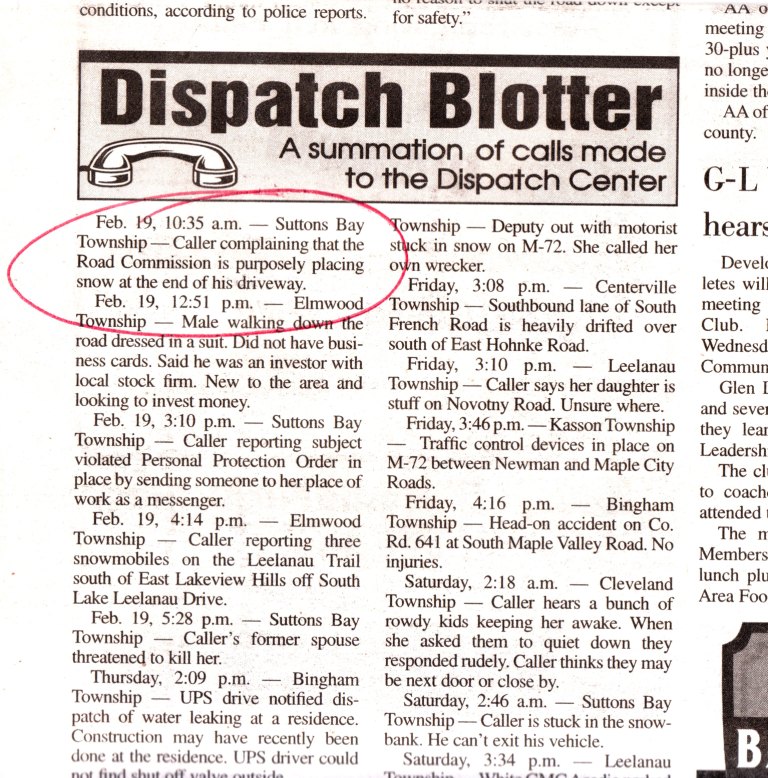


So, Here’s the Drill…

(And, this is only a drill.)

A.V. Walters

This must be what it’s like having triplets. We now have five emu chicks in our care. I swear, the older ones have developed a swagger. They are dominant, and clearly in charge. (As in charge as anyone can be, of emu chicks.) The two youngest struggle to keep up and are the first to nod off after exercise or a meal. (Sometimes nodding off while standing in the middle of the food dish.) In the past day or so, the volume of food they eat has quadrupled. They finally have the technique down and are eager to demonstrate their belly-stuffing proficiency. Their food (chopped kale and apple bits) must be finely minced. I feel like a cook at a high school cafeteria, all the work and none of the appreciation.

We’re trying to imitate what would be the normal emu-raising techniques of the average emu dad. (In the emu world, the female lays the egg, and that’s it. The male hatches them and raises the chicks.) At this stage they would need a lot of warming time (and, apparently sleeping time) underneath their dad’s umbrella of warm feathers, so we let them spend a lot of time under the warming lights in their “nest.” We take them out, four or five times a day to “run” them—they need practice walking (and also running.) Because they are enormously messy, (they eat a lot, and so…) they are confined to the tiled areas of the house. (In fact, for one or two of those exercise breaks, Rick has to watch them while I clean their nest and the area around it—you cannot believe the mess made by five, very tiny birds—weighing only about 14 ounces each.) While exercising, we have tissues at the ready. I swear, they must poop their body weight each day. Released to the kitchen area, they run from end to end. (Actually, they’re kind of led—being hard-wired to follow two, tall legs.) Their little emu feet are not designed for slippery tile floors, so once they pick up speed, there’s a good bit of rolling, sliding, and a little bit of crashing, in the mix. I’m convinced that the older ones are doing this on purpose. Yesterday one ran at full tilt, and then went into a high-speed slide, just as he reached the lower rungs of the chairs in the breakfast nook. He slid clear through, under the first chair, stopping squarely under the second.

Out for a walk.

Out for a walk.

I have to give them credit. In less than a week they have managed bipedal locomotion, even standing on one foot to scratch the occasional itch! They mostly eat standing (an entirely different balancing act.) They have (for the most part) mastered pecking at and snagging small food items and then getting the whole business down their gullets. This is quite impressive for creatures whose brains are smaller than an almond.

We look forward to the day that it’s warm enough to take them outside. Actually we need to get an enclosure before we try that (again!) The other day, we thought a little excursion would be good—it was warm enough and sunny. Before we could get the stragglers out the door, two of them had taken off, at high speed, in different directions. We rethought the whole deal and dashed to round-up the two speedsters. They’re quicker than we are—so now, fencing first.

With the little guy, straggling behind.

With the little guy, straggling behind.

They’re fed about four times a day, and that’s a lot of chopping. They have emu “kibble” available all the time, but prefer the fresh, so I chop. It feels as though regular life has been pushed to the wayside to make room for emus. It’s a lot like parenting, without the backtalk. (Well, there is a little peeping.) Already, we have one adoptive home waiting. Some of these emu-babes will find homes as sheep guardians. A couple will be pets and some will stay here on the farm to guard the sheep here.

Are we missing someone?

Are we missing someone?

This fostering gig will be short but intense. The emus will stay with people until they are big enough to have a fair shake with predators, (especially foxes.) They have to be too big for a hawk to carry away, and they will need to get to know the kinds of critters that they’ll be guarding. (Mostly sheep, but one family will have them to guard their free-range chickens.) It’s all in a day’s work for emu foster-parents. At least they’re not asking for the car keys… yet.

Look Ma, No Kindling

A.V.Walters

Makes me sound like a boy scout, eh? Actually it’s a comment on the weather. It’s been full-blown winter in Two Rock, which, just back from northern reaches of Michigan, doesn’t feel that bad. Our nights are at, or just below freezing, and the days just now warming from the forties, on up into the mid-fifties. Apparently we missed a big storm that landed just before we did, and some really cold nights, or so the neighbors tell us. We live in a rambling, turn-of-the-century farmhouse. That translates to no insulation, so even our mild winter can put a serious chill in the air.

‘No kindling weather’ means that the woodstove seldom gets so cool that you need to start the fire from scratch. We’re pretty much running the fire 24-7. Sometimes, when I wake up in the night, I stagger out of bed and out to the stove to add a couple of logs—just so the morning won’t be so nippy. Our little stove is undersized for the house. Then add to that the lack of insulation and pretty soon you’re talking about a different kind of lifestyle—layers. No fashion plates, here. On a chill morning we look like Eskimos. The house isn’t really that cold—we try to keep it squarely in the upper fifties, but that can slowly chill to the bone if you don’t move around a little. I remember the uproar in the 1970s when Jimmy Carter suggested that Americans turn the thermostats down to 68!  After my Two Rock training, I start to sweat at 68. Writing in the chill is a challenge. I keep wandering off, to sit in front of the fire—just to warm up a bit, you know. Sometimes I cheat, and bake. The oven heats up the kitchen and takes off the frosty edge.

We’re both stubborn. So far, neither of us has even been tempted to do the modern thing and turn on the heat. There is a furnace, an ancient behemoth that is a hulking monument to inefficiency. We could warm this place up quick, but once you start, there’s no end to it. It’s really an indirect way to heat the great outdoors, and at enormous expense. When the furnace runs you can almost watch the propane meter drop by the minute. Long ago, when I first moved here, I vowed to use it only when I had guests. (I cannot expect innocents to endure my seasonal obstinacy.) I’m holding firm to that vow. Rick’s made of similar stuff. He shows no inclination to change course, so we bundle up and wait for spring. Just this evening, while out fetching wood, he said Hi to the neighbor across the way and asked, How you doing? Our neighbor, outside for a smoke and hunched against the cold, responded, Can’t complain. So Rick offered, Go ahead, just one. The neighbor grumbles, Well, I’m going through the propane awful fast! Rick smiled to himself, and said, I hear ya, as he headed back inside.

And sometimes, if the day is warm, we open the windows, and let it in.


Old Business (something old, something new, something rotten, something phew!)

We’re headed out of town for a couple of weeks, and so it was time to take care of some things that had gone a little ‘long’ anyway. There’s something especially satisfying about getting rid of old garbage before the New Year. In this case, I mean that literally. Garbage.

There’s a funny thing on the farm; we have no trash service. It’s assumed that if you select a rural lifestyle, you’ll adopt a more hands-on approach to the nitty-gritty details of life, as do most rural residents. From time to time the tenants whine about it, but Elmer sticks to his guns. If he provided trash pick-up, there’d be no incentive for tenants to reduce their trash stream by composting and recycling. Elmer knows of what he speaks. He spends a lot on dump fees. Despite the fact that he’s a farmer, Elmer doesn’t separate or recycle, at all. He doesn’t even compost. As a widower, he buys more processed foods than most, and all that packaging ends up in the trash. Besides that, there’s a Re-Use store at the dump, where folks donate things that are still good. Often on hauling day, Elmer will come home with as much as he took!

I gloat over my low dump charges. If you go through and get your vehicle weighed in and out, the rate is ridiculously low. Today we paid $5.00 for sixty pounds of trash. That’s especially low when you consider that this is our first dump run in about eight months. We recycled at least four times that much—but hey, recycling is free. It’s been funny over the years to watch the strategies of the tenants in disposing of their household waste. One woman sneaks to a department store dumpster on a regular basis. Another used to bring her garbage to a friend in town—and stuff it into her curbside bin (or that of the friend’s neighbors.) Still another used to bring her trash into work, until she got caught! I note that guys never discuss their trash strategies. They just cross their arms and nod.

I’m another odd case. I don’t have much household trash. I compost the organic stuff, burn some of the paper and cartons to start the fire in the morning, and recycle everything that I can. The county dump is located conveniently only a few minutes away, so I don’t know why everyone avoids it so. Even with all my waste reduction efforts, some stuff just has to go into the trash. The clear plastic bags that my dried fruits come in, and some blister-packs (which I avoid buying whenever possible)—these things must be hauled off to the dump. It takes me six to eight weeks to collect a full bag of these things. They’re clean, don’t smell and don’t attract pests—so I don’t mind them building up. It used to be that I’d go about 3 months before I’d make a trip to our local land-fill—but that was before Rick. You see, Rick has a truck.

Nobody wants to stuff a passenger car to the gills with garbage, but a truck gives a whole new horizon of hauling avoidance. By the time we need to load up the truck for the trash, the recycling is at the point of ridiculous. Today we filled the entire truck bed with paper, cardboard, bottles, plastics and a little scrap metal. (We don’t eat much in the way of canned goods—other than what we can, ourselves.) The bottles… Well, that gets a little embarrassing—it must look like we’re drunks—but it’s really just an accumulation over a fair amount of time. Today I unloaded four big plastic bins of assorted, glass containers. I was glad the dump was deserted, (it being Christmas Eve Day and all) so I didn’t feel like I’d need to explain—“No, really, this is over 8 months worth!” Once I was unloading my glass containers and some wise guy commented, “That must have been some party… How do you get invited?” I suppose it was a pick up line (you’d be surprised how many guys will try to hit on you at the dump) but even then, it was a little embarrassing.

After all is said and done, it feels good to have all the trash gone. We can go into 2013 with a lighter step and an empty basement. And it clears up one New Year’s resolution, before the new year even starts.

The Anxiety of Young’Uns (And, what thanks do we get?)

A.V. Walters

We’ve been in a tumult lately. My sweetie’s teenage daughter has been in a downward spiral. You know, the you-can’t-tell-me-what-to-do phase, only in a big way. From strictly a developmental point of view, this is entirely normal. (Well, to a point.) Parents need to learn that they have limited control, and the best that they can do, is their best. Beyond that you cross your fingers and fasten your seatbelt. I believe that psychology has failed to fully plumb the depths of all the various, developmental periods in our lives.  Oh, they have the early years pretty well mapped; it’s easy to check out this tortured teen. But they’re missing the point, these life stages continue to unroll, dependent upon our own circumstances. Once we hit adulthood, the shrinks roll their eyes and say, “That’s just life.” (“So, how does that make you feel?”)
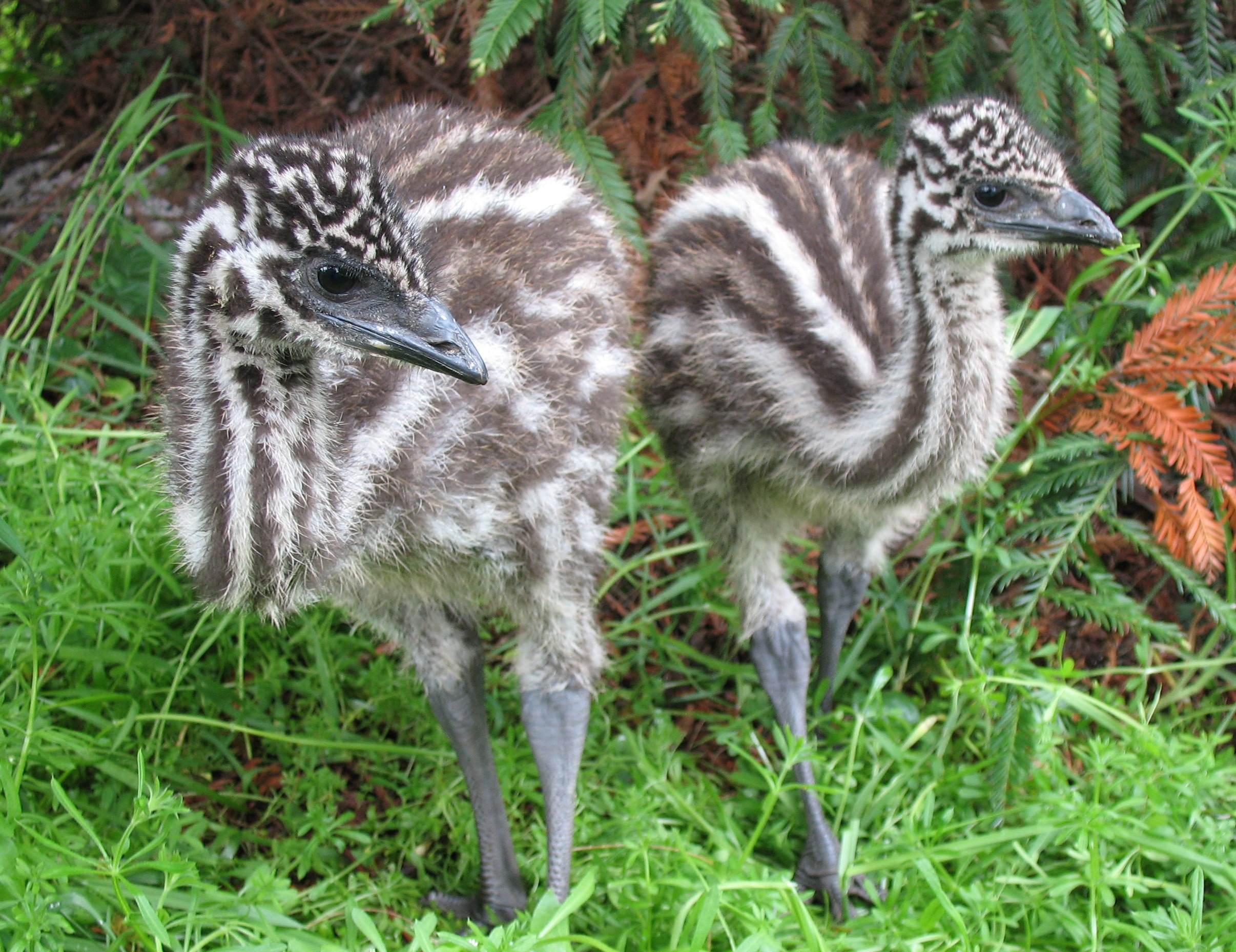
Many of these developmental plateaus are linked with common-life events, a marriage, the birth of a child, divorces, the death of a parent. They all resonate at deep levels that challenge our interior balance and make us question how to move forward, from here. My dad passed away almost two years ago. I still miss him terribly, but we did the best we could and that’s all anyone can ask. It changed me. I feel protective towards my mom, and I find myself planning my life for a different kind of future—planning for the fruitful and productive end-game. Now, I’m next in line, as the older generation. Not a geezer yet, but it’s on the horizon. Another stage, waiting to be explored.

My landlord is retrofitting one of his barns. Around here, a lot older farmers just let their barns decay and collapse. It seems wasteful, but it turns out there are ordinances about being able to tear down a derelict barn. Sometimes it’s about preserving historical structures or, to hold the ‘country-estate’ developers at bay, rural counties have legislated protection for aging agricultural buildings. Elmer is a hold-out. Despite his advancing years, he’s still fixing and building. There’s always some construction project going on around here, usually several at once. They seem to drag on forever that way, but time ticks by differently if you’re busy. By remaining in a constant mode of renewal, I think Elmer is cheating time. His knees are trouble and he says he’s ‘semi-retired,’ but he may well be the busiest man I know. And I think there’s something to that. If you think retirement is your golden time to sit back and relax, I think you may be planning on checking out. The secret seems to be staying in the thick of it—being busy and engaged. (I know, this ain’t a news flash, but a lot of folks seem to forget it.) I can’t imagine anything better than being too busy to notice the passing of the years.

But, there’s a downside to this meditation, and well, nobody’s perfect. As part of the ongoing barn work, Elmer had an electrician come to test and redo some of the wiring. No one remembers how long the power was down (or at least they’re not owning up to it) but when Rick went to check on the emu eggs, the incubator they’re in was now fifteen degrees lower than it should be. How long that had been going on, or how low it had gone before that, who knows. There we were, all set with strategies for enduring a storm induced power outage and, without notice, inadvertence steps in. With any luck, these eggs should start hatching as early as next week, but now, we don’t know if they’ll make it. There’s nothing we can do now except wait, and see. I guess it’s no different than teenagers — we just do what we can, keep an eye out for ‘power outages,’ and hope for the best.

Paris rain

Between Seasons

A.V. Walters

The first serious storm of our winter rolled through last night. We were forewarned— forecasts of power losses and flooding in low lying areas made us tidy up and hunker down. It’s not cold though, and so, it doesn’t feel like real winter. The storm blew in from the southwest, with temperatures in the mid-50s (F). I went out to the garden for (yet another) last tomato harvest. I keep saying that, but the tomatoes aren’t listening, and keep ripening. I suppose only freezing will end the bounty. The garden looks bleak but tomatoes, scallions, peppers, beets and the occasional winter squash still make the garden walk worthwhile. No more canning though. These tomatoes go directly into daily meals, or into the dehydrator.

The idea of a power outage had us worried. It’s the downside of usurping nature in the incubation of emu eggs. Once undertaking the task, what do you do if the power goes out? It’s not like Mr. Emu will jump back into babysitting once we’ve disturbed his paternal, confinement trance. Now, we’re watching him, and the Mrs., to see if they go back into breeding mode. In the meantime, there are nine eggs in that incubator. What could we do to keep them viable if we go dark and the incubator goes cold? So, despite the fact that it wasn’t all that cold out last night, we fired up the wood stove to chase off the gloom and to test the temperature range to see if we could step in should the utilities fail. It turns out that the space under the stove, where Kilo usually sleeps, is exactly in the hatching range between 95 and 99 degrees, Fahrenheit. (What are the odds?!) As long as we don’t sleep through it, we’re covered for an emu power emergency. Of course, this morning the house was a toasty 68—about six degrees higher than our standard, indoor, winter norm. I should be happy to be within the range that most folks set as their low-normal, but I’m accustomed to my winter chill.

The winds have died, but it’s still raining.  A few small branches are down, the last of the fall leaves have been stripped from the trees and the valley below us is a new lake. That’s standard for winter, the pastures that frame our view, fill and drain to the rhythms set by the storms. The hills are a lush, eye-popping green. Now that the peach tree is leafless, we have our full-range view back. It’s not winter yet, but it’s coming. December will likely bring more high winds, rain and cold.

It’s also lambing season. I always thought it odd that the farmers’ timing ran opposite to what you’d expect. The calves and lambs here are born into our coldest weather, to take advantage of the free and healthy feed offered by our green hills. By spring, they’re ready for market (or nearly) and the farmers keep and feed only their breeding stock during the long dry summers. Good thing those lambs come in wearing sweaters! The baby emus (should we be so lucky they hatch) are a different story. We’ll need to keep them warm for about a month. We’re devising an emu-baby corral, out of straw bales, to be warmed by a heat lamp. Then, if the power goes out, we’ll really have a conundrum because they’re sure as heck not going to fit under the wood stove. What do you do with a passel of shivering emu-babes? Bring them in? A house full of them? Bedlam, I tell you. All we can do is cross our fingers and hope the power holds. We’re between seasons, autumn and winter, California and the emus’ native home of Australia.

A.V. Walters

The rains have come. Those first showers over a week ago, have worked their magic. At first it was just a blush–a wisp of color if you caught it at the right angle. Now there’s no question, our hills are turning green. It’s a funny dynamic that our gardening season is the opposite of our green season. Still, after months of dead brown hills it’s a relief to the eye to see this transformation. There are still goodies from the garden, they’ll go on until the hard frosts hit. This is the seasonal pause, the green relief in still fine weather, before the storms and cold come. It’s a pleasure to work outside in the cool, sometimes grey days.

I’ll be posting a little less frequently this month. I am, after all, fully committed to NaNoWriMo. It could be that Editor Rick picks up the slack. He’s undertaking those end-of-season projects, readying for winter, seed-saving (he’s so organized), tool management, and soon, pulling buckets. All that stuff that I let lag until the storms force my hand. My head is miles and decades away, weaving the fabric of a 1931 speakeasy in Detroit. Outside, the creeping green is putting me in the mood with the intense colors of my childhood. While California is lovely, it is difficult to go without green for five or six months of the year. I’m not saying I miss snow (though sometimes, I do) but I do welcome the return of green.

It’s less than a week to the election–don’t forget to vote. If you’re here in California, and if you value good food and informed choice, remember to vote for Proposition 37. Let’s get those GMO foods labeled.

I’ll pull my head out of fiction at least once a week, to give you the what’s up in Two Rock.

Tomato Thieves

A.V. Walters

Here it is, October, and the tomatoes are beginning to yield in a big way. Finally, the season catches up. Most all the regular summer vegies are gone, a few lingering summer squash, some cucumbers and then–the tomatoes. It’s October canning again. Last weekend I set the kitchen up for canning, prepped my jars, counted my lids and rings and then headed out to the garden with a three gallon bucket. When I got there, there were hardly any ripe tomatoes. Just the day before those vines looked like Christmas trees and then–next to nothing. I blamed Don. It’s not fair, because I had no evidence. But Don has a reputation for pulling jokes on people–I figured it had to be him. I picked what there was, and plotted my revenge.

Yesterday, I got a call from one of my neighbors. She said that there were strangers in the tomato patch. I threw on my clothes and bolted out after them. Sure enough, a friend of one our residents was there, picking a grocery sack full of tomatoes! This is a tough call. It is a community garden. Granted Rick and I provide most of the plants and almost all of the work, but all summer we regularly deliver the harvest to each of the residents on the farm. We encourage “the community” to help themselves to the bounty from the garden. And, we’ve never had a problem before with having enough to share and to can.

This interloper was accompanied by one of our kids from the farm, a human shield, in my mind. That’s a despicable tactic–to use children as cover in your fiendish plot. I know these kids, they’re good kids, but for the life of me, I cannot get them to eat tomatoes. I held my tongue, that is, until she went after the corn. She pulled several ears from the stalks, pulled back the husks and, determining that they were not yet ripe–threw them to the ground. That was it. I approached her, my eyes fixed on that paper grocery sack near filled with lovely heirloom tomatoes. She had a nervous smile. I initiated the conversation, “So, you know that this is a community garden–for the folks who live here on the farm.” She shifted the weight of the bag in the crook of her arm, nodding. The kid asked about the corn. I explained that it wasn’t ready yet–told her how to tell–and explained that we didn’t get full pollination, so some of those ears would have gaps, like missing teeth where the kernels didn’t fill in. And I told her that the ears they’d thrown down should be fed to the pigs, and not wasted. The kid and the tomato thief nodded.

They didn’t meet my gaze. It wasn’t clear that I’d made my point. “It’s fine,” I said, “As long as the stuff you pick is for farm residents, for consumption here on the farm.”

She paused, “Of course, these are for the kids, here.” She nodded at the kid. The kid nodded, too.

Sheesh, I’ve been trying for three years to get these kids to even try the tomatoes. You couldn’t pry their mouths open with a crowbar. And now this woman is lying and including the kid in the lie. Great training, eh? I sighed, turned and walked back over to my conversation with the woman who’d placed the call. She shook her head. Then she advised me that on Sunday morning there’d been a couple of folks here she didn’t even recognize, picking tomatoes. And I’d blamed poor Don!

I don’t know the solution to this problem. While I’m more than happy to share with my farm neighbors, I also want to get in my winter supply of canned sauce and canned whole romas. Who are these people who would show up at harvest and help themselves, when they’ve not participated in the garden–and who are strangers to the farm? I just don’t get it. My sister tells me I’m the little red hen.

When I came home this morning, I found lovely printed signs which Rick had made.


THIS GARDEN WAS

PLANTED BY AND IS FOR THE USE OF

FARM RESIDENTS

PLEASE RESPECT THIS

I don’t know if the signs will have any effect on the tomato pilferers, but already they’ve done wonders for me.


If you’re from a small town, you’re always from a small town. They don’t let go of you, they welcome you home when you visit and they celebrate your triumphs with you, even from afar.


http://www.mininggazette.com/page/content.detail/id/526936/In-the-Catbird-Seat-Joe-Kirkish.html

AV. Walters

And no rain, in even a normal year, for at least a month. We’re not getting our usual heat wave this month–and with the fields like tinder, that’s a good thing. We are all wary of the risk of wild fire. In most years I take the advice of ’30 feet of defensible space’ seriously–I clear everything away from the house diligently. This year there’s no need. Not even the weeds grew in this dry season. There was a fire yesterday–somewhere between here and town in the other end of the valley. It was a grass fire–it’s a different smell and taste than a more serious structure or forest fire. Smoke lite. Apparently they got it out, because the air cleared and the lingering haze made for a lovely sunset.

I’ve been following fire and emergency news these days because I’ve become more involved as a volunteer with our local fire department. Not fighting fires–I think I’m a little long in the tooth (and clumsy to boot) for that. But I can chip in with administrative stuff, or selling T shirts for fundraising. It’s a small community, everybody does what they can. It’s so dry that our new firefighters have to train on the hoses without water. Don’t laugh. Nobody has excess at the wellhead these days, so they learn to man the hoses dry–with the seasoned volunteers pulling and pushing at the back end of the hose to simulate the force of real water. Consider it a dry run, in the most real sense of the term. They revel at the chance to share training programs with nearby departments that have city water.

Our wells are low and that intensifies the mineral salts–leaving a cloudy blush on the glasses, if you use the dishwasher. When canning, I have to put vinegar in the water with the bottles, or they’ll come up clouded and gritty feeling. Some of this is normal at this time of the year. The rest has us seriously conserving and sniffing now and then for smoke when outdoors. It’s a good thing that the rainy season runs during the same time as the winter heating season. By the time I put a fire in the stove, it’s cold and wet out.

I buy bottled water for coffee–not because of contamination (our well is high up on the hill) but because I’m a coffee nut, and I like the flavor of a less–gritty–source of water. In the low part of the valley the wells are contaminated. It’s a fact of rural living–nitrates in the water. Those folks must drink bottled water, especially kids. It’s a reminder that , even here in rural county, we need to be aware of our footprint on the planet. Nitrates are a common form of contamination in areas with heavy livestock concentrations, especially where, like here, people rely mostly on shallow wells. This is a dairy area, with chickens and beef cattle thrown in for good measure.

Many years ago the county put in a dump, (now called a transfer station and refuse disposal area) about a mile from here. The runoff from the site runs into our local creek. There’s a debate in the valley, not too seriously entertained, that the county dump is the source of the contamination. Folks who’ve been spreading manure on these hills for generations wince–and don’t point too many fingers, except occasionally, for sport.


Furry Ground-Blight

A.V. Walters

We do the garden walk everyday. It’s a way to check how things are doing, see what’s ripe and do a little weeding along the way. Admittedly, after last year’s debacle, I’m constantly checking the tomatoes for any sign of (I’m afraid to even say it) blight. By August, you expect a little bit of yellowing or leaf curl, but a true blight is a sight to behold. It can wipe out whole patches in a matter of days. The best you can do is to quickly dig out the affected plants and dispose of them—far away. Do not compost a blighted plant, especially towards the end of the summer season. It can infect your compost pile, which, if it doesn’t get hot enough thereafter, will spread the disease with every innocent looking shovel full of black gold. (By this time of year I don’t have enough high nitrogen materials to keep the compost cooking—especially this year when it’s so dry that even the weeds are gray.) Bottom line: Don’t ever risk composting blighted plants. ‘Taint worth it!

So, it was with some angst that yesterday’s walk revealed a tomato plant in full wilt. A Black Crim, too, one of my favorites. Blight? Too early to tell and it didn’t really have the signs. Was its drip emitter plugged? No. And then, the big question, any sign of gopher? We’ve never had a gopher problem with tomatoes. Last year, a friend of ours said gophers were going after his tomatoes, big time, and we could only wonder if different gophers might have different food preferences. Gophers—picky eaters?) In fact, some of the tomatoes are planted in bottomless buckets—ones that were cut in the early days of bucket farming, before I was aware of the dangers of that Furry Ground-Blight.

Our tomato plants are not small. Most of them are taller than me. They’re held up by our super sturdy, tomato cages but, by this time of the year, they’ve extended well beyond the perimeter of the cage. Rick has had to stake some of them because the weight of the plants has even the super-sturdy cages listing. And, it’s tough to find the cage in that jungle, let alone the bucket. There’ve been no major gopher signs in the immediate environs. So, yesterday afternoon, we did a triage watering to see if it had any effect. Sure enough, by evening the patient had perked up considerably. That’s a good sign.

First thing this morning I went back out to check. I’d left my morning schedule open, just in case I needed to quarantine that wilted tomato. Sadly, it had wilted again. I pushed my way through the foliage to get a look at the bucket and the drip emitter. And, AHA! There it was. The evidence. The loose pile of loamy soil was directly in the bucket. Damn gopher!!!

It is a relief that it’s not a viral problem. But, I don’t remember if this particular tomato plant is in a bottomless bucket. That’s a big issue. Following this morning’s revelation, we resolved to retire all of the bottomless buckets, next season. But, if this was a drilled-out bucket, we’ll need to worry about gophers that have learned to go in from the top!

Next season, we could have a serious problem. Don’s little, field-farming venture (the squash and pumpkin plot) has failed. Undone by gophers, is the official reason. And it is true that his “crop” has been hit hard by gophers. We include his pumpkin patch on our garden walks, and the ground is perforated with gopher holes. Every week we could count more and more of his plants, succumbing. There’s more to it, though. Don wasn’t really ready, or geared up, to harvest and market the produce. That may be okay for the pumpkins—we still have time before the Halloween, pumpkin season, and I’m sure he’ll harvest what pumpkins he has left. Pumpkins will endure enormous levels of neglect, but the other things, zucchinis, crooknecks and cucumbers, require attention and harvesting. Don never stepped up to the plate on this. There are zucchini’s over there the size of Buicks! And the crooknecks look like ancient gourds. He’s given up, and the field is now, Gopherland. He’s got a major case of the Furry Ground-Blight.

From our perspective, this is a debacle. He’s essentially breeding gophers over there and, next season, there will be more of them fur balls and they’ll be my problem. (Thank God for buckets.) So we’ll need to determine whether our poor Black Crim was the victim of a subterranean attack, or whether we need to worry about gophers mounting the ramparts of our defenses. I watered the patient again this morning. With extra water, it may be able to limp to the finish line. It’s a shame, that plant must have a bushel of tomatoes on it—beautiful green ones. During my inspection this morning I got the first two and hopefully, not the last, ripe tomatoes from that plant. We shall see. And, as usual, in Two Rock, we have a late season for tomatoes.

Rick is fuming. (Well, as fuming as Rick gets.) He’s determined to get this varmint, though he’s had limited luck with his trapping efforts in the past. Last I saw, he was muttering under his breath, “Rodenator.”

As I mentioned in a previous blog, the Rodenator is an expensive, propane fed device that explodes, frying underground varmints in their burrows. (“Hold my beer… watch this!”)

Patience in Small Batches

A.V. Walters

This is the time of year when, as a kid, we picked berries and fruit and my mother made jam and preserves. Mornings were for picking and, after lunch, it was time to do the canning—the already hot, summer kitchen sweating with the aroma of fresh fruit, sugar and paraffin. (Yes, paraffin. We did it the old way.) We’re a large family and a successful summer could be counted in the Mason jars lining the pantry—enough to tide us over until the days lengthened and we’d be at it again.

With so many pickers (there were seven of us and that probably equaled five actual pickers) we brought in gallons of fresh fruit. You could count the season’s progression as the jars filled—strawberry, plum, blackberry, raspberry, thimbleberry, blueberry, peach, pear, and finishing up with apple. . My version of summer includes the bubbling of veritable cauldrons of jam and the jiggling rattle of jars and lids boiling on top of the stove. There were enough of us that we needed to do jam in quart jars.

My dad was in charge of paraffin. As the steaming jars were filled, each got a thin coat of paraffin, followed, after it cooled and turned translucent, with a thicker coat that filled in the deep well that formed in the cooling wax cap. He melted the paraffin in bent tin can, simmering in a pot of water. When he wasn’t looking, we’d quickly dip in our fingers in the hot wax, making perfect, inverted copies which my mother would find later. Canned goods, other than jam, actually still got glass lids with rubber gaskets and bails—the way my great-grandmother did it. When we modernized using the fresh, new, gummed caps and screw top lids, my father’s paraffin job was displaced. He resisted some, until he found out that the post-canning plunk, as the jar cooled,was the sign of yet another perfect seal.
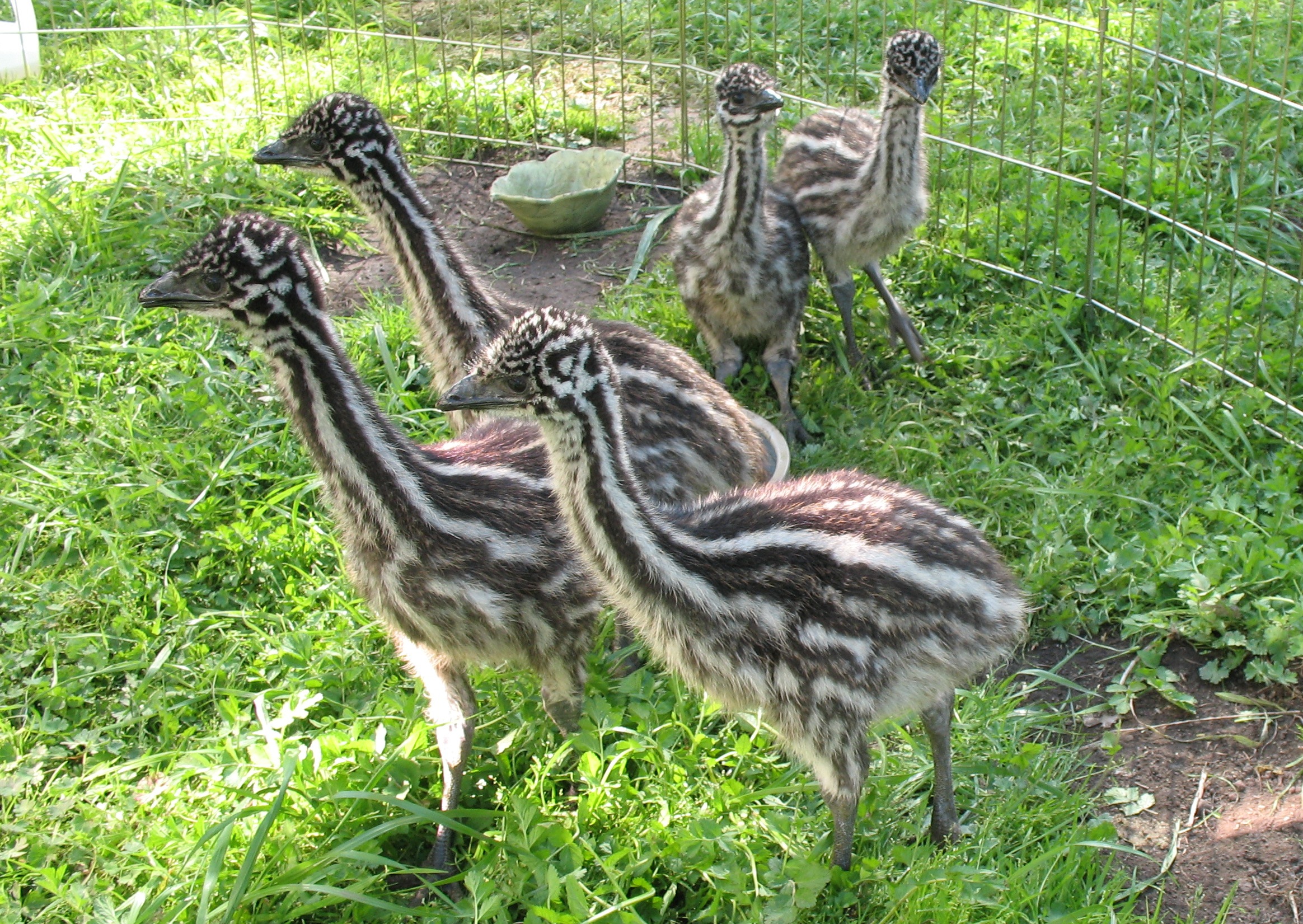
My grandmother dragged us on the annual tour of her old, Finn lady-friends—them all exclaiming at us; a swarm of towheads, lined up in stair-step, chronological order. All of the old Finn ladies baked and canned—it being a measure of one’s housekeeping prowess. When one of them died, the others would assemble to grieve and compare notes. No funeral gathering was complete until they’d made an accounting of preserves in the decedent’s larder. (The old men, when they passed, were judged by the size of their woodpiles—winter’s warmth, split and stacked, ready for the widow.) So summer canning runs deep in my bloodline.

My adult life demanded smaller yields—there was no way that my smaller family could consume at that level. Still, there were gifts to consider and enough to get the two of us through winter, with enough to remember the flavor of summer, but nothing compared to the cornucopia of jars from my childhood. My parents continued to make big batches of jam, especially thimbleberry, which they shipped across the continent (and even across the ocean) to those of us far away from our childhood berry patches.
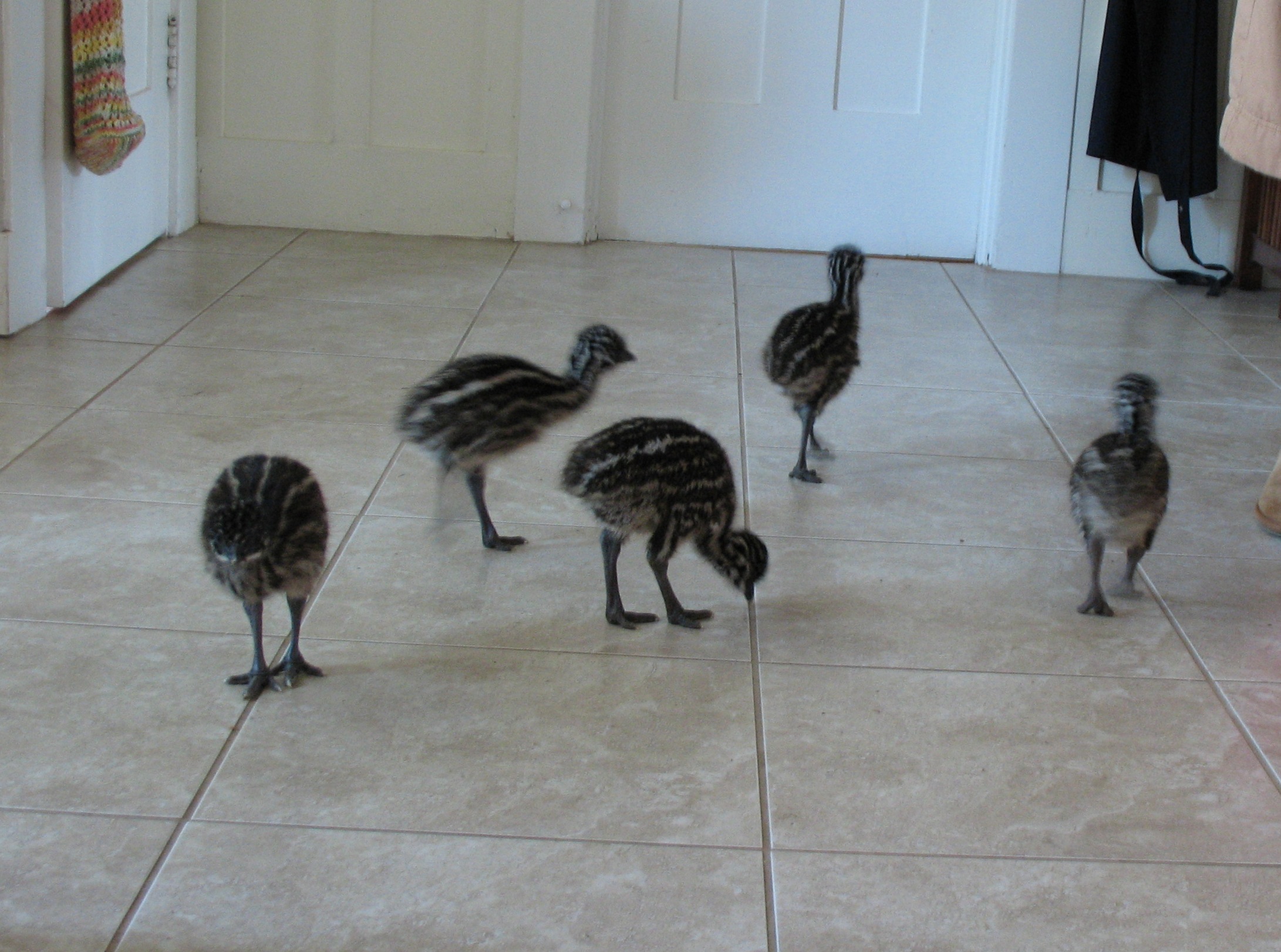
Eighteen months ago my dad passed away. True to tradition, he left an impressive wood pile, but the loss left a huge hole in our lives and my mom cut way back on her canning. Picking and putting foods by is, in large part, a social experience. Last year she hardly made any jam at all. This year, her berry season came early. It’s been happening a little earlier every year. Climate change isn’t fiction. It’s here—with Northern berries in mid-July, and ticks! (There weren’t ticks back home when I was a kid because the winters were too cold and too long. Now, they have to worry about Lyme disease.) Nobody believed that those early berries were really “the season.” Just some fluke—a smattering of early. My mother went out for just a few minutes, every day, and made small batches of jam, a couple of half pints at a time. Each day she’d report on her progress—she had set herself a summer quota. It worried me, a bit. It was not our normal, marathon method. I was afraid she’d lost heart in it. I thought she might be getting too old. Then, at the end of July, the berries dried up. (Usually that’s peak season!) The annual vacationers came, looking to recharge their own larders, but the berries were already gone! My mother sat smug—she’d reached, and then surpassed, her quota—all in small batches. I had to set aside my concerns. There’s more than one way to fill the pantry.

Thinking of her, I’ve been making small batches of peach jam as they come ripe on the tree (great peaches by the way—this is the tree from which we stripped all the leaves back in May.) But, they’re coming faster now, so I anticipate a large batch of peaches, any day now. Today I made 11 pints of plum jam. Our friend’s tree was laden, and so it all came at once. I still have blackberries to go and of course there’ll be tomatoes to can if they ever decide to ripen. (Still paying the price for our late start.)

I feel as though my dad is there with every jar, hovering— just in case we need paraffin.


Spiders and Flies and Cows, Oh My!

A.V. Walters

Warning: This blog contains graphic descriptions that may be offensive to sensitive readers.

It is that time of year when gardeners, plants-in and waiting, are beset by bugs. I live next door to a dairy. Dairies attract flies. (Let’s not go there. It’s enough to say, it’s about the cows.) Flies attract spiders. I live in what must be the spider capital of the universe. If I don’t “sweep” or power-wash my house a couple of times a year, it looks like the wicked witch of the west lives here. The entire shadow area under the edge of the clapboards is completely filled in by spider webs. The eaves are, well, scary. My car is home to countless arachnids as well, and gets so covered in fly specks that people comment when I go into town. While I’m not fond of spiders, living here has helped me put them in perspective. At least they help keep the bugs (flies!) in check. Our plethora of insects also feeds an enormous number and variety of birds. Hey, I’m looking on the bright side here.

At about this time every year we get The Invasion of the Leaf Hoppers. They’re after green, anything green. Wave your hand over my radishes and you’ll see a cloud of them. As the green dries out of the surrounding landscape, gardens are left to absorb the bugs from everywhere else. This past week the valley farmers cut and bailed the last of the hay from the bottomlands. The hills are golden and dry. All those bugs are on the move—looking for their next meal.

It would be easy to panic and reach for a chemical solution. I think it would also be a mistake. Organic growers have options for a real emergency, but the basic framework calls for patience. Over time, the mantra, feed the soil not the plant, should lead to soil and plants healthy enough to endure the annual onslaught. This is a natural, seasonal event and agriculture over the centuries has survived pests. I guess I can, too.

Left to their own devices, plants are not defenseless against insects. When insects nibble (or chomp), plants respond chemically by making their leaves a little more bitter. It’s not so much that we’d notice (though I have tasted some overly stressed and, resultingly bitter, greens in my time) but enough to dissuade the bugs. It takes a little time. I know that when the leaf hoppers first arrive, it looks like an emergency. Hold off! Don’t reach for sprays or toxic powders. Let the plants do their magic. (The same can be said of white flies—though with them I’m inclined to reach for the Safer Soap earlier on.) You can help. Make sure they have enough water, especially if it’s hot. One year I fed my garden manure tea, but I can’t say if it was any more effective than water—but I felt better. Probably with that little extra bit of care the vegies will be just fine.

Of course, from time to time there are infestations that threaten the survival of the garden, or maybe just one of your crops. The watchword there is Know Your Bugs. We do have natural methods for most pests. For larger marauders, there’s hand-picking. This is not for the squeamish for faint of heart. It is very effective, particularly for slugs, snails, caterpillars (especially those amazing tomato hornworms, which you can feed to your chickens) and squash bugs (which I always thought was an imperative command.) These larger pests can do damage quite quickly—a tomato hornworm can defoliate a plant in days. I just squish them in my fingers, which makes the kids on the farm recoil in horror. You can also throw them in soapy water, or gently relocate them to a different environment (yeah, right.) Check the undersides of leaves for eggs, which you can squish, or wash off (or spray) with soapy water. With squash bugs, if you stay on it early in the season, you may solve your problem early on. In any event, make sure you exterminate them at the end of the season (they’ll congregate on the last remaining squash and pumpkins, or their leaves) or you’ll see them again next year. In a bucket-garden, handpicking pests is easy. When you fill the bucket reservoir, they all head up the plant for high ground. And there you are, waiting…

For little winged critters, there’s soapy water spray, both for them, their larvae and their eggs (in particular watch for those voracious cabbage moths and their larvae—sure they look like pretty white butterflies but they can do real damage.) For crawling critters—especially at the seedling stage, there’s diatomaceous earth. And if things are really bad, you can treat with Bt (bacillus thurengensis)—the organic gardener’s ace in the hole. Probably you won’t need most of these tactics.

The internet is an incredible resource, both in identifying the pest of the moment, and in suggesting treatment alternatives. Check there first, before resorting to the hardware store.

I have spiders in my garden, too. They are honored guests. I try to water and weed without disturbing them. They are my plants’ guardians. My family will be surprised that I have made my peace with spiders. From arachnophobe  to arachnophile in just a few short garden seasons.

Now if we can just do something about the gophers.


A.V.Walters

We have settled into our normal summer weather pattern. That’s warm (80s) days and cool nights, fueled by ocean fog. It slows down the garden some, but makes this valley extremely livable. You can watch its magic, just before dusk when the winds from the west sweep in a low ‘cloud’ layer, that’s really high fog. Some evenings the sunlight streams in, below the fog, and its raking light illuminates the fields, revealing things you never see in mid-day.

This pattern lets us reap the benefit of old-fashioned air conditioning—we open the windows at night and close them in the morning before the first glimpse of sunshine. It keeps the house in the 60s and 70s, regardless of the daytime highs. Each day the overcast, fog really, clears by about 10:00 am. This gives us marginally shorter daylight exposures, and, sure, that makes for a slightly longer number of days to harvest. It’s worth it. Because our daytime temperatures are also mediated by the ocean, we don’t get the blistering summer temperatures of the inland valleys. It keeps the grapes away. The grapes like really hot days.

Now, doesn’t that sound catty? The NorthBay area, famous for it’s stellar wines and acres of rolling vineyards, has agricultural flair, but sometimes lacks the depth of real farming. It is boutique and/or corporate. Throughout the north bay counties our organic farmers and Farm Trail participants keep it real. It’s only my opinion, but to keep the farm atmosphere, I think the investment side needs to have a stake in the game. Put simply, I like to see dirt under the fingernails. Elmer doesn’t do dirt, but, at an age when most would’ve retired, he still sweats the details of chickens and sheep. If the coyotes yip and howl at night, he wakes up to listen—are his flocks at risk? And he’ll roll out of bed to pull on his jeans and shoes if there’s something to be done about it.

I’m not against vineyards, but when I head inland and see those valleys covered with endless rolling fields of vines, I wonder just who is going to drink all that wine? And, from a gardener’s perspective, monoculture often means too much of a good thing. I believe in diversity.

These past four years have been telling for the grape growers. In this economy, who can afford twenty-dollar bottles of wine? It’s been a boon to cheap wine drinkers, but has put the squeeze on the vineyards. As the high end wines lost market share and reduced their ouptut, the quality vineyards have been forced to sell their grape juice to some of the lower end producers. For the savvy shopper, that spells pretty damn good wines at very reasonable prices. (She smiles as she licks her lips.)

Still, I like that our valley’s climate has kept us in more traditional agriculture. Even though we have great soils, our cooler climate makes real crop/vegetable farming a challenge. So these rolling hills are still host to chicken farmers, rangeland for beef cattle, and dairies.

A dairy is a strange kind of range. Around here we see old-fashioned dairies, where the cows primarily eat grass and the size of the operation is limited to how far a cow can walk twice a day. The dairy next door rotates its fields, and has extra land for harvesting hay. That hay feeds the cows once our dry summer hits and the green drains out of the landscape. We watch out the windows as the cows move from field to field, and every night and morning head in for milking, like city commuters. Right now the only green grass in sight is in the very bottom of the valley, which currently is crowded with cows.

The garden is in. Now we just water, weed and wait. We are behind, but I’m not worried about it. It’s not like last summer, when the fog lasted through the days and the garden just didn’t mature. Even with our late start, things are perking along nicely. We’ve had a couple of crook neck squash, tomatoes and cucumbers so far, with the promise of many more—copious flowers and many many baby green vegetables in sight. It’s a nice time to pause, count our blessings and catch our breath. After all, in a few short weeks we’ll be starting in with some of the winter vegetables, and there’s harvesting and canning to come. For now, we can let the bees do the work.

Farm Surprises

A.V. Walters

You just never know around here—something’s always up. We water the gardens by hand. I don’t mind, it’s a bucket by bucket meditation. We’ve got a couple of good watering wands—with off/on switches—that let you shut the flow between buckets. This saves water and minimizes spillover, which cuts down on weeds. I water each section twice a week, on different days for the three gardens. It takes me four to five hours each week. Usually, I get up early and try to get the watering done before the regular work day, and before the sun is high. I admit, after such a dry winter, the buckets look like little islands of green on a moonscape. The ground is very dry this summer.

Aside from the heightened fire risk, the dry doesn’t affect our garden operation. We are already operating on water conservation mode with the buckets. Elmer is concerned that, before the summer is out, we’ll be trucking water in, but he hasn’t said anything about cutting back in the garden.

That leads to the first farm surprise. About a month ago (while I was still down and out with the cold from hell) one of our pastures was plowed and planted! Not a big pasture, but it was usually occupied by 3 rams who have the thankless job of “servicing” the ewes. As I’ve said before, this is not a dirt farm, but the farm foreman convinced Elmer to let him put in a cash crop of pumpkins, zucchini, crookneck and cucumbers. Whatever possessed him to put in a field crop in the driest year in a decade is beyond me. (And, these crops are water suckers.) Don, the foreman, is conscientious, though; he set up the field with drip irrigation. At least we won’t be wasting water. I don’t know what kind of a deal he worked out with Elmer—we are all sharecroppers in one way or another.

Because of my head-cold, Don’s crop got a head start on my garden. His vegies, looking much more like a farm operation than my silly bucket brigade, are a half-foot taller than mine. Don has always had a quiet respect for my garden over the years, but now, with victory in sight, he’s ribbing me. He pulled up next to me while I was watering yesterday and asked how my midget garden was doing. I smiled and told him we had a long season and I intended to take full advantage of it. It’s a good thing, he said, because his corn is tasseling and chest high. Mine, of course, was only just transplanted from starts and is all of a strapping five inches. Okay, I know I got a late start. But, Don has to be nice to me—I have the tomatoes.

Don is giving me flack about why I don’t use drip irrigation. He sees all this hand watering as sheer insanity. Sure, it would be easier. And, for a cash crop it makes perfect sense. However, it’s a significant investment for the gizmos and tubing and a lot of work to install. I remind myself from time to time that I am a tenant here. I am a gardener, not a farmer. In five years, I’ve never had an offer of help for such a high-end investment of time and money. But for twenty bucks, I got this lovely switchable watering wand. And so I drag the hose behind me. I’m not complaining. I don’t begrudge one minute I spend in the garden. (Except for those two moments this summer, so far, when I stupidly went into the garden barefoot, and both times ended up getting stung by the wasps.)

It was the dragging hose that led to the discovery of the second farm surprise. We are not kidding when we call one of the gardens “the long garden.” It’s over 160 feet long and about 15 feet wide. There’s a hose spigot at one end. At the other end, across the lane there’s a hose spigot at a tenant’s house. I can use that. I have a 75 foot hose, which I don’t mind pulling along behind me. But I do object to having to undo the hose and haul the whole thing 160 feet to the next spigot. Rick suggested that we plumb in another spigot, halfway down the long garden, and then my hose will essentially cover the entire garden without having to move it. We consulted with Elmer, who said it was fine, just get the materials from Number Four.

Rick looked around, no pipe. He checked out the far reaches, behind the chicken barns, still no luck. Then he looked in, under and around Number 7 only to find oversized pipe and—pigs! Yes, surprise, surprise. There are now 4 pigs in a pen in the shaded area, under the far end of Number 7. Who knew? It turns out that one of the tenants approached Elmer about keeping a couple of pigs. The tenant works in a fancy high-end grocery store and brings home the gourmet, ‘unused’ produce—so essentially the pigs eat pretty well, and for free. Elmer said it was okay, but he’d buy two baby pigs, too (so we have four.) The tenant does the feeding and slopping and mucking, and at the end of the season they each get two grown up pigs. It’s a sweet deal, all the way around. I told you we were all sharecroppers in one way or another. Elmer gets his summer vegies from our garden (plus a load of winter squash) and we get to have a garden that exceeds any tenant’s dreams. Like I said, it’s a sweet deal all the way around.

So the surprises are pumpkins and pigs. But these things are supposed to come in threes, aren’t they? There’ll be one more surprise. Last year some wise guy (and we’re betting it was Don. “Who, me?”), planted carving pumpkins in the winter squash buckets.  So this year, somebody’s going to plant strange and exotic squash in his pumpkin patch. (“Who, us”?) It’ll be awhile until he figures it out. But, I can wait.


Tomatoes in Bondage

A.V. Walters

There’s a debate, heated sometimes, about whether tomatoes should be allowed to sprawl or whether they should be restrained in cages. This is a true measure of the farmer-gardener divide. Obviously, tomatoes grown in the field couldn’t be effectively caged. (It would interfere with all that mechanized equipment.) Here, on our farm, there’s no question. Elmer likes a tidy garden. When I came, I decided to solve that with a few cages, and now he’s a convert. (Well, an armchair convert, since it’s us doing the work.)

The garden stores offer a wide, and wild, variety of vegetable restraints. I’ve tried most of them. Any such restraint system must be analyzed in terms of ease of use, strength, durability (season to season), visual impact (yes, it matters), accessibility (if you can’t get your hand in, nothing’s coming out) and cost. Since it’s an investment, the repeat gardener wants something that will give years of use. Back in the city, over the years I tried those wooden stacking cages, standard wire cages, lattice fencing, and these lovely, but expensive, aluminum spiral stakes. Part of the consideration is just how many tomatoes do you have? With just a couple of pampered urban vines you can afford the high end stylish systems. These days, though, with thirty-three bucketed tomatoes, we have to go with industrial strength cages

We made the investment last year. We’d been monkeying around with “tomato-cage-lite” for a couple of years and they kept collapsing under the weight of the plants. So last year, we bit the bullet and bought thirty, heavy-duty, welded-wire, 54 inch cages. (That’s the gardener part of me.) They were on sale, and since I was buying so many of them, I negotiated an even better price. There was no way I’d have paid the original sticker price of over nine bucks a cage. (That’s the farmer part of me.)

Our cages are the envy of the farm. I’m not sure why, because it’s a community garden—so everyone enjoys the tomatoes. But both years that we’ve had them, they’ve elicited comments of admiration and envy. I don’t think it’s a come on—Hey honey, them’s fine restraints you got there—this is real equipment admiration, with just a touch of covetousness. They just are nice sturdy industrial strength cages and everyone who sees them, notices.

I suppose you could put in the cages when the tomatoes were just little sprites. But, that would be too easy. It’s not just that, though, in the early garden, when you’re digging in, there’s so much to do to catch the early season. You do what’s needed so you can get it all done. Then, when there’s a breather between establishing the garden and the onset of weeds, you can worry about the extras, cages, structures for pole beans and cucumbers, etc. Some years I’ve been caught short, wrestling undisciplined, sprawling, teenage tomatoes into cages. It can take up to three people to do it if you wait too long. This year was just right. I needed to sterilize the cages in bleach-water after last year’s blight, so that caused a little delay, but otherwise the timing was perfect. For the most part, the tomato plants were less than a foot tall, so the cages slid over them easily

The installation of the cages brought out the neighbors. It’s a sign; the garden is in. (Hopefully it’s also a sign that there’s no room for any more tomatoes.) We all stood out in the early evening rays, enjoying beers and garden talk. One of the neighbors nodded at how good they look and added, “You know, I’ve got a bunch of beans started…” She doesn’t know if they’re bush beans or pole beans. More buckets to dig in….beans, fit to be tied.

Orphan Tomatoes

A.V. Walters

Well, we’re behind schedule but things are finally falling into place. You know that the garden is “in,” when the stragglers begin to arrive. I have a reputation for an open door policy to wayward vegetables. I can’t help it; there is nothing so sad as a homeless vegetable-start, without a garden. They have roots, after all, and need someplace to call home and put them down.

And every spring, tomatoes are the best example. This year we put a limit on tomato plants. (Not that we don’t every year, to no avail.) We dug in twenty buckets, in the long garden, and six in our backyard (for the exiled Romas.) That was it! Right.

The buckets we dug in were supposed to accommodate the ten or twelve tomatoes I had in my sights, six Romas, and then room for the inevitable tomato contributions of my farm neighbors. On our return from vacation, we planted the Romas and eight heirloom tomato starts and put the call out. One neighbor had three, another two. I planted them in short order. I’d thought there would be more, but I was certainly game to pick up a few more for vacant buckets. I even checked with Elmer, because his cousin has a habit of late tomato start donations. No, No, he says, she would only have a couple, and those he wanted to give to his girlfriend for her garden. So the coast was clear and I could pick up enough heirlooms for the remaining buckets. That was ten days ago—I thought the tomato question was finally closed.

But, there are always tomato stragglers. The main garden sprouted it’s own volunteer, so we honored it with a bucket. This week the neighbor who’d had three late arrivals, popped up with four more! I eyed the patch. We’re starting to get heirloom duplicates. Two black cherry tomatoes, two brandywines, two black crims. The new prospects looked healthy and not too leggy. Well, okay, we can squeeze them in without crowding—but no more—I looked right into her eyes. She avoided my gaze. Digging in new buckets this late is a bitch. She held them out and I took them. Our famous hardpan is a challenge if you don’t get the buckets in early. I huffed and puffed and then dropped them into place in their new buckets. It’s been warm this week.

Yesterday, three more showed up in half gallon pots. Nobody claimed them; they just appeared out of nowhere, in amongst the established tomatoes. They seemed harmless enough and, clearly, well tended. Sigh. So, in they went. This weekend we’ll be doing the cages. I can only hope that that sends the message that we are done.

Today another neighbor—this time with two tomatillos! “They’re not tomatoes, really!” (I jammed both the little buggers in one bucket.) We’re up to thirty-three. And, just for good measure, she brought along another lemon cucumber. This is how the garden grows. I’m just glad they’re not kittens.

Snake on the Road (and Behind the Wheel!)

A.V. Walters

I was driving into town today and saw a dead snake on the side of the road. It was a big snake, maybe three feet long. Driving by, I couldn’t tell what kind of a snake it was, not that I’m an ophidian expert. But I do know that snakes fill an important niche in the ecosystem. Admittedly, I’d wouldn’t want a rattlesnake close to the house or anything but for the most part, like most creatures, if you leave them alone, they’ll leave you alone. What disturbed me about this snake was that it had been run over. It was well over on the side of the road, squished flat in two spots; so somebody had to have aimed at it. Since generally folks don’t go driving on the shoulder, I guess that, seeing the snake sunning itself on the edge of the road, the driver veered off the roadbed proper to kill it. It wasn’t near where anyone lived–sort of an open fields area. So why go to the trouble to kill a snake that wasn’t posing any danger to anybody in particular?

The stretch of road between here and town is a pretty dangerous place for wildlife. I know, a deer hit me there, just a few weeks ago. In the paper-scissors-rock game of survival, it doesn’t matter who started it, the car has the clear advantage. On any given day there are several roadkill victims along that stretch, mostly deer and possum, with the occasional raccoon or skunk thrown in. These though, are accident victims. I don’t get the feeling that anyone is aiming at the poor possums. (But, given what I saw today I might have to adjust my thinking on that.) Unfortunately for them, their stress coping mechanism (passing out and  “playing possum”) may work well for those predators who won’t eat dead meat, but it’s just not working with the yokels in pick-ups, crowd.

I’m squeamish about spiders, so I can understand that some people might have their hesitations about a particular species. I’ll dispatch a spider if it’s in the house. But I hold my breath, and go on about my business, when I encounter them outside. They, too, have their place.

I understand we have a lone (and lonely) wolf that’s made the news in Northern California. He’s tagged with a tracking collar. Apparently he roamed south from Oregon, in search of a mate. That wolf has a hinky sense of direction, as there aren’t any prospective partners for him down our way. There’s been an outcry from some of the locals in that area–against the wolf–so much so that the wildlife researchers studying him have to be careful not to release any real-time information about his whereabouts. The anti-wolf contingent would go out of their way to hunt him down. Some are ranchers, concerned for their livestock. Some are hunters, worried that the wolf will kill something they might’ve wanted to kill first. The wolf’s scat reveals that he mostly eats rodents and small critters along with the occasional deer, not exactly your big game opportunity. Some people don’t like wolves on principle. Even the fairy tales treat wolves unfairly. Our language picks on them, too, “a wolf in sheep’s clothing,” or “a wolf at the door.” (And, of course, the reference to a predatory male of our species.)

I’m having trouble with that. What makes us think that we should be the arbiters of what is, or isn’t a desirable species? That snake was just minding his own business when, out of nowhere, somebody decided to snuff out his existence. Up until that moment, it had been a pretty good day. (For me and the snake.)