Archives for category: chores

Feed The Soil, Not the Plant!

A.V. Walters–

It’s the organic gardener’s mantra. If the soil is healthy, the plants will be healthy. If the soil isn’t healthy, there’s little you can do for the plants, that isn’t ultimately bad for the soil. Chemical fertilizers are the equivalent of an IV drip. Maybe it will do in a pinch, but it’s no solution to the nutrition issue. Do things that are good for the soil, and you will be rewarded with a healthy garden. It’s almost that simple.

I’ve been soil building for over thirty years. Trouble is, I keep moving on and leaving my efforts behind. This year we will have a garden. Last year we didn’t have our well in, so it wouldn’t have been responsible to put in a garden. Instead, I took soil samples and sent them in to the extension office for testing.

The results were grim. Our soils are largely glacial deposits. Sand, and lots of it. We’re deficient in most of nutrients for which they test. Most importantly, there’s not a lot of organic material to hold what’s there. With straight sand, it’ll take a good bit of soil building before we have something to hold the nutrients and to hold moisture.

That said, it’s not a disaster. Our delays have helped. We’ve changed the location for the garden–our first pick didn’t have as much sunlight as we thought. Being here has let us learn more about the location, the winds and how the sunlight falls. This land hasn’t been farmed (conventionally or otherwise) in at least thirty years, so the good news is that there are no bad things in the soil. We just need to build it up. The fastest way to get that process started is to add compost, or composted manure. And we’re lucky. It’s easier to amend sand than it is to lighten heavy clay.

I watched last winter as the Amish farmers spread manure on their fields in February and March–really in the middle of winter. At first I was surprised, but thinking more, it made sense. The fields are frozen, so their teams (they farm with draft horses) don’t get mired in the muck from early spring rains. The composted manure doesn’t care when it is spread, it’ll freeze now, but then “activate” when things thaw, and the early rains will carry the nutrients into the soil. It’s an efficient use of winter down time. I knew then that I’d need to watch for a supply of composted manure, come February.

And, this past weekend, there it was. A craigslist ad for 100 tons of composted cow manure. I forwarded it to Rick. He laughed. Meanwhile, I went to the internet to get the weight to volume conversions and I did the calculations.

I assured him, “No sweetie, we don’t need 100 tons.”

“What do you think we need? Says in the ad that there’s a ten ton minimum.”

“We need fifty tons.”

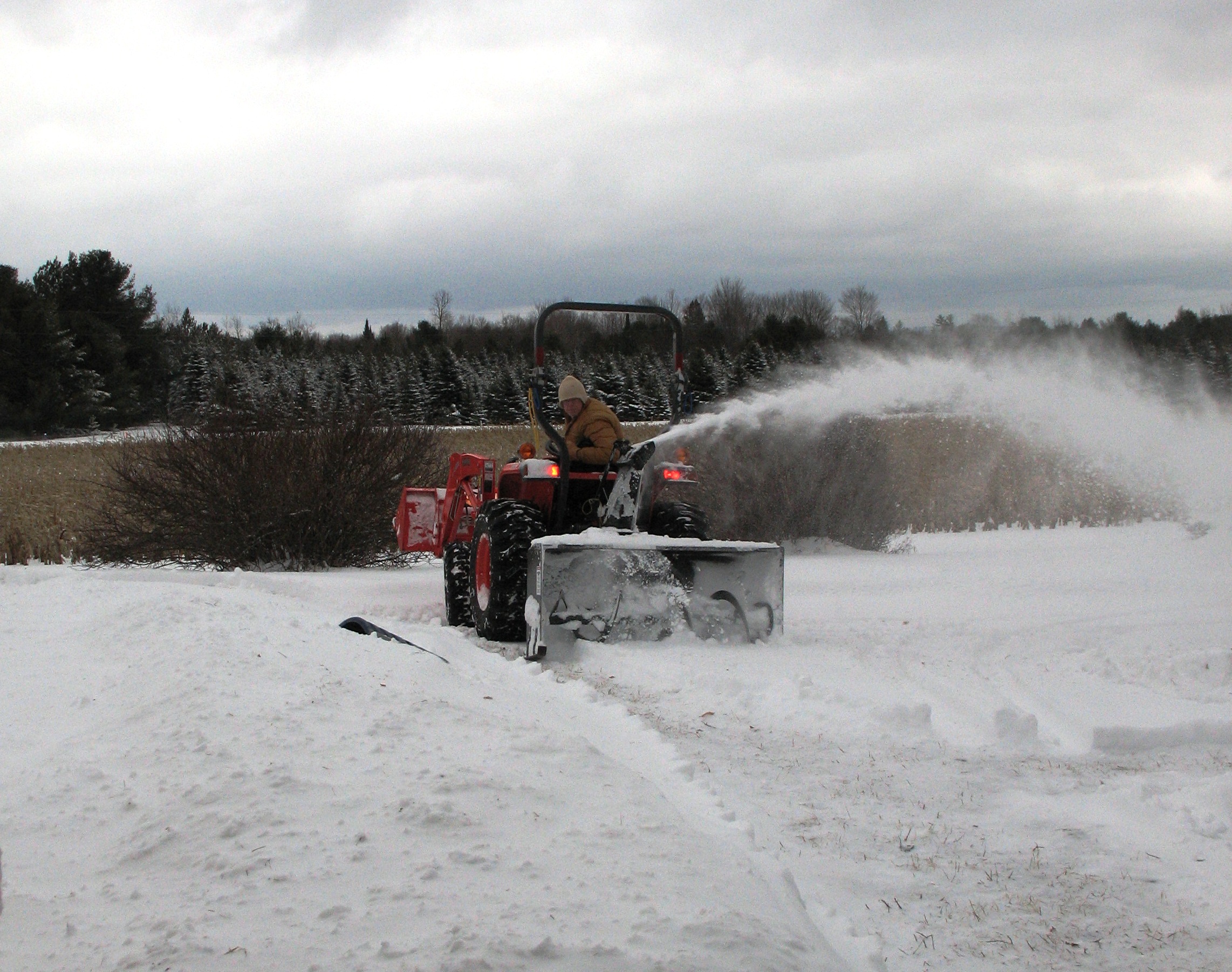
He could hardly believe me. But if we’re going to jump start this garden, and if we’re serious about it, that’s what we need. There’s the garden, and then more for our small orchard. We’ll need to amend deeply in the orchard. (Thank God for the Kubota and the backhoe! Maybe, if it’s a light enough mix, we could use the snowblower to spread it!) (I wonder what Rick will say about that.)

You can see where I get the idea.

You can see where I get the idea.

Rick is a nice boy from Southern California. I don’t think there’s any way in the world that he ever thought that he’d be the kind of guy to purchase fifty tons of composted manure. He’s shaking his head. I’ve negotiated with the dairy owner for a good price. So, now we just need to find a trucker to haul it. This isn’t a case where owning a pick up will help. This is easier said than done. I haven’t yet been able to find a hauler. The primary crop in these parts is cherries. Cherry farmers use flatbed trucks (with stacked bins.) A flatbed won’t work for manure. I’ve asked around, so far with little luck. Once I disclose what I want hauled, I’ve detected a near-immediate, and serious lack of interest.

It may take a while or so to get this all arranged. That’s good, because in the interim, I’d like to haul all of the trees we cleared last summer over to the new garden site to do a burn. Nothing helps a new garden like bio-char. Winter isn’t just about seed catalogs and dreaming. Sometimes there are garden chores that are best saved for the dead of winter.


The Tyranny of Round Numbers

A.V. Walters

This is my 200th blog. Next week, I’m coming up on my third anniversary of blogging. I’ve been stuck on this momentous event. Somehow, it felt like I was supposed to be profound, or something. Oh well, what you see is what you get.

I was a conscripted blogger. “They” said that indie writers and publishers needed to blog. Apparently, we need an online presence in order to sell books. Ha!

I bellied up to the bar, and started blogging. What does a fiction writer blog about? Everything, and nothing. I followed my nose, tried to stay away from politics (a stretch for me) and focused on chronicling the rich parts of the everyday. I cannot honestly say that the blog has ever sold a book. And then, after about eighteen months, they said, “Oh, never mind the blogging, it doesn’t work for fiction.”

But, by then, it was too late. Like most writers, I live in my head. I am probably most comfortable in writing. In this funny, online world, I have made friends. Political friends (even when I pledged not to go there,) artist friends, gardeners, organic farmers, people who keep bees, people who can vegetables, celiacs, funny people, other writers, editors, ne’er-do-wells and goody-two-shoes. In short, I have found community.

They are everywhere. My “regulars” are as far flung as Australia, Singapore, France, United Kingdom, Brazil, Canada, Germany, India, New Zealand, and all corners of these United States. In the blogosphere, I travel all over, too. Over the course of three years, I’ve been visited by over seventy countries. I am continually amazed that we can connect across the ether. These connections give me hope. Even as governments fail us, and corporations sell us, we can all be ambassadors of civility, humor and peace.

Not that I’d be considered a “successful” blogger. My numbers remain relatively low. I refuse to play SEO games. I refuse to do internet marketing or advertising. (Aren’t these scams?) I refuse to amend how I title my blogs, just to capture more “hits.” Indeed, learning that the blog wasn’t going to sell books, anyway, was liberating. I am free to be stubborn! I can do whatever I want in this forum; it is my world! (And welcome, by the way.) Despite what my trusty editor, Rick, says, I am even free to use semi-colons.

Our most popular topics are about season and gardening (oh, yeah, and emus.) The single most enduring blog is still Naming Emus. Stories about living on the chicken farm in Two Rock are popular, too. The shock of relocation is wearing off; we’re comfortable in Northern Michigan and revel in seasons (and snow removal.) It’s been an adventure. And you’ve been there, all the way.

We’re hovering on many exciting new ventures for the next year. We’ll finish the cabin and move in (gypsies, no more)—we’ll get the garden started (already I’m up to my ears in seed catalogs), I’ll finally try my hand at beekeeping (after wanting and waiting for five decades!) and, if there’s time and energy, we’ll get chickens. I’ll keep blogging, and sharing, though I may slow down just a bit this spring. I’m trying to get my head back into writing—I have an unfinished novel haunting me.

So, thank you all for following, sharing, commenting and enriching my life. Raise a glass—Happy 200!
(Next time, pictures, I promise.)


ooops, here’s the link to the most visited blog, https://two-rock-chronicles.com/2013/03/10/naming-emus/

Banking on Winter…

A.V. Walters–

After several false starts, I think we can finally say that it’s winter. The last eighteen hours have dropped six inches on us, with another five or six expected over the next two days. More than that, the temperatures are dropping. The next week promises single digits and lower, if you count the wind chill factor. It’s not last year’s record breaking snows and recurring ‘polar vortex,’ but it is winter.

We’re a bit concerned about the heat in our little basement apartment. So far we’ve been fine—interior temperatures in the low sixties, which works for us. When we did the remodel, we did connect the apartment to the heating and cooling for the house—then we promptly blocked it. The landlord keeps it way too cold in the summer and way too hot in the winter. In addition, she has dogs—lots of dogs. I’m allergic to dogs, so a shared HVAC system isn’t going to work for me. I’m a mess when I visit my mum, with just the one dog, so blowing three dogs’ worth of winter dander into my living space is a non-starter.

Up until now, we’ve done fine with a little plug-in baseboard heater. After all, it’s a (walk-out) basement apartment. Nearly two sides are imbedded in the ground. As a baseline, underground keeps things warmer than at the surface.

Our landlord’s heat ducts run above us, and that warms us up a little more. The furnace is in the basement—two rooms away; it’s collateral heat. Still, we start to worry when our interior temperature drops into the fifties, a tad chilly, even for us. At that point, I begin baking. While Rick loves the goodies, it’s not exactly a heating strategy (and threatens to send us both into spring portly.)

With the snow drifting around the house, and with silent thanks to my dear departed dad, I finished up our regular snow removal chores by ‘banking’ the foundation. It’s an old-fashioned insulation strategy. I piled the snow up about four feet against the cinder-block foundation walls that are also our exterior walls.

My dad grew up in the far northern reaches of Michigan’s Upper Peninsula. When we returned there, he had a local-yokel solution to most of the problems posed by extreme weather. To be really effective, my dad used to make us bank the house two or three feet thick, cautioning us not to pack it against wood or other surfaces that could be damaged. We don’t have quite that much snow yet, but today was a good start. In the next few days, with the snow we’re expecting, I’ll finish, and bank the foundation anywhere that there aren’t windows. Rick smirked a little at my efforts, but I noticed that he packed snow over areas of shallow or exposed pipes. He’s not eager for a repeat of last winter’s pipes freezing.

It’s “cold snow,” light and fluffy. With a grin, Ricks tells me that it’s snow—but that it’s a dry snow.

A Long, Dark Winter–

A.V. Walters

Long time, no blog.

It’s not all dark. We had a wonderful Thanksgiving, up in Copper Harbor, driving into, and then, back out of winter. We enjoyed an initial, if unseasonable, winter blast early in November. I would have blogged about it, but then the news and photos came in from Buffalo. Really, we couldn’t compete with that. How could I even complain that the season had caught us unawares, when southeast of us the Lake Effect had dumped five feet of snow in two days? Then, it rained, taking all of our snow with it. We went to bed the evening of November 24th, with no snow in sight. We woke to five inches on the ground, and a long, white drive (over the river and through the woods) up to visit my mother for the holiday. The further north we drove, the deeper the snow. It was lovely, but then I wasn’t the driver.

After about a week of visits and goodies, we retraced our steps home, to a cold, but nearly snowless landscape. It’s been a roller coaster of a winter.

We’re losing our light as we tiptoe up to the solstice. But the real darkness in our lives lately has been the news. 2014 has brought repeated waves of senseless tragedies, the lather, rinse, repeat, of police violence against unarmed, young black men. And, even children.

I’ve always made a conscious effort to keep politics (other than about food issues) out of this blog. But, the last thing this country needs, right now, is for its citizens to go silent, to go dark.

I’ve always had a fierce belief in the Rule of Law, and so the recurring failure of the legal system to deliver a fair and reasoned response has been heart-rending. From my safe, middle-aged, white, woman’s perspective, I cannot even imagine how betrayed our African-American communities must feel. The Grand Jury system has been rigged, not only in its failure to deliver justice, but in the fact that its lack of transparency has repeatedly pre-empted our constitutional guarantee of an open trial by jury. We fail to deliver justice to the victims of these assaults and, in so doing, we compound the historical injustices to disadvantaged and minority communities. Even worse, it’s been done in secret. This is a clear abuse of the Grand Jury system—District Attorneys have a clear conflict of interest when they choose to use the Grand Jury process to investigate police abuses. It’s difficult to hold my head high. I am ashamed of the American Lie of fairness and (color) blind justice, in our legal system. The racist, Old-Boy network of mutual back scratching and “justice” with a wink and a nod remains. I feel sick about it. And the news has been full of revelations of deeply ingrained racism in our institutions of justice and public safety, not to mention the bias and propaganda we are seeing in the main-steam press. There is no “post-racial.”

Just when I wanted to throw up my hands in disgust, I read that a group of young people from the Ferguson community were working with the Department of Justice to find constructive solutions—a six point plan that, if implemented, would begin to restore faith in the system. I read of the flyers that Ferguson protesters tucked onto the windshields in the areas of the marches—reasoned, honorable statements against racial bias, seeking to step beyond the tragedies to solutions. And I saw huge crowds of peaceful protesters, people of all races, stepping up to bear witness that this, this is not our way. I am humbled that my angered paralysis was not as strong or as wise a response as those from the affected community who are reaching across to their tormentors to seek peace and fairness.

It gives me hope, even as the bodies line up and the scales of justice tilt wildly, the wrong way. This evil must not keep us from being our best selves. We cannot afford to be discouraged. Our dignity, our very humanity, is in the balance. We certainly cannot give up and turn away as small minds, full of hate, decide what kind of world we’ll live in.

Join protests. Write letters. Talk about it. Turn to it and face it, not away from it. Racism is our underground disease and collective shame. Our founders capitulated to it—and our worst war was fought over it. In the scrutiny of the light of day, its ugliness becomes increasingly apparent and perhaps that is our best hope to overcome it. It may be that we will never be free of racism. If constant vigilance is the price of a just society, I have to be willing to do my part.

The solstice is only a fortnight away. Two short weeks and we’ll begin to turn the tide of darkness. The promise of spring will lift my heart. Maybe the hope I see in the dreams of young people, earnestly opposing injustice, will bring peace to my anguished heart and to this troubled nation.

What doesn’t kill you…

A.V. Walters


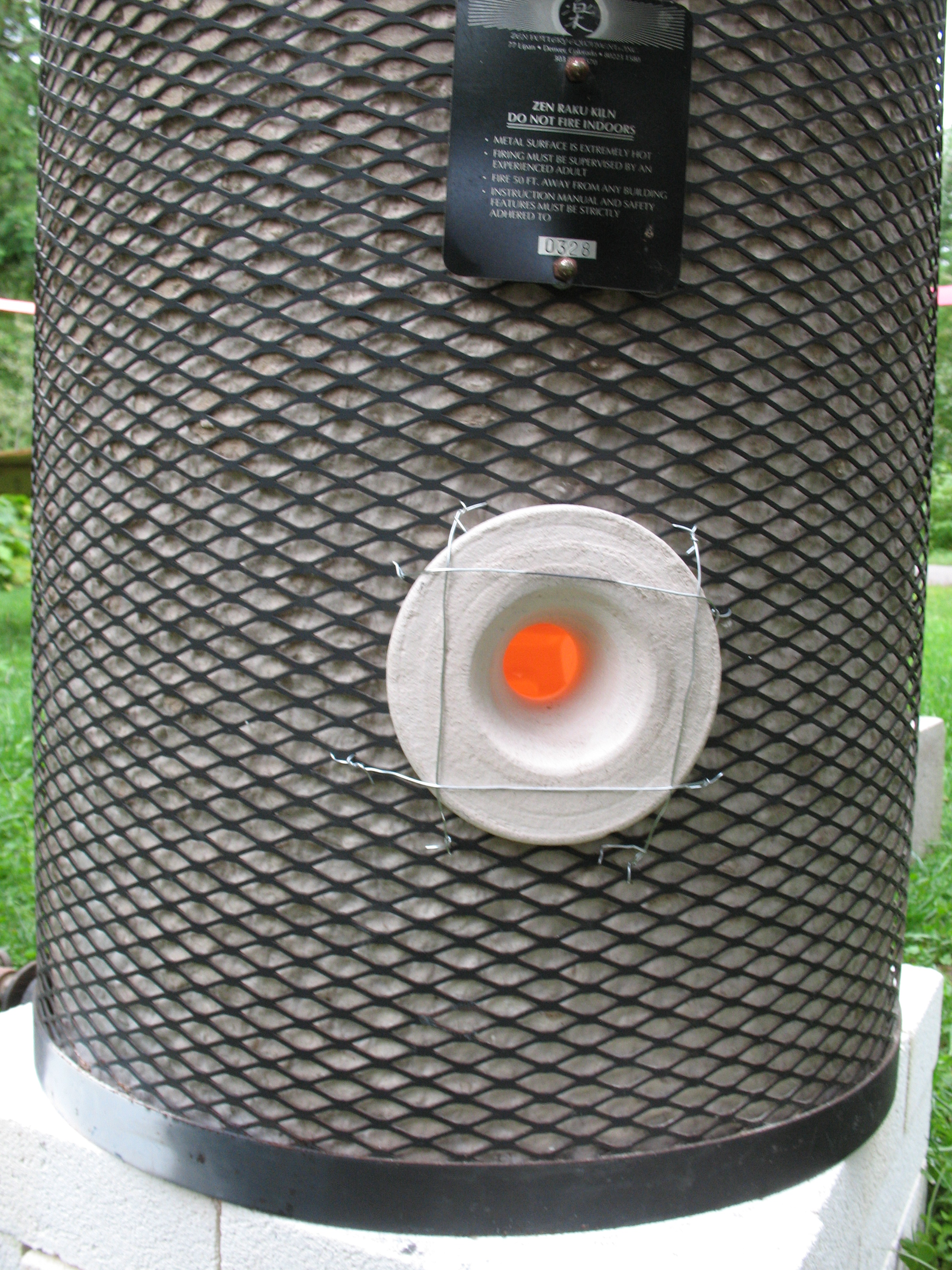
The glow and promise of raku!

The glow and promise of raku!

Yeah, right. It’s raining, and we have to go purchase building materials, and go vote. That means we have a day off from working at the site. We bemoan this, though we really need it. We both ache. There are times, at the end of the day, that I’m so tired I want to roll into bed without so much as dinner. (Though, I’m not going without a glass of wine!)

I know that this adventure is both taking its toll, and building us up. We’ve both dropped weight (though Rick is downright skinny and I’m beginning to bake goodies, to fatten him up a bit.) I have forearms like Popeye. I guess it’s making us stronger.

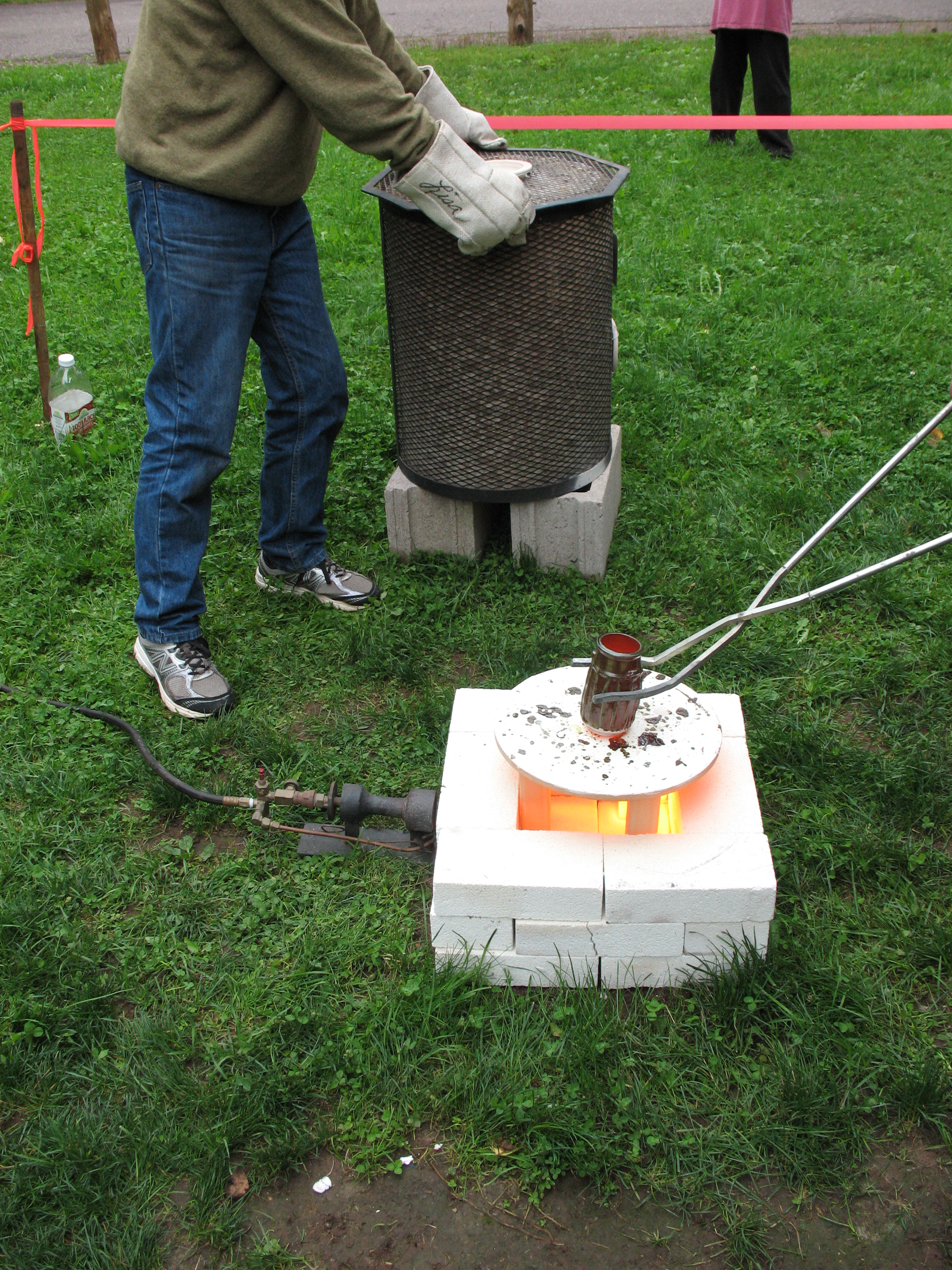
Actually, I know it. We took a couple of days at Labor Day to go visit my Mum. She’s a potter and had weekend plans to participate in a raku firing event. For those who may not know, a raku firing is a fire-filled, fast, somewhat ceremonial, blast furnace of a ceramic kiln firing. It’s a blast. From my childhood as a potter’s daughter, raku meant party. It combined the best of everything—fire, good food, a soupçon of danger, and that ooh-aah factor every time you open a kiln. Anyway, though I said that she’d need help with the event, I really just wanted to be there—to help and to live the fun that is raku.

The fired pot--headed for reduction in wood chips.

The fired pot–headed for reduction in wood chips.

As we loaded up the truck (kiln, tongs, gloves, pots, and propane) I grabbed her two, small propane tanks. They felt empty.

“Mom, we’ll need to stop and get fuel—these are near empty.”

She gave me a funny look. “No, I exchanged them last week.”

I hefted them again, two tanks at arms length, and and shrugged.

Rick came over to resolve the debate. “The seals are still on those tanks—they’re full.”

I looked down. Lugging one tank is normally work—two tanks would not usually be within my capacity. So, I guess it’s true. What doesn’t kill you makes you stronger. It was a great firing and a great day.

It’s About Time

A.V. Walters–

IMG_2054

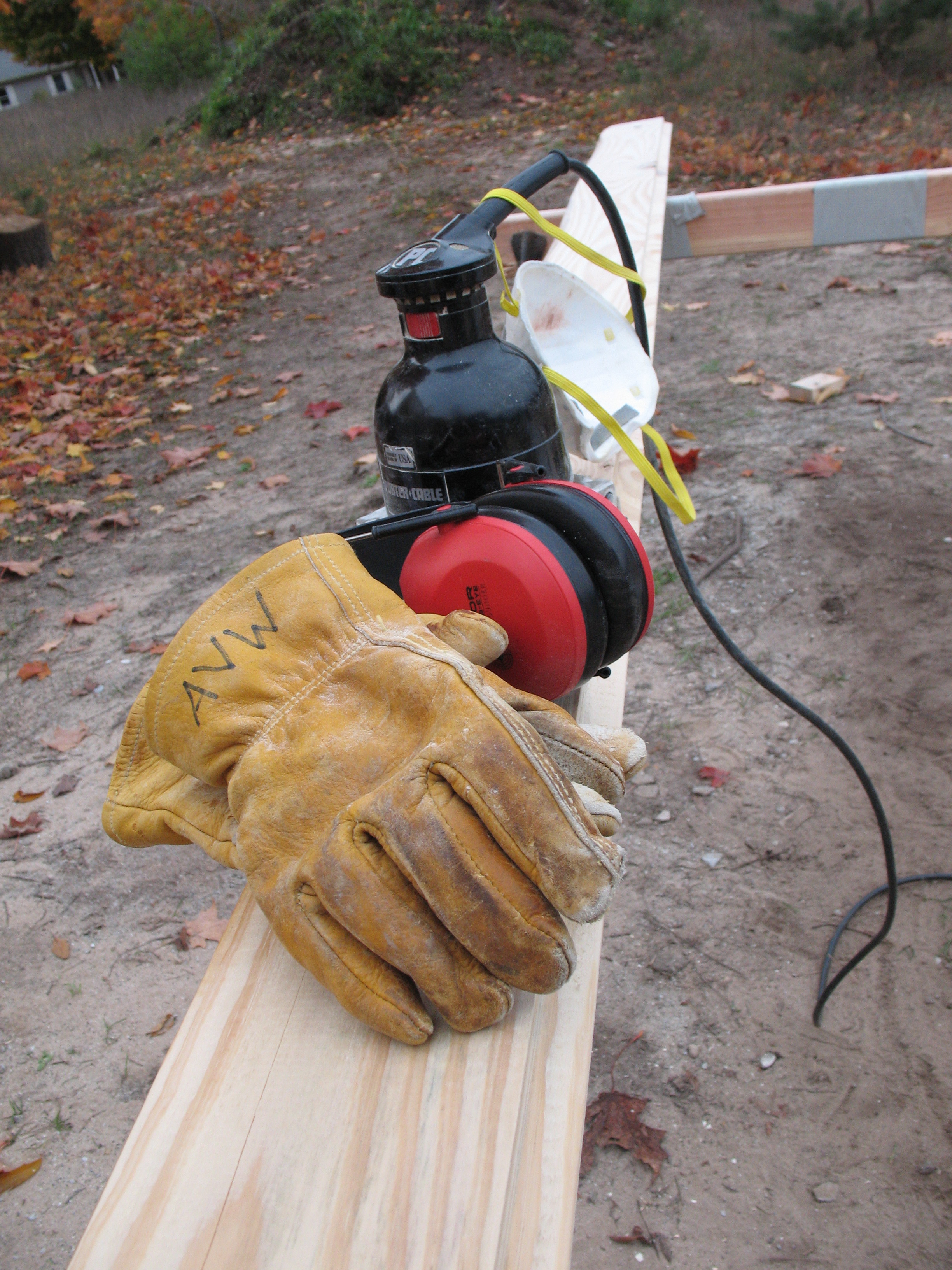
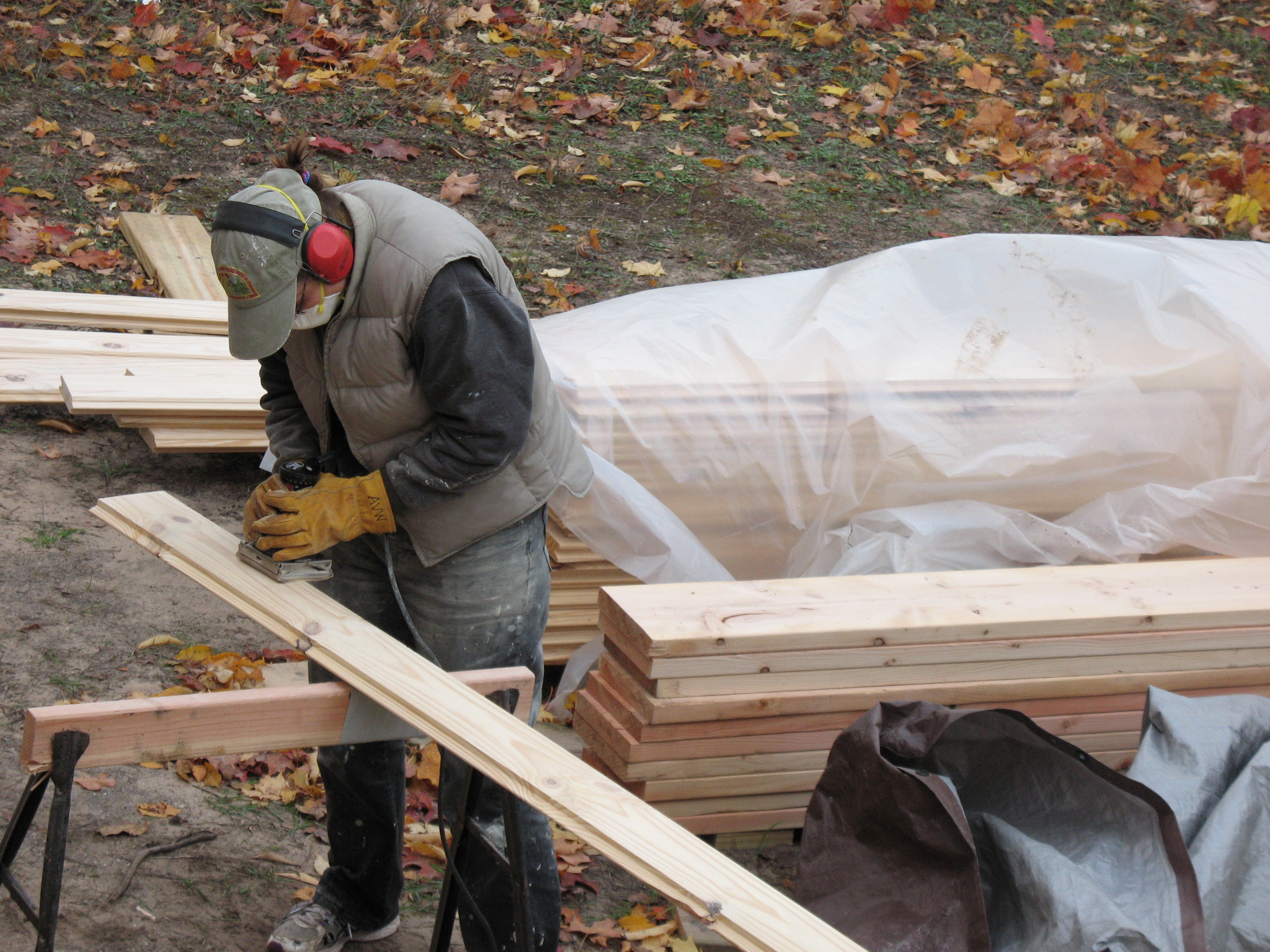
Lately, my job has been sanding. It gives me a lot of time to think. I work in a bubble—face mask, ear protection, hat and eye glasses—for safety, but it keeps me in my own head. Of course, there’s always the day job, so my attention is split, part to regular work and part to building. While I sand, Rick has been busy working the site, rough wiring, and building, installing the boards that I’ve finished sanding.

In the Zone

In the Zone

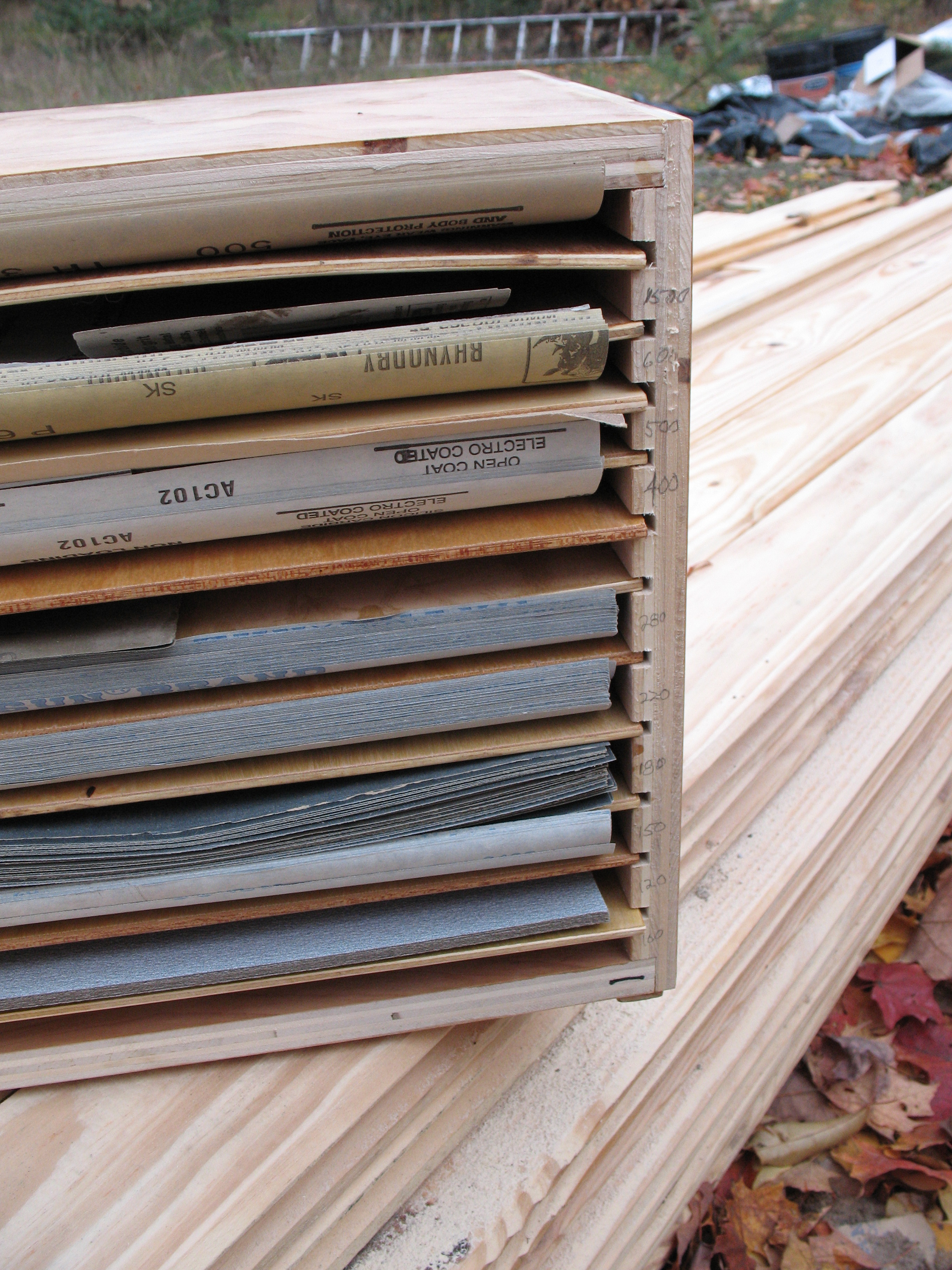
I learned sanding from my Dad. I think I earned that chore as a little kid because I was observant and, well, anal. I have a constitutional tolerance for the tedious. Now as I sand, I hear my Dad’s voice—and it’s a comfort.

“No, go with the grain. There, that’s it.”

The task of sanding is so integrated with my childhood memories that the sandpaper, the smell of sawdust, and the feel of sanding are enough to bring my Dad back. His voice and advice is a part of the physicality of the job. I’m using the sander he advised me to buy. I’d burned through two Black & Deckers, prepping my house for a paint job, when he said I needed better tools. So here I am, twenty-six years later, still using the Porter Cable he’d recommended.

We’ve had a lot of trouble with lumber on this project. We’ve rejected nearly a third of what we’ve ordered from local building supply houses. We even tried the local “specialty” builders’ outfit—and paid a significant premium for what was supposed to be custom picked lots. You can get quality lumber from the discount guys, but you’ll have to spend a ton of time picking through it. So, we swallowed hard and tried a “pro-builder custom order.”

It was a more than a disappointment. It was just as junky as if we’d picked from the top of the rejects pile at the discount stores. For this we paid an extra 25%? I called to complain. Rick and I sorted the pile into junk, usable and good. The sales guy lives not far away; he said he’d drop by. When he did, he looked at the pile and shook his head. “Yeah, that’s just not right.” Even then, it took two more deliveries to get it right. Another delay.

Every glitch just burns daylight. We’ve had snow flurries already so the delays are really a problem. We want to achieve a “defendable” enclosure before any serious snow accumulation. As for lumber, we’re back to hand picking on our own—it’s cheaper and, if you get junk, you know who to blame.

“Check your sand paper. See, if it clogs up like that, it’s time to change the paper.   Here, let me show you.”

“Daddy, how will I know when it’s done?”

“You’ll know, honey, your fingers will know.”

My dad had a belief that sometime, in our past, there was a Golden Age of Tools and Materials. Even when I was little he would curse the shoddy workmanship in building supplies. When materials fell short of the mark it was the fault of some national disgrace. I grew up to the litany of, “Goddamn Canadian nails!” or “How can they sell this shit!” He cursed like a trucker.

Rick shares this creed. He’ll eye a 2 X 6, shake his head and throw it back in the pile. “You just can’t get quality materials anymore!” (Another kind of echo from my Dad.) Picking up yet another bowed or twisted 2 X 10, he points out the wide soft wood between the growth rings, “See that, plantation lumber, grown fast and weak.”

Was there really ever a NeverNeverLand of strong nails and straight lumber?

I don’t believe it for a minute. It’s an argument about quality that’s been going on at least since the Industrial Revolution—and probably back beyond that—to the woodworking guilds of the Middle Ages. Wood is an agricultural product. Trees are not perfect. What makes lumber true, is time. Time and effort. Somewhere in the chain of commerce someone has to care enough, or make enough money, to make it worthwhile to spend the time to do it right. It’s the same for building and for any craft. In a world of mass production, suppliers will produce any product that will sell. Unfortunately that means that the quality will be as marginal as the market will bear.

As my father aged he became more and more of a fine craftsman. He complained less about milled lumber, not because it got any better, but because he bought raw, and milled and finished it himself. Towards the very end of his life the furniture he built was more art than craft. He was not fast. He certainly couldn’t have made a living at it. But he knew the work was good and it gave him great satisfaction. He reached the point where he’d select wood for its “flaws,” knots or whorls, and then fashion the piece to highlight these natural features.

In the months before he passed away he and I were enjoying morning coffee at a walnut table he’d made. “See this?” he tapped a spot where the grain swirled and rippled, catching the light. “That’s where I let the sun out.” He smiled and ran his hand along its smooth edge.

Rick and I are building a log cabin. The purveyors of the materials would prefer we call it a log home, but ours will be a modest dwelling that fits within the cannons of the design’s history. It’s suited to the simple lines of its primitive forebears. There is a lot of natural wood. Rick is taking the time to position the beams to their best advantage, even to straighten them with weird clamps and strapping devices of his own invention. I don’t think a builder could afford that level of care on a paying gig. This will be our home.

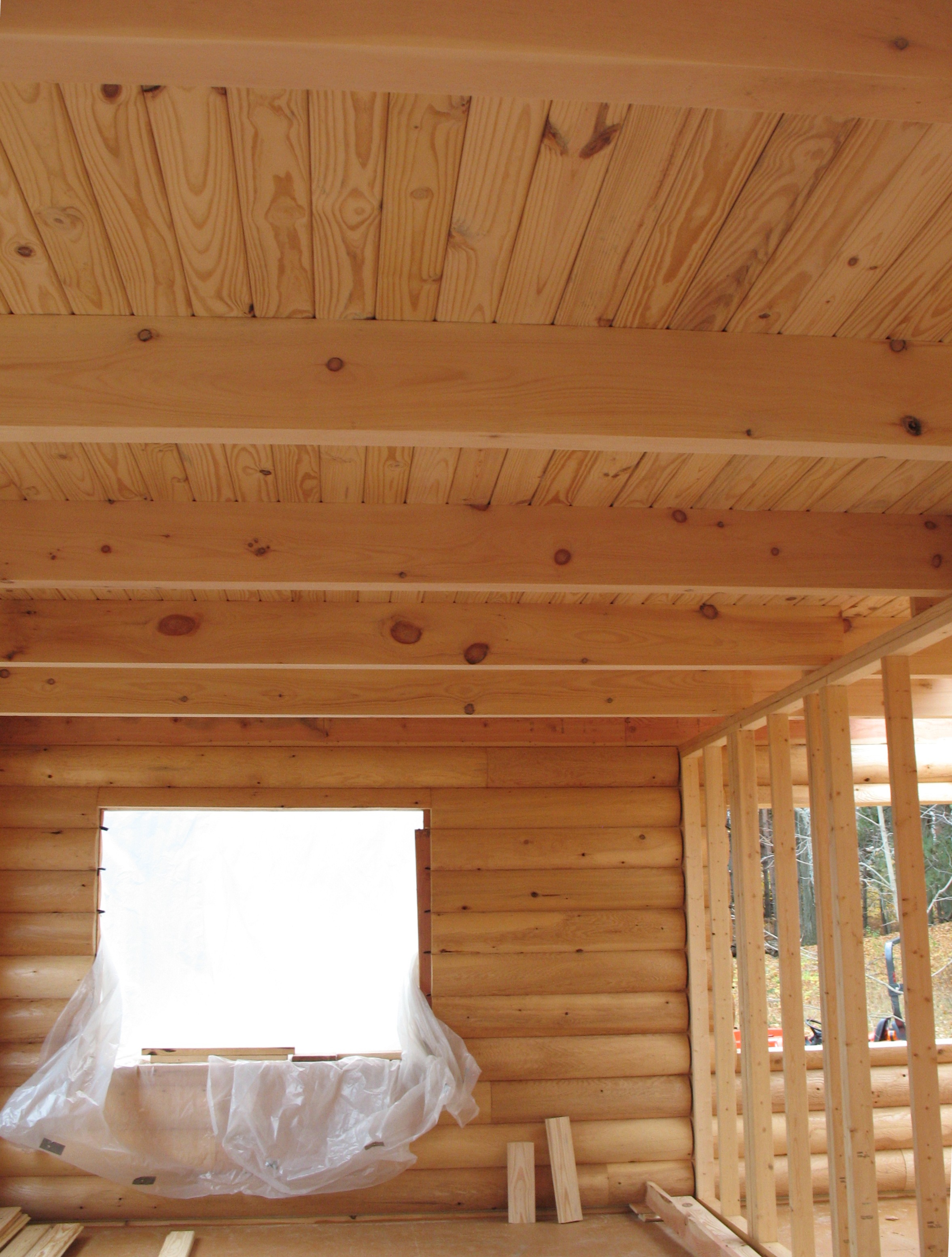
A traditional log cabin would have beams across the log perimeter, with a heavy plank ceiling that served as both the ceiling above and the floor for the second level. We searched for the right material that would work, and be in the spirit of a log cabin. We settled on kiln dried, southern yellow pine, beveled, tongue and groove, 2 X 6s. It was a special order so we had to take the quality on faith and wait several weeks for it to arrive.

IMG_2059

When it did, it was a huge disappointment. The wood was much more knotty than the catalogue description. It was not “finish-milled” and ready, as described. Rustic shouldn’t be synonymous with slivers. This wood bore the deep mill markings, chatter and the “tear-out” that you get when the mill’s blades are not sharp. Worse yet, the wood arrived moldy. And I’m not talking about the ubiquitous blue stain that comes with some pine. This wood was alive with green and orange colonies of mold. (Again, I can hear my Dad’s voice, “Kiln dried, my ass!”) Our expensive special order was a bust. We had to decide whether to reject it (and pay the chunky restocking fee AND wait for new wood) or whether to roll up our sleeves and solve the problem, which brings me to sanding.

IMG_2058

I am neither as strong, nor as skilled as Rick in building. I am really just a knowledgeable gopher, but I can sand. And that’s what we did. We bleach treated all the areas of mold and then sanded it all to remove any sign of mold or mill markings. All 150, 12-foot lengths, both sides. (There I was, sanding pine, a wood my father didn’t think was worth burning!) It took me an extra two weeks—while Rick worked on site grading and electrical. It’s up now, and looks really good. A silk purse from a sow’s ear.

I have my hands on my hips now. “Really Daddy, how will I know, how will my fingers know?”

“You’ll know it’s done, honey, when it’s as smooth as a baby’s ass. You just keep sanding ‘til then.”


My Dad's Sandpaper Box

My Dad’s Sandpaper Box


New Territory, New Toys…
A.V. Walters

In the early days...

In the early days…

No! Did I say toys? Tools, tools, really it’s new tools! It’s a whole new world of what one needs to do—snow, building, planting. First, after carefully reviewing the used market for almost a year, we got the Kubota tractor—which we we’ve needed for road grading, excavation, and will certainly need for snow clearing. Rick cut in the driveway and dug out the foundation for the cabin with it—it’s no toy.

Then, I saw a good deal on a log splitter, on craigslist. In Two Rock we heated with wood and we split it all by hand—both of us. Of course, Northern California doesn’t pack nearly as much of a winter punch as Michigan. We used to use about two cords of wood a year to keep toasty. Here we figure we’ll need about five. The log splitter was a good call. I used it, feeling like a bit of a traitor to my trusty maul and wedge. But in an afternoon, without breaking too much of a sweat, (though it is still work) I split about a cord. Wow. We already had chainsaws (when we met, Rick and I owned the same brand and model of chainsaw. Kismet!)

The generator/inverter was a no-brainer. So far, there still isn’t any power to the site. (Though it looks like next week the electric company will bring in the underground lines for power—with phone and internet piggybacking in the trench.) Everything needs power—nailers, sanders, lights, saws. So the generator can’t be considered a toy by any stretch of the imagination.

Back in the spring, we were looking at the costs of excavation—road, foundation, well line, septic. It was daunting. We’d already bought what’s called a back-blade (it’s like a big scraper) so, my next job was to look for a used backhoe attachment for the Kubota. It took awhile—It was my job to make it work financially—to make any purchase pay for itself with savings from what we’d otherwise be paying others. I also had to learn about what implements would fit on our tractor. There’s a whole culture of tractordom—sub-frames, hydraulic kits, three-point attachments and PTOs. Things need to match—and I’m not talking about accessorizing. I found one—and we finally hooked it up. It was quite a feat—first, installing a sub-frame, and then uniting two pieces of equipment that weigh tons. The conjoined parts look like a large, prehistoric insect. Usually, I’m not one much for mechanized things, but horsepower does have its advantages.

Rick immediately started digging the line for the well. He’s far more mechanically inclined than I am, within an hour, he had the levers and controls figured out, and he was trenching like a pro. I’m a little jealous. I want to dig, too. (Don’t worry, my turn will come.) In the meantime, I’ve become quite the craigslist maven. Hey, there’s still a snow-blower to consider. A 3 point snow-blower is a thing to behold—throwing a veritable fountain of snow 20-30 feet in the air. Winter is coming… they’re tools, after all, not toys.

One Year Counting Blessings

A.V. Walters

It’s an anniversary of sorts. A year ago today, two exhausted ragtag souls arrived in Michigan, California cats in tow, truck, trailer and pick up. It was a hairy trip, with no clear home in sight. Here we are, a year later–under construction but with a light at the end of the tunnel. We’ve learned a lot, mostly that this still appears to be the most sane plan for what we want to do when we grow up. We’ve survived the fiercest Michigan winter in decades (with another on the way, they say.) We are not dissuaded. It’s been raining–and the forecast for at least the next week predicts the kinds of rainstorms that hold construction work at bay.

We sigh, we shrug. At least we have a solid plan. Our little cabin is wrapped in its raincoat. The well drillers came last week–113 feet to ample, clear, clean water. We’re digging–site drainage, water lines, and then we’ll get to the septic. You can almost always dig in the rain.

I was talking to a California friend today. He asked after our progress and listened for a minute or two while I bemoaned weather delays. Then he made me stop. “Remember, you’re talking to California, here. What we wouldn’t give for just a fraction of your rain. It’s 95 degrees out here today–in October. We look up and wonder when…. if, our rains will come.”

Water was one of the reasons we came. We also came because my mum wasn’t well. I’m happy to report that she is much improved. It’s good to see her with energy and plans again. She’s getting ready for winter, too.

I’m ready for it. We’ll keep on keeping on. We’re feeling lucky on this anniversary.With one eye on the sky, I’m looking at craigslist for a used 3 point snowblower for the tractor.


Progress

A.V. Walters

Things are looking up.

Things are looking up.

We’ve been fighting the weather. As you might imagine, we are not big agents of change in that fight. Mostly, the weather is winning. This is not about climate change (though today’s the big march and I wish you all well.) This is about construction.

We have made some great strides in our building—but there hasn’t been any “honeymoon” phase in which we’ve had the opportunity to revel in the progress. No sooner had the last lag been set in the first floor log walls, than the clouds rolled in for days of heavy rain. It’s not like the rain can really damage the cedar logs—but it can wreak havoc on the plywood subfloors, which, so far, are still open to the sky. (Not to mention that it will all drain into the basement, anyway.) So, as soon as the stacking crew packed up, we pulled out the tarps and heavy duty plastic to try to contain the damage. The good news is that we knew this could happen—so we used a deck sealer on the subfloor—which has helped to minimize the absorption.

That first night was crazy—there we were, trying to secure huge tarps in high winds, in the middle of the night. We had some lighting—you couldn’t even hear the generator over the howl of the wind. Finally we worked out a rhythm to the mechanics of it all. By 1:00 am, we’d lashed it down as much as possible, just in time for the rain to hit. Most critically, we’re trying to cover and keep the floor as dry as possible. Each day we (mostly Rick) run out in the dry spells, pull the tarps, sweep out the water (or pump the basement) and then we re-secure it all before the next wave. Last night a squall hit while we were re-tarping. We just climbed under it and waited for it to abate. When inside, Rick is glued to the weather service site—and the radar projections. We no longer have any dry shoes.

Wait, wait, there’s good news! Tomorrow it should clear and give us at least four days in which to get ourselves more battened down. There could be more, but the weather service doesn’t extend its local prognostications to specifics out of that 5 day window. (Though I’ve already seen internet projection for heavier than normal snowfall for 2014/15 season! Sheesh!) We just need to hang in there until we get the roof on—then we can finish from the relative comfort of a weather tight envelope. And having the first floor done is a step in the right direction.

Rick is a builder from California. They don’t build in foul weather in California. I once knew a fence builder in Oakland who’d pack up his truck if the wind picked up on a cloudy day! Here in Michigan, they’re not much for building in driving rain—but you’ll hear them extol the virtues of building in snow! Probably most Michigan builders would laugh at our tarping efforts; what’s a little wet? (Snow is much better for the materials—as long as your equipment will work, why not? One of our stackers was advising Rick that if, in the dead of winter, the oil in your equipment gets too cold, too viscous, you can use transmission fluid instead. I don’t think that he was kidding, but I also I don’t think Rick was contemplating building in sub-zero conditions.)

Yes, we’ve run late in the season—but it’s not yet color (though some trees are turning, harbingers of what’s to come.) There’s still plenty of time to get things “buttoned down” before snow flies. I told my sister if she uses that expression, (buttoned down) one more time, I would button her down. Most of my family is urging us to hire builders. What is it they think we’re doing? Soon we’ll even have power, propane, and even water somewhere on the horizon. (The well-drillers didn’t want to hear from us until all the heavy equipment was finished.)

But then we had to give it a raincoat.

But then we had to give it a raincoat.

In the meantime, we’re meeting lovely people (the stacking crew—the Flanagan brothers were a total hoot.) We’ve even found a couple of reputable suppliers—rare in this industry. We’re moving right along.

Thunderstorms

A.V. Walters

The good news is that our new basement has proved itself to be watertight. Good thing, too. We’ll be needing that. Michigan sees a lot of wild and wooly weather. I’ve been telling Rick about Great Lakes thunderstorms for years. Though we’ve been here near a year—the weather has not cooperated to show off its best thunderstorm stuff. That is, until yesterday and last night.

It was tremendous. We had dramatic, roiling clouds, winds, driving rain and amazing lightning. For hours! I timed it and the lightning flashes were about 30-40 per minute—and it lasted from late afternoon yesterday until the wee hours of the morning today. Finally he had the chance to see the full-blown spectacle of non-stop lightning, with its  rumbling and crashing soundtrack. Nothing like California. The cats are both CaliforniaCats, too. Kilo was cool; Bob was flipped out about it. Nothing in their experience prepared them for the noise. I’d attach a picture, but unless you’re really good with a camera, lightning isn’t easy to capture. I’m not that good.

Years ago, I visited my sister in Southern California. It was her birthday—a little wine and conversation got us on to the topic of thunderstorms. California is wimpy in that department. That’s a blessing, because with California’s dry summers, Michigan’s lightning would burn California to a crisp! The evening ran long; wine and nostalgia are a potent mix. Two weeks later she packed up and headed “home.” Afterwards, she acknowledged that the conversation made her family so homesick, they decided to abandon the dream of sunny California. I don’t know the statistics now, but then, Michigan had the highest “rate of return” for folks who’d moved on, but couldn’t stay away. Some folks just can’t settle in to a climate that lacks actual weather.

The not so good news was the rain. We got almost four inches overnight. I’m not really complaining, we needed it—but there’s no roof yet on that basement. It’s watertight, but in this case it held the water in. So we came to the site the next morning to a wading pool. We briefly considered having a small lap pool in the basement. Four inches is too much to bail—so Rick headed to the hardware for a pump. A couple of hours later—we were back in business.


Sundays and Making Wood…
A.V. Walters–

indian pipes1
We’re busy building. I suppose, given how late it is in the season, we could/should just power on through and build every day. But there are other priorities in the mix. Once built, we’ll need to heat our new home. Our plan is to heat as much as possible using wood from the property. One cannot wait until the snow is thigh-high to go out for firewood. “Making wood” is what the old Finns call it, back home. Mostly, we’re cutting deadfall. There’s plenty of it these days, because those damned (but beautiful) Emerald Ash Borers keep killing the ash trees. At least the wood will still make good fires, and keep us warm in the winter.
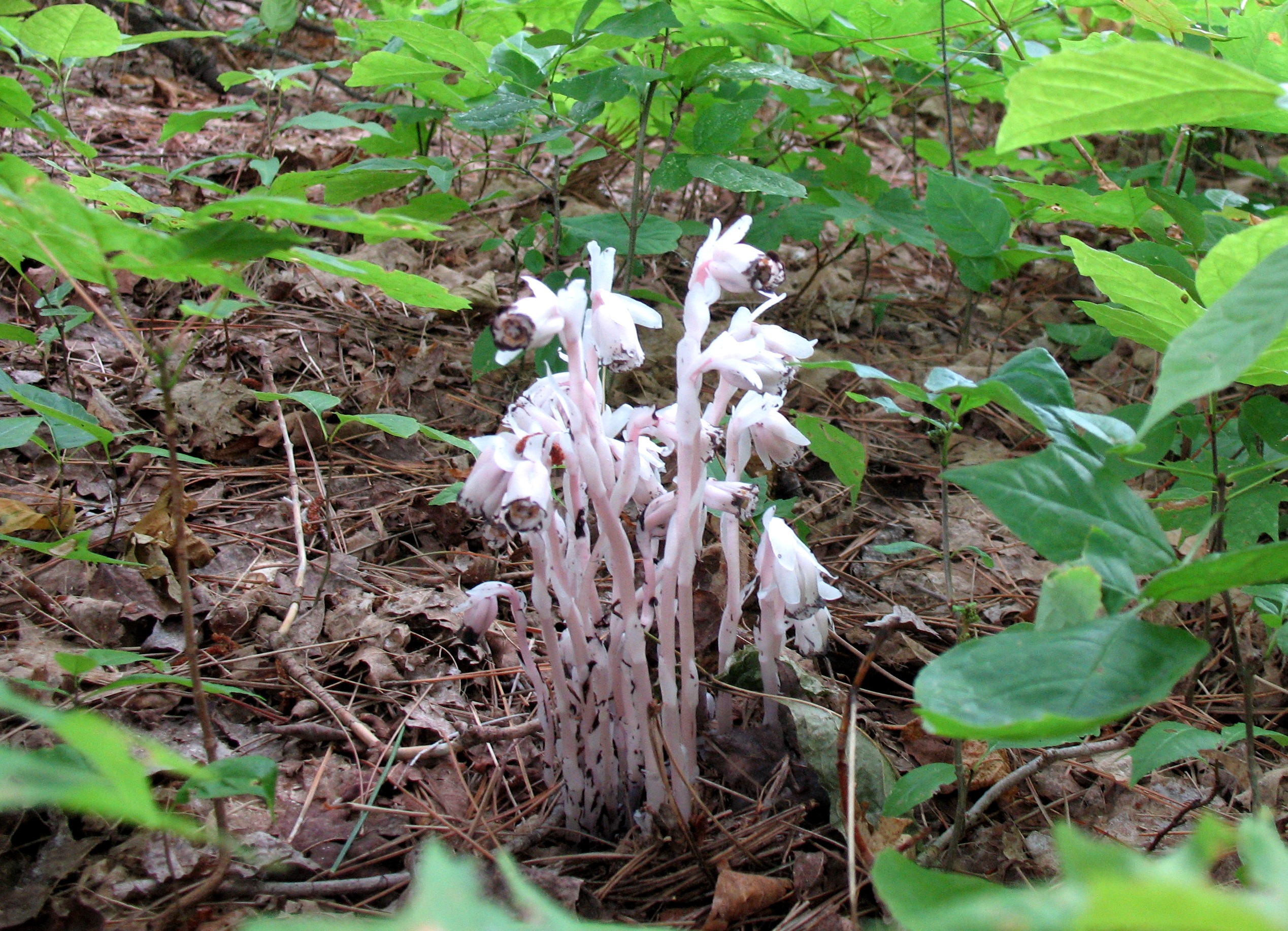
Anyway, we decided to take one day a week to cut firewood. Sundays. It’s a lovely change of pace, and brings us deep into the forest. It’s still backbreaking labor, especially on our steep hills but there’s always something new to see. Today it was Indian Pipes.

Indian Pipes are a rare form of plant. Also called “ghost plant,” they are a luminescent white—turning to a soft pink. They have no chlorophyll, and so cannot make their own food. Instead, they tap into certain kinds of fungus, which themselves have tapped into certain trees. The fungus-tree relationship is mutually beneficial, but the Indian Pipes are parasitic—they do not give back to either the fungus or the tree. They actually flower, like a regular plant—and are food for bees, both in nectar and pollen. Because they have no “plant” color, many think that the Indian Pipes are fungal. Without chlorophyll, they don’t need sunlight and can grow even in the densest of forests. No bigger than the spread of your hand, they’re easy to miss on the forest floor. They are often found in areas with beech trees or pines. We have both.

We’ve seen several patches of them this summer. When I was a kid we used to find them in the northwoods of Keweenaw County. We picked one once, from deep in the forest, to bring to a naturalist friend for identification. She chastised my parents, because the ghost plants are so rare. That got my attention—an adult wagging her finger at other grown-ups—my parents! No picking! I took the admonishment to heart and, to this day, I treat Indian Pipes with respect. indian pipes2

The Indian Pipes were our big score of the day. Of course, the firewood, too. All of it came from trees that had already fallen. Unfortunately, when the ash trees fall, they take prisoners—crashing to the forest floor, dragging their neighbors down with them. Today we gathered mostly ironwood (hophornbeam), beech and a little maple. We’re clearing trails for future access, so the day’s haul was moderate. Next Sunday, we’ll be at it again and who knows what we’ll find.

Bunker Mentality–

A.V. Walters–

IMG_1868

We’re building. It’s a small footprint, our cabin at the edge of the woods. We picked the site for its view across the valley, and so that we’d get sheltering shade in the summer. We are months behind schedule. If I were the type, I’d be getting close to panicky. On our walks, I note that we’re seeing the occasional flash of early color in the trees

Initially, we had weather delays—frost well into May, administrative delays—title and permitting problems and then, a comedy of errors on the foundation.

This county requires that building plans be prepared by an architect or a licensed “building designer.” Since we’d already drawn up our plans, we went with the building designer method—to check for technical and structural details, and to make the plans look professional. We informed the designer that there was a slope to the property—but he wasn’t concerned—I guess he figured it wasn’t his department.

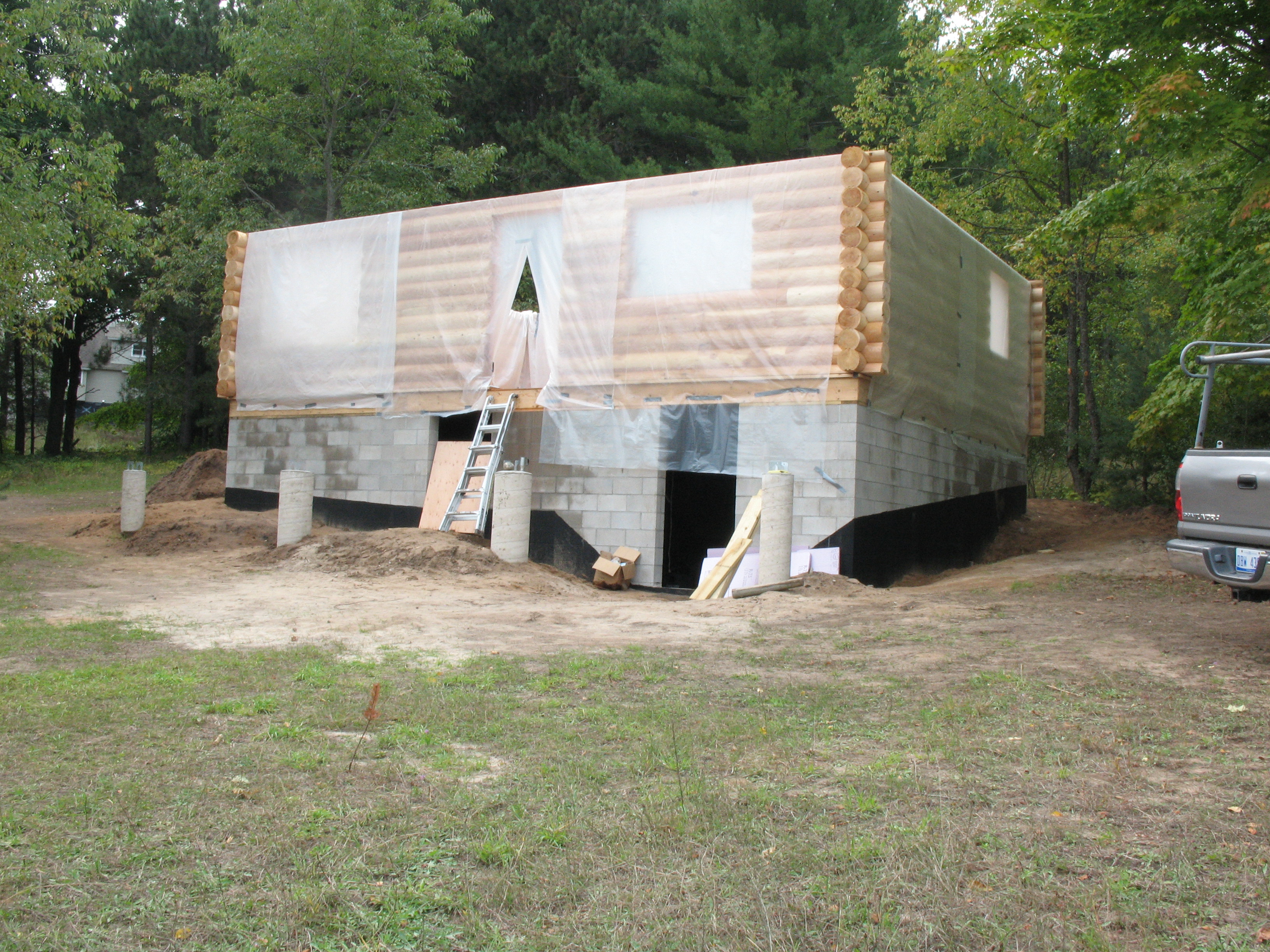
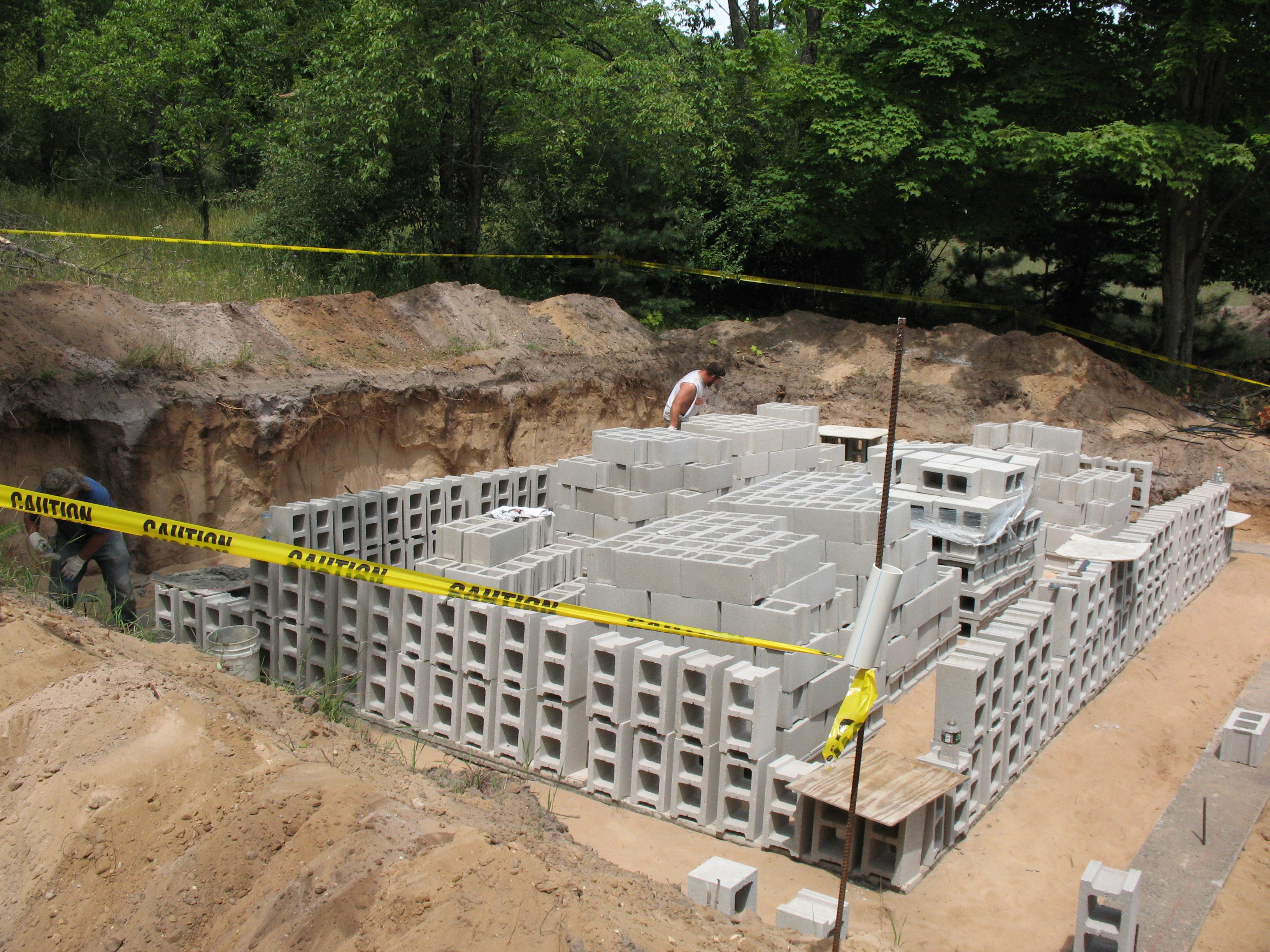
When the approvals were finally complete, we hired a local mason to build the foundation. Though Rick is a builder, there are very good reasons to hire out parts of the job to those with greater experience. Most of our building proficiency is from California, where foundations are usually poured concrete (with lots of rebar reinforcement.) California has earthquakes, and they take their foundations seriously. Michigan foundations are often built with concrete block—especially for smaller buildings like our little cabin. It’s heavy work and we are not young.

The plans called for a crawlspace—just enough of a foundation to meet the frost requirements for local code. It’s a cabin, nestled into the gently sloping hillside, with a cozy, low profile. We knew we might have some adjustments because of the slope. We consulted with the mason. He didn’t see a problem, maybe a couple of extra courses of block. He instructed Rick on exactly how he wanted the excavation to be done. Rick did the digging, per instructions, with the Kubota. As he did so, it started to look like the back-side of the hole was a lot deeper than the mason had described.
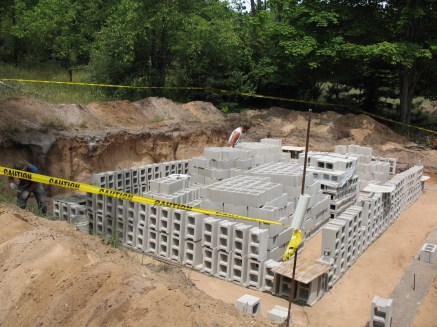
IMG_1883

On the mason’s return, he too, was surprised by the depth of the hole. He accused Rick of not digging level and true. Measurement proved that it was almost perfect, (a little less than a half inch off, across a forty-foot run.) The mason shrugged. He’d have to go at least an extra two courses of block—and he submitted a revised bid. We nodded. The price seemed fair. After all, what do we know from masonry?

A day or so later, he advised that the wall sill wasn’t high enough, to address issues of drainage and slope, he’d have to go yet higher. This crawlspace was exceeding crawl (except in timing.) We’d gone past duck walk to homo-erectus—though still not a legal height basement. I ran down to the County permits department to advise of the change. The clerk asked me why we didn’t just go all the way, for a full basement. Oh no, it’s just a little cabin. That would be thousands of dollars more and we didn’t really need a basement. It’s a cabin—and with the extra height, we’d be giving up on that snuggled-into-the-hillside look.

It was a Friday night. I went into town for milk and beer. I ran into our buddy, Linus, from up the road. He was picking up a pizza. Linus works at one of the cherry farms, but used to be in heavy-equipment and construction. During cherry harvest he works long days—and pizza-to-go is part of the equation.

“How’s it going with the foundation?”

“Well, it’s a lot deeper than we thought. We’re up to ten courses.”

He nodded. “So you’ll be pouring a floor, then?”

I shook my head. “No, we’ll still keep it to a crawl space—now, it’s just a tall one.”

“No, you’ll be pouring a floor… a four-inch slab.” It wasn’t a question.

I looked up at him. “We really weren’t planning on a full basement, it’s too high.”

“I doesn’t matter. At ten courses, you pour a floor for stability.” He was nodding his head with certainty. He doesn’t talk much, and, for him, this was pushy.

“Yeah? You think so?”

“Four inches—no less.” His pizza was up. He nodded at me, “Tell Rick I said so.”

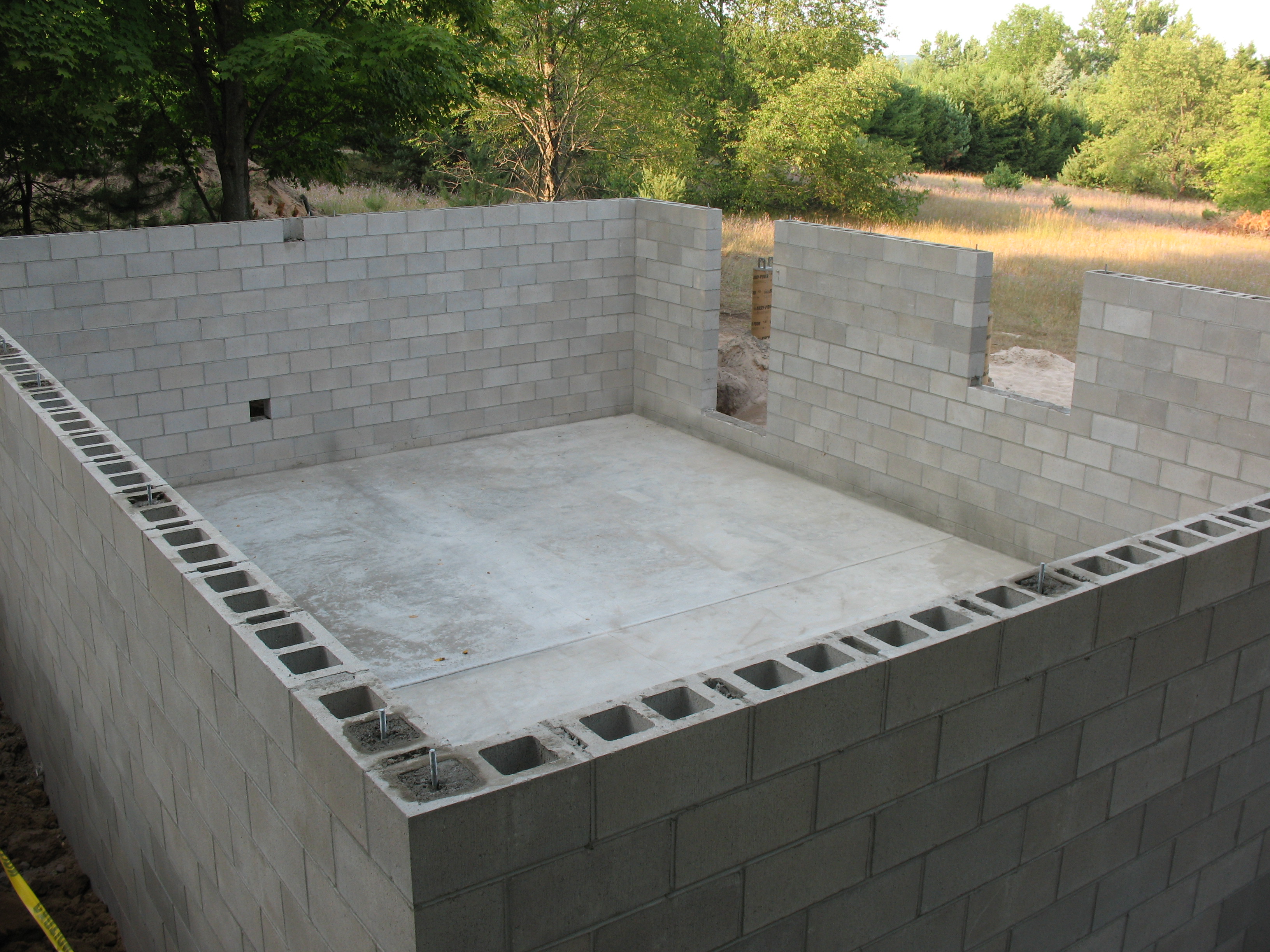
The weekend was a running debate. We had to have a serious discussion with the mason. Could this be true? Why hadn’t he said anything? Rick reconfigured the plans for a full basement, just in case. If you have to pour a floor, you might just as well go the full twelve courses for a legal basement. And, if you’re putting in a full basement on a slope, you should put in a door on the downslope for a walkout, and, yeah, maybe a window, for light. We tried to imagine our little cabin, perched up on an eight-foot high, block foundation. A bunker. An eyesore! “Don’t worry,” Rick assured me, “If we have to go this route, we’ll bury as much as we can. We’ll landscape it.”
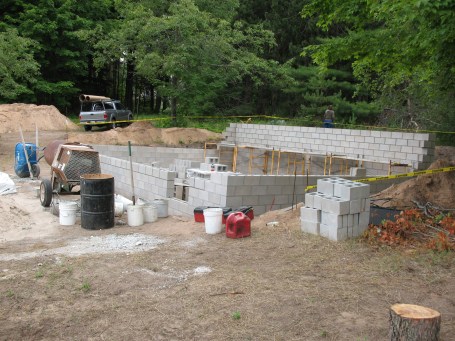
IMG_1904

Monday morning was telling. Rick put it direct to the mason. “A friend said we should be pouring a four-inch, slab floor—for structural reasons—any truth to that?”

The mason didn’t meet his eyes. He scuffed his boot in the sand. After a long silence, he offered, “Well, it is a good idea.” Why hadn’t he said anything before? That made the decision. I zipped up to the county offices with Rick’s revised plans. The clerk nodded.

“You won’t regret it, a basement is really handy.” She smiled, a little smug. But, she’d been right.

For the next couple of days we watched as the courses of concrete block grew, towering above us. We looked for the bright side. You can always use extra storage… right? Rick could have a shop downstairs. We could move the laundry down there, too. And, we told ourselves, the added height gave us a hell of a view from the front porch. The foundation price was now double the original bid. We sighed and wrote progress payments.

During the foundation work the mason’s little daughter took ill. Really ill. She was hospitalized for over a week. Though we only lost one “official” day of work, the family’s trials cost in “attention” time. Who could blame him? If I had a little one at risk, I’d be glued to her. These are the important things in life. We were happy to accommodate.

We did have a little tiff over the details of the floor. We wanted a vapor barrier under the slab. The mason didn’t want to deal with it. We insisted. It wasn’t the norm, he said. He got more than a little grumpy about it. In the end, we’re the owners—we insisted and prevailed.

With the block work and floor complete, the only remaining thing was to insert the rebar and pour concrete into the wall cores. We were anxious for completion—because then the project would be ours again. With us at the helm, we could make up for some lost time. Rick asked the mason about the rebar placement. Given his California roots, Rick was concerned about what looked to be sparse reinforcement. After all, we’d doubled the wall height, so for structural reasons, now was not the time to go light on strength.

The mason threw a fit. Was Rick questioning his professional integrity? He was almost yelling now. The mason went to his truck and took out his copy of the Michigan Code Book. He shook it in Rick’s face. “It’s all in here. I don’t go by California code. I go by Michigan rules. We don’t have earthquakes here!” He threw the book back into the cab of his truck and left for the day.

Tired of being at a disadvantage, Rick came home, went online, and purchased his own copy of the Michigan Code book. But, in the meantime, we had little choice but to trust the mason. He came the next day for the “final pour.” It was a relief. After our inspection, scheduled for the following Monday, we’d finally be able to start our building process. I paid the mason.

Well, “we” failed the inspection. California, Michigan, it doesn’t matter. The code is pretty much the same, no matter, and the amount of rebar in our foundation didn’t meet code. (So much for “professional integrity.”)

I emailed the mason. He called, livid, like it was our fault—accused us of pissing-off the building inspector. We told him to speak to the Inspector, himself. Apparently, that conversation set him straight. We didn’t even have to say that he should read his own Code Book, instead of shaking it in our faces. He was whipped and compliant.

It took another week to get it finished. The inspector told him exactly what he expected in reinforcement—even more than what code would have required, but by this time, the mason was cowed and obedient. We helped with the final pour. Now we have the strongest foundation in the county, a literal bunker. If there’s ever a tornado or a hurricane, we know where to go. Oh yeah, and turns out the vapor barrier, we fought over, is Code, too!

IMG_1914

The foundation took a little over a month. Not too bad, considering all the changes and hiccoughs. It’ll be nice to have a basement, and there’ll be that incredible view from the front porch.

Ripples…

A.V. Walters–

ripples

Sometimes there are crystalized moments in your life, moments that are loaded in a way that forms who you will be, or that define a new direction that your life will take. I’m fascinated at how a chance event can snowball to construct an entirely different version of you, than the expected path might have yielded. You may not even know it at the time but, upon reflection, you can see how the impact of that moment left its fingerprint on you, and maybe on others around you.

We all have answered those “pivotal” questions, “Where were you when…” But they reflect a wider sensibility—that of a community or a nation. And I don’t doubt that those incidents that form the arc of history have an impact overall. What I’m talking about here, though, are the more personal moments—the AHA! events that took who you were, an instant before, and then mapped a new direction for who you became as a result.


From time to time, in this blog I’m going to address those ripples—in my life, and in the lives of those I know. I invite you to ponder your own circuitous paths, and how the “you” of today emerged. Feel free to share.


The Magnificent Radovini Brothers

stick built

We were stair-step kids, arriving with catholic regularity, one, nearly every year. Before long, our standard issue, three-bedroom tract home was too small, owing to our lopsided gender distribution. When the time came that my brother, the only boy, really needed a room of his own, we four girls were too much for the other bedroom.

My parents own interests were running out of space, too. My father’s woodworking and my mother’s new involvement, in the world of clay, were spilling out of the utility room and into the kitchen. So, my parents took the plunge. Together they sketched out a plan to expand our home to make enough room for our wild tribe, and enough for all the different things we did. An architect made their dreams into plans and the bank gave the go ahead. My parents found builders, the highly recommended Radovini Brothers. These young men accepted the job, but warned that, in the middle of it, they’d be taking off for two weeks for a long planned family reunion. As long as the project was enclosed before they left, and then finished before the end of the summer, my parents didn’t mind. How could they? They understood family.

It was high theater for us. It was summer and we were off school so we could watch. They were doubling the size of our house, there was digging, with its piles of dirt and concrete, and finally, The Radovinis arrived. We loved them. They were five brothers with mops of dark hair and sun-bronzed skin. They worked shirtless. The neighbor women came to watch. The Radovinis worked and laughed and sang—sometimes opera, sometimes Italian folk tunes. The brothers harmonized, in their songs and in the rhythms of their work. They brought enormous lunches, which they unpacked from coolers with great ceremony. Food was important. They ate with great gusto, the jokes and ribbing continuing between bites.

It was like being visited by the circus. They were as charmed by us as we were by them, a string of blond towheads, following their every move like puppies, soaking in the aroma of pine boards, and watching the building take shape.

Our house grew by the day—faster even than we’d been told to expect. These men loved their work, and loved showing off their skills. Our jaws hung slack as we watched the drawings from the plans take shape in the air. It was a two-story addition and they were fearless—walking out on the thinnest of planks, twenty feet in the air, tossing up tools to the outstretched and ready hands of trapeze-artist framers. We tipped our heads back and shielded our eyes from the summer sun with cupped hands, to watch. How lucky we were to have found such tradesmen! As the time for their scheduled vacation approached, they worked long hours, determined to frame and sheath the structure before their trip—as promised.

The oldest brother approached my father. Were we happy with the work? Of course! Sheepishly, he requested that my parents advance the full contract price. The brothers were traveling across Canada for their reunion and wanted a “safety reserve.” My parents, thrilled with their work, were happy to oblige. Hell, they’d have adopted them if they could.

In their absence, we clamored over the new addition like squirrels. We collected nails and pieces of scrap wood—which we hammered into odd towers. When parents weren’t watching, we walked on the skinny joists, high above what would be our new garage. It was all so exciting–we could hardly wait for their return.

My father broke the news at dinner one night. We knew that something was up. My mother’s face was puffed and red. There’d been an accident. The Radovinis, they were going over the mountains—with most of the family riding in a travel trailer. A passing car clipped their trailer and forced it, and its tethered truck, over the edge. Four of them had been killed, along with their wives and children. The surviving brother would never walk again. With him, all that remained of this vibrant family was the elderly grandmother and an infant child, who’d remained home. The singing and laughing, gone.

My parents never mentioned the money. And, from that day, we became builders. My dad rolled up his sleeves and learned. His weekends became building time. We were his cadre of conscripted workers, little fingers stuffing insulation around windows, holding the end of the measuring tape and carrying tools and supplies. He learned wiring and plumbing and tiling (Oh My!) So did we. He harnessed his intense fear of heights to finish the roof and upper walls. We learned to put our fears in context. Money was tight, but skills we could learn. We became a family that built what we needed. We never shied from what willing hands could perform. It took my parents, and us, ten years to finish, but it was done, and done well.

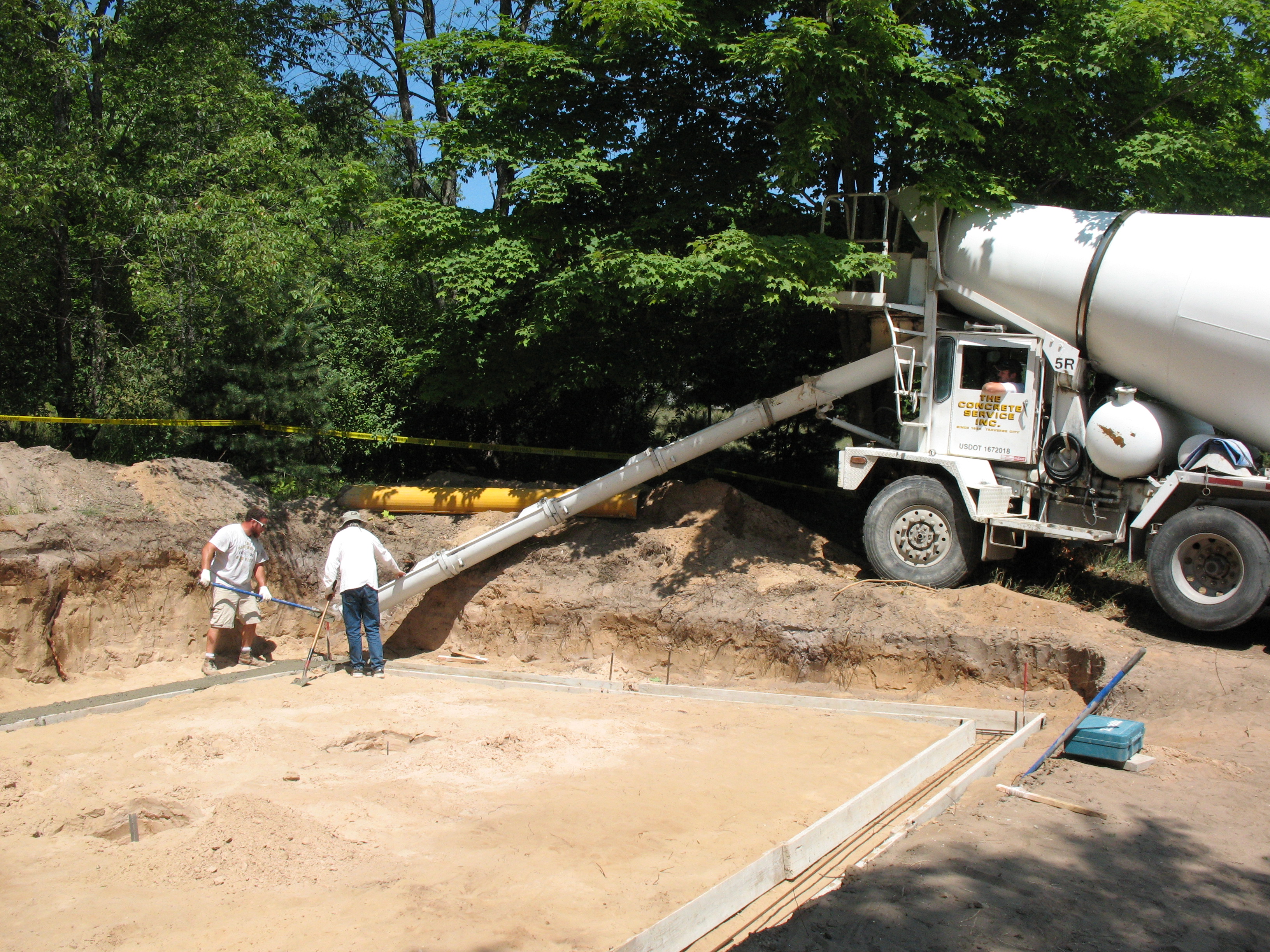
That continues to today—not a professional builder in the bunch, but my siblings, mostly girls, are not strangers to the working end of a hammer. The Radovinis came into our lives nearly five decades ago. Right now, I am poised at the largest project of my adult life—my husband and I are building a home. As I wrote this, the concrete truck arrived to pour the footings.


Pouring Footings

Pouring Footings

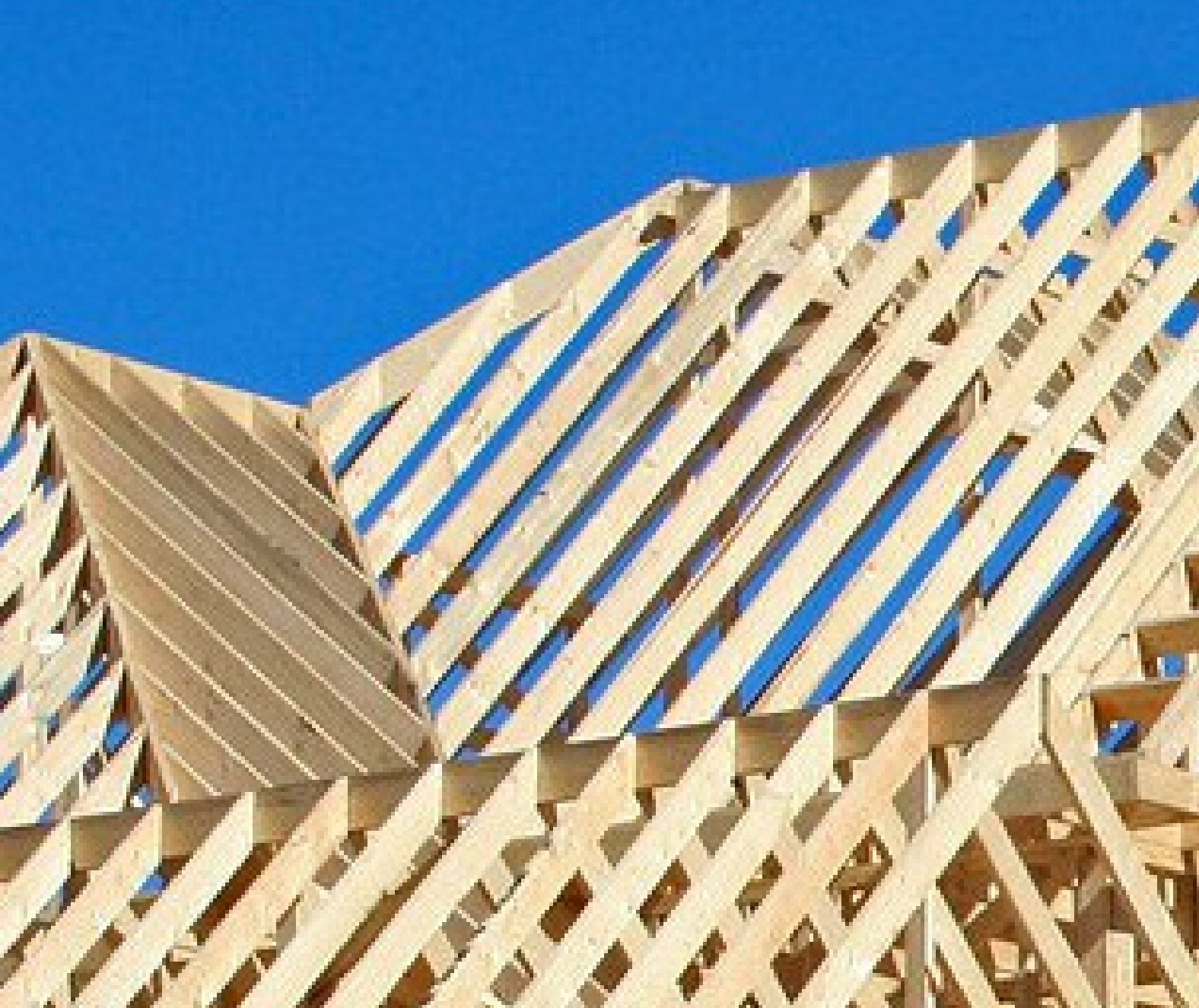
In my minds eye, I can see the Radovinis, perched, straddling the skeletal ribs of our new roof, drinking ice water from re-filled Coca-Cola bottles. They chug it down and pour the rest over their heads, laughing and working in the summer’s heat.


Good Enough Gardening

A.V. Walters–

Now, a good gardener would have done things differently. A good gardener would have had the soil tested and would have amended accordingly. This year, I’m going to have to be a good-enough gardener. The plants went into their buckets in a flurry of enthusiasm, an unexpected last chance to see things growing, and enjoy them on my dinner plate through the season. What can I say; it’s a done deal.

I’ve heard that the soil here is alkaline. (And the water is hard.) I suppose you could say that this little bucket-garden is a test plot. We’ll just have to see how things go. I fully expect to test the soil on our property, next year, and amend accordingly. So far, we’ve been pretty lucky. We planted in a good spot, which I picked for the southern exposure. What I didn’t figure on was wind. Wow. Like Two Rock, this place has wind, and then some, to spare. (The wheels are turning and I’m thinking… a good spot for wind power.) My little southern exposure turned out to be perfect, because the house also offers the garden some shelter from the wind.

I’m not joking about the wind. It’s a beautiful day, so I hung out the laundry. It hangs horizontal. By the time I finished pinning up the first load, the first things up were already dry. Whipping in the breeze, even the towels dry soft and everything comes up lint free. There has to be another way to harness that energy for good.

Today was watering day for our little garden, too. In Two Rock I was able to satisfy watering by topping off the buckets, twice, once a week. In Two Rock, there was no rain during the growing season. But, there was more clay to the soil, and that helped to hold the moisture

Here, it is largely sand. Even with Michigan’s regular rainfall, I think I may have to water a little more frequently—especially with these winds. The plants, in the ground for about a week now, look healthy and have started to take off. Everything has sprouted a round of new leaves, and the peppers and tomatoes have started to flower. I was surprised at how little they suffered from transplant shock. I’m looking forward to the results of our experimental garden.

With today’s gardening finished, I decided to take advantage of the wind and do “extra” laundry. You know, the stuff you don’t usually do—the throw rugs and some blankets, even my winter coat and the winter’s down clothing. They’ll easily be dry by evening. I’m letting the wind do the rest of my day’s chores, and I’ll get the credit.

Garden Surprise

Michigan Meets the Bucket Garden

Another Bucket Garden

Another Bucket Garden

A.V. Walters–

I had resigned myself to not having a garden this year. There’s just too much going on. We have building to do—and that has to take the lead. In Empire, we had a late spring, and nowhere to start seeds. Now that we’ve moved, well, it’s a little late. Michigan has a shorter season—and, unlike Two Rock, it’s not forgiving on the harvest end. Besides, in a rural setting like this, a garden needs infrastructure. I don’t have time for infrastructure.

A garden, especially a vegetable garden, is an artificial environment. Its inhabitants have needs. In Michigan, they have some basic needs that exceed my Californian framework. Here, we have garden predators. And not just the usual gopher hazards (though we have those, which, like in Two Rock, we can solve with buckets.) Here, we have deer. Worse yet, the place is crawling with bunnies. That means we need a really tall fence (six feet or better) and it has to extend underground. Bunnies are not deterred unless you prevent them from burrowing under the fence. With their Bambi faces and cute eyes, these critters’ benign outward appearance hides a darker garden reality

Moreover, we don’t yet have water on the property. I’m no fool. I read French Dirt. Never plant a garden until you have a sure water supply. Our well is not yet in. No well, no water. No water, no garden. It’s as simple as that

Still, Monday I ran into town and stopped at my favorite grocer, Oryana (a local co-op). I was doomed, even before I stepped inside. There, at the entrance, were racks and racks of organic vegie starts. At good prices, too! Some of them even knew my name! I have no discipline—I quickly snagged a bunch and headed home. On the way I rationalized my decision. I could plant them just outside the window of our little, basement apartment. After all, my planting buckets are sitting idle. The landlady’s dogs, though pests in many other ways, allegedly keep the yard clear of deer and bunnies. (We’ll see.) Surely the landlady would enjoy fresh produce through the summer, too.

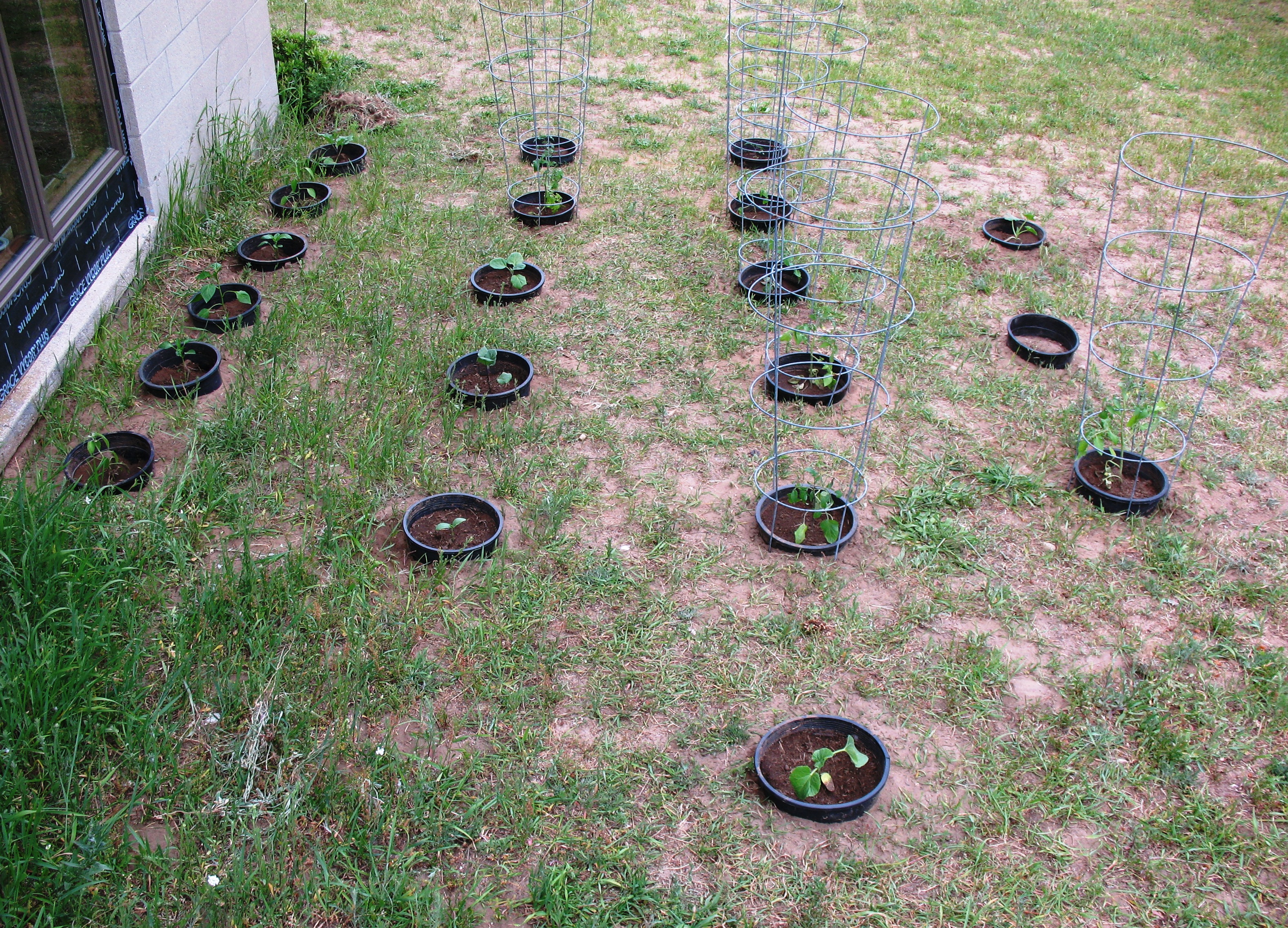
It won’t be a big garden—only twenty buckets. Eight tomatoes, five peppers (can’t find decent hot peppers in Michigan), an eggplant assortment, cucumbers, zucchini, crookneck, and a cantaloupe. We’ll skip the leafy things—I just picked through what was left at Oryana’s. It’s just a tad late in the season, but I’m happy to have something to grow.

I was sheepish on my arrival home. After all, we’d had the garden discussion. Rick knew something was up immediately. He laughed when I admitted to my impulse purchase. But, of course, he helped me dig-in the buckets.

Ahhhh, Shoes…

A.V. Walters–

I did a laundry run, yesterday. I gambled, and wore shoes. It’s the first time I’ve stepped out of the house, in shoes, since November. What lightness of being! What fleetness of Foot! I’ve loved winter, but at some point, it’s a relief not to have to pull on your hefty winter boots. That’s not to say that the snow is gone—or that it’s warm. But for a trip to town with laundry, it’s finally a safe bet that the roads and parking lots will be clear of the slippery stuff

We’re suffering from faux-Spring. You look out and it’s sunny. We can even see some dirt. There’s a snow-free zone around trees, and on sidewalk areas that have been kept relatively clear of snow. But when you step out, it’s beyond brisk, mid-twenties. I neglected to pull on my thermal layer before heading out for the Laundromat, and I paid for it in chill. Today it even snowed a bit. Winter isn’t finished with us yet.

Shoes, though, that’s a big step. (Pun intended.) And, it gives you big ideas. Gardening. Building. Picking berries. Oh, yeah, and even sandals!

Meanwhile, Back in California…

A.V. Walters —

This, we miss.

This, we miss.

In California, they’ve had the warmest winter on record and the third driest. My California friends have raved about the weather (even while admitting that the drought is a problem. But hey, if you’re going to have a weather calamity, you might as well enjoy it!) Knowing I’m a gardener, they’ve sent photos of Spring, to tempt me from here, under my blanket of snow. Late rains finally brought the green back into the hills of Two Rock, and that’s good for—emus!

Green Hills for Grazing

Green Hills for Grazing

Emu Views

Emu Views

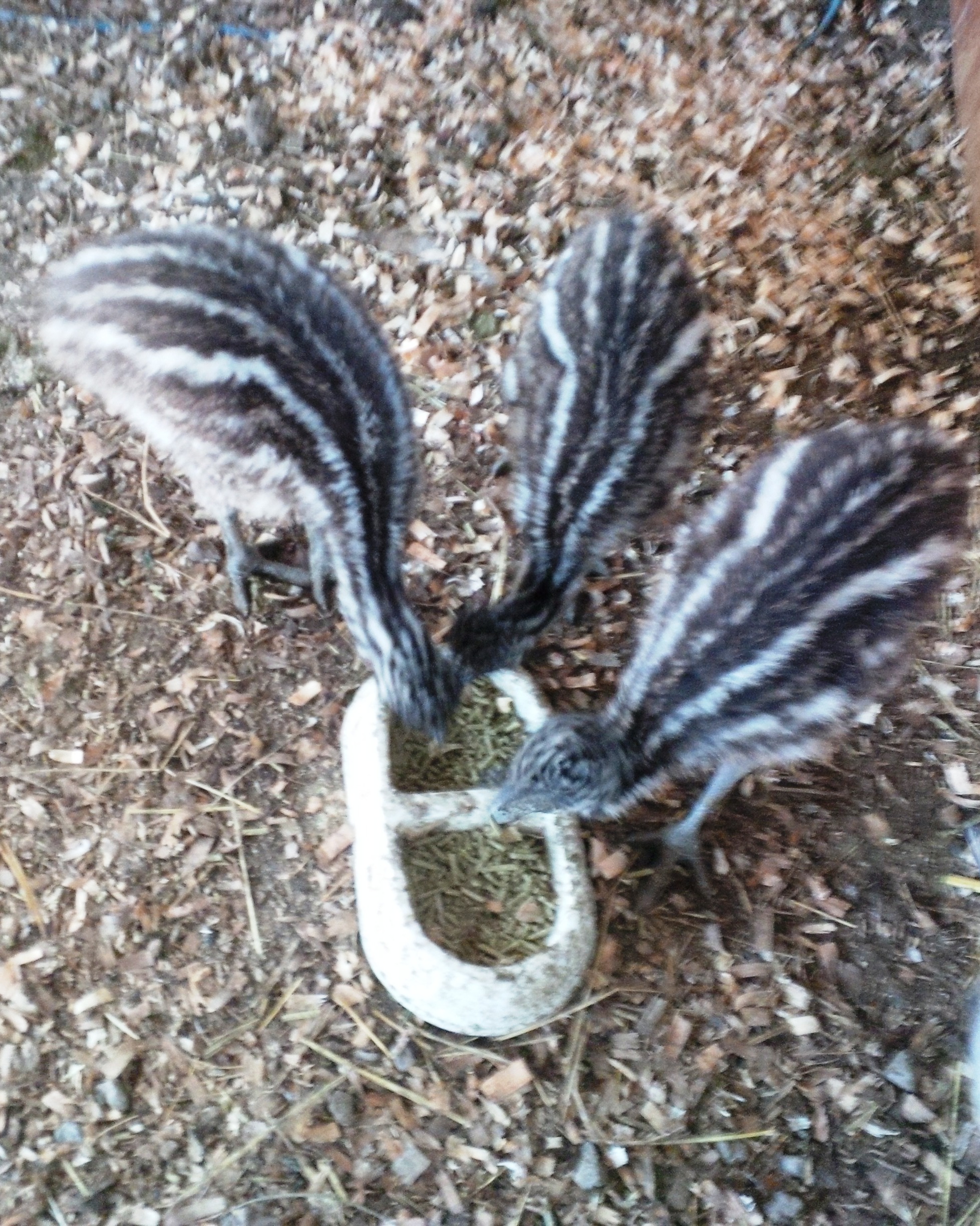
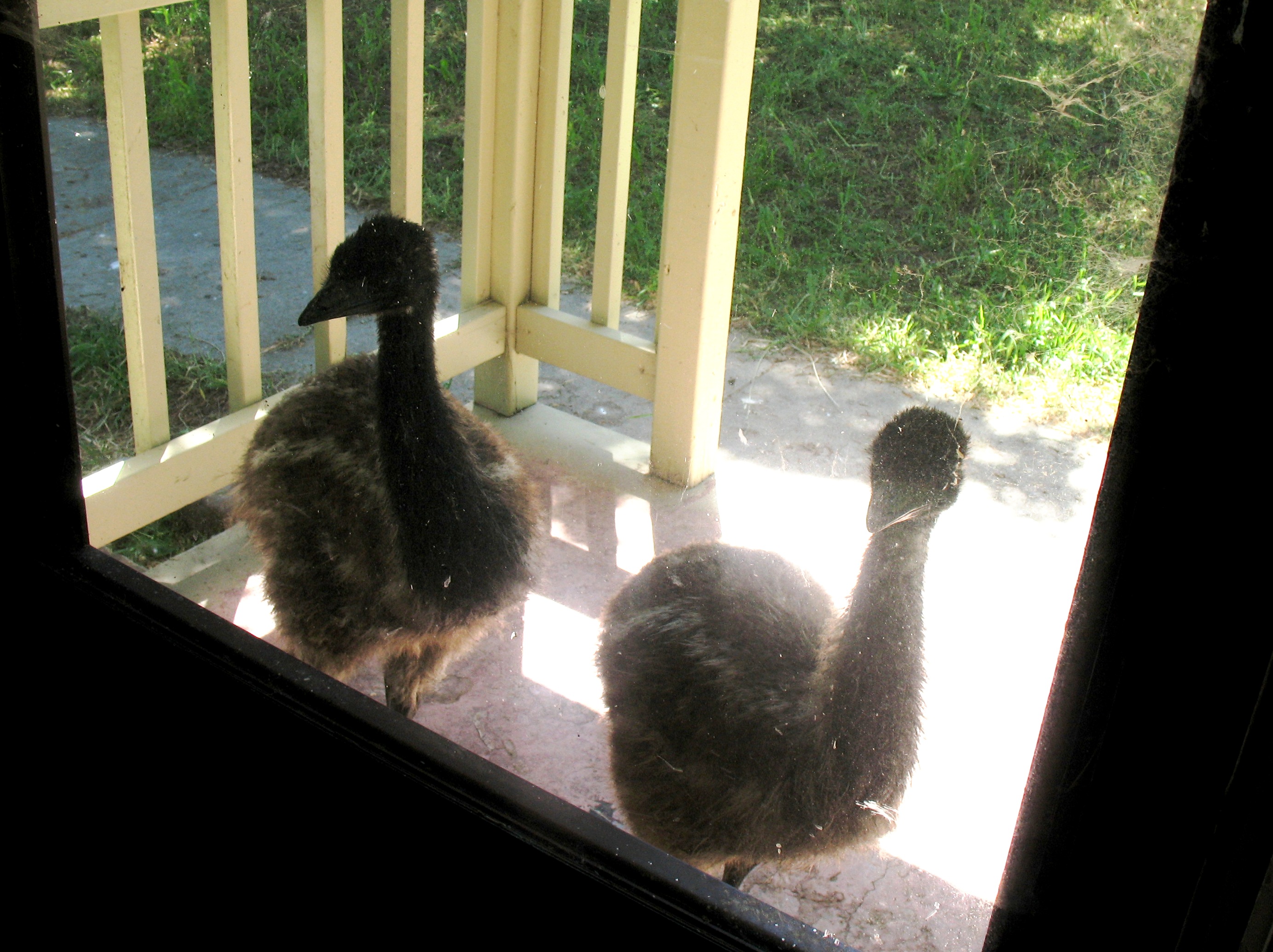
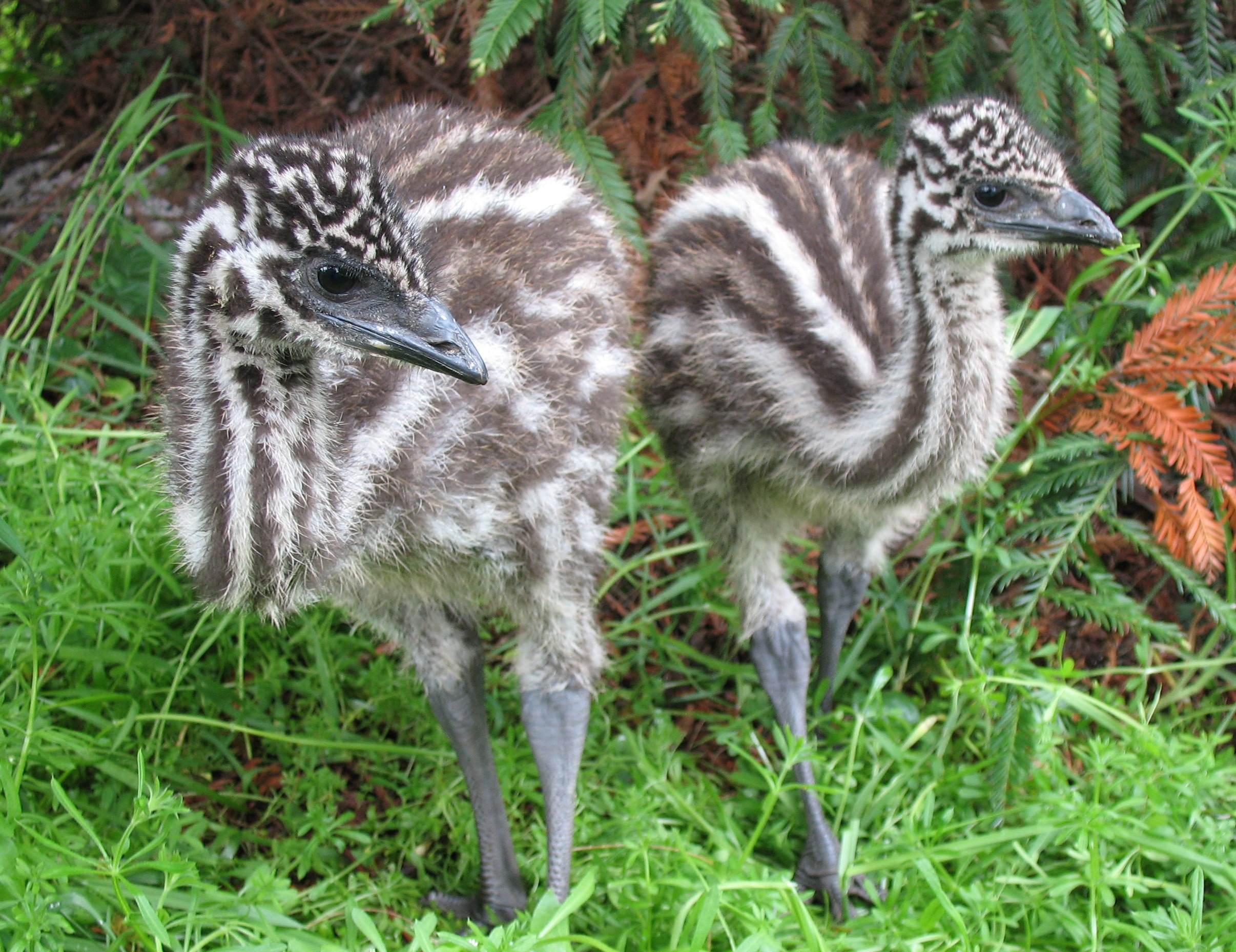
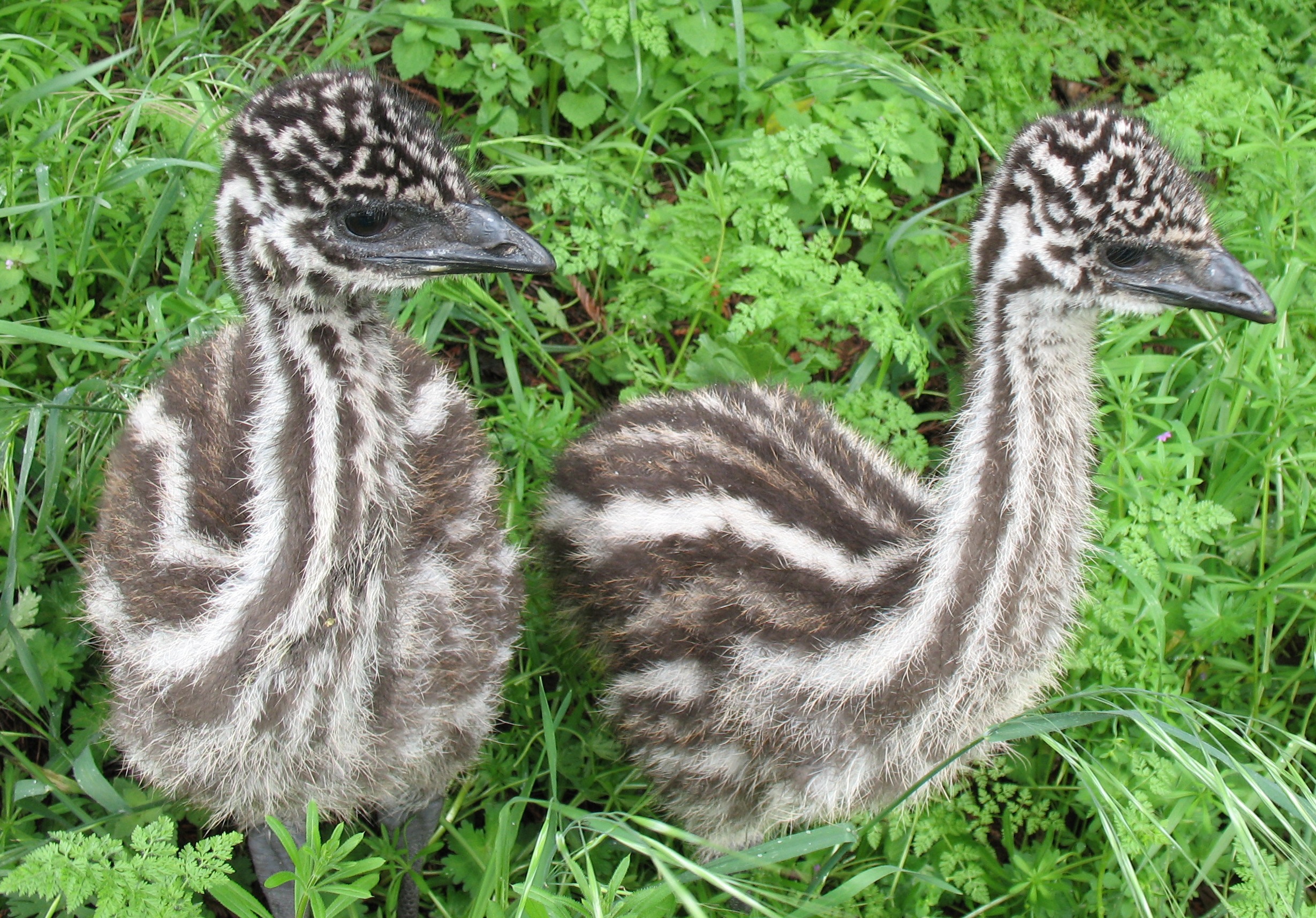
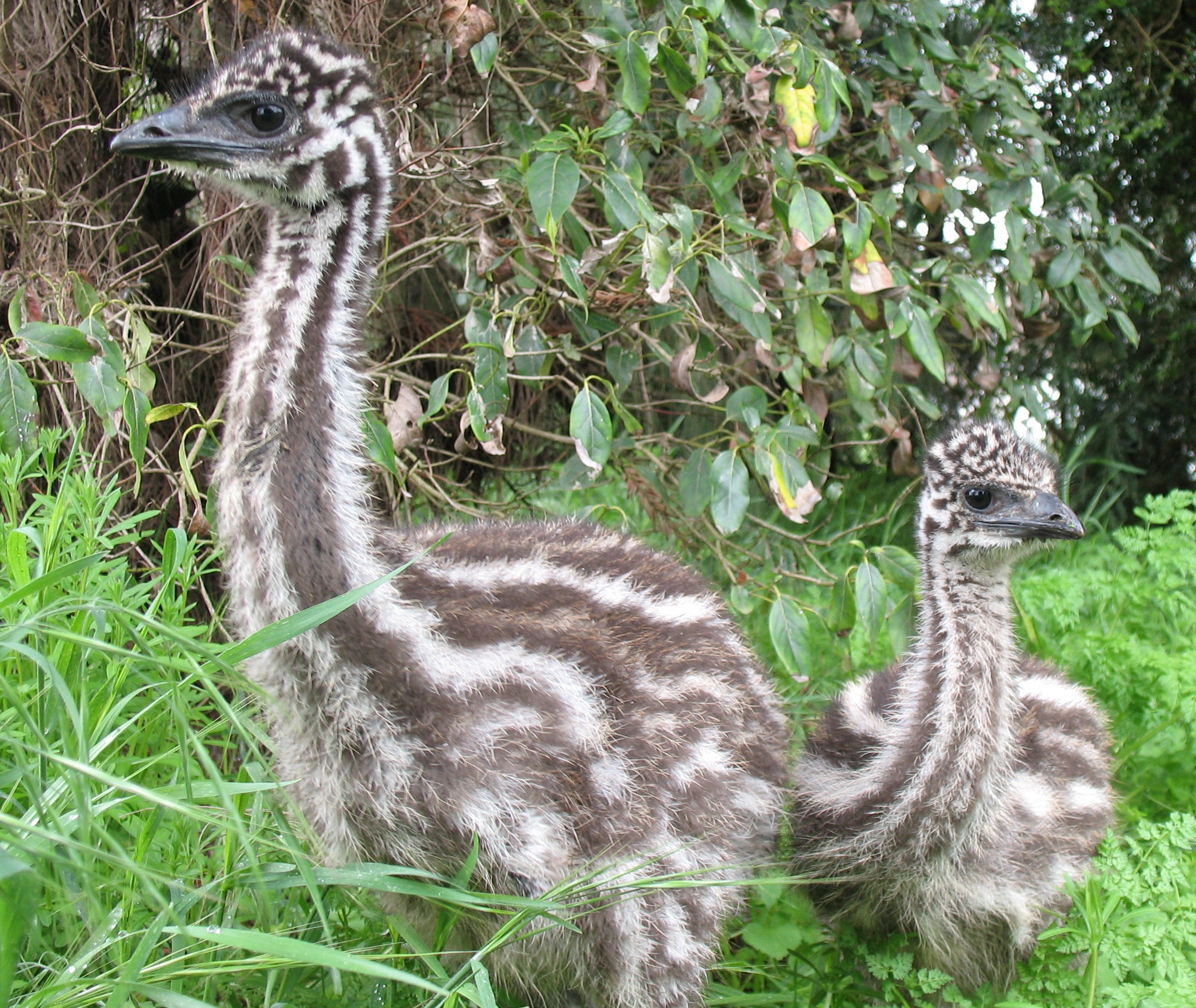
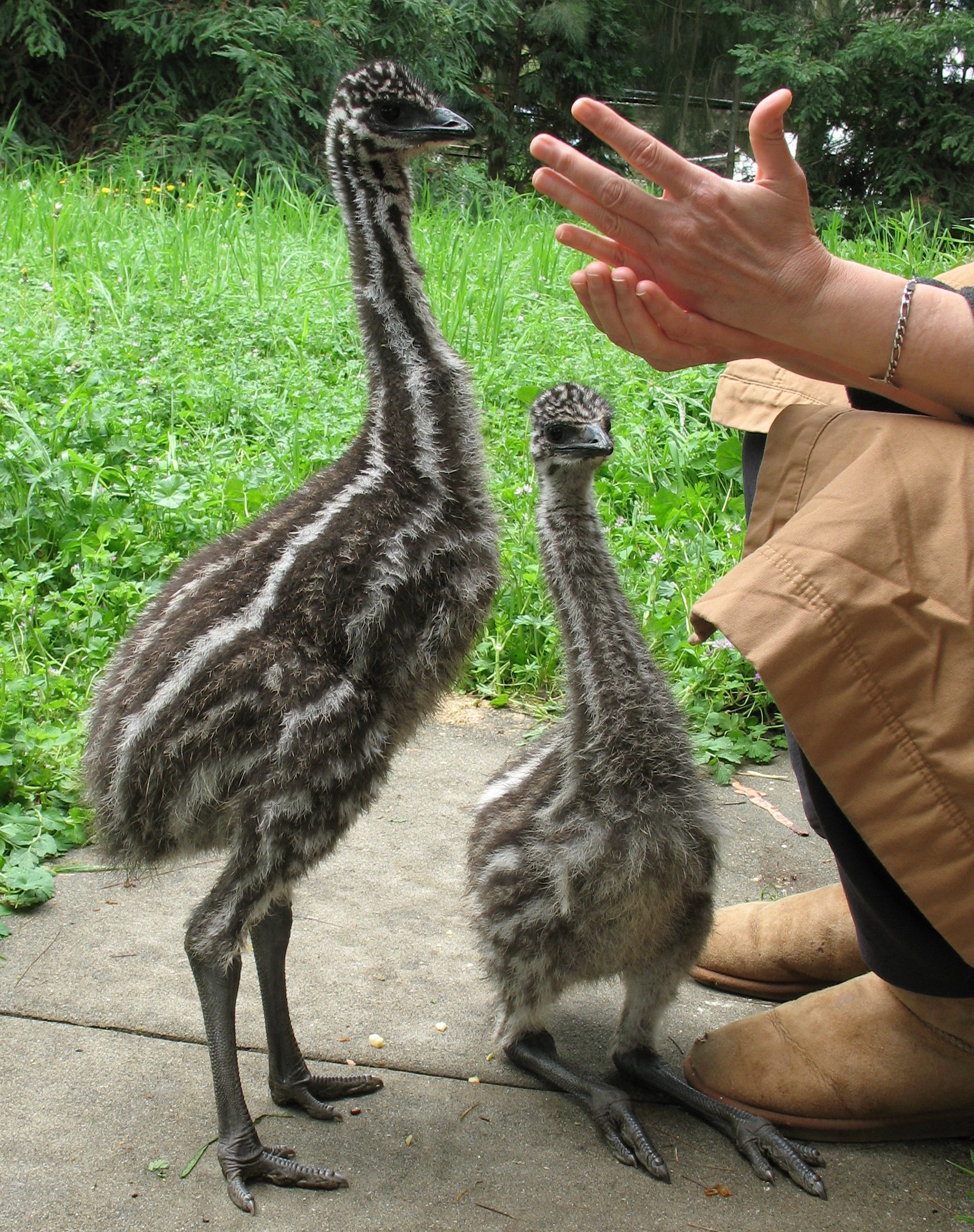
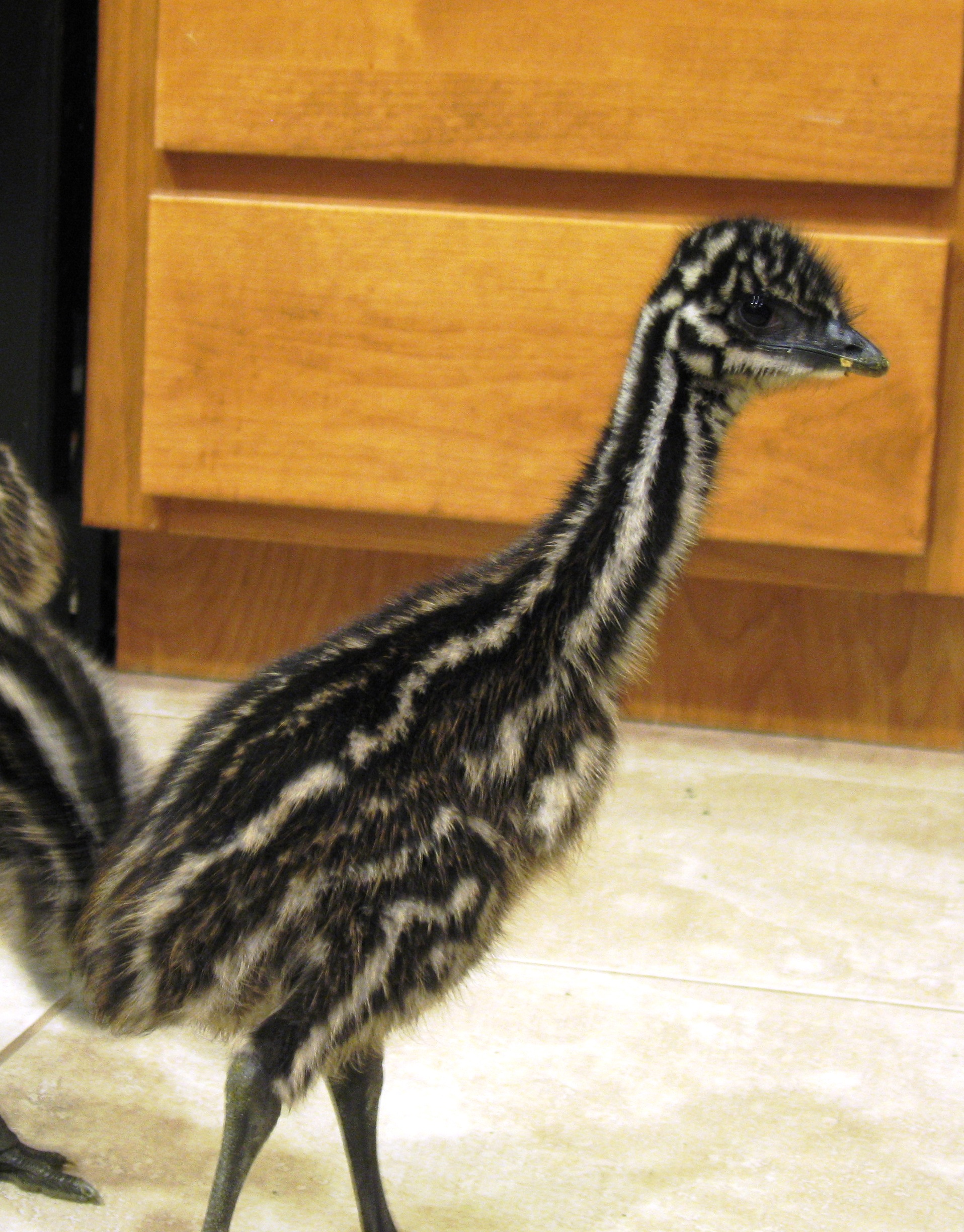
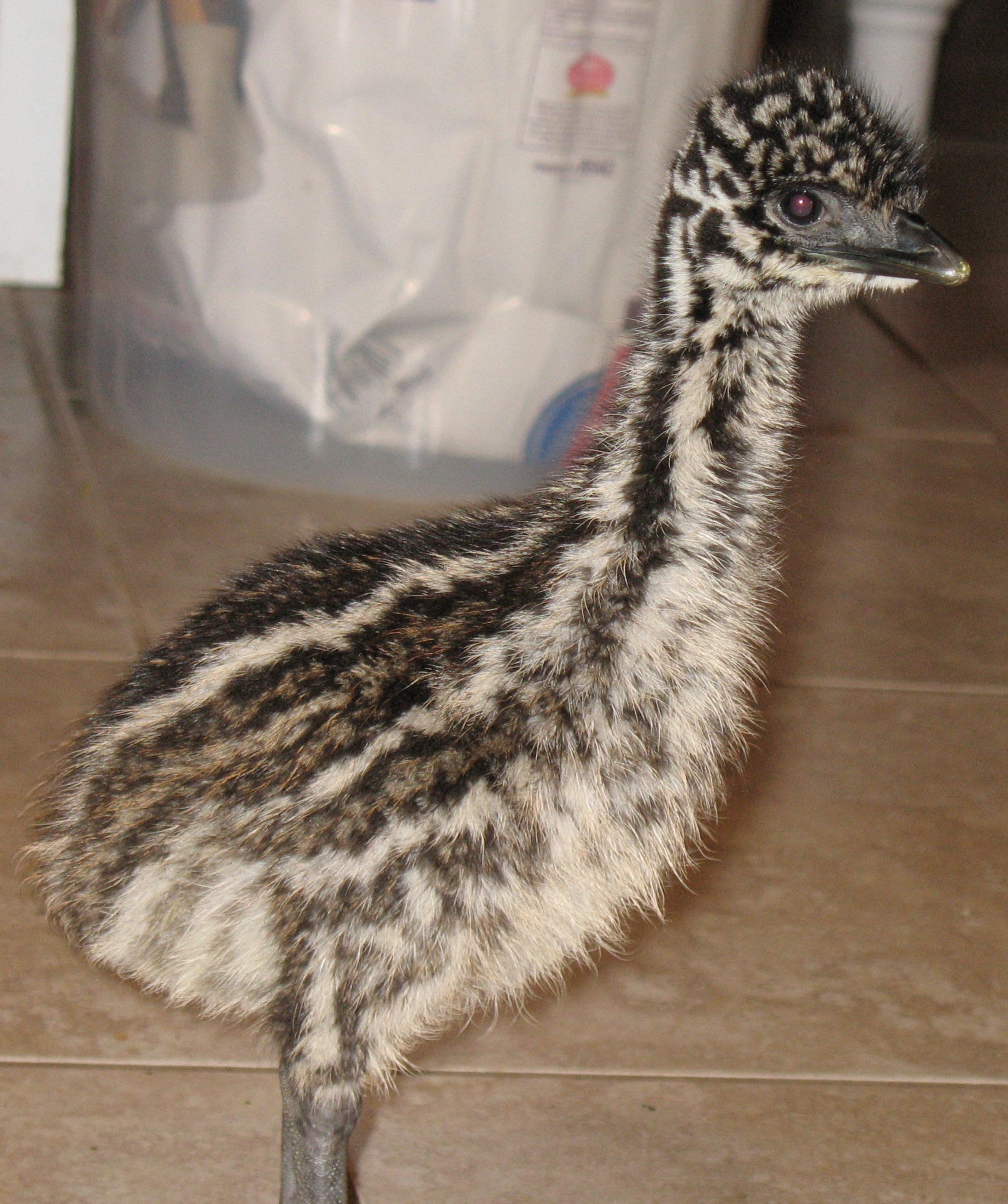
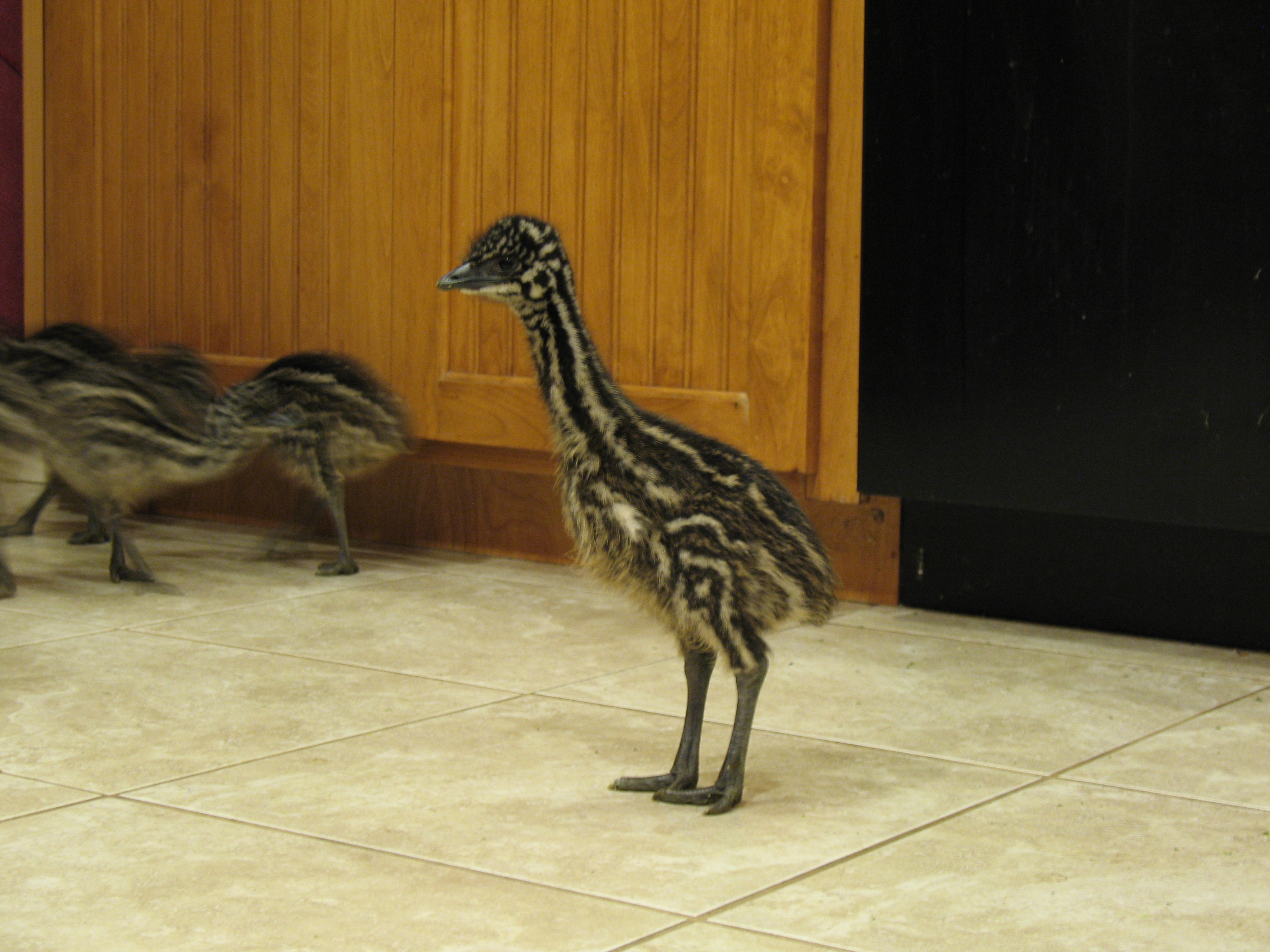
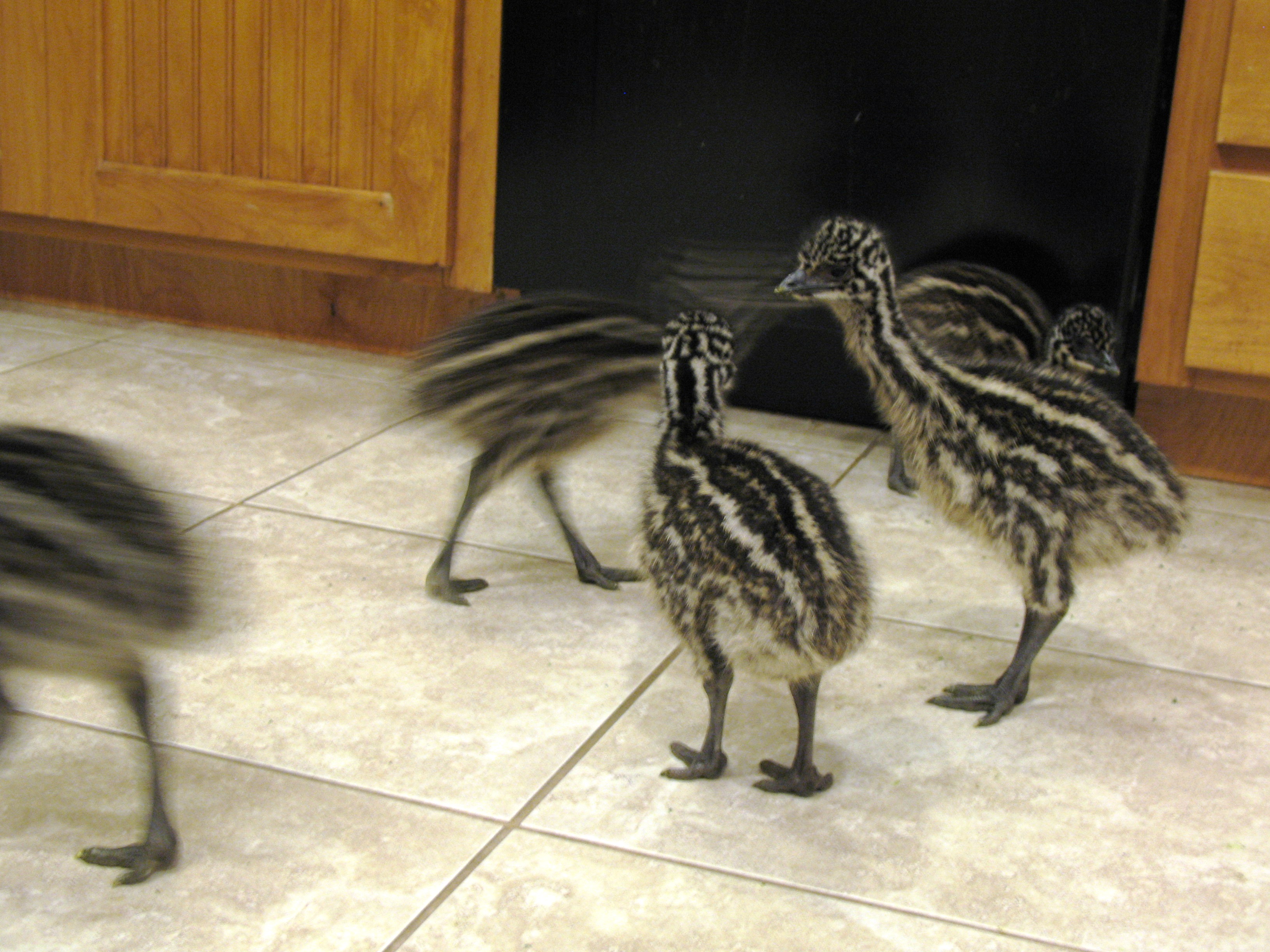
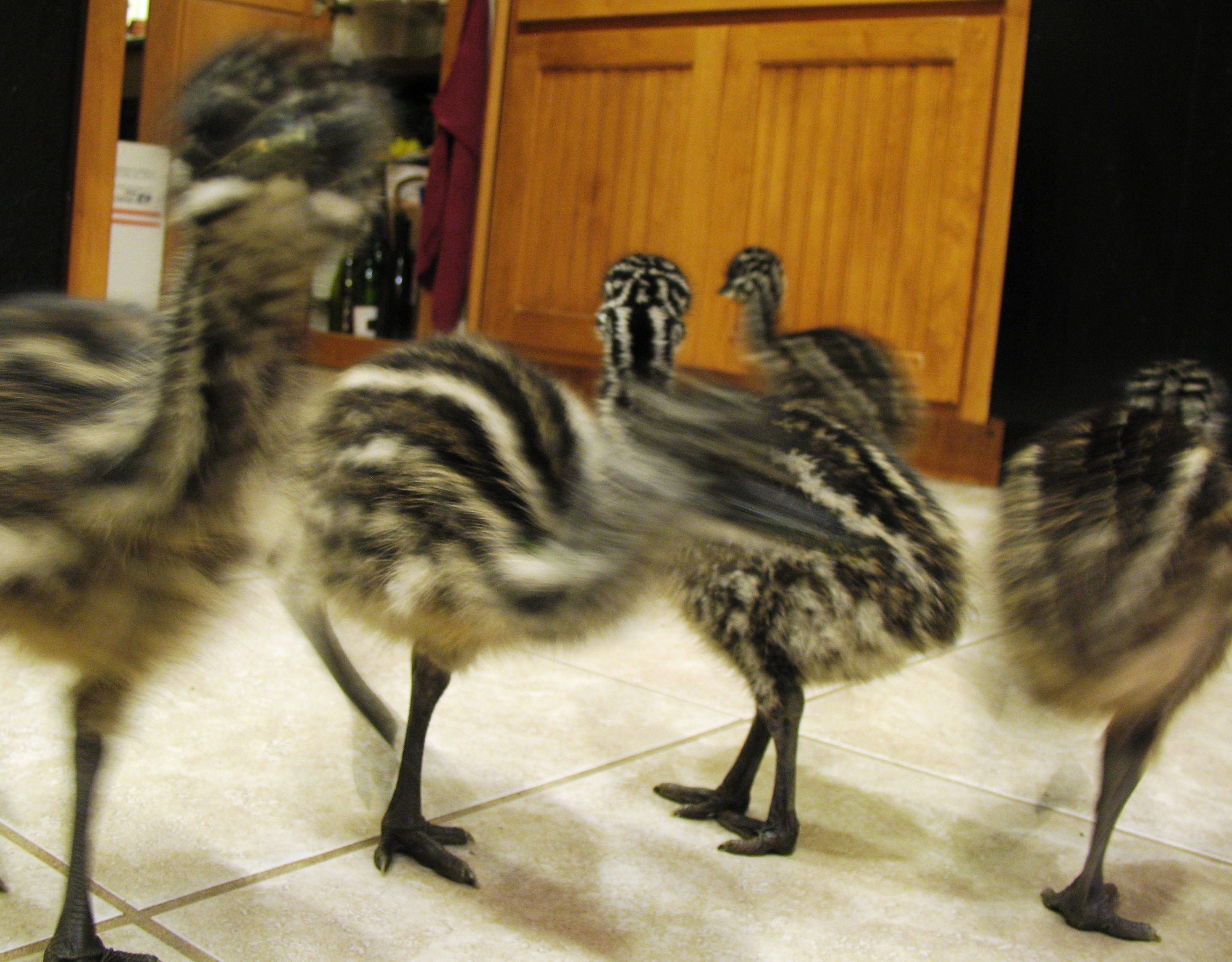
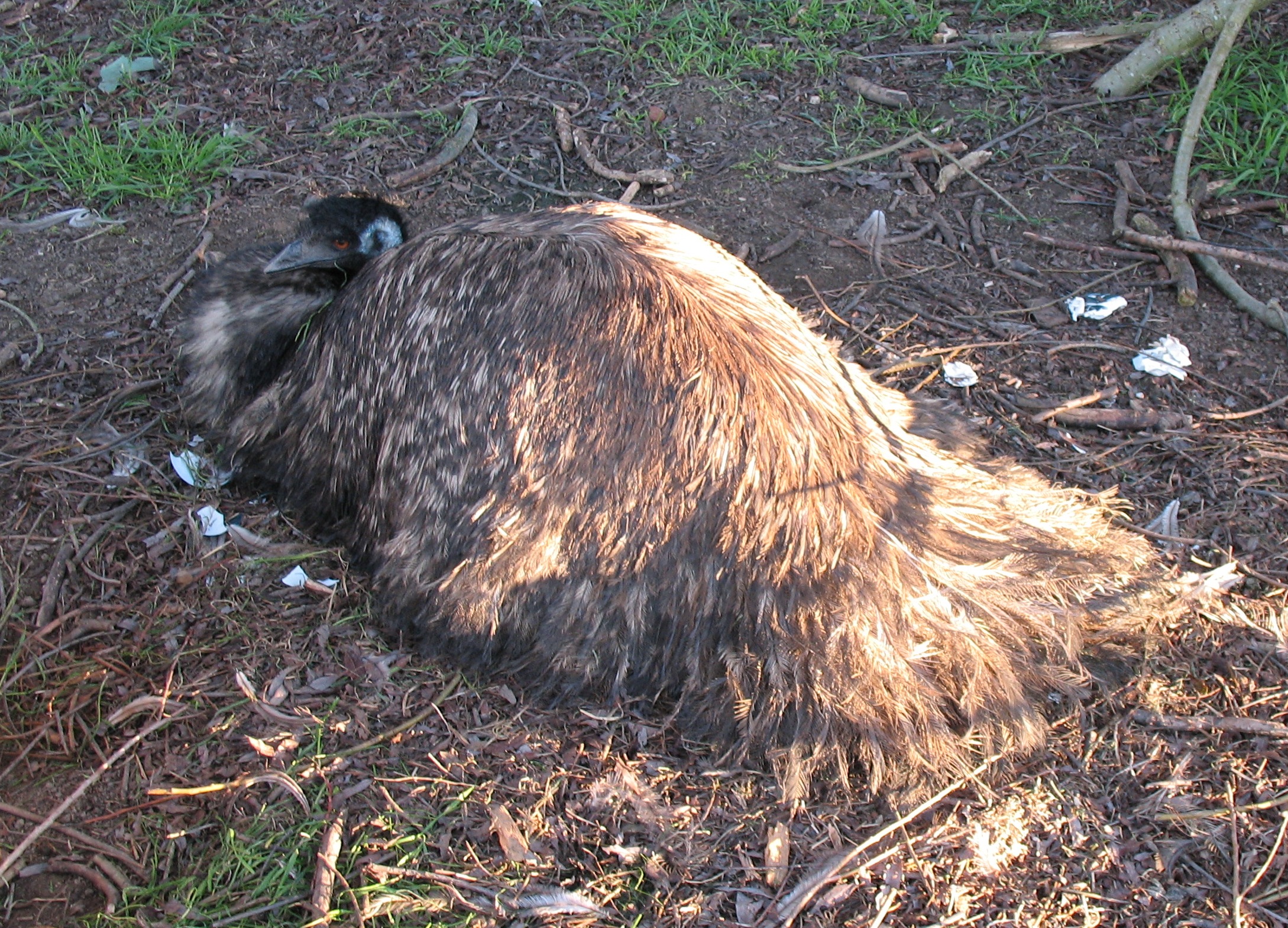
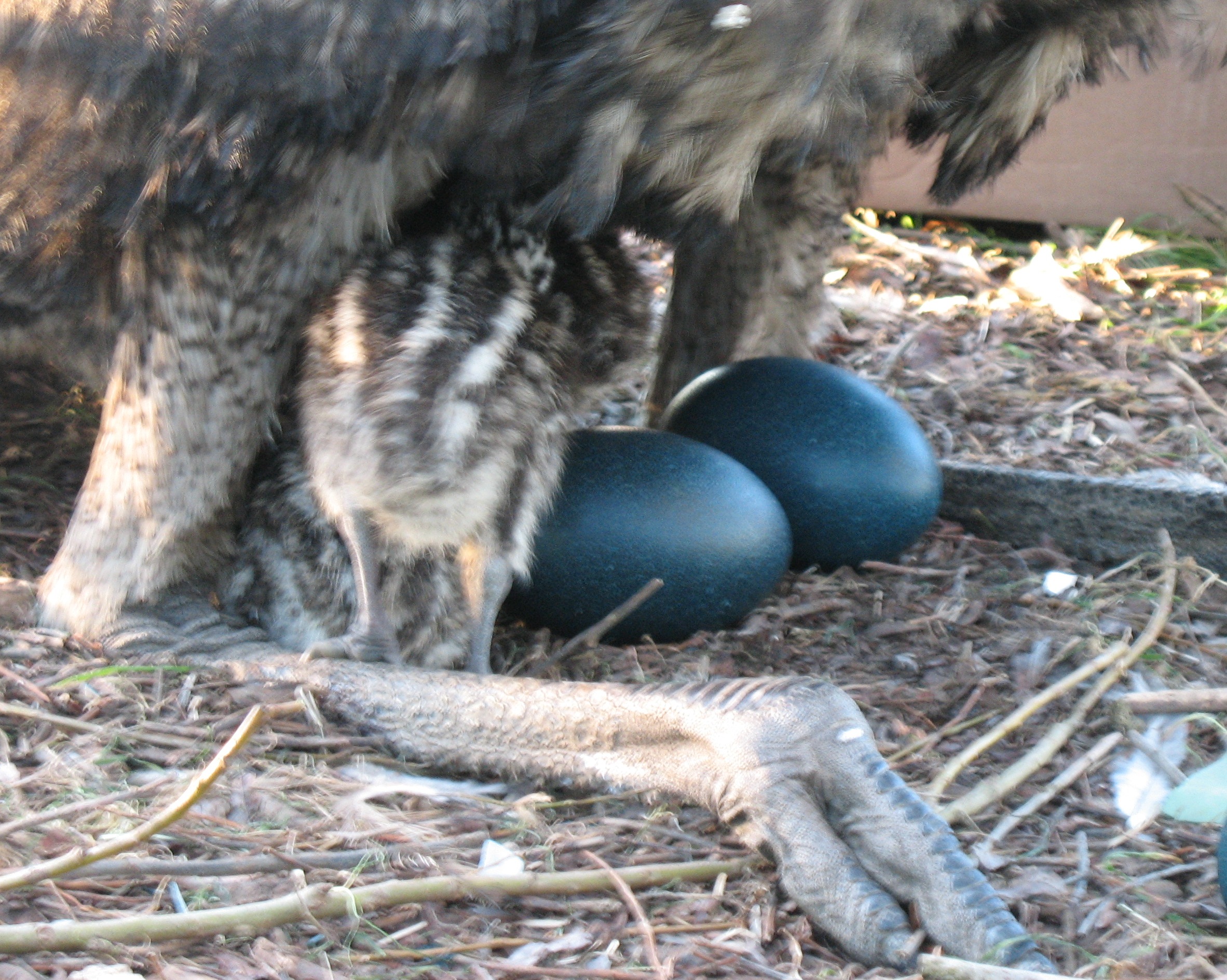
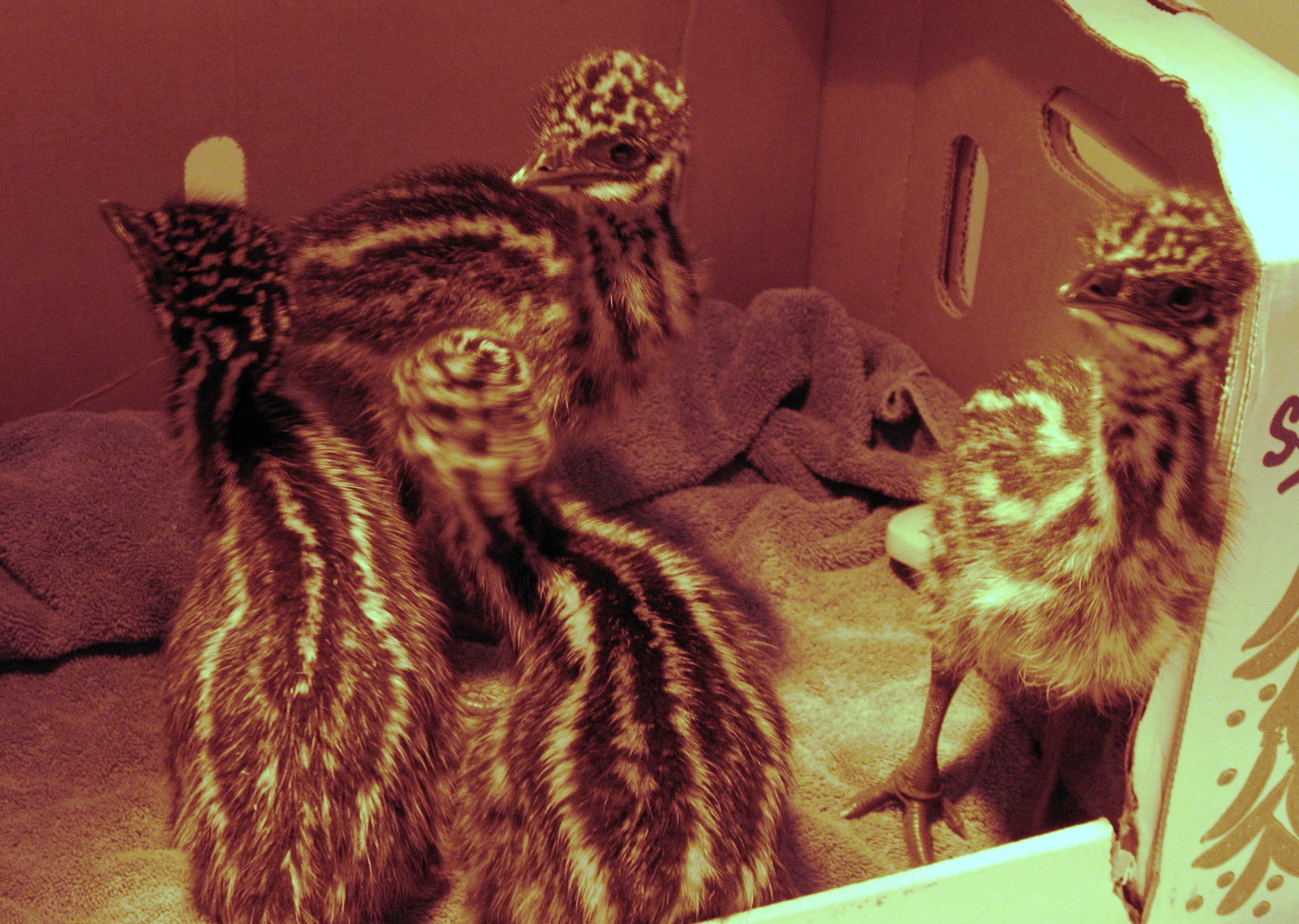
Yes, Emus! Back on the farm, Elmer’s daughter is raising four emu chicks. She wants them to be guards for her organic duck operation. The emus we reared last year are a little skittish around the ducks—and there were some duck injuries when raucous ducks agitated their delicate emu sensibilities. Ducks were stepped on. The solution is emus who have been raised with ducks. So that’s what Deb is doing.

Emus at the Feeder

Emus at the Feeder

Up Close

Up Close

A Quiet Moment in the Pen

A Quiet Moment in the Pen

So, our teen emus, Kelvin and Gatsby, will be stuck with sheep duty. That’s not such a bad gig, more turf, more freedom, better view. Nice work, if you can get it.

Emu Teens. You have to wonder, is botching the job the way out of chores?

Emu Teens. You have to wonder, is botching the job the way out of chores?

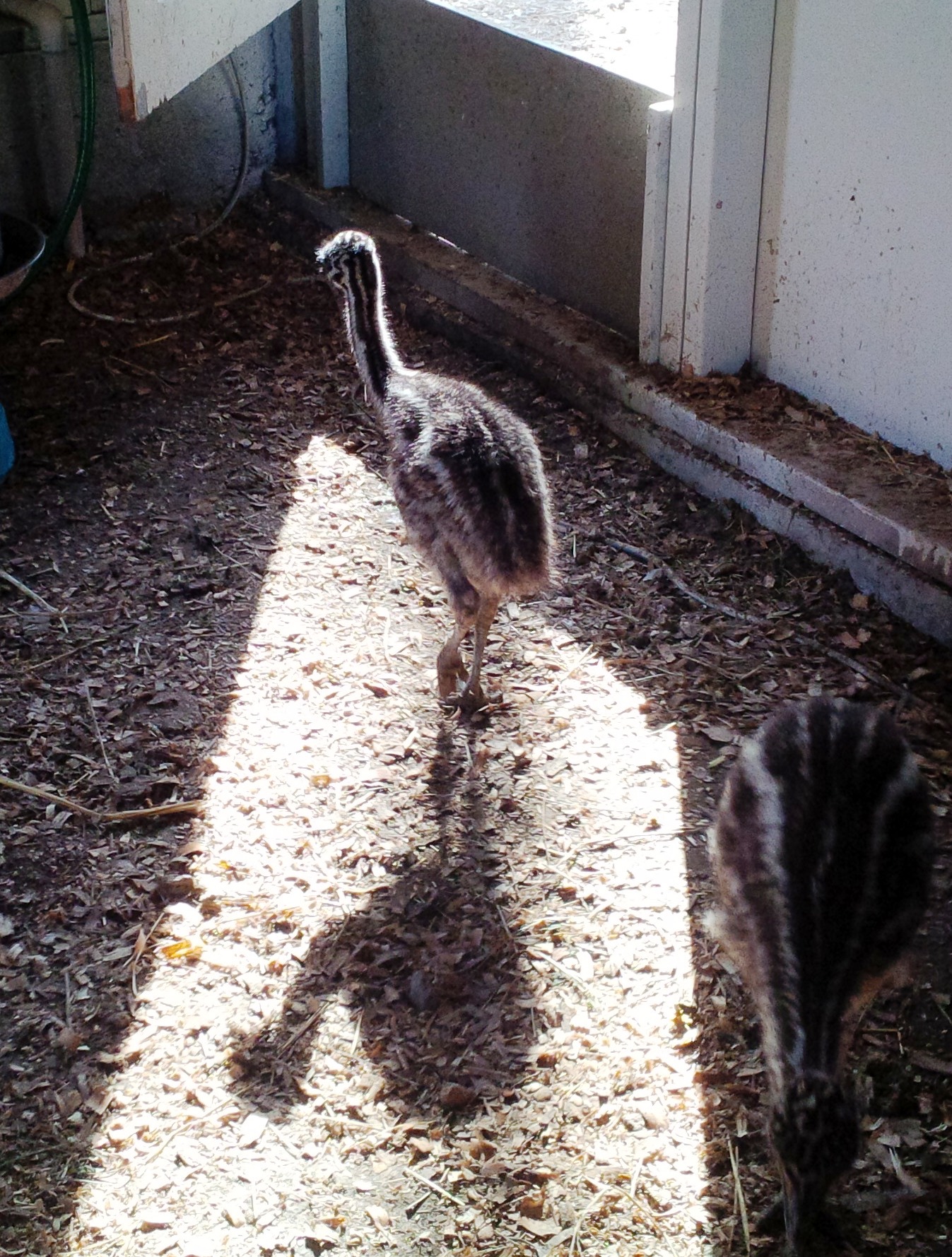
After some early garage and barn living, (Deb is not so crazy, as we were, to keep emus indoors) the new babies are settling in nicely.

Can we come out, yet?

Can we come out, yet?

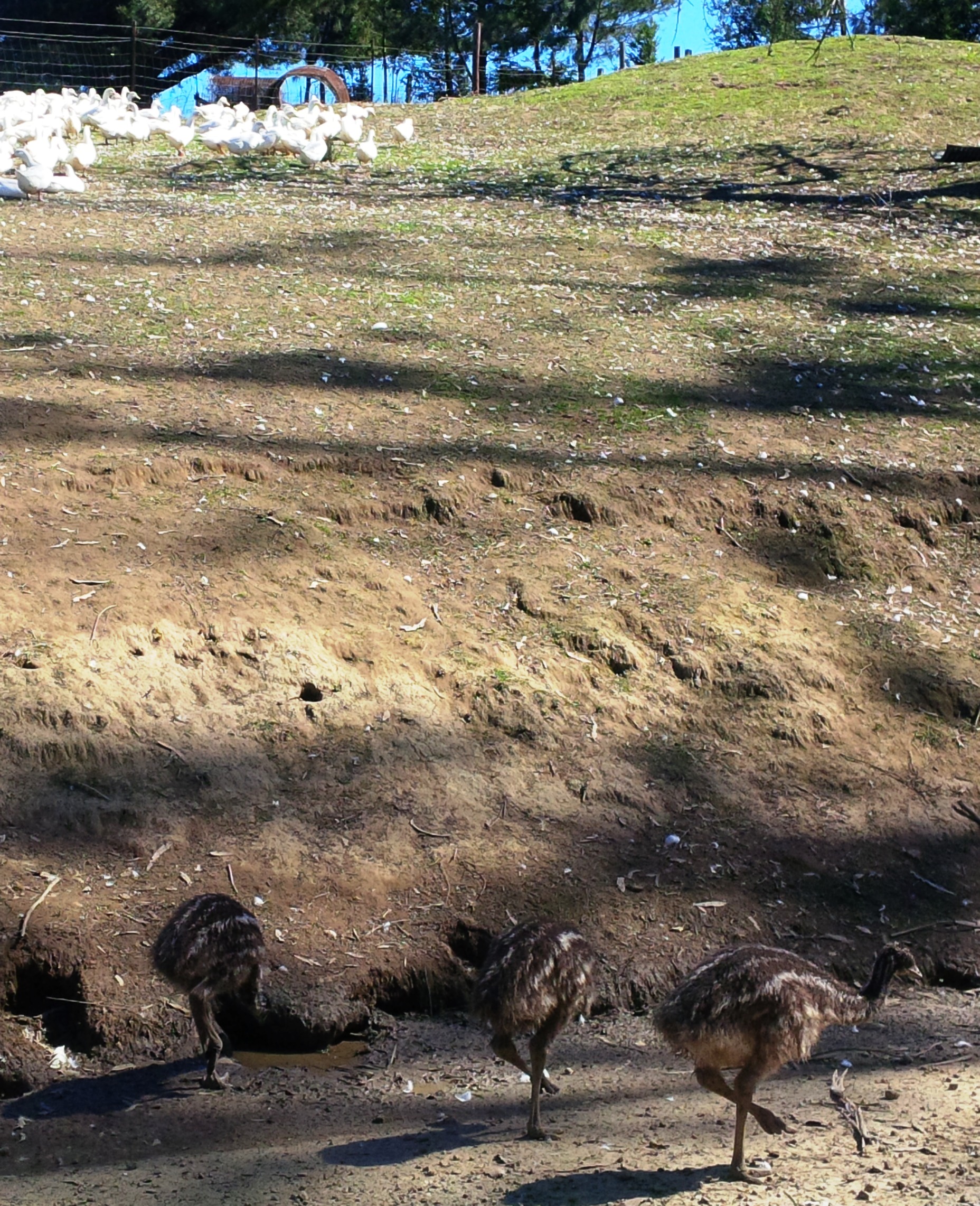
Now, they stay with the ducks. Not that they socialize, but they are comfortable sharing space. Right now the emu babes are about the same size as the ducks. In the future, the emus will shoot up, no doubt surprising the ducks! They’ll serve as their guardians from predators. The teen emus were doing okay at the guardian job; during their tenure the duck losses stopped. Coyotes, foxes, and even hawks were discouraged by the emu presence. However, it wasn’t working because the emus themselves were injuring the ducks. Clumsy emus.

Ducks above, emus below.

Ducks above, emus below.

It’s nice to hear how things are back on the farm. We’re biding our time, waiting for the snow to melt. Then things will get very busy around here.

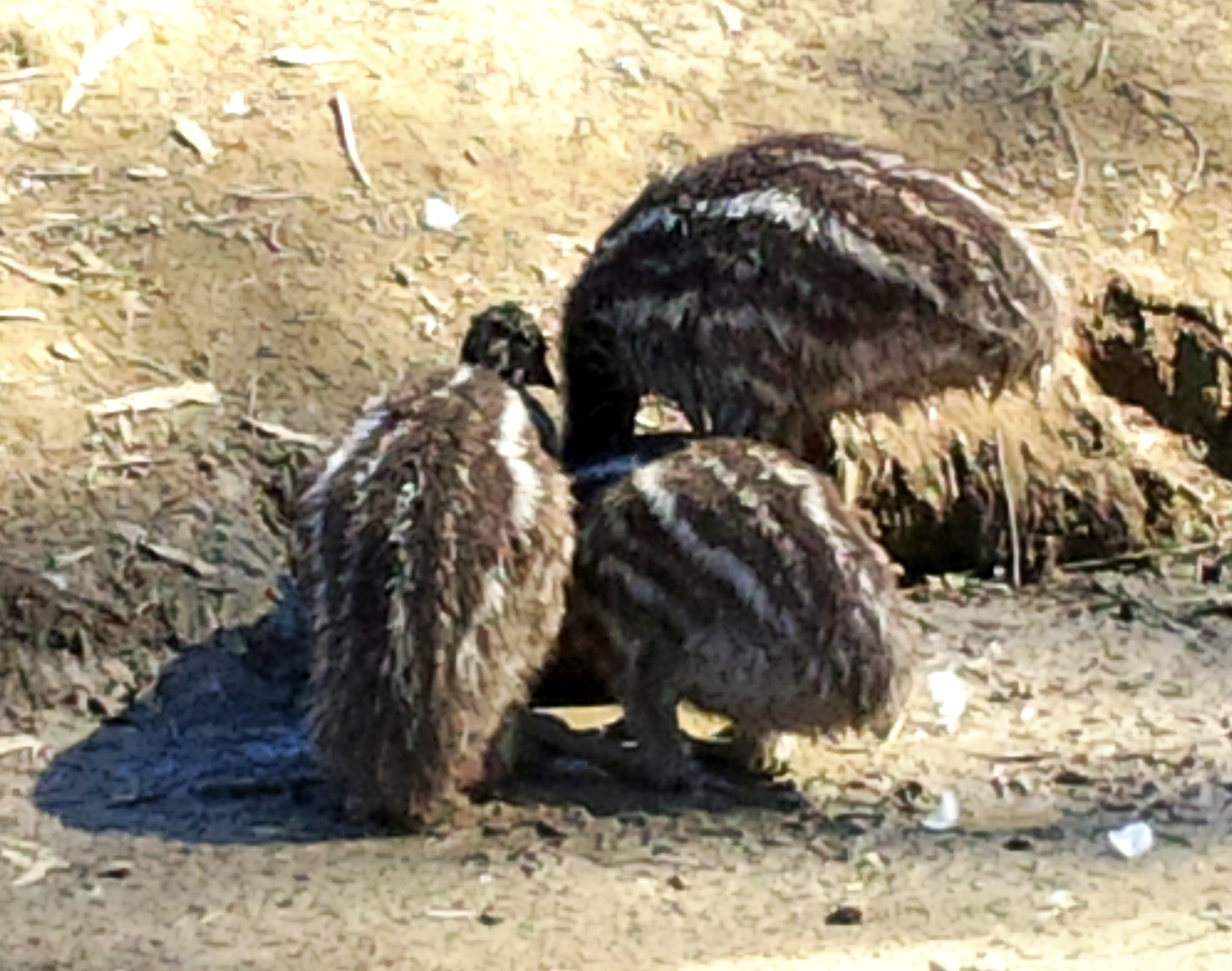
Emu Huddle--For these last pics, I asked Deb where the fourth emu was. Apparently, Number Four was occupied pecking at her red shoes!

Emu Huddle–For these last pics, I asked Deb where the fourth emu was. Apparently, Number Four was occupied pecking at her red shoes!

Pipeline Postscripts

A.V. Walters

mid feb

I lived in California for thirty-five years. Rick lived there all his life. It is in our blood to be water-thrifty. Conservation is a lifestyle issue—not to flush every time, short showers, dozens of little tricks learned over time to save water. That is not the culture in Michigan. Doing dishes, my brother doesn’t think twice of letting the water run, while a conversation or other task takes him away from the sink. Watching, I squirm. Here people have lawns, and they water them, with sprinklers.

With our uber-winter this year, many have had their pipes freeze. There are four communities in Upper Michigan where the entire towns are at risk of freezing pipes. (Our water temperature at the tap is 36 degrees.) In L’Anse, Michigan, the townsfolk are being advised to let their faucets run—constantly, to keep the mains from freezing solid. Some developments were built with plastic supply lines. Plastic won’t conduct electricity. If your plastic lines freeze you’re in trouble. The advice there is to cross your fingers and move out until Spring. (You’re crossing your fingers in hopes that the pipes themselves won’t burst, leaving you with an even worse mess when the thaw comes.) The utility wonks in L’Anse are telling people not to shovel the snow away from over their water lines. (Too late for us, eh?) It’s often a surprise to people from milder climates that a good layer of snow actually insulates from the more extreme cold.

Now that the welders have zapped our lines clear, we’ve been told to leave the tap running, all the time, until Spring. Our water-miser ways may have even contributed to the freeze in the first place. We’re struggling with what feels to Californians like water waste. My natural inclination is to shut off the tap—always. Now we can’t and I’m having trouble with that adjustment. You can hear the water run. You wake up at night, foggy-brained, thinking that you need to get up—someone has left the tap running.

I’m trying to adjust my attitude for the duration. Think of it as a water feature, I tell myself, you know, like a fountain. That’s the ticket. Don’t folks use water sounds for relaxation? I try to reconcile my discomfort with rationalization. After all, this water comes from Lake Michigan. I’m just recycling it—through the house septic, through the sandy soils of Empire and then back to the Lake. In the meantime, as a renter, I’m glad I don’t pay the water bill.


Training Cats

A. V. Walters

Who, me?

Who, me?

I’ve always had well-behaved cats. I train them as kittens. That’s right, trained cats. I’m from a large family where good behavior wasn’t optional. With kittens, I use a squirt gun to enforce the House Rules. It’s about boundaries. Some places are okay for cats and some are verboten.

Bob came to us as an adult stray. He is a genial cat, not bright but friendly. In fact, he is clueless. As a kid, I had a school teacher who, when confronted with less-than-perfect indoor etiquette, would demand, “Where were you raised, in a barn?!” In fact, it was a slur on the agricultural kids—the farmers and the French-Canadians. But I try to remember it as a cautionary guideline, with Bob. After all, he’s a twice-abandoned farm cat. And, as a matter of fact, he was raised in a barn.

When he first arrived on my door-step, Bob had no boundaries. He felt fully entitled to get up on the kitchen counters or the table, and help himself to whatever goodies were there. Well, something had to be done about that! I used a spray bottle and Bob learned. What he learned was that he could not go on the counters if somebody was around! Bob learned to be a sneak. So, we redoubled our efforts. To reduce temptation, we made a concerted effort not to leave anything out. Butter went into a covered dish. The dishes were mostly washed after a meal. Meat scraps went into the freezer (not the garbage) for disposal later. And we watched, like hawks, to catch him in the act. That was the tough part, because, as a sneak, Bob was good at quietly committing his mischief. The only notice we got was the thump of his feet hitting the floor, after his forays. He had a well-practiced innocent look. “Who me?” (Though, there were clear Bob prints on the countertop.)

For the most part, he’s well-trained, now, though there are the occasional lapses. The most egregious of his sins is his propensity to lick the cream-cheese frosting off of the carrot cake. After icing the cake, it needs to sit out for a bit to set up. Bob did it again, last night. Rick came in to a freshly iced, and licked, cake. We’ll need to be more diligent about putting the cake away—or covering it. And, well, it’s back to training… We can’t have cats mixing with cakes.

I’m glad that we’ve had such success with him. Most people think you cannot train a cat.

Dry-Run–

A.V. Walters–

We’re learning. It turns out that this little rental has taught us many valuable things about living with season. We’ve learned that ice dams are common in older homes (and inexcusable in new ones.) We’ve learned that it’s really important that one’s water supply lines be buried deep enough. It’s the coldest, snowiest year in decades; so, it is a good test for us. We’re holding up, and we’re learning.

Oh, we have no water.

Even back in sunny California, there would be cold snaps from time to time and many people would have their pipes freeze up. I remember, when I first moved there, I was aghast that many (especially older) homes ran their pipes on the outside! When I lived in Oakland, our water supply line entered the house on the front—above grade! In the winter, I wrapped that pipe—first with foam pipe insulation, and then with towels and plastic. We never had our pipes freeze. Here, water supply lines are buried deep (hopefully below the frost-line– about 48 inches, around here.) Sometimes, it’s not deep enough.

Did I mention we have no water?

If it’s any comfort, it’s not just us. A couple of other properties in the village have come up dry. There’s a whole triage routine to this, first you root around under the house to see whether the pipes under the house are frozen solid. You check the meter (if it’s running wildly, you have a burst pipe—if it’s not running at all (even with open faucets) you likely have a frozen pipe. This little cottage has heat tape on the pipes. We learned that after the water stopped, when Rick was running his diagnostics. Once you’ve identified that the problem isn’t under you, you need to find out what it is. If it’s in the Village water main—they need to fix it. If it’s in the line between the main and the meter—you need to fix it. This is where it’s good to be renting. The standard solution (after you call the landlord) is to call in a welding company who will essentially use jumper-cables to melt the ice in the line. Not many companies will do this kind of work—they say the liability is too high. Huh? Wow, that’s not the kind of response you want to hear…

So, we’re still waiting for water.

Today is day three. We’re carrying water, by bucket, from the neighbors. We’re starting to look a little scruffy and the dishes are piling up in the sink. The company that still does this kind of work is in high demand right now. Take a number.

And, there’s some small-town humor in it. I went to the Village office to start the “who’s side of the line” investigation. Our friendly clerk took down the information. When I gave my name, she looked up, “Oh, you’re the one that got married last week.” It was a statement, not a question. They run all the vital statistics info in the local paper. I have a distinctive first name.

“Yup, that’s me.” Yup, that’s us. Geezer newlyweds. Later, the village crew came down to investigate the problem. You just know that they’d all been told. Later, a neighbor from down the block dropped by to assure us that we could come get water at his house. Small towns talk. It’s not a bad thing. People in town see the construction cones. They read the paper. They hear that some folks got married, and some are froze-up. It’s about community.

Our future building plans keep adjusting. We are now serious about adequate insulation and ventilation in the roof, in order to fend-off ice dams. And now, you know we will bury our water lines—deep. This little cottage has been our dry-run for winter living. We just didn’t know how dry.


Postscript:

Finally, they came to free up our lines. That freed me up to run to the store for dinner groceries. At the checkout, the clerk (who lives around the corner from us) nodded, “I hear your pipes are froze up.”

I smiled, “Not anymore, the guy’s there now, fixing it.”

“Runs down the driveway, does it?”

“Yeah.”

He nodded knowingly, “You folks keep a tidy driveway, could be part of the problem.”

“What’s that?”

“You know, you could leave some snow in the driveway—for more insulation.”

I howled. “I’ll tell him.”

So it’s a small town. They talk, they notice. They hear about troubles and they have opinions.


Somewhere to Put It–

A.V. Walters–

“No, you have to start a lot wider than that. Over by the trailer is your line.”

I looked at him like he was crazy. “Dad, it’s a driveway, not a runway.”

“Just do it. In February, you’ll thank me.”

It’s still snowing here, and that brings back my father’s voice. When I was a teenager, we moved north to snow country. For my dad, the move took him home to the routines of his youth. We had a steep learning curve to adapt to the Keweenaw snows. He was doing the teaching, and we were doing the shoveling. There are two basic frameworks for how to approach snow control—pick a line of demarcation and stick to it, or clear wide in preparation for a winter of snow. My dad adhered to the old ways, taking a seasonal perspective on snow removal.

We felt silly; at our house we started the season clearing the snow five to ten times the width of the actual driveway. The neighbors scooped their driveway only 10-feet wide. Ours looked like a parking lot. We used the traditional Yooper snow scoop, pushing the day’s snow far from the driveway, into the woods. We thought our Dad was nuts. We scooped and shoveled anytime there were 2, or more, inches of snow. Needless to say, we shoveled—a lot.

By February, it was clear that there was a method to his madness. It snowed and snowed and snowed. And, we shoveled and shoveled and shoveled. Our neighbors were still maintaining their 10-foot driveway, but the accumulated piles on either side were so high that they had to throw the snow up, and over the banks they’d created. Then, they actually had to climb up on top to re-shovel the piles back even further. And, they had no visibility entering or leaving their driveway. Having pushed our early snow way to the sides, we were still shoveling, but we had plenty of space to put the accumulated snow. Our banks were manageable, and our driveway clear. My dad didn’t even say, “I told you so.” He just crossed his arms and nodded.

This week, in the local paper, the headline read, “We’re Number Two, Thankfully.” Snowfall to date, here in Leelanau County, is second in the state only to my old haunts up in Keweenaw County. Nobody with a shovel wants to be Number One. (Ask my mum and my sister, back home.) Many, these days, avoid the whole issue by using snow-blowers (or by scurrying, tail-between-the-legs, to Florida.) We still shovel. Rick does almost all of the heavy lifting here, and he started early season snow removal with a wide open swath of driveway. (How did a California boy know such a thing?) Though we didn’t expect this year’s record snows (and, admittedly, our banks are higher than my Dad would’ve liked) we still have a wide, clear area in our driveway.

It’ll be interesting how our two counties fare over the rest of the winter. Keweenaw’s lake, Superior, is 93 % frozen, considered “frozen over” for all practical purposes. That means that back home they won’t be seeing any more “Lake Effect” snow. Our lake, Michigan, is only just over half frozen, so, we should still be seeing Lake Effect snow, for some time. Who knows, we may yet be Number One!

I help some with the shoveling, and I like it. Nothing brings back my father’s voice like a smug and heavy snowfall in February.

Laundry

A.V. Walters

Today is one of those mundane days when you have to take care of the basics. Little else is more humbling, in modern life, than a trip to the Laundromat. When we first found our little winter safe-haven, it was advertised as having “laundry hookups.” We shrugged; we’d just buy a stackable unit and take it with us when we left.

Then, we made the trip to see our little honeymoon cottage. With just one glance at the laundry closet, we knew there was a problem. First, it was too small to hold conventional American laundry machines. Closer inspection revealed that, sure enough, there were water hook-ups, but there wasn’t a drain line, or venting for a dryer. Clearly, despite the listing language, nobody had ever done laundry in this cottage. When we mentioned this to the landlord, he hemmed and hawed. I can’t blame him; it is a vacation rental, after all. Who wants to pay the utilities so folks can go home with clean laundry? He said it hadn’t come up—vacationers and all. They used the Laundromat here in the village. We signed the papers and moved in, anyway.

It turns out that the local facilities are geared to the summer rental cycle. In English, that means there are no laundry facilities in town during the winter. We Googled it. There are no ‘winter’ Laundromats in the county, at all, except one on the bay-side of the county—about as far as one can get from us—maybe thirty miles. So, we can go to Traverse City, the next county east of us (a mere twenty-two miles), or we can go into the county south of us, a fourteen mile drive. Laundry has turned into a bigger deal than we could have imagined.

Generally, we head south. It’s shorter and the Laundromat there is cleaner, friendlier and fully staffed. There’s a bit of a snow squall out, today, and the run to my favored facility was hairy. I nearly spun out once, that, and the poor visibility had me creeping along at grandpa speeds. When I finally arrived, the attendant met me at the door. Sundays have short hours and I had just missed “last call,” the latest that they’ll permit you to start a load.

I’m stubborn. Having gone to the trouble of loading everything up and heading out into the snow, I wasn’t about to go back home without clean clothes and linens. Especially the linens. You see, most of our things are in storage and we have only one set of sheets. If I gave up for the day, I’d have to haul the dirty clothes back inside, pull out the sheets, make up the bed again with dirty sheets, only to have to strip them again tomorrow on a renewed laundry quest. So, I set off for Traverse City.

Surely, I figured, there must be a shortcut to eliminate the northern dogleg, before heading east. But if there is, I couldn’t find it. Peering through the snow, I took unfamiliar roads that seemed to head in the right direction. Soon, the road I was on got narrower and narrower (and the snow got deeper and deeper) to a dead end. I had to backtrack. After a couple of turns in near white-out conditions, I was lost. So, I headed north, knowing that it would ultimately have to take me to Empire—and then I could head east. Sigh.

Here, in the Traverse City Laundromat, the last dryer load is lofting in grand circles. My quarters are depleted. Soon I can fold, and head home into the snowy night. Like I said, these little household management details will keep you humble.


The Other Side of Winter II

A.V. Walters

Too windy even to bury the car!

Too windy even to bury the car!

It’s blowing and cold out there. It is snowing, but the wind is so strong, that it’s tough to tell what’s new snow, and what’s just being whipped around and redistributed. The usual storm pattern swoops across from the west or northwest. We look out and the snow is horizontal. We’ve noted from the national weather maps that in the center of the county, near where we’ll be living come spring, there’s a pocket of particularly heavy snow accumulation. One look at the winds today tells the story. All the snow from here ends up there. I see a Kubota in our future.

Without appreciable new snowfall (indeed some areas now have less than before) the driveway has drifted over and needs another shoveling. Rick has taken the laboring oar on snow removal. He maintains a beautiful driveway and paths through the yard. He’s learning to sculpt them so that the wind helps keep them clear, though in some places, drift, it will. I’d love to brag about his efforts, but since much of my family lives far north of here (and with really heavy snow) they’d just scoff. My niece reported on her facebook page the other day that she and her children are tobogganing off their roof. We just can’t compete with that.

Still, some things are universal. No matter where you are, everyone complains that, shovel as they may, they just hate it when the plow comes and negates their hours of work, filling in their driveways with road accumulations. Rick bemoans that it isn’t just more snow, plow snow is heavier and crustier. If you let it sit it will turn to a driveway-blocking wall of lumpy ice. It’s not an observation; it’s a conviction.

This past week our local weekly paper did a feature article on ‘the snow plow drivers of Leelanau County.’ It’s appropriate. Those guys (and they seem to be all guys) are doing a hell of a job keeping the roads clear in this record-breaking year. Now, in mid-January, our to-date snow-fall total is 152 inches, which exceeds the usual seasonal total. Only two weeks ago the paper quoted a local meteorologist as saying that we’d hit our 150 and then it would stop. Think again. Anyway, I had to laugh when the veteran snow plow driver stated that his pet peeve was when homeowners would push their snow into his road. (Apparently it makes for a rough ride.)

The Other Side of Winter

A.V. Walters

I get comments, (mostly by email) from friends and family when I post a blog. They’re usually supportive but, occasionally, they’re smart-assed. There was a range of comments on my last post. Apparently everyone wants to know–how are these two transplants doing with winter? It makes me wonder if bets have been placed. One friend thanked me for posting a positive perspective on the season. This is, after all, one of the most intense winters in decades (which is why everyone is so curious as to how Rick and I will handle it. Of course, to us, it’s all new.) My sister set me straight.

I guess my warm and fuzzy “snow dusting” blogs are pissing her off. She lives waaay up north, and they’ve had so much snow, that they’re running out of places to put the stuff. My mom reports that the snow banks are between 10 and 12 feet high. My mom is delighted; but she’s not doing the plowing. For many, they have to get up early to deal with the snow before they go put in a full day at work. For my sister, Kelly, lately that’s been three or four hours of extra work each day, hand shoveling out her entry and the path to her chicken coop. Today she was especially heroic—she snow-shoed over to my mother’s satellite dish, to clear it, so my mom could get reception. (Poor mum, last night she missed Downton Abbey!) Kelly’s husband also puts in several hours each day with the plow—besides their home and store, he keeps a number of other families clear.

Kelly is not alone in her frustration. She runs the town’s general store, so she hears about it from everyone. Over the weekend a colorful, but not particularly volatile local came into the store, stomping the snow from his boots and railing, “I’ve had it. Snow just isn’t fun anymore! I’d suck someone’s cock if the bastard would just blow out my driveway!” He hand-shovels, and has run out of places to put the snow. Now, he’s loading it into a wheelbarrow, then carting it across the highway, where he shovels it again, mostly up over the existing banks and into the woods. He hopes the Road Commission doesn’t notice that some of it strays onto the highway. (You’re not supposed to shovel your snow into the roadway, though the plows feel free to fill your driveway with road snow.) Keweenaw County checked in earlier this week at 167 inches for the season, and that was before the most recent foot, or so. I guess this all helps to keep the northerners fit.

So here I am, singing the praises of the beauty of winter. Add to that, I work from home—I don’t need to shovel out everyday—and Rick has taken up most of that duty, in any event. My family and I talk, everyday. Discussions about the weather are sometimes charged. There’s a fierce one-upsmanship to even the most casual comparisons. My mother called first thing this morning, and demanded to know, “What’s your temperature?!” (“Oh, hi mom. It’s 9.”) “Yeah, well it’s minus 7, here. Visibility is so low, I can’t see the mountain!” Really, it’s much milder here; I can’t compete.

Yesterday, my brother called to warn me about “wind chill.” (We’ve actually had a Wind Chill Warning.) We’re in a cold snap—it’ll put us in the single digits and negatives for the better part of the week. Really, though I’ve been in California for thirty-five years, I didn’t slip into a coma. I do remember wind chill. It seems that everywhere, but here, it is really snowing. My brother (a few hours south of us) has seen 14 inches in the last two days. My mother (well north of us) has seen even more. Us? A dusting, maybe five inches over the past four days, barely enough to shovel every day. Today, we are seeing the beginnings of the “big storm”. We check the radar by keeping an eye on the weather websites.

Critters here are challenged, too. It’s tough when, everyday, you have to dig deeper for your food supply. The last two nights, rabbits have come to clean up what’s left of the birdseed we threw out for our jays, juncos and chickadees. We get squirrels, too, and that makes me nervous. The squirrels can get into the engine compartment of your car. Sometimes they’ll even eat the insulation on the wiring. I mentioned it to Rick, who noticed that the squirrels seemed particularly interested in hanging out under and around his truck. (He went out to check the engine compartment—just to make sure there weren’t any rodent condos going in. Believe me; you don’t want to tangle with squirrel HOAs!)

Inside, (though I don’t think it’s any gotten any colder) the cat has taken to snuggling up all day on the electric baseboard heater. It hasn’t the charm of a good woodstove, that’s for sure. It’s a little pathetic, but we all do what we can.

Our local papers are full of weather reports and snow records, too. Our year-end snow count topped 100 inches. The local Meteorologist promised that the colder temperatures would slow the snow. Also, he points out, if the Lake freezes over, it will lessen the “Lake Effect” snow. If the Lake freezes over? Look at a map. See how big Lake Michigan is? They don’t call it a Great Lake for nothing. When a Great Lake hits 90% ice cover, it’s said to have “frozen over.” (Normal winters usually see a 50% cover.) How often does a freeze over happen? Well, in the last 110 years, only four times (1904, 1976-1978.) His report is otherwise scientifically problematic, saying (and I quote), “Northern Michigan only gets 140 to 150 inches of snow each year. We’ve already had 100 inches, so that leaves January, February and March to get an additional 50 inches.” What? So, if we reach our statistical norm, someone’s going to turn off the snow?

We’re lucky. Nestled next to the lake like this, we get the snow, but not so much of the cold. Inland areas can get bitterly cold. And, we have great winter gear. My oldest sister abandoned the state a couple of years ago, saying she never wanted to be cold again. When we decided to move east, she gave us all her winter gear—coats, hats, scarves and mittens by the bin-full. (We’ve got so much down, we’re up!) We have no excuse for being cold, or for staying in. In fact, as soon as I finish this, Rick and I are headed off for a walk. We thought we’d go take a look and see what the Lake is doing.

Winterizing

(from November 1, 2013)

I haven’t done this since I was in college, renting cheap housing and doing everything I could to make it habitable for the cold months. We didn’t move in time to get building underway, so we’re hanging close so we can get a jump on spring, when it comes. We’re in a “vacation” rental—read “summer.” It’s a very cute, little cottage, in a charming, little village on the shores of Lake Michigan. It’s a beautiful destination location for summer tourists. We’ll see how it fares for a Michigan winter. The landlord says that it’s insulated. We’ll see about that, too. What is clear is that it has single-pane windows.

Some of the windows have storms, that is, storm-windows, and they’ll help. Growing up, I remember the semi-annual ritual—spring and fall—washing the windows and taking down the storms to put up screens, followed six months later with more window-washing and taking down the screens to put up the storms. It marked the seasons and was the 1960’s version of energy efficient.

But these storms leak like sieves and even with them, in the cool evenings, the glass radiates cold and drafts. Closing the curtains helps, but with winter coming, we’re resorting to the old college trick of covering the windows with heat-shrink plastic. In the 1970s, especially after the oil shocks of 1973, everyone started to install dual-pane windows. Even today, upgrading windows and installing weather-stripping is one of your best bets for saving on heating costs.

Like most people, I grew up with single pane windows. They fogged over whenever anyone showered, or when my mother made dinner. I remember waking to elaborate, frosty patterns on the windows—lacy fractal beauties that would melt as soon as the sun hit.

Nostalgia is a wonderful thing. It is not energy efficient, though, and so we’re battening down the hatches for the winter, ahead. Right now, it’s windows and doors first—later we can consider more drastic measures, if needed. If we can figure out the wind patterns, we can build snow-walls to slow drifting over the driveway and front entry. If memory serves, I expect we’ll do a fair measure of shoveling. It’s one way to get fit (and stay warm.) If the weather is brutally cold, we can always try “banking”—piling snow around the house for a wind-break and extra insulation. I remember that being helpful in my college days.

Maybe we’ll need these things… or, maybe I’m just scaring Rick. He was born and raised in the Los Angeles area and this relocation, (even from Northern California) is an exercise in bravery, for him. Bravery or foolhardiness! When they heard his plans, friends all raised their eyebrows, “Michigan? Well… it gets pretty cold there. And, it snows, ya know.”  He’d nod. He’s heard it all. Back in Two Rock, they’re probably still harvesting the tomatoes and squash, that’s if they remember the garden. Here, it’s in the thirties.

Like I said, we shall see. We’ve been here three days.

Update: It’s winter, now. It’s that time of year when instead of reporting the likelihood of snow as a percentage, they report what percentage of the day it will snow. Rick has sealed us up as tight as possible and we bought our first snow shovel. We’re looking for used, cross-country skis and snow-shoes. For the most part, we have great winter gear and we’re trying to use these short days and long nights for creative ventures. There is that long standing, winter temptation though… hibernation.

Hope the wind doesn't blow!

Hope the wind doesn’t blow!

Taking Leave(s)

A.V. Walters–

Six years on the farm cured me of a common American delusion—the need to clean up after nature. In rural living, nature is just too big to consider tidying up after her. Sure, if you make a mess (like after cutting firewood) you could clean it up, you could even mow, if you wanted or needed to. And, weeding in the garden makes good sense. But beyond that, I figure that nature is pretty much on her own.

When we left Two Rock, we gave away the lawnmowers. I don’t think I’m likely to live anywhere where I’ll need one, again. However, at our little, Empire rental, there is the issue of the leaves.

Our neighbors are positively obsessive about lawn care and leaf removal. I acknowledge that if you have a lawn, it’s better for the grass to remove the leaves. However, our garden implements are in storage—deep in storage. I’m not digging way to the back of the unit to find a rake so that I can collect the leaves at a rental. Besides, Empire is very windy. I note that there are often leaves there one day that are gone the next. (Sometimes, even in the direction of our obsessive neighbors.) In the old days, when I lived in the city, I used to enjoy raking leaves. But then there was the problem of what you’d do with them. If the city has a decent recycling program, it makes sense. But it makes no sense to gather them, only to pay to have them put in a landfill somewhere where they’ll never breakdown naturally.

I visited my brother this weekend. He has not raked at all this season. He lives on a tree-covered city lot, in a village with a great many trees. When we arrived, the leaves were deep in his front yard—in some places, a foot deep. Like many suburban folks, he secretly believes that the wind patterns deposit all the nearby leaves in his yard. He supports this theory by the fact that the leaves lay in deep drifts over his lawn, even as his neighbors lawns are relatively leaf free. And, he notes that some of the leaves in his yard are oak leaves, and he has no oak tree. Of course, those same neighbors, whose yards are clear, have been diligently blowing and/or raking those leaves into neat piles and removing them, regularly, for a couple of months. Still, my brother clings tightly to his leaf-conspiracy theory.

He lives in a community, where, if you deliver your leaves to the edge of the street (there are no curbs) the village will regularly send around a big, leaf-sucking rig to spirit away one’s unwanted autumn harvest. These leaves are then composted, so suburban homeowner’s can maintain their tidy lawns and feel positively righteous. If one doesn’t rake and remove, there’s always the possibility that the Village could cite you, or worse. I decided that I could help out by raking his leaves.

Waiting for Pick-Up

Waiting for Pick-Up

It went well at first. It was actually fun, wading shin deep and using my rake (and my body) as a plow. Soon, though, it became clear that I was going to run out of street-edge on which to deposit the autumn harvest. (And he has a corner lot!) The neighbors have tidy, minimalist leaf piles. The more I raked, the crazier my pile got. I began to marshall the leaves to the edge of the yard. A simple pile wasn’t going to do it, more like a line. Then, a wall. As I worked, the wall got taller, and deeper. I wasn’t sure what the rules were—just how thick could my wall get and still be leaf-suckable?

I started getting comments from neighbors as they walked by: “I sure hope you’re getting paid for that!” (I’m not.) “That looks like a lot of work!” (Yup.) “What are you gonna do with all them leaves?” (I dunno.) Some kids came by waving and laughing at the height of my leaf pile. One almost launched herself into it but I caught her eye, and brandished my rake, “You do, and you’ll have to rake it back up!” She giggled and ran off.

By the time I finished, I’d built a veritable fortress with my leaf-wall. It was three to four feet high, and at least as deep, running some 160 feet on two sides. I don’t know if it will work for the leaf-sucker, but I’m not really concerned. I don’t live here.

I was going to bury this car, but my nephew came out and caught me.

I was going to bury this car, but my nephew came out and caught me.

White Poppies

RR Edwards


Regular California Poppies

Regular California Poppies

Regular California Poppies

Regular California Poppies

The obsession started the day I noticed an unusual patch of white-petaled flowers. They were among an irregular sea of bright orange California poppies—the only surviving descendants of a package of mixed, native wild-flowers that I’d sown a few years earlier.  There they were, White California poppies!


White Poppies

White Poppies

I’ve always loved our state flower, whose beacon of orange can be seen everywhere this time of year. In some respects, it grows like a weed—appears randomly, in small isolated patches, or covering whole fields. It spreads at will, thrives in most types of soil and, once the spring rains germinate its seeds, will continue to bloom through the dry months of early summer. But all this outward heartiness belies the sensitive side of this flower. You can look, but you cannot touch! Once established, it doesn’t like being jostled and will wilt and die at the drop-of-a-hat. As the state flower, they’re protected—you’re not allowed to pick them. But anyone who’s ignored, or been unaware of this law, is soon holding a drooping blob of orange and green, and that usually dissuades any future attempts at gathering. Though I’ve always believed this plant to be an annual (dying out completely, after dropping its seeds in the summer), I was surprised that a number of our potted poppy plants survived last winter, and went on to flower this spring. Who Knew?


A More Delicate Poppy

A More Delicate Poppy

I had never seen, or heard of a white California poppy. The only response my casual inquiries drew was, “Really?” Eventually, someone told me that it was a rare, but not unheard of genetic mutation that, over time, reverted back to brilliant orange in successive generations. That’s why you don’t see ever-spreading patches of white poppies. I can’t attest to the accuracy of this premise, but it made sense to me. I guess I could have gone on-line and researched the topic, but it made little difference to what had become my mission — to create a permanent strain of white California poppies.

I assumed that if I wanted to reinforce the mutation, I needed to find it in another, “unrelated” patch of white poppies. And so, during the travels of my daily life, I scanned my surroundings in search of other genetic outcasts. I finally found what I was looking for in an area I’d passed countless times—an embankment along a nearby freeway on-ramp. Now, I had to watch and wait for the white poppy petals to fall away, and the seed pods to ripen and dry. This was the same routine I was going through, in front of my home—anxiously waiting for the seed pods to dry, and collecting them before they burst and scattered their tiny seeds.


The Average Seed Pod

The Average Seed Pod

The average seed pod is about 3” long, about 1/8” in diameter, (though that can vary a lot) and tapers to a point at both ends. Its trick in spreading its seed is not unique, but it is unusual. When the seeds ripen, (they’re the size of large grains of sand) and the pods dry, the pod splits in half as if it were spring-loaded, and flings the seeds as far as several feet. The difficulty in gathering seeds is waiting long enough to be sure the seeds are mature, but picking the pods before they “explode.”


Nearly Mature

Nearly Mature on Scraggly Plants

When this adventure started, several years ago, I was able to collect several hundred seeds from my yard, but only a few dozen from the on-ramp location. (The difference, in part, was simply access.) A problem with the seed I collected was that I couldn’t ensure that all of them came from white-petaled plants. By the time I came up with my grand plan, the seed pods were already developing and had long since lost their petals, so there wasn’t a clear division of plants by color. Unavoidably, some of the seeds I gathered came from orange poppies.

Sprung and Unsprung

Sprung and Unsprung

That was a few years ago and it wasn’t until last year, after moving to Two Rock, that I had a chance to put my plan to work. I placed seeds in 6” pots, separating them into groups of “home” and “on-ramp” poppies. (I wanted to be sure that I could pollinate one group with the other.) When the plants started to bloom, I found that about half of them were white and the others were orange. I pinched off as many of the “undesirable” blooms as I could, and used a Q-tip to transfer pollen from one group of white flowers to the other. By this point I was second-guessing myself about my “scientific protocol” but it was, what it was.

On top of that we had to leave for about 10 days to attend a family memorial back east. I arranged for the neighbor’s son, (who we’d hired to feed the cats in our absence) to pick off the orange blossoms when they appeared. I explained to him the reason for the task, but perhaps it was all a little too esoteric for a 14 year-old boy to appreciate, because upon our return, I was greeted by a speckled patch of orange and white poppies. At this point, the experiment was out of control—the orange and white flowers had engaged in unbridled relations, and there was no telling what the color of their offspring would be. (Not that there’s anything wrong with that! That’s why they call them wildflowers.) I decided to make the best of it, and continued to remove the undesirables. When the pods were ready, I harvested those seeds where I felt confidant of white-petaled-parentage, and allowed the rest to go on about their natural business, spreading their seeds. But I vowed to do better next year.

As I mentioned before, I was surprised that a number of last year’s plants made it through the winter, and they became part of what turned out to be a sizable patch of new poppies that came up this spring. Rather than plant any of the seeds I had gathered from previous seasons, I decided to work with what nature had delivered. What I hadn’t expected, and was pleased to see, was that most of the new flowers were white. And so I began, again, pinching off the orange blossoms and, when possible, removing the entire plant that was producing them.

Bounty

Bounty

Well, the last of the poppies are now drying up. (Due to our unusual weather, it was an early poppy season.) And I’m happy to report that I’ve collected an impressive quantity of seeds—and there’s more to come. Just how many seeds is hard to say. By weight, it’s a little over an ounce and a half. That may not sound like much, but there are thousands of them. But when I started this whole thing a number of years ago, I had no idea how changed my life would be.

So many tiny seeds!

So many tiny seeds!

The love of a wonderful woman and an opportunity to create something special together, are calling me and my white poppies to lands in the east. I’m not sure how I’ll do with snow in the winter and humid summers, and I’m less sure how my fine petaled friends will do. But, I’m optimistic (and that’s saying a lot, for me) and I think these two California transplants will do fine, just fine.


Breaking Just the Rules

A.V. Walters

It was hot today, hotter in town. Sometimes it might just be better to set hard work aside on so hot a day. But we had committed to prune and thin the oak trees at Rick’s house. (Sounds funny, because I think of this as Rick’s house, but I have to remember that he has a house, a family and a former life.) That house is listed for sale right now, so there’s a flurry of sprucing up going on. Rick is doing his part, too.

That yard is graced with elegant mature oak trees—a lovely canopy against the heat of the summer sun. It hasn’t been pruned in years, so the understory has a lot of dead branches. It makes the yard look a little like a haunted forest, so it really did need some help. We arrived, ladder, chainsaw, Japanese pruning saw and loppers, ready to bring shape, air and light back to these gracious oaks.

I’ve been an avid tree pruner for years and I grew up heating with wood, so chainsaw protocol is in my blood. There isn’t anyone in my family who isn’t comfortable with the working end of a splitting maul or a chainsaw. Rick is newer to the lumberjack world, but he’s a professional handy guy, a bricoleur by trade. So he’s no stranger to tools and safety. I don’t know how things all went so wrong, so quickly. But, we broke all the rules.

First, there’s ladder safety. The area where we were working was sloped. We started out right, I was spotting Rick, holding the ladder when he was working on high. Later, perhaps eager to finish on such a hot day, we split up. I started on the ladder, but climbed up into the tree and was limbing from above, using the pruning saw. Rick took the ladder, and was working, not far from me, using a chainsaw. He was watching me, because I have a reputation for being clumsy. He wasn’t crazy about me climbing around in that tree. But it was going well. In no time, our work area, the driveway beneath the trees, was littered with branches.

Maybe because I’m female, and never as strong as the guys, I’ve always felt pressed to do the same work—but my way. Instead of lobbing off a big branch, I make a series of small cuts. It takes me longer, but it’s safer. I’m always careful to first make scoring cuts so that a severed limb can’t swing uncontrolled on a bark tag. I always work well ‘inboard’ from my cuts. A big branch can swing – and especially if you’re on a ladder—it can be dangerous. Years ago, I did a short stint as a park ranger—the guys all laughed at my ponderous progress.

Though Rick takes bigger ‘bites” (lobs off more at one whack) than me, I’ve always observed him taking all due care. He’s usually better than me—ear-plugs for power equipment—gloves—I could learn from him.

So, maybe it was the heat.

There I was, in my perch in the tree. I looked over to ask Rick if he could spare the loppers. He was at the top of the ladder, just finishing a cut when the long, severed end of the branch twisted as it fell. I called out to warn him, but, with the earplugs and the chainsaw, he couldn’t hear me. The wider, spreading end of the branch swung slowly, towards the base of the ladder. I held my breath, but my worst expectation bore out as the branches swept the feet of the ladder sideways, and my Rick was in the air with the chainsaw. It was in slow motion, and if I close my eyes, I can still see it. He pushed the chainsaw away as he curled for the fall. It would have been a “good” fall, too if the ladder wasn’t on its side on the ground below him. He hit directly across the ladder’s legs, on one end of him, the back of his head cracked against the aluminum frame, bending it. In the next second, the backs of his legs hit, angled across the other side of the frame.

There was Rick, sprawled over the mangled ladder and I was stuck in the tree. I called out to him, but still he couldn’t hear me. I screamed for help. Rick couldn’t hear that, either. In that moment I realized how fundamental he has become to me, to my view of life, as we know it. It’s all about not giving up, and second chances.

Every male in my family has had some kind of accident having to do with chainsaws, or wood splitting or cutting. All have survived—though in a couple of cases, it was close. Mostly we learn from them—thankful that travesty didn’t turn to tragedy. Rick has just joined that “prestigious” club

I was getting ready to jump down, (Rick, now hogging the ladder with his body) when one of the house’s co-owners ran out to the driveway to see about the screaming. Rick was getting up and brushing himself off—looking dazed. He removed the earplugs and ordered her to stop right where she was—his glasses were missing and he didn’t want anyone to step on them. I knew he must be okay.

He’s pretty banged up—but it’s a miracle that he didn’t split his head open (or didn’t break something!) That’ll be the joke in the future—hard-headed. We actually stuck around and finished the job. I think I’m more rattled by the whole thing than him—but then, I saw it. We’ve both learned, and clearly, safety has just become more important. (I think my family needs to find a better initiation than chainsaws.)

And, maybe it was just the heat, but I’m feeling lucky.

Not By The Hair of My Chinny-Chin-Chin

A.V. Walters

Today the goats got out. I don’t know how. I was on the back porch, talking on the phone to my mother, and looked up to see two goats staring at me. “Rick!” We rounded them up and brought them back to one of the old sheep barns where they’ve been staying, ever since one of Elmer’s tenants abandoned them. They herded pretty well over, but balked at going back in through the gate. One of them appears friendly, the other a little stand-offish. We were taking note of their demeanor, because these are the goats that have been recommended to us for our front-yard-emu-training efforts. These goats are full grown, but little.

There have been some strange goings on, of late, with gates and locks—and this goat fiasco fit right in. The gate was wide open. The gate peg had been laid neatly on top of the fence post, indicating that the goat escape was no accident. We need to get to the bottom of this, since there’ve been mysterious issues with our gate, and we don’t want the emus out on the road.

Getting the goats into their pen was a bit of a feat; once we got to the gate, they took one look and weren’t so interested in cooperating anymore. We had to trick them, with carrots as bait. (It turned out not the best goat treat. Who knew?) Once inside the pen I came to the conclusion that maybe these goats had been abandoned for a reason. Indeed, that was when “friendly” suddenly wasn’t. The more it became clear to them that they were being returned to the pen, the more aggressive she got.

Friendly Might Just Be Aggressive

Friendly Might Just Be Aggressive

She originally liked being patted on the face, but when confronted with a return to captivity, she started pawing and then butting. She’s only knee high, but a butting goat is no joke. You don’t dare turn your back on it. (Rick had noted the same behavior when he’d passed by their pen, about a week earlier.) Taking no chances, I decided to climb the fence to make my escape. Her shyer companion isn’t as friendly, but isn’t a butting problem either—she follows her more aggressive friend, but keeps her distance.

Shy Is Looking Good

Shy Is Looking Good

Finally we got them re-situated. It was a lesson learned. (No, not “Don’t look a gift goat in the mouth.”) We now know that we don’t want these goats in our yard. It’s enough that we have to watch out for emus and chickens (but not having to go down to the hen house for eggs, is a plus.) I really don’t want to have to defend myself from aggressive goats. The great goat escape was a minor annoyance but it’s one that will save us grief in the future. So, the verdict is in, No goats.

Voters and Chickens:

Rights (or the lack of) and Repercussions

A.V. Walters

The Chickens have the floor…

Our emus may have to adjust to a different future that I’d imagined for them. It all goes back to a wacky election in 2008.

You see, in that year, animal rights activists put a referendum on the California ballot that would forever change the way chickens are kept on farms in our state. The measure was poorly defined, and the drafters were a million miles from anything in the world of chickens or eggs or economic realities. Still, the objective was to decrease the level of “cruelty” in livestock agriculture. Who could be against that? With some measure of bitterness, I note that that same election cycle produced another measure that stripped marriage rights from gay and lesbian couples in our state. Here we are, over four years later and to date we haven’t sorted out either one of these issues. Chickens given rights, people losing rights! Only in America!!

On the same-sex marriage issue, we are leaping into the future. In part because of the unfairness in the Proposition 8 law, the public dialogue has changed radically. One by one, states are stepping up (as well as the international community) to ratify human rights, ending discrimination in our antiquated, marriage laws. Sadly, in California the situation remains unsettled because actual law moves more slowly than public opinion (and that may be a good thing, sometimes.) This deplorable referendum has worked its way up through the appellate courts and into the highest court in the land. I can’t say the chicken situation is working out so well, either.

Everyone would love to know that the chickens (or eggs) they eat come from some warm and fuzzy, loving farm-home. Modern farming, especially livestock, isn’t warm and fuzzy. Large scale farming is even less so. Since the Chicken Rights referendum wasn’t specific about how chickens should be kept, litigation immediately ensued. (How ironic, a “what came first” thing—the rules or the legislation.) So, farmers waited for instructions. While we’re moving towards an ascertainable standard, the deadline for compliance looms, and many of the older farmers are just closing up shop. What is clear is that the chickens need more “personal space” and elevated wire cages may soon be a thing of the past.

Elmer’s been watching the issue since that election. He’s attended the poultry conferences and seen the new, demonstration equipment. He’s lived on a chicken farm for his entire life and has watched poultry and egg production methods come and go. “Cage free is the future,” he says, “And that’s what we had when I was a kid!” He shakes his head.

“When the cages came in, it was supposed to be the wave of the future. The elevated, wire cages solved a lot of the problems—the waste dropped through the cage for easy removal, the feed was delivered to the troughs along the cage and the eggs rolled forward on the wire chute for easy gathering. Since the chickens weren’t standing in their feces, a lot of the diseases we dealt with, in the past, just disappeared. It was clean and modern.”

The downside to the economy of scale was, well, the scale of it. The press for more production led to overcrowding, and some kinds of wire cages were harmful to the chickens’ feet. Now the consensus is that chickens should be back on the floor, they should be cage-free and should have material (greens, straw or shavings) for “scratch.”

The new law won’t solve the issues of scale and size, and disease becomes a bigger concern. Given the new (and still unclear) restrictions, and the high costs of labor, the commercial solutions offered are high tech and expensive. Nobody wants to see egg costs go to $6.00 a dozen—which we sometimes see here from organic “boutique” farms. The operations challenges remain the same, waste removal and disposal, food delivery and egg collection. The industry is pimping gorgeous equipment—rolling (conveyor) floor beds, automatic feed dispensers and egg collection, all the bells and whistles. And the cost for an operation the size of Elmer’s? Try a cool, half-million dollars. It’s so high, that the only way to make it work is to seriously expand production. So this law, while well-meaning, will drive small producers out of business, and create even bigger factory farms. Good news for chickens?

Elmer is experimenting. He could retire if he wanted but instead, he’s going back to “chickens on the floor.” He’s cutting and bailing his own hay and straw for scratch and bedding materials. He’s resurrected old brooder boxes from over sixty years ago (farmers never throw anything out.) He’s modifying his manure collection system, using bedding materials for absorption, and thus minimizing the frequency of full removal (as relocating the chickens for cleanup is stressful to the chickens.) In short, he’s going back to the kind of farming they practiced when he was a boy. He’s mindful that he’ll need to keep an eye out for any increase in disease and, even at this experimental stage, he’s seeing a increase in predation

Chickens in elevated cages are relatively safe from predators. Elmer’s barns are designed for cage operations, with open sides for ventilation. On the open floors, especially where the chickens are given some access to open-air yard areas, he’s seeing a return of raccoon losses and fox and coyote problems. Even with his small scale experimental operation, he’s losing a chicken a day. This too, is like the old days.

He asked me today if I thought emus could guard against raccoons. In an instant, I saw the writing on the wall (or the broad side of a barn door.) It burst my bubble— the image of our emus patrolling the open range with sheep. I don’t know how emus would react to raccoons—but they’d be good guards against foxes and coyotes. A quick online search reveals no firm information on the emu/raccoon dynamic. It makes me a little sad to think of Gatsby and Kelvin guarding a chicken barn. But, on a farm, we do the work that comes our way. So, we shall see.

Emu Cool

A.V. Walters

Emus Callilng

Emus Calling

Soon, it’ll be time for these emus to move on, literally, to bigger pastures. As is their nature, they’ve become cocky and territorial. No bird, nor cat, dare light in their yard—the emus are a patrolling force to be reckoned with. Of course we have no idea what they’d do if they caught one of these trespassers—and I doubt they know, either. I worry a little that they might be too possessive to admit sheep into their private club. But, sheep are their future, their raison d’être. It’s to protect the sheep that the fields need patrolling. That’s the way it’s going to be, and Gatsby and Kelvin are going to have to learn to loosen up a bit.

They remind me of teenagers, hanging out in front of the convenience store, trading the short ends of cigarette butts, harassing the littler kids, and sneering at the adults who might dare to look at them askance. They march around the yard with purpose, their pre-historic, long-legged gait almost a swagger. Of course, if I come out with apple treats, the veneer of cool peels away in a split second and they’re eager emu babes, again.

Today was just such an exercise. I decided to wash off the front porch and clean the sidewalks. (Dirty birds!) Rick came along to man the hose—and the emus’ curiosity revealed them for the eager children they are. They seem to love anything with water. Rick trained the spray into the yard and, with little encouragement, they dashed in and out of the shower like kids through a sprinkler on a hot, summer day. Even after the running stopped, they (Kelvin mostly) stood and let Rick hose them down. Dripping, they followed me as I broom-scrubbed, hopping and pecking at the push-broom like curling champions (sport, not hair.) Cool aplomb gave way to raw enthusiasm as they followed me, chirping at this fun, new adventure.

I decided to wash down the storm door and that brought a new round of chirps as they admired their reflections in the clean glass and then stooped close to peer into the house. They clearly remember that, once upon a time, the house was part of their domain. Someday, somebody is going to open a door, perhaps to call for a kitty-cat and, before they know it, two grown emus will be zipping across the threshold. What a shock it’ll be, and I’m sad that I’ll miss it.

I think I can hear them in there.

I think I can hear them in there.

Too soon, for Gatsby and Kelvin, the scrub-down was done. We shut off the water and put away the broom and bucket. Once we’d retreated indoors, back to work after the break, the emus remained at the door, beaks glued to the glass, hoping for an encore.

Hey, Come out to play.

Hey, Come out to play.

“Hey, can Rick and AV come out and play?”

Another Emu Day

A.V. Walters

The new garden is almost complete. Rick is working the last of the bugs out of the drip irrigation system. Three quarters of the plants are in, either as starts or as seeds. It’s a typical summer Two Rock day. It’s sunny and cool and the afternoon winds have whipped up. Over the weekend, in addition to the garden, Rick and I finished stripping the last of the diseased peach curl leaves from the peach tree. We’re in good standing with our spring/summer farm chores and it’s not yet Memorial Day.

With all our attentions elsewhere, the emus have been on their own. Their job at this point is to eat and grow into full size emus. If I sleep in, their chirping reminds me in the morning that it’s time for emu kibble. I wonder how long they’ll keep the chirping. I’ll miss it when they stop. They continue to lose their baby feathers and their striped markings. Rick and I can tell them apart, but nobody else can.

Elmer would like to tag them somehow, maybe with anklets—to tell their gender in the future. I’m not sure what kind of identification system would work, and still let them grow. I look at their dad’s feet and there’s a lot of growing to be done yet. I think they have a few weeks, if not a month more with us, before they’ll head out to learn the sheep trade. In the meantime they’ve become quite territorial about the front yard—keeping the feral critters at bay. They chase the dairy trucks, from the safe side of the fence. I wonder if the drivers notice…and wonder.

They’ll make good guardians, unless the predators come bearing apple treats.

The Last Garden

A.V. Walters

It’s hot in the valley. And dry. This has been on odd year. We had heavy rains in November and December—with an absolute deluge the first week of January. And that was it. Winter is our rainy season, but this year, it wasn’t. After that, we had a few light rains and one storm in the spring. The local farmers are nervous. Over all, the state isn’t experiencing water shortages. There was a heavy snow-pack early this year, so the reservoirs are full, but those that depend on local, well water may be pumping dust by the end of summer.

The past two weeks they’ve been cutting hay. Sometimes, especially here, where we can have drenching fogs, the farmers can get two cuttings, in the spring. Last year it was cool and very foggy—so, we saw three hay harvests. This year, they’ve cut the first time, and it’s dry and yellow underneath. One cut is all they might harvest this year. That means when the summer heat hits, and all the grass goes, (first to gold, then to brown) they’ll be using up the limited hay supply for the dairy and beef herds.

Like I said, the reservoirs are full. Water managers around the state got their snow-pack early so there’s no hew and cry over it being a drought year. In an odd twist of fate, the cities have water, but reservoirs that supply them don’t help the farmers. And, they don’t recharge local aquifers on which the rural areas rely for well water.

Changes in our lives have us wondering how long we’ll be here. I’ve loved Two Rock, and it’s been good to me. But it’s time to move on to build a different future. (Maybe somewhere where there’s water!) So I wasn’t sure this year whether I should put in a garden.

I have been in charge of the farm garden for going on seven years. If we plant it—and have to leave—would someone step up, and care for it? This year was to be a banner year. Over the past few years, the main garden has been shaded by a line of trees Elmer planted to stop erosion from the dairy next door. If ever there was evidence that livestock can damage the land—the field next door is a clear example. The land drops two feet at the edge of our garden—right at the fence. The cows line up and watch me while I garden, and because of the drop we’re nearly at eye level as I bend to dig or weed. It’s a little weird. In any event, late last season Rick spent a couple of weekends pruning and topping that line of trees. This year the garden finally enjoys as much sun as it did when I first arrived.

Early in the spring I asked Elmer how he felt about putting in a farm garden. He hemmed and hawed and finally said we should. We discussed the dry winter and I said that this year we were ready with the drip irrigation. (Rick set it up last year and it was a huge relief in the workload.) I told Elmer I’d get to the garden once he’d plowed. Usually he plows in April, and then again in the first week of May. That digs under any weed seeds that might flourish in the fresh, loose soil. This year he didn’t plow. And, I waited.

Finally, I figured he’d changed his mind. He did plow what we call the “orchard garden,” where he and his girlfriend plant their personal stuff, but he didn’t plow either the main garden or the long garden by the chicken barn. I saw that he’d plowed and tomatoes appeared by the orchard a couple of weeks ago. In the meantime, spring has rolled to summer. It’s hot and digging is getting difficult. With all this dryness, we are getting an early start on the hardpan layer in the soil. It’s a curse and a blessing, that hardpan. If you wait too long to put the garden in, the digging is near to impossible. But that same hardened layer keeps the soils underneath moist. If you water smart—you can do a garden with very little input. That’s the theory behind our bucket gardens. (See https://two-rock-chronicles.com/2012/07/04/the-proper-planting-of-buckets/)

Getting Ready

Getting Ready

Without a word, Elmer plowed Friday night. Late. I woke up Saturday and realized that I needed to put in a garden. I’d already become accustomed to the idea of no garden, so this is an adjustment. The plow didn’t go deep enough to deal with the hardpan, so digging-in the buckets is a lot of work. If you don’t loosen the soil under the buckets, the roots won’t get beneath the hardpan into the moist earth below. So today I dug in enough buckets (and gopher-shielded rings and corn rings) for a modest garden. It’ll host eight tomato plants, half dozen peppers, four cucumbers, some zucchini and yellow crook-neck squash, a couple of winter squashes, beans, some lettuce, spinach and herbs, and corn. That’s enough for the farm tenants, since most don’t cook much and fewer avail themselves of the garden. I’ll plant with seeds and some starts, this week. I’m not planting the long garden this year.

Digging-in

Digging-in


Gopher proof rings

Gopher proof rings


I don’t know if we’ll be here for harvest. (But, we should be able to enjoy some of the early offerings.) With the drip system, the garden will trickle along, with or without Rick and me. It’ll be like a ghost garden. If that’s the case, I can only hope my farm neighbors will enjoy the harvest. (Assuming someone will water it, said The Little Red Hen.)

Ready for plants

Ready for plants

A job worth doing…

A.V. Walters

It’s ringing in my ears—I’m alternating between, “A job worth doing, is worth doing well,” and then there’s, “Lipstick on a pig.”

It’s always a challenge—matching the effort you put out with the task at hand. Arguably, one ought do their best, right? But what if the task is not that critical? What if “good enough” actually is?

We all know people who are so angst ridden about perfection that they can’t get anything done. Perfectionism can be a curse, one that often prevents some people from getting anything started in the first place. Anything! And, we all know the scourge of slap-dash. Personally, I hate undertaking something that comes on the heels of slap-dash, because it means you need to undo before you can get it moving in the right direction. Finding one’s way between the two extremes, and doing so in a way that’s appropriate to the task, is a lifelong balancing act.

My current project is refinishing an old oak bathroom vanity. It never was a “joy to behold,” just a serviceable, oak vanity, sold at home improvement stores all over the country when “golden oak” was the remodeling flavor du jour. Rick’s helping, too and I think he’s as torn as I am about it. It’s been stored in a barn for a decade or two, so the old finish is almost falling off. It’s a situation where the bad news is the good news. This finish is so bad that it’s easy to remove. We’ve just spent the day sanding. So I ask you—do we take it to perfection?

The vanity will be used in the home of a charming, senior couple who live happily on a fixed income. There’s nothing extra in their budget for big maintenance projects—they’re perfect candidates for the non-profit “fix-it” organization, Rebuilding Together, for which we volunteer. The vanity was an after-thought and is beyond the scope of the original project. So now, we’re scrounging and doing it as cheaply as we can. I searched Craigslist for a couple of weeks—unable to find a replacement cabinet in the size we needed and for what we wanted to spend. It has to be that size or we’ll have to redo the floor, too. Sigh. Anyway, after weeks of looking I finally found this vanity—not on Craigslist, but right under our noses, in one of Elmer’s barns! It was a hundred yards from us the whole time. It’s the perfect size and even matches the existing accessories and trim. Who knew?

I talked Elmer into donating it to the cause, and now we have to refinish it. We’ve sanded off what was left of the old finish and removed the water stains. Now we have to put the new finish on it. Just a coat of varnish?  Really, to do it right, we should first put on a coat of “golden oak” stain. Not only is that an extra step but, by staining it first, we risk revealing any problems in our sanding and bad areas in the neglected and abused wood. How far do you go to make something (that wasn’t wonderful in the first place) look as good as new?

Of course, we’ll stain it. I hate to say it, but we’re going to put in more time than the original manufacturer did making the damn thing.

But then, there was that moment, when it was clear we should replace the vanity. The wife looked anxious, she didn’t want to be any trouble, after all. Then she reached up to the seventies-vintage mirror/medicine cabinet (which has the ubiquitous “golden oak” finish) and said almost wistfully, “Maybe one that could match this?”

It’s no longer the style—that color. But the fact that it would be truly appreciated makes all the difference. So, we’ll stain and seal it, over the next few days. Then we can go back, install it, and finish the rest of the job.

Just needs the top.

Just needs the top.

Guylaine Claire Cover jpgec cover

Happy Mother’s Day everyone.

I’m newly enrolled in Amazon’s Kindle Select Program, which gives me the right to have 5 free giveaway days. In honor of Mother’s Day (but a tad late, because I’m figuring this stuff out) the Kindle e-version of my books will be available free, on Amazon, tomorrow May 13, 2013.

Check it out, The Emma Caites Way and The Gift of Guylaine Claire will be free Kindle downloads on Amazon. (The Emma Caites Way was the 2012 Bay Area Independent Publishers Association Literary Fiction Award winner!)

So if you’re a mom, had a mom, or ever knew a mom, enjoy. Of course, if you like them–don’t be shy about posting so, as an Amazon review. Thank you and have a great day.

A.V. Walters

Mum’s the Word
A.V. Walters
Mother’s Day is coming and it makes me think about my mom, and other moms who’ve had an impact on the way I think. I was blessed with a truly great mother. She was, and remains, interested in everything, creative, opinionated, charming, indulgent and still disciplined. She hung out with the greatest bunch of friends, mostly women, who were raucous and fun. My mother is a potter and so we found ourselves growing up at the edge of the world of creativity and craft and, on a good day, art. (We didn’t want to get snooty, after all.)
But mothers (and women) come in different stripes. It took me a little longer to open my eyes and appreciate all the things they had to offer. I had a boyfriend in college, Lionel. One weekend we went to visit his parents and to help a friend hang a gallery show near their home in Toronto. I was nervous, meeting the parents, and all. I needn’t have been. First, and it was the weirdest thing, his mom was the spitting image of my mom. They could have been sisters! I immediately felt comfortable with her and, I think, she with me.
Lionel had regaled me with stories of what a great cook she was, yet he couldn’t make toast. When it was time for dinner, I was not too surprised that the men-folk retired to the den while mom was left to do the cooking, alone. She closed the door to the kitchen. I joined her and offered to help. She assigned me to make a salad–and then she closed the kitchen door. The kitchen was stuffy and hot, so I asked why she kept the door closed.
She laughed, “Oh, habit, I guess,” taking a stick of butter out of the fridge, “They think I keep kosher.” She smiled.
During dinner (and it was great), she asked Lionel if he’d be back the next weekend for his cousin, Marsha’s wedding. From his response, it was obvious that he’d completely forgotten about it. He asked who she was marrying! His mother rolled her eyes.
“She’s marrying David! She’s only been dating him since high school, where have you been?”
Between bites, he responded, “David? No, he’s such a dweeb. She can’t marry him.”
Lionel’s mother paused a long moment before she answered, “Well, your cousin’s no prize either.”
Lionel almost choked on his dinner. That ended that conversation. I learned that different families communicate in different ways. I’d observed a push-pull in candor that was different in my family–but clearly worked for them. Lionel and I broke up shortly afterwards. I’ve never given him much thought over the years, but I think about his mother, frequently.
Happy Mother’s Day out there, to everyone in all their wonderful and different ways.


Mr. Emu  (Dad)

Mr. Emu (Dad)

Sometimes I’ll look at my stats and see that someone has found my blog based on a particular search. Maybe I know the answer–but it isn’t really clear in my blog postings. Then I feel like I’ve let that searcher down. This morning there was a search “baby emu falls down, rolls and gets back up.” Where are you searcher? I imagine that you’re expressing concern about your baby emu, that maybe you think there’s some terrible neurological problem. Fear not! Come back, come back. I have the answer. Your baby emu is playing! Yes, that’s right, we call it the emu dance.
Have you ever noticed that when creatures play (including us) they mimic adult behaviors (behaviours if you’re a Brit or former colonial)? Kids build forts or play house. Kittens roll and tussle–chase things and pounce. Emus dance. After all, without arms there’s not a lot of variety in the play department. That “drop, roll, and run” is a prelude to an emu courting dance. If your baby emus is doing it, it means she/he is happy. They are playing in the only way an emu knows how. (Often, immediately afterward they’ll race around at high speeds–running is another emu talent used in play.) The really fun part is that sometimes, they’ll do it to music! It’s a sight to behold. They love music, especially if the music has whistling sounds or flute solos–high notes that sound like Papa emu’s whistling tones. Also, if you can whistle, it a great way to summon your emu, because they are already pre-wired for that sound.

I hope that emu questioner comes back–there’s no need to worry. (Next time, think about posing a question in the comments area.)


Now, for the meantime, I’m back to my volunteer work.


It’s that time of year again…that time when we roll up our sleeves to volunteer as amateur builders (well, I’m an amateur, but Rick’s a pro) and spend a couple of weekends fixing up the homes of seniors and those on fixed incomes, so that they can remain comfortably in their homes. Rick and I are House Captains on a big project this year–so for the next week or so, there may be scant activity on the blog. Bear with us and our aching muscles. We have an entire yard to transform, two porches to rebuild, a bathroom to remodel. wiring to upgrade, a chicken coop to build, a garden to put in, fences all the way around….it will be transformative for all. But don’t worry, it’s not just us. This organization (Rebuilding Together) recruits a zillion volunteers for the ‘big day.’ Our project alone will probably have 40 volunteers who show up, work gloves in hand, ready to pitch in. (And we’ll need them.) On a large project like this, one day isn’t enough, so Saturday we met with 15 volunteers to set the fence posts. We cleaned up a lot and cut down some out-of-control trees (so there can be sunlight in the garden.) One of our volunteers yesterday was 83! (He’s worked on several of our projects and he works so hard he puts the kids to shame.)

This week is planning and logistics. Then, next Saturday our army of fresh-faced, muscle-flexing, angels will descend on the site and, by days end, our exhausted crew will go home with amazing images of before and after dancing in their heads. It’s incredible what you can achieve with good will, doughnuts and coffee! See you soon when things are under control and Rick and I can return to our own dreams of building a future.

Don’t worry about the emus–they’re thigh high now and spending their days munching away on the greens in my front yard.

They Grow-up So Fast

A.V. Walters

When the two baby emus made their run for it, we realized that the small pen in the back yard was too small. Still, they could have said something, instead of just making a jail break and heading out for the highway. A growing emu needs room to stretch its legs. (And, we can appreciate that, because if there’s one thing a emu has, it’s legs.) There’s a balance; too little space and they get bored and nervous, too big a space and they are intimidated and cower in a corner.

IMG_0750

IMG_0740

So, with the help of some folding pen-panels from Elmer, we secured the front yard.  Now they have a forty by eighty foot area with trees and bushes, and grass almost as tall as they are—enough for any growing emu. They seem mollified and haven’t made any further escape efforts. (Not that we’re giving them much opportunity.) They roam about eating the greenery, and have decided on a favorite corner for their hangout. The new digs won’t eliminate fence running (that’s an emu fact-of-life) but it has stopped the neurotic pacing. Also, the emus seem very much in tune with the sounds of our voices (even when we’re inside the house) and that appears to give them some reassurance that they are not alone and unprotected. (I know, I’m anthropomorphizing again, and being an overly vigilant parent, but when I talk on the phone, in my office, they gather at the steps outside and munch away quietly. If I move to the living room, they munch away under the window, there.)

Huh?

Huh?

It’s still too cold at night for a complete outdoor lifestyle, though that’s coming soon. It might have happened this week, but I’ve been down with a bug. When I’ve got chills and fevers I’m less inclined to banish the babies to the elements. Now that they’re in the front yard—we need to parade them through the house, morning and evening to get them to their little emu warming station in the back bath for the night. It’s quite a production—much emu cheerleading banter—to get their enthusiasm up—followed by a mad dash to the destination (front door or back bath.) The emus will follow you if you walk fast or run. But they’re not smart. If they’re distracted along the way they’ll forget the objective and then wander around the house, which, given their messy proclivities, is not a good thing. Rick is much better at it than I am. They really get that cheerleading vibe from him and follow at a clip. I spend more time in emu roundup mode, rather than leading.

IMG_0728

They are destination happy. Once outside, they barrel around in circles at full speed.  And, full speed is impressive. Their legs have grown and they can really move. Standing around, they’re knee-high, but when they do their happy dance, they come up to mid-thigh. An adult emu can run 30 miles per hour. I haven’t clocked these little guys, but they outrun us.  The “lawn” is hip-high on them (shin-high on us) and, running, they look like they’re speed-swimming on a sea of green. All this cavorting and dancing I take as a sign of healthy, happy emus. In the evening, they’re eager to come back in and canter after us to settle in under their heat lamp to relax after a long day of emu vigilance.

IMG_0724

Most of their food now comes from grazing, putting a welcome end to the endless chopping of their early days. We still give them apples, as treats. It pays to have something they want, to get their attention. At some point we’ll have to move these guys to the pastures, where the sheep are—and we’ll probably need those treats as bait. There’s a tension to how much we handle them. There is one kind of contact they tolerate and, if they’re relaxed, actually seem to enjoy—they like having the front of their necks stroked. (We’re suspecting that neck contact is important to them. If the chicks are nervous, they’ll pace and crisscross each other with their necks. Also, the few times an adult emu has displayed what might be considered affection, it “caressed” with its neck.) But, we have to remember they are not pets. They need to develop a tolerance to human contact without making them dependent, so “training” is not an option. (Besides, they’re not that bright—think of the term ‘bird brain’ in the context of a 150 pound, flightless locomotive.) Still, it’s fun and gratifying to step out on the front porch and immediately have two emus hurtling in your direction to see what fun or treats are in store (and because they like to be near us.) In fact, I think I’ll go check on them, right now.

Apple treats, anyone?

Home Again, Home Again, Jiggity-Jig

R.R. Edwards

I had just turned onto our road, after a trip into town, and about half way down the half-mile stretch to the house, I spotted a couple of odd creatures standing in the road. As I got nearer, it became obvious that they were, in fact, some kind of bird. At first I thought they might be a couple of escaped chickens and, as I got closer I saw that, in fact, these were escaped birds. But, to my amazement, these weren’t chickens making a break for it—they were our adopted emu chicks, on the loose and halfway to the highway! The last time I’d seen them, they were in the yard, running around the enclosure we’d set up for them.

For a few seconds I just sat there, a bit stunned and unsure what my next move should be. They stood there, staring back, just as unsure about their next move. When I inched the car forward, the chicks answered the question for me—they started heading back down the road in order to put distance between themselves and the mysterious, iron beast that had blocked their path.  So, following their lead, I began my very own, emu round-up, behind the wheel of my trusty steed.

The emus were surprisingly “cooperative”—they kept scooting along at a relatively brisk pace and, only once, did one of them threaten to take off, across an adjacent pasture by squeezing through the fence. Fortunately, he kept moving in the right direction and, when the fence ahead of him ran out, popped back out, onto the road. When we arrived where the road split, (straight, the road took you to the neighboring dairy, and to the right was our place) I managed to steer them in the right direction. Now that we’d arrived at the house, the next trick was going to be getting them either back into their pen, or into the house.

At this point I had to hope that “Mother Nature” (in a twisted sort of way) would take over, and that the chicks’ bond to me was strong enough to overcome their confused and somewhat panicked state. I got out of the car and slowly approached our feathered charges, afraid that all my work would be for naught, and that they would bolt. But, as soon as I called to them, their little heads spun around and they came running up to me, cheeping away. They were clearly thrilled to have been found by a “parent” and would have happily followed me, anywhere. Since it was lightly raining, and they looked a little soaked from their adventure, I led them inside where they could huddle under the heat lamp to dry out.

After telling AV, “Guess what who I saw standing in the road,” I realized how lucky we were, in so many ways. Once they got out of their pen, they could have headed in any direction. We’re surrounded by miles of open pasture, and once out there, they would have been next to impossible to find. The fact that they’re “fence runners” kept them on the road, between fences, but they had covered a quarter-mile, in a relatively short amount of time, and had I been back much later, they might have made it to the main road and hitched a ride to just about anywhere. Or, when confronted by me on the road, they could have “flipped me the bird,” and taken off in any direction. (And, these little guys, at the tender age of 1-month, can out run me!) All kidding aside, we lucked out that our little birds are home safe. I would have assumed that, once out of their pen, they would have stayed around the house, looking for us or a way back inside. But like most youngsters the thrill of adventure dulled their sense of self-preservation, and down the road they happily trotted. Clearly, the trials and tribulations of parenting (and youth) are universal.


Easter Emus

A.V. Walters

It’d be quite a joke, wouldn’t it, to give someone an emu chick for Easter? Precious and cute and the size of a teacup, they’d have no idea what was coming. It’s Easter and our two remaining chicks are a month old. They’re the size of small geese. Cleaning up after them is quite a chore.

The good news is that they are gaining body mass at an amazing rate and soon they’ll be fully outdoor birds. Already they spend the bulk of their daytime hours outside in a kennel enclosure. They’d much prefer if we spent the day out there with them, but, after an initial panic, they settle in and spend their days munching on grass and doing the emu dance. At this point they’re too big to be prey for hawks, so I can relax, go inside and get some work done. We know that in the wilds, they’d be out and about already, but we are protective guardians and want them to be fox-proof before we put them out in the pasture.

Since they get so upset if we pick them up, this week we’ve reverted to herding them. Their first trip down the nine steps to the back yard was quite an adventure (it looked like emu snowboarding) but now they take the steps like pros—nothing to get excited about, just out for a stroll. We still run them in the kitchen at night (and give them apple treats.) Mostly I continue this because it’s so fun to see Rick do the “excite the emus” run. He’s raised kids, so he knows the universal language of baby talk. It is universal—even emus respond. I can’t tell who’s more adorable, the emus, or Rick with the emus.

For a few weeks we lined the interior of their little tiled room with newspapers. Not only was that a messy affair, but we don’t take a paper. We are fully digital in the news department. At first Elmer provided some, but country folk are stingy with their newsprint. Everybody uses newspaper to start their woodstove fires. When I found myself snitching the free papers from the stands in town—well, something had to be done. I’d started rating them by their absorbance—not the measure of print-worthiness to which most writers aspire.

Rick solved the problem. He bought a roll of heavy craft paper and cut numerous templates of the floor—emu carpet. Now I pick up—and then every couple of days just roll a layer off and dispose of it. Like I said in an earlier post, Kids, don’t try this at home.

And that emu dance! It’s quite a sight now that these guys are thigh high. (It’s even more impressive with the adults, because, as you might have guessed, this dance is the early training for emu courtship.) I know that we have happy emus when they do the emu kicking roll, dance steps and then hurtle around the enclosure at breakneck speeds. (I’m really understanding that expression, now.) I’m hoping for rain today because the emus love water, and I’ve heard that they dance in the rain.


Pictures later


Country Fresh

A.V. Walters

Even while I lived in the city, I hung onto my rural roots. I gardened and produced most of my summer fare from a postage stamp-sized back yard. I canned jams from the plum tree, and I hung my laundry out in the sun, to dry. So, it should come as no surprise that, when I moved to the farm, not only would I want to continue these patterns, but there’d be some room for expansion. But when I explained my plans to Elmer, he seemed a bit alarmed. Not at the gardening, that made perfect sense. And, like a lot of country folk, he fully supports canning. The problem arose when I asked Elmer to put up a clothesline, of all things!

He squirmed at the notion, “Why the heck would you want to do something like that?” I was ready with my environmentally friendly, power-of-the-sun, low-carbon-footprint, Pollyanna diatribe.

“Well, we have a lot of wind, you know. It whips up the dust, and all. So, you’d want to be sure to bring it in before the afternoon winds start up.” He didn’t sound convincing, and it seemed like a strange response—a little wind would be exactly the ticket. In what better environment could there be to dry laundry? (I’d failed to note the almost-complete absence of clotheslines, in the area.)

Elmer never did help out with getting that line up, and given his reaction, I didn’t press it. After a while, I bought the materials and installed it myself. And, he was right about the wind and the dust. If you left the laundry out, late in the day, you’d have to wash it, again. But our mornings were still, and my line was set up to take advantage of the morning sun.

One morning I pulled a fresh towel from the line and headed into town for a swim. (There’s nothing like a vigorous work-out in chlorinated water to clear your head.) As I walked back into the changing room, I caught the unmistakable stench of cow manure. I laughed to myself and thought, somewhere there’s a farmer in here, for sure.

I’ll have to admit, here, that when you’re exposed to something a lot, you become, well, desensitized and… I live next door to a dairy. So, when I grabbed my towel, I almost choked. That farmer was me! And that certainly explained why they don’t hang their laundry out. Oh my! And that was the end of my energy saving foray with country laundry.

Someday, I’ll live somewhere with a different background aroma—and I’ll go back to the clothesline. (Rick said he thinks he knows the perfect location.)

Indoor Emus?

Kids—Don’t Try This At Home

A.V. Walters

We really don’t have much in the way of options in this. We are renters. We don’t have easy access to a barn or a shed or other outdoor structures that we don’t mind being trashed by five of the messiest creatures on earth. Still, these emus are technically babies. They still need to have an environment that is heated until they reach a body mass that is large enough keep themselves warm. We put them outside now for several hours each day. It’s a shorter run if it’s cloudy, or if, like today, it’s raining. I’m watching to see when they start to tremble, at which point I’ll haul them back in and put them under the heat lamp.

While they’re out frolicking, I take the opportunity to clean their little room. I’m so relieved that it is a tiled bathroom. Even then, I line it with newspapers everyday, so that I can just roll up a day’s worth of filth, and dispose of it. You cannot believe how much “trash” is generated by five emu chicks! They’ve almost tripled in size since the first day we took them in, at the beginning of the month. They’re growing, eating and you-know-what, at a prodigious rate. It’s not surprising—an emu reaches adult size and weight in about a year. By comparison, it means they need to grow the human equivalent of a year’s worth, every month. They are now knee high, without much of a stretch. (And that means that their “mess” extends up the walls, that much higher now.)
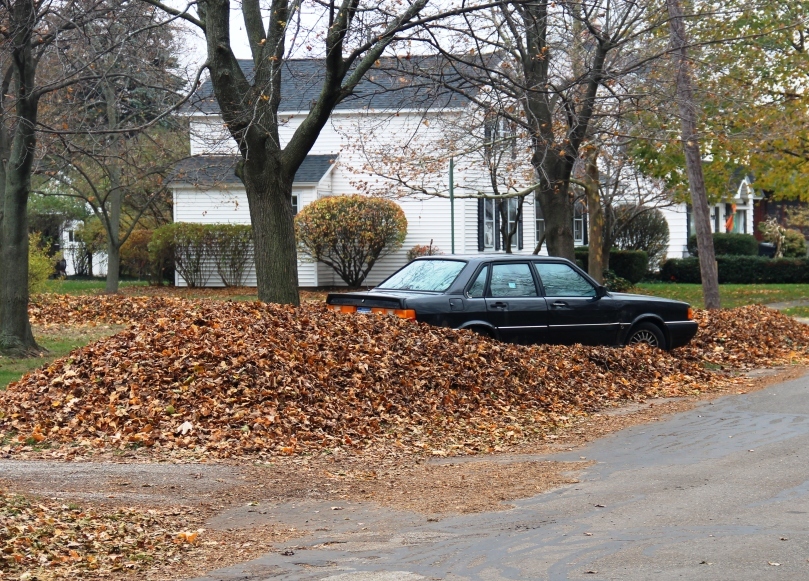
It raises the issue of how one measures emu growth. Their flexible little necks complicate the equation. Extended? On tippy-toe? (And yes, they’ll stand on tip-toe to look into the trash bin, to peck at any odd spot, or over a low enclosure.) The knee-high average is just standing with no effort at extension. I suppose the best way would be to weight them, but they’re so wiggly that I can’t figure out how to get them back on the scale. Just weeks ago, when we weighed them in at teacup size, it was a relatively easy proposition. I can’t imagine doing it now.
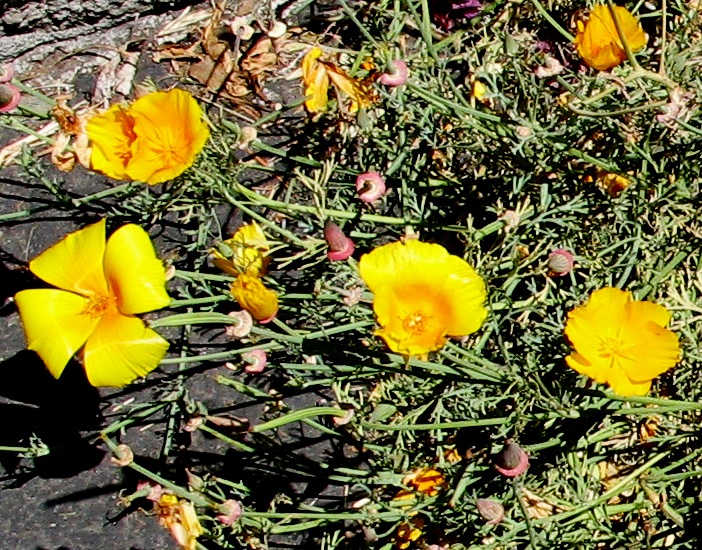

And, fast! They can run. Together they move like fish in a school, (well, a school of kindergarteners) en masse with sudden, inexplicable and semi-choreographed changes in direction. They also dance and play—a series of hops, often preceded by rolling over and then followed by a group mad dash in every direction, knocking each other down if at all possible. It keeps up laughing.

With any luck, two will have a new home by week’s end. The first potential adoption fell through when the gentleman realized how fast they’d grow, and how hard it would be to relocate them for his scheduled move in eight months. “Maybe next year.” Ha! Do you think I’m going to do this again? But now, there’s a much better prospect in the works. Every now and then, when I worry about how to adopt-out emus, I realize that it’s not really my problem. (Yeah, I know. If it’s not my problem, then why am I up to my knees in emus?) I’m just a renter here, and these are Elmer’s emus, after all. Well, you know, I could just move away…

Naming Emus

A.V. Walters

Understand, these are not our baby emus. We are merely foster parents, keeping bodies and souls together until they’re big enough to handle things autonomously. (Read—until they are bigger than the things that want to eat them.) They are grazing animals; over their lifetimes, most of their dietary needs will be met by mowing the lawns or fields where they’ll live. In light of that, my relentless chopping of greens and worrying over nutritional requirements is downright silly. But, I’ve failed as an emu foster parent before, and this is looking like my last chance at it, so worry I will. These five babies are in our charge, and I will do the best that I can.

More upright, more stable on their feet!

More upright, more stable on their feet!

For now, I chop up kale and apples into miniscule pieces, toss in enough emu chow (can you believe they make such a thing?) to make sure that they get their vitamins, and feed them as often as they’re interested. Then, I clean up after them. They’re a lot of work.

It’s a good thing that they’re cute—which is my version of Darwin’s Law—survival of the cutest. It applies to all baby creatures (on a relative scale—have you ever seen a baby hyena?) It probably applies to all relationships—they work as long as cute lasts. By that I don’t mean the obvious attraction to physical attributes, I mean that inner essence of the self that shines through in those moments of unguardedness—that’s cute enough for me. I see it in these little emu babes already—the first signs of personality (emuality?) peeking through.

Close up cute.

Close up cute.

They are each very different, at about two weeks old. It may be birth order—just the developmental advantage that comes with hatching five or six days before the youngest of them, but I think it’s much more than that. Some are bold and curious, others find more comfort sticking with the pack. I understand that. I was the fourth out of five (in quick succession.) It’s not that I don’t credit my parents with raising us, but I think by the time you get to four, the younger ones just follow along, doing what the others do.

We are trying not to name these emus (at least, formal names.) They are not ours, and naming is the privilege of the ultimate, emu adopter. Some will be farm emus and never will have names. (You may have noticed that Mr. and Mrs. Emu don’t have specific monikers, just enough to identify gender.) Some will be pets. I can’t say whether emus will ever answer to names—other than perhaps a call to dinner. It’s not clear to me whether emus engage in that kind of pet/keeper intimacy. Though I’m fond of them, I don’t find any demonstrable intelligence in the emu behavior I’ve observed. Much of their actions appear to be hardwired—though I’ve not given them much opportunity to show higher learning.

You see their markings are distinctive.

You see their markings are distinctive.

Still, it’s helpful to be able to identify individual emu babes and so we’ve got nicknames for them based mostly on their individual markings. As they mature, the stripes and distinctive markings will fade, as will the titles they now carry: Two Dot, the oldest and boldest; Dot Dash, just as big but less likely to investigate or venture solo; Blondie, lighter colored than the others, independent and extremely gentle; Sleepy, well, that tells you; and C3, named for the markings on the back of his head—it looks like he was labeled. C3 is the baby. He struggles to keep up with the bigger guys and then immediately afterwards, crashes into a deep sleep. He’s the one I worry about.

Of course I use ‘he’ and ‘she’ loosely here. There is no clear way to identify emu gender at this age—except by inverting them and groping around in there—and even then, only if you know what you’re doing. I’ve looked it up on the net and haven’t decided whether I’m up for that, with this passel of squealing, kicking baby chicks. There are theories about identifying emu chick’s marking patterns and likely gender. They certainly do have distinctive patterns—however, ours don’t seem to match the patterns shown in the photos on the internet. Perhaps we have a tribe of chicks with some new gender form, but I doubt it. Your mileage may vary.

Also, they say that emu personalities are largely gender based. The females are more aggressive, though I don’t think I could separate that out from the effects of birth-order development, at this stage of the game. Gender does make itself clear down the road when they reach sexual maturity. The females’ throats develop in width and they vocalize in a deep thrumming, almost drum-like sound. It’s impressive. The males, I’m afraid, just grunt, snort and occasionally whistle. (Insert your own joke here.) That’s about two years down the road—we won’t be around when these emus can tell us more about who they are. Since we’re not promoting these emus for breeding purposes, I don’t know that gender matters. It certainly doesn’t if your job is to guard sheep. Still, it’s a very basic question, and most folks want to know—is it a boy or a girl? I think that that says something more about how we relate to the animal kingdom, than anything to do with the emus. We pick names to express gender, to tell more about the critter, or the person, even before we meet.

I’m no good with names, anyway. It runs in the family. We joke that names just don’t stick in a big family. When she calls your name, by the time your mother gets to using your name, she’s usually run through most of your siblings’ names anyway. (Jim, John, no… Bob, no, Bill….) So, names don’t stick easily in my head. To make a name stick, I need a voice or a story. I rarely remember faces—at least not without a voice.  But if I get to know your voice, the name will stick. Or, if you tell me your story, I’ll usually capture the name along with it. If I’m lucky, the face will come with the voice. Once my mother came to visit as a surprise for my birthday. I came home to find her and my sister in my kitchen. I didn’t recognize either of them! Granted, I had a bad head-cold, and it’d been several years since I’d seen them, but I didn’t recognize them until they spoke. Unfortunately, before that had happened, I’d turned to my husband and said, “There are strangers in our kitchen.”

There are strangers in our kitchen.

There are strangers in our kitchen.

So giving these little birds names isn’t high on my list of priorities. It’s more important that I keep them fed and safe. It’s fun to watch their antics and to see traits revealed that will tell you about the ‘who’ of who they’ll be in their future. Maybe that’s how it was for my mother, with five little kids within six years.  It must have been a blur, like five little emus slip sliding across the tile of my kitchen floor. It makes me wonder, is there a name for that?

What's the name for that?

What’s the name for that?

Emutude

Another Emu Adventure!

A.V. Walters

It was clear, as soon as we arrived, that something had changed with Mr. Emu. When he’s sitting on eggs, he is generally in a trance-like state. He is wary but once he recognizes me (aided by the apple treats he gets) he is friendly. Yesterday he started hissing as soon as we rounded the top of the hill. It took only a moment to discern the reason for his agitation—as a little emu babe popped out from underneath him. Then another. Mr. Emu is in protection mode.

Proud father

We changed the water and gave Mr. Emu an extra-generous helping of diced apples—emu candy. As soon as he’d relaxed, he stood up. He frequently does that—I think he’s showing off his eggs/babies. (Rick’s rolling his eyes as he reads this.) I’m anthropomorphizing again! Rick doesn’t put much stock in the depth or profundity of emu thinking. So, when Mr. Emu stood, he revealed four baby emus—stunned and blinking in the light. There are still three un-hatched eggs yet to go, though there are no guarantees. It was time to get busy on our plan to secure Mr. Emu’s household.

Five and Two

Emu adults have little to worry about in the predator department. At over five feet tall, and with a nasty kick, in this area the emus are sometimes used to protect sheep. They can (and do) easily prevail over coyotes. Some think that the emus bond to the sheep but I think it’s just more likely that they have an instinctive hatred for dingos/dogs/coyotes (well-intended adults)—anything in the predator category. Other than the occasional (but very rare) mountain lion, the area hasn’t any prey animals big enough to threaten an emu. Not so, though, for the chicks…

They are just little bitty guys, a tempting morsel for any number of our local small carnivores—hawks, coyotes… but mostly foxes. A fox is small enough to hide in our spring grasses, undetected by even a diligent emu dad. And besides, with so many chicks, dad’s attention is split and a fox could make off with a chick in a heartbeat. We have lost chicks to foxes before.The Emu Five

So, the plan was to install a fox-proof fence, with extra screening at the bottom (like crib-bumpers, since once an emu baby broke his neck in the fence.) This time we were going to cover our bases against all known emu baby hazards. We still had some time—Mr. Emu and his miniature charges are pretty safe in the immediate post-hatch period. A fox won’t stare down an adult emu, and at first the chicks need to stay warm underneath their daddy’s skirts.

Today was supposed to be the big fence building day. Except… I received an unrelated call from John, a former emu breeder. We addressed his concerns and then I announced that Mr. Emu had hatched four emu babies. John congratulated me/him/us and then launched into a barrage of questions—where was I keeping them, what was I feeding them, what did I plan for exercise… I stopped him. I explained that these were Mr. Emu’s babies, how he raised them was his business, and that they were where they belonged, under their dad. John was horrified. “But the foxes will get them!”

I explained that we were headed out to put up a new emu-perimeter. John was not convinced. “You don’t know—the foxes will get them. It was a real struggle for us with the baby emus. The foxes would climb fences. It’s a bad, fox year, I’ve lost several newborn lambs this spring.” John set me straight. Did I think a mere fence was going to outwit a fox? Our emus wouldn’t stand a chance—they were dinner. It was a short call after that. John would hear of no other solution but to kidnap and hand-raise. We had to “bring them in.” Anything else was just a feeding program for the foxes.

Hand raising these emus wasn’t quite what we had in mind. We have a very busy spring planned. But was hard to argue with John’s emphatic insistence. He was, after all, the local emu expert.

Baby emus require elevated temperatures for weeks after they hatch. Usually they’re warm and cozy under their dad. My house is hardly what you’d call warm (though I’m proud to say it’s cozy.) So I scrounged around for a heat lamp and scurried into town for a thermometer and a sack of ratite feed.

The feed store only had the adult emu food. The clerk said I could use it for the chicks if I supplemented with finely chopped kale and apples. I’ve done this before, you need to cut it all into teeny tiny pieces. Armed with supplies I headed home to outfit the nursery. It’s a good thing we don’t use that second bathroom. The shower stall is a perfect place to raise birds. Once we’d stabilized the temperatures (to emu temp—about 90 degrees F), we set out to steal the babies.

Mr. Emu was no more friendly, today—until—again— he got his apples. Emus are not smart (Rick’s rolling his eyes, again, at the obvious.) They can be dissuaded from the obligations of parenthood with just a handful of treats. As usual, he stood up, revealing that there are now five baby emus! One was so recently hatched, that he was wobbly and couldn’t stand very well. We quickly started with the apple barrage—distracting Mr. Emu’s attention with goodies as we deftly scooped up four of the chicks, placing them in a deep, cardboard box. Each chick squealed when grabbed and relocated to the carton. With each squeal, Mr. Emu hissed and lowered his head (a sign he may be getting ready to kick.) We decided to leave the new hatchling with his dad for another day. He was too vulnerable and his sibling chicks would literally walk all over him.

Our box now loaded with our squirming, chirping charges, we slunk back down the hill with Mr. Emu’s babies.

Well, it’s for their own good. Right? Even well armed with the specter of voracious foxes, I feel guilty stealing his family. (Even so, we’ll be back tomorrow for the straggler.) This time, we are determined to save those little emu babies.

new home

Now, safe and warm in the shower, the emus quickly pecked down their first meal. This was a huge relief to me, because sometimes you need to teach little emus to peck and eat. It’s one of the first skills that their dad demonstrates. We were lucky that our charges got some of the fundamentals down, before we made off with them.

Stay tuned for the next thrilling episode of, Operation Emu!

It’s that time of year again–well, it’s late for that time of year. For some reason I always miss the true peak of pruning season and sneak it in, just before the whole thing starts to bloom. So today I’m doing three trees and the roses.

The pyracantha ought to be a shrub, but before I got here someone let it go and it was a tree–dropping its litter and berries all over the roof. I’ve been pruning it shorter and shorter each year. I’m trying to make it into an arch over the sidewalk and now, after six years, it’s finally started to take some shape. I also do the annual whack at the buckhorn. It’s a shame, really. It was planted next to the house–as though it were a shrub. Unfortunately, in its natural state it would be a lovely, large tree. Elmer, the landlord, wants a shrub, though, so each year I whack it into a sad version of its real intentions. I feel guilty doing it, but the alternative is that Elmer will. I love the man, but he is a plant butcher. So I undertake the annual ritual of pretending that you can, year in–year out, cheat nature. The buckhorn should never have been planted next to the house. Ultimately, if left to its own devices, its roots can, and will, destroy the foundation. I have trouble with this. One of my pet peeves is the short-sighted planting of trees. In any planting scheme, one should always consider the soil, the light and the size of the proposed tree as it will fit into the existing landscape. In that regard, this farm is a constant test of my patience and reserve. And finally, I’ll trim the peach tree.

The peach has it’s own history, as previously discussed in this blog. It was infected with peach curl when I came, and finally, last summer (after stripping all the leaves) we had a curl free season. The tree grew lots of new, lovely, healthy branches. It has never looked so good. So I’ll trim it with a mind to an improved shape and maximizing this year’s crop. It bears lovely peaches. Pruning the peach has its own hazards. It’s planted on a mound in a rock garden. The rocks are large–and tippy. Under one side of the tree, amidst the treacherous rocks, some enterprising garden fool has buried a large, Victorian era bathtub. I guess it’s supposed to be a water feature, though usually it’s just a breeding ground for mosquitoes. Over all of this, is a groundcover–vinca major, whose job it is to obsure one’s footing enough to guarantee a dip in the very cold, murky water of the tub, should you try to prune in the winter. I’ve fallen in once already today. The mounded garden makes it impossible to water the peach tree. The rocks and tub make it impossible to use a ladder safely in pruning. This is the kind of tree placement that is typical on this farm. It’s a good thing Elmer makes his living with livestock.

That’s what’s new on the farm. My personal life has been a roller coaster of personal trials this past month, so the pruning comes at a good time. Pruning is a very reflective chore–each cut a set of decisions about shape and future direction. I love it. It is as close as one gets to sculpture in adult life. I’m pruning in my life, too, making decisions about future directions. So there are parallels to this winter chore.

I’ve returned to writing–jumping into The Trial of Trudy Castor as though I’d never stopped. It’s funny how you can leave a story–for months even, and then pick right up with it, like an old friend. In my recent tumult, I’ve neglected my marketing on the last book The Gift of Guylaine Claire. It’s not nearly as easy a read as the first book, though I think it’s the better of the two. I also think that the French Canadian name, right there in the title, inhibits interest. We shall see. In the interim, I’m offering a free download of it–good through the tenth of March. If you have an e-reading device, feel free to download it through smashwords.com. Enter the coupon code  VH78Q at check out. If you like it, please leave a review on goodreads.com (or, if you must, on Amazon)–or comment here on the blog, if you prefer. I look forward to some input.

Old Business (something old, something new, something rotten, something phew!)

We’re headed out of town for a couple of weeks, and so it was time to take care of some things that had gone a little ‘long’ anyway. There’s something especially satisfying about getting rid of old garbage before the New Year. In this case, I mean that literally. Garbage.

There’s a funny thing on the farm; we have no trash service. It’s assumed that if you select a rural lifestyle, you’ll adopt a more hands-on approach to the nitty-gritty details of life, as do most rural residents. From time to time the tenants whine about it, but Elmer sticks to his guns. If he provided trash pick-up, there’d be no incentive for tenants to reduce their trash stream by composting and recycling. Elmer knows of what he speaks. He spends a lot on dump fees. Despite the fact that he’s a farmer, Elmer doesn’t separate or recycle, at all. He doesn’t even compost. As a widower, he buys more processed foods than most, and all that packaging ends up in the trash. Besides that, there’s a Re-Use store at the dump, where folks donate things that are still good. Often on hauling day, Elmer will come home with as much as he took!

I gloat over my low dump charges. If you go through and get your vehicle weighed in and out, the rate is ridiculously low. Today we paid $5.00 for sixty pounds of trash. That’s especially low when you consider that this is our first dump run in about eight months. We recycled at least four times that much—but hey, recycling is free. It’s been funny over the years to watch the strategies of the tenants in disposing of their household waste. One woman sneaks to a department store dumpster on a regular basis. Another used to bring her garbage to a friend in town—and stuff it into her curbside bin (or that of the friend’s neighbors.) Still another used to bring her trash into work, until she got caught! I note that guys never discuss their trash strategies. They just cross their arms and nod.

I’m another odd case. I don’t have much household trash. I compost the organic stuff, burn some of the paper and cartons to start the fire in the morning, and recycle everything that I can. The county dump is located conveniently only a few minutes away, so I don’t know why everyone avoids it so. Even with all my waste reduction efforts, some stuff just has to go into the trash. The clear plastic bags that my dried fruits come in, and some blister-packs (which I avoid buying whenever possible)—these things must be hauled off to the dump. It takes me six to eight weeks to collect a full bag of these things. They’re clean, don’t smell and don’t attract pests—so I don’t mind them building up. It used to be that I’d go about 3 months before I’d make a trip to our local land-fill—but that was before Rick. You see, Rick has a truck.

Nobody wants to stuff a passenger car to the gills with garbage, but a truck gives a whole new horizon of hauling avoidance. By the time we need to load up the truck for the trash, the recycling is at the point of ridiculous. Today we filled the entire truck bed with paper, cardboard, bottles, plastics and a little scrap metal. (We don’t eat much in the way of canned goods—other than what we can, ourselves.) The bottles… Well, that gets a little embarrassing—it must look like we’re drunks—but it’s really just an accumulation over a fair amount of time. Today I unloaded four big plastic bins of assorted, glass containers. I was glad the dump was deserted, (it being Christmas Eve Day and all) so I didn’t feel like I’d need to explain—“No, really, this is over 8 months worth!” Once I was unloading my glass containers and some wise guy commented, “That must have been some party… How do you get invited?” I suppose it was a pick up line (you’d be surprised how many guys will try to hit on you at the dump) but even then, it was a little embarrassing.

After all is said and done, it feels good to have all the trash gone. We can go into 2013 with a lighter step and an empty basement. And it clears up one New Year’s resolution, before the new year even starts.

Playing Possum on the Bell Curve

A.V. Walters

It’s about nine miles into town and, at certain times of the year, it’s carnage. This is that time of the year. The hills are verdant. Our seasonal rains have started and the wild critters have come out, in force, to take advantage of the return of resources. That means they’re moving about and, unfortunately, they don’t understand the rules of the road. The only rule that should concern them (besides, RUN!!!) is that they cannot win in a faceoff with a motorized vehicle.

About a month ago, I noticed (what my partner calls) the annual, ‘Running of the skunks.’ All of a sudden, for just a couple of weeks, the skunks decide that they need to cross the road, now (and often fail.) Yes, of course, they’re trying to get to the other side, but why the sudden, yearly mass-migration, just to get there?

The steel-verses-fur imbalance is especially true of the possums. There were four of them on the shoulder today and they weren’t playing possum. Possums have an unusual survival strategy. When confronted with extreme stress—a life or death choice—they lose consciousness. That age old technique was a winner when their primary opponent was a predator. Some time ago, (say, a millennia) there was a survival advantage to fainting in the face of danger. (It worked for Victorian era women, too. Go figure!) Those oddball possums who developed this strategy, lived to see another day, and bred like rabbits.) It worked because many predators will only eat live prey, so the ‘play-dead’ strategy fooled them. Embedded deep in the predator instincts is the caution not to eat carrion—to protect them from illness borne by rotted or poisoned meat. (Oddly enough, that’s the strategy my partner used, growing up, while foraging through the family refrigerator.) But the possums don’t just ‘play’ dead, they actually go into a neurological overload, and completely shut down. They are literally, out cold.

When the threat at hand is a three-thousand pound, multi-wheeled projectile, hurtling directly at you, this passing out thing doesn’t quite cut it. Possums have failed to make the evolutionary connection to address this kind of threat. (On the other hand, they are such prodigious breeders, their niche in the ecosystem is safe— unfortunately, the predators don’t fare as well.)

In most species, a variety of coping mechanisms falls pretty evenly on a bell curve—some are aggressive, some passive (and in our species, some are passive-aggressive, but that’s another blog.) Someone once explained it to me this way: in an earthquake, some people will seize the moment and run outside the building at the first sign of a tremor. Others will hunker down in that “triangle-zone of safety” next to the kitchen counter or behind the sofa (or the I-beam tee-pee they had welded, ‘just in case.’) Nature can’t choose who will survive so she takes a Darwinian approach, and provides a range of personality types to address life’s risks. Maybe the guy who gets out, by running into the street, will be the lucky one (or maybe he’ll be crushed (inexplicably) by an I-beam tee-pee or cut to ribbons by the tons of falling glass from the skyscrapers above.) Perhaps the building won’t fall and the guy curled up behind a well-built sofa will brush himself off and go about his business. (Or, maybe he’ll die, trapped in his Ikea-built ‘cocoon of safety,’ before the rescue dogs can find him.) Since survival of the species appears to be nature’s objective, (okay, sometimes it‘s just a crap-shoot) she relies on variety to ensure that at least part of the team will make it to see another day.

Possums are failing that strategic variety test, and driving down the road, past the possums, makes me wonder how we’re doing in the strategic variety department. I wonder how the Walmart mentality of endless consumption ranks next to the possum’s self-induced anesthesia. Are we failing to diversify our options? From overreliance on fossil fuels, to the loss of species diversity, and the loss of knowledge of “the old ways,” (gardening, canning, cooking, building, animal husbandry and such) in the general populace, I worry that our culture is failing in its obligations to future generations (not to mention ourselves.) Politicians rail about preserving “the American way of life” without noting that it’s a recent phenomenon—and potentially unsustainable. What’s truly needed in our culture is a renewed diversification of talents , interests and, well, thinking.

I attended a party, last night, where the adults stood around chatting, wine glasses in hand, and the teenagers were in the next room, glued to the video games on the TV screen. I wondered, what kind of real, survival skills do video games develop. (Here’s a test you can do at home: Shut off the power, and see which kid gets up and looks for the fuse box, and which one just sits there in the dark.) In my narrow view electronic entertainment is a sorry waste of opposable thumbs. (Not that opposable thumbs would have done the skunks much good.) Still, the party was a holiday celebration for folks who’d volunteered all year to help fix up the homes of the poor and elderly. Those in attendance were builders, architects, tradespeople and genuinely nice people who volunteer their time for others. Wait a minute, there’s a survival strategy, altruism. On balance, I guess that helps a lot. That’s one area where we are ahead of the possums.

Paris rain

Between Seasons

A.V. Walters

The first serious storm of our winter rolled through last night. We were forewarned— forecasts of power losses and flooding in low lying areas made us tidy up and hunker down. It’s not cold though, and so, it doesn’t feel like real winter. The storm blew in from the southwest, with temperatures in the mid-50s (F). I went out to the garden for (yet another) last tomato harvest. I keep saying that, but the tomatoes aren’t listening, and keep ripening. I suppose only freezing will end the bounty. The garden looks bleak but tomatoes, scallions, peppers, beets and the occasional winter squash still make the garden walk worthwhile. No more canning though. These tomatoes go directly into daily meals, or into the dehydrator.

The idea of a power outage had us worried. It’s the downside of usurping nature in the incubation of emu eggs. Once undertaking the task, what do you do if the power goes out? It’s not like Mr. Emu will jump back into babysitting once we’ve disturbed his paternal, confinement trance. Now, we’re watching him, and the Mrs., to see if they go back into breeding mode. In the meantime, there are nine eggs in that incubator. What could we do to keep them viable if we go dark and the incubator goes cold? So, despite the fact that it wasn’t all that cold out last night, we fired up the wood stove to chase off the gloom and to test the temperature range to see if we could step in should the utilities fail. It turns out that the space under the stove, where Kilo usually sleeps, is exactly in the hatching range between 95 and 99 degrees, Fahrenheit. (What are the odds?!) As long as we don’t sleep through it, we’re covered for an emu power emergency. Of course, this morning the house was a toasty 68—about six degrees higher than our standard, indoor, winter norm. I should be happy to be within the range that most folks set as their low-normal, but I’m accustomed to my winter chill.

The winds have died, but it’s still raining.  A few small branches are down, the last of the fall leaves have been stripped from the trees and the valley below us is a new lake. That’s standard for winter, the pastures that frame our view, fill and drain to the rhythms set by the storms. The hills are a lush, eye-popping green. Now that the peach tree is leafless, we have our full-range view back. It’s not winter yet, but it’s coming. December will likely bring more high winds, rain and cold.

It’s also lambing season. I always thought it odd that the farmers’ timing ran opposite to what you’d expect. The calves and lambs here are born into our coldest weather, to take advantage of the free and healthy feed offered by our green hills. By spring, they’re ready for market (or nearly) and the farmers keep and feed only their breeding stock during the long dry summers. Good thing those lambs come in wearing sweaters! The baby emus (should we be so lucky they hatch) are a different story. We’ll need to keep them warm for about a month. We’re devising an emu-baby corral, out of straw bales, to be warmed by a heat lamp. Then, if the power goes out, we’ll really have a conundrum because they’re sure as heck not going to fit under the wood stove. What do you do with a passel of shivering emu-babes? Bring them in? A house full of them? Bedlam, I tell you. All we can do is cross our fingers and hope the power holds. We’re between seasons, autumn and winter, California and the emus’ native home of Australia.

A.V. Walters

I know I said I was finished canning for the season. And then, there was the threat of frost, so we decided to do one last harvest before the more delicate items perished. We brought in peppers, the last eggplant, basil (but unfortunately, not enough of it), a bunch of late-maturing winter squash (spaghetti, moschata, butternut and one lone delicata that was hiding in the foliage) and then we took a hard look at the tomatoes. Sure enough, many had split and rotted after the rains. But looking closer, there were still a lot of really lovely tomatoes in there, so we harvested.

And harvested, and harvested. We made an ample last harvest delivery to everyone on the farm and still there were over three five-gallon buckets of tomatoes. Eighty-eight pounds of tomatoes—in November, no less. So we pulled out the canning equipment, from its brief rest in storage and set up for one last (no, really) run. Twenty-three quarts later, we are finished. We did extra thick sauce infused with basil (for pizza or spaghetti); we did tomato pieces, most sorted by color—red, orange or yellow, which will be lovely for stews or soups; and we did some fancies—mixed colors in patterns—which are almost too pretty to eat and will probably be gift items. (So if you’re family and you’re reading this, close your eyes on this part.) Then we washed up and put all the gear away again.

It was a welcome reprieve from regular life, which has had some twists of late. Anyone who is the parent of a teenager can relate—a runaway with issues and attitude. As much as you ache for their safety and mental state, you also wish you could can them, too, safely into tidy jars, tucked into the pantry until they’re ready for real life. Once we’d done all that we could do, a little tomato therapy of peeling and dicing and canning was just the ticket. And by the end of the weekend, she was home, safe, and probably already gearing up for her next snit. You wonder, was I ever that young and clueless?

By last evening, the kitchen was clean, the jars in neat rows, cooling, and we relaxed in front of the fire. Winter is coming and the early mornings are decked out in frost. Stupidly, I left a lot of the basil in the garden and the cold burned it to a blackened, limp mess. A day earlier and I could have dried it for winter. Oh well. In the daytime it’s too warm for a fire, but by night the chill is in the air and it’s time for some heat. This morning, I noticed that more tomatoes are ripe. No way. I’m not canning them. I’ve already put the canning stuff away twice. But, I may take some and dehydrate them. I heard from an old Italian friend that the secret of great cooking with canned tomatoes was to dry some too, and then snip bits of the dried tomatoes into the pot twenty minutes before the meal is ready. Supposedly the dried ones bring back the aroma of summer.

Last night, friends called. Their neighbor has an excess of apples—did we want any? Plenty for applesauce or the emus. Applesauce is always a lovely treat in the winter. Oh, on second thought don’t go too far with all that canning equipment; we still have some empty jars. And, more emu news, next time.