Archives for posts with tag: priorities

Dry-Run–

A.V. Walters–

We’re learning. It turns out that this little rental has taught us many valuable things about living with season. We’ve learned that ice dams are common in older homes (and inexcusable in new ones.) We’ve learned that it’s really important that one’s water supply lines be buried deep enough. It’s the coldest, snowiest year in decades; so, it is a good test for us. We’re holding up, and we’re learning.

Oh, we have no water.

Even back in sunny California, there would be cold snaps from time to time and many people would have their pipes freeze up. I remember, when I first moved there, I was aghast that many (especially older) homes ran their pipes on the outside! When I lived in Oakland, our water supply line entered the house on the front—above grade! In the winter, I wrapped that pipe—first with foam pipe insulation, and then with towels and plastic. We never had our pipes freeze. Here, water supply lines are buried deep (hopefully below the frost-line– about 48 inches, around here.) Sometimes, it’s not deep enough.

Did I mention we have no water?

If it’s any comfort, it’s not just us. A couple of other properties in the village have come up dry. There’s a whole triage routine to this, first you root around under the house to see whether the pipes under the house are frozen solid. You check the meter (if it’s running wildly, you have a burst pipe—if it’s not running at all (even with open faucets) you likely have a frozen pipe. This little cottage has heat tape on the pipes. We learned that after the water stopped, when Rick was running his diagnostics. Once you’ve identified that the problem isn’t under you, you need to find out what it is. If it’s in the Village water main—they need to fix it. If it’s in the line between the main and the meter—you need to fix it. This is where it’s good to be renting. The standard solution (after you call the landlord) is to call in a welding company who will essentially use jumper-cables to melt the ice in the line. Not many companies will do this kind of work—they say the liability is too high. Huh? Wow, that’s not the kind of response you want to hear…

So, we’re still waiting for water.

Today is day three. We’re carrying water, by bucket, from the neighbors. We’re starting to look a little scruffy and the dishes are piling up in the sink. The company that still does this kind of work is in high demand right now. Take a number.

And, there’s some small-town humor in it. I went to the Village office to start the “who’s side of the line” investigation. Our friendly clerk took down the information. When I gave my name, she looked up, “Oh, you’re the one that got married last week.” It was a statement, not a question. They run all the vital statistics info in the local paper. I have a distinctive first name.

“Yup, that’s me.” Yup, that’s us. Geezer newlyweds. Later, the village crew came down to investigate the problem. You just know that they’d all been told. Later, a neighbor from down the block dropped by to assure us that we could come get water at his house. Small towns talk. It’s not a bad thing. People in town see the construction cones. They read the paper. They hear that some folks got married, and some are froze-up. It’s about community.

Our future building plans keep adjusting. We are now serious about adequate insulation and ventilation in the roof, in order to fend-off ice dams. And now, you know we will bury our water lines—deep. This little cottage has been our dry-run for winter living. We just didn’t know how dry.


Postscript:

Finally, they came to free up our lines. That freed me up to run to the store for dinner groceries. At the checkout, the clerk (who lives around the corner from us) nodded, “I hear your pipes are froze up.”

I smiled, “Not anymore, the guy’s there now, fixing it.”

“Runs down the driveway, does it?”

“Yeah.”

He nodded knowingly, “You folks keep a tidy driveway, could be part of the problem.”

“What’s that?”

“You know, you could leave some snow in the driveway—for more insulation.”

I howled. “I’ll tell him.”

So it’s a small town. They talk, they notice. They hear about troubles and they have opinions.


Somewhere to Put It–

A.V. Walters–

“No, you have to start a lot wider than that. Over by the trailer is your line.”

I looked at him like he was crazy. “Dad, it’s a driveway, not a runway.”

“Just do it. In February, you’ll thank me.”

It’s still snowing here, and that brings back my father’s voice. When I was a teenager, we moved north to snow country. For my dad, the move took him home to the routines of his youth. We had a steep learning curve to adapt to the Keweenaw snows. He was doing the teaching, and we were doing the shoveling. There are two basic frameworks for how to approach snow control—pick a line of demarcation and stick to it, or clear wide in preparation for a winter of snow. My dad adhered to the old ways, taking a seasonal perspective on snow removal.

We felt silly; at our house we started the season clearing the snow five to ten times the width of the actual driveway. The neighbors scooped their driveway only 10-feet wide. Ours looked like a parking lot. We used the traditional Yooper snow scoop, pushing the day’s snow far from the driveway, into the woods. We thought our Dad was nuts. We scooped and shoveled anytime there were 2, or more, inches of snow. Needless to say, we shoveled—a lot.

By February, it was clear that there was a method to his madness. It snowed and snowed and snowed. And, we shoveled and shoveled and shoveled. Our neighbors were still maintaining their 10-foot driveway, but the accumulated piles on either side were so high that they had to throw the snow up, and over the banks they’d created. Then, they actually had to climb up on top to re-shovel the piles back even further. And, they had no visibility entering or leaving their driveway. Having pushed our early snow way to the sides, we were still shoveling, but we had plenty of space to put the accumulated snow. Our banks were manageable, and our driveway clear. My dad didn’t even say, “I told you so.” He just crossed his arms and nodded.

This week, in the local paper, the headline read, “We’re Number Two, Thankfully.” Snowfall to date, here in Leelanau County, is second in the state only to my old haunts up in Keweenaw County. Nobody with a shovel wants to be Number One. (Ask my mum and my sister, back home.) Many, these days, avoid the whole issue by using snow-blowers (or by scurrying, tail-between-the-legs, to Florida.) We still shovel. Rick does almost all of the heavy lifting here, and he started early season snow removal with a wide open swath of driveway. (How did a California boy know such a thing?) Though we didn’t expect this year’s record snows (and, admittedly, our banks are higher than my Dad would’ve liked) we still have a wide, clear area in our driveway.

It’ll be interesting how our two counties fare over the rest of the winter. Keweenaw’s lake, Superior, is 93 % frozen, considered “frozen over” for all practical purposes. That means that back home they won’t be seeing any more “Lake Effect” snow. Our lake, Michigan, is only just over half frozen, so, we should still be seeing Lake Effect snow, for some time. Who knows, we may yet be Number One!

I help some with the shoveling, and I like it. Nothing brings back my father’s voice like a smug and heavy snowfall in February.

Musings from the Polar Vortex–

A.V. Walters–

Just enough snow.

Just enough snow.

Now there’s a new phrase for you, eh? The only vortex part of it is the rushing-in from the void of all the misinformation about weather, generally, and climate change, specifically. Oh, how the reality-based wonks among us rue the day that somebody started calling it “global warming.” It so distorts the opportunity to study the facts, and create meaningful policy, (or dialogue) in an atmosphere of an anti-science witch-hunt.

Now, the cold snap has subsided, leaving us in the more normal seasonal range of temperatures in the 20s. This weekend they’re predicting a warming trend—one that will bring us sunshine and above-freezing, nighttime temperatures. You’d think we’d be happy about that. In fact, it creates just another set of problems.

First, there’s the leaking roof. In winter’s cold, it’s not a problem. But when things warm up, the leaking roof, in combination with ice dams (damns?) makes this little rental an interesting place. (Buckets and mopping up.) The landlord knows, but it was a bad roofing job and now there’s nothing he can do until spring. At the same time, he plans on putting in new windows—which will be a big improvement, though we’ll be long gone, by then.

That kind of freeze/thaw cycle also creates treacherous roads. The thaw provides the fodder, in the freeze period, for black ice and other hazards of navigation—both pedestrian and vehicular. It means we’ll be strapping on yet another layer of winter gear (spikes) onto our boots. I used to think that these were for old folks. However, my mom swears by them and she insisted that they become part of our new, winter wardrobe. I’m a regular Yeti fashion-plate. At least it’s safe.

And, finally, I don’t want our snow to melt. I’m just about to get cross-country skis. I like look of winter. I love roads with a nice, thick, white, base. (I’m not a fancier of salt or the dirty slush it brings.) So my fingers are crossed that the snow stays through the warming spell.

There are northern things that will take some adjustment. The winter tap water is frigid. My California roots say, “Don’t waste water—use it cold and straight from the tap.” My fingers say, “Skip the frostbite, run it ‘til warm.” The water is so cold that it hurts your teeth to drink it. Northern living takes longer to get anything done, whether it’s the time suiting-up, or shoveling-out, life has to be a little more… intentional. And, the butter is too damn hard to spread on toast. (I can hear my sisters, “Turn up the heat, goofball. Good Lord,” shaking their heads, “They live like a couple of Eskimos.”) This might be solved when we have our own place, and it has insulation. For now, unless I’m baking, the kitchen is chilly. Otherwise, our winter redoubt suits me fine, for now. If only someone could convince the cats.


This Is How It Goes–

A.V. Walters–

Up north, in the U.P. where my mother lives, folks are getting Lyme disease. These are hearty, out-doorsy people, who spend a lot of time in the woods. Lyme disease isn’t new—it’s been around for decades, just not up there. It’ll take a little time for people to wise up to the new reality—the ticks have moved north. Soon, folks will take precautions, recognize symptoms, and will have made the adjustment so that a bite doesn’t necessarily mean a long-term, debilitating illness. You adjust.

In Michigan, (and southwest Ontario) the forests have been devastated. A shipment from China apparently, and inadvertently, imported the Emerald Ash Borer. It’s a pretty, little bug. Here, we have plenty of ash trees, and no predators. Estimates are that, so far, 20 million trees have been infected and died. There is no cure—they offer some heavy-duty, toxic treatments that can hold it at bay, (if your favorite yard tree is at risk) but nothing can be done to protect the forests. Before it runs its course, we will lose about 80 million trees. Now that the seasonal leaves are gone, you can look into the woods, as you drive by, and see all the fallen trees. It’s heartbreaking. Ash naturally grows in a diverse forest—so there are still plenty of other trees standing but, like the elm before, this area can kiss its ash good-bye.

We have forested property. We walk its hills, shaking our heads. The ash are dying and falling. The tree has a distinctive bark, so even in the winter it’s easy to identify. As we walk, we see not only the downed victims of the blight, but every one of those standing trees, with that lovely deeply-grooved bark, is doomed. They say to expect 100% losses. There are timber restrictions on the movement of ash wood-products. Areas are quarantined to try and prevent the spread. Our quarantine area is Lower Michigan. It’s spread to some counties in the U.P. now, too. So far as I can figure, the only winners in this game, and it’ll be short term, are the woodpeckers, who eat the larvae.

Bat White-Nose Syndrome is spreading across North America. It’s caused by a fungus. In some bat populations, the mortality is 95%. Because it affects a wild species, and the primary transmission route is bat-to bat, there’s not much that can be done. It originated in Europe. Nobody knows how it arrived here, but human transmission is likely. The fungus can be transported by the movement of people and equipment, in the forest. That’s the likely way that it got here. Unlike the European bats, ours have no immunity to the disease. It thrives in cold temperatures, infecting bats during hibernation. Unfortunately, the close contact of bats cuddling in hibernation, speeds its transmission. People shrug. Too bad about the bats, eh? Well, it’s more serious than that. The bats eat the bugs. What are we going to do with the resulting bumper crop of bugs?

Dutch Elm, West Nile, Lyme disease, Emerald Borers, White-Nose. I could go on. (Don’t even get me started about the bees, who are primarily the victims of neonicitinoid pesticides.) These are pests that are spread beyond their borders by the impact of people. In some cases, it is simple relocation, like our Ash Borer. In others, because our climate is changing and so extending the range of existing critters.

Maybe, like Lyme in Northern Michigan, we can adjust to new threats. What about the bats, or the bees, or the ash trees? How will we adjust to a world without bats? What will we do with the resulting bonanza of bugs? More poisons like neonicitinoids? How can we know the rippling impact of these changes? It threatens to change the face of nature. Most Americans don’t live in nature and they won’t notice. They get their food—sprayed, plastic-wrapped and GMO’d. They fail to comprehend that diversity is a necessary component of a healthy environment and take no notice of the rapid level of extinctions all around us. Most Americans don’t know we have a bat crisis, or that the Ash trees are dying.

For my part, next spring I’ll put up bat houses and maybe purple martin condos. I’ll shun chemical interventions and try to live lightly on the planet. I’ll read and try to stay informed. Because this is how it goes.

So, Ya Takin’ Bob?

A.V. Walters

A Snaggle-toothed Bob

A Snaggle-toothed Bob

Among farmers, especially livestock farmers, I sometimes sense a certain… offhandedness—not quite callous, but a level of indifference, to the needs of animals that go beyond maintenance. I suppose one gets a thicker skin when you have to handle them all the time, in all kinds of circumstances—and they’re bound for the table, in any event. On our way out of Two Rock, I encountered this repeatedly in comments made about our move.

Granted, we were moving all the way across the country. And, that alone is an overwhelming enough undertaking. Still, repeatedly we fielded the question, “Ya takin’ Bob?”

Bob is what’s known as a barn cat, having been twice abandoned on our farm. Initially he was Don’s cat, but Don and his wife bought a house and moved into town. While residing here, they had acquired a little farm menagerie—two dogs and two cats. When they left, they picked one dog to take, and abandoned the rest. The other tenants absorbed Don’s leftovers. We shook our heads; even Elmer thought it wasn’t quite right. But, the critters all managed to find homes, of sorts, amongst the neighbors.

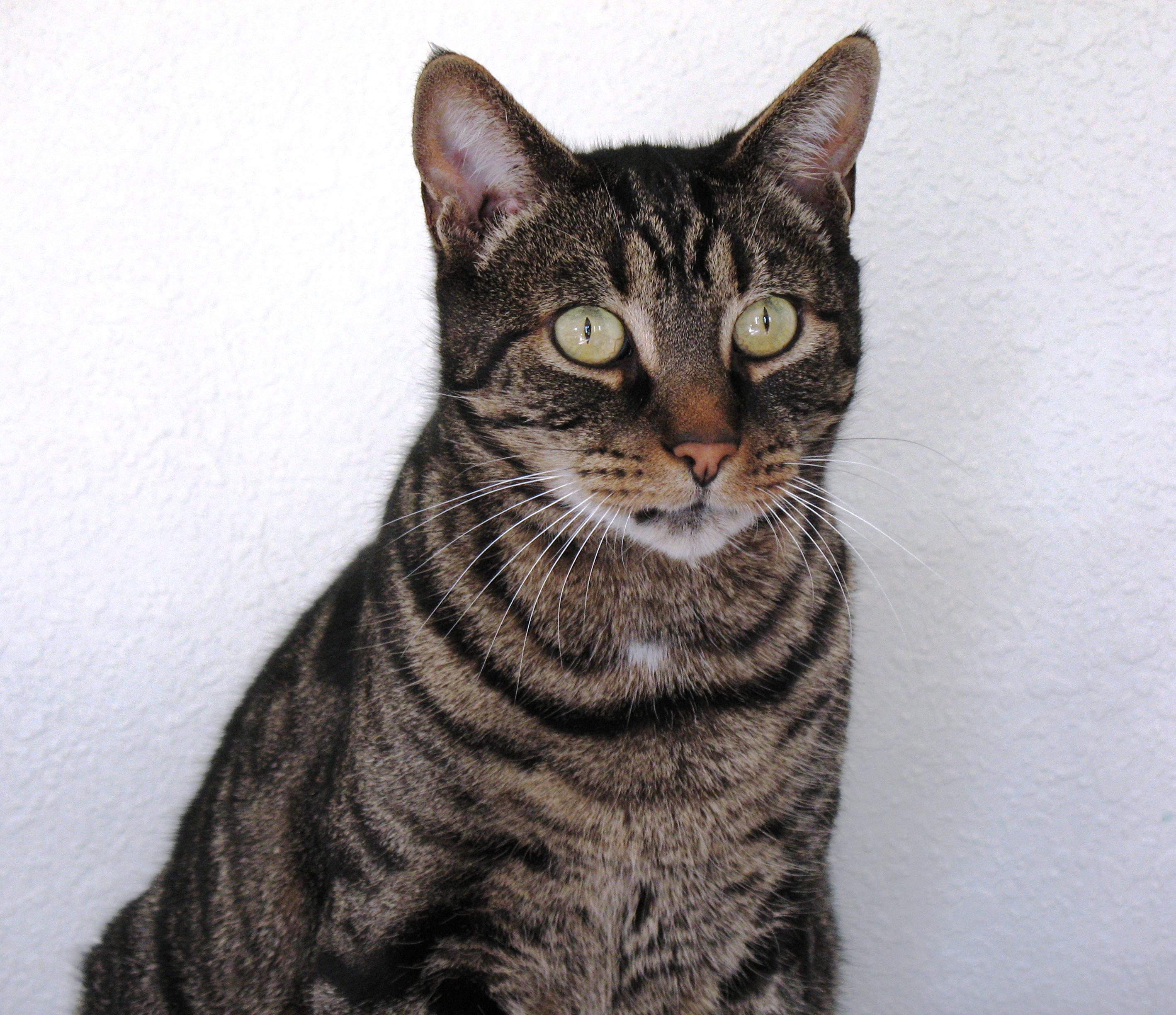
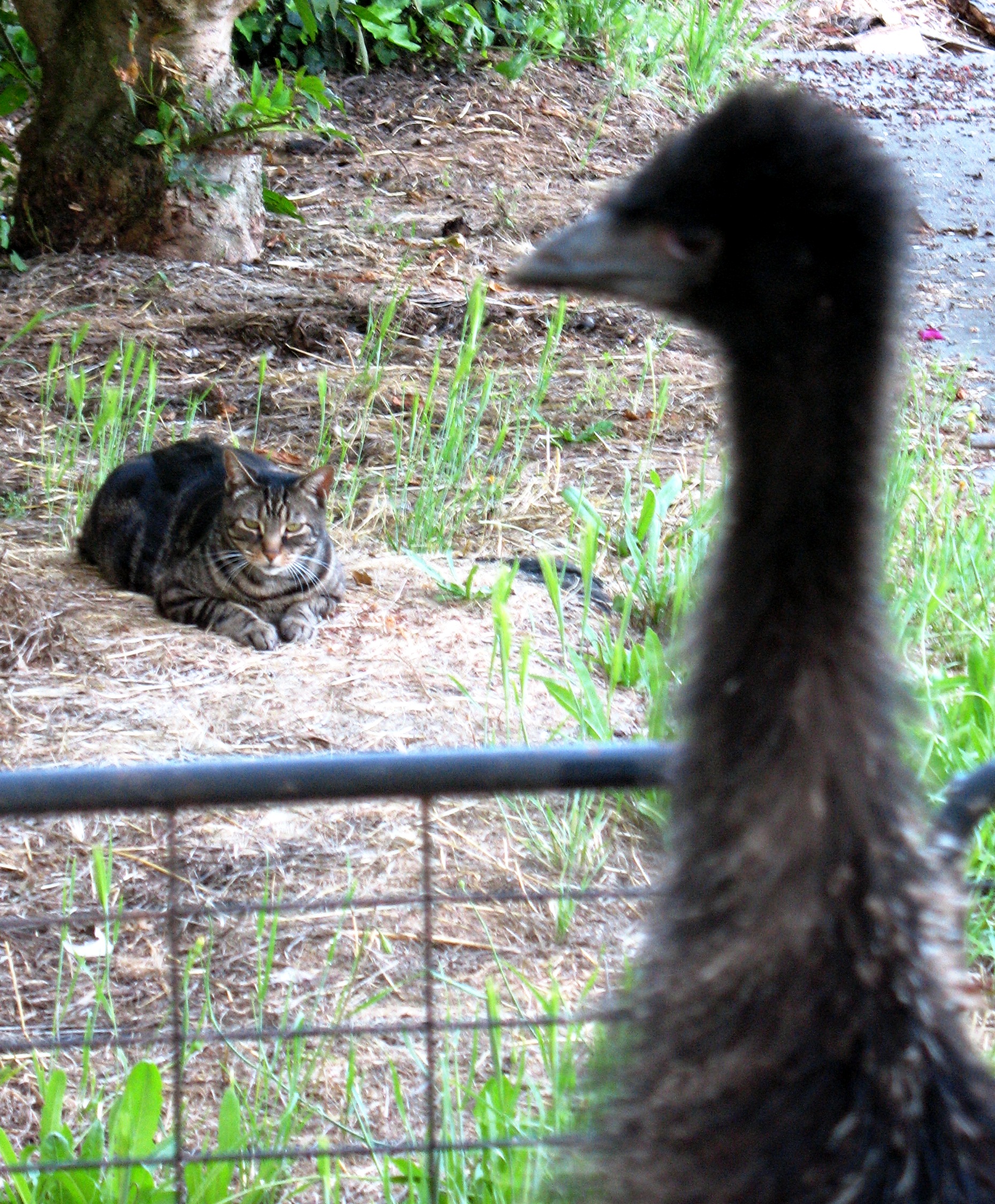
I’d have taken Bob in a heartbeat. After all, he had become Kilo’s best friend. My cat, Kilo (also a rescue cat), has a habit of finding feline playmates and inviting them in. I met Bob this way when I first moved to the farm—suddenly, I had two tabbies in my front yard, playing and hunting gophers, together. The two look alarmingly alike and, more than once, I’d opened the door for Kilo, only to find it was Bob I’d let in. Bob is a charming and social cat. He is sweet but dumb and, hey, good-natured and dumb isn’t so bad on a cat.

I was disappointed when another tenant beat me to the Bob adoption program. So, Bob moved to Stan’s, at the opposite end of the farm, and we saw less of him. For a while, we hosted Bella, Bob’s sister. She didn’t like Kilo, (or any other cat, for that matter) and took her leave to live with yet another tenant, so she could be an only-kitty. It was a matter of musical cats for a while. Then, Stan moved to another farm, taking Bob with him. I thought we’d seen the last of Bob.

Months later, Don alerted me to the fact that Bob was back on the farm! Don had seen Stan pull up in his truck and dump Bob at his old, former home. Elmer fleshed the story out more—he told me that Stan had called to see if he could return as a tenant. (When Stan’s new landlord learned he had a cat, he’d been given the option—leave or get rid of the cat.)  At the time, our farm had no housing available, so I guess the obvious solution was to abandon poor old Bob. (Personally, I think Stan’s landlord put the choice to the wrong critter.) The funny (not haha funny) part of this story was how incensed Don was about Stan’s treatment of Bob. Huh? If that ain’t the pot calling the kettle black.

Bob was traumatized by his sudden dislocation and disappeared for a few months. Then, one spring morning, a very skinny Bob was on the doorstep with Kilo. Bob had found a home. He’s been with us ever since. I suppose we shouldn’t have been surprised, or offended, when hearing that we were leaving, each of our neighbors asked that question, “So, ya takin’ Bob?”

Of course we’re taking Bob! One doesn’t just abandon a family member. And, maybe there’s the difference between farmer and non-farmer. We have pets. Farmers have animals.  And yes, I wish I could have taken the emus.

Bob, from a safe distance.

Bob, from a safe distance.

Maybe Too Much of a Good Thing

A.V. Walters

We all want our food to be safe. We all think that one of the roles of government is to ensure a safe food supply. And they are trying. (Take that any way you like.) There’s regulation pending that would make it hard for organic and small farmers to sell produce. You see, growing food isn’t a spotless operation. It’s done in dirt. Major producers can afford the equipment (and use the chemicals) that give you that pristine, scrubbed, (and not nearly as fresh) produce. Small farmers and roadside stands can’t. It’s as simple as that. Note that most of the outbreaks of food borne disease aren’t coming from small sustainable producers–they’re coming from Big Ag. We need to amend the proposed regulations to provide exemptions for sustainable producers. What looks like a good thing actually favors Big Ag over traditional farming. For more information or to make a comment supporting change to the proposed rules, click on the link. http://salsa3.salsalabs.com/o/50865/p/dia/action3/common/public/?action_KEY=12303

Online Timing

A.V. Walters

I cannot tell you how many friends have been after me to go online with social media. I always resisted, citing my privacy concerns. So, finally I did it, just in time for the Edward Snowden revelations and this blizzard of media attention to privacy issues. No, I’m not happy about it. And now all those same friends are laughing and emailing me about having chosen the worst possible environment in which to “go public.” What nobody is mentioning is that, while the government is a problem, multinational corporations have NO constitutional limitations on what they do with your private information and they are out there, swapping your personal info like bubble gum cards. (Buy Them, Trade Them, Collect the Whole Set)

I heard on the radio yesterday that Orwell’s book, 1984, has been an overnight success in sales in the past few days. Too bad George missed the peak. Everybody’s trying to find a way to sell their novels.

A job worth doing…

A.V. Walters

It’s ringing in my ears—I’m alternating between, “A job worth doing, is worth doing well,” and then there’s, “Lipstick on a pig.”

It’s always a challenge—matching the effort you put out with the task at hand. Arguably, one ought do their best, right? But what if the task is not that critical? What if “good enough” actually is?

We all know people who are so angst ridden about perfection that they can’t get anything done. Perfectionism can be a curse, one that often prevents some people from getting anything started in the first place. Anything! And, we all know the scourge of slap-dash. Personally, I hate undertaking something that comes on the heels of slap-dash, because it means you need to undo before you can get it moving in the right direction. Finding one’s way between the two extremes, and doing so in a way that’s appropriate to the task, is a lifelong balancing act.

My current project is refinishing an old oak bathroom vanity. It never was a “joy to behold,” just a serviceable, oak vanity, sold at home improvement stores all over the country when “golden oak” was the remodeling flavor du jour. Rick’s helping, too and I think he’s as torn as I am about it. It’s been stored in a barn for a decade or two, so the old finish is almost falling off. It’s a situation where the bad news is the good news. This finish is so bad that it’s easy to remove. We’ve just spent the day sanding. So I ask you—do we take it to perfection?

The vanity will be used in the home of a charming, senior couple who live happily on a fixed income. There’s nothing extra in their budget for big maintenance projects—they’re perfect candidates for the non-profit “fix-it” organization, Rebuilding Together, for which we volunteer. The vanity was an after-thought and is beyond the scope of the original project. So now, we’re scrounging and doing it as cheaply as we can. I searched Craigslist for a couple of weeks—unable to find a replacement cabinet in the size we needed and for what we wanted to spend. It has to be that size or we’ll have to redo the floor, too. Sigh. Anyway, after weeks of looking I finally found this vanity—not on Craigslist, but right under our noses, in one of Elmer’s barns! It was a hundred yards from us the whole time. It’s the perfect size and even matches the existing accessories and trim. Who knew?

I talked Elmer into donating it to the cause, and now we have to refinish it. We’ve sanded off what was left of the old finish and removed the water stains. Now we have to put the new finish on it. Just a coat of varnish?  Really, to do it right, we should first put on a coat of “golden oak” stain. Not only is that an extra step but, by staining it first, we risk revealing any problems in our sanding and bad areas in the neglected and abused wood. How far do you go to make something (that wasn’t wonderful in the first place) look as good as new?

Of course, we’ll stain it. I hate to say it, but we’re going to put in more time than the original manufacturer did making the damn thing.

But then, there was that moment, when it was clear we should replace the vanity. The wife looked anxious, she didn’t want to be any trouble, after all. Then she reached up to the seventies-vintage mirror/medicine cabinet (which has the ubiquitous “golden oak” finish) and said almost wistfully, “Maybe one that could match this?”

It’s no longer the style—that color. But the fact that it would be truly appreciated makes all the difference. So, we’ll stain and seal it, over the next few days. Then we can go back, install it, and finish the rest of the job.

Just needs the top.

Just needs the top.

Mum’s the Word
A.V. Walters
Mother’s Day is coming and it makes me think about my mom, and other moms who’ve had an impact on the way I think. I was blessed with a truly great mother. She was, and remains, interested in everything, creative, opinionated, charming, indulgent and still disciplined. She hung out with the greatest bunch of friends, mostly women, who were raucous and fun. My mother is a potter and so we found ourselves growing up at the edge of the world of creativity and craft and, on a good day, art. (We didn’t want to get snooty, after all.)
But mothers (and women) come in different stripes. It took me a little longer to open my eyes and appreciate all the things they had to offer. I had a boyfriend in college, Lionel. One weekend we went to visit his parents and to help a friend hang a gallery show near their home in Toronto. I was nervous, meeting the parents, and all. I needn’t have been. First, and it was the weirdest thing, his mom was the spitting image of my mom. They could have been sisters! I immediately felt comfortable with her and, I think, she with me.
Lionel had regaled me with stories of what a great cook she was, yet he couldn’t make toast. When it was time for dinner, I was not too surprised that the men-folk retired to the den while mom was left to do the cooking, alone. She closed the door to the kitchen. I joined her and offered to help. She assigned me to make a salad–and then she closed the kitchen door. The kitchen was stuffy and hot, so I asked why she kept the door closed.
She laughed, “Oh, habit, I guess,” taking a stick of butter out of the fridge, “They think I keep kosher.” She smiled.
During dinner (and it was great), she asked Lionel if he’d be back the next weekend for his cousin, Marsha’s wedding. From his response, it was obvious that he’d completely forgotten about it. He asked who she was marrying! His mother rolled her eyes.
“She’s marrying David! She’s only been dating him since high school, where have you been?”
Between bites, he responded, “David? No, he’s such a dweeb. She can’t marry him.”
Lionel’s mother paused a long moment before she answered, “Well, your cousin’s no prize either.”
Lionel almost choked on his dinner. That ended that conversation. I learned that different families communicate in different ways. I’d observed a push-pull in candor that was different in my family–but clearly worked for them. Lionel and I broke up shortly afterwards. I’ve never given him much thought over the years, but I think about his mother, frequently.
Happy Mother’s Day out there, to everyone in all their wonderful and different ways.

And now… on Kindle…

A.V. Walters

I attended a business conference this week. Most of the presentations were dry as dust, except for one woman, who is an expert on the psychology of purchasing behaviors. From a larger, societal, perspective, what she was saying gives me the shivers. She studies people and their shopping behaviors, which are increasingly happening on-line. There is an ever-increasing shortness of attention span, nowadays, (hello, are you still with me?) that can take your breath away—in a nanosecond kind of interval. She analyzed the time spent researching (reading other customer reviews or perusing manufacturer’s sites) and how long it takes to complete the purchase-cycle. Once a decision has been made, people react in a split-second. The difference between a sale and losing a customer’s attention can literally be a question of how few clicks it takes. Too many clicks, or too much text… and you’ve lost them. Alas.

This is particularly surprising when the product is a book. Consumers who cannot instantly obtain the book they want will be drawn and diverted by “People who purchased this item also purchased that item”—and off they go! In a product that will take them hours to read, and from which they should derive many more hours enjoyment and contemplation, they’ll change their minds (or simply lose interest) if they cannot have it… now!

She reported that Amazon knows this, and designs it into their interface. Amazon now sells more books than any other outlet in this country. Industry pundits claim that in a few scant years, Amazon will be the biggest retailer in the world. And, we’re not just talking books, either—Amazon sells everything.

I guess I’m old fashioned. Apparently, I frequently stand in my own way—the only thing between me and success is… well, me. My books are on Amazon. I’m a POD (print on demand) author, so Amazon is the best distribution vehicle for the small or self publisher.  But I have never listed my e-books with Amazon. I’ve been loyal to smashwords.com.  Something about its counter-culture approach has always appealed to me. And, I’ve been offended by the war of the Goliaths—the major players in the publishing industry who seek to turn authors into “content providers.” I see the squeeze between retailers and publishers and note that more often than not, the losers in that battle are the authors.

I know that the publishing world is in flux. It is both a curse and an opportunity for authors. Caught in the new age of information, the old stuffy publishing houses have pulled in, more than ever. They are reticent to take a risk on new talent. The only sure-fire books these days are celebrity tell-alls, diet books, or Clancy-type thrillers. Oh, yeah, and anything with vampires.  Literature is lost in the mix. And yet, in the corners of the maelstrom, good books are peeking out. There is a chance that an elegant or beautiful story can find its audience. Oh yes, your story has a chance, if it can find its nanosecond.

And so, I announce that my books are now available as e-books on Amazon for its Kindle readers. For the moment, I have stopped tilting at windmills and will go with the mainstream (read–tsunami.) My sister loves her Kindle. She reminds me of this, all the time. I see it in the grocery store, people reading in line. The marketing experts tell us that gum, candy and tabloid purchases are down, because folks in the queue are busy with their smartphones. The impulse purchase has moved online. And now, for better or worse, so have I.

So, if you have a nanosecond or two, check them out—The Emma Caites Way and The Gift of Guylaine Claire—now available, instantaneously, at an on-line retailer near you.


The following is an article written by guest writer TRESSA S. EDWARDS, daughter of our intrepid editor. Originally published in her high school newsletter, Tressa has given us permission to post her article. Though the content is not typical for Two Rock Chronicles, we feel Tressa’s voice deserves to be heard, and look forward to her future contributions to the blog and to Two Rock Publishing.

New Hope in the Battle Against AIDS/HIV

Tressa S. Edwards

For the last 32 years, AIDS has been a somewhat mysterious disease, killing off nearly 30 million people since its discovery.

On June 5th, 1981, American Epidemiologists reported that five previously healthy men in LA had become ill. Two of them died, becoming the first lives claimed by a then unidentified virus. Now, over 33 million people are infected with the same virus that causes AIDS. Though there is now a name for it, a cure hasn’t yet been discovered. Or has it?

In 2007, a man known as the ‘Berlin Patient’ was cured of HIV, the virus that leads to AIDS. His name is Timothy Ray Brown and, at the time, was the only person on record to be cured of HIV. He received a life-saving (in more ways than one) bone marrow transplant for Leukemia. Found in the bone marrow was a gene mutation which made the newly produced white-blood cells resistant to infection while playing host to the HIV virus. Though he was lucky, not everyone can have that same opportunity. Aside from being incredibly painful, bone marrow transplants can be fatal or have severe side-effects. This rules them out as both practical and as a cure.

Recently, however, there was a baby who was cured of HIV. She was born to an unknowingly HIV-positive woman in rural Mississippi. Just 30 hours after she was born, her bloodstream was tainted with signs of the virus. She was indeed HIV positive, having most likely contracted the disease in the womb. After confirming her status as HIV-positive, she was transferred to the University of Mississippi Medical Center and given her first dose of AIDS medicine. Within a week, the viral load was almost undetectable. She was then continually treated for the next 18 months, until the mother disappeared with her child. She re-appeared some time later, telling doctors that she had not given her child her medication in over 5 months. The doctors assumed that the virus would have continued to replicate, and start to deteriorate the child’s immune system. However, they ran tests and found her to be HIV negative. After checking and rechecking the results, the young girl was deemed ‘cured’ by researchers at the University of Massachusetts, as well as John’s Hopkins. She is now 2 1/2 years old, and still HIV free.

So what does this mean for a cure? It means that those at risk of being born with HIV, as well as those already born with HIV, are given a possible chance to remove the virus from their systems. Though there are preventative measures already available for mothers who could potentially pass on the virus, they are not always effective. Instead of simply giving people a way to potentially prevent the disease from being passed on, there may be a way to now ensure that even if it is transferred, it doesn’t have to claim more lives. Scientists and researches along with doctors are figuring out ways to measure the proper dosage, and length of time which newborns need to be given the standard AIDS medicine for it to effectively remove the virus from their systems. Let us hope they find a way soon. In the mean time, we must remain proactive and aware.


Mr. Emu  (Dad)

Mr. Emu (Dad)

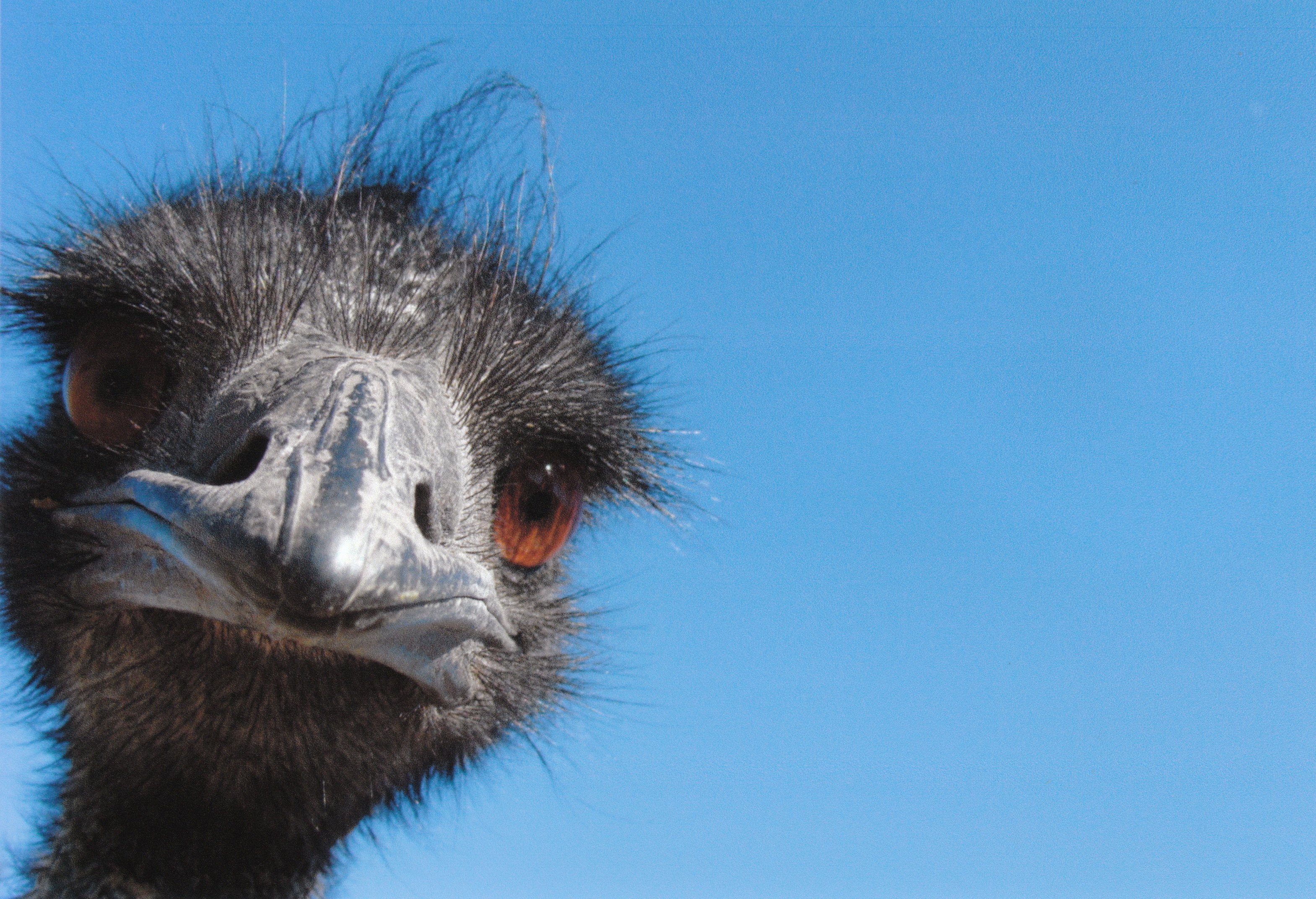
Sometimes I’ll look at my stats and see that someone has found my blog based on a particular search. Maybe I know the answer–but it isn’t really clear in my blog postings. Then I feel like I’ve let that searcher down. This morning there was a search “baby emu falls down, rolls and gets back up.” Where are you searcher? I imagine that you’re expressing concern about your baby emu, that maybe you think there’s some terrible neurological problem. Fear not! Come back, come back. I have the answer. Your baby emu is playing! Yes, that’s right, we call it the emu dance.

Have you ever noticed that when creatures play (including us) they mimic adult behaviors (behaviours if you’re a Brit or former colonial)? Kids build forts or play house. Kittens roll and tussle–chase things and pounce. Emus dance. After all, without arms there’s not a lot of variety in the play department. That “drop, roll, and run” is a prelude to an emu courting dance. If your baby emus is doing it, it means she/he is happy. They are playing in the only way an emu knows how. (Often, immediately afterward they’ll race around at high speeds–running is another emu talent used in play.) The really fun part is that sometimes, they’ll do it to music! It’s a sight to behold. They love music, especially if the music has whistling sounds or flute solos–high notes that sound like Papa emu’s whistling tones. Also, if you can whistle, it a great way to summon your emu, because they are already pre-wired for that sound.

I hope that emu questioner comes back–there’s no need to worry. (Next time, think about posing a question in the comments area.)


Now, for the meantime, I’m back to my volunteer work.


It’s that time of year again…that time when we roll up our sleeves to volunteer as amateur builders (well, I’m an amateur, but Rick’s a pro) and spend a couple of weekends fixing up the homes of seniors and those on fixed incomes, so that they can remain comfortably in their homes. Rick and I are House Captains on a big project this year–so for the next week or so, there may be scant activity on the blog. Bear with us and our aching muscles. We have an entire yard to transform, two porches to rebuild, a bathroom to remodel. wiring to upgrade, a chicken coop to build, a garden to put in, fences all the way around….it will be transformative for all. But don’t worry, it’s not just us. This organization (Rebuilding Together) recruits a zillion volunteers for the ‘big day.’ Our project alone will probably have 40 volunteers who show up, work gloves in hand, ready to pitch in. (And we’ll need them.) On a large project like this, one day isn’t enough, so Saturday we met with 15 volunteers to set the fence posts. We cleaned up a lot and cut down some out-of-control trees (so there can be sunlight in the garden.) One of our volunteers yesterday was 83! (He’s worked on several of our projects and he works so hard he puts the kids to shame.)

This week is planning and logistics. Then, next Saturday our army of fresh-faced, muscle-flexing, angels will descend on the site and, by days end, our exhausted crew will go home with amazing images of before and after dancing in their heads. It’s incredible what you can achieve with good will, doughnuts and coffee! See you soon when things are under control and Rick and I can return to our own dreams of building a future.

Don’t worry about the emus–they’re thigh high now and spending their days munching away on the greens in my front yard.

Digital Pickpockets

They say that you should check now and then. I didn’t really believe it, but, because they say you should, from time to time I do a Google search on my own book titles. Really, to be extra careful, one ought to Google a section of text, which might be a better test.

So it’s the end of the month and I ran through the Smashwords standard SEO search on both The Emma Caites Way and The Gift of Guylaine Claire. I didn’t expect to find anything unusual, just the routine references to my blog and the on-line booksellers who carry the books. In all honesty, it’s a rote thing; I’m not even sure what I’m looking for.

And then, there it was! An on-line retailer (who, until this is fully resolved, shall remain nameless) that was listing The Emma Caites Way for download as a PDF. Looking closer it gave the online “handle” for the individual who “shared” it, and that person was not me. Somebody was actually stealing my book and making it available for online download. Can you say copyright? A few more clicks confirmed my suspicions. I don’t know whether to be outraged or flattered.

It wasn’t even a very sophisticated theft. The Emma Caites Way is a particularly distinctive title. I did that on purpose. They didn’t change it—I guess because that way they ride my negligible marketing coattails. Nor did they remove my name from the PDF (a not impossible task.) One has to wonder how this can pay. I’m a pretty small-scale target, a self-published author with only a couple of books. That leads to the inescapable conclusion that they didn’t select me specifically. It’s no measure of the quality of the product. To make such a violation financially viable, this character would have to hit many, many authors and let the numbers do their work.

This must be pretty common. The website has a message to copyright holders who contend that their work has been illegally listed. There’s a form you fill out, the DMCA Complaint Form. (Digital Millennium Copyright Act) I guess that with this kind of theft so common, one needs to streamline the process. That’s another argument that this is about the numbers, not about someone who picked me, because of the content and quality of my work. I suppose it’s an argument against smashwords free downloads, but I hate to restrict that as a marketing option for a new author.

I filled out the form and submitted it. Someone on the other end will look at the information and no doubt delete the pirated listing for my “document.” And that will be that. There was a time when theft of copyright was at least a compliment.

Heads up out there. It’s probably not about the dollars and sense of it, but you do need to watch your back. Constant diligence, in this, and in everything.

Country Fresh

A.V. Walters

Even while I lived in the city, I hung onto my rural roots. I gardened and produced most of my summer fare from a postage stamp-sized back yard. I canned jams from the plum tree, and I hung my laundry out in the sun, to dry. So, it should come as no surprise that, when I moved to the farm, not only would I want to continue these patterns, but there’d be some room for expansion. But when I explained my plans to Elmer, he seemed a bit alarmed. Not at the gardening, that made perfect sense. And, like a lot of country folk, he fully supports canning. The problem arose when I asked Elmer to put up a clothesline, of all things!

He squirmed at the notion, “Why the heck would you want to do something like that?” I was ready with my environmentally friendly, power-of-the-sun, low-carbon-footprint, Pollyanna diatribe.

“Well, we have a lot of wind, you know. It whips up the dust, and all. So, you’d want to be sure to bring it in before the afternoon winds start up.” He didn’t sound convincing, and it seemed like a strange response—a little wind would be exactly the ticket. In what better environment could there be to dry laundry? (I’d failed to note the almost-complete absence of clotheslines, in the area.)

Elmer never did help out with getting that line up, and given his reaction, I didn’t press it. After a while, I bought the materials and installed it myself. And, he was right about the wind and the dust. If you left the laundry out, late in the day, you’d have to wash it, again. But our mornings were still, and my line was set up to take advantage of the morning sun.

One morning I pulled a fresh towel from the line and headed into town for a swim. (There’s nothing like a vigorous work-out in chlorinated water to clear your head.) As I walked back into the changing room, I caught the unmistakable stench of cow manure. I laughed to myself and thought, somewhere there’s a farmer in here, for sure.

I’ll have to admit, here, that when you’re exposed to something a lot, you become, well, desensitized and… I live next door to a dairy. So, when I grabbed my towel, I almost choked. That farmer was me! And that certainly explained why they don’t hang their laundry out. Oh my! And that was the end of my energy saving foray with country laundry.

Someday, I’ll live somewhere with a different background aroma—and I’ll go back to the clothesline. (Rick said he thinks he knows the perfect location.)

Hearth and Home

A.V. Walters

It’s a strange underpinning to the season of renewal, an almost depressing release of the winter norms, that comes before the longer days and warmer weather can step in to ease the transition. You see, in winter we endure the long, dark days with the light and warmth of our woodstove. There is a center to our home, as we cozy up each evening in front of the fire to rehash the day, or play Scrabble, or just sit and read. When it’s warm, the fire isn’t necessary for heat, but we miss basking in the golden light of the flames. There’s an intimacy to it and a ‘place’ where we belong in the winter evenings.

The day-time temperature in our home now ranges around 64˚ (F)—that’s about what we heat it to, in the winter. Somehow though, especially if it’s gray out, it doesn’t seem quite warm enough. And we’re not sure where to sit in the evening—the living room suddenly darker, without the glow of the stove. I confess we’ve lit ‘cosmetic’ fires—small fires with just enough warmth to keep the “hearth” in “hearth and home.” The cold glow of a computer screen just isn’t the same, even if it does spell a certain increase in productivity.

Both Rick and I seem to be experiencing a similar winter withdrawal. We wonder whether this is common, or just us. The rhythms of spring and summer, gardening, long evenings outdoors, sometimes chatting with the neighbors—beer in hand, aren’t due for at least another month. Now, with daylight savings, the days are longer but not yet appreciably seasonal. Mostly, it just makes us feel tired.

We theorize that, in many homes, the cold blue glare of the television has become a poor, substitute hearth. Modern folks have opted for entertainment, rather then the primal satisfaction of day’s end in front of the fire. Do they even know this? Do they ever think about the crackle of kindling, and the random dance of the flames? We certainly don’t miss television, but we yearn for a more fully realized shift of season to help direct our energies away from our now-empty patterns of winter.

I confess that I’m filling some of the void with evenings of baking—tonight, a flourless, almond based chocolate extravaganza. Summer may find us, eventually, garden-ready, but a bit rounder.


Nature Giveth, and Nature Taketh Away

R.R. Edwards

Life in rural Sonoma County can be an odd blend of nature at its best, and then a show of its harsher side. We’d arrived home yesterday at about 4:00 a.m. after a stressful couple of days, and an 11 hour drive. Awaking after only a few hours of sleep, we were beat, and decided it was a day to lie low. We owed Mr. Emu a visit—it had been about a week since we’d made off with his five chicks to give them a better chance at survival, and, after debating about dragging our tired asses out of the house and up the hill, nature’s perfect afternoon of sunshine and blue skies won out.

We made our way past the field where Mrs. Emu was grazing alongside the sheep, stopping only long enough to give her a few pieces of apple we’d cut up for Mr. E. She’s now in the habit of making her way over to the fence when she sees us walking up the road, looking for her share of apple. Further up the road are the two fields (divided by a fence with a gate) that Mr. E has been occupying along with about a dozen sheep and lambs. The upper field holds a pond that you can’t see from the road, and the emu’s nest was near the pond. When we arrived at the lower field, there was no sign of Mr. E. We thought this odd as he’s usually wandering along the fence, near the road, and even when he’s in the upper field, he can usually be seen. It was then that we noticed a lone buzzard, standing in the far corner of the field. I didn’t give it a lot of thought—normally, if there’s something a buzzard is interested in, they’re all interested. Any carrion meal of note is usually well attended. I was about to head to the upper area in search of our missing bird when AV says, “Let’s check it out.”  As we approached, the buzzard took off, abandoning what was clearly the remains of an animal. At first, the only thing I could see was a rib-cage, picked clean. Just as I was thinking it, AV said, “It’s Mister Emu!” My heart sank, and AV looked as if she were about to cry. I wandered closer, and it was then that I realized it wasn’t Mr. E, but the remains of a lamb. It’s not often that we’d be relieved to come across a dead lamb (especially one who was killed by a predator) but, in this case…

After recovering from our initial shock, we started looking for clues as to who the culprit might have been. We didn’t see any tracks or other evidence but concluded that it was most likely a coyote—even though a fox could take down a large lamb, and there are (be it rare) mountain lions about, coyotes are usually the biggest problem.

It was then that we noticed two lambs that were trapped between a pair of fences that ran between this and an adjacent field. (A 6’ wide strip was planted with trees to create a wind-break, and the fences protect the young trees from the sheep.) How the lambs got themselves trapped in there, or how long they’d been there was unknown, but before we took on this unexpected task, we still needed to solve the mystery of the missing emu.

We passed through the open gate, to the upper field, and came over the rise to an open area next to the pond. And there, sitting on his once-abandoned nest, was Mr. E.  Along with this discovery came the realization that he had returned to the nest with the intent of hatching the two eggs he’d walked away from, about a week earlier. In our haste to remove the last chick, we left the eggs he’d abandoned the day before, not imagining he would return to them. In the past, he’s pushed eggs out of the nest, or left them if he determined they weren’t viable, and we never saw him return or reclaim an egg, once he made the decision.  Needless to say, our relief at finding him alive and well was replaced by guilt. First, we’d taken his 5 chicks and then, carelessly left the eggs that he’d now brooded over, needlessly, for perhaps a week. Our learning curve on emus continues to be steep.

We were now left with a lot of questions, and few answers. First, did the predator’s attack on the lamb prompt Mr. E to return to the nest in a misplaced effort to protect his unborn? Or, was Mr. E pointlessly sitting on his nest rather than tending to his duty of protecting the lamb from a coyote? And, why were the two other lambs trapped in the fenced area? Were they fleeing from an attacking coyote by working their way through the fence? Were there originally three lambs stranded between the fences, cut off from the rest of the flock, their mothers and the emu—one falling victim and pulled out, into the open field and eaten? Or, were all these events totally unrelated, and it was just another day on the farm?

We removed the remaining emu eggs from the nest, and made our way back down the hill to the lower field.  We opened up the end of the fenced area, coaxed the two lambs out, and back into the field to join the ewes. We located the hole in the wire fence that gave the lambs access. Whether they wandered in, in search of greener grass, or were spooked by the coyote, we’ll never know. Oddly enough, it was in this same fenced-off area that two emu chicks fell victim to a fox, a couple of years ago. That event also raised similar questions—did the chicks wander in between the fences, where they couldn’t be protected, or did the fox pull them in, seeking protection from the emu parent? AV had come upon the scene, after the fact, where she found a highly agitated Mr. E, frantically pacing outside the fenced area.  There, just out of the emu’s reach, were the remains of one chick, and the other was nowhere in sight, most likely carried off by the fox. The fatal error may have been Mrs. Emu’s choice of a nesting sight next to this fenced-off “no man’s land.” (Though the male emu hatches and rears the young, the nest is established where the female chooses to lay her eggs.) AV returned the next day, with apple treats, and found Mr. E standing at the nest site, still dazed from the trauma of watching his chicks meet a violent end. A surprisingly, touching moment occurred while AV tried to console what was clearly a grieving parent—this oversized, prehistoric beast gently wrapped his long neck around AV’s shoulder, and embraced her.

Today, we headed back over and found Mr. Emu in one of his usual spots—walking the perimeter of the lower field, near the road. We fed him apple pieces and emu chow, and life (as if we can ever truly understand it,) seems to have returned to normal. That is, if you consider five emu chicks living in your bathroom, normal.


It’s that time of year again–well, it’s late for that time of year. For some reason I always miss the true peak of pruning season and sneak it in, just before the whole thing starts to bloom. So today I’m doing three trees and the roses.

The pyracantha ought to be a shrub, but before I got here someone let it go and it was a tree–dropping its litter and berries all over the roof. I’ve been pruning it shorter and shorter each year. I’m trying to make it into an arch over the sidewalk and now, after six years, it’s finally started to take some shape. I also do the annual whack at the buckhorn. It’s a shame, really. It was planted next to the house–as though it were a shrub. Unfortunately, in its natural state it would be a lovely, large tree. Elmer, the landlord, wants a shrub, though, so each year I whack it into a sad version of its real intentions. I feel guilty doing it, but the alternative is that Elmer will. I love the man, but he is a plant butcher. So I undertake the annual ritual of pretending that you can, year in–year out, cheat nature. The buckhorn should never have been planted next to the house. Ultimately, if left to its own devices, its roots can, and will, destroy the foundation. I have trouble with this. One of my pet peeves is the short-sighted planting of trees. In any planting scheme, one should always consider the soil, the light and the size of the proposed tree as it will fit into the existing landscape. In that regard, this farm is a constant test of my patience and reserve. And finally, I’ll trim the peach tree.

The peach has it’s own history, as previously discussed in this blog. It was infected with peach curl when I came, and finally, last summer (after stripping all the leaves) we had a curl free season. The tree grew lots of new, lovely, healthy branches. It has never looked so good. So I’ll trim it with a mind to an improved shape and maximizing this year’s crop. It bears lovely peaches. Pruning the peach has its own hazards. It’s planted on a mound in a rock garden. The rocks are large–and tippy. Under one side of the tree, amidst the treacherous rocks, some enterprising garden fool has buried a large, Victorian era bathtub. I guess it’s supposed to be a water feature, though usually it’s just a breeding ground for mosquitoes. Over all of this, is a groundcover–vinca major, whose job it is to obsure one’s footing enough to guarantee a dip in the very cold, murky water of the tub, should you try to prune in the winter. I’ve fallen in once already today. The mounded garden makes it impossible to water the peach tree. The rocks and tub make it impossible to use a ladder safely in pruning. This is the kind of tree placement that is typical on this farm. It’s a good thing Elmer makes his living with livestock.

That’s what’s new on the farm. My personal life has been a roller coaster of personal trials this past month, so the pruning comes at a good time. Pruning is a very reflective chore–each cut a set of decisions about shape and future direction. I love it. It is as close as one gets to sculpture in adult life. I’m pruning in my life, too, making decisions about future directions. So there are parallels to this winter chore.

I’ve returned to writing–jumping into The Trial of Trudy Castor as though I’d never stopped. It’s funny how you can leave a story–for months even, and then pick right up with it, like an old friend. In my recent tumult, I’ve neglected my marketing on the last book The Gift of Guylaine Claire. It’s not nearly as easy a read as the first book, though I think it’s the better of the two. I also think that the French Canadian name, right there in the title, inhibits interest. We shall see. In the interim, I’m offering a free download of it–good through the tenth of March. If you have an e-reading device, feel free to download it through smashwords.com. Enter the coupon code  VH78Q at check out. If you like it, please leave a review on goodreads.com (or, if you must, on Amazon)–or comment here on the blog, if you prefer. I look forward to some input.

Boomerang Advice

A.V. Walters
Once I had a very long conversation with a census worker. He confessed that he loved to scuba dive, but that he’d gained some weight and his wet suit no longer fit. As soon as he lost the weight, he was going to get back to it. I looked him squarely in the face and said, “Buy a new suit.”

No, that wasn’t necessary–he was using the new suit as an incentive for the diet. So I asked him how long it had been since he’d been diving. Ten years.
Clearly, the new suit wasn’t enough of an incentive and actually, instead of being a carrot, had turned into the stick. He felt guilty about the weight and used that guilt to self-flagellate and deny himself the pleasure of an activity that would enrich his life and would probably help him to lose weight. I told him so. He looked liked I’d slapped him.

About a month later he was back on my doorstep. He’d come to thank me. With the new wet suit, he’d been diving and was feeling more alive than he had in years. Of course, then he asked me out–and I declined. Why it is that I get into these conversations with perfect strangers is another thing entirely, but the message is to get to the business of enjoying life and accepting the challenges presented. Every time we put off being who we are, we lose time–the most precious commodity of all.

It’s advice that, once given, should always be taken right back. Look in the mirror. What aren’t you enjoying today? Get to it.

Old Business (something old, something new, something rotten, something phew!)

We’re headed out of town for a couple of weeks, and so it was time to take care of some things that had gone a little ‘long’ anyway. There’s something especially satisfying about getting rid of old garbage before the New Year. In this case, I mean that literally. Garbage.

There’s a funny thing on the farm; we have no trash service. It’s assumed that if you select a rural lifestyle, you’ll adopt a more hands-on approach to the nitty-gritty details of life, as do most rural residents. From time to time the tenants whine about it, but Elmer sticks to his guns. If he provided trash pick-up, there’d be no incentive for tenants to reduce their trash stream by composting and recycling. Elmer knows of what he speaks. He spends a lot on dump fees. Despite the fact that he’s a farmer, Elmer doesn’t separate or recycle, at all. He doesn’t even compost. As a widower, he buys more processed foods than most, and all that packaging ends up in the trash. Besides that, there’s a Re-Use store at the dump, where folks donate things that are still good. Often on hauling day, Elmer will come home with as much as he took!

I gloat over my low dump charges. If you go through and get your vehicle weighed in and out, the rate is ridiculously low. Today we paid $5.00 for sixty pounds of trash. That’s especially low when you consider that this is our first dump run in about eight months. We recycled at least four times that much—but hey, recycling is free. It’s been funny over the years to watch the strategies of the tenants in disposing of their household waste. One woman sneaks to a department store dumpster on a regular basis. Another used to bring her garbage to a friend in town—and stuff it into her curbside bin (or that of the friend’s neighbors.) Still another used to bring her trash into work, until she got caught! I note that guys never discuss their trash strategies. They just cross their arms and nod.

I’m another odd case. I don’t have much household trash. I compost the organic stuff, burn some of the paper and cartons to start the fire in the morning, and recycle everything that I can. The county dump is located conveniently only a few minutes away, so I don’t know why everyone avoids it so. Even with all my waste reduction efforts, some stuff just has to go into the trash. The clear plastic bags that my dried fruits come in, and some blister-packs (which I avoid buying whenever possible)—these things must be hauled off to the dump. It takes me six to eight weeks to collect a full bag of these things. They’re clean, don’t smell and don’t attract pests—so I don’t mind them building up. It used to be that I’d go about 3 months before I’d make a trip to our local land-fill—but that was before Rick. You see, Rick has a truck.

Nobody wants to stuff a passenger car to the gills with garbage, but a truck gives a whole new horizon of hauling avoidance. By the time we need to load up the truck for the trash, the recycling is at the point of ridiculous. Today we filled the entire truck bed with paper, cardboard, bottles, plastics and a little scrap metal. (We don’t eat much in the way of canned goods—other than what we can, ourselves.) The bottles… Well, that gets a little embarrassing—it must look like we’re drunks—but it’s really just an accumulation over a fair amount of time. Today I unloaded four big plastic bins of assorted, glass containers. I was glad the dump was deserted, (it being Christmas Eve Day and all) so I didn’t feel like I’d need to explain—“No, really, this is over 8 months worth!” Once I was unloading my glass containers and some wise guy commented, “That must have been some party… How do you get invited?” I suppose it was a pick up line (you’d be surprised how many guys will try to hit on you at the dump) but even then, it was a little embarrassing.

After all is said and done, it feels good to have all the trash gone. We can go into 2013 with a lighter step and an empty basement. And it clears up one New Year’s resolution, before the new year even starts.

The Bad News and the Good News

A.V. Walters

We were already pretty much resigned to it. Yesterday was the deadline. It was several days past the last possible date on which we could expect the emu eggs to hatch. With as many doubts as we had about Mr. Emu’s ability to incubate the eggs during the coldest days of the year, I can’t say that modern technology did any better. (And, it’s been cold, into the twenties at night, several times.) At the moment, the score is: emus—0, electricians—1. Sadly, it was not the much anticipated storm-driven power loss that did us in; as best we can tell, it was the inadvertence of renovation. So yesterday we walked down to the incubator and flipped off the switch.

When the storm clears we’ll remove the eggs and take them outside, to open and bury them. We feel compelled to do an ‘egg-topsy’ to determine whether they were ever viable, and if so, at what stage of development they failed. I’ve done this before, and believe me, you want to do it outside. If you’ve ever experience a rotten egg—think of that times six (for the size of the emu egg) and with an explosive force rivaling anything outside of a military application. One time, an egg exploded when I was burying it. I was enveloped in a cloud of shimmering, golden light—a halo about 12 feet across. It was beautiful—until I took a breath. OH-MY-GOD! The stink—I thought I would die. There I was, encased in a cloud of rotten egg, my clothing saturated in the stunning mist of it. It was breathtaking, literally, in every way. There was no escape. Quickly, I finished the burial and headed directly into the shower—clothing and all. So this time, we’ll be very careful.

I’m sad it didn’t work out. Before we went to do the deed, Rick chopped up a bunch of apples. We thought it would be nice to visit the emus, after pulling that plug—sort of an affirmation of the reason we made the effort, in the first place. We hadn’t been up to visit them in four days, which isn’t unusual. So, we crossed the highway and headed up the hill. That part of the farm is almost a mile from our side, and we chatted about whether we should intervene in the emus’ future efforts, at all. (It’s not like we get a lot of support with it, and we’re not sure anyone even wants more emus on the farm.) Still, those emus keep trying, so it’s hard to not want them to succeed.

Well, it’s lambing time. (I know, it seems odd to bring those baby lambs into the world at the coldest time of the year, but they are dressed for it—100% wool!) I have to admit, it’s fun to watch them cavorting about, in the sun. (I mean, They actually frolic!) Sheep are lumbering, dirty and dumb, but watching little lambs, though, is like watching children. They bounce and run. They form little bands of trouble, and then, at the slightest provocation, run lickety-split, back to their moms.

Anyway, when we got to the high fields, only Mrs. Emu was in sight. We exchanged nervous, knowing looks. Well, when we had removed the eggs, we’d predicted it. Emus will continue to breed until the days start to lengthen. A search of the field revealed what we already figured—Mr. Emu was bedded down with five new eggs. By week’s end, we’re sure there’ll be more. (Those darned emus—you turn your back for a minute…)  This time, we won’t take the eggs. If Mr. E can keep them alive over the next 55 days or so, they’ll hatch into a warmer, Sonoma County Spring, with a good chance of surviving. (It’ll just be a question of outsmarting the predators.) We decided their start date is December 15th, so we’re counting down. There’s some good in this, beyond winter timing—the earlier batch of eggs was conceived during the worst period for emu nutrition (the late fall is yucky, dry grass and a few treats from us), this later clutch comes after two months of green grass and plentiful water. So perhaps these new emu babes have a better start, out the gate. A door doesn’t close, but a window opens…


Playing Possum on the Bell Curve

A.V. Walters

It’s about nine miles into town and, at certain times of the year, it’s carnage. This is that time of the year. The hills are verdant. Our seasonal rains have started and the wild critters have come out, in force, to take advantage of the return of resources. That means they’re moving about and, unfortunately, they don’t understand the rules of the road. The only rule that should concern them (besides, RUN!!!) is that they cannot win in a faceoff with a motorized vehicle.

About a month ago, I noticed (what my partner calls) the annual, ‘Running of the skunks.’ All of a sudden, for just a couple of weeks, the skunks decide that they need to cross the road, now (and often fail.) Yes, of course, they’re trying to get to the other side, but why the sudden, yearly mass-migration, just to get there?

The steel-verses-fur imbalance is especially true of the possums. There were four of them on the shoulder today and they weren’t playing possum. Possums have an unusual survival strategy. When confronted with extreme stress—a life or death choice—they lose consciousness. That age old technique was a winner when their primary opponent was a predator. Some time ago, (say, a millennia) there was a survival advantage to fainting in the face of danger. (It worked for Victorian era women, too. Go figure!) Those oddball possums who developed this strategy, lived to see another day, and bred like rabbits.) It worked because many predators will only eat live prey, so the ‘play-dead’ strategy fooled them. Embedded deep in the predator instincts is the caution not to eat carrion—to protect them from illness borne by rotted or poisoned meat. (Oddly enough, that’s the strategy my partner used, growing up, while foraging through the family refrigerator.) But the possums don’t just ‘play’ dead, they actually go into a neurological overload, and completely shut down. They are literally, out cold.

When the threat at hand is a three-thousand pound, multi-wheeled projectile, hurtling directly at you, this passing out thing doesn’t quite cut it. Possums have failed to make the evolutionary connection to address this kind of threat. (On the other hand, they are such prodigious breeders, their niche in the ecosystem is safe— unfortunately, the predators don’t fare as well.)

In most species, a variety of coping mechanisms falls pretty evenly on a bell curve—some are aggressive, some passive (and in our species, some are passive-aggressive, but that’s another blog.) Someone once explained it to me this way: in an earthquake, some people will seize the moment and run outside the building at the first sign of a tremor. Others will hunker down in that “triangle-zone of safety” next to the kitchen counter or behind the sofa (or the I-beam tee-pee they had welded, ‘just in case.’) Nature can’t choose who will survive so she takes a Darwinian approach, and provides a range of personality types to address life’s risks. Maybe the guy who gets out, by running into the street, will be the lucky one (or maybe he’ll be crushed (inexplicably) by an I-beam tee-pee or cut to ribbons by the tons of falling glass from the skyscrapers above.) Perhaps the building won’t fall and the guy curled up behind a well-built sofa will brush himself off and go about his business. (Or, maybe he’ll die, trapped in his Ikea-built ‘cocoon of safety,’ before the rescue dogs can find him.) Since survival of the species appears to be nature’s objective, (okay, sometimes it‘s just a crap-shoot) she relies on variety to ensure that at least part of the team will make it to see another day.

Possums are failing that strategic variety test, and driving down the road, past the possums, makes me wonder how we’re doing in the strategic variety department. I wonder how the Walmart mentality of endless consumption ranks next to the possum’s self-induced anesthesia. Are we failing to diversify our options? From overreliance on fossil fuels, to the loss of species diversity, and the loss of knowledge of “the old ways,” (gardening, canning, cooking, building, animal husbandry and such) in the general populace, I worry that our culture is failing in its obligations to future generations (not to mention ourselves.) Politicians rail about preserving “the American way of life” without noting that it’s a recent phenomenon—and potentially unsustainable. What’s truly needed in our culture is a renewed diversification of talents , interests and, well, thinking.

I attended a party, last night, where the adults stood around chatting, wine glasses in hand, and the teenagers were in the next room, glued to the video games on the TV screen. I wondered, what kind of real, survival skills do video games develop. (Here’s a test you can do at home: Shut off the power, and see which kid gets up and looks for the fuse box, and which one just sits there in the dark.) In my narrow view electronic entertainment is a sorry waste of opposable thumbs. (Not that opposable thumbs would have done the skunks much good.) Still, the party was a holiday celebration for folks who’d volunteered all year to help fix up the homes of the poor and elderly. Those in attendance were builders, architects, tradespeople and genuinely nice people who volunteer their time for others. Wait a minute, there’s a survival strategy, altruism. On balance, I guess that helps a lot. That’s one area where we are ahead of the possums.

The Anxiety of Young’Uns (And, what thanks do we get?)

A.V. Walters

We’ve been in a tumult lately. My sweetie’s teenage daughter has been in a downward spiral. You know, the you-can’t-tell-me-what-to-do phase, only in a big way. From strictly a developmental point of view, this is entirely normal. (Well, to a point.) Parents need to learn that they have limited control, and the best that they can do, is their best. Beyond that you cross your fingers and fasten your seatbelt. I believe that psychology has failed to fully plumb the depths of all the various, developmental periods in our lives.  Oh, they have the early years pretty well mapped; it’s easy to check out this tortured teen. But they’re missing the point, these life stages continue to unroll, dependent upon our own circumstances. Once we hit adulthood, the shrinks roll their eyes and say, “That’s just life.” (“So, how does that make you feel?”)

Many of these developmental plateaus are linked with common-life events, a marriage, the birth of a child, divorces, the death of a parent. They all resonate at deep levels that challenge our interior balance and make us question how to move forward, from here. My dad passed away almost two years ago. I still miss him terribly, but we did the best we could and that’s all anyone can ask. It changed me. I feel protective towards my mom, and I find myself planning my life for a different kind of future—planning for the fruitful and productive end-game. Now, I’m next in line, as the older generation. Not a geezer yet, but it’s on the horizon. Another stage, waiting to be explored.

My landlord is retrofitting one of his barns. Around here, a lot older farmers just let their barns decay and collapse. It seems wasteful, but it turns out there are ordinances about being able to tear down a derelict barn. Sometimes it’s about preserving historical structures or, to hold the ‘country-estate’ developers at bay, rural counties have legislated protection for aging agricultural buildings. Elmer is a hold-out. Despite his advancing years, he’s still fixing and building. There’s always some construction project going on around here, usually several at once. They seem to drag on forever that way, but time ticks by differently if you’re busy. By remaining in a constant mode of renewal, I think Elmer is cheating time. His knees are trouble and he says he’s ‘semi-retired,’ but he may well be the busiest man I know. And I think there’s something to that. If you think retirement is your golden time to sit back and relax, I think you may be planning on checking out. The secret seems to be staying in the thick of it—being busy and engaged. (I know, this ain’t a news flash, but a lot of folks seem to forget it.) I can’t imagine anything better than being too busy to notice the passing of the years.

But, there’s a downside to this meditation, and well, nobody’s perfect. As part of the ongoing barn work, Elmer had an electrician come to test and redo some of the wiring. No one remembers how long the power was down (or at least they’re not owning up to it) but when Rick went to check on the emu eggs, the incubator they’re in was now fifteen degrees lower than it should be. How long that had been going on, or how low it had gone before that, who knows. There we were, all set with strategies for enduring a storm induced power outage and, without notice, inadvertence steps in. With any luck, these eggs should start hatching as early as next week, but now, we don’t know if they’ll make it. There’s nothing we can do now except wait, and see. I guess it’s no different than teenagers — we just do what we can, keep an eye out for ‘power outages,’ and hope for the best.

AV. Walters

And no rain, in even a normal year, for at least a month. We’re not getting our usual heat wave this month–and with the fields like tinder, that’s a good thing. We are all wary of the risk of wild fire. In most years I take the advice of ’30 feet of defensible space’ seriously–I clear everything away from the house diligently. This year there’s no need. Not even the weeds grew in this dry season. There was a fire yesterday–somewhere between here and town in the other end of the valley. It was a grass fire–it’s a different smell and taste than a more serious structure or forest fire. Smoke lite. Apparently they got it out, because the air cleared and the lingering haze made for a lovely sunset.

I’ve been following fire and emergency news these days because I’ve become more involved as a volunteer with our local fire department. Not fighting fires–I think I’m a little long in the tooth (and clumsy to boot) for that. But I can chip in with administrative stuff, or selling T shirts for fundraising. It’s a small community, everybody does what they can. It’s so dry that our new firefighters have to train on the hoses without water. Don’t laugh. Nobody has excess at the wellhead these days, so they learn to man the hoses dry–with the seasoned volunteers pulling and pushing at the back end of the hose to simulate the force of real water. Consider it a dry run, in the most real sense of the term. They revel at the chance to share training programs with nearby departments that have city water.

Our wells are low and that intensifies the mineral salts–leaving a cloudy blush on the glasses, if you use the dishwasher. When canning, I have to put vinegar in the water with the bottles, or they’ll come up clouded and gritty feeling. Some of this is normal at this time of the year. The rest has us seriously conserving and sniffing now and then for smoke when outdoors. It’s a good thing that the rainy season runs during the same time as the winter heating season. By the time I put a fire in the stove, it’s cold and wet out.

I buy bottled water for coffee–not because of contamination (our well is high up on the hill) but because I’m a coffee nut, and I like the flavor of a less–gritty–source of water. In the low part of the valley the wells are contaminated. It’s a fact of rural living–nitrates in the water. Those folks must drink bottled water, especially kids. It’s a reminder that , even here in rural county, we need to be aware of our footprint on the planet. Nitrates are a common form of contamination in areas with heavy livestock concentrations, especially where, like here, people rely mostly on shallow wells. This is a dairy area, with chickens and beef cattle thrown in for good measure.

Many years ago the county put in a dump, (now called a transfer station and refuse disposal area) about a mile from here. The runoff from the site runs into our local creek. There’s a debate in the valley, not too seriously entertained, that the county dump is the source of the contamination. Folks who’ve been spreading manure on these hills for generations wince–and don’t point too many fingers, except occasionally, for sport.


Serendipity

A.V. Walters

How curious, that something I researched years ago, intended to play a small part in The Gift of Guylaine Claire, would surface as a current events issue simultaneously with the publication of the book.

I was looking for a concept sculpture, something to tie Guylaine to her indigenous roots and to Canadian history. (Something beyond the famous Maisonneuve monument in Montreal.) Even in fiction I like to find actual historical events that give my work texture and depth. In my search, I found Kateri Tekakwitha. Kateri was perfect. Her story mirrored the story I’d created for Guylaine’s grandmother, Claire, in that she was a native Christian convert, whose family and tribe ostracized her for her conversion. And, like Claire, her faith was deeper than that of those who’d lead her to it. Her childhood affliction with smallpox left her partially blind and disfigured and yet she was not bitter. She traveled hundreds of miles alone through the wilderness to find a community that would accept her. There, she lived a short life of service. Kateri is historically documented, as are many of the miracles attributed to her. In short, Kateri was a dream story come true as a subject for my fictional French-Canadian/Métis sculptor. She became a small part of the Guylaine Claire story.

It turns out that, after three and a half centuries, Kateri is about to finally achieve the ultimate recognition for her toil. On October 21, the Roman Catholic Church will canonize her as Saint Kateri. She will be the only First Nations individual to ever be so recognized. (Saints don’t just come along every day, you know.) Her story straddles the current day borders of New York and Quebec so she will be celebrated as an American, Canadian and First Nations Saint.

The Gift of Guylaine Claire is not exactly a glowing endorsement of traditional Catholicism. It is, however, a tribute to finding one’s own transcendent path regardless of any specific belief system or circumstance, in an atmosphere of forgiveness, loving and tolerance.

And with that, I announce the print release of The Gift of Guylaine Claire. It is now available* at your online retailer or, by request, at many fine brick-and-mortar book stores.


*also available as an ebook through Barnes & Noble, Smashwords and other ebook outlets.


Food Fight!

A.V. Walters

We share this house with two cats. Both are rescue cats—one urban, one farm. They get along famously; indeed, the fact that they were already friends figured into Bob’s being invited to stay when his own home options dried up. Kilo is still king of the roost, but he is a benevolent ruler and the two get along like littermates, even though they met as adults with very different backgrounds. When I first moved here, Kilo was a sheltered, city cat. Bob, already a farm resident, would come down to visit, both me, and Kilo. Soon, Bob started teaching Kilo how to hunt gophers. Clearly, Bob won a place in my heart that way.

One thing they have in common is food issues. Kilo is allergic to most cat foods. It’s one of the reasons I kept him, after rescuing him. I, too, have many food allergies, so I stuck with him until we found a brand he could tolerate. I suppose, if I’d had to, I’d still be making him chicken & brown rice mush. I’m a softy that way.  I also had to recognize the marketing limitations of a cat who could only eat one brand of kibble. Kilo took to his limited diet with gusto—maybe too much so. After a scrawny kittenhood, he’s developed into a cat that Rick calls Butterball.

Bob loves to hunt and eat gophers. It’s an honorable farm cat tradition. The only problem is that gophers don’t agree with Bob. Poor Bob can’t keep a gopher down; he’s a gopher-barfer. If I see Bob with a gopher in his mouth, I run to close the cat door. If he insists on repeating the gopher-in/gopher-out performance, he has to do it outside.

Probably half the country could learn a lesson from Bob’s plight. The problem, from Bob’s perspective, is that the consequences of his eating habits are not immediate enough for him to make the connection. Just like most of the rest of us. It took me years to discover my food issues. But we do have the advantage of science, education and news. We can learn from the collective knowledge of the health and medical professions. Still, we don’t do so well.

We’re told that obesity is epidemic. Yet, most Americans fail to change their eating habits even when their health and waistlines are screaming the obvious. A new study shows that our biggest adversary in this may be the food industry. Processed foods are killers. They’ve been saying for over a century that a calorie is a calorie is a calorie. According to the makers of highly refined, junk-filled foods, the obesity problem is an individual problem—it’s how much people eat, not what they eat. I call that a blame-the-victim defense. Just recently, science has stepped in to prove that processed foods are a big part of the problem.

The Journal of the American Medical Association published the results of a clinical trial by Dr. David Ludwig. On its face, it looked like yet another analysis of weight loss/maintenance diet regimes. The study’s post-weight-loss subjects were divided into three groups. Each group represented a different theory of weight-loss maintenance—a high protein, Atkins-type diet, a standard low-fat diet (the one we’re all advised to eat, whole grains, fruits, vegies and lean proteins) and a low-glycemic diet—lower carbohydrates in total, and those were “slow carbs,” the kinds of carbohydrates that digest slower and convert to blood sugar levels at a slower rate. This diet reduced the available processed foods. Each group rotated through each of the diet regimes and each individual was kept to a set caloric intake for the duration, regardless of the diet at any particular time. The rotation through the various regimes was designed, in part, to determine whether there was a metabolic adaptation to the weight loss, or, put more simply did what the participants ate, post-weight loss, change how they metabolized those calories?

The results were notable. Clearly, regardless of caloric intake (because all the diets maintained the same calorie count), the fewer carbohydrates consumed the more energy the subjects expended—as measured by weight maintenance. The Atkins-style, high protein diet was most efficient at both weight loss and weight maintenance—it produced more energy on the given caloric intake. But this diet also produced adverse health effects, and that made it a poor, long-term choice for a healthy life-style. The low-fat diet was the worst for weight maintenance—belying decades of weight and health expert advice! The best bet for health and weight maintenance was the low glycemic diet. Its low blood sugar carbohydrate approach prevented the insulin-endocrine response that tells the body to store fat. The really interesting thing about this diet is that it completely limits highly refined and processed foods because, regardless of calorie counts, these high-glycemic foods trigger the body’s response to store fats. Processed Junk Foods Kill.

Knowing this, we can still eat well—especially lean meats, some whole grains, and our fresh from the garden vegetables cooked at home without additives—and maintain a healthy weight and metabolism. It makes perfect sense, the “obesity epidemic” has compounded since our culture abandoned fresh foods for the convenience of highly refined, packaged foods. Even more deadly are the “super sugars” —high fructose corn syrups that are abundant in processed foods and beverages. Fifty years of corporate food tinkering have brought us an epidemic of obesity, and all its attendant health woes. These high glycemic foods tap into our innate drives—it was one thing as a hunter-gatherer to crave sweets and calories, another entirely in the land of plenty, a cornucopia of processed sugars and treats.

You won’t see much of this study, out in the light of day. It’s likely to be buried in the boring science files. You see, it flies in the face of the farm-food industry. There’s no money in selling ingredients—only in the “value-added” convenience products, those same refined products loaded in high-glycemic, refined carbohydrates. Big Food is out to make you fat. And, when you get fat, they’ll tell you it’s your fault—that you eat too much. They won’t cop to the fact that their products actually disrupt your endocrine system, tricking your body into becoming a fat producing machine. (They’ve known this for years!)

Knowing this, we are armed with the solution to the Bob problem. We can determine what is good for us and change our habits so that we don’t suffer from our foods. After all, Bob is a cat. I don’t expect him to reflect deeply on his food choices. Faced with a boring bowl of kibble and a warm, fresh, wriggling gopher, Bob is making a hardwired, cat choice. The other part of the problem, the personal discipline part, is tough for everyone. We don’t want to completely eliminate desserts, or fun foods. But we do need a way to keep them in their ‘occasional’ corner. They are designed to tap into our tastes in a way that speaks to irresistible. Food scientists have carefully tinkered with the balance of sweet, salt and fat to create Frankensteins of satisfaction. Most of the time, we must resist.

A doctor friend once told me that genetics was largely responsible for choosing our life spans, that eating right and moderate exercise would only buy us a few months to a year at the end. “Then why do you harp on it so?” I demanded. He smiled, “Oh, you’ll live almost as long, you’ll just wish you hadn’t.” So we are left with the challenge of choice—the result of which will be decades away.

The other day, I was chatting about gopher garden strategies with two of the women who live on the farm. One of them, in the medical profession, paused and then asked, “Do you think you could get sick from eating a bad onion?”

“A bad onion?” I said, startled by the abrupt about face.

“Well, yesterday when I was cooking, I took the last onion. It was a little black and soft at one end, so I cut that part off and used it anyway. Then, later, I got pretty sick.”

The other woman leaned forward, “The part you ate, was it firm and looked good?”

“Yeah, looked fine, smelled fine.”

We kicked it around, but the general consensus was that the onion didn’t seem a likely suspect for her stomach upset. Who hasn’t pruned off the mushy bit of an onion from time to time?

“I guess, then, it must have been the huge piece of chocolate cake and ice cream that made me sick.”

We were quiet for a minute and then, simultaneously the other woman and I said, “Naw, must have been the onion.”

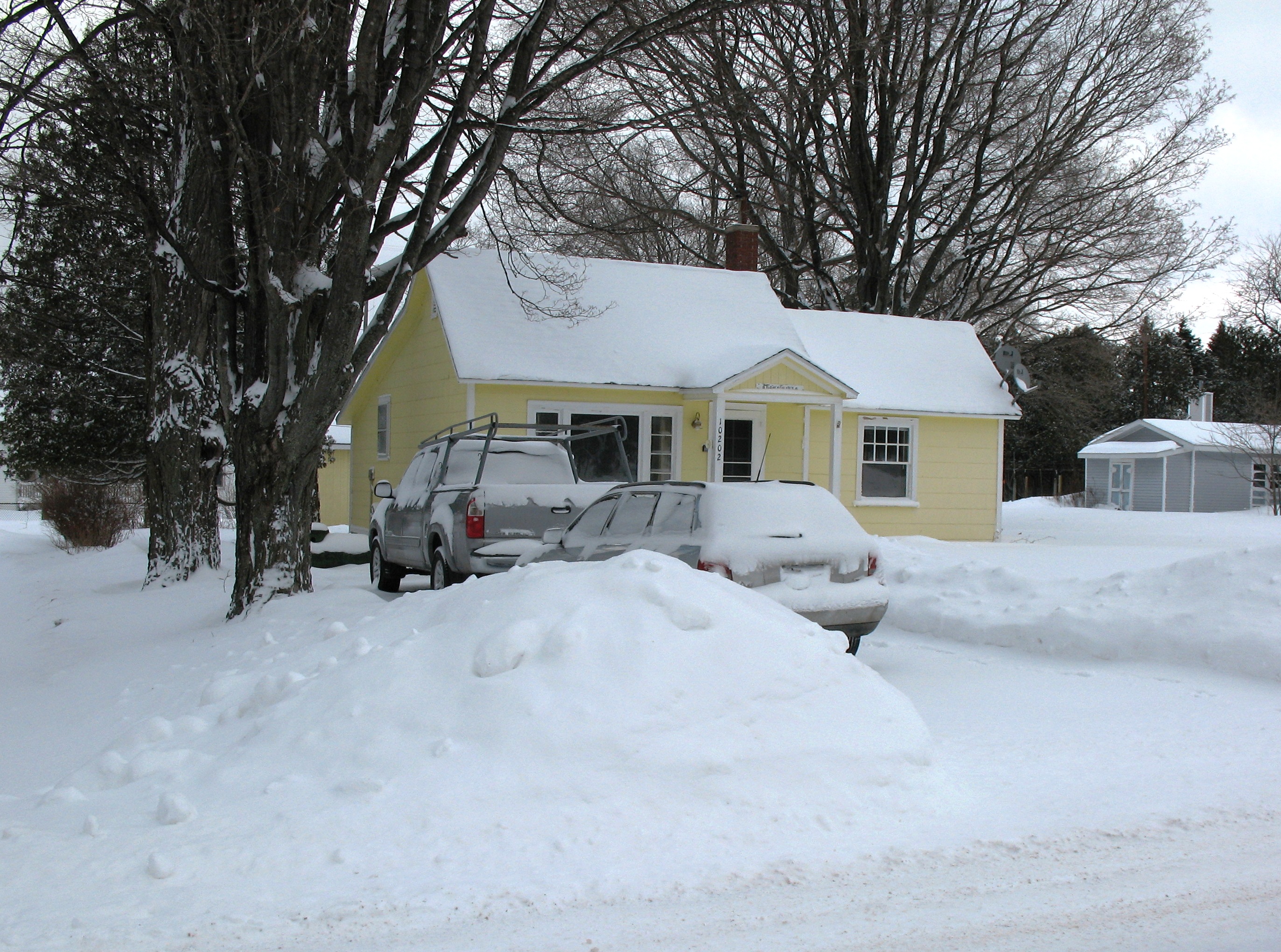
All our efforts have paid off, but this is only the beginning of the fight. In November, Californians will get to vote on whether or not genetically modified foods must be labeled in their state. This spring the California Right to Know (GMO) initiative effort collected 971,126 signatures in support of the measure, almost twice the number needed to qualify for November’s ballot. A broad coalition of organizations came together to launch this statewide referendum that will require that any genetically modified foods, or products containing genetically modified ingredients, be labeled in the marketplace.

Who worked for this? Volunteers fanned out across the state. We are gardeners, organic farmers, health professionals, scientists, parents and regular people who are concerned about the inevitable consequences when ‘Frankenfoods’ are released into the food chain and into the environment. The public support for the labeling movement is enormous, even in this divisive political year. A National poll taken by the Mellman Group found that 91% of Americans favor labeling of GMO foods. (see website http://www.labelgmos.org/)

But it’s not over yet. We still need to win in November. GMO seeds and their companion chemicals are big business and those corporate interests aren’t going to go away without a fight. Already, the storm clouds are on the horizon. Despite overwhelming public support, every similar measure across the country has been defeated in the last weeks before the vote, flooded with corporate money and disturbingly inaccurate PR. They paint us as anti-farmer! The nerve! Just watch the airwaves; we will be inundated with the tragic tales of farmers who need GMOs to get by. We’ll be told that GMO technology is essential to feeding the world. We’ve heard it all before. This initiative isn’t anti-farmer. It doesn’t ban GMO products. If farmers and food producers want to grow and use these products in our food, they just need to tell us. This bill is about transparency and our right, as consumers, to know what we’re eating. We’ve proven with other food labeling that consumers use the information on those labels, and that providing that information isn’t prohibitively expensive to producers. When we win, California will be the first state to successfully protect its consumers’ right to know.

This country was founded on the idea that, in the marketplace of ideas, the best will rise to the top. For that to work, we, as voters and as consumers, need to have the information to make our own decisions. That’s what labeling is about. It’ll be a big fight, but I think we’re up to it. Almost a million people signed the petition. If you believe in this, talk about it, tell your friends, volunteer. I can’t imagine any good reason why labeling isn’t a good idea. After all, if what they’re pandering isn’t sinister, why are they afraid to tell us what’s in it?

A.V. Walters
Home from the holiday. While I’m not one for hauling souvenirs post vacation, I did manage to bring home one whopper of a cold. And like out-of-focus pix of treasured monuments, I’m sharing this with my traveling companions, friends and family. Next time I’ll send postcards. This has put a crimp in my post-vacation style (Well, this and the pre-vacation collision with a suicidal deer that’s disabled my car.) I was supposed to be putting in the garden over the last couple of days, but have opted for ibuprofen and Benadryl cocktails instead.
The purpose of the trip, aside from, well, a vacation, was to snap pictures of relevance to The Emma Caites Way, for the website. Wait a week or so, until this cold clears up (for both me and photographer/editor/book designer extraordinaire, Rick) and then check to see the results on the website (TwoRockPress.com.) Maybe we will even have garnered some shots worthy of a cover for the upcoming release of The Gift of Guylaine Claire. It’s tough to tell such things when rambling in an anti-histamine fog. On the home front, something must have died out in the valley, because the buzzards have been circling. It makes me nervous, having a cold and all. In the meantime, the garden (and Rick’s weeds) wait…

Today the first chapter of my second novel, The Gift of Guylaine Claire will be posted on the TwoRockPress.com website. For those of you who liked The Emma Caites Way, we hope you’ll also enjoy the new book. It is a very different book, about life, the connections we build and the losses we sustain, with its roots in Canadian and French-Canadian history, art and sculpture. This book gave me a chance to explore my own Canadian connections and history. Full publication is expected at the end of this month.

For those of you unfamiliar with The Emma Caites Way, Smashwords.com still has a sample download available, as well as ebook purchase.

A.V. Walters

Rebuilding
A.V. Walters

It’s become somewhat of a seasonal ritual. It started way back in school when we’d cripple ourselves training for track and field. Later, when that idiocy abated, my spring enthusiasm would takeover and I’d break out of my winter lethargy with a ten-hour day of heavy digging, in preparation for planting the garden. Of course, over the next few days, my body would pay for it. It’s always the same, and I never learn. But like I said, it’s a ritual.

Here in Two Rock, it stays cooler longer, so we have a late planting date, and the worst of the digging gets done by Elmer’s plow. (Granted, digging in the buckets later is still no cakewalk, but I’m always up for it.) So, I’ve managed to substitute my disabling, spring digging ritual with an equally disabling, spring volunteering ritual. And, like the Garden, it’s all well worth it.

Petaluma has a local chapter of Rebuilding Together—an organization that helps our low-income, elderly or disabled neighbors. We make repairs and improvements that helps make it possible for them to continue living in their own homes. It’s a great organization. There are two main workdays each year– in the spring the volunteers help individuals and in the fall, we plant trees around town or work on our public parks. I’ve been at it for five years now; it’s a ritual that has stepped in to fill the void left by track and field practice. Usually I’m put on a crew that works to tame out-of-control gardens. (Though, I’ve done everything from painting and laying floors to installing a garbage disposal.) It’s an all-day work-fest with a score or more of other volunteers per work site. We all work like crazy people, and at the end of the day a life and home are transformed. There’s enormous satisfaction in it. (A couple of days later, when I can bend over again to tie my shoes, I feel even better about it.)

You should see our volunteers. Our crew, this spring, included a guy in his eighties. He had his work gloves on and was manning a wheelbarrow, delivering mulch. There were a handful of septuagenarians, and then the rest of us, mostly in our forties and fifties. It’s incredible to see all these strangers (and some familiar faces from past Rebuilding days) come together and, without any kind of rehearsal and surprisingly, little direction, fall into a comfortable and steady work rhythm. We’re like bees—each busy and productive, compounded by the activities of the whole group. You can’t believe how much work can be accomplished with so many hands pulling together! If you would like to participate in that kind of community, I can highly recommend you contact your local Rebuilding Together chapter. Spring is a lovely time to help in a positive transformation.

So, now I’m broken in for the season. This weekend I can start digging in my buckets, getting ready for a late, but frost-free, planting. I can hardly wait. (We’ve even talked about adding a fourth garden plot!)Winter has faded and my neighbors on the farm are coming out of their homes, rubbing the winter out of their eyes like bears emerging from hibernation. And what’s on their minds? “Where are we going to put the tomatoes this year?” “Did you know the Seed Bank has organic vegetable starts?” We’ve managed to cultivate a crop of eager gardeners. It’s exciting.

My only question about all of this is, where are the young people? Clearly, we’re not reaching out to share and nurture the values that connect us to our community, the seasons, our bountiful gardens and, most of all, each other. Suggestions, anyone?

A.V.Walters

Presbyopia

(Where the heck is that?)

I am a person full of theories, and I think that I just naturally look for the patterns of order in the universe. I’m not saying my theories always make sense–they’re certainly never subjected to the challenges of science, or peer review. I look for meaning in the little details. This has always been true of me, I’m given to rumination and to trying to make sense of things. I believe in developmental phases, both hard-wired and those triggered by a combination of chronology and circumstance. We all know of the “terrible twos”, and the agony of adolescence. (For kids and parents.)  We know that there are acquisitional phases and times to consolidate our gains–those things that we’ve learned and are now solidly under our belts. I know that there are new and different phases continuing through the whole continuum of human existence that are not yet recognized. Indeed they could not have been, because too few lived long enough for any such phenomena to be observed, tested, catalogued and acknowledged.

Now with life expectancies stretching easily into the eighties and nineties, there are new paths to chart, even as we’re only just beginning to get a handle on the fifties and sixties. (I think we did the forties back in the sixties, if you know what I mean—the recognition of the mid-life-crisis seems deeply cemented in the movies of my youth.) I’m a trailing boomer, so I’m following in the footsteps of the developmental stages of the largest demographic bulge ever studied. If they’d just get it figured out, aging will be a veritable yellow brick road for me. However, while some things are obvious, the connection to meaning that I’m seeking, is less understood. In the crevices of this process I’m looking, maybe in vain, for reasons. What rhyme or reason is there to this process that, on some days, just feels like an inexorable death spiral? Still, if you hit your fifties and things aren’t starting to fall into place, in terms of world-view…ya gotta wonder.

That brings me to vision. As a kid I had incredible acuity. My brother and I were the eagle-eyed of my family, taking after our mother.  She told us that this kind of vision was a special gift, and nobody could take it away. She was only in her early thirties at the time, with eyes like a hawk and nary a glimmer that it wouldn’t always be the case. So, in our forties, my brother and I took our failing vision as some kind of personal insult. I suppose we could have, and should have, taken note of our dear mum’s progression of ever-thickening specs, but we didn’t. In my mid-forties I just flat-out refused to believe that my vision was failing. (Hey, my mom said that nobody could take it away!) That came at a high price because as time went by, I failed to notice that I was reading less and less. Sewing and weaving fell by the wayside—too busy, I told myself. But, I still obsessed in the garden, its open-air setting fit my advancing presbyopia quite nicely.

When I came to Two Rock the fireplace in my lovely, rented house had been painted over so many times that you could hardly tell it was tile. The outermost layer was metallic gold–and that had to go. So, I asked Elmer if I could strip it down. Of course he quizzed my on my intended method and, when it sounded like I knew what I was doing, he gave the okay. I cranked-up the hot air gun, grabbed a putty knife and slowly, peeling off about eighteen layers of paint, revealed an incredible Arts and Crafts era, tile fireplace. It’s a gem. Elmer was thrilled with it. Not long after that, I found myself struggling to read regular-sized print. For some time I’d been squinting at labels in the grocery store–even started to carry around a pair of dime-store “cheaters” in my purse, and I just cursed the world for using such ridiculously small type. But finally, I had to face it–there I was, middle-aged, newly on my own after a long-term, failed marriage and suddenly (okay, not so suddenly), blind as a bat.

Digging-in my heels, every inch of the way, I finally made the dreaded appointment to get my eyes checked, where it was confirmed. Biology had turned on me and bit me in the ass–I was no longer the super-hero of vision I had once been. I ordered the eyeglasses, progressives, but I was surly about it. Elmer’s almost two decades my senior but he doesn’t wear glasses. (But his friends make jokes about it and it’s common knowledge that he’s a terrible hunter because he can’t see to shoot.)  I railed. My parents laughed. My brother commiserated. Then, (with a dirge, rather than fanfare) my new specs arrived.

And what a shock. I could actually read, again. I could see the instruments on the dashboard. (I wondered how long that light had been on!) Who knew it was so bad? And, oh my god, the work on the fireplace really sucked! It turned out that I hadn’t done a very good job removing all of the paint, after all. Sure, you could see the tile, but it had a shabby-chic look that hadn’t been my intention. So, I went over the whole thing, using a dental pick, no less. (Apparently Elmer never noticed how bad a job it was, confirming that he can’s see either!) Now, the fireplace looks really good. But, it made me wonder–what else had I missed before I finally broke down and got those glasses? How much of my life had been out of focus? Maybe it explained a lot. How lucky I am that that kind of blindness brought me here.

And just what purpose does losing one’s vision serve? I’m looking for the deeper meaning, here. I mean, I’m a far shot from being pushed out to sea on an ice-floe. There’s still plenty of tread on these tires. Nonetheless, a century ago, most of the women my age didn’t make it this far. This aging business is largely uncharted territory. So, exactly how are we served by failing eyesight? I’d hate to believe that it’s just a senseless result of decline. Of course, being who I am, I have a theory about that. I think that far-sightedness forces us to teach the younger generation the skills they’ll need, that we mastered earlier, but can no longer do. It’s not lost on me that, uncorrected, my current comfortable focal distance is just right for looking over someone’s shoulder–to watch and check their work. I’ve gone from the age of super-vision to the age of supervision. Where it not for this decline, we’d all just go on doing everything ourselves, and not pass on the know-how. Still, eyeglasses are a godsend, even though they may put a wrinkle in the natural order of things.

Well, that’s my theory, and I’m sticking to it! I feel it’s so much more comforting than the only other rationale that occurs to me–I don’t want to face that not being able to see close, up may have been symbolic of my life’s circumstance, that I could see everything at a distance, perfectly–outside my own sphere–but not the important things that were right under my nose. Maybe, like the fireplace, things had been falling apart for some time, but I just couldn’t see it. But don’t get me wrong, I’m not so pessimistic that I’d want to countenance that as a phase of living. I’m just saying…

A. V. Walters

Musings on Spring

It’s Saint Patrick’s Day and, with this week’s heavy rains, our corduroy hills have taken on that Irish, emerald green.  I call them corduroy because the ranchers cut the hay and leave it in rows on the hillside. The hills across from us are so steep that a tractor can only go strait up and down–any turn on the steep part of the slope and they’ll tumble. On that steep terrain they cut, but don’t bother to bail or collect the hay. So the cut hay lays on the hillside in stripes–stripes that echo, season after season, on the landscape. The week’s rains have washed the cows and today they stand out starkly–black and white, against the green. With the intense green and the equinox next week, we can’t help but think of spring.

In my Michigan hometown, up on Lake Superior, they’re thinking of spring, too. My mother, even in her mid-seventies, is a rabid gardener. As soon as the snow retreats she hustles to rake up the garden in preparation for spring planting. It’s a big job, one she tackles in stages that are measured by the progress of the snow’s melt. She races against time, knowing that when late May fades into June, it’ll be blackfly season–and she’ll want to be indoors for that. It’s been a mild winter in the North, too mild. This week they’re having a false spring. It was eighty degrees in the Harbor today–a record breaker by all accounts. Most of the snow is gone, or nearly so. I can picture my brother-in-law standing in the parking lot of their general store, broom in hand (his excuse for being outside) face tipped to the sun. In fact I’ll bet all the inhabitants of the Harbor were out today, drinking in the summer-like weather.

It’s not necessarily a good thing and they all know it. In separate calls to my family today, three of them mentioned the obvious danger of too early a spring. The trees can be fooled, lulled into an early bloom. Flowers have the same risk. When that happens, winter reaches her icy fingers back to what March should be and the bloom will fail, taking next summer’s fruit with it. And nothing is quite as winter-numbing as the sight of a daffodil in it’s crystal sheath, after a freezing rain. Still, standing outside in shirtsleeve weather has its own hooks, after months of cold and grey.

Today in Two Rock the rains gave way to blustery winds. The clouds have been chased away and the sun shines on new hills. The grass is growing faster than the sheep and cows can eat. Walking out to the road, to get the mail, I spooked a huge flock of black birds–invisible in the tall grass until the moment they launched, en masse, into the sky. I was startled and laughed out loud at the surprise of it.

During the worst of the rains I was scheduled to collect signatures for California’s referendum to require foods with genetically modified ingredients to be labeled as such. We were positioned at the door to Whole Foods. (Yes, I know–shooting fish in a barrel.) Still, it was interesting. The signatures flowed easily between cloudbursts but when the rains really came down, the shoppers hunched their backs, scrunched up their faces, avoided eye contact and ran for their cars. I can’t blame them, it was cold and wet. Some people stopped to say they’d already signed, and to thank us for being there. One well-dressed man shook my hand and told me he hoped it wasn’t too late already. I couldn’t help but agree.

It’s an early spring here, too. To a lesser extent we have a similar problem as my family back home. We’re not clear of the danger of frost, not until May. But the equinox is a milestone. I can start hardy seedlings indoors next week. Then, in the weeks after that I can start some of the more delicate vegetables. I struggle with the temptation to rush the process. I’m no different than the folks back home, who sweep parking lots in the sun, where only a week or so ago there was snow. We all yearn for spring, for planting and the promise of summer’s warmth. And that’s what’s up in Two Rock.

A.V. Walters

Good People, Behaving Badly

It’s tough, the worst of all situations. We can all be pleased when somebody who needs to step up to the plate, behaves better than we expect. But when people we know and love seem petty or mean spirited, well, that’s a tough one. Often circumstances dictate–illness, a death in the family, tragedies of luck or finance. These things can test us. I’ve seen some of it lately and I shake my head. There’s little I can do. But it reminds me of something I did a decade ago when I lived in a big city. I wrote it up several years later, mostly because I didn’t want to forget. So, I’ll offer it up to you now and then I can stop shaking my head, and remember….remember to shake my head and then forgive.

The Car Alarm

Some years ago I had a neighbor with a defective (or just overly sensitive) car alarm. I was repeatedly made aware of it, and had complained several times to him about how annoying it was. The alarm would chirp, then announce, “You are standing too close to the vehicle, step away from the vehicle.” Then it would go into a twenty minute cycle of alarm noises–an assorted selection of them. It would chirp randomly without provocation and would, several times a day, go through its entire litany, of course, at ear-splitting volume. For some reason, my neighbor couldn’t hear it when he was inside his house. I don’t know why, I certainly could in mine. (Or perhaps it gave him a false sense of security, periodically, throughout the day.)

Then I came down with a really monstrous case of the flu. I was home all day, trying desperately to sleep-off the symptoms. Of course, with annoying regularity that alarm would go off, eliminating any chance of relief and annoying me to the ends of my limits. It reached the point where I would wake up in sweats, even if the alarm had only chirped. Finally, in desperation (and floridly drenched in a feverish sweat) I threw on my robe and went next door to make the neighbor as fully aware as I was,  how disruptive his alarm had become. My neighbor did not answer the bell so I started beating on the door with my fists. I knew he was home because I could hear the damn music. Hell, I could feel the vibrations through my feet on the front porch. Then I picked up a stick and beat on the door–still no response. I walked around to the living room side of his house and beat on the window with my stick. I even screamed at the window. But, still no response. I returned to the front porch and rifled through his mailbox for something to write on. With a pencil from my robe pocket, I sat on his steps and began writing a livid note on the back of a piece of mail. At this point, when my attention was fully on the missive I was composing, the music stopped and the neighbor stepped out onto the porch, standing above me. There I was,  in total disarray, sweaty and flushed, seated on his front steps in my bathrobe, writing on his mail.

He had not come to the door in response to my efforts to get his attention–he was going out somewhere and he was in a hurry. Surprised to see me sitting on his porch, he asked if there was a problem? What was I doing with his mail? Well, I let him have it about the alarm. He made a few apologetic noises, but acted completely unaware of the affront of his car alarm and was taken aback by the intensity of my reproach. In an effort to explain, I approached his car. My hope was to trigger the damn thing so that he could fully experience the impact of the alarm’s blast.  I touched the car, but it did not make a peep. Then I pushed hard against the fender–still nothing. This alarm, that had kept me up in my sickbed for the previous four hours, simply refused to perform on my command. By now my neighbor was looking at me oddly. With keys in hand, he approached the driver’s side of his vehicle, ready to go about his day, indifferent to my plight.

It was clear to me that the only way to make him really understand was to trigger that stupid alarm. I tightened the belt of my robe and, in bare feet, stepped up onto the bumper of his car. Still, nothing. So, I began jumping up and down on the bumper of his precious, goddamn car (do I even have to say it?) to no avail. I stepped up onto the trunk of the car and jumped up and down, but …  (It never occurred to me that he’d probably disarmed the alarm when he came out of his house.)

Though the alarm stayed silent, my neighbor didn’t–“What the hell are you doing? Get the fuck off my car!” he shook his keys at me. I’m sure I made quite a sight. Only in that moment did I stop to examine how I must look, under the circumstances. Sheepishly, I stepped down from the vehicle, blurting, ” You’ve got to do something about that damn alarm.” He shook his head, climbed into the car, muttering, and drove away. I looked up to see that my scene had attracted the attention of the other neighbors. They peered down the block in my direction. One waved. It was now very quiet on the street. I sheepishly returned to my house and climbed back into bed. Well, at least it was quiet.

The neighbor must have had the alarm fixed shortly after that. In any event the problem stopped. No one ever said anything to me about my little street performance. All I can say is that it really did seem like a good idea at the time. Now, I try to be more understanding when I hear stories about bizarre behavior.

A. V. Walters

Better Living Through Chemistry

The other day I woke to the sound of gas-fired weed whackers. It was a relief. We’ve had strange weather this winter. No rain. We rely on seasonal rains to recharge the wells and this season has been dry. Here in Two Rock it’s green; we get a lot of fog coming in from the ocean. The fog (and in this year’s weather, frost) provides enough moisture to keep the ground green, especially in the low-lying areas where the fog settles. Looking across the landscape you can see the contours of where the fog flows by the trail of green it leaves on the hills. But that moisture doesn’t go deep. If you dig, it’s damp down only a few inches. It’s green, but it’s not growing and that makes the farmers nervous. I know on our farm they’re working to keep the sheep moving, rotating from field to field so the sheep don’t damage the grass down to the roots. Sheep can do that. Usually in the winter I have to mow my lawn every week—or at least every ten days. This season I think we’ve mowed only three times.

And then there’s the cold. It’s been really cold here at night, for months now. Really cold for us is low thirties and high twenties. With nights like that the sheep need extra nourishment to keep warm. The days are lovely, with temperatures climbing sometimes well into the sixties. Even with those warm days though, the cold nights and low moisture keeps the plant growth rate down.

There’s a funny thing I learned about cows (and even some sheep) when I moved here. They sometimes suffer from a “the grass is greener on the other side” syndrome. Even if a cow is surrounded by lush pasture, it will lean out through a fence if there’s greenery on the other side. You need to keep grass at the edge of the fence-line short and groomed. If you don’t, the cows will cut their necks on the barb-wire fences trying to lean out for the grass on the outside of the fence. I live next to a dairy, so even though we don’t do cows here, we get to observe what is done in the world of cows. We share an access road and some fences.

A year ago last autumn, somebody decided not to mow (or more correctly, weed-whack) the fence lines along the dairy side of our single lane driveway. I guess someone figured it was faster and cheaper to spray with herbicides. They were certainly effective. Late that autumn they sprayed and everything green along the lane shriveled and died. Stripped of its protective vegetation, the shoulder of the lane soon began to crumble. The seasonal rains fell on that naked dirt and what little roots remained were not enough to hold the soil. Freed up from roots, the gophers made the little gully along the lane their alley and churned the soil mercilessly. More soil eroded into the gully and washed away with every rain. By mid-winter, our undermined road began to crumble at the edges.  To save the lane, they dug the gully deeper to funnel the water away. The gophers dug deeper, too.  The edge was hardpan, barren, clay; its organic matter had flushed away so no new grasses would grow there. Grasses have a fine and broad stabilizing root system. Weeds grew there though, but their long tap roots did little to hold our road edges.

Through our long dry summer the grasses did not return along the lane. A few weeds sprouted, but not many. Last fall they chopped down the weeds. The farmers had to dig another ditch, inboard fifteen feet or so from the fence, to divert the water away from the lane’s edge. The gully along the road edge was eroded and jagged. It could no longer carry excess water along the side of our lane, without causing further road damage. Like I said, it’s been a dry winter and so far the new diverter ditches have not been tested. Here and there, along the lane there are some patches of fog-fed green. We’re hoping they’ll spread, their roots working through the soil to rebuild that mat of living material that holds all that’s good in the soil.

So, in this case the annoying drone of weed-whackers is a relief. It means somebody’s learned a lesson and we won’t be spraying anytime soon. With any luck, the rains expected next week will be gentle and will nurture the right kind of growth to re-stabilize the soil and return our lane to its former secure state.

A.V. Walters

Spring?

I may have spoken out of turn when I announced it was Spring in Two Rock. It’s something, but I’m not sure just what. Northern California seasons can be a little confusing, especially if, like me, you’re from areas that have real winter. I’ve been here over thirty years and I still get caught short by faux seasons.

So we’ve had gorgeous days in the 60s and 70s. We walk up to feed the emus and, from the vantage up the hill, the valley is beautiful. The daffodils are in bloom, even in Two Rock. (I say even because Two Rock is always a couple weeks behind Petaluma–and more when it comes to frost free nights.) The grass is lush, mostly from melting frost or fog, because we’ve had so little rain this season. I just barely got the peach tree pruned before the buds started to swell. A few of the blossoms have popped open like popcorn. Plum trees are in full bloom throughout the valley. Over the weekend we drove to Santa Rosa and saw them pruning the grape vines in the vineyards. The most dramatic and confusing thing is the mustard. Farmers put it in as a cover crop, sometimes mixed with rye grass. The mustard is in full bloom now. Whole fields of yellow, sloping with the contours of our rolling hills, take your breath away as you crest the hill and come down into the valley. How could it not be Spring with that display of yellow?

Three nights of sub-thirties temperatures is how. We still need to keep the fire burning to keep the house from slipping into the 50s. I’ve always thought that this mid-winter hesitation was a feature in the California winter. It’s too early to plant but you can still clean up the garden, prune (though you best hurry up on that at this point), plan, divide bulbs and generally get things ready. If you’re really old fashioned, you can clean and sharpen all the garden tools. (I always wished I could be that dedicated. Instead I sharpen on the fly, as needed, and almost never clean a shovel or spade.) My first Spring here I was chomping at the bit to plant. Elmer said, “No. We see frost until the first week of May.” Every year he’s been proved right. So I wait, leaf aimlessly through the seed catalogues and peer anxiously at the dwindling wood pile.

I worry about the weather. Though the surface is damp from the dew and frost-melt, too little rain has left the soil dry any deeper than that. I worry about the well and about whether the dry soils will be a challenge for the garden through the summer. Will this cold weather kill off the blossoms and spoil the fruit tree harvest? Can the peaches and plums pollinate so early–when the cool days and nights impede the bees? But I’m a worrier. Probably it’ll all be fine. By April I’ll be planting seed starts for transplanting when the soils warm up. In May we’ll be digging in buckets, and it will fall into place, like it does every year. In the meantime, I’d better throw another log on the fire.

A. V. Walters

Food for Thought

I don’t generally include my political beliefs in my blog. Please bear with me, this rant is related to the topics of the blog, and after I get this off my chest I’ll retreat to my usual, bucolic subjects.

My blog includes issues of rural living, gardening and the slower, and possibly richer, human dynamics that go with a rural lifestyle. I’ve confessed to years of organic gardening, even when I lived in the city. What I haven’t revealed is the depth and length of my interests in food issues.

Back in the late seventies I did my undergraduate thesis on World Food Scarcity and Sustainable Agriculture. Even back then it was apparent that our efforts to export “modern” agriculture were wreaking havoc in the third world. A closer examination of those same practices here, revealed the early cracks in the crumbling view of American agricultural invincibility.Doesn’t anyone remember the Dust Bowl? It was time to look in the mirror. Even then, soil erosion, pesticide contaminated underground water supplies and the dangers of widespread monoculture were beginning to illustrate cracks in our agribusiness model. Some changes and improvements did occur–university extension programs hailed crop rotation (like it was a new concept) and alternative tillage approaches. But the solutions offered all came in the form of agribusiness management models and, at the encouragement of government programs, our farms began to look less like farms and more like chemically dependent corporate entities. We continued to lose old-style and family farms to corporate agribusiness. I became a believer in the alternatives.

After college, I kept my convictions about having a smaller footprint on the planet. I’m not perfect, but I knew (and know) that one person can make a difference. I supported California’s early efforts to develop organic standards. I grew much of my own seasonal food in my postage-stamp sized, urban, back yard. When possible (and early on, it wasn’t easy) I sought out and supported local organic farmers. I rejected fast food. I believe deeply in the value of cooking for oneself and those you love. I think sharing a quality, home-cooked meal with friends and family is the essence of civilization and one of the most enjoyable forms of social intimacy. I tried to convey the essence of those pleasures in The Emma Caites Way, as the characters bonded, sharing common goals and great meals. I am a slow food advocate.

For a brief while, in the late seventies and early eighties, I supported the idea that the then-new concepts of agricultural recombinant DNA (now called GE or GMO crops) could revolutionize agriculture in a good way. I thought there was promise in the concept, much as the Ford Foundation’s advanced hybrids had brought us short stalked rice–a boon to food production on marginal lands and in resource poor countries. (Yeah, like some earlier folks had hailed the then-new technology of television as a boon to education!) As the science developed, I was horrified when, instead, the technology brought us Frankenfoods and pesticide-resistant (or worse, pesticide-containing) crops–and all without adequate testing–not only of the impact of those crops on the consuming public, but also on the environment. How can a crop be a good thing if planting it requires ever increasing amounts of chemicals to be flooded onto the soil? Even worse, the very licenses under which these GMO seeds are sold prohibit further scientific review. We, the consuming public, were advised that the intellectual property rights of the Corporate Agribusiness Elite were more important than public safety. We are the guinea pigs. And we are expected to be satisfied with Monsanto’s and Dow’s assurances that these products are safe.

In a warning shot across the bow, a decade ago we saw the Gen-Star debacle, in which strands of wheat DNA were inserted into corn. No need for testing, we were assured, because the products were intended for animal consumption only. Yeah, right. Sure enough, this restriction was ignored and human food products were manufactured from this FrankenCorn. People with wheat sensitivities reacted. Products were pulled from the shelves and the government of Mexico protested that the crop was grown, without disclosure or permission, in Mexico, where the original seed stock that made modern corn possible lives. I cannot begin to explain how important that fact is–because of the dangers of gene stock contamination.

I am one of those chemically sensitive people. I can’t tolerate scented products. I have food intolerances and serious food allergies. I can’t take most antibiotics. My life became much easier in the mid-nineties when food labeling meant that I could go to the grocery store, like a regular person, and read the labels to see whether I could eat the processed foods. Now everyone reads labels to check for vitamin content, or sodium, or sugar. Labeling empowers us to take control of our diets without having to grow all our foods in the backyard. (Not that it stopped me from doing so.) When food labeling was first proposed, the food industry screamed that it would be ruinously expensive, that it would result in lost trade secrets or secret recipes, that businesses would fail and that consumers weren’t sophisticated enough to use the information anyway! Pshaw! The world didn’t end. Millions of Americans assiduously read food labels today. We accept without question that we have the right to know what we’re eating.

Which brings me to my soapbox today. (What, you thought I was already on one?) We have the right to know. I want to know what I’m eating and I have that right. In my case, cross-contamination of foods could result in illness or life-threatening allergic reactions. The Gen-Star incident showed us that GMO crossed foods could result in triggering food allergies in unsuspecting sensitive people. You don’t have to be for, or against, GMO agriculture to recognize that Americans have the right to literally put their money where their mouths are. In my case, it is a critical question. But every consumer has the right to align their dollars with their convictions. To do so, you have to know. According to the average grocery cart, most Americans are already eating GMO foods, though polls show that under thirty percent of us think so. Today, over 50 countries (covering 40% of the world’s population) require GMO labeling. It’s shocking that we’re so far behind the curve.  A California initiative currently collecting signatures would require labeling of food products that contain GMO materials. It’s that simple–you disclose your ingredients and let the consumer decide. It’s a pretty American kind of solution to a thorny problem. I urge all Californians to sign the petition for The California Right to Know Genetically Engineered Food Act of 2012 and to support it in the election in November. It’s a no-brainer.

And now, if someone could help me down off my soapbox…(that’s an unscented soap soapbox.)

A. V. Walters

Good Enough

Our farm foreman is a hard-working man. I admire that, but I know from my own life that there has to be more. Sometimes I think there’s a bitter edge to his efforts. He is not a stupid man, but he sometimes takes obvious pride in backwards ways. When I first moved in, Elmer instructed him to seal the new tile floor in my kitchen. To me, work is work but I guess Don thought sealing the grout on a new tile floor was not proper ‘farm’ work. He grumbled.

He also wore his grubby farm boots while doing the job. And he applied sealer over his own footprints—making them a semi-permanent part of my interior. I left it the way it was for over a year—contemplating the meaning of footprint décor. Elmer saw it and shook his head. Guests noted it. Finally I took some ammonia and Elmer’s floor-scrubbing machine and stripped and resealed the floor. So, it’s not lost on me that with Don, you need to be careful what you ask for—you might just get it. It seems Don thinks that people spend too much time on unnecessary, “fancy” extras (like sealing grout.) If you were to send him to pick up materials to do finish carpentry, he’d come back with a pile of 2x4s.

Still, if there’s a problem, this guy is there. When the water went out last week and one problem cascaded into another, Elmer and Don were out there up to their ankles in it. And he knows the rhythms of the farm and the season. Regardless of what project is cooking, Don knows as well as Elmer what needs to be done generally—that we need to be cognizant of the danger of frost till mid-May, even when they can plant earlier in town, a scant 10 miles away; and that you need to check the fences in the slow times, early in the winter, before the lambs find the little gaps. (I’ve spent some time chasing escaped lambs and sheep—the fence checking is a really good idea.) You don’t always find that level of conscientiousness in hired hands.

I mentioned that to Elmer and he nodded. He and Don are friends since their teen years when they sheared sheep together. “Yup, Don is a straight shooter, alright and a damn good farmer.” Then, it was as though a cloud passed over his face, and he looked away.

“Elmer? You okay?”

“Yeah,” He shrugged

I didn’t understand what had just happened, and, in my usual way, I couldn’t help but press further, “Well, Elmer, I figure you’re a damn good farmer, too.”

He paused, looked down and then at me, “Well, I used to be.”

I nodded, “Well, you are getting on now, I guess you get to relax some.”

“It’s not that,” he continued, “I was a good farmer and took care of business. It was always something, you know—fences, chickens, minding the sheep. Then my wife got sick.” He shook his head, “I was waiting for her to get better. There were treatments and some adjustments in our lives. I didn’t know what was really going on. I should have been there but there was always something on the farm. By the time I understood how serious it was I’d lost a lot of time, you know, with her.”

I didn’t know how to respond. He had tears in his eyes.

“When she died I was a real mess. All I could think was that there she’d been, sick and sometimes alone—and I’d been off somewhere, tending to the farm. I lost that time. I’ve still got my girls and grandkids. I have friends. Hell, I’ve lived on this farm my whole life, I know everybody around here and that’s what’s important. I realized it after she died and I decided to change what comes first. It’s my kids and grandkids. And it’s people. From then on I was proud to be a good-enough farmer.” He nodded and looked up at me, “You have a good day now.” And he was on his way, down the drive.