Archives for category: Uncategorized

A Matter of Scale—

A.V. Walters—

IMG_2311

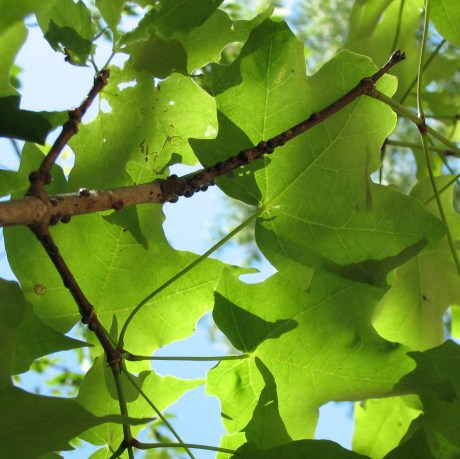
Beautiful? Yes. But look closely at the bumps on the twigs.

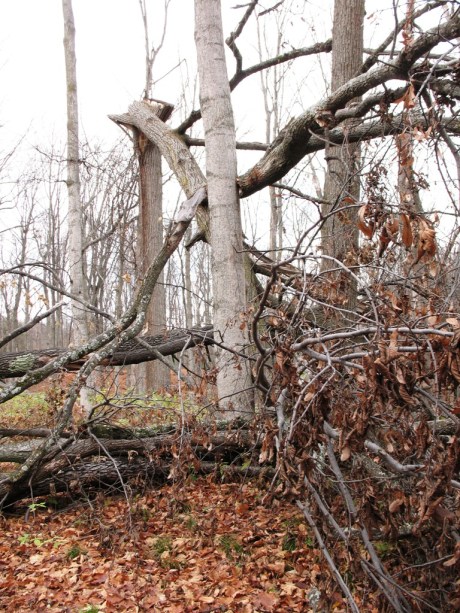
Rick and I have returned to our Sundays “day off,” in which we spend Sunday afternoons cutting wood up in the woods. We are still clearing trails and cleaning up after the wild Storm of 2015. I’m sure that the trees down, from just that storm, will heat our Michigan winters for several years to come. This doesn’t even touch the backlog of deadfall accumulating from the dying ash and beech trees. We’ll have work, and heat, for the rest of our lives.

Last Sunday I noticed that the forest was sticky. All over, the understory plants are glazed with a tinge of sap—not unheard of in spring, but a little unusual, given how dry it has been. After a light snow year, April and May had precious little rain for us. The forest is crispy-dry. We didn’t get any of our usual spring morel mushrooms. Here, and up in the U.P., there have been fire warnings. (In May!) We watched the Canadian wildfire in Fort McMurray in horror.

This is not really unusual—when California has an El Nino season, Michigan’s weather is mild and dry. Finally, this week the dry spell broke and we’ve seen lovely storms to accompany the greening of our forests.

So what’s up with sticky? Yesterday, a friend, brow furrowed with concern, pointed out the scale on the maple tree next to our house. Yuck. His trees have it, too. Scale is an insect infestation. Maples always have some measure of scale, but the outer branches of our tree were lined with the limpet-like outer shells of these tiny sap-sucking vultures. It appears that we are having a major infestation of scale. The scale is responsible for the sugar-coated forest.

We live in Michigan. Bugs, in all shapes and forms, are a way of life here. Still, bugs of any kind, in great numbers, are unnerving. After our friend left, I stood in the soft rain, running my hands down every branch I could reach, squishing all those thousands of little scale bugs. Rick just shook his head.

“What are you going to do, molest every tree in the forest?”

Well, no. But the two maples next to my house—those I can help. It’s worrisome. Is this, yet another forest calamity in our future? Naturally this called for a research trip to the internet.

The likely problem is the dry spring. Maple trees under stress produce a thinner, more sugary sap. It’s a stress reaction, to ensure the energy needed leafing out in spring. The scale bugs, in turn, thrive on the sweeter mixture, ironically putting the trees under more stress. So, as long as the dry cycle is not repeated too much over the years, the scale is a cyclical problem that will solve itself.

There are measures I can take. I could have “power washed” the trees, before the leaves came out. I could use poisons (not likely!), sprays or root saturation with systemics. I could use a dormant spray in the very early spring—a perfectly acceptable organic measure—like we’ll be using on the orchard trees when they’re bigger. But, Rick is right. I cannot treat the entire forest. I need to relax here, and wait patiently for the ladybugs. Scale is a favorite of ladybugs and birds.

In the meantime, the rains will wash the forest clean of “sticky.” And, at the same time, they will feed the trees, making them stronger and better equipped to deal with the pests. I’ll step back and let the problem solve itself. Sometimes there is a danger of looking too closely.


Wascally Wabbits!

A.V. Walters–

IMG_2307

Cages and Wraps

Late April and early May were a whirlwind of activity. We ordered over 200 trees, anticipating the participation of 40 volunteers in this spring’s tree planting extravaganza. The trees arrived. The volunteers did not. There were good reasons for standing us up, but that still left us on our own with a lot of bare root trees.

With bare root plants, you have, at best, two weeks to get them into the ground. You can “heel them in” to buy additional time. Heeling in is essentially storing them in dirt—either by digging a trench, or mounding. Still it’s planting and uprooting them again—more work for us and more trauma to the tender roots. So, we rolled up our sleeves, and planted.

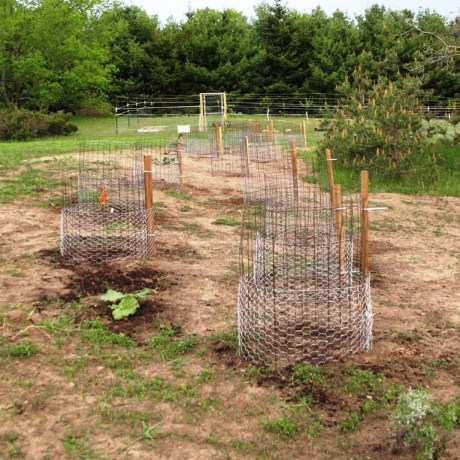
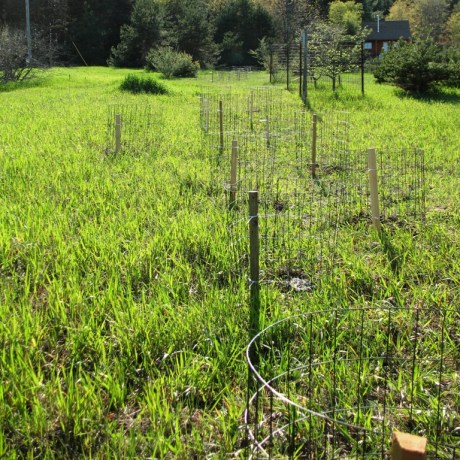
No sooner were the trees in, than we began to lose them to deer and rabbits. So began the next great surge—the making and installation of the tree cages. In all, over a very short period, we made and installed almost one hundred and fifty cages. By the time we finished, and feeling invincible, I was almost beginning to think that rabbits could be cute. Then, we (mostly Rick) re-fenced the garden/orchard area with rabbit-proof fencing. You’d think that there would be an opportunity then, to breathe and rest. Ha! Just when you thought it was safe to go back into the water…

Below the house, we’ve planted a hedge of berry and blooming plants. Well, eventually it will be a hedge; currently it is a widely spaced and hopeful collection of spindly plants. Its purpose is to provide a visual break and to host a wide variety of blooming plants that will be good for the bees. As a side note, there are a number of berry plants that will provide treats for us, too. There are blueberries, high-bush cranberries, service berries and elderberries, mixed in with lilacs, redbuds, red osier, and lavender. In a few years it will be really beautiful. Because the berry plants are particularly tasty (and because I have an emotional and aesthetic stake in this hedge), they were among the first to be caged. Finally, after weeks of work, we could relax.

Well, I actually went into town for groceries, and bought some new work shoes. Rick was working on plumbing, so I walked up to the house to show him my fancy new footwear. On the way up the path, I saw it. A baby bunny. Cute, eh?

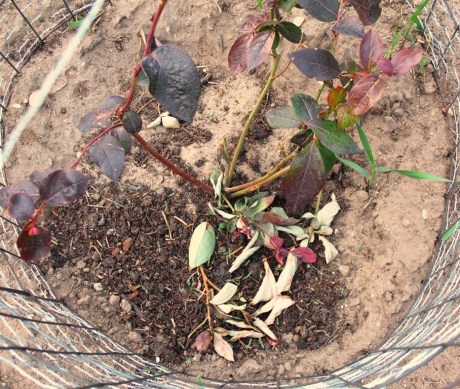
Not so much. The baby rabbits are very small. They fit nicely between the wires of our new tree cages. Once in, they are protected from predators, and can munch, at their leisure on our berry plants. From my vantage on the path I could clearly see a baby bunny giving my brand new blueberry bush a serious pruning. I rushed it, waving my arms, screaming. It ran. And stopped, thirty feet from the new hedge… waiting. Quickly, I surveyed the damage. One blueberry, neatly pruned to half its original size. One baby bunny, stalking. And, across the field, half a dozen baby bunnies, frolicking.

Rick came to the door of the house, alerted by my cursing. I held out the severed blueberry branches and he understood immediately. We pulled out a roll of chicken wire and began cutting cage-wraps, glancing nervously over our shoulders to the hedge. I should have stood guard, because in the twenty minutes it took to cut the wire wraps, three more blueberry plants were pruned to within an inch of their lives! Thank God for new shoes!

IMG_2308

Blueberry, it’s branches trimmed!

Now, all of the berry and bloom hedge plants have double cages. I’m also going to string deterrent wires across the tops, to discourage any deer, who might reach down into the shorter cages for a nibble. It’s the Fort Knox of landscaping. Maybe now we can relax a bit. Except that it’s time to put in the garden.

Bunnies? Maybe they’ll be cute again, someday.


It’s Working—

A.V. Walters—

I asked my landlady for the contact information for the farmer who leases the fields surrounding us. She reacted badly to the request—assuming, for some bizarre reason, that I would say something to him that would jeopardize her long-standing arrangement. She refused to give me his number, but told me where I could find him, half way across the county.

I had no such ulterior motives. I keep bees. He sprays pesticides. Though I have registered my bees with Fieldwatch, many farmers are not aware of it. I merely wanted him to give me a heads up when he plans to spray.

Before I could get contact information, the farmer showed up to prep the soil for corn. My landlady shot out to talk to him, like a bat out of hell, before I could get there. She was waving her arms and pointing at our property, jabbering. I walked out calmly to introduce myself. As soon as I was within earshot, the landlady lowered her voice, finally shutting up as I approached.

“Hi, I’m Alta. My husband and I have the parcel across the street.”

“Hi, I’m Dennis.” He reached out of the tractor cab and shook my hand. I handed him a slip of paper with my contact information.

“Are you putting in seed today?”

“No, just prep. The corn’ll go in tomorrow.”

“Good. If we know beforehand, we can close up the bees and avoid any pesticide issues. I’d appreciate if whenever you spray, or seed, you could give us a call, the night before.”

“Sure, I work with Julius the same way. You know Julius?”

I’ve never met Julius, but all the beekeepers in the area at least know of him. He’s a beekeeping institution and has mentored most everyone who keep bees in this county. “Don’t know him, but I’ve heard a lot about him. Good things.”

“Yeah. He’s a great guy.” He scratched his head. “I get the spray, but why do you need to know when I put in seed?”

“Most seeds, especially corn, are pre-treated with insecticides. Just the dust from those seeds can kill bees.”

“Yeah? I never knew. I’ll have to talk to Julius about that one. You new to bees?”

“It’s our second year—but we lost all our hives over the winter. We just installed our new bees this week.”

He nodded. “Julius lost a bunch, too. What do you think happened?” During this exchange, my landlady just stood slackjawed. I guess it wasn’t what she expected.

I shrugged. “It was a tough year. Bee losses generally for 2015 were forty-four per cent. I know one of our hives had varoa mites. But we also lost our strongest hive. You know, the warm winter is almost tougher on the bees than a cold one. And of course, we’re all struggling with pesticide issues. It’s tough to keep bees home.” I paused, “It’s a critical issue—bees are responsible for a lot of our food production.”

“Well, don’t you worry. Just like me an’ Julius, we can work together.” He smiled. “I like to eat, too.”

So, of course, I left a pint of honey on the seat of his truck. This is how it’s supposed to work.


The Scent of Bees

A.V. Walters

IMG_2302

I’ve wanted to keep bees since my age was in the single digits. My grandfather kept bees. And turkeys. And rabbits. We never knew how many hives he had, because he was forever loading them up into the back of his old Suburban, and carting them around to “someone who needed them.” I didn’t understand why someone might need bees.

He was a quiet man of many talents. He was not a big feature in our lives, because there had been a divorce. For their own reasons, neither my grandmother, nor my grandfather’s second wife, were eager to see a relationship between Grandpa and his grandchildren. The visits were few and far between. But he was interesting and different. He made things with his hands. He was, literally, always trying to build a better mousetrap. He didn’t talk much, but when he did, what he said was solid. Or funny. Sometimes, darkly funny. He thought it was funny to pick up hitchhikers when his Suburban was full of bees.

So, bees have always been in the back of my mind. But, there were always too many reasons why I couldn’t keep bees. In my urban years, my partner was adamantly against it. In Two Rock, my landlord was allergic to stings. (You don’t waste a good landlord, like that.) So the move to Michigan was my chance to finally become a beekeeper. I say “become,” because it takes some time to really be a beekeeper. There’s a lot to learn, especially now, when the bees are in so much trouble.

I’ve joined a beekeeping group. Many of us are “newbees” but in the group there’s a generous wealth of talent and experience—and the rest we make up for with enthusiasm. Our founder is a dynamic young man, willing to share his decade or so of experience.

When spring rolled around, our group put together an order of bees from a supplier down in Holland. It’s a three and a half hour drive to Holland, but our fearless leader, Matt, said he’d do the pick up. There was only one wrinkle, Matt’s wife was expecting their second child—if the baby came early, Matt needed a back-up driver. I volunteered. How hard could it be? Others in the group looked dubious. They teased me, advising me to drive with the air-conditioner on full—to chill-out the bees.

Of course, by volunteering, I somehow guaranteed an early delivery date (for the baby, not the bees.) The day before the scheduled pick-up I emailed Matt—to ask how his wife was doing. “Funny you should ask,” he responded. They were just checking in to the hospital. I was now on-the-hook.

I told my mother, who was horrified at the idea of sharing a ride with hundreds of thousands of bees.

I told my sister, who told me not to pick up any hitchhikers.

I told Rick, who devised a system of bed-sheets and boards—to put over the bees to keep them away from me in the car.

I’m not put off by a long drive. The morning of the trip, though, we lost our spring weather. On the way down, I experienced every kind of weather, driving rain, sleet, buffeting winds and hail. Finally, in Holland, I missed my turn. I didn’t worry; I could just double back—or so I thought. Holland was having its Spring Tulip Festival. Many streets were closed and the town was a maze of festival detours. It’s a pretty little town, and many of its streets are lined with tulips. Lots of tulips. The tourists were there, en masse, dressed for a spring festival despite near freezing temperatures and occasional snow squalls. And, predictably, traffic sucked.

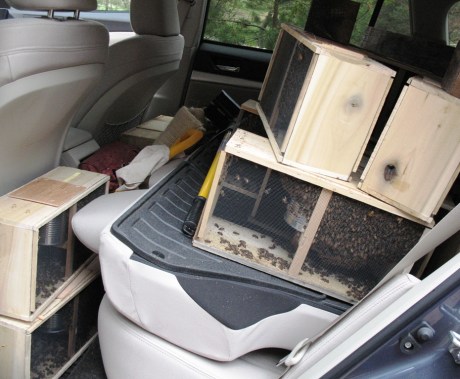
Finally, I arrived at my destination. The bee pick-up was held in the bee-master’s garage. The car area was filled with bee “packages” and the adjacent shop area displayed many bee accessories—wooden-ware, bee tools and such. Bees are sold as three-pound packages, in shoe-box sized wood and screened boxes, each containing approximately 10,000 bees and a queen. They also come as “nucs”—mini-hives with five frames containing all the components of a working hive, bees; a laying queen, brood, drones, honey and “bee-bread” (the mixture of honey and pollen fed to the larvae.) I was there to pick up about forty packages.

The garage was not only filled with boxes of bees, it was awash with loose bees, and beekeepers. Beekeepers are an odd lot. The beekeepers assembled for the pick-up and bee related shopping were oblivious to the loose bees, drifting in and around the garage. Regular folk would flee.

The bee vendors loaded the car for me, concerned that I wouldn’t leave adequate space between the packages. “Bees need air, you know.” The bee-master was concerned that the car wasn’t big enough for the Club’s order. I was concerned that he’d want to put bees in the passenger seat, right next to me.

IMG_2303

Bees, in every nook and cranny.

Finally, after many adjustments, and one sting (not me), the loading was complete. Loose bees hovered in and around my open vehicle. The bee-master saw me unfolding Rick’s driver-protection-sheet, and shot out of the garage.

“Whoa, what’s that for?”

“To cover the bees while I’m driving.”

“No way. There’s too many bees—too much heat. You cannot cover them at all.”

“But it’s freezing out…”

“Good thing, too,” he replied. “I’d keep the AC on full, just in case.”

(FYI—when the temperature drops, the bees settle down and hunker together, to stay warm)

And so it was. I swallowed hard for a long drive with loose bees. I layered up my clothes and drove home with about 400,000 bees in the car, through the snow and sleet, and with the air-conditioning on full. The bees didn’t give me any trouble at all. I wondered what my grandfather would think of that! The bees had to spend the night, in the car. I worried, since it really was cold, but I needn’t have been concerned. In the morning the car was warm, and the windows were steamed up, all generated by the bees.

There was something else, too. Most beekeepers are familiar with the smells of their hives. On a warm day in the bee yard, the hives are redolent with the aroma of honey and the fragrance of beeswax. It’s a clean, sweet smell that I equate with beekeeping. But, that’s not really the smell of bees. In a small car with, 400,000 bees, you get to smell the bees. It took me awhile to figure it out—notes of the musky smell of barn and fresh cut hay, with a hint of tobacco leaf. That’s the smell of bees. I wonder if my grandfather, tooling about in his Suburban full of hives, ever caught the scent of bees.

IMG_2306

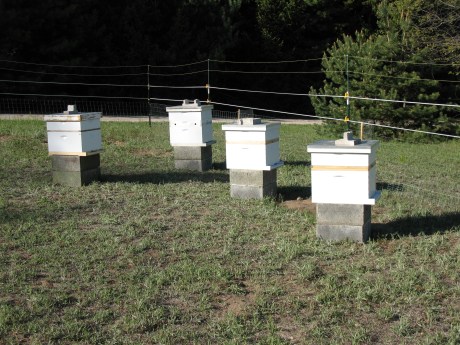
And, finally home in their hives.


What’s Eating You?

A.V. Walters–

IMG_2304

Spindly cages over even more invisible tree whips!

Just as you can identify a critter by its tracks, you can tell who is eating your trees and foliage by what is left behind. This is critical information to the hopeful planter of baby trees. If you don’t know who is doing the munching, how will you know how to stop them?

Last year, we lost some of the seedlings early—like within a week of planting. At the same time, a deer jumped our garden/orchard fence and ravaged the baby fruit trees. Though they survived, I was devastated. I could clearly follow the deer tracks to each and every tree victim—and then on out and over the fence. Bastards! We solved that problem by making the fence higher—but I missed a learning opportunity in garden sleuthing. And, I blamed the deer for other losses outside the garden.

I was wrong.

You see, when a deer grazes on your seedlings, they bite and run. They leave a ragged edge. Other critters have other distinctive habits. The modus operandi of the dreaded cottontail is to use those sharp rodent teeth, leaving a clean, angled cut—almost as though pruned with a shear. Bunnies are an under-recognized threat.

Porcupines also dine on seedlings and branches. I’ve been impressed with what I thought was deer damage on the wild bramble canes, only to learn that raspberry and blackberry canes are among the porcupines’ favorite spring and summer foods. And in the winter, they’ll also gnaw on tree bark at the base of a tree, eating the nutrient rich cambium layer, girdling and often killing the tree. Indeed, starved for salts, they’ll gnaw on plywood siding, or the tires on your car! (Salt from road clearing gets imbedded in the rubber tires.) Just this week we saw gnaw marks on our rubber garden hose! (And on our neighbor’s garden shed.)

Yesterday, I saw a huge porcupine, swaying in the wind in the top of a maple tree. They love the leaf buds—before they unfurl and get too tannin. It was a very windy day and, looking up I saw that porcupine hanging on for dear life—just to eat those tender new bits. Never before had I contemplated the risk of being thunked by a falling porcupine. Ouch.

But my chief opponent of the moment is those bunnies. When we plant trees in the forest, I don’t worry about the rabbits. It’s too hilly and woodsy. The bunnies are out front, by the house, in the grassy open areas. That’s where we’re putting the hazelnut and mixed berry hedges. No sooner did we start the planting than the rabid rabbits were right after them.

This is no surprise. Tomorrow we will be changing the fence around the vegetable garden (before we plant) because last summer the bunnies made short work of our garden. With the tree seedlings, we had to quickly change gears and immediately put up welded-wire tree cages around each seedling. The cages are made from cut fencing material, formed into circles by bending over the wire tabs from the cuts. With a more than a hundred seedlings at risk, that’s a lot of work!

The natural world notices. We finished the planting (and most of the cages) yesterday. We came out this morning to a parade of deer prints—a veritable square dance of deer, checking out the new additions to the neighborhood. Thank God those seedlings were safely in their cages.


161 Trees…

A.V. Walters–

And counting.

Dear readers, I will return. But there are still bare-root trees to plant, and until they’re all in the ground, these aching bones will not be blogging. The oaks and tulip poplars are in, the hazelnuts (almost, just five to go) The service berry, black elderberry, and redbuds are almost in (I’m saving just a handful for the end, when I’ll put in a mixed berry hedge. Most of the trees were selected to make the bees happy. Right now, getting them all planted, will make me happy. Another day, maybe two. Then I have to make cages for them to keep them safe from the bunnies and deer. And then we pray for rain.


Musings on Planting Trees–

A.V. Walters–

IMG-3

And that doesn’t even include the trees we bought from Benzie County!

Professional “re-foresters” can plant hundreds, even thousand of trees each day. Depending upon the terrain, they use dagger-like tools, either hand or foot powered, and can put in acres of trees in short order.

I am not one of them. I am too fussy. Each tree gets an actual hole, not just a slash with the roots jammed in. Each tree gets a shovel-full or two of compost, which must be blended into the natural soils, so water doesn’t “perch,” causing root rot. I layer in the roots, so they’ll have a stable start. This year, I’m loading up a little on the compost. They’re predicting a hot, dry summer and the compost helps to hold moisture in the root zone. I cheat a little, and soak the roots in Terra Sorb (or work a pinch of it into the hole), also to give them the moisture advantage. If no rain is predicted, they get a starter sip of water, (though spring soils are pretty moist.) Sometimes, we give trees a cage, to protect it from deer or rabbits during its infancy. There’s only so much you can do.

Professional tree-planters work on a scale that allows for a relatively high failure rate. From my perspective, there seems to be little point to doing all that work if the trees don’t survive. Sure, there are losses from natural forces, deer, bugs, and the like. This past year we lost two baby trees when other trees fell on them. There’s nothing you can do to protect from natural hazards. The best you can do is to give them the best start possible. Do I sound like a parent? I’m pleased to report that we have a good survival rate for last season’s seedlings.

In the forest, you need to look for a good spot–a hole in the canopy for light, not too close to existing trees, not near an obvious deer path, not in the “fall-line ” of any existing afflicted trees, and hopefully sheltered from strong winds. Of course, you’re carrying a bunch of seedlings in one bucket (with some water) and another bucket of compost and a spade. I spend a good bit of time, wandering in the woods, finding those good spots. I couldn’t be happier, even with the load–what a lovely way to spend time.

We don’t celebrate Earth Day. We spend a couple of weeks each year, planting. So far this season, I’ve put in 98 trees (including 3 orchard trees.) I’m over the half-way mark. I hurt like hell, but things are moving right along.


Ah, Spring

A.V. Walters

In our minds, our little house—our work in progress—is picturesque. All winter, we could hardly wait for spring to get back to work on it, in earnest. I’ve been asked to send photos of our progress. Then, earlier this month, the snow finally melted. It was like waking up after a bad drunk.

Construction is a messy thing. Just before the snow, we finished up the septic system, and sealed the log exterior. Somehow, in my minds eye, things under that snow were peachy. Spring has been an awakening.

Installing your own septic system is like buying new underwear. You’re happy to have it, maybe even proud of it. But it isn’t something you show off. It is, in fact, an ugly scar on the scenery. It was time to do some reconstructive landscaping. With any luck, after an enormous amount of work, you won’t be able to tell that we dug there at all.

We added this to our annual spring planting schedule. We take a fervent approach to diversity, adding dozens, if not hundreds of new trees and plants, every year, to fill in what climate change takes. I don’t mean that lightly. The forest is suffering. We are losing our ash trees to the Emerald Ash Borer, and the beech trees to Beech Bark Disease. Last summer’s “freak” wind-storm took out over 35 trees. Changes in the environment are accelerating. We have to hustle just to keep pace. We select our plants emphasizing climate tolerance, and, hopefully, outguessing the next blight. At least diversity should serve us there.

So, every year we purchase baby trees of many varieties to diversify the forest. This year, in trees, we will plant white oaks, hemlock, tulip poplars, witch hazel, dogwood, and redbud. We’re also planting shrubs and bushes for soil conservation and wildlife habitat (a hazelnut windrow and a mixed berry hedge.) To the forest trees, we add 100 hazelnuts, red osier, elderberry, serviceberry, blueberry and high bush cranberry. And then, to fix the scar over the new septic we have clover, native knapweed and various wildflower mixes. Needless to say, we are not putting in a lawn.

So far, the 27 white oaks are in, and we’ve prepped and seeded the front with a mix of clover and over 3,500 square feet of wildflower mix for the bees. I’m trying to keep them closer to home with a delicious variety of safe blooms that haven’t seen pesticides. (I can’t account for what the neighbors, or local farmers, plant.) Rick says the bees will go wherever they want, but I’m like the frantic parent, putting in a swimming pool so the teenagers will stay home. (Rick says that just means you have to feed their ill-mannered friends, too.) That’s not lost on me because I know we may lose many of the new wildflowers to the deer and the bunnies. Bambi and Thumper are no longer cute to me.

By this time next month, we’ll have used all of the 45 tons of composted manure that we purchased last year. Rick can hardly believe it. He thought I was crazy.

I’m exhausted and we still have 158 plants and trees to go. Until the front area heals, there’s no point in pictures, it’s just sorry looking. The next few weeks will be all about planting. The first waves, fruit trees and oaks, are in. Next week the big shipment will arrive. And after that, we should be frost free enough to put in the garden. Ah, Spring.


IMG_2295

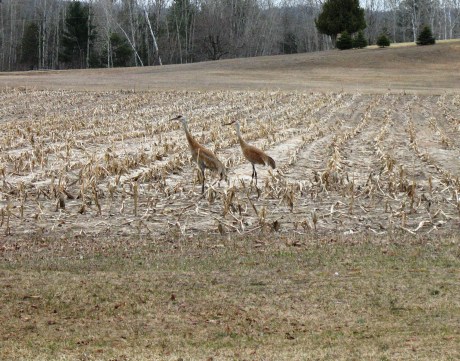
Sandhill Cranes, Yesterday

No Reservations Needed–

A.V. Walters–

Back in my California days, I always wanted to go see the Sandhill Crane migration. There was an area outside of Modesto where the cranes would come and settle for a while each year during their migratory cycle. A couple of friends were also interested—but we never made it happen. One of the three would always have a conflict—and the other two never got it together to do it anyways, or we’d miss out on the limited reservations for crane viewing. Back there, you had to do Sandhill Cranes by appointment.

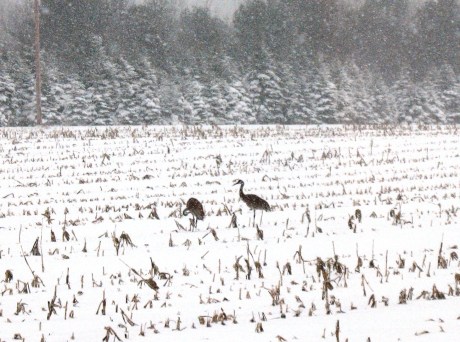
The cranes are beautiful. They’re a little odd, with a strange whooping type call. I know this because, now, thousands of miles away, the cranes are our neighbors. They live nearby in the cedar swamp between here and the town of Cedar. We can hear their weird yodeling call during the long light of summer evenings. In the late autumn, or early spring, sometimes they’ll fly over to the cornfield adjacent our little apartment, to glean corn bits from the field.

It’s funny how something you failed to pursue in one part of life, actually comes to your doorstep later. We don’t get a whole migrating flock. It seems that our cranes stick around for the winter. Maybe they do a short trip south—but if they do, it’s pretty abbreviated, because we see them so frequently here. I think I prefer just a couple of neighbor cranes to some overwhelming migratory flock. It’s certainly more intimate—and doesn’t require a reservation.

Snow Cranes

Sandhill Cranes, Today

Friction Fit

A.V. Walters

IMG_2293

I’m sorry that I haven’t been posting. I have been busy with everyone’s favorite task in home building. I’m insulating.

For good reason, Michigan takes insulation seriously. Back in California I remember building inspectors glancing at insulation, with a nod and a wink. Not so here. Normally, we have winters that warrant a rigorous inspection. Without insulation, we’d spend a fortune (and a lot of natural resources) to keep the place habitable in the winter.

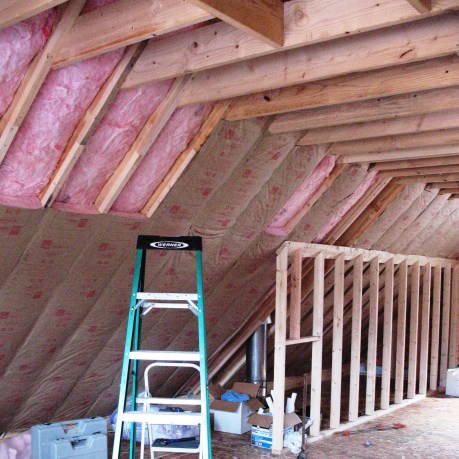
Because there’s little you can do to insulate log walls, the remaining areas get extra scrutiny. In part because the default—fiberglass–is such a miserable job, we considered all of our options. Rigid, closed-cell board, which is not itchy at all, was time consuming and expensive. We secured bids on foam spray installation. They were outrageous—especially because of the manual labor to install the cold-roof baffles, before the spray. Ultimately we opted for the tried and true, the fiberglass, do-it-yourself option.

We have to meet R 49 in the roof and ceilings. When you include the cold-roof baffles, there’s not enough depth between the rafters to get R49’s worth of insulation. So, we found a company that made sturdy R5 baffles AND we firred-out the rafters with 2X2s for extra depth. Then we used high-density fiberglass batts. Of course, they don’t make such things in the depths we needed, so we opted for three layers of R-15 batts to get to the R-value we needed. It has been an amazing amount of work, most of it overhead, unpleasant and itchy (on a ladder, in protective layers and mask.) With three layers, it means dozens of times up and down the ladder to fill each bay. The first two layers are “friction fit,” that is, they are held up by their sheer orneriness. The last, faced, layer is stapled.

IMG_2292

It’s nearly finished. Some of it has to wait—to accommodate wiring and plumbing first. I don’t mind the break, though it might be hard to go back to it. Our little house will certainly be cozy when this is all done. I’m curious to see how it will fare in summer—whether the cold-roof baffles and ridge vent will really keep the roof (and thus the upstairs) cool. In that department, we are blessed that the house falls in the shade of the hill in the afternoons and that should help us keep comfortable, too. It’s important, because we’ve opted not to air-condition.

I’m happy to be nearly finished. It turns out that the only part of this task that is not friction fit, is me.


Minding Our Bees and Qs

A.V. Walters

IMG_2287

Ah, The Sweet Smell of… Failure?! How can that bee?

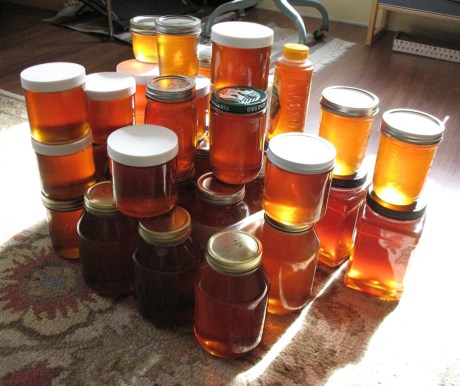
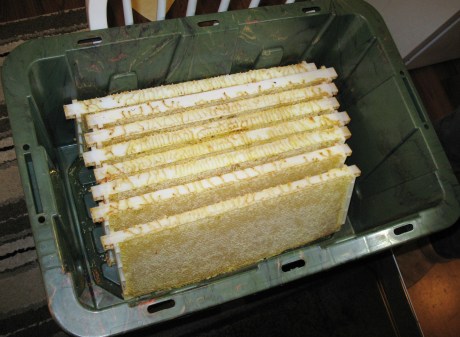
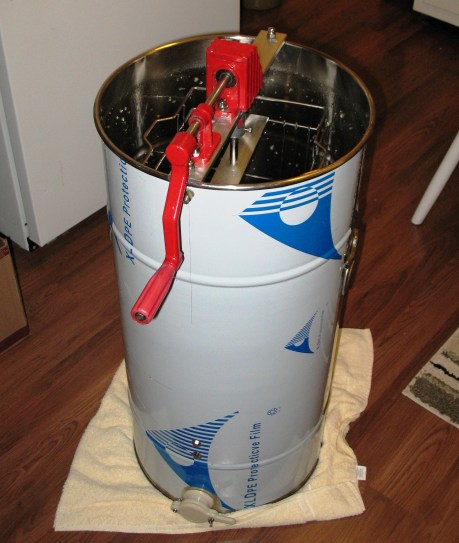
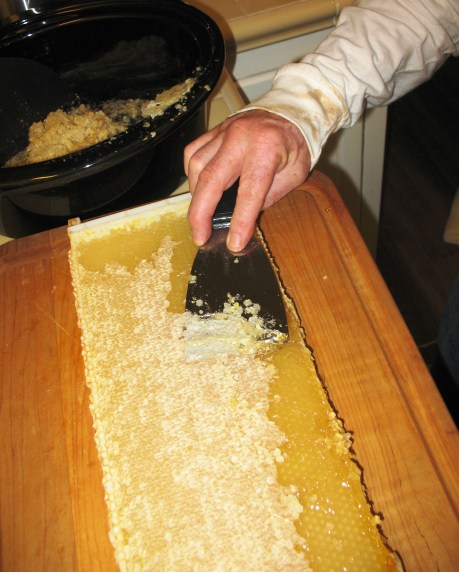
We’ve just spent the better part of the weekend processing honey.  The house smells sweet and clean from honey and beeswax. Unexpectedly, we have a lot of honey. This is honey that was left in the hives so the bees would have something to eat over the winter. The problem is that the bees didn’t make it. We checked the hives a couple of weeks ago and confirmed our worst suspicions; all the hives were dead.

They must have died pretty early in the winter, because they left ample stores of honey. At least they didn’t starve. There’s nothing wrong with the honey, so, once we’d cleaned up the hives, and done our limited forensics, we collected up the laden frames for processing. We had very productive bees. Our mild winter appears to be melting into an early spring, and we wanted the hives empty before we have a bunch of grumpy, hungry bears roaming around.

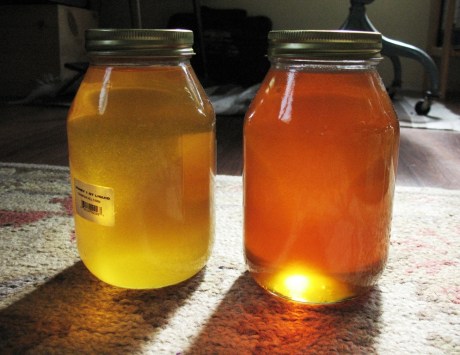
The late season honey is very different from our first harvest. The honey from early in the season is light, with a floral aroma. The late season honey is thick and more strongly flavored—made with the robust pollen of Black-eyed Susans and Goldenrod. I can’t decide which I like better.

IMG_2289

We’re not quite finished processing, but it looks like we’ll end up with just shy of seventy pounds of honey. Add that to the thirty-five pounds we harvested last fall, fifteen pounds from the Pinta hive, and… well, it’s a lot of honey. Today we had to run out to buy another dozen quart canning jars. (Folks at the local grocery wonder out loud what you’re canning in March. It’s early, even for maple syrup.) The new quart jars, along with every jar and container in the house brings this batch to about 27 quarts. It makes for a bittersweet failure. We’d rather have the bees.

We’ve checked with the experts and the most likely explanation is that our bees succumbed to varoa mites (or to the viruses that the mites carry.) There was some evidence of mite activity in the two smaller hives. Our aggressive hive, Santa Maria, was not so clear a case. It could have been the weather. This winter’s warm/cold oscillations were very hard on local bees. We’re not the only ones who have had losses. Even experienced beekeepers are cursing this winter. It seemed mild, except (quite abruptly) when it wasn’t.

We have cleaned up the hive boxes, and set them ready for spring–we have new bees on order. I’ve also ordered a well-recommended book on natural beekeeping–and I attended a day-long class on advanced beekeeping techniques. I feel almost ready to try again. We’ll monitor mite levels closely. We’ll do mid-season splits (dividing colonies in half, and “forcing” new queens.) Splitting not only increases the number of hives, it also interrupts the varoa breeding cycles. And, we’ll investigate and experiment with natural methods of hive treatment.

IMG_2290

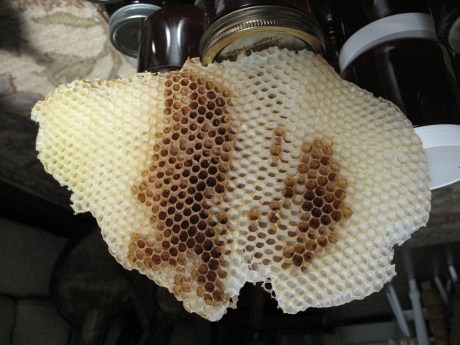
Bees’ combs are amazing structures.

Overall, we can’t complain. The retail value of the honey we harvested has covered our initial investments in bees and equipment. It makes good sense to try again. We plan to start with three hives, and split to six, mid-summer. At the end of the season we can assess the hives’ strengths, and either go into the winter with six, or recombine some for larger, stronger hives for next winter. Unfortunately, the new normal in beekeeping is to expect thirty percent losses–and that’s when you do everything right.

We’ll have to be a lot better about minding our bees.


Dreams, Anxieties and Outcomes

A.V. Walters

b3

Ready to go!

When I was very little, my father dreamed of owning a sailboat. Saddled with five small children, it wasn’t a dream that was on his horizon, but a man can dream. He had the big blue book of sailing, Piloting, Seamanship and Small Boat Handling. It lived on the shelf in the living room, and he’d take it down from time to time and study it—while bringing my mum up to speed on the tips and best practices he’d learned. The closest we got to boating was an 18 foot, molded mahogany canoe. It was big enough to hold the whole family for day excursions, though in rough water the waves came dangerously close to the gunnels. Five little tow-heads with guarded, wide eyes scrutinized those lapping waves.

I understand the lure of the long-term dream. I’m approaching a number of mine—living in the country, building a home, and keeping bees. I have to keep pinching myself. In my mind’s eye, I also always wanted play a musical instrument. I cannot sing (or so say those around me) but I love music and throughout my life I wanted “in” on that secret language.

That’s how I think my father felt about sailing. His grandfather had worked the lake boats. He grew up on stories about the big lakes. When he retired, it was time. He didn’t need a fancy boat or a fast boat. He wanted something stable; after all, he was a beginner in his sixties. He settled on a MacGregor—a bit of a tub, with an oddly avid following. To pinch his pennies, he searched for one that needed work. (Sound familiar?) It was not seaworthy when he got it. He spent a couple of years upgrading, and, being a woodworker, he added a lot of nice little touches one wouldn’t expect on a beginner boat. As completion approached, he pulled out the big blue book and he and my mom drilled on small boat handling. As a landlubber, she was cautiously enthusiastic. Her father had been an expert boat pilot, both in the Coast Guard and during his 1920s exploits as a rumrunner in Detroit.

b1

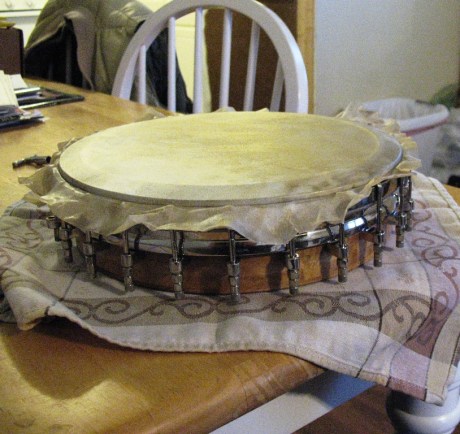
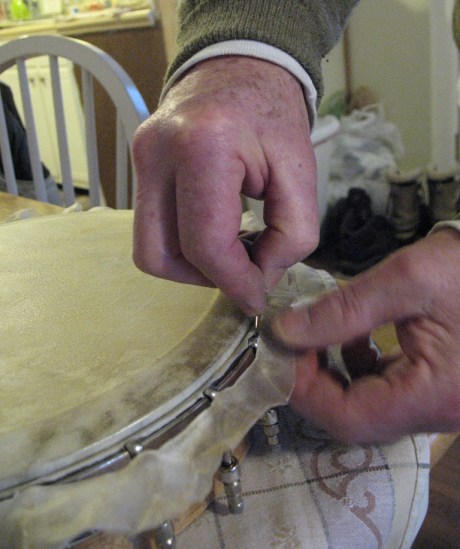
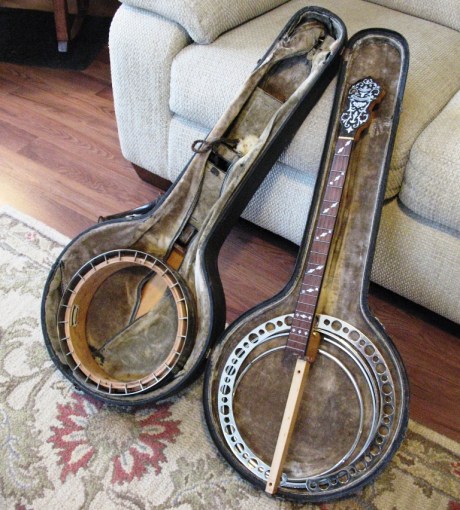
We have finished the banjo restoration. I say “we” because a project this cool attracts volunteers. Rick could not resist, and it became our joint endeavor. Really, how hard could it be? It took many internet consultations. Rick re-machined some of the damaged parts. There are You Tube videos on how to stretch a calfskin banjo head. (Of course, beyond the general, no two of them agree on how it’s done.) We picked a natural calfskin (not white) because it’s most likely what would have been put on the banjo when it was first made, back in 1928. We were a little intimidated by the mounting process. Basically, you learn what you can—and then you throw caution to the wind and let common sense guide you. Then you have to set the tailpiece and the bridge, so that you can install the strings. Suddenly, it’s a banjo! It’s not rocket science, but I’m grateful that there were extra hands in the crunch. It’s beautiful, fully restored to its authentic 1920s glory. It has a rich, warm resonant tone—with just the right amount of steel-string twanginess. I am smitten.

b2

My father only sailed for a couple of seasons. He loved his boat. He had a vast book knowledge of how to maneuver it on the water. But he hadn’t counted on seasickness. Both of them. Even if you think you know the ropes, it’s hard to master sailing if the Captain and the crew (of one) are both incapacitated, hurling over the sides of the boat. In the calmest of conditions they could handle the motion, but of course, the calmest of conditions don’t include wind. Wind is a necessity in sailboat operation. They floundered. It became a bit of a joke in the Harbor—these two eager, elderly sailors, flailing at the task. More than once they ran aground, because neither of them could see beyond their nausea to steer to safety. My nephew (who apparently takes after my grandfather and can sail like a pro) tried to help. In the end, all he could do was to watch, laughing. I understand their predicament because I, too, am plagued with motion sickness.

My father did well on the sale of the boat. After all, it was in mint condition with many, many, lovely little upgrades.

Now it’s time to walk my talk on the banjo. I’m a little nervous. The instrument itself is so awesome that I feel like a fraud, holding it. It’s unnerving, to get that close to your dreams. All I need now is a pitch pipe, so I can start up with the proper tuning.


Arts and Crafts

A.V. Walters

IMG_2274

When I refurbish a piece of furniture, I have a couple of rules. This is not to say that my way is universal, or that I pretend to be some fancy, high-end professional restorer. But, I do try to maintain the integrity of the piece. My rules, in short, try to restore the piece to its original condition, respecting the aesthetic of the time; when possible (in keeping with the first rule) try to reveal the beauty of the wood (or other materials); and maintain, or return the piece to its original functionality. It’s not enough to be cool-looking and old; I want it to be useful, too.

There are exceptions—just as our aesthetics are shaped by our experiences, sometimes we make substitutions. What we modern people admire about classical Greek sculptures—the revealing beauty of the white marble—is not what the Greeks had in mind. Originally, those marble statues were painted! Accustomed to the elegant monochrome, my eye is offended whenever I see a “fully restored” Greek figure. To my eye, with paint, they look garish and cheap.

My favorite era of antiques is Arts and Crafts—sometimes known as Mission. This artistic movement was a backlash against the frippery and soulless excess of industrialization. At its best, the lines were clean and simple, harkening back to a time of craftsmanship and honest labor. (At its worst it can be chunky and monolithic, crude for crude’s sake.) The philosophy behind Arts & Crafts reflected the relationship between the materials and the craftsman, showing each to its best potential. Of course, once popular, its designs were copied and manufactured, en masse, by American factories. Savvy manufacturers, like the Stickley brothers, created a design cult and a “buy in” mentality for their lines of cottage-style furnishings. The success of the movement’s philosophy, and marketing, soon made it another passing fad. By the start of The Great War, the style was already fading. Its American heyday was between 1905 and 1915.

I like the furniture of that era, featuring rich woods, quarter-sawn oak or aged natural cherry. Like many antiques, there’s additional caché for a piece when it has its original finish. Sometimes, that’s an original “fumed” finish—and I laugh. What we see today in those fumed finishes, often dry feeling and nearly black in color, looks nothing like it did when it came from the factory. They were ammonia based “lusters”—added after the standard wood finish, a process that created an iridescent color—almost a glow, in pastel tones. But, the factories knew that the fuming was ephemeral. It didn’t last. In fact, the fuming actually degraded the wood. So current antique emphasis on an “original fumed finish” puts a premium on what was really a failed experiment from the start. It’s not unlike the Greek statues—completely different in their own time. I’ll sand and refinish a fumed surface—regardless of the premium (breaking my own first rule.) I once sold a chair to an appellate judge who wanted a blond mission rocking chair, specifically so that he could experiment with fumed finishes. Now, that’s a purist. I pale by comparison.

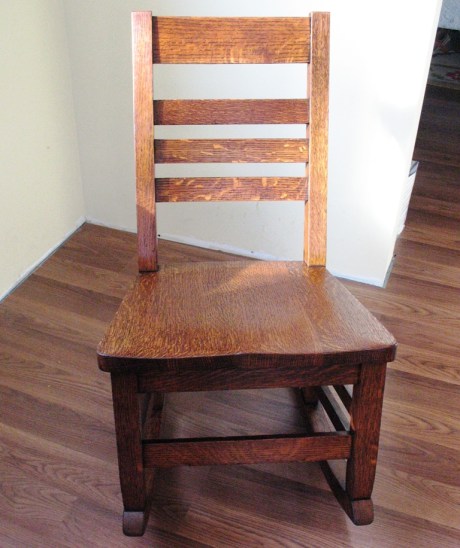
Recently I found a lovely little “sewing rocker” on craigslist. From the picture, it had nice lines, but was nearly black. I figured I could refinish it, so long as it was solid and the joints tight. At thirty-five bucks, it was worth the effort, especially since I need a small chair for the downstairs bedroom. In person, it was just as dark, but it didn’t have the dry feeling of a fumed finish that I’d expected. I bought it. Once home, we found a faded label—Otsego Chair Company. A quick trip to the internet told us that Otsego was a Michigan company that closed in 1915. So our little rocker is at least one hundred years old.

With winter slowing us down outdoors, this is a nice time for indoor projects. I’m still waiting for the rest of my banjo parts, so I pulled out the little chair. I wondered about the nonstandard color—near black. I decided to start with a thorough scrubbing with Murphy’s Oil Soap. What a shock. This piece was never fumed; it was just filthy!

Underneath all that grime was a lovely little chair with a slightly weathered, rich patina. I didn’t remove the original finish, but, in the interest of my second rule, I did cheat a bit and enhance it with a layer of penetrating stain. The oak is quarter-sawn and highly figured. That means that the wood was cut for structural stability—and to enhance the variation in the wood’s grain. Before adding stain—I hit the “rays” with a lighter, golden-oak stain, another cheat. That way, they resist the overall, darker stain, and emphasize the contrast in the natural oak grain. I think it came out nicely. A coat of beeswax polish and it will be ready to put back into service.


The Sum of Its Parts

A.V. Walters–

blog pic

We tend to be do-it-yourselfers. Both Rick and I come from families where you fixed it, before you replaced it. Sometimes, if whatever “it” was, was not within your field of expertise, you paid somebody to fix it. Sometimes, cost or convenience inspired you to do it yourself. There’s a little bit of a mantra to it, even if “it” is intimidating, “Well, how hard could it be, really?”

All the way to building a house.

That history, combined with an appreciation of older things, has led us, separately and together, to a good bit of investigative repair and reinvention. My home is filled with rescue-antiques. Rick is the mother of invention when it comes to building and repairing challenges. We have accumulated no small measure of experience in woodworking, refinishing, building, tool maintenance and repair, mechanical and electronics repair (mostly Rick), art restoration and the mending and making of things in fabrics (mostly me.) We have projects upon projects. Which brings us to the Paramount question.

In the midst of my mid-life upheaval, I decided I needed an intellectual challenge (because writing novels wasn’t enough?) I wanted to learn to play an instrument, and in so doing, to immerse myself in a participatory way, in the language that is music. I had to choose which instrument would be appropriate for a (then) solo, middle-aged woman. It had to be something I could play alone, and maybe with others. I envisioned myself playing and practicing on a big porch with a view. My first choice, violin, wasn’t a good fit—as a previous car accident had left me with neck issues. I thought about the sax—but even the idea of relearning the breathing for a wind instrument, left me winded. So, I decided on the banjo, mostly because I could not think of any banjo music that sounded sad. I picked up a cheapie banjo on craigslist and began learning and plinking. I have a long way to go.

But, as things work out, once you open the door in a particular area, opportunities step in. When my brother learned that I had an interest in the banjo, it turned out he had a contact for an old banjo with history. He sent it my way.

It is a Paramount, tenor banjo from the mid-twenties. It’s beat up and beautiful. For a number of years it’s been sitting, disassembled (thanks to a “well intentioned” friend) in its case. I’m coming very close to having that lovely long front porch, overlooking the valley, so I thought it was time to get the Paramount in shape. Rick, as is his way, raised an eyebrow.

The banjo needs a lot of work. First and foremost, it needs to be completely disassembled and cleaned. Then, a new “head”—the stretched skin that gives the banjo its distinctive sound. The choice was whether to use a synthetic head material, or the traditional calfskin head that was used when the Paramount was first manufactured. We also need to replace the tuning pegs—which raised the question,again, of new versus old. The Paramounts had ingenious Page, geared pegs, new back in the day, and no longer manufactured.

In the past, everyone had said that I need an expert to help with this banjo renovation. So, I asked around and received several referrals to a local guy, who was reputed to be both better, and less expensive, than the “ship it off to Lansing” guys used by local music stores. I called and made an appointment. First, he gave me his tour of successes—a line-up of string instruments, hanging awaiting pick up by his other customers. They were lovely—so we got to the Paramount. His eyes widened when he saw the disassembled banjo. A Paramount is an impressively machined instrument, sturdy and buttressed with all manor of hardware. The expert marveled that the parts were mostly there—you could see that he was positively itching to get to the task. He knew that I had contacted him mostly for assistance with the installation of the new head—but soon his enthusiasm overflowed to the rehabilitation of the wood and the nickel-plate parts. He pointed out the accumulated finger grime on the mother-of-pearl inlayed finger board. I hadn’t noticed how bad it was. He insisted that the entire instrument be disassembled, lovingly cleaned, then reassembled, before a new head could be stretched. He was adamant that only vintage parts should be used—and of course, a calfskin head. He explained the intricacy of the stretching of a banjo head, a process not unlike stretching the canvas for an oil painting. His enthusiasm was contagious, and I was completely on board. As he described the work necessary to restore the banjo to its former glory, the dollars were mounting. He looked up at me, but I didn’t blink. I’m a pushover for any argument favoring an antique’s original integrity. I was sucked in by his description of the painstaking task. With the vintage parts and laborious restoration, my “free” banjo was fast approaching a thousand dollar rehab.

“That grimy fret board,” I asked, “what would you use to clean it?” I expected to be drawn further into the secret and arcane world of instrument restoration.

“Oh, Windex will do it.” He said offhandedly.

My heart skipped a beat. “Windex?” I’ve done enough antique restoration to know that you minimize “wet” treatments, especially near inlay or marquetry. He noticed my alarm.

“Why, what would you use?”

“As mild a cleaner as possible. Probably Murphy’s Oil Soap, with very little water, a damp cloth to wipe it clear and then dry it immediately with a soft terry.”

He nodded, “Yeah, that’d work, too.”

But he’d now handed me the tail-end of the thread that would soon unravel the spell he’d woven.

“And the nickel-plated parts?” I asked.

“Ammonia soak—you know the Windex, and then, where needed, a little steel wool.” My eyes widened and he followed up, “Don’t worry, that steel wool wouldn’t hurt for the tough spots. Why, what would you use?”

“I like Never-Dull. It doesn’t scratch and can clean most any metal finish.”

“Never heard of that.” He pulled out a polishing compound he sometimes uses.

I had to press further. “What about the areas on the neck, and the other wood surfaces, where the finish is worn?”

He looked at me seriously. “There’s a temptation to refinish that—but it’d be a mistake. As long as the wood integrity isn’t threatened, you keep the value of a vintage instrument by maintaining the original finish. You can do that with a little Pledge.”

The bubble didn’t just burst, it imploded.

Pledge?”

“Yeah, you know, or any polish and wax finish.” I had visions of 60s era homemaking commercials and gingham aprons. I needed an exit strategy.

“This is adding up. We really just need help with the calfskin head—the cleaning part is grunt work that we can really do ourselves.” His face fell. It wasn’t just that the fish had slipped the hook—you could tell that he had really wanted to get his hands on the banjo. There’s genuine satisfaction in the restoration of a beautiful old item. He nodded. And helped me repack the banjo parts back into the case. He was really a nice and genuine fellow. He was, after all, the person most recommended in the area.

I took the banjo home and told Rick the tale.

So, really, how hard could it be?

We went online, researched and ordered the replacement tuning machines, and the calfskin replacement head material. We even broke down and bought an original Paramount wrench to stretch the new head. (They look kind of look an old skate key.) There are You Tube videos that show the many phases of banjo restoration, including stretching a calfskin head.

Rick helped disassemble the rest of the banjo, and I started the painstaking cleaning process, starting with the inlaid fret board, using the materials of my choice. The expert was absolutely right (in part)—cleaned up, it is beautiful. The nickel plated, metal parts have been gently restored to their former gleaming glory. We have some wood repair still to do, but I’ve ordered all the replacement parts and look forward to the challenge of finishing the job.


Follow the Money–

A.V. Walters–

IMG_2269

That’s my rule of thumb, whenever there is a whiff of scandal. I remember California’s Energy Crisis—the one that ushered in billions in debt as the state struggled to meet energy needs. Why the sudden scarcity of electricity? I believed then, that the crisis was manipulated. California couldn’t get any traction with FERC—the federal agency charged with regulating the energy exchanges. After all, George W. was the new Sheriff in town, and California didn’t vote for him. Years later, litigation in Washington State revealed the graft and market manipulation that gave us the “crisis.” By then, George W.’s friend, Enron was already gone, and California spent the next decade digging out from the debt of that fraud. Follow the Money.

What if there doesn’t seem to be any money? Then, look to who benefits.

And that brings us to Flint. We are told that the poisoning of 100,000 Flint residents was the unfortunate result of managerial ineptitude. Clearly, at least that is true. But, we need to look a little harder. Following the money doesn’t help, because the very fact that the parties in question were already under Michigan’s draconian and, unconstitutional, Emergency Manager Act, means that the lack of money had already been established. However, we’ve seen enough of the results of Michigan’s Emergency Managers to know that the appointment of a Manager, combined with the stripping of democratic representation, generally means that the troubled, usually minority, community in question, has something, some asset, that the Governor’s cronies want.

It’s too early to know whether the Flint crisis was steeped in some other, darker motivation. But there are early, and troubling, indications that saving money for Flint wasn’t the primary objective. Follow the money—look to who gains. As always, governmental transparency is essential to maintaining the integrity and trust of the citizens. Recently, the State of Michigan dropped to last place in the fifty states, in its score for government ethics. We have a long way to go to rebuilding citizen trust, so I suggest the Governor step forward with ALL the relevant records.

Governor Snyder did release two year’s worth of “relevant” emails on the issue. Unfortunately, those records were not complete, were heavily redacted and did not go back nearly far enough. When someone makes the effort to hide their actions—they are hiding their motives. Then, we need to look even harder at the facts. Let’s face it, it is unlikely that the citizens of Flint voted for this administration—they are not his constituency.

I don’t have the answers. I only have a healthy sense of curiosity and a deep sense of outrage at what has happened to the citizens of Flint, and especially to the children, whose futures have been diminished. To say the least, I have questions.

Emails released by Detroit Water and Sewerage Department (DWSD) reveal that Flint was offered a very sweet deal for continuing with Detroit water. The price offered was lower than any savings offered by switching to the new Karegnondi Water Authority pipeline, both in the short and long term. Why then, the rush to change Flint’s water supply?

This is not Michigan’s first Emergency Manager water crisis. Long before Flint, the City of Detroit (and DWSD) were placed under the Governor’s Emergency Manager’s powers. Go back a couple of years, to the days when, under the Emergency Manager, DWSD was cutting off water service to delinquent homeowners—while carrying delinquent corporations with far more egregious non-payment histories. It was an international embarrassment. DWSD was caught failing to accurately credit payments made and returning individual customer’s checks—because payments had to be in cash. In short, under the Emergency Manager’s powers, DWSD was making customer payments and accounting more difficult and then, based on the very problems they were creating, suggesting that the only solution was to split up and privatize Detroit’s water assets. Nestle, everyone’s favorite purveyor of necessities, was discussed as the “obvious” choice for privatizing Detroit’s significant water assets. You know, the same company that denies that water is a human right, and advocates that municipal water supplies be turned over to for-profit corporations. What connections did the Governor or the Emergency Manager have with Nestle, or any other private water interests? (Besides the fact that Deb Muchmore, the wife of the Governor’s then-Chief of Staff, is a Nestle spokesperson.)

I question whether the seeds of the Flint crisis don’t start with the Emergency Manager’s efforts, in Detroit, to ‘starve the beast’ of DWSD. After all, the long-term viability of DWSD was enhanced by Flint’s water supply contracts. Only a full release of all documents will tell. Why the rush to a new water source if DWSD was offering a good deal? Why sign on to a new, as yet un-built, pipeline, if it wasn’t the best economic deal? Who was paying for the new pipeline? Whose interests, other than the City of Flint, were to be served by the new pipeline? (It’s been suggested that the pipeline was also to serve Eastern Michigan’s fracking industry.) Is there any truth to this? Even if the new, Karegnondi Water Authority pipeline was a viable water solution for Flint, why the rush to use the Flint River in the interim, especially since it had previously been determined to be unsafe? Experts had warned that the Flint River was badly contaminated. Experts also advised that the Flint River water was corrosive and would damage the city’s water infrastructure unless properly treated. Why wasn’t this done? Surely, minor savings couldn’t justify trashing the existing water system, and risking the release of toxic lead into the city’s drinking water. Whose interests were served by starving DWSD? I have questions, and the citizens of Michigan and the City of Flint deserve answers.

We have a right to know. Those in charge—all the way to the Governor’s office—have to account for what has been done. It needs to go on their permanent record. The legacy of this Governor’s administration, and its appointments, is a generation of poisoned children. If this is mere negligence, those responsible must be identified and removed from any decision-making authority or power. There may be cause to seek criminal prosecutions for decisions that were, at best, reckless. I’m not so sure they were even well-meaning. But answers to these questions may reveal something even more hideous.

If there’s any connection between the crony-capitalist friends of this administration and the results in Flint, we owe it to the children to leave no stone unturned in our investigation. If reckless decisions were made, in order to provide profit opportunities for friends of the administration, then these actions go well beyond negligence. We need to determine whether there was a criminal conspiracy to benefit private interests at the expense of public obligations. We’ll need to look to any and all documents related to Emergency Manager control of or involvement with ANY water assets in Michigan. We’ll need to look to any campaign contributions, or other “considerations,” from companies that could have benefitted.

This isn’t just a question of integrity. (Michigan’s current government is already at the bottom of that list.) It’s a question of intent. If it turns out that this imbroglio was the result of a conspiracy to funnel public assets into private coffers—then ALL conspirators are liable for the damage resulting from the furtherance of the conspiracy. In Michigan we have wondered, how will we afford to remedy this situation—care for the poisoned populace and fix the damaged infrastructure. If this was done for profit, then all those who participated in the scheme will share the culpability and liability. And if individuals knowingly participated in a scheme that poisoned Flint, they must be charged and tried. People have died because of this. This goes beyond reckless disregard, if this was done for profit, it is a crime against humanity.

Like I said, we have to follow the money. We have questions and we need the answers, for the sake of the children.


Getting Mike: Part Three

A.V. Walters

Mike sign

We are all, each of us, a bundle of talents and deficits. My sweet Rick would be the first to agree; he is continually amazed that a highly functional, over-educated adult, like me, cannot tell left from right, or measure anything with accuracy. The trick is, that for most of us, we focus on the talents we possess.

We completely fail at this when the object of our attention becomes a diagnosis, and not a person. A diagnosis can be an opportunity, or an excuse, depending upon how one wields it. In essence, a diagnosis regarding mental capacity gives us information about the nature (and maybe cause) of a deficit. It’s what we do with that information that matters.

A couple of decades ago, I worked as a coordinator for an Adult Literacy Program. We banged our heads against this very phenomenon, repeatedly. Students and tutors would blame their failures on learning disabilities diagnosed when the students were children, instead of looking for the work-around. Despite the educational failures of the past, we found that many of our students were highly motivated and, with individualized instructions, were able progress beyond everyone’s expectations. All too often, the diagnosis of a learning disability had quickly become the operative reality—an excuse for failure instead of a challenge for success.

I have mentioned in this series that my Uncle Mike was shortchanged by the educational system. He had speech impediments that, unrecognized and unaddressed, led teachers to believe that he was language impaired and uneducable. A second chance in his late teens gave him speech therapy—and language. Not that Mike doesn’t have deficits but, armed with language, he presented a whole new package. Mike moved away before I was an adult, so I didn’t have much opportunity to get to know the “new” Mike, the one who could talk, until many years later.

Mike is highly literate. (His keen vision and ability to quickly read signs from a distance were a godsend while traveling with him, across the country.) He reads newspapers and follows current events. He is just as opinionated and informed as the rest of the family—which is saying a lot. He is funny and, in particular, gets situational humor. He has a great memory. But, because his speech is not perfect, many expect him to exhibit lower levels of performance. Mike hides behind these low expectations and, even if it means that he’s misjudged, never puts himself in a position where he will disappoint. Surely, sometimes he fails to “connect the dots,” but I never know if it’s capacity, or training. Mike has spent a lifetime fulfilling his diagnoses.

Not that there aren’t deficits. He has great difficulty measuring the motivations of others. Perhaps an early life without language meant that he could hide behind my grandmother’s skirts, and let her do the coping for him. This is especially true when, all too often, in his human interactions he was the victim of bullying and abuse. He doesn’t get arithmetic at all—and is at a total loss with budgeting and money. Beyond that, I’ve decided to judge Mike’s skills by first-hand experience, rather than by maligned expectations.

A decade ago Mike and I worked together to set him up in his first apartment. He was thrilled with it, with its humble furnishings and independence. We bought him a modular desk, (IKEA style) that required assembly. I took the lead—never pausing to read the directions. Mike and I chatted as I worked. About half way through, Mike expressed his reservations, “Alta, I don’t think that will work.” I was tempted to press on, but Mike got up off the couch and showed me that part of my assembly was backwards! (Did I mention that spatial skills are not my strong suit?) We both laughed so hard, we cried, and then finished the project, together.

Similarly, as we approached the end of our travels, I took a back road shortcut, up a steep hill in Hancock. It’s a winding road—I know it well and I took it at a good clip. We were nearly to the top when Mike cautiously inquired, “Is this a one-way street?” It was, and he was right to question what would have been reckless in two-way traffic. Mike gets it. We have to do a better job of “getting” Mike.

The point is, Mike has a far greater understanding about what goes on around him than we give him credit for. His homecoming can be a new beginning, for all of us. We can plan for successes, instead of failures, while providing safe opportunities for success. There are many wonderful possibilities here. Mike is a little intimidated by his return to real winters—but once his health is recovered, I think he will enjoy snow and season. Already, he is recounting childhood memories of winter in a favorable light.

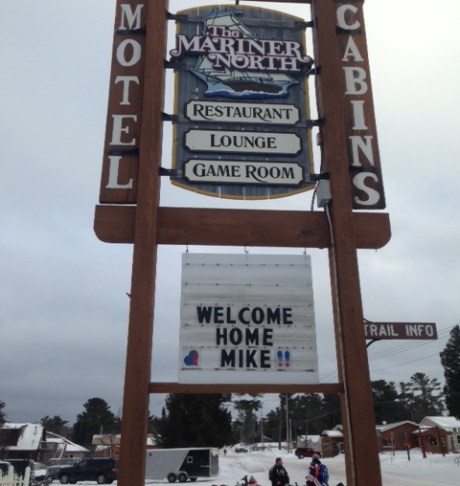
There are decided advantages to small town living. My hometown, Copper Harbor, has about one hundred, year-round residents. Already, I am impressed with the welcome. Family members and friends are pulling together to outfit Mike with clothing and necessities for winter living. All of us are making plans for fun and community engagement as soon as Mike is on his feet. This is a seasonal town, if he wants, there are opportunities for work in the summer. My sister told the owners of a local resort that Mike was coming, and when we rolled into town, he was welcomed home, on their marquis! It brought tears to my eyes, and a ready smile to Mike’s face. Finally, we know that he is safe and loved. Finally, Mike has come home.


Getting Mike: Part Two–

A.V. Walters–

IMG_2266

It was the Christmas storm, in New Mexico, that triggered our actions. That, and the fact we finally got Mike to give us an address.

Squalor is such an ugly word. So is elder-abuse. I try not to be judgmental. I know that every person has their own reasons for what they do, and that it doesn’t help if I overlay my own perspective. I think the facts should speak for themselves. You’re free to draw your own conclusions.

I had coordinated with Adult Protective Services before my arrival in New Mexico. I wanted to document conditions—and I wanted company out to the site—just in case. APS was concerned, too—they wanted me to coordinate with local law enforcement for “civil standby,” which would cover police presence, not only for the initial status check, but for the time it took to pack Mike’s belongings, and go. The county sheriff’s department had jurisdiction, but they reached out for additional back-up from the local police department that had previously been to the location. We were quite the parade. Mike was living in a remote trailer out in the high desert. We, (me and my entourage of law enforcement, totaling four vehicles), met down the road, and then pulled up to the trailer, together. To my shock, the police flanked the entry, hands on holsters, while the deputy pounded on the door. She, Mike’s “friend,” answered—of course, Mike was home.

She presented as a good-looking, if overly made-up, middle-aged woman. She wore one of those “stylish” track suits. You wouldn’t look twice if you passed her on the street. She called Mike to the door. He peered out at the collected entourage—slack-jawed and stunned. His clothing hung on him, his pants held up by a belt with a long tail that spoke to the enormous weight loss since I’d last seen him. He sported a Hard Rock Café t-shirt, several sizes too large, and stained with the kind of deep grime that screams poverty. His hair was clean, but long, and matted. His feet were wrapped in pressure bandages. Even that prelude didn’t prepare me for the inside of the trailer.

Mike’s eyes found me in the crowd and he relaxed, but just a little. I handed him the kitty carrier and told him these people had to come inside to see where he lived. I instructed him to put the kitty in the carrier, so that we wouldn’t scare her off. Unfortunately, the cat was already outside—Mike went out to try to find her, but we never saw her.

We took advantage of his search for Penny, to go into the trailer where Mike had been living for ten months. I knew that he mostly lived there alone. We knew from conversations with Mike that She “lived” there, in address only—mostly she spent the nights at her boyfriend’s apartment. Mike was proud that he “held down the fort” at the trailer. Every couple of weeks, he’d be taken to the boyfriend’s house, to clean up—and to do laundry. Sometimes, if weather was really severe, he’d spend the night at the boyfriend’s.

Getting a good look, inside the trailer, brought tears to my eyes. There was NO water, NO sanitation, NO power, and NO heat. An outdoor, propane, “patio heater” stood in the center of the main room, an empty propane tank, on its side, next to it. No matter, at least today was a warm day. Plastic gallon-jugs of water circled the heater—so they wouldn’t freeze at night. I knew, from Mike, that there was a generator outside that gave light, and access to a microwave oven, when there was fuel. Too often, there wasn’t any. The only significant furnishings were two “easy” chairs, one heavily worn and shabby, and the other in reasonable condition. It was no challenge to guess where Mike had been sleeping for the last 10 months.

The trailer was filthy, covered in the reddish grit that comes from the wind-blown desert of New Mexico. It was strewn with rags, or so I thought, until She told me they were Mike’s clothes. There was a plastic trash bag with his clean laundry—he had no dresser, not even boxes for his clothing. There was a short, folding shelf unit for his personal effects—his razor, miscellaneous papers and junk he’d collected. I had to step outside for a moment, overwhelmed. We’d clearly waited too long, and though he denied it, Mike had paid the price. I went and found Mike, wandering in the field, looking for the cat. “Mike, you have to come with me, now. You cannot stay here, any longer. It’s not safe or healthy.” He dropped his head. I hated to do it—Mike believed I was dashing his dreams.

You see, Mike saw this as his opportunity for homesteading. Apparently, She owned the property. She relieved him of his Social Security money each month, and fed him the fantasy that soon, they’d own the trailer, together, outright. Then, they could see about real “improvements.” Mike had spent the previous summer clearing the mesquite and tumbleweeds from the “yard.” He showed me the tree he’d planted, that he watered diligently from those plastic jugs. He was nothing if not patient, and proud.

By law, most livestock is treated better.

I’d brought plastic trash bags, to pack. I was concerned about the possibility of gathering up pests, and bringing them to my mother’s, where Mike would be living. I was optimistic on that front—even insects couldn’t thrive in these conditions. As I headed back in, to pack, one of the officers offered me gloves—those blue, nitrile gloves they wear at crime scenes to avoid contamination. I gratefully accepted them. Mostly, I just wanted to pack Mike into the car, and escape with just him. After all, anticipating the worst, I’d brought him new clothing. But, I know that there’s a danger in that kind of uprooting; you dismiss and abandon the person’s past—good and bad. Though the officers were quietly conversing amongst themselves—appalled at the conditions, I had to be mindful that this had been Mike’s home, and that he was proud of it. I packed what I could—sorting out the clothing that was too grimy, or threadbare, deciding what was worth hauling across the country.

The officers and APS admitted that this was a clear-cut case of abuse. But, they didn’t seem in favor of prosecution. Mike certainly would be unable, or unwilling, to cooperate—he believed this woman was his friend and, in any event, he was safely leaving the state. At the time, I had no interest in going down that road—I just wanted Mike healthy, safe, and away. One of the officers mentioned that this was not her first time doing this. She was outraged at any suggestion of abuse—after all, how could it be abusive if Mike agreed to it. And, she told the officers, She lived there, too! (Yeah, right. We all knew better.) Mike and I stopped in Roswell, on our way out of town, for a haircut and to close his bank account—he had almost nothing to show for his 44 years in New Mexico.

At last, we headed home. It’s a long trip, over 1,600 miles, to the UP. Mike was quiet at first, but finally, he began to chat—about the problems with his feet, about his cat, about the burritos she’d brought him to eat, from the convenience store where her current “boyfriend” works. Other than a feral cat, lost to him now, nothing he said about his life in the desert made me feel any better. It will take some time for Mike to adjust.

My niece, Jessica, who is a saint, arranged a medical appointment for the day after we arrived home. On the trip, Mike wouldn’t undo the bandages on his feet—he said the doctor (whom he hadn’t seen in a month, because She didn’t get him to his appointments) told him that only a doctor should wrap or re-wrap them. My mother and I were in the exam room when they removed the wrappings. We didn’t know what to say. His feet were grossly swollen and crusted—skin split from the swelling. There was evidence of frost-bite—a testament to his living conditions. His feet did not look human. The doctor took one look, and sent us to Emergency.

No thanks to his “friend” in New Mexico, Mike will be okay. His feet and legs will recover, if slowly. He now has loving caretakers who will see to it he eats properly, exercises, and gets needed medical care. They tell us he came very close to losing his feet—and maybe his life. We’ll deal with the blood clots for several months, yet—with blood thinners and proper pressure wraps. I arrived, apparently, just in time.

I’m still fuming. In front of Mike, I’m careful not to criticize his “friend.” I understand Stockholm Syndrome, and how a victim can attach to his oppressor, or worse, when the victim believes it’s his friend. I take a deep breath, and think of what he’s been through. Given what we now know about his physical condition, I wonder if I made the right decision not to prosecute.



Getting Mike: Part One–

A.V. Walters–

It was inevitable that sooner or later we’d have to step up to the plate to resolve this. The only real resolution was to bring Mike home.

Mike is my uncle. He is congenitally disabled–starting with a birth condition that caused brain damage, which (very common in the day) was left untreated. He did not get the kind of early intervention and treatment mandated now, that would likely have left him far more capable. My grandmother shielded him–to protect him from the bullies that taunted and repeatedly injured him. He clearly has deficits–but sometimes it’s hard to tell what’s damage, what’s training and–well, when Mike is manipulating for his own ends. The very fact that he knows when he can gain advantage, hedging with the truth, means there’s more capacity there than is generally acknowledged.

Mike’s childhood in Michigan was pretty harsh. Bullying is widely recognized today as an insidious and twisted problem–one that damages both the victim and the perpetrator. Schools have special programs. Teacher and students alike are encouraged to step forward to set things to rights. Not so in Mike’s day. School was a veritable gauntlet of hazards. My grandmother would rail, and the administration would shrug. They made it very clear that they would have preferred that he be institutionalized early on. They made it Mike’s fault.

My grandmother refused to give up. She researched high and low and found a special program to maximize the potential for kids like Mike. She wanted him to have the satisfaction and autonomy that comes with work. Like most parents on mentally challenged children, she didn’t want him to be a burden–and worried what would happen when she and my grandfather died. She found a great program in New Mexico–run by a dynamic and wonderful young man–who saw potential in all “his kids.” And the program was wonderful. First and foremost they were the ones to identify Mike’s speech impediment. (When I was little I could never understand him–most couldn’t, and soon, Mike talked less and less.) As a late teen, Mike received intensive speech therapy. It worked. Mike could suddenly communicate–and he was funny–even theatrical. My grandparents were vindicated. Not that Mike doesn’t have deficits, but, in the absence of communication, everyone assumed that he was far less functional than he really was. Shame on the rest of us.

The relocation was a big step, but my grandparents uprooted themselves from generations of family and history in Michigan, to give Mike a chance. It was a tough move, loaded with sacrifices. Being from Michigan gives one a love of season and lakes and snow. New Mexico, especially the high Eastern Desert, takes a special kind of appreciation. Mike bloomed. The employment training offered wasn’t wonderful–hospital orderly, bus boy, laundry worker–but they were jobs, steady jobs, for kids who were never expected to have any prospects.

After a while, the program, and its continuing support fizzled. State administrations changed, budgets were cut. Finally there were really no special programs for Mike, just a handful of advocates–family and friends who’d come to know him. Still, he lived with his parents and had a regular job. My grandparents missed Michigan. Some people have only one great leap of faith in them–that leap brought them to New Mexico. There was no going back.

Mike’s biggest problem is his inability to discern the motivations of others. He’s a genial guy. Not many people will take the time to befriend a mentally disabled person. When they do, they are either saints, or, unfortunately, predators. It’s been a problem all of his life. The “friend” who got him into stereo equipment–soaked up his savings and, after he’d cashed his commission check, vanished from Mike’s life. There was a similar scenario with camera equipment. It’s a recurring theme, and so we’re leery.

When my grandparents passed, nobody knew what to do about Mike. Mike made it abundantly clear that he wanted to stay where he was. It was his community and he had a job. My parents would have taken him to Michigan, but Mike’s memories of Michigan are full of abuse and bullies. I would have taken him to Two Rock, but California was an unknown. Mike wanted to stay. We cut a deal. If Mike could stay and take care of business–work, pay bills, take care of himself, he could stay. Long distance monitoring isn’t great. My grandmother’s friend, Mary-Jo has helped. She would call and drop in on him. Mike calls my mother every week, on Sundays. There have been slips, but mostly Mike has kept up his end of the deal. Or so we thought.

A couple of years ago, Mike had a friend who suggested that they share an apartment, to save money. We were immediately suspicious. The “friend” wasn’t interested in communicating with us–more suspicions. But, Mike jumped the gun and moved anyway. We had no evidence of trouble, so we opted for a wait and watch plan. Things seemed to be fine. Mike continued to report to work. My grandmother’s friend watched like a hawk (the woman is a blessing). At one point, when Mike didn’t call, we called the local cops–for a “welfare” visit. He was fine. He was angry with us–he’d just missed a couple of calls because of problems with his phone. Still, we worried.

Last spring Mike was going in for cataract surgery. His roommate didn’t pick him up, so Mike gave the medicos Mary-Jo’s name and number. She retrieved him from the clinic. While he was there, the doctor noted a nasty infection in his leg. These have plagued him, off and on, all his life. He started up with regular treatments at a wound clinic. His legs were too bad to continue working. My mother offered to pick him up and take him to Michigan where he could have better care. Mary-Jo reported that Mike was unshaven and disheveled. We were alarmed that the roommate hadn’t followed through, and that he wasn’t taking care of himself.

Then, our mail was returned as “not at this address.” Again, we requested that the police visit. Too late. Mike was gone. For a while we lost contact, but still, we had no evidence of actual trouble. We had nothing to report and nowhere to report it to. We’d dropped the ball.
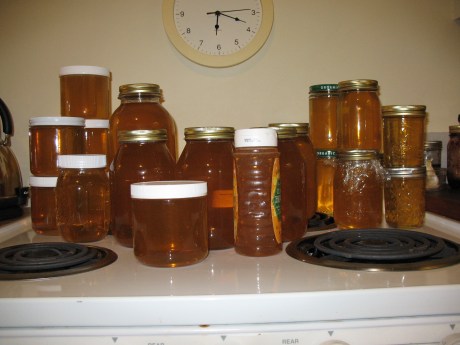
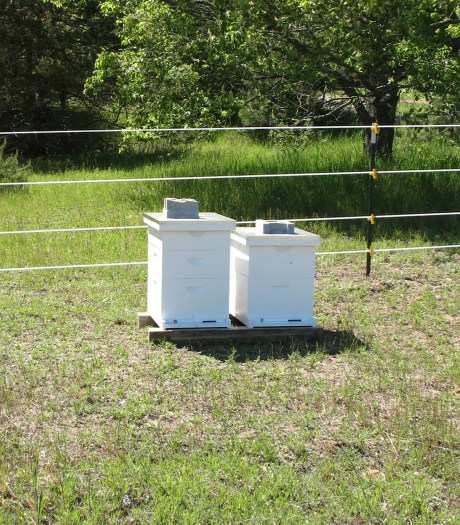
After a bit, Mike’s calls to my mother resumed. Yes, he’d been out of communication, but there were reasons. He’d moved to a place in the country–and there wasn’t great cell reception. He was clearing part of the property and planting trees. He had a kitten. He was so excited, it was hard to be angry. But, he had no address. The trailer where he was living was new, and there was no address yet. We’d have to be patient, there was so much to do. No address meant that we couldn’t send him cards and treats and care packages. These goodies had long sustained him–the occasional box of cookies, a needed winter coat, cards–with a little cash tucked in. These outreaches meant the world to Mike. How could he not give us an address? Well, the post office had to put it on the route and they’d have to install a mailbox, out on the highway. He confided that his friend was still angry that we’d called the police previously. Soon, soon, he’d have an address.

He sounded great. He sounded happier than he’d been in years. He was working outdoors, enjoying it and proud of the results of his labors. He was so thrilled that he had a kitten–all his own. We worried. He was also keeping in telephone contact with Mary-Jo, she didn’t like the situation, one bit, and she told him so. We talked about it and we decided to let the tenor of Mike’s voice be our guide. His voice was strong and he was happy.

His birthday rolled around. My mum called for his birthday. He was missing the goodies. What could she say? Well, Mike, when you give us your address and we’ll resume the packages and cards. Tough love. Over Christmas, Mike called my mother, elated that they’d put up the mail box. He gave her his new address! Before she’d send him any goodies my mother told Mike she would send him something and he’d have to send it back, a test of the new postal address. She did, and he did. So, she sent him belated birthday and Christmas packages.

Then, after Christmas, New Mexico had a storm. We read about it but we’re from Michigan. What’s the big deal about a little snow? It was a big deal. Mary-Jo called, frantic. Was Mike going to be okay? My mother gave her the address–explained that things were fine now according to Mike. Things weren’t fine. Mike likes it there, but we’ve learned that he lives in a trailer with no heat, no water, no sanitation. There’s power, but only when there’s fuel for a generator. Winter is a big deal under these conditions. Mary-Jo, determined detective that she is, advocate for this vulnerable son of her best friend–she found out just how grim. He told her he keeps warm under a thermal blanket, he and his kitty. The “roommate” doesn’t live there, she drops off groceries. He visits at her place every couple of weeks–to do laundry and have a shower. She cashes and keeps his Social Security checks.

I am on a mission. I have contacted and coordinated with Adult Protective Services. Mike’s going to have a visit.The police will escort us. If conditions are as Mary-Jo reports, Mike and his kitty are coming home to Michigan. He’s not going to like it, but he’s not getting a choice this time. I won’t post this until he is safe with me–I don’t want to jinx it this time. I just finished a two day, 1,600 mile drive to New Mexico. I thank all those who have coordinated to make Mike’s rescue possible, especially Mary-Jo. Tomorrow is the big day.

Snow Cats, Hot Cocoa and GMOs

-A.V. Walters-

IMG_2260

It’s snowing again. We’re expecting seven inches by tomorrow and then it will really feel like winter.

Yesterday we were out clearing. Snow shoveling leads to play—at least for those of us with snow history. The snow on the ground was a little too dry for a decent snowman. Though I managed a couple of good snowballs, I couldn’t get anything good going (Rick, shoveling, didn’t want to play along) so, I had to settle for making a snow cat. Yes, a snow cat—nice and fat like my favorite cat—who is unfortunately named Kilo, making a permanent joke of his girth.

On the way up to the house site, we noticed tracks—large, feline tracks. They were much too large, and the spread of the step is too long, to be a house cat. This summer, I noticed similar tracks in the sand and wondered if we had bobcats or a lynx. But tracks in sand are difficult to identify, so I let it go. Now, in snow, it is absolutely clear that we have a regular visitor who is something larger than Kilo or Bob. I followed them (the tracks, that is) in a meandering trail that ended across the way because my quarry walked up the neighbor’s driveway—which had been plowed after the tracks were made.

I’m not surprised; there are plenty of bunnies here to keep a wild cat well fed. We see their tracks, too, along with those of the mice and squirrels and their veritable freeways of tracks. I came home, determined (after a cup of hot chocolate) to identify our feline visitor. I believe it’s a bobcat. The size is right, the length of the stride, and even the meandering path. It’s unlikely we’ll ever see him, because they are nocturnal, but it’s nice to know he’s there.

IMG_2257

“And now, a word from our sponsor…”

Hot chocolate is always nice after my own meanderings in the snow. I’m going to put in a plug for Hershey’s here—as they have recently announced that they’ve nearly completed their transition to non-GMO sugar in all their products. They made their statement in a benign way, declaring that they are responding to clear customer demand. No company wants to support such a change on environmental grounds—and risk the wrath of the larger food industry. Still, I admire Hershey for making the shift. The company also has a nice website which identifies which of their products are gluten-free. That’s good for me. They’re not perfect, but for today, they can bask in their non-GMO glory.

The Hershey announcement has the Minnesota sugar-beet farmers in a tizzy. Minnesota leads all other states in sugar production—all from sugar beets, all of them GMO modified and drenched in Round-Up. Previously, Hershey bought sugar made from sugar beets. Sugar-beet spokespersons are circumspect about the Hershey announcement—hoping that it’s not a trend. Surely, Americans won’t abandon conventional, chemically saturated, agriculture. Will they?

Here’s the rub. The sugar-beet farmers and cooperatives couldn’t change gears to go back to non-GMO seeds if they wanted to. There aren’t any non-GMO seeds available. Monsanto has so flooded the market with their poisonous seed-and-Round-Up combo, that the farmers have no fallback position. This, despite the evidence that GMO yields are no better than organic, or conventional fields. (Listen up organic farmers, here’s a window of opportunity to grow conventional sugar beets for seed!)

Consumers can make a difference. It will be fun to watch conventional agriculture scramble as more and more of us vote with our dollars for healthier products that don’t contaminate our soils and water. In the meantime, I’m warming up with a hot chocolate and anticipating a few more days of heavy snows.


Perfect Hot Chocolate—one heaping teaspoon of unsweetened cocoa powder, one teaspoon honey and one cup of whole milk or, for a special treat, almond milk.


New Year’s Values

A.V. Walters–

I’m not one much for the celebration of artificial holidays. Generally, if the way in which a holiday is celebrated suggests that one should shop, I’m not interested. I make exceptions for food (especially if it’s fresh, organic and local! I think that holidays should be about great food shared with loved ones and the appropriate celebration of season.) It’s no mistake that breaking bread with others—the root of the word communion, is also the root of community. It’s probably fair to say that I’m a Grinch about Christmas.

Not that I don’t shop. (Good Lord, I’m building—sometimes it feels that all I do is shop!) But shopping, in the retail sense, has become a recreation activity in our culture. North Americans have more stuff than we can house—I know this because my day job is about self-storage, an industry that has burgeoned over the past few decades. We have too much stuff.

What we don’t do, is shop wisely. Americans shop for values in the dollar sense, not for values in the real sense. Everybody likes a bargain—but at what cost? I note that Costco (a company I like because they have decent labor policies and are responsive to members’ environmental concerns) is having a sale on Georgia Pacific paper (a company that I despise for its political culture and rampant environmental abuses.) Will other Costco consumers stop and think about the impact of each individual selection? I doubt it. I have to pause, and recognize that the very economies of scale that make Costco successful, work against local economies—and encourage the very unbridled consumerism that decouples our relationship with the planet. It’s a matter of degree. It’s about taking the time to look below the surface—on any individual purchase—as well as with any particular company. Even though limited individually, our dollars collectively, are the second most powerful political and policy tool we have at our disposal. The first is our vote.

I also know that the very economic policies supported by our corporate economy have squeezed consumers in ways that make globally-unwise shopping the average consumer’s primary option. Think about Walmart and its devastation on small town economies— the fact is that their pay is so low as to force employees onto food stamps and public programs. There is an implicit trap in the Walmart cycle—they prey on the poor. By the time a community realizes that Walmart is not a good deal—it’s too late. All of the local businesses have closed. There are no other shopping options. Behind the scenes, the profits go to the Walton family, the production jobs go offshore, and consumers are left with shoddy products that will not endure. Go ahead, buy it, and then buy it again when it breaks. Adding insult to injury, our tax dollars help to support their full-time workers who cannot live on what Walmart pays. Where’s the value in that?

Is it too much to ask North Americans to look deeper into where their dollars go? I hope not. Buy local. Buy from your farmer’s market or co-op. Support local tradespeople and service companies—before you head to the chain store with your coupons. Fix it, instead of buying a new one, and tossing the old into the trash. Research your larger purchases on the internet—and make sure that your dollars support your real values. Buy used goods, or surplus goods—you’ll save money, reduce waste and decrease our reliance on the retail culture. Make, or build, things yourself, when you can. This is the strength of the American dream. Since when did self-sufficiency become passé? Let your dollars support your ideals.

Oh yeah, and Happy New Year.


Better Late Than Never–

A.V. Walters.

IMG_2254

Yesterday’s Barbed Wire

The day before yesterday, Rick and I went for a walk in the woods. There was a wind-storm over Christmas, and we wanted to see if any more trees were down. We wore our regular shoes. There was no snow. So, we busied ourselves, with some minor trail-clearing, before yesterday’s predicted storm. (It’s nice to remove the trip hazards, while you can still see them.) At least the additional trees that fell were already dead—this is normal winter renewal.

We also wanted to check on our “widow-makers,” trees that came partially down in the wind-storm last August, but that were caught in the surrounding trees—hanging, but not stable. These are a woodsman’s worst nightmare. They are extremely dangerous to clear, as you can tell by their name. We have several snarls—where a fallen tree smashes into its neighbor, and that one into its neighbor—and so on, until four or five trees are entangled. We’ve been slowly clearing them, hoping that winter would level them for us. No such luck, so far.

IMG_2232

Widow-maker.

Unfortunately, several widow-makers block, or threaten, our trails. One of them is further complicated by being bound up in some of the ancient, barbed-wire fencing. The trees have grown, embedding the wire deep into their trunks. A big maple, split at its base, leans heavily on a smaller maple, over our main access trail, both of them wired together. It’s just a matter of time, and wind, until the smaller tree splits or collapses under the burden. (Should the bigger tree fall fast, that entrapped wire could cut through a bystander like a hot knife through butter.) We decided at least to clear the wire. Tinsnips in hand, we do what we can.

Yesterday morning we woke up to a different world. Finally, winter has arrived. It’s tough to estimate, with the drifting, but I’d guess we got a good six inches of dry, fine, powder. It’s about time.

IMG_2255

What a difference a day makes.

Though the mild season has seen great savings in heating costs and convenience, it is disconcerting not to have a real winter. This new blanket of snow sets that to rights. It will also provide needed “chill” hours to our fruit trees and down-time for the bees. Not that the bees need super-cold temperatures, but it is hard on them to have warm weather with no blossoms. Now, they can huddle and give up on the search for pollen and nectar.

Now, one would think that, being late December, we’d be ready for winter. Were we that well-oiled, seasonal machine, we’d be waiting, ready, with the snow-blower already set up on the Kubota. Yeah, right. Instead, we flailed about in the snow, disconnecting summer implements and hooking up the blower. The reward is that the blower makes short work of snow removal. Rick did the driveway, parking area and paths at the house site, and the drive at the apartment—ours and our landlady’s, in a couple of hours. Altogether it’s over a thousand feet of plowed road and path, about ten feet wide.

IMG_2256

Suiting up.

We’re settling in now, to the slower pace of winter. Things need to be more deliberate. A trip to town requires clearing the car, first. Work on the house requires warming glue or caulking materials. You have to think ahead. We don’t mind. We have the necessary tools and we like the snow. Another snowfall like this one, and we’ll break-out the snowshoes.


Home for the Holidays–

A.V. Walters.

Over the hills and through the woods…. There is something nostalgic about going home for the holidays. You can sample the traditional recipes from your past, and slip comfortably into the identity assigned to you by your family, oh-so-many-decades ago. Your siblings are there to remind you, just in case you forget, and pretend to be an adult.

This effect is doubly true in my case. Home, my mother’s house, is in the far north. It echoes with the traditions of the past–heating with wood, guaranteed power outages that have you pulling out the oil lamps, and storing the holiday excess out on the deck (or back porch)–where frigid temperatures are a certainty, and a back-up, for regular refrigeration. Even holiday meal planning comes with an asterisk (and, if the power goes, we’ll just put that ham out in the barbeque….)

My home town is a summer tourist destination; it lies on the shores of Lake Superior, in the lee of Brockway Mountain. It’s that mountain that prevents any cell phone or digital reception. During the height of the summer season you can watch the tourists, desperately waving their various high tech devices doing reception ballet–searching, in vain, for signal. We tell them, “You’ll have to drive to the top of the mountain–you can catch a signal there.” Indeed if you go up there to catch its world famous view of Lake Superior, half the people up there are making calls, or catching up on their internet connections. In the winter, they do not plow Brockway Mountain Drive, so there’s no cell service at all.

There are plans and skirmishes to bring the twenty-first century into town. It’s not a bad idea–the local volunteer fire department is still radio dispatched, because cell phones don’t work. The volunteers carry pagers. It’s argued that the absence of cell reception could cost lives–especially given that the town and its environs are renowned for extreme sports, mountain biking and black-diamond ski slopes. That brings us to the continuing tower, and anti-tower battles. The pro-tower folks have the  built in safety issues on their side. The anti-tower forces argue that cell towers have no place in the pristine forests of the far north. Rightfully, a cell tower will clash with the historic views–which have been safe from interference since the turn of the last century, when copper mining played out. I see the need–but I secretly am anti-tower–if only because I hate for things to change.

It’s Christmas. The guests have yet to arrive–my mum and I have been cooking all day. And, I guess in recognition of tradition, we are enjoying the annual internet-down quiet of the holiday. I’d post this, but Copper Harbor is comfortably settled into internet silence, to match its cellular status. Oh well, the holiday is for nostalgia, anyway. We are moments away from plenty of noise–as the siblings, their kids and grandkids will fill the house with more energy than we can muster. There will be the parade of gifts, the meeting of the boyfriend-du-jour, and the dog, snuffling around the kitchen to poach anything that drops. We’ve slipped into the 1950s, and all is well.

Fore!

A.V. Walters

IMG_2251

I admit it. I am the kind of person who laughs at my own jokes. Even if I’m the only person who laughs…

This will require some history.

My ex and I purchased the property (that Rick and I are currently developing) over twenty-five years ago. A few years later, an adjacent parcel sold—and the buyers built a house. Ours was empty, so the husband in that duo, Brian, felt free to use our front panhandle as a driving range. He’d practice his golf swing, and send his dog out to collect the golf balls. The dog tired of this, at some point and, apparently, Brian’s version of sport and fitness didn’t include walking, which left our land with a collection of unretrieved golf balls. He’s a nice guy though, and we’d communicate from time to time. He’s a hunter and we gave him permission to hunt on our (otherwise posted) land.

Years later, the couple divorced and their house was sold.

When Rick and I arrived, we started a collection of those golf balls. We’d find them in the strangest spots. Some partially buried and others, under trees, as much as a couple of hundred yards from where he’d teed up, in his front yard. We’d go for walks on our property, and come back with a pocket full of golf balls, which we tossed into one of the tree cages. We have no interest in golfing.

IMG_2253

Last year, Brian, who missed the area, bought a lovely parcel just up the road. He’s saving for when he and his new partner can build. In the meantime, he’s hunting there, and has put in a little garden. We go right by his property on one of our regular walking routes. Lately, when we head off to walk that way, we each grab a couple of golf balls, and toss them onto Brian’s driveway, or into his garden.

We have no idea whether Brian has, or ever will, notice. Or, if he’ll ever piece it together, in any way—that the golf balls he lost two decades ago are the same ones mysteriously appearing on his new property.

But, Rick and I are laughing. I guess that means that we’re well-suited. It’s enough of a joke, just between us. We’ll continue to enjoy our walks, and life’s little pleasures, as we still have a couple of dozen balls left to go.


The Reward of the NewBees–

A.V. Walters.

IMG_2242

Perhaps, a tiny basement apartment isn’t really the best place to process honey. After all, it is a sticky business.

Last week, we “harvested” the honey—which was simply removing the frames from those hives we decided could afford to share their honey with us. That’s honey “in the comb and on the frame,” though—nowhere near ready to pour into jars for the pantry.

Some people just eat comb honey—wax and all. It is certainly the most “natural” way to do it—but I have limited patience for that much wax in my teeth. And, it’s messy. There are several options for how to separate the wax from the comb. You can cut it from the hive frame, crush it and filter it—an insanely messy business. Or, you can spin it.

We picked spinning. We bought a cheapie, two-frame spinner, online. It came with no directions. (I guess we’re supposed to know what we’re doing.) We looked at the tools recommended, in the many catalogues and bee sites, and decided to improvise. Our process is based on common sense, not experience. We’re winging it here, so don’t think this is the right way, or the only way, to do it.

IMG_2245

We start with the frames. There are ten frames in each layer of a standard Langstroth hive. Many backyard beekeepers use an eight frame configuration, for lighter, more maneuverable supers (hive boxes.) It’s not a bad idea, but since we went with a mix of used and pre-fab hives, we stuck with the standard, larger ten-frame design. We removed a full hive layer (super or bee box) of honey—so ten full frames. Once you lift a full ten frames of honey, you begin to appreciate why the smaller eight frame configuration has become popular. (We’ll just have to grow muscles.)

If you harvest early in the season, you need to first separate the bees from the frames you want to remove. This is done either with a “bee escape” (it allows the bees to leave, but not come back in) placed in the hive a day before harvest, or by using a blower to remove the bees from of the frames. But, when it starts to get cold, the bees crowd lower in the hive for warmth and we took advantage of this with a late season harvest. We only had a few of workaholic bees on the honey frames, which we brushed off with a feather. (That’s not a metaphor, we used an actual feather.)

We placed the honey-laden frames in a sealed bin (so the bees couldn’t go after them) and brought it inside for processing. The honey is much easier to spin if it’s warm. We don’t keep it very warm in our home, so we had to turn up the heat to a sweltering 72 degrees. We used a sharpened putty knife to skim the top coating of wax from one side of each frame, the “capped” comb—and then placed it in the spinner. Voilà, liquid gold! Then we flipped each frame, skimmed the cap off that side, and repeated the process. We put the “skim,” (a mixture of beeswax, with some honey) into a crockpot. On moderate heat, the wax softens, and floats to the top, leaving honey below. After it cools, we pulled the hardened wax off, and poured off the remaining honey. That way, we don’t waste any honey.

IMG_2243

A two-frame spinner can only handle one side of two frames, at a time. Spun, the honey flies against the inside of the spinner and collects in the bottom as you process. It’s slow and tedious, but it smells incredible. Honey and beeswax—sweet and clean. This very tangible reward is enough to keep you going.

IMG_2239

After it was all spun, it sat over-night. (Though it wasn’t our intention, letting it sit allowed almost all the bits of wax to float to the top, making the next step easier.) We then cold-filtered the honey and put it in jars. (We used paint filters from the hardware store.) Most of our canning jars are in storage, so we’d been saving store-bought honey and peanut butter jars for months. As we filtered, we began to panic. This was much more than we’d expected—and we were nearly out of jars (oh, and lids!) Soon we were using old honey-bear squeeze bottles…and anything else we could find. We ended up with over 35 pounds of honey. (At roughly 2.85 pounds per quart, it left us scrambling.) That’s enough for us for maybe a year—and some gift jars. Not bad, from one hive, in a ‘bad’ year. (According to local beekeepers, this was a low-yield year.)

IMG_2246

Now, we need to do is figure out how to process the wax. We’re thinking, candles. And amazingly, the place is not too sticky.

IMG_2250


And, The Winner Is…

A.V. Walters-

hives

Home, sweet home.

Where is winter? We have no snow. Though the ENSO (El Nino Southern Oscillation) typically gives us a mild winter—this is the most extreme in forty years of Michigan, El Nino tracking. The temperatures are hovering in the mid 40s during the day, some days it’s warmer. If I’d known, I’d have planted chard, and maybe garlic. On warmer days, our bees are out and about, but I have no idea what they’re doing. There’s very little blooming in this odd December weather. I’ve heard that bees enjoy the occasional mid-winter jaunt—out to stretch their wings and to defecate. Like most creatures, they hate to soil the nest.

The mild season poses tough questions for us as newbee beekeepers. On one hand, the bees, so far, have not been subjected to the temperature extremes of the past few years. That must be good. On the other, they are out and about and active—potentially increasing their caloric needs. How do we balance this out? It’s like the old question, do you get wetter walking or running in the rain?

We were all ready to harvest some honey in October—but it didn’t get cold. We could see the bees out there, still gathering. So we waited and debated. We are in this, for the bees, and honey is a fringe benefit, not the primary objective. Our first inclination was to leave all the honey for the bees during the winter—perhaps to harvest a little in the spring. Our bee group looked at us like we were crazy. Not only was that a waste (in their view), they added that a hive, top-heavy with frozen honey, was a liability for winter survival. That swung us back towards a harvest. All this extra warm time has only compounded our confusion.

We have two issues: winter-wrap and harvest. In northern climates, beekeepers have a variety of bee protection measures to keep bees warm (other than carting them off to Florida.) There are simple hive-wraps, insulated hive-wraps, or baffled hive enclosures. Then, there are special feeding formulas, and the debate of the protein/carbohydrate balance suitable for winter nutrition. It’s daunting. The catalogues are full of bee pampering solutions, vitamins and herbal treatments. We shrug. Honey is bee food. We’ll leave them with their honey. After all, our goal was to keep Michigan-hardy bees. We selected our bees from Michigan over-wintered stock (not those pampered, Florida snowbirds.) We see over-pampering as part of the problem. As for the winter-housing, we do intend to wrap the hives when temperatures fall into the 20s on a regular basis. The biggest issue is to protect them from wind. Bees huddle and give off heat and moisture during the winter. The northern beekeeper must be careful not to impair circulation too much, because trapped moisture can lead to mold and mildew borne bee illnesses. Really, there are almost too many variables!

Finally, over the weekend, we did an inspection and took some honey. It was winter-warm—low 50s, so the bees were in slow-active mode. Mostly, they ignored us. At first blush, the hives looked terrible. We know that there is a normal fall die-off—but nothing prepared us for the mound of dead bees on the ground in front of each hive. Oddly, that may be good news. The location of the bee bodies (just below the entry) indicates that bees, dying in the hives, are being tossed out the front door—in a normal, housekeeping kind of way. A true hive collapse has few bodies—since the bees just fly away and die, mysteriously. Our active bees, though slowed by winter, look good. And the scouts are doing their jobs. Both Rick and I received “warning thunks” as we disrupted the hives, but no stinging.

We first investigated the two friendlier hives, Niña and Pinta. I’ve been worried about Pinta, since it was the first to slow down, back in October. We have limited experience, so we can only compare the three hives to each other. Pinta seemed listless—and had the most noticeable pile of corpses. But her guards were quick, and the bees inside were clumping in the middle—a good sign. We were disappointed that the top super (a hive box) held only some beeswax comb—no honey. Below, things looked good—plenty of honey and bees. We found the same situation with Niña, the other mild-mannered hive. We decided not to harvest honey from either of them. Maybe we are too conservative, but we’d like our bees to over-winter naturally.

Of course, the winner is Santa Maria, our beehive on steroids. Santa Maria, (our problem child of the summer) calmed down after we added an extra super to the hive. We think the aggressive behavior was just because the bees were busting out at the seams of their space. We’re lucky we caught it, and they didn’t swarm! This is the upside of an aggressive hive. They are industrious! These bees went right to work and filled that entire super with honey. We were shocked. Looking deeper, the hive had more than enough for winter—two full supers of honey! We relieved her of one whole super. (Ten frames from a standard, medium, Langstroth hive.)

This was the hive we were so anxious to trade! We’ll just have to learn to harness that energy, and keep them busy! (I remember parents saying things like that about us as kids. There may be something to it.) With this new appreciation for “busy as a bee,” we closed up the hives and carried off our bounty.

Next, we’ll deal with processing.

Note: I realize that the recycled photo, above, may give the wrong impression about the mild winter. I didn’t take pics when we harvested honey–so I used one from earlier in the summer. I didn’t think of it until later–but our trees are bare and most of the greenery is gone.

Wrapping up the Season

A.V. Walters


IMG_2235

Post bucket

We’ve had nearly an extra month of fall. Tomorrow, though, temperatures are expected to tumble down to seasonal norms. We’ve been rushing around to take advantage of the extended season and to get a jump on spring, next year.

We garden in buckets. It’s habit, from California, where it solved some of our irrigation issues. It also kept the gophers out of the vegetables. We’ve kept it up here in Michigan for some of the same reasons–water, critters, and because our soils need a lot of work. The buckets let us amend most intensely where the plants will live. Before the next season, we pull the buckets and empty the amended soil and leftover roots back into the soil. It could wait until spring, but we had the warm weather, so I did it this week. It will make it easier to spread amendment over the whole garden area in the spring, but we’ll probably stick with the buckets for a few seasons yet. It is more work–but promises better harvests until we can get the garden’s soil into better shape.

It was also time to attend to the fruit trees. They needed an end-of-season weeding, and it was time to wrap their trunks before winter. There are two main reasons for wrapping the trunks of fruit trees. It prevents sun scalding. Winter sun can warm the trunk–expanding the bark and the moist tissues below–on the sunny side. The temperature differential can split the bark, endangering the tree. By wrapping the trunk with light colored material, you reflect the sun’s heat away. The other reason to wrap is to dissuade mice and other critters who’d be inclined to nibble at the baby trees’ thin bark. Mice can easily girdle, and kill a young tree. I knew I’d arrived to the task just in time, when I saw that one of the apple tree’s lower trunk showed the early signs of nibbling! Now all of the fruit trees are wrapped and ready.

IMG_2238

A tidy wrap to protect the baby tree.

IMG_2237

Lined up in winter finery.

Along the way, I noted some successes. Before we planted the trees, located in the fenced garden area, we dug amendment in deep–very deep. In prepping their planting holes, we went down four to five feet deep and at least that far across. We wanted to give them a good start, and since our soils are poor, it was our best chance to add nutrients to the soil for the trees’ formative years. It has already paid off. Because we were attacked early by deer, the garden orchard trees had both the fence and individual tree cages for protection. In spite of having been seriously nibbled by deer, the apple, plum and pear trees have all more than doubled in size. They’ve outgrown the cages! They look more like 3rd or 4th year trees than 1st season trees. We may even see apples and pears next year.

IMG_2236

The cherry trees–grown outside the garden fence–didn’t get as much care. First, they’re all cherry trees. This is cherry tree country. One of the pioneer plants in our sandy soils is the American Black Cherry. I didn’t think that the cherries would require as much soil amendment. I only dug the amendment in to a depth of 18 to 24 inches. I also thought that cherry trees would be safe from the deer. They’re bitter! No such luck. We must have voracious deer. They munched on the cherries, too. Immediately after, we gave them cages, too. But while the others have recovered and really grown, the cherries have recovered, but stayed smaller. For future plantings, we’ll keep the deep-amendment program.

It makes me wonder if we should dig and replant the cherry trees. It’s a lot of stress on a little stick of a tree. I’m sure we’ll debate it all winter. More likely, I’ll be researching organic methods of fertilizing–not as good as a nice deep start, but we shall see. Any thoughts on that?

Gone With the Wind

A.V. Walters

It’s pretty quiet now, though the valley thrums with the low hum of generators, punctuated by the occasional whine of a chainsaw.

We live in a place that is blessed with steady winds. While our current impetus is to finish the house enough that we can move into it, Rick and I can’t help but take note of our regular winds and nod at each other. Sooner or later, we’ll do something to harness that power. To my way of thinking, wind power is a better bet than solar in northern regions; you can always count on the wind, summer or winter. Still, most of the alternative energy attention goes to solar. Our neighbor is installing a bank of solar panels now. We’ll watch to see how they perform come winter.

Early last week, we were pre-staining 4X8 panels to use to enclose the soffits. It’s a lot easier to apply the stain when they’re still on the ground. We set up on a series of saw horses–we’d stain on one, and then move the sheets out to dry on the others. Each panel needed first to be perched on its edge and vigorously swept clean of milling crud, before we could apply the stain. While I brushed down the next sheet, a gust of wind behind me picked up one of the stained ones, and pitched it directly at me. It caught me on the backs of my calves; Rick heard my yelped cursing from the basement. Wind power–it can leave you badly bruised.

I shared my story with our builders, who all had construction wind horror stories of their own, with injuries ranging from bruising to quadraplegia. Clearly the lesson was that wind is a powerful, and unpredictable force. When working on a construction site, you must consider the placement of any material that could catch the wind and act like a sail, including (as we learned last winter) tarps and plastic coverings.

Now that the house has a roof, and is partially enclosed (upstairs windows installed) we worry less about the impact of weather. Armed with this new sense of immunity, Rick and I headed north this past weekend, a break to visit my mum. It was a marathon trip, a 900 mile round trip in a three day window. It was a wonderful break–even with the drive. The surprise came on the way home.

Two counties away, we started noticing a number of trees down. Many were snapped, mid-trunk, like toothpicks. Soon, we were obsessed, scanning the sides of the highway, and finding plenty of damage. We were only gone two and a half days–what happened?

In Traverse City there were areas without power, or signal lights. Traffic snaked along, on single lanes squeezed between emergency equipment, cutting downed trees from the roads and from where they’d fallen on homes. We were anxious to get home to check out our new home under construction–where we already know the winds can be fierce.

We didn’t stop at the apartment; we went straight to the house. There it was, safe and sound, without even a leaf out of place. There was no indication that there’d been a storm at our house. Of course most of the county has no power because of the fierce storm that ripped though on Sunday. We missed it. It’s the biggest weather event since we arrived in Michigan, and we were away!

There’s argument as to whether there were tornadoes. Leelanau County doesn’t get tornadoes, or so they say. Yet a number of people swear they saw funnel clouds. The weather service flatly denies that there were tornadoes. At least this is what we hear. We are still at the mercy of the rumor mill, because there’s no power–no internet–and no “hard” news. Wanting to know, I did the next best thing, I went down to our local hardware store. Indeed, the damage was pretty bad. Many cars and houses have been hit with flying trees. At least three pontoon boats were picked up from small lakes, flipped and smashed to bits in shallow waters. We’ll have to wait until the power resumes to get the whole story.

We walked the back woods today, and we’re not completely unscathed. We’ve lost at least thirty trees, many of them fell and took out their neighbors, like dominoes. The unfortunate part is that the standing dead ash trees did not fall. The maples, the basswood, trees laden with summer foliage, those were the ones that caught the winds and came down. There’s a lot of clean up to do, we’ll have to re-open all the trails that we opened when we first arrived. We’re in good company, power company employees are out, surveying the damage and calling in the “tree boys” to free the lines of downed trees. We talked to one of the line surveyors, who warned us it could be days before we see power. We’ll be fine. We can take “flushing” water out of the creek. We have a generator, to keep the refrigerator and lights running. (Too bad it’s not powerful enough to run the well pump.)  We can cook on the propane barbecue. We’ll be just fine. Maybe I’ll even find a way to post this update.

That wind though, it certainly would be nice if we could harness it for the power of good, instead of ….

Posted courtesy of laundromat wifi.

Important for everyone. What is Spring for, if not for the renewal of hope.

Single Digit Cuisine!

IMG_2070

A.V. Walters–

It’s nippy out there. We’re pretty winter hardy but low single digits, and lower, get our attention. That’s frostbite weather.  It’s also the range at which our minimally heated apartment begins to drop below 60. That’s the point where I take notice, and action. The cold front has been predicted for several days, and I made plans.

I started with a hearty, East Indian rice casserole. The aroma of turmeric, coriander, cumin, cinnamon, cloves and just a dash of cayenne is enough to warm anyone. So is the oven at 375. Then on to a batch of oatmeal cookies–Rick’s been asking for a couple of days and this seemed just the opportunity. Oven at 350 (and opening and closing between cookie sheet batches.) Finally, one of our regulars, a loaf of banana nut bread. It bakes for approximately an hour. By the end of it, we had goodies galore and the temperature was back up above 60.

We’ll see how we hold through the night (or, I see muffins in our morning!) This cold is expected to last the week. We’ll be portly by then.

New Territory, New Toys…
A.V. Walters

In the early days...

In the early days…

No! Did I say toys? Tools, tools, really it’s new tools! It’s a whole new world of what one needs to do—snow, building, planting. First, after carefully reviewing the used market for almost a year, we got the Kubota tractor—which we we’ve needed for road grading, excavation, and will certainly need for snow clearing. Rick cut in the driveway and dug out the foundation for the cabin with it—it’s no toy.

Then, I saw a good deal on a log splitter, on craigslist. In Two Rock we heated with wood and we split it all by hand—both of us. Of course, Northern California doesn’t pack nearly as much of a winter punch as Michigan. We used to use about two cords of wood a year to keep toasty. Here we figure we’ll need about five. The log splitter was a good call. I used it, feeling like a bit of a traitor to my trusty maul and wedge. But in an afternoon, without breaking too much of a sweat, (though it is still work) I split about a cord. Wow. We already had chainsaws (when we met, Rick and I owned the same brand and model of chainsaw. Kismet!)

The generator/inverter was a no-brainer. So far, there still isn’t any power to the site. (Though it looks like next week the electric company will bring in the underground lines for power—with phone and internet piggybacking in the trench.) Everything needs power—nailers, sanders, lights, saws. So the generator can’t be considered a toy by any stretch of the imagination.

Back in the spring, we were looking at the costs of excavation—road, foundation, well line, septic. It was daunting. We’d already bought what’s called a back-blade (it’s like a big scraper) so, my next job was to look for a used backhoe attachment for the Kubota. It took awhile—It was my job to make it work financially—to make any purchase pay for itself with savings from what we’d otherwise be paying others. I also had to learn about what implements would fit on our tractor. There’s a whole culture of tractordom—sub-frames, hydraulic kits, three-point attachments and PTOs. Things need to match—and I’m not talking about accessorizing. I found one—and we finally hooked it up. It was quite a feat—first, installing a sub-frame, and then uniting two pieces of equipment that weigh tons. The conjoined parts look like a large, prehistoric insect. Usually, I’m not one much for mechanized things, but horsepower does have its advantages.

Rick immediately started digging the line for the well. He’s far more mechanically inclined than I am, within an hour, he had the levers and controls figured out, and he was trenching like a pro. I’m a little jealous. I want to dig, too. (Don’t worry, my turn will come.) In the meantime, I’ve become quite the craigslist maven. Hey, there’s still a snow-blower to consider. A 3 point snow-blower is a thing to behold—throwing a veritable fountain of snow 20-30 feet in the air. Winter is coming… they’re tools, after all, not toys.

Learning the Language…

A.V. Walters–

IMG_1897

I had the best of intentions this spring. We walk most days, and my plan was to try to identify all the new plants as they popped up through the leaf litter in the forest floor. Ha! Then, we started work on the apartment, putting in such long hours that we didn’t get out for our regular walks. By the time we got back into the forest, it was lush and green, overgrown way past my ability to catch up on the name-game.

It’s not like I don’t know anything. After all, I grew up around the Great Lakes—most of these plants are familiar. But I know them by the names that kids use, like sour grass, white man’s footsteps and sugar plums (oxalis, plantain, serviceberries.) I’m looking to upgrade my botanical vocabulary.

We’re back to walking regularly. My new goal is to positively identify at least one plant a day. We come home from our walks with pockets stuffed with leaves and berries. Then I hit the books (and the internet) to find their “real” names. We notice other things along the way, too. A few weeks ago someone dropped off a load of bee hives in a clearing along the road we live on. Sometimes, you can hear their hum from 100 feet away. A few weeks later, an electric fence went up around them. We scratched our heads. Just who was that fence supposed to dissuade?

According to the DNR (Department of Natural Resources), there are no wolves, bears or cougars in Leelanau County. You hear of sightings, but they’re never “substantiated.” I’ve been hearing of them for 25 years. I can’t imagine that the DNR has a stake in not acknowledging them, but neither is it comforting to think they’d be wrong for so long. (More head-scratching.) Almost twenty years ago I found a deep and impressive set of scratches in the bark of a tree—six feet up from the ground. That’s a bear. This winter, on one of our snowshoe hikes, we found (big) cat scratch marks on a deadfall tree—with big cat prints to match. (More tree scratching.) Yesterday, on my walk I found bear scat. I spent my childhood summers in Keweenaw County—I know bear scat when I see it. Then, I heard through the neighborhood grapevine that one of the neighbors had seen a bear in her yard.

For whatever it’s worth, these things don’t scare us. It doesn’t change how we move through the trails. (I might re-think planting blueberry plants around the new house, though.) I’m glad that the forest is healthy enough to support the critters all the way to the top of the food chain. Other than us, I mean. I have no intention of setting the record straight in any official capacity. I’ll keep cataloguing my way through the plant kingdom, so I’ll feel more at home, in my new home.


Ripples…

A.V. Walters–

ripples

Sometimes there are crystalized moments in your life, moments that are loaded in a way that forms who you will be, or that define a new direction that your life will take. I’m fascinated at how a chance event can snowball to construct an entirely different version of you, than the expected path might have yielded. You may not even know it at the time but, upon reflection, you can see how the impact of that moment left its fingerprint on you, and maybe on others around you.

We all have answered those “pivotal” questions, “Where were you when…” But they reflect a wider sensibility—that of a community or a nation. And I don’t doubt that those incidents that form the arc of history have an impact overall. What I’m talking about here, though, are the more personal moments—the AHA! events that took who you were, an instant before, and then mapped a new direction for who you became as a result.


From time to time, in this blog I’m going to address those ripples—in my life, and in the lives of those I know. I invite you to ponder your own circuitous paths, and how the “you” of today emerged. Feel free to share.


The Magnificent Radovini Brothers

stick built

We were stair-step kids, arriving with catholic regularity, one, nearly every year. Before long, our standard issue, three-bedroom tract home was too small, owing to our lopsided gender distribution. When the time came that my brother, the only boy, really needed a room of his own, we four girls were too much for the other bedroom.

My parents own interests were running out of space, too. My father’s woodworking and my mother’s new involvement, in the world of clay, were spilling out of the utility room and into the kitchen. So, my parents took the plunge. Together they sketched out a plan to expand our home to make enough room for our wild tribe, and enough for all the different things we did. An architect made their dreams into plans and the bank gave the go ahead. My parents found builders, the highly recommended Radovini Brothers. These young men accepted the job, but warned that, in the middle of it, they’d be taking off for two weeks for a long planned family reunion. As long as the project was enclosed before they left, and then finished before the end of the summer, my parents didn’t mind. How could they? They understood family.

It was high theater for us. It was summer and we were off school so we could watch. They were doubling the size of our house, there was digging, with its piles of dirt and concrete, and finally, The Radovinis arrived. We loved them. They were five brothers with mops of dark hair and sun-bronzed skin. They worked shirtless. The neighbor women came to watch. The Radovinis worked and laughed and sang—sometimes opera, sometimes Italian folk tunes. The brothers harmonized, in their songs and in the rhythms of their work. They brought enormous lunches, which they unpacked from coolers with great ceremony. Food was important. They ate with great gusto, the jokes and ribbing continuing between bites.

It was like being visited by the circus. They were as charmed by us as we were by them, a string of blond towheads, following their every move like puppies, soaking in the aroma of pine boards, and watching the building take shape.

Our house grew by the day—faster even than we’d been told to expect. These men loved their work, and loved showing off their skills. Our jaws hung slack as we watched the drawings from the plans take shape in the air. It was a two-story addition and they were fearless—walking out on the thinnest of planks, twenty feet in the air, tossing up tools to the outstretched and ready hands of trapeze-artist framers. We tipped our heads back and shielded our eyes from the summer sun with cupped hands, to watch. How lucky we were to have found such tradesmen! As the time for their scheduled vacation approached, they worked long hours, determined to frame and sheath the structure before their trip—as promised.

The oldest brother approached my father. Were we happy with the work? Of course! Sheepishly, he requested that my parents advance the full contract price. The brothers were traveling across Canada for their reunion and wanted a “safety reserve.” My parents, thrilled with their work, were happy to oblige. Hell, they’d have adopted them if they could.

In their absence, we clamored over the new addition like squirrels. We collected nails and pieces of scrap wood—which we hammered into odd towers. When parents weren’t watching, we walked on the skinny joists, high above what would be our new garage. It was all so exciting–we could hardly wait for their return.

My father broke the news at dinner one night. We knew that something was up. My mother’s face was puffed and red. There’d been an accident. The Radovinis, they were going over the mountains—with most of the family riding in a travel trailer. A passing car clipped their trailer and forced it, and its tethered truck, over the edge. Four of them had been killed, along with their wives and children. The surviving brother would never walk again. With him, all that remained of this vibrant family was the elderly grandmother and an infant child, who’d remained home. The singing and laughing, gone.

My parents never mentioned the money. And, from that day, we became builders. My dad rolled up his sleeves and learned. His weekends became building time. We were his cadre of conscripted workers, little fingers stuffing insulation around windows, holding the end of the measuring tape and carrying tools and supplies. He learned wiring and plumbing and tiling (Oh My!) So did we. He harnessed his intense fear of heights to finish the roof and upper walls. We learned to put our fears in context. Money was tight, but skills we could learn. We became a family that built what we needed. We never shied from what willing hands could perform. It took my parents, and us, ten years to finish, but it was done, and done well.

That continues to today—not a professional builder in the bunch, but my siblings, mostly girls, are not strangers to the working end of a hammer. The Radovinis came into our lives nearly five decades ago. Right now, I am poised at the largest project of my adult life—my husband and I are building a home. As I wrote this, the concrete truck arrived to pour the footings.


Pouring Footings

Pouring Footings

In my minds eye, I can see the Radovinis, perched, straddling the skeletal ribs of our new roof, drinking ice water from re-filled Coca-Cola bottles. They chug it down and pour the rest over their heads, laughing and working in the summer’s heat.


Monochrome

A.V. Walters

Bluff View

Bluff View

Winter. Pretty much black and white, right? Hardly. Maybe because we are cloaked in a postcard perfect layer of white, it forces one to take a closer look. There’s a world of color out there, if you look for it. The snow itself is a constantly shifting set of hues, depending upon the light. Right now it’s brilliant white, with the edges, drifts and footprints defined in shades of grey and blue. Just after dawn or at dusk, the snow glows pink—what my mother calls “The pearly hour.”

But, it’s more than that. At first glance the naked trees are black, grey and taupe. Looking closer reveals myriad shades and colors. The dogwood tips are a deep ruby. The cedar trees mix the characteristic yellow-green of their foliage with the rusty seeds at the tips. Across the street, our snow is interrupted by some kind of dried seedpod in a dark umber and waving, golden dried grasses. That gold is echoed above in the clinging brassy parchment leaves of young beech trees. Look deep into the forest and you’re rewarded with the winter greens of the white and red pines (with their warm brick and brown trunks)—to the almost-blue green of the spruce. Driving through the county side, I am surprised by the range of color in the sleeping, winter fields; the amber corn stubble poking up through the drifts; the burgundy tips on the cherry trees; the shocking, spilling-over, yellow of the naked willow branches; and the dense green of the snow-flocked Christmas trees that survived to see another season.

Today we went for a hike along the beach. Along the shore and extending out in the shallows, Lake Michigan has its usual winter, ruffled collar of jumbled frozen piles of snow, slush and ice. Out about fifty feet, the collar gives way to the steel grey waves, lapping and spraying occasionally at the ragged edge. This is a sand beach and the winter surf sweeps the sand in with the frozen frothy foam at the end of the waves’ reach. Parts of the beach are slick and icy, dangerously dusted with fresh blown snow. Other parts are sheets of frozen sand, lifted and arched by the heave, and hollow underneath. It’s a world away from its usual summer world of flip-flops, bathing suits and kayaks.

We’ve noticed an odd behavior at the parking-area turnaround at the township park/beach. Folks in the area drive down to check up on the Lake. Whenever we’re there, we see it. These are winter people, who, on their way somewhere else, detour down to the park for a glimpse at whatever the Lake is doing. They pull up and sit for a few moments, just watching whatever winter has in store that day. Today was not windy and the Lake was quiet. Sometimes it’s wild and crashing.

We think of it as our winter hike but we’re wrong. Today we ran into our neighbor at the beach. He’s an elderly gent; we see him out walking his dogs, regularly. There was a family, with lots of little bundled kids out cavorting and sliding on the icy beach. And then, there were all the footprints, evidence that any number of hardy souls come out regularly in the cold to enjoy the beauty and colors of winter. It’s nice to know that others appreciate the winter landscape, as we do.

A.V. Walters–

ec cover

Many years ago, I worked waiting table. The head waitress at the restaurant was a very funny woman with an incredible sense of presence. One day, she used the restroom on break and, unbeknownst to her, she got the back of her skirt caught in the waistband to her pantyhose. She returned to the dining room floor with one side of her ass exposed to the world. The woman had class. When a patron called it to her attention, she turned, looked, and without missing a beat, she said, “I suppose now you want me to turn the other cheek?”

I would have died on the spot. I’m not sure I’ve confessed to this before, but I am not a technical person. I struggle with it–especially so since Two Rock Press is a small concern and I try to be professional about it. You can only imagine my mortification when I discovered (thanks to a kindly reader) that the Amazon download for The Emma Caites Way was bollixed. We’d accidentally uploaded the wrong file. Folks who downloaded it ended up with a version that was not fully edited–once they hit the later chapters, it was all highlights and alternate wording. My deepest apologies. So, if you are one that downloaded previous version, throw that trash away. There is another free download day for The Emma Caites Way on December 2. (You may receive a notice from Amazon.)

If you haven’t previously taken advantage of the free Amazon download (Kindle version)–lucky you, you missed the muddle! Feel free to enjoy it now. Hey, tell a friend. I’m feeling so relieved that this was an easy fix, I feel like celebrating. So, come on and celebrate with me. Enjoy a free copy of my award-winning, life-affirming, deliciously fun, romp and triumph of a novel, The Emma Caites Way.

What, now you want me to turn the other cheek?

Hope the wind doesn't blow!

Hope the wind doesn’t blow!

Taking Leave(s)

A.V. Walters–

Six years on the farm cured me of a common American delusion—the need to clean up after nature. In rural living, nature is just too big to consider tidying up after her. Sure, if you make a mess (like after cutting firewood) you could clean it up, you could even mow, if you wanted or needed to. And, weeding in the garden makes good sense. But beyond that, I figure that nature is pretty much on her own.

When we left Two Rock, we gave away the lawnmowers. I don’t think I’m likely to live anywhere where I’ll need one, again. However, at our little, Empire rental, there is the issue of the leaves.

Our neighbors are positively obsessive about lawn care and leaf removal. I acknowledge that if you have a lawn, it’s better for the grass to remove the leaves. However, our garden implements are in storage—deep in storage. I’m not digging way to the back of the unit to find a rake so that I can collect the leaves at a rental. Besides, Empire is very windy. I note that there are often leaves there one day that are gone the next. (Sometimes, even in the direction of our obsessive neighbors.) In the old days, when I lived in the city, I used to enjoy raking leaves. But then there was the problem of what you’d do with them. If the city has a decent recycling program, it makes sense. But it makes no sense to gather them, only to pay to have them put in a landfill somewhere where they’ll never breakdown naturally.

I visited my brother this weekend. He has not raked at all this season. He lives on a tree-covered city lot, in a village with a great many trees. When we arrived, the leaves were deep in his front yard—in some places, a foot deep. Like many suburban folks, he secretly believes that the wind patterns deposit all the nearby leaves in his yard. He supports this theory by the fact that the leaves lay in deep drifts over his lawn, even as his neighbors lawns are relatively leaf free. And, he notes that some of the leaves in his yard are oak leaves, and he has no oak tree. Of course, those same neighbors, whose yards are clear, have been diligently blowing and/or raking those leaves into neat piles and removing them, regularly, for a couple of months. Still, my brother clings tightly to his leaf-conspiracy theory.

He lives in a community, where, if you deliver your leaves to the edge of the street (there are no curbs) the village will regularly send around a big, leaf-sucking rig to spirit away one’s unwanted autumn harvest. These leaves are then composted, so suburban homeowner’s can maintain their tidy lawns and feel positively righteous. If one doesn’t rake and remove, there’s always the possibility that the Village could cite you, or worse. I decided that I could help out by raking his leaves.

Waiting for Pick-Up

Waiting for Pick-Up

It went well at first. It was actually fun, wading shin deep and using my rake (and my body) as a plow. Soon, though, it became clear that I was going to run out of street-edge on which to deposit the autumn harvest. (And he has a corner lot!) The neighbors have tidy, minimalist leaf piles. The more I raked, the crazier my pile got. I began to marshall the leaves to the edge of the yard. A simple pile wasn’t going to do it, more like a line. Then, a wall. As I worked, the wall got taller, and deeper. I wasn’t sure what the rules were—just how thick could my wall get and still be leaf-suckable?

I started getting comments from neighbors as they walked by: “I sure hope you’re getting paid for that!” (I’m not.) “That looks like a lot of work!” (Yup.) “What are you gonna do with all them leaves?” (I dunno.) Some kids came by waving and laughing at the height of my leaf pile. One almost launched herself into it but I caught her eye, and brandished my rake, “You do, and you’ll have to rake it back up!” She giggled and ran off.

By the time I finished, I’d built a veritable fortress with my leaf-wall. It was three to four feet high, and at least as deep, running some 160 feet on two sides. I don’t know if it will work for the leaf-sucker, but I’m not really concerned. I don’t live here.

I was going to bury this car, but my nephew came out and caught me.

I was going to bury this car, but my nephew came out and caught me.

Nearly Back

A.V. Walters

Yeah, I’ve been erratic in my posts–gone almost the entire summer. And I’ve left you all hanging on the outcome of the emus. What can I say? It’s been a tough run. I still have several posts to finalize the Two Rock section of the chronicles, but I’ve also nearly completed the relocation that I’d hinted about all last spring. We’ll complete the first phase of the relocation on Friday, when we settle into a rental for the winter…a real winter, with snow and season because now we’re located in Michigan–Northern Michigan–Leelanau County. We are excited at the prospect of real seasons. We are also completely adrift in terms of them, I’ve been in California for 35 years and Rick has never lived outside of California. Even though I grew up always a stone’s throw from a Great Lake, I’d say I’m a little rusty in the weather department. Let me get just a little bit settled (at least let the cats find their sea legs) and I’ll finish a few Two Rock postings before I launch into the new venture.

The Jump on Season

A.V. Walters

It’s so dry that for over a month it’s felt like October. There are agricultural practices that mark time, plowing in spring, cultivation and harvesting in summer and, around here, spreading in fall. Yes, that’s manure spreading. The dairies store it in in lagoons and tanks until the time is right to load battalions of “honey trucks” to spread this rank slurry on the fields and hills. It is the most environmental of solutions (the practice, not the slurry.)

For a traditional dairy, whose size is limited by how far a cow can walk for milking, the amount of manure produced does not overwhelm the carrying capacity of the land. (Though it can, and does, contaminate the ground water.) This traditional recycling puts the nutrients back into the soil, to fertilize the grasses that our winter rains will bring, and that then feed the herds. This would not be a solution for the big factory dairies, whose cows never see grass and whose scale requires an industrial strength waste disposal system. Here though, on the small farms in the rolling hills of Sonoma County, it is a common agricultural custom.

Usually, the spreading starts in October. This year, everything is so dry (including the lagoons) that the spreading started in mid-August, before the slurry went to sludge. The hills are a brittle brown (soon to be a different kind of brown.) During the manure spreading, we keep our windows closed. Our wild Two Rock winds whip up the particulate and, if you open the windows, the house will soon have a layer of dust. We know what’s in that dust—so we hunker down. This, too, is part of the flavor of agricultural living.

I thought I’d have moved by now—but my pre-relocate obligations are taking longer to wind down than anticipated. It’s been a tough summer, full of false starts and dashed hopes. The delays have been good, too. We’ve been able to help out for some things we almost missed. We’ve strengthened ties and said (multiple) goodbyes. (Some say, “Well, goodbye already.”) We’ve packed (and then unpacked some.) We’re looking forward to a new life and the challenges of new seasons. My dear mum is patiently awaiting the grand arrival. She’s the primary inspiration for the change. After losing my father, I’ve become more conscious of the need to enjoy the present—lest it slip into the past without proper savoring and leave us with deep regrets.

We’re still on hold, but we can see an end in sight—maybe we’ll get away before the hills are all—that color of brown.

The Last Garden

A.V. Walters

It’s hot in the valley. And dry. This has been on odd year. We had heavy rains in November and December—with an absolute deluge the first week of January. And that was it. Winter is our rainy season, but this year, it wasn’t. After that, we had a few light rains and one storm in the spring. The local farmers are nervous. Over all, the state isn’t experiencing water shortages. There was a heavy snow-pack early this year, so the reservoirs are full, but those that depend on local, well water may be pumping dust by the end of summer.

The past two weeks they’ve been cutting hay. Sometimes, especially here, where we can have drenching fogs, the farmers can get two cuttings, in the spring. Last year it was cool and very foggy—so, we saw three hay harvests. This year, they’ve cut the first time, and it’s dry and yellow underneath. One cut is all they might harvest this year. That means when the summer heat hits, and all the grass goes, (first to gold, then to brown) they’ll be using up the limited hay supply for the dairy and beef herds.

Like I said, the reservoirs are full. Water managers around the state got their snow-pack early so there’s no hew and cry over it being a drought year. In an odd twist of fate, the cities have water, but reservoirs that supply them don’t help the farmers. And, they don’t recharge local aquifers on which the rural areas rely for well water.

Changes in our lives have us wondering how long we’ll be here. I’ve loved Two Rock, and it’s been good to me. But it’s time to move on to build a different future. (Maybe somewhere where there’s water!) So I wasn’t sure this year whether I should put in a garden.

I have been in charge of the farm garden for going on seven years. If we plant it—and have to leave—would someone step up, and care for it? This year was to be a banner year. Over the past few years, the main garden has been shaded by a line of trees Elmer planted to stop erosion from the dairy next door. If ever there was evidence that livestock can damage the land—the field next door is a clear example. The land drops two feet at the edge of our garden—right at the fence. The cows line up and watch me while I garden, and because of the drop we’re nearly at eye level as I bend to dig or weed. It’s a little weird. In any event, late last season Rick spent a couple of weekends pruning and topping that line of trees. This year the garden finally enjoys as much sun as it did when I first arrived.

Early in the spring I asked Elmer how he felt about putting in a farm garden. He hemmed and hawed and finally said we should. We discussed the dry winter and I said that this year we were ready with the drip irrigation. (Rick set it up last year and it was a huge relief in the workload.) I told Elmer I’d get to the garden once he’d plowed. Usually he plows in April, and then again in the first week of May. That digs under any weed seeds that might flourish in the fresh, loose soil. This year he didn’t plow. And, I waited.

Finally, I figured he’d changed his mind. He did plow what we call the “orchard garden,” where he and his girlfriend plant their personal stuff, but he didn’t plow either the main garden or the long garden by the chicken barn. I saw that he’d plowed and tomatoes appeared by the orchard a couple of weeks ago. In the meantime, spring has rolled to summer. It’s hot and digging is getting difficult. With all this dryness, we are getting an early start on the hardpan layer in the soil. It’s a curse and a blessing, that hardpan. If you wait too long to put the garden in, the digging is near to impossible. But that same hardened layer keeps the soils underneath moist. If you water smart—you can do a garden with very little input. That’s the theory behind our bucket gardens. (See https://two-rock-chronicles.com/2012/07/04/the-proper-planting-of-buckets/)

Getting Ready

Getting Ready

Without a word, Elmer plowed Friday night. Late. I woke up Saturday and realized that I needed to put in a garden. I’d already become accustomed to the idea of no garden, so this is an adjustment. The plow didn’t go deep enough to deal with the hardpan, so digging-in the buckets is a lot of work. If you don’t loosen the soil under the buckets, the roots won’t get beneath the hardpan into the moist earth below. So today I dug in enough buckets (and gopher-shielded rings and corn rings) for a modest garden. It’ll host eight tomato plants, half dozen peppers, four cucumbers, some zucchini and yellow crook-neck squash, a couple of winter squashes, beans, some lettuce, spinach and herbs, and corn. That’s enough for the farm tenants, since most don’t cook much and fewer avail themselves of the garden. I’ll plant with seeds and some starts, this week. I’m not planting the long garden this year.

Digging-in

Digging-in


Gopher proof rings

Gopher proof rings


I don’t know if we’ll be here for harvest. (But, we should be able to enjoy some of the early offerings.) With the drip system, the garden will trickle along, with or without Rick and me. It’ll be like a ghost garden. If that’s the case, I can only hope my farm neighbors will enjoy the harvest. (Assuming someone will water it, said The Little Red Hen.)

Ready for plants

Ready for plants

Guylaine Claire Cover jpgec cover

Happy Mother’s Day everyone.

I’m newly enrolled in Amazon’s Kindle Select Program, which gives me the right to have 5 free giveaway days. In honor of Mother’s Day (but a tad late, because I’m figuring this stuff out) the Kindle e-version of my books will be available free, on Amazon, tomorrow May 13, 2013.

Check it out, The Emma Caites Way and The Gift of Guylaine Claire will be free Kindle downloads on Amazon. (The Emma Caites Way was the 2012 Bay Area Independent Publishers Association Literary Fiction Award winner!)

So if you’re a mom, had a mom, or ever knew a mom, enjoy. Of course, if you like them–don’t be shy about posting so, as an Amazon review. Thank you and have a great day.

A.V. Walters

Beware of Emus!

Emus and The Great Outdoors

A.V. Walters

I have a friend who, when her last kid headed off to college, remodeled the newly vacant bedroom, making a sewing and project room for herself. After twenty-two years of putting every one else first, the house, and her life, underwent extensive renovation. It was a shock to the kid when Thanksgiving rolled around, and the room had been, as the French put it, “repurposed.”

Last weekend we came home from a grueling day of volunteering on a day that had started out nippy, but quickly warmed to blistering. The night was clear and warm, and the emus had spent the long day outside. I went into their little bathroom retreat to do the daily clean up before letting them in for the night. Needless to say, it was, as usual, filthy. We looked out at our frolicking prehistoric birds and decided it was time. I fed them outdoors, an odd ritual because they’re grazers. Outside they are surrounded by food, but it made me feel better to give them their kibble. They haven’t been inside, since.

Her neck has lost almost all markings

Her neck has lost almost all markings

Emus and The Great Outdoors

He still has his baby speckles

I spent a full day cleaning out their room. Rick vacuumed and mopped areas where they’d been and I washed out everything from the back entry clear through to the front door. Emus, no more! The final act was to take the sign down from the bathroom door. It was liberating to return the house to mammal-only occupation. I’m glad we did it, and we’d do it again, just not inside!

The emus seem very happy in the front yard. It’s a big area, and a perfect emu training ground for the open pastures with the sheep. Outside, they look smaller but every now and then I note the changes. (The effect is exaggerated because we haven’t weed-whacked since the birds have been out front.) Their heads can easily reach my waist (and curiously, pluck my neatly tucked-in shirt from my jeans.) Initially they cowered in fear at any new thing. Now, when the loud and lumbering dairy truck goes by, they chase it along the fence, as though their patrol activities had actually run it off. Yesterday a feral cat jumped over the fence and, with apparent glee, the emus gave chase. Nothing in that cat’s experience had prepared it for the charging birds. A possible dinner had now turned into two, possible diners! From the birds’ perspective, they’ve been hanging with cats for their whole lives, but none had ever been game enough to give them a real run for their money. Our cats are smarter than that. (Well, and a little intimidated.)

He goes into the emu roll!

He goes into the emu roll!

The emus still like to hang out with us humans. I sit and drink my morning coffee on the front steps. I give them kibble morning and evening, though they could really survive only on the greens out front. They hover, looking for treats, a stroke on the neck, or gently pecking at any speck or spot on our clothes. It’s emu grooming—I guess it means we’re family. They like to tug softly on the ends of my hair. They are particularly fond of pecking at the contrasting wrist-bands on one of Rick’s shirts. The other day one caught a glitter and, in a flash, snatched one of my earrings! Thank god it didn’t taste very good and she spat it right back out. I’d hate to consider the alternative retrieval methods.

Scruffy!

Scruffy!

These days, the emus are looking teenage-scruffy. They’re losing their baby feathers (and with them, the markings by which we’ve identified them.) Underneath we can glimpse the sleek dark feathers to come. As chicks they looked like Scandinavian rugs but now, they look a little moth-eaten. We can still tell them apart, though. The presumed female has gotten much larger. More than that, they have distinct personalities. The female is more assertive, while the presumed male is reserved and gentle. He eats constantly, a nibble here, a nibble there, and barely touches my hand when I give him treats. But, she wolfs down her food! (Just like her mother!) So much so, that sometimes she needs to go and get a drink of water to wash the bolus of kibble down that long neck. Our gender assumptions are based, in large part, on the personality traits of the emu gender reversal. We shall see, well down the road, if we are right.

AV. Walters

And no rain, in even a normal year, for at least a month. We’re not getting our usual heat wave this month–and with the fields like tinder, that’s a good thing. We are all wary of the risk of wild fire. In most years I take the advice of ’30 feet of defensible space’ seriously–I clear everything away from the house diligently. This year there’s no need. Not even the weeds grew in this dry season. There was a fire yesterday–somewhere between here and town in the other end of the valley. It was a grass fire–it’s a different smell and taste than a more serious structure or forest fire. Smoke lite. Apparently they got it out, because the air cleared and the lingering haze made for a lovely sunset.

I’ve been following fire and emergency news these days because I’ve become more involved as a volunteer with our local fire department. Not fighting fires–I think I’m a little long in the tooth (and clumsy to boot) for that. But I can chip in with administrative stuff, or selling T shirts for fundraising. It’s a small community, everybody does what they can. It’s so dry that our new firefighters have to train on the hoses without water. Don’t laugh. Nobody has excess at the wellhead these days, so they learn to man the hoses dry–with the seasoned volunteers pulling and pushing at the back end of the hose to simulate the force of real water. Consider it a dry run, in the most real sense of the term. They revel at the chance to share training programs with nearby departments that have city water.

Our wells are low and that intensifies the mineral salts–leaving a cloudy blush on the glasses, if you use the dishwasher. When canning, I have to put vinegar in the water with the bottles, or they’ll come up clouded and gritty feeling. Some of this is normal at this time of the year. The rest has us seriously conserving and sniffing now and then for smoke when outdoors. It’s a good thing that the rainy season runs during the same time as the winter heating season. By the time I put a fire in the stove, it’s cold and wet out.

I buy bottled water for coffee–not because of contamination (our well is high up on the hill) but because I’m a coffee nut, and I like the flavor of a less–gritty–source of water. In the low part of the valley the wells are contaminated. It’s a fact of rural living–nitrates in the water. Those folks must drink bottled water, especially kids. It’s a reminder that , even here in rural county, we need to be aware of our footprint on the planet. Nitrates are a common form of contamination in areas with heavy livestock concentrations, especially where, like here, people rely mostly on shallow wells. This is a dairy area, with chickens and beef cattle thrown in for good measure.

Many years ago the county put in a dump, (now called a transfer station and refuse disposal area) about a mile from here. The runoff from the site runs into our local creek. There’s a debate in the valley, not too seriously entertained, that the county dump is the source of the contamination. Folks who’ve been spreading manure on these hills for generations wince–and don’t point too many fingers, except occasionally, for sport.


Frozen Shoulder

A.V. Walters

I’m struggling with a frozen shoulder. (No, it’s got nothing to do with this cold weather that’s keeping the tomatoes from ripening! Our usual September heat is late.) It’s the second time this has happened, so it’s not a big surprise. I’m thinking back, a couple of decades, and remember that both my parents had trouble with frozen shoulders in their fifties. It happened to my mom twice, my dad, just the once. So, I figure I’m both due, and genetically doomed.

What is it? It’s an excruciating condition causing pain in the shoulder. Initially, it’s just a twinge when you reach, slowly escalating, until your arm hangs uselessly and the pain keeps you awake at night. It will often resolve on it’s own, eventually reversing its painful course after a mere 18 to 30 months! With therapy it can reverse faster—and, with less loss of range of motion that characterizes this dread condition. A friend of mine informed me that, in Japan, the common name for this condition is ‘Fifties Shoulder.’ Thanks! Just what I needed—another reminder, beyond my presbyopia, letting me know I’m over the hill.

I live too far out of town to bother with formal therapy. Between the time, the drive (gas and all) and the copay, I’ll pass on that. It’s not my style, anyway. I’m enormously stubborn when it comes to this kind of medical event, and the inevitable call for “professional” intervention. My sister says I’m so stubborn, that I’d perform my own brain surgery! I’m not quite that bad. (But, it does make me wonder if she thinks there’s something wrong with my brain, and that I should operate.) Okay, I’m the first to admit, I am medically “difficult.” Just show me what I need to do and I’ll take care of it on my own. You can learn a lot from the internet. (And, if you think a little knowledge is a dangerous thing…)

I wouldn’t be so cocky if I hadn’t just beaten it, with my right shoulder. After months of pain, I finally decided to research the therapy. I checked the net and asked my mother about her therapy sessions. Over a decade ago I had a long recuperative period after an auto accident. During that time, I got a survey course in the various and sundry methods of physical treatments. So now, I have a pretty good idea of the objectives and the techniques available. In January, I earnestly set to fixing my bad shoulder. It was painful but, in a couple of weeks, I had substantially increased my range of motion, and decreased the pain. In three months, I had it whipped. This time, (now, the left shoulder) I’m not going to let it get as far advanced as it had, before. I’m getting on it, right away.

It makes you wonder though—what does this ailment mean in the bigger picture? It’s usually self-correcting, albeit, after a painful run. So, it’s not just the inevitable, relentless decline of age. What bodily mechanism decides to throw the shoe into the works, only to fix itself, all without explanation? Of course, I have a theory. (See previous post, Presbyopia.) I believe that it is a natural part of the human cycle of interaction. Only by temporarily immobilizing the independent, but nearly-geriatric, can you get them to ask for help. That may be the only way to get the stubborn among us to slow down enough to show the next generation what needs to be done. So, if you haven’t already shared your knowledge of gardening, sewing, weaving, cooking or building—now’s the time. If it has to, your body will force you to ask, because these things must be done. The seasons wait for no one.

Well, that’s my theory and I’m sticking to it. I’m also using heat, massage and stretching. I get up from the computer frequently to vary my activities. I’m increasing my water intake. I’m determined to get back to normal as soon as possible. As I’ve said before, I’m a far shot from being ready for the ice floe. Really, I’m not dead yet—feeling better all the time—think I’ll go for a walk

And now, back to the garden.

A.V. Walters

The July free download of my second novel, The Gift of Guylaine Claire, is ticking by! Check it out at https://www.smashwords.com/books/view/177928

Enjoy it now, before it goes to print and gets a hefty price tag! Pages and pages of characters and plot! All available now. And, if you like it, you can leave a review. (Well, I suppose you can leave a review either way, eh?)


Orphan Tomatoes

A.V. Walters

Well, we’re behind schedule but things are finally falling into place. You know that the garden is “in,” when the stragglers begin to arrive. I have a reputation for an open door policy to wayward vegetables. I can’t help it; there is nothing so sad as a homeless vegetable-start, without a garden. They have roots, after all, and need someplace to call home and put them down.

And every spring, tomatoes are the best example. This year we put a limit on tomato plants. (Not that we don’t every year, to no avail.) We dug in twenty buckets, in the long garden, and six in our backyard (for the exiled Romas.) That was it! Right.

The buckets we dug in were supposed to accommodate the ten or twelve tomatoes I had in my sights, six Romas, and then room for the inevitable tomato contributions of my farm neighbors. On our return from vacation, we planted the Romas and eight heirloom tomato starts and put the call out. One neighbor had three, another two. I planted them in short order. I’d thought there would be more, but I was certainly game to pick up a few more for vacant buckets. I even checked with Elmer, because his cousin has a habit of late tomato start donations. No, No, he says, she would only have a couple, and those he wanted to give to his girlfriend for her garden. So the coast was clear and I could pick up enough heirlooms for the remaining buckets. That was ten days ago—I thought the tomato question was finally closed.

But, there are always tomato stragglers. The main garden sprouted it’s own volunteer, so we honored it with a bucket. This week the neighbor who’d had three late arrivals, popped up with four more! I eyed the patch. We’re starting to get heirloom duplicates. Two black cherry tomatoes, two brandywines, two black crims. The new prospects looked healthy and not too leggy. Well, okay, we can squeeze them in without crowding—but no more—I looked right into her eyes. She avoided my gaze. Digging in new buckets this late is a bitch. She held them out and I took them. Our famous hardpan is a challenge if you don’t get the buckets in early. I huffed and puffed and then dropped them into place in their new buckets. It’s been warm this week.

Yesterday, three more showed up in half gallon pots. Nobody claimed them; they just appeared out of nowhere, in amongst the established tomatoes. They seemed harmless enough and, clearly, well tended. Sigh. So, in they went. This weekend we’ll be doing the cages. I can only hope that that sends the message that we are done.

Today another neighbor—this time with two tomatillos! “They’re not tomatoes, really!” (I jammed both the little buggers in one bucket.) We’re up to thirty-three. And, just for good measure, she brought along another lemon cucumber. This is how the garden grows. I’m just glad they’re not kittens.

You heard it here first. The Emma Caites Way has won the Best Literary Fiction Award by the Bay Area Independent Publishers Association (BAIPA.) Formal Press releases and such needed, but we’re still at the jaw-hanging, stunned phase. I guess we should celebrate and, maybe, garden!

Prep Work

A.V. Walters

Today was the kind of pre-garden work that I wouldn’t wish on anyone. Last year some of our orphan, Roma tomatoes brought a blight with them. You can always second guess yourself about taking-in strays. They looked a little peaked upon planting but perked right up and grew beautifully for weeks before the blight hit. It seemed to be associated with our summer fog. I know that after a couple of damp, foggy mornings the plants were ravaged. Usually I rotate the beds but the tomatoes had been so happy that I planted them in that same bed at least two years running. Not a good practice.

So, this year, before anything could go in, I had to scrub and bleach-treat all the buckets that were in the same garden as last year’s tomatoes. It’s a lot of work–about fifty buckets, all muddy from last year. A lot of bending,  stretching and scrubbing, so tomorrow, I’ll ache some. I still have to spray the tomato cages–they’re a likely contamination vehicle, as well. And then we’ll be ready. I dug in a handful of buckets today. Rick tried digging in a couple of the plastic bins that Elmer wants to use. No way. They’re flimsy 35 gallon bins. By the time you drill the bottoms for drainage, it’s apparent that they don’t have the structural integrity, or UV resistance, to be worth the effort. A season of summer sun and these things will be in pieces. (And digging them back out, like we do the buckets? I-don’t-think-so!) So, I think we’ll be sticking with the buckets.

We’ll get the bulk of them dug in over the next ten days and some of them planted. We need to go away for a bit, in mid-May, which is going to disrupt our usual garden schedule. I was all panicked about it, but then realized that a week or so, one way or the other, is not a big deal. We have such a long growing season, on the tail end, that there’s a lot of leeway on planting time. Not like back home, where it’s a race to get things in as early as possible because of the danger of an early September frost. Here, we’re still picking tomatoes in November. Last year we were still canning tomatoes in October! We ate chard all winter. Our cool summers–with the occasional, heavy fog–can stall everything except the squash. Nothing slows the squash. Our pumpkins and zucchinis are relentless.

That was it for the day. Not really gardening, but it all works in that direction.

Rebuilding
A.V. Walters

It’s become somewhat of a seasonal ritual. It started way back in school when we’d cripple ourselves training for track and field. Later, when that idiocy abated, my spring enthusiasm would takeover and I’d break out of my winter lethargy with a ten-hour day of heavy digging, in preparation for planting the garden. Of course, over the next few days, my body would pay for it. It’s always the same, and I never learn. But like I said, it’s a ritual.

Here in Two Rock, it stays cooler longer, so we have a late planting date, and the worst of the digging gets done by Elmer’s plow. (Granted, digging in the buckets later is still no cakewalk, but I’m always up for it.) So, I’ve managed to substitute my disabling, spring digging ritual with an equally disabling, spring volunteering ritual. And, like the Garden, it’s all well worth it.

Petaluma has a local chapter of Rebuilding Together—an organization that helps our low-income, elderly or disabled neighbors. We make repairs and improvements that helps make it possible for them to continue living in their own homes. It’s a great organization. There are two main workdays each year– in the spring the volunteers help individuals and in the fall, we plant trees around town or work on our public parks. I’ve been at it for five years now; it’s a ritual that has stepped in to fill the void left by track and field practice. Usually I’m put on a crew that works to tame out-of-control gardens. (Though, I’ve done everything from painting and laying floors to installing a garbage disposal.) It’s an all-day work-fest with a score or more of other volunteers per work site. We all work like crazy people, and at the end of the day a life and home are transformed. There’s enormous satisfaction in it. (A couple of days later, when I can bend over again to tie my shoes, I feel even better about it.)

You should see our volunteers. Our crew, this spring, included a guy in his eighties. He had his work gloves on and was manning a wheelbarrow, delivering mulch. There were a handful of septuagenarians, and then the rest of us, mostly in our forties and fifties. It’s incredible to see all these strangers (and some familiar faces from past Rebuilding days) come together and, without any kind of rehearsal and surprisingly, little direction, fall into a comfortable and steady work rhythm. We’re like bees—each busy and productive, compounded by the activities of the whole group. You can’t believe how much work can be accomplished with so many hands pulling together! If you would like to participate in that kind of community, I can highly recommend you contact your local Rebuilding Together chapter. Spring is a lovely time to help in a positive transformation.

So, now I’m broken in for the season. This weekend I can start digging in my buckets, getting ready for a late, but frost-free, planting. I can hardly wait. (We’ve even talked about adding a fourth garden plot!)Winter has faded and my neighbors on the farm are coming out of their homes, rubbing the winter out of their eyes like bears emerging from hibernation. And what’s on their minds? “Where are we going to put the tomatoes this year?” “Did you know the Seed Bank has organic vegetable starts?” We’ve managed to cultivate a crop of eager gardeners. It’s exciting.

My only question about all of this is, where are the young people? Clearly, we’re not reaching out to share and nurture the values that connect us to our community, the seasons, our bountiful gardens and, most of all, each other. Suggestions, anyone?

Gardener, Florist

A.V. Walters

I always thought that there were two types of gardeners, the ones who grew flowers and the ones who grew vegetables. I do recognize that there is some overlap. I grow a few decorative plants while my mother dabbles in lettuce and radishes. But I’ve never known anyone, with a feel for dirt, who didn’t lean strongly in one direction or the other. I’ve known some who gardened vegetables with a decorative eye. (Something I admire and need to work on.) But vegetable gardeners concern themselves with producing food instead of the less tangible, visual rewards. Flower gardeners must also address an aesthetic aspect of gardening, unless they focus just on a cutting garden. Regardless, gardeners are gardeners, and true practitioners come to it with an understanding of space, light, soil and plant needs. (I mean, doesn’t everyone know that you don’t plant a cactus next to a begonia?)

That old pseudo-spiritual expression comes to mind here, “As above, so below.” From a gardener’s perspective, I always thought the expression related to an understanding that whatever plant you saw, there was as much, if not more, going on down below the soil.  Planning a garden requires more than just visualizing what you want to see growing in a particular spot. You need to consider what the spot has to offer and exactly who, in the plant world, would like to live there. Most unsuccessful gardens failed at this stage of the game.

A falling out with a friend made me realize that, in fact, there’s another type of gardener entirely. For decades, my friend had planted profusely every year. An artiste, she enjoyed the over-planted look, veggies, flowers (and anything else that stood still long enough at the nursery) mixed together. It was a fecund and lush look–plants cheek to jowl, a veritable jungle. Like my city turf, she had a very small yard. She maintained that profusion with regular and ample infusions of cash. Her nurseryman was like a permissive psychotherapist. If she wanted a spot of red in the corner, he sold her the plant, without inquiry as to what kind of neighborhood it would enjoy. It was a MiracleGro extravaganza. She disdained my pedestrian goal of high yields and bed rotation.

And so, this continued year after year—me, with my own form of vegetable order—a mini-farm oasis in the city—and she, with her wild-and-wooly lush, instant-gratification, plantings. Of course, she liked her results, so I let her be.  She occasionally made remarks about my garden “rigidity,” to which I could only shrug. I once bemoaned that I didn’t have room for a persimmon, and she chided me that there was plenty of room, suggesting several, inappropriate, locations in my small yard. Her own tiny backyard boasted at least eight different fruit trees, some planted as close as a foot apart, abutting a small rose “forest” with at least forty varieties. Needless to say, her plants would do well initially, but she was always having to remove “problem” plants from the mix. Her interest wasn’t in food production, so to her, her low vegetable yields didn’t signify a larger problem. Admittedly, her back yard was quite something to behold.

Thus we co-existed for years, each of us generously,  and quietly, looking down our noses at each other. That is, until she asked for advice. (I ignored the alarm bells and flashing lights.) Sometimes asking for advice is really just soliciting for approval. Bonding, not solutions, being the objective. This is a typical misunderstanding in between-the-genders communication, but I didn’t expect it in the garden world. I actually thought she wanted gardening advice.

She certainly seemed impressed by the bags of beautiful produce I delivered to her on a regular basis, as did others. Her low yields didn’t bother her, but the scrawny vegetables did. I started, cautiously, indicating that, well, I wouldn’t recommend anything “chemical” as a fix. (She knew me well enough to know that I’d never go there.) So, I pointed out that to enhance quality, she might need to reduce the demands on her soil. You know, too much competition in the root zone could be the problem. What I was suggesting was something entirely foreign to her way of thinking. Not only was I recommending she her reduce her profuse planting, but to actually cull existing (and apparently sacred) plants. She responded in horror, what kind of gardener did I think I was—obviously I was anti-plant! She implied that I was just jealous of her lush sanctuary and only bent on denuding it.

I tried to explain about root competition, pointing to her fruit trees, how you needed to allow them root space of their own, and not entwine them. Well, that was beyond the pale.

It was the beginning of the end of the relationship. Other annoyances soon erupted, but it all started with a difference of style in gardening, of the rhythms between orderly and dramatic.

I’ve adjusted my view of gardening. Flower or vegetable—it’s not really so different. Gardening is about a commitment to soil and plants and nurturing them on their own terms. That other business, it’s not gardening. It’s not sustainable in the way I understand the word. Hey, they’re florists. The objective is the show. It’s not my place to challenge those values.  It’s just a different way of looking at dirt. I don’t always agree because from my side of the fence, it looks extractive. But pointing fingers won’t solve it. We have two entirely different value systems. A florist is a plant arranger whose focus is on the visual presentation. Whether or not dirt is involved, the objective is flora as painted canvas. So, there are gardeners and there are florists. We should nod, wave and appreciate each other’s art form…  and never talk shop.

We’re official! It’s probably long overdue, but Two Rock Press finally has a website. I can’t take any credit, I’m a technical idiot. But our editor, Rick (who also has technical issues but is braver and more diligent than me), and our friend Paul, (who is a total techie wizard, who just shakes his head and sighs about us), have prevailed! I’m sure there are still glitches to be worked out, but it’s up and running. For information about The Emma Caites Way, or the upcoming, Gift of Guylaine Claire, visit us at tworockpress.com.

Gadabout, TMI

A. V. Walters

I spend more time than most, watching cows. The view out my back window looks out over the valley–which is peppered with cows. My front window looks across the land to the  dairy paddock, next-door,  for birthing cows. It’s essentially a cow delivery room. So, I see a lot of cows.

Still, I don’t quite get cows. It may not look like it, but they’re always doing something–ambling along with a lumbering gait in some kind of quasi, synchronized cow ballet. When I first arrived I noticed that the cows all faced one direction in the morning and the other in the afternoon. I watched for several weeks until I’d confirmed that, in fact, cows (like most of us) don’t much like the sun in their eyes. (It was news to Elmer, too. He’d never noticed, being a chicken farmer, and all.)

Often cows at rest, without any apparent provocation, will suddenly all head off together as though something’s up. Maybe there’s a feed truck, or not. Sometimes the cows will just get it in their heads that right now is the time for all of them to move, suddenly (though lumberingly), en masse, to the other side of the pasture, where they’ll proceed to do–absolutely nothing. It defies comprehension.

One day I noticed that a single cow at rest, would suddenly kick-up and bolt across the pasture. It happened over and over. This was new. I asked Elmer about it. He shrugged, “Maybe it’s heel fly season.”

“Heel flies?”

“Yup. They bite and lay eggs, right here,” he pointed down, to his ankle.

“Yeah, and then…?”

“Oh, I don’t know. I don’t run cattle. But I know it’s not good for them, makes them cough. You watch’em, when they lay down and tuck their feet under, they’re protecting their feet. It’s not too bad here, real bad in the central valley.”

Of course, I had to look it up. Sure enough, there are heel flies. (Not that cows have much in the way of heels, mind you.) They’re also known as cattle grubs or warble flies. The story is, the eggs hatch and the larvae migrate through the body, feeding off the cow. Usually they mature in the chest cavity–making the cows cough. The parasite interferes with respiration and, in dairy cows, cuts down on milk production. With beef cattle (we have both around here) they fail to gain weight and, when the larva matures, it eats it’s way out, between the cows shoulders, ruining the hide. And I’m sure the cows aren’t too crazy about it, either.

This little, agricultural-science education was more gross than I was ready for. But wait, there’s more…

The term gadabout? It comes from gad, or gadding, which is “to be on the go, without a specific aim or purpose.” It describes the behavior of cattle taking evasive maneuvers from the damn heel flies. So a gadabout is a person who flits about socially. And a gadfly is either “any of various flies that bite or annoy livestock,” or, “a person who stimulates or annoys, especially by persistent criticism.”

And all that comes from the desperate sprints of righteously annoyed cows. More than you wanted to know, eh? Sometimes, that’s life on the farm. Makes ya kinda wanna settle in with your feet tucked underneath you…