Queen Santa Maria: “Off With Their Heads!”

A.V. Walters
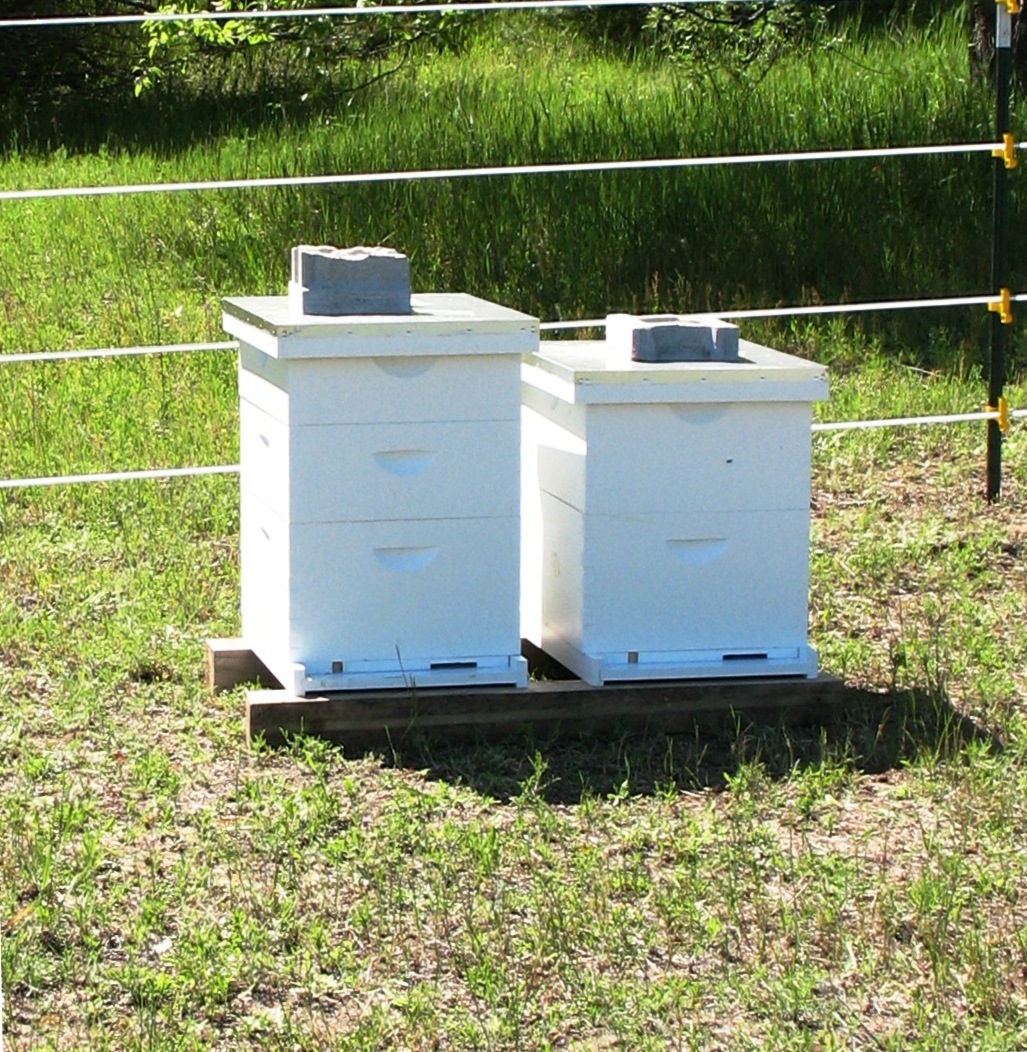
Too Close For Comfort

Too Close For Comfort

They say that a beehive takes on the personality of its queen. That may be a little much, but they are all her children. I don’t know whether there can be a true personality in a critter that has a colony culture. Much of bee activity is driven by pheromones. The queen’s chemical aura both binds the workers to her, and simultaneously suppresses their reproductive systems. They communicate via the famous “bee dance” and with a complicated and primal chemical/olfactory messaging. If you think bees don’t communicate, try disturbing the hive or, more tellingly, mess with one of the scouts.

Our bee adventure has had mixed results. At the outset, shortly after “installing” our bees, I became ill. As a result we lost precious time learning to speak ‘bee.’ Our bees had minimal interference for the first 6 to 8 weeks. Sure, we watched their comings and goings, but until I was back on my feet, we didn’t do full hive inspections.

Just watching from the outside, though, there were clear differences between the hives from day one. We started with two “nucs,” which are established mini-hives—a queen, workers and a few frames of comb with brood and food. Alternatively, you can buy “package bees” and a queen, but they take a little longer to get established. With our short season, we decided on the nucs. We started with two hives and the transfer was pretty uneventful. In the first few days it was clear that the activity levels between the hives was alarmingly different—one was inching along while the other was a bustling center of action. We thought there was a problem with the “smaller” group (who, to their defense had been smaller in number from the start.)

Then, we got the third hive. With three, we needed to identify them better so we named them—Niña, Pinta and Santa Maria. Niña was the hive we thought was struggling. When Pinta arrived, it became clear that Niña and Pinta were far more alike, and that Santa Maria, (going gangbusters) was the outlier. Pinta came with a few more bees than Niña—so it was a little more active. That Santa Maria, though, was the New York hub of bee-dom. We even relocated the hives further apart from each other, out of concern that the Santa Maria mob might overwhelm the territory. Other than that, we left them alone to do their bee-thing.

It’s fun to watch them, their comings and goings. By careful observation you can see whether they’re coming back to the hive laden with pollen, or empty-handed. While gardening I spent a lot of time observing the bees. People from my bee group warned that there can be hungry times for the bees, between various blooms, even in summer. We saw no such lags. We are really well located to take advantage of several different biomes—forest, open fields, stream habitat and swamp. It seemed something was always blooming. Our intrepid workers were always coming home with saddlebags full of pollen. We’d check, peeking in from time to time, (especially when we had the ant problem) and as the colonies grew we added additional supers on to the stack. Even our little Niña was doing well.

It is enormously gratifying to see your own bees pollinating the vegetables in your garden. As we move around the property we keep our ears open for the buzz of pollinators. Sometimes its one of the local native varieties, but often we spy our honeybees out working the fields. There is something peacefully pastoral about the steady work rhythms of the bees. They remind us that “measured and steady” is a template for natural success.

Santa Maria, though, is like a hive on steroids. It is what beekeepers call an aggressive hive—and that’s a good thing. Aggressive hives produce far more honey than loafers like Niña and Pinta. Some beekeepers search out aggressive hives for breeding. If we get that far, it’ll be interesting to see how the different hive types do in over-wintering.

If we get that far.

You see, like some ominous Frankenbee hive, Santa Maria has become a problem. Our bees share the fenced area with the garden and the orchard, or at least Niña and Pinta do. Santa Maria is not so keen on sharing. Twice, I’ve been driven from the garden, stung, because something about my activity alarmed the Santa Maria scouts. Once I was coiling hose. The other time, I was weed-hacking, but not near Santa Maria. Beekeepers learn to expect the occasional bee sting. It goes with the territory. We suit up for working with the bees. The rule of thumb is, suit up and move confidently—without any fast or threatening maneuvers—and you’ll be fine. That is exactly the case with Niña and Pinta. Steady and just a touch of smoke and the bees tolerate an amazing level of interference.

But, Santa Maria has me wearing my bee gear to garden! We noticed last week that Santa Maria bees sometimes came from underneath the hive. A cautious peek revealed that there is hive building outside the hive box. That either means that these overly busy bees are building unauthorized honeycomb or, worse yet, that a small offshoot swarm has taken up housekeeping close to the old homestead. Either way, it helped to explain why they are so aggressive in the garden.

So, Saturday, we suited-up to investigate. Keeping in mind the general attitude of Santa Maria, it felt like we were arming for war (and it’s a good thing we did.) The objective was to lift and move each of the stacked bee boxes, so that we could flip over the bottom board to get an idea what they were up to, down there. This is a bit of a chore, because at this time of year, when the bees are well stocked with honey, each of these frame boxes can top 70 pounds! (We guess that ours were at about 50.) We got past the first two layers, oohing and ahing at the stores of honey. The bees were well smoked and on alert, but not hostile. When Rick cracked loose and started to separate the third box, the bees went crazy. Some people are afraid of a “swarm” of bees. A swarm is a relatively gentle bunch. They are in the middle of relocating and they have bigger fish to fry than some human. However, bees pouring out of a hive in defense of their home is a thing to behold. Within seconds I was inundated with bees. We kept our cool, that is, until the bees started stinging me through my jeans.

We had agreed, in advance, that in the event of a problem, the stung person would retreat and the remaining person would close up the hive. I retreated—bringing with me a small cloud of angry bees. Once I’d cleared the worst of them off my legs, I went back to help Rick. After all, the retreat didn’t really solve the problem and it wasn’t fair to leave him with the heavy lifting and the defensive smoking at the same time. Ultimately, we just closed the hive back up, but didn’t succeed in checking out the problem under the hive. So, we still have the problem.

Tonight is our beekeeping-group meeting. We are eager to get advice, from the more experienced keepers, on how to handle the-hive-on-steroids. For those of the group, who like aggressive bees, we may offer to swap for a kinder, gentler hive. Maybe what we need to do is replace the queen. (“The Queen is dead… Long live the Queen!”) Whatever the solution, we’re ready to gear up, again, (with more layers) and literally, get to the bottom of this problem.

Beyond Sustainable

A.V. Walters

Food Stamps 2

For decades, sustainable has been the goal. Organic gardeners and farmers could proudly point at their successful efforts for the fact that they’d brought in crops that were not at the expense of the environment.

Agriculture, as it’s practiced in this country, is a significant factor in environmental degradation. Soil erosion, soil desiccation, loss of beneficial bacteria, poison build-up in the soils (and groundwater), bee losses—these are all “normal” conditions brought about by standard American agricultural methods. By contrast, organic practices, crop rotation, organic soil amendment (cover crops, compost and natural manure applications), these actually build soil health and soil volumes. As an organic gardener’s soils improved, she could be proud of the fact that she was building a better tomorrow in her corner of the planet.

Now we know that that is not enough.

The living world is a connected system. Excessive carbon in the atmosphere is changing the climate all over the planet and, organic or not, we’re along for the ride. It’s not enough to mind your own little corner with the objective of saving it. We need to save the planet. We can start by doing exactly what we’ve always done. Recent research shows that sustainable garden/farm practices actually trap carbon into the soils. Better soil, better air, better climate! So the organic gardener’s efforts actually help to offset some of the bad practices everywhere else!

Think of the changes we could make if we expanded organic and sustainable gardening practices everywhere! I imagine a world in which your local “garden center” does not have an “aisle of death,” with its shelves lined with poisons. To get there, people need to stop buying those products. To convince them to let go of their poison remedies, the organic tribe needs to spread the word. We need to reach out, with solutions, instead of judgments. We need to have classes and write articles on alternatives to the garden fed with chemical fertilizers and “guarded” with pesticides. It can be done. (And yes, I know we’re all busy, but really, our lives and our future depends on this and we can make time.)

Imagine how much more progress we could make if our agricultural system changed to include some of those same techniques. Successful ancient farmers built our civilization using sustainable methods. Our current version of extractive farming has only been used for half a century. We can revive those sustainable traditions and decrease our reliance on chemical inputs. Recent studies on extended crop rotation have shown we can increase soil health and minimize chemical usage.

“Substantial improvements in the environmental sustainability of agriculture are achievable now, without sacrificing food production or farmer livelihoods.” – See more at: http://www.leopold.iastate.edu/news/10-11-2012/benefits-of-longer-rotations#sthash.0Zeiwsun.dpuf and at www.cefs.ncsu.edu/…/croprotationsfinaljan09.doc Even beyond that, the evidence is coming in that shows that an international conversion to sustainable agricultural practices on a larger scale could literally save the planet.

This isn’t rocket science. Sustainable practices are cheaper, healthier and sounder than the system that puts food on the tables for most of America—and changes in farming methods could prevent topsoil losses, sequester carbon (reducing climate change) use water more efficiently and deliver better quality foods for Americans.

proclimweb.scnat.ch/portal/ressources/2302.pdf

Our mindsets have to change to make this possible. Our language has to change to embrace a brighter future, without building resistance to what we need to do to get there. Sustainable isn’t enough. But regenerative is. Regenerative Agriculture isn’t exactly new. It’s what all good farmers did before the chemical revolution. So another revolution will be necessary to make the change. It won’t be easy. There is huge resistance in big money—and big money has a lot to lose here. The agri-chemical industry will not go gently into that good night. (Monsanto, the “poster-child” culprit in agricultural degradation, already owns the Google words for “sustainable agriculture.” In a cruel joke of technology, Monsanto gets the first search hit for those words.)

If you want regenerative farming and gardening to survive and thrive, you’ll have to put your money to work. Don’t buy gardening chemicals. Support your local farmer, especially your local organic farmer. Read labels—and be picky about what you buy. Don’t buy GMO foods. Reduce your consumption of processed foods. If you haven’t already, start a garden. Plant trees. Because we are all part of the problem, we can all be a part of the solution.

In a quote often (and perhaps mistakenly) attributed to Winston Churchill, “You can depend upon the Americans to do the right thing. But only after they have exhausted every other possibility.”

(And thanks to the United States Postal Service for the beautiful Forever stamps.)


Gone With the Wind

A.V. Walters

It’s pretty quiet now, though the valley thrums with the low hum of generators, punctuated by the occasional whine of a chainsaw.

We live in a place that is blessed with steady winds. While our current impetus is to finish the house enough that we can move into it, Rick and I can’t help but take note of our regular winds and nod at each other. Sooner or later, we’ll do something to harness that power. To my way of thinking, wind power is a better bet than solar in northern regions; you can always count on the wind, summer or winter. Still, most of the alternative energy attention goes to solar. Our neighbor is installing a bank of solar panels now. We’ll watch to see how they perform come winter.

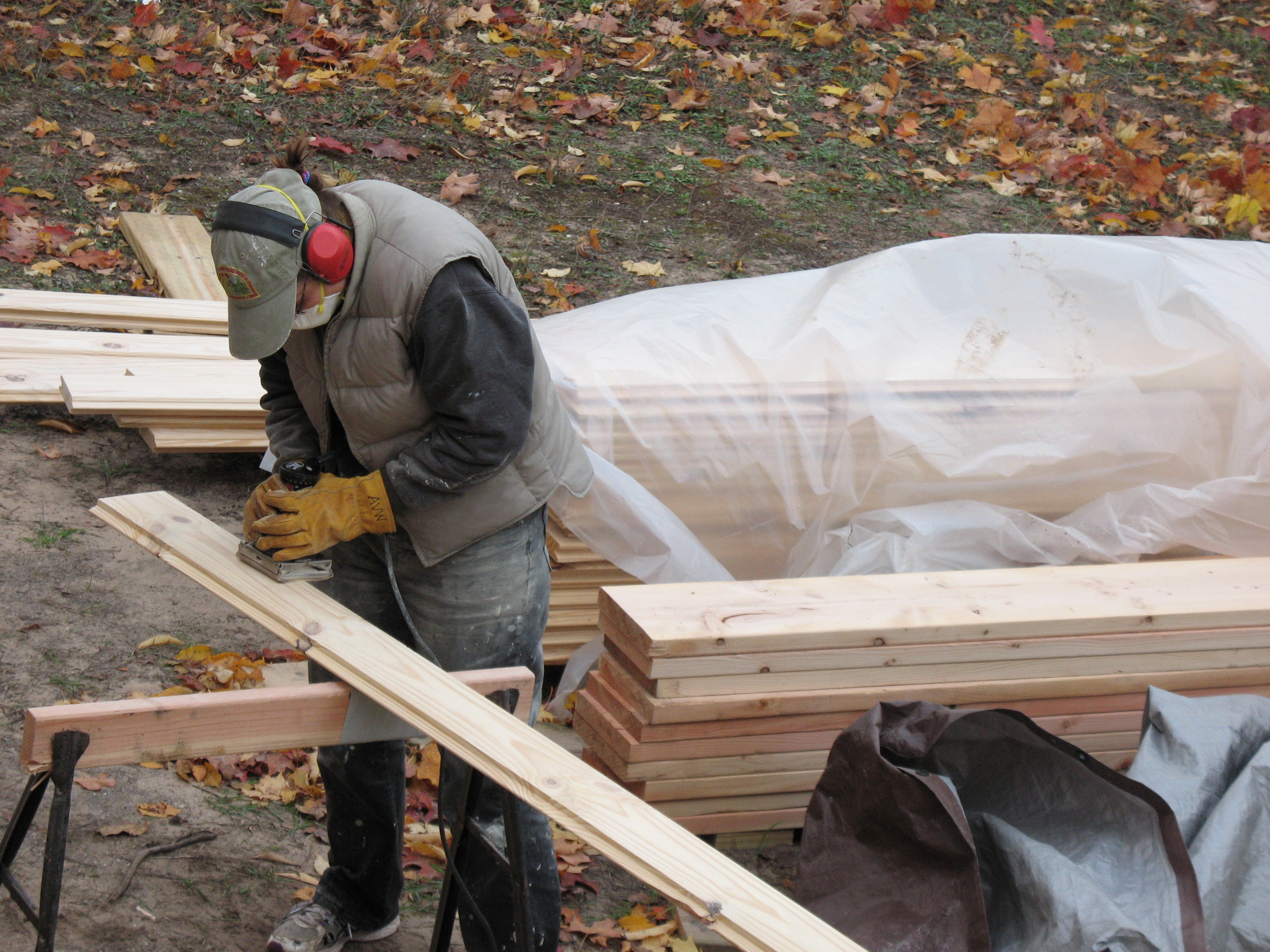
Early last week, we were pre-staining 4X8 panels to use to enclose the soffits. It’s a lot easier to apply the stain when they’re still on the ground. We set up on a series of saw horses–we’d stain on one, and then move the sheets out to dry on the others. Each panel needed first to be perched on its edge and vigorously swept clean of milling crud, before we could apply the stain. While I brushed down the next sheet, a gust of wind behind me picked up one of the stained ones, and pitched it directly at me. It caught me on the backs of my calves; Rick heard my yelped cursing from the basement. Wind power–it can leave you badly bruised.

I shared my story with our builders, who all had construction wind horror stories of their own, with injuries ranging from bruising to quadraplegia. Clearly the lesson was that wind is a powerful, and unpredictable force. When working on a construction site, you must consider the placement of any material that could catch the wind and act like a sail, including (as we learned last winter) tarps and plastic coverings.

Now that the house has a roof, and is partially enclosed (upstairs windows installed) we worry less about the impact of weather. Armed with this new sense of immunity, Rick and I headed north this past weekend, a break to visit my mum. It was a marathon trip, a 900 mile round trip in a three day window. It was a wonderful break–even with the drive. The surprise came on the way home.

Two counties away, we started noticing a number of trees down. Many were snapped, mid-trunk, like toothpicks. Soon, we were obsessed, scanning the sides of the highway, and finding plenty of damage. We were only gone two and a half days–what happened?

In Traverse City there were areas without power, or signal lights. Traffic snaked along, on single lanes squeezed between emergency equipment, cutting downed trees from the roads and from where they’d fallen on homes. We were anxious to get home to check out our new home under construction–where we already know the winds can be fierce.

We didn’t stop at the apartment; we went straight to the house. There it was, safe and sound, without even a leaf out of place. There was no indication that there’d been a storm at our house. Of course most of the county has no power because of the fierce storm that ripped though on Sunday. We missed it. It’s the biggest weather event since we arrived in Michigan, and we were away!

There’s argument as to whether there were tornadoes. Leelanau County doesn’t get tornadoes, or so they say. Yet a number of people swear they saw funnel clouds. The weather service flatly denies that there were tornadoes. At least this is what we hear. We are still at the mercy of the rumor mill, because there’s no power–no internet–and no “hard” news. Wanting to know, I did the next best thing, I went down to our local hardware store. Indeed, the damage was pretty bad. Many cars and houses have been hit with flying trees. At least three pontoon boats were picked up from small lakes, flipped and smashed to bits in shallow waters. We’ll have to wait until the power resumes to get the whole story.

We walked the back woods today, and we’re not completely unscathed. We’ve lost at least thirty trees, many of them fell and took out their neighbors, like dominoes. The unfortunate part is that the standing dead ash trees did not fall. The maples, the basswood, trees laden with summer foliage, those were the ones that caught the winds and came down. There’s a lot of clean up to do, we’ll have to re-open all the trails that we opened when we first arrived. We’re in good company, power company employees are out, surveying the damage and calling in the “tree boys” to free the lines of downed trees. We talked to one of the line surveyors, who warned us it could be days before we see power. We’ll be fine. We can take “flushing” water out of the creek. We have a generator, to keep the refrigerator and lights running. (Too bad it’s not powerful enough to run the well pump.)  We can cook on the propane barbecue. We’ll be just fine. Maybe I’ll even find a way to post this update.

That wind though, it certainly would be nice if we could harness it for the power of good, instead of ….

Posted courtesy of laundromat wifi.

“There Are Raspberries in the Woods!”

A.V. Walters

At the top of the incline...

At the top of the incline…

Yesterday was hot and muggy. My big chore for the day was watering and feeding the garden. We have poor soils, so initially, as we build the soils with organic materials, we are also fertilizing with a ground, whole-fish mixture. It’s a messy venture, with mixing in 5 gallon buckets and then pouring back into a watering can–or, for the fruit trees, into our special, slow-feed (cracked-bottom) bucket. Just watering is an exhausting exercise in hose dragging (three hundred feet of heavy duty hose to three locations) and the alchemist’s fertilizing concoction stinks. It splashes all over –and, in the heat, red-faced and sweating, I was quite a sight (and smell) even from a distance.

Our neighbor happened by. She’d been hiking up in our hills. We haven’t seen each other in weeks and she stopped to catch up. The whole neighborhood is in a tizzy over the loose and barking dogs. So far, nobody has the nerve to press the sheriff to do something about them; that day is coming. The barking, especially late at night, is driving everyone crazy. I’m always surprised that people aren’t more direct. We exchange stories. She’s kind enough not to mention my fishy, disheveled state. But, she seemed a little more agitated than just the usual barking dogs annoyance.

Just as she was about to depart, she turned to me and said, “You know, there are raspberries in the woods.”

“I know.” I gestured towards the house we’re building, “We’ve been so busy… I haven’t had time to get back there.”

She nodded, then wrinkled her face, obviously dissatisfied with my response. She leaned forward, almost conspiratorially, “No, really, you should get back there. They’re ripe…really lovely.” And then she repeated, lowering her voice, “There are raspberries in the woods.” I thanked her and she headed home, disappearing through the pines.

I was pretty spent from my morning’s chores. The woods are cooler and the suggestion to pick berries was stuck in my head. Fresh raspberries… I could make sorbet. Wouldn’t that be lovely on a hot, sticky day? And, it’s been weeks since I walked in the woods.

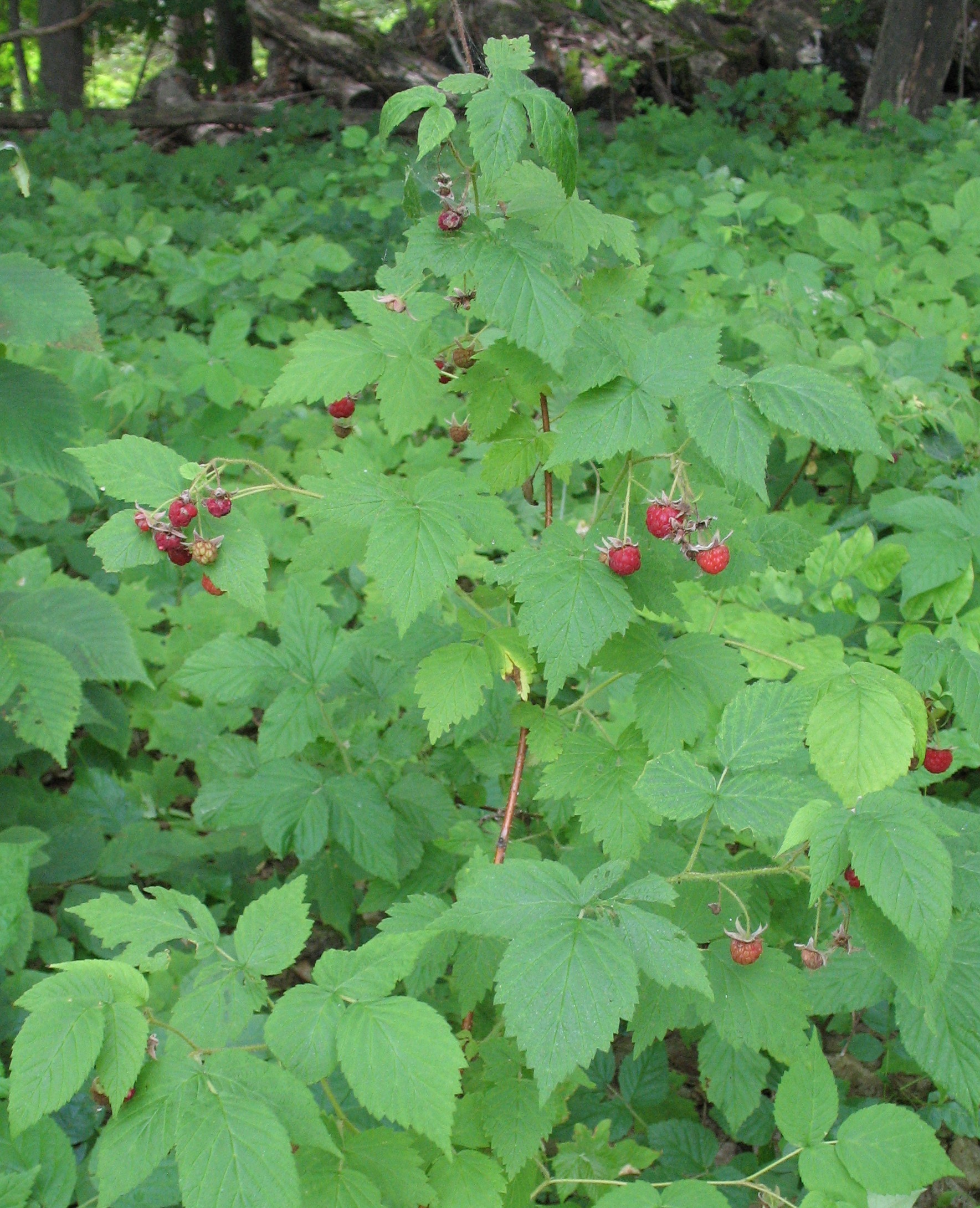
There are raspberries in many parts of the back-forty. Marilyn hadn’t been specific about which area got her so excited. So, I ambled west, down the south side of the two-track, figuring that if I didn’t find anything I’d cut north before it got too steep. It was lovely, a light breeze and a near full canopy of shade. I found plenty of berry canes, but the berries were not ripe in the shaded areas. I headed up the hill, hoping they’d be further along in the sun, up on the ridge.

I crested the top and saw red berries almost immediately in what had become a jungle of brambles since I was last there. Just as I turned to find the trail, I came upon three teenage girls who were taking turns cutting a log with a bow saw. I was stunned. So were they.

“Hello,” I said, “What are you doing?”

A fresh faced blond in braids responded, “We’re camping.”

“Ah,” I said, “I meant, what are you doing, here?”

“We’re camping. We’re with a Christian camping group. We come here every year.”

“You come here, every year?”

“Yes, at least for the last few years, since I’ve been coming. We have a lease with the owner.”

“And, the owner’s name is…?”

“I don’t know, but our camp counselor might.”

“That might be helpful, because I’ve owned this property for over twenty-five years and I’ve never leased it to anyone.”

By now, the girls were looking a little nervous. They stood up and brushed themselves off.

“Perhaps you should take me to your leader,” I smiled. They didn’t get the joke. Maybe it’s too old. Maybe I’m too old.

They led me, single file, down the trail to where it widens along the ridgeline. We came to a campsite with about a dozen tents. The trails were neatly swept clean of leaf litter. There were “furnishings” made from cut logs, tied together with heavy twine: a big dining table; log stools; and storage shelves full of packs, tied, shoulder high, between trees. A combination tent/lean-to held coolers, half buried in the ground. Everywhere around me, young teens were busy, working together to establish camp. I was taking note that they seemed well organized, and supervised. It almost felt like another world had sprung up in our woods, like they were playing house there, with their swept trails, neat lines of tents and twined furniture. But it wasn’t lost on me that they were cutting quite a bit of wood. Most of it looked like deadfall. I am sensitive to people cutting wood on the property. The other two girls ran ahead to find their counselor. The blond stayed with me, as she narrated what the campers were doing.

Her companions came back, with another girl, just a couple of years older.

“Yes,” she said, “Can I help you?”

“Well, it seems that you are camping on my property, without permission. And if the girls are right, this is something you’ve been doing for years.”

“Yes, we have been using this site for several years, but we have a lease with the owner.”

“I’m the owner.”

She looked flummoxed. “I’m not sure what to say. We’re a Christian group.”

“Me either. But I need to point a few things out — you’re storing your coolers, your food, on the ground. We have bears here and that can attract trouble. Your storage areas are too close to the ground–again if there’s food in those packs, the bear can easily get to them.”

“Thank you. I’ll mention that to our supervisor.”

“Okay, maybe you should take me to your leader.” She didn’t smile.

“They’re all in a meeting, over by the other camp.”

“The other camp?”

“We have two camp sites. We compete with each other.”

“Oh. I guess we should go there.”

So, the counselor, the blond, whose name was Emily, and I began the hike over to the meeting. I guess since Emily found me, she became a permanent part of the entourage.  The counselor asked me to let her know when we were no longer on my property. We hiked for some time and then I told her that we were at the property line. We still had some ways to go before we reached the “headquarters.” At one point, we ran into some other campers, the counselor stopped to ask where the meeting was being held–and then directed Emily to take me there. We proceeded down the trail, with Emily in the lead chatting about the camp and what they did. In the distance, we could see a group of women, sitting in a circle next to a van. As we approached them I informed Emily that once we’d arrived, it would be inappropriate for her to stay–that my business and concerns were with those in charge. She paused and then told me that she would leave, but first she needed to introduce me. I found that to be charming, especially under difficult circumstances. Finally, I was introduced to the woman in charge of the camping operation.

She explained that they leased the camping area from the owner–and gave the name of my neighbor, to the north. She believed that they were on his property, but if that was not the case, it was a mistake. I told her that the camp I had first encountered was on my property, and not by just a little. It was located about two thirds of the way into our back forty. She apologized and added that they were, after all, a Christian Youth Organization, dedicated to teaching wilderness camping to young men and women.

I couldn’t help but say that one of the first wilderness lessons was about knowing how to read a compass and a map, and it appeared that the leadership of this group had failed miserably at this threshold skill. I explained that I was angry–not specifically at her, and I didn’t want to direct my anger at someone who wasn’t personally responsible. I said that I also wasn’t crazy about the fact that the girls were cutting wood on my property.

“They don’t cut living wood.”

“No? I’ve found cut stumps, in the past, from live trees cut down–I’ve been finding cut logs for several years now. And, I’m afraid that I’ve been wrongfully blaming my neighbors.”

She wasn’t really listening and jumped in to explain, “We teach no-impact camping. The girls are instructed not to cut down any living trees.”

I paused, “You do understand that this situation puts me at some risk?”

“Oh, no,” she said, “We wouldn’t put you at risk.”

“Well, I expect that your lease with my neighbor contains release language, and indemnification language, and that there is insurance coverage, correct?”

“Yes.”

“Well then, since we don’t have a lease, we aren’t covered by any of those protections, are we? Your girls could be injured and then I’d have something to worry about, wouldn’t I? That’s especially concerning since I’ve seen what I consider to be unsafe camping practices. What’s my current exposure if one of your girls is injured by a bear, because you store your food on the ground, right next to their tents?”

“We can leave, right away.”

“That’s not what I’m asking for. But, when are you scheduled to leave?”

“Next Saturday.”

“I need to talk to whomever it is that’s in charge of the lease arrangements. I’m not trying to run you off, but I need to get this straightened out, so that I’m not exposed because of your mistake.”

“Perhaps you can draw me a map, or show me where your property line is?”

I drew her a map, showing her where the property line was, and gave her my contact information, so the Director could reach me to iron this out. Then, I headed back down to our building site to tell Rick.

“We have a problem.”

“What, no berries?”

“We have an infestation in the woods.”

“An infestation of…?”

“We have an invasion of young Christian Campers.”

He could barely believe it. But, it did begin to make some sense. For those of you who follow this blog, you know we’ve had problems with woodcutting. All of the cut logs we’d found, it didn’t make sense. But now–now that we had “competitive camping” on the property, it made all the sense in the world.

At no point in the thick of it did I stop to consider what impression I may have made. There I was, dressed in grubby construction clothes, red-faced, drenched in sweat, and smelling strongly of fish. I can only wonder what they all thought.

When I checked my email, the Camp Director had contacted me. He confirmed what I’d feared–that the group had immediately broken camp. I hadn’t wanted to run them off–just to bring their occupation of the property into some arrangement more formal than trespassing. Still I mentioned all the cut logs (more than thirty at last count) and I referred him to a previous blog in which I’d railed about unauthorized cutting on the land. (https://two-rock-chronicles.com/2015/04/19/a-storms-a-brewin/)

When Rick and I re-visited the campsite, there wasn’t a trace of them. Even the leaf litter had been re-spread, carefully and evenly, over the trails and their site. The only reminder was an impressive pile of cut wood–which they’d said they’d leave.

We’re trying to work out “compensation” for the use now–something in the vein of some volunteers, next Spring, to help with tree planting. We’ll make it fun and educational–maybe we can help some young people to get involved in understanding why we plant for the future and for forest diversity. I think it will all work out in a win-win kind of way.

But we’re left wondering about my neighbor. Why couldn’t she just tell me we had a camping invasion? What’s up with speaking in code? Now, Rick gets a glint in his eye and whispers, “There are raspberries in the woods.” I have to laugh. And, those Christians? I can only hope that they can forgive us our trespasses, as we forgive those who trespass against us.

IMG_2182

And, at the end of this adventure, I realized that I’d completely forgotten to pick berries.

Up to Our Eyebrows

A.V. Walters

A Roof!

A Roof!

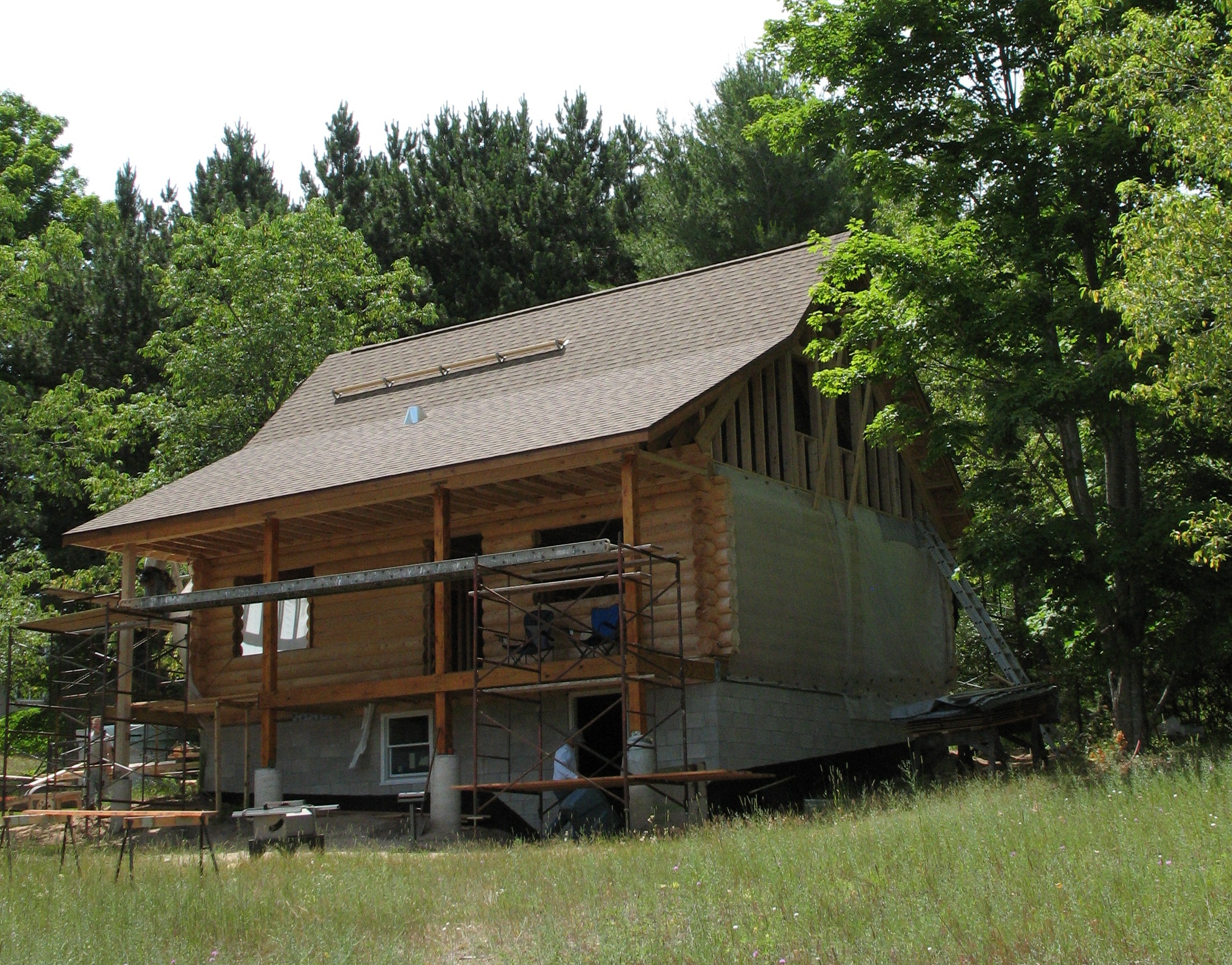
The past month or so has been a whirlwind of work and changes. First, we finally have a roof! We’re working on the gable ends, and the doors and windows aren’t in, but we no longer wrestle with tarps every time the wind is up, or rain threatens. Rain was a real trial during the roof installation. After a record dry May, our crew was finally ready in June. And then the rains came. It was on again, off again, and every transition was a tarp wrangling event.

It’s a steep roof, a 12/12 pitch, on the main section. We’re thankful to the Flanagin Brothers, whose daring and determination made it go up. Rick and I would have been hard-pressed to pull it off by ourselves. (We’re talking about fifty, twenty-foot long, 2”x12”s, here.) Too high, too hard, too scary. They were undaunted by the challenge. Crazy characters, they’re twin brothers whose laughter ( and, on a rare occasion, bickering like an old married couple) rings out from the work site and who, in almost eerie symmetry, work together like interlocking puzzle pieces, finishing each other’s sentences and solving problems near wordlessly–as though building were some kind of secret dance routine. It’s been a pleasure to have them around. Soon, their work will be finished and it’ll be back to Rick and I to finish. We’ll miss their levity, skills, and their cool confidence.

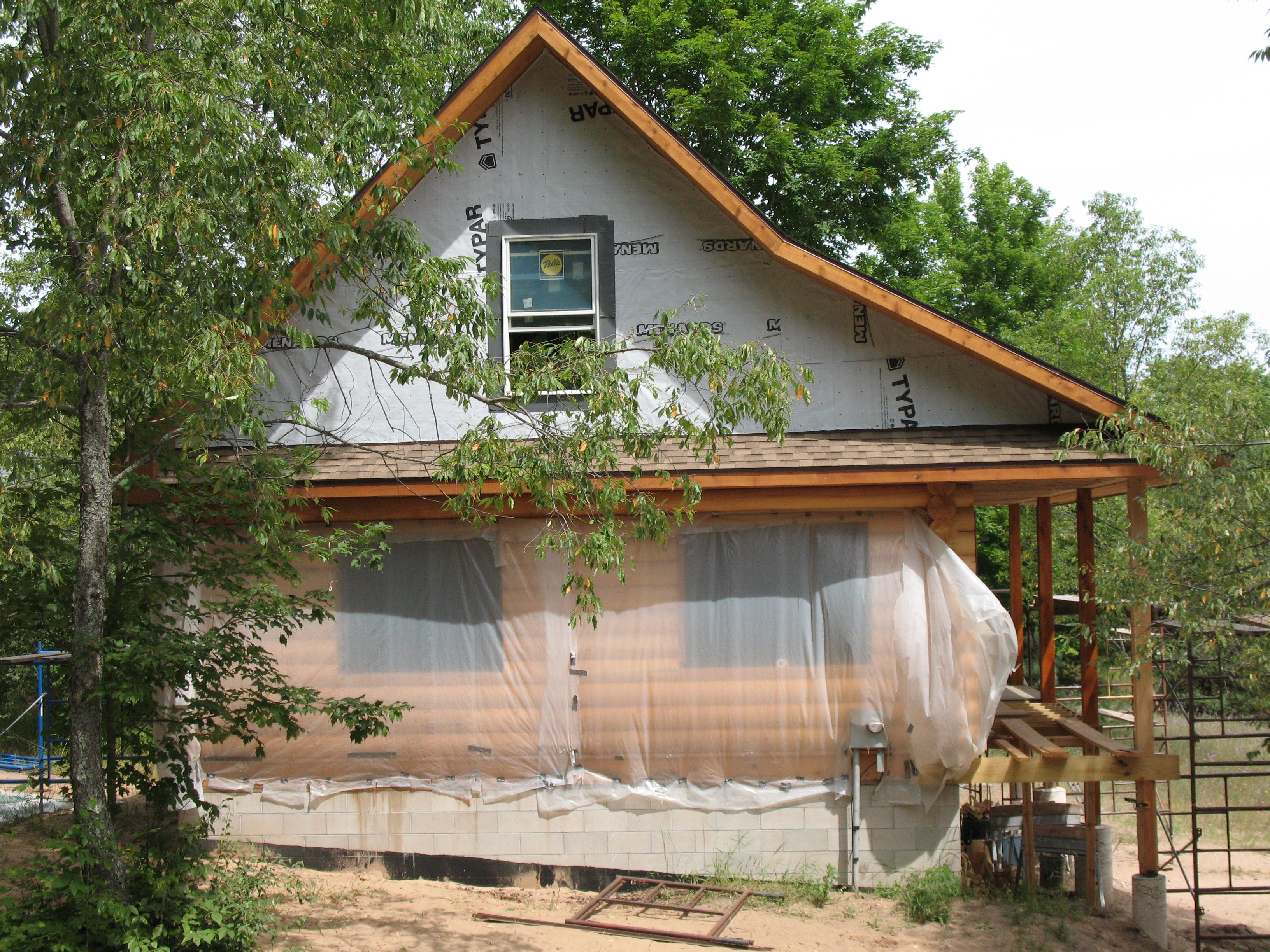
They’d be gone already, but for a last minute idea. They were about to enclose the gable ends when one of them (I can’t remember which one) mentioned that the log to gable-wall transition could really use an “eyebrow” roof. (This would be a roof line that sticks out about two feet, separating the log walls and the A-line gable-end walls.) The other twin completed the idea, “Yeah, it’d give you sun protection in the summer and keep the rain and snow off the log walls.” Rick and I looked at each other and the decision was made. Why didn’t we think of that?

With eyebrows!

With eyebrows!

It’s an old-fashioned design element–a sensible way of using an extra layer of roof overhang to protect the walls and to give relief from the heat of the summer sun, while still making the most of the low-angled winter light. The Flanagins keep trying to sell it to us on aesthetic grounds–but we’re already sold on function. Besides, it doesn’t win us over to tell us it’ll have that “cute cottage look.” We’re not big fans of cute. So, the Flanagins are still with us, and we’re literally up to our eyebrows in the project.

The excitement of building progress–even interrupted by rainstorms–has helped to carry me along. I’ve been under the weather, a victim of self-inflicted illness. I have food sensitivities. While I’m usually very careful, in the busyness of full-tilt construction, I misread a food label, and I’ve been paying the price for weeks. My apologies, dear readers, I have not been up to blogging–or much of anything else. It’s a good thing the bees mostly look after themselves. Had they been pets, they’d have perished from neglect. Rick has never witnessed a full-blown celiac episode, and he has a new appreciation for my normal level of kitchen vigilance.

I’m mending now, and picking up the pace on those things I can do on site. I’m sealing the interior of the log walls, and just starting on the exterior. I’ve been using my downtime to source cool building materials on craigslist, recycled or reclaimed timbers that make the project distinctive, and lower its carbon footprint. It helps to us keep out of the big box stores and away from retail prices. And every offbeat purchase has a story, which gets woven into our story of building the house.

Critters and Bunnies and Bugs! (Oh My!)

A.V. Walters–

Welcome to Michigan. Gardening in California was a formulaic cinch, by comparison. There we had concern about water, and gophers—but there aren’t many insects in California’s parched climate. Of course, we had the flies from the dairy, but they didn’t bother the garden.

Gardeners here have to be a hardier lot. There are seasons, with their never-ending uncertainties. We had a late May frost that zapped the blooms, and may cost the region much of its fruit this year. It didn’t affect our garden, because I was too chicken to plant with the night-time temperatures dipping so low. Our starts were safe and snug indoors, by the window. Not that we’ve been without garden trauma. The deer jumped the fence and did all that damage to our fruit trees. The trees are slowly recovering, the pears in the lead and the apples trailing. I think they’ll all survive. Deer are a serious garden hazard. At least we think we’ve ironed out the fence issues with deer.

We have gophers, but so far, they haven’t been seen in the garden. Most everything is in buckets (except lettuce and greens—fingers crossed.) Right now we’re trying to figure out how to amend the fence again to keep out the bunnies. We thought we had the spacing right, but somebunny is sneaking in at night and nibbling away at the peppers. Too bad we always have to learn through losses.

That’s true for the bugs, too. We’ve lost almost half of the tomatoes to insects. I’ve been out of area so long, I don’t even remember the names of all of the voracious 6-legged predators. Some kind of leaf-hopper-thingie is chewing through the tomato stems. One solution seems to be that our starts need to be bigger before we set them out. The larger ones have not been munched by bugs. Alternatively, we are considering floating row covers, which will outwit the bugs, and give us some frost protection, too. We lost some squash to cutworms—not a crisis, but the tomatoes came as a shock. In California, nothing touches the tomatoes. Here, it’s a race between the bugs and the bunnies.

The bugs are after us, too. Black flies, mosquitoes and deer flies. We’re sitting ducks out there. The worst are the black flies. Thank God they have a pretty short season and should be gone by July. We mixed up a concoction of vinegar, water and vanilla, which seems to keep most of the bugs at bay. Before we found that, we were swollen and itchy—to the point of under-the-weather.

My father used to shake his head at scant summer clothes. As teens, we ran around in cut-offs and tank tops, oblivious to the hazards. Between the summer sun and the bugs, you were toast. Now, I dress like Dad, long sleeve tees, jeans, a neckerchief and a hat. Sometimes older is wiser.

Even our bees are plagued by bugs! Of our three hives, one has always been a little vulnerable. The ants have discovered the weakness, and are trying to set up shop in the top of their hive. Several times a day, I interrupt their efforts, and squish every single ant that doesn’t move faster than me. There are thousands of them. Rick has a plan for ant-wells*. We’ll get the supplies on our next town run and then we’ll foil those ants!

* hive stand legs in sheltered oil moats. More on that later.

Welcome Homebees!

A.V. Walters/Photos by Rick Edwards–

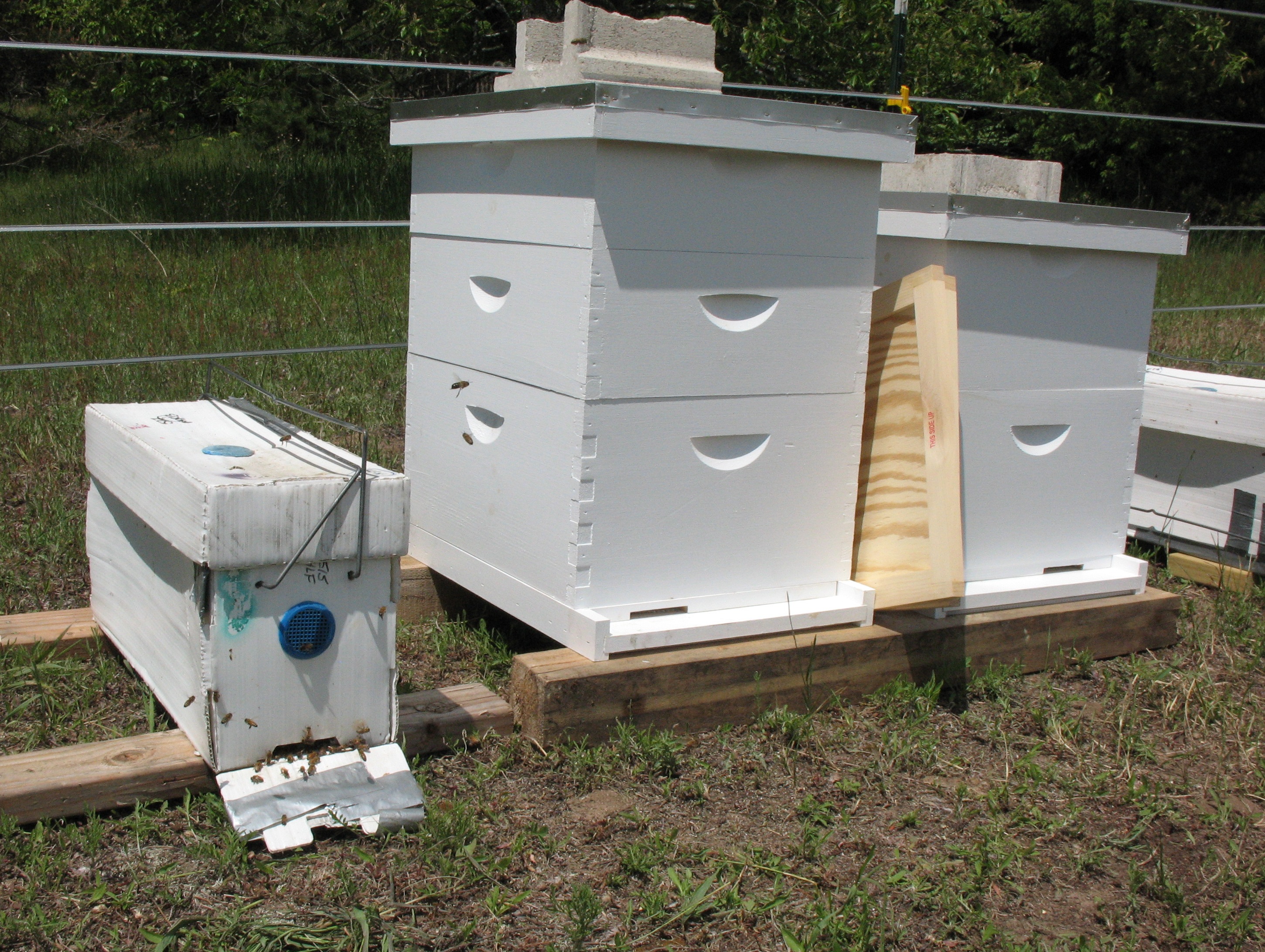
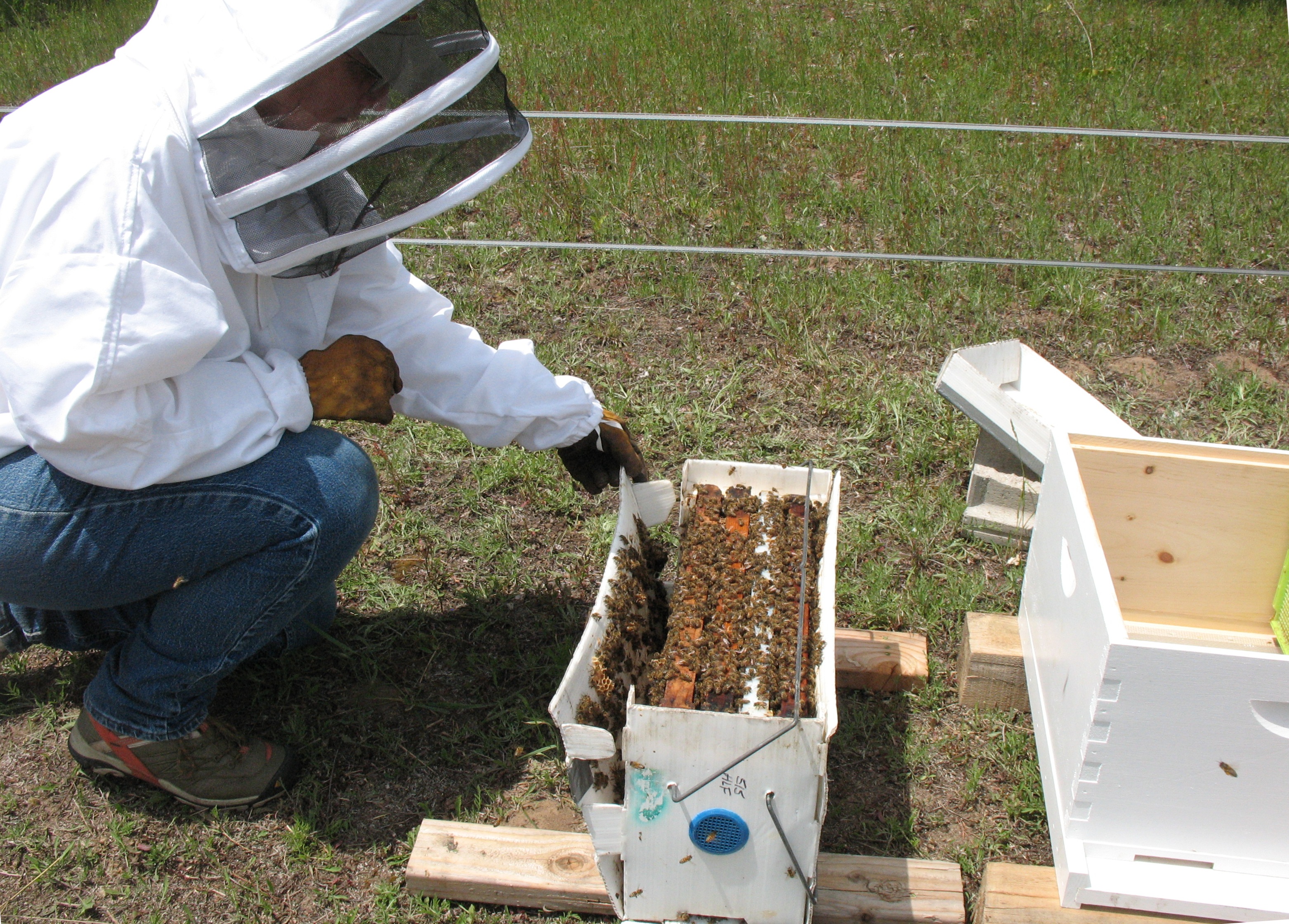
Bee transport next to new home.

Bee transport next to new home.

Opening up the "nuc" box.

Opening up the “nuc” box.

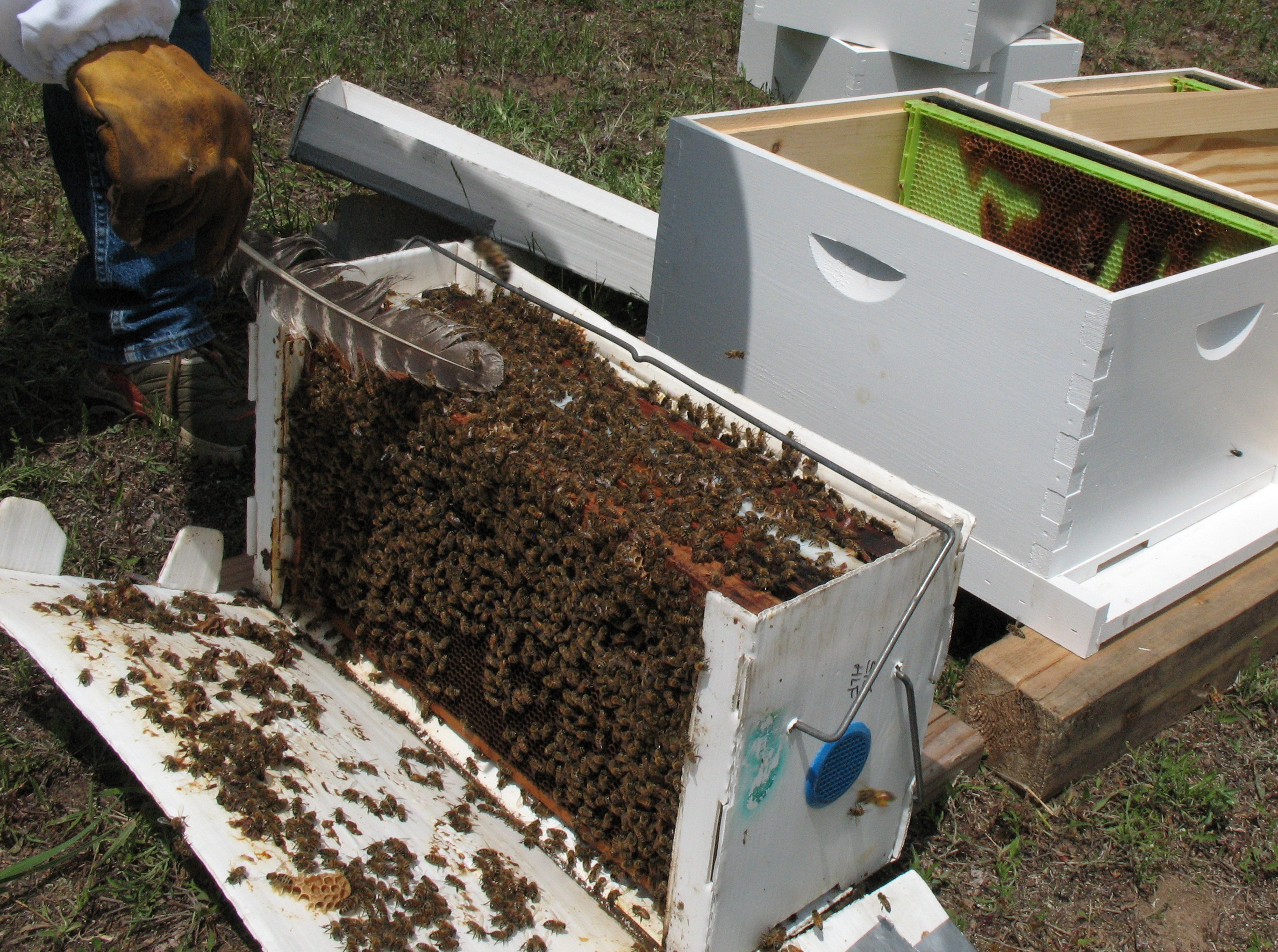
Checking the frames.

Checking the frames.

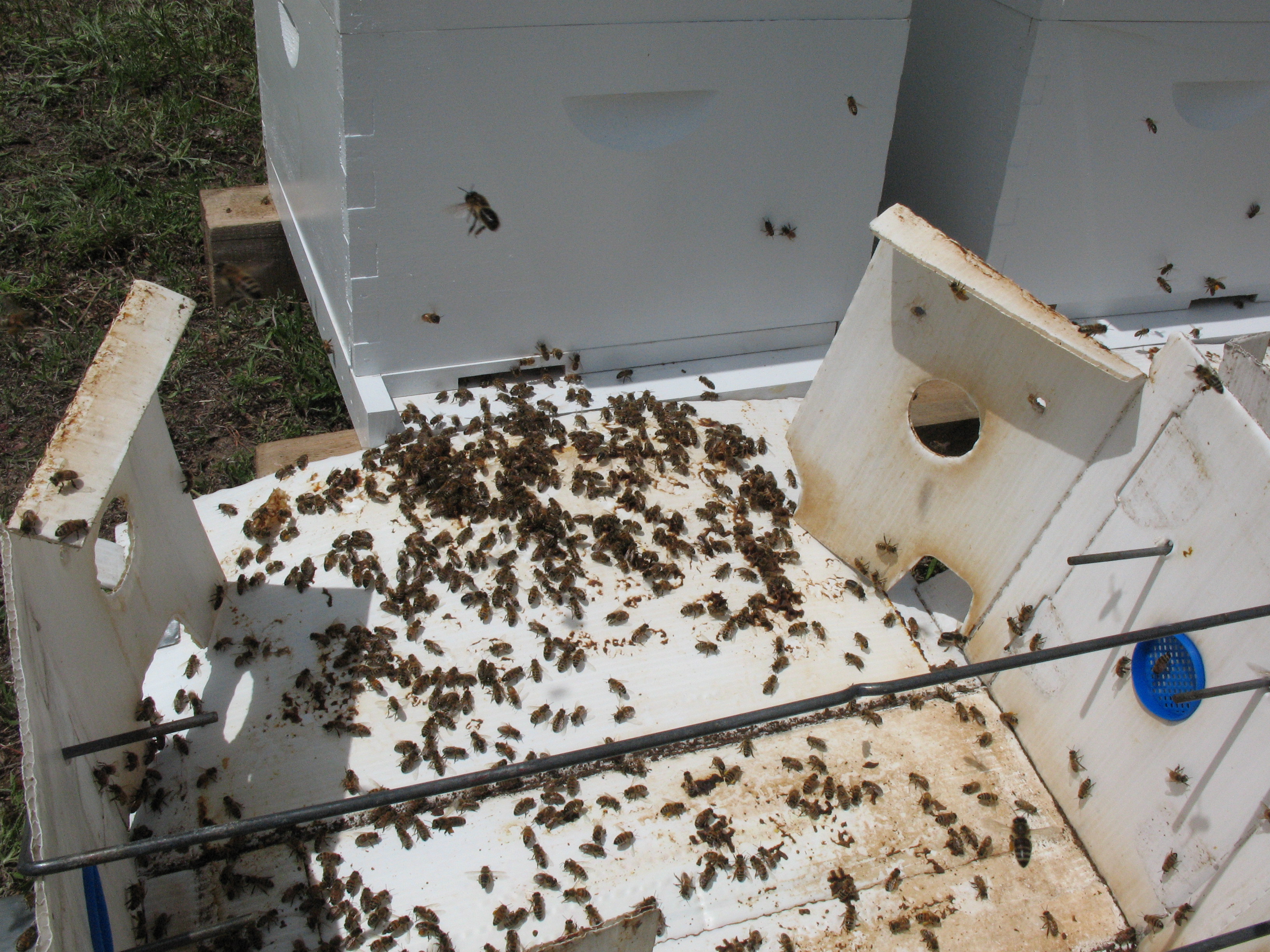
Stragglers, joining the rest in their new home.

Stragglers, joining the rest in their new home.

Rethinking Hunting

A.V. Walters

Just when you thought it was safe to go back in the water…

It’s been a busy week–construction, completion of the fence, the arrival and installation of the bees, and putting all of the little plant starts into the ground. What a relief when the last yogurt container was empty and we could survey our little garden kingdom without the feeling that something else was needed…immediately. With the fence up, we moved the tomato cages (which had been protecting the new fruit trees) into their positions over the baby tomato plants.

The bees appear to be very happy. Their comings and goings are fun to watch. They have settled in and now they they probably know the neighborhood better than we do. It rained yesterday, and the morning saw a few dead bees on their doorstep. We weren’t alarmed. Bees die everyday. The average worker bee lives no longer than 45 days. By the end of their lives, they’ve done just about every job in the hive, starting with tending the young and moving on to more skill intensive tasks–building comb and maintaining the hive, guarding, foraging and scouting for pollen and nectar, and finally, returning to the hive to again tend to the young (and to teach new bees the ropes.) What was interesting was that we first noticed the dead bees on their doorstep on a rainy day. A rainy day is an opportunity for a little housekeeping. The bees can be crabby when they have to stay inside.

Yesterday was an eye-opener. Rick was up early, anticipating the construction crew. We had a dense and drippy fog–so there was the question of whether or not to start the roof. We’re watching the forecast, hoping for a window of dry, so we can safely pull off all the tarps that have kept the weather out of the house all winter. He wandered over to the garden to get a look at how the bees were handling the fog. Bees are generally early risers.

What he wasn’t expecting was the ravaging of the fruit trees. A deer had come right over our new 5,000 volt electric fence and sampled the leaves of of every single tree! Some she liked better than others. One poor little apple tree was completely denuded. The garden plants were unscathed–probably too small to attract deer attention. Still, we were in shock. Everyone we talked to had said that the deer won’t often jump an electric fence. Once they do, though, they’re trouble. What’s up with our deer? We suspect that the fenced area is so large that it doesn’t post a mental logistics problem for leaping deer. We are reduced to guessing at deer geometry.

We think most of the trees can be saved. I immediately zipped over to our neighboring cherry farmer to buy more small “tree cages.” Now, we have fences within our fences. Today, we’ll have to solve the problem of this deer–who now thinks our garden enclosure is his personal dining room. (Just where are those guard bees when you need them?) We’re debating two options: extend the fence higher with non-electric lines (as Rick pointed out, if they’re not touching the ground, the deer won’t be shocked in the air, even if they touch the fence); or set up a lower, perimeter line to interfere with the “jumping zone.” Maybe we’ll have to do both. (Then we’d have outer fences, to protect our electric fences, which protect our tree fences.) This is getting to be the Fort Knox of gardens.

The day was otherwise so busy that we didn’t have the time to work up a really foul mood about all of this. I did see Rick brooding a bit–asked what it was about. (After all, we have so many fronts on which to fret.) He looked up and said that he might reconsider whether to hunt on the property.

(Sorry, no photos, trouble with internet connection. I don’t have the skills to do pics from an internet cafe!)

Baby Steps

A.V. Walters

Looking deceptively innocent.

Looking deceptively innocent.

The fence is complete. After tonight, the last night on which we expect a frost alert, we can put our garden starts outdoors into their permanent homes. We’ve been hauling them out every day (all seventy or so of them) and then hauling them all back in at night. They’ll join the orchard whips, to be protected from the deer by the new fence. If we had any doubts about whether the fence was needed, in the interim, a few deer stepped in to convince us we’re on the right path. We hope the trees will recover.

The bees arrived today. The same fence protects them from the bears. Today we simply placed their bee transport boxes next to their hives. They were too agitated from the trip to pull the frames and place them into the hive bodies—we’ll do it tomorrow. When we pulled the plug from the boxes, the bees from one of the hives poured out in an angry mob. I was afraid they’d swarm (and I’d fail on my first day of beekeeping!) Within an hour they’d settled down and already some of the bees had found the pin cherry trees, blooming right behind the hives. The autumn olives are in bloom, too; their near-tropical fragrance is the perfect bee balm. The bees wasted no time and got right to work. Tomorrow we’ll do the transfer to their permanent homes.

Home, sweet home.

Home, sweet home.

The roof framing crew showed up, too! Soon we’ll have a roof and we can settle in to the summer’s rhythm of finishing the house, minding the garden and the bees. We’re all on the same trajectory here. Things are looking up.

The Morel of the Story…

A.V. Walters–

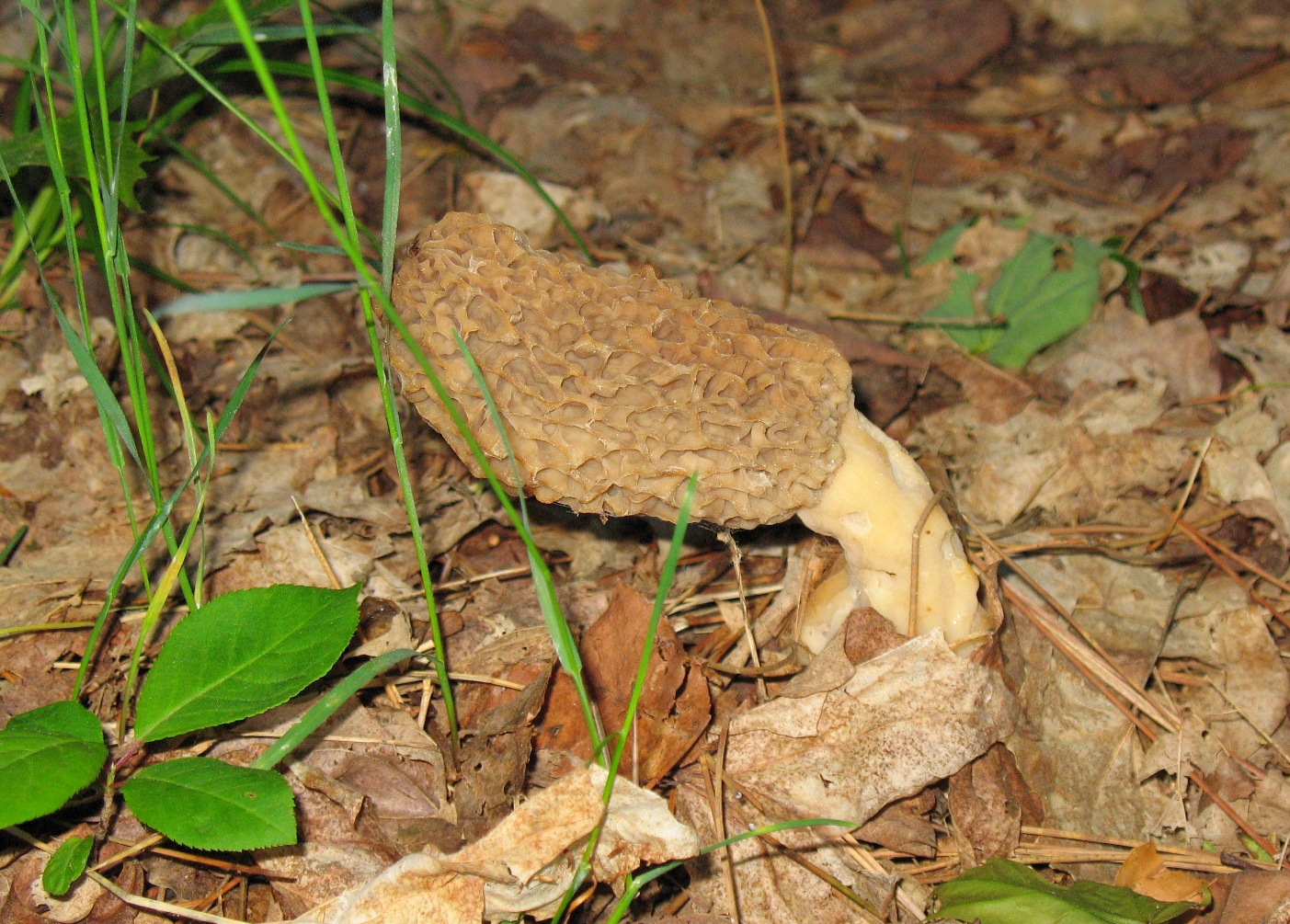
We found another one! So now you see why morel mushrooms are safer to eat than most. They're so distinct looking, it would be hard to pick them wrong.

We found another one! So now you see why morel mushrooms are safer to eat than most. They’re so distinct looking, it would be hard to pick them wrong.

I am a middle child. What pleases me, may not be what pleases others. Middle children learn to like what they have—and not too visibly—or their older siblings will take that, too.

When I picked the property, I knew that it, too, was an odd duck. The “back forty” is too steep to develop or farm. Only the forest holds those steep, glacial sands to the planet. The front “panhandle” is slightly sloping down to the road, which was the reason for including it in the parcel. The property needed road access. Across the road is the swamp. At the low end, the swamp end, the soil won’t perc, so you cannot build there. It’s lovely bottomland, but it’s also the low spot where one can expect killing frosts. A neighbor planted fruit trees down there, and didn’t understand why, after a few years, they all died. Wet feet. The water table is so high that the poor trees literally drowned

The sellers waxed philosophic about the beauty, the views, the “potential.” They were realtors, had any of that been true, they’d have kept it. Not that there aren’t views, especially up on the hills, especially in the winter, when the leaves are gone. But you cannot build to take advantage of those views because the steep hills (and winter conditions) preclude any possibility of a road or driveway. The property is beautiful—it’s just not marketable for development. Oh, and the sellers told us, there were mushrooms.

Until last year, I’d never seen any mushrooms. Morels have a short season and, though I’d been here in May, I never saw them. Last year, I saw a bunch of them. They were in a plastic bag, dangling from the waistband of a mushroom poacher who was walking our south ridge. We ran the poachers off—but the morels went with them. I didn’t have the fortitude or attitude to demand that they surrender their bounty.

This year we’ve been regularly stalking our slopes, eyes glued to the ground. (So much for the view.) It’s been a dry spring, and cool, so much so that the leaf litter has been crunchy underfoot. Morels like warm and wet. We searched and searched to no avail. My sister, 150 miles south of here, went morel hunting several weekends in a row and found hundreds. She told me I just didn’t know how to look. Over and over again, she said, “You have to get low, they’re tough to see.” They are. And, they are especially difficult to see when they aren’t there.

This past week, we’ve had heavy rains. So, despite the fact that the season is technically over, Rick and I went for a last stroll to check for “shrooms.” We also figured we could harvest some wild leeks, “les ramps” to the gourmet crowd. For best flavor, you harvest them late—just as their leaves yellow. We weren’t twenty steps into the forest when Rick found the first mushroom—right in the middle of the path! We spent an hour or so—poking around, digging ramps and collecting beautiful morels. There weren’t many mushrooms, enough for a wonderful dinner. We had sautéed wild leeks and morels over penne—with thyme, and just enough goat yogurt for creaminess and tang. It was a feast for kings—as good as any served in this foodie-snob restaurant capital.

Maybe we’ll get an extended season. This will guarantee a few more hikes into the back forty, even though we’re really busy. Not bad for a couple of middle kids.

Sorry, no pics. We were so excited that we ate the evidence.

Beer Garden Blues

A.V. Walters

IMG_2132

We started our little garden plants in tiny peat pots, some weeks ago. We’d carefully researched our frost-free date, and back-calculated the time for germination. I’m picky about such things because one of my pet peeves is vegetable starts that are root-bound at planting time. The date came, and went, and the weather forecast still warns of possible frost, so we cannot plant. But, our little sprouts are ready to roll. To harden them off, we’ve been carrying them outside on nice days and back in again every night. It’s like babysitting.

Though I’ve never been an advocate of multiple transplanting (too lazy), this year I’m won over, if only to avoid the dreaded tangle of strangled roots in the bottom of the peat pots. Yes, I know that peat pots can supposedly be just dropped into the hole, but I’ve never done that, because even though the roots can grow through them, I’ve still experienced them causing a strangling ganglia of roots. And yes, I know there’s a whole school of thought that advocates multiple transplants for tomatoes—almost as gardening gospel. I don’t buy it. Like I said, I’m picky.

We’re going away for a short trip. Added to my root-bound anxieties is the knowledge that the tiny peat pots would dry out before our return. They desperately need larger pots that can hold enough moisture to cover our four-day absence. Transplanting is not an option; it’s a necessity. Since I wasn’t planning on it, I don’t have pots, one or two sizes up, in which to put these little sprigs. I had planned on going from peat pots, direct to the buckets dug into the garden. We’re not talking about a handful of vegie starts here; there are a lot of them.

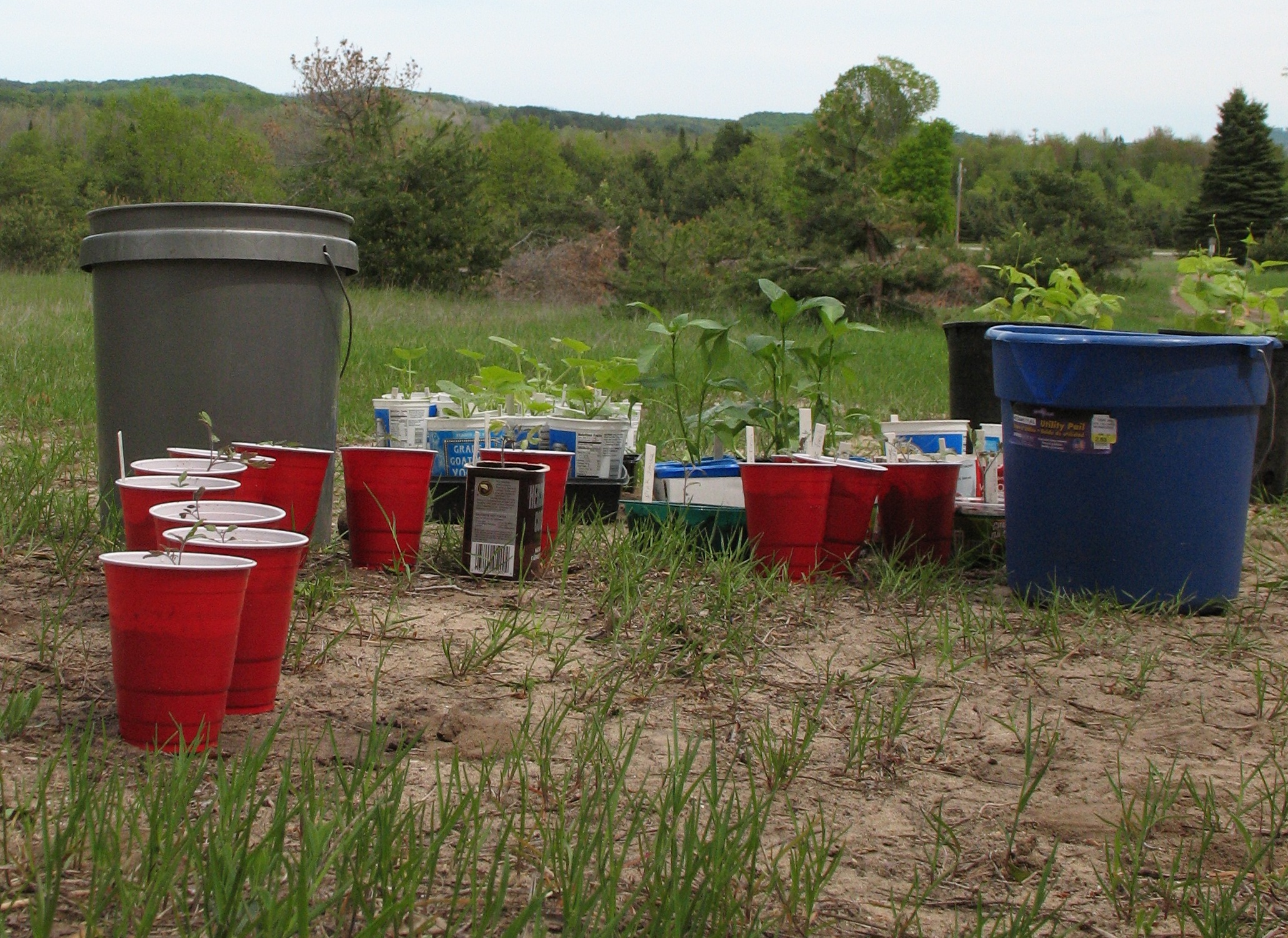
After exhausting all of our yogurt and salsa containers, each washed and punctured with drainage holes, I started scrounging through the recycling bin for additional pots. I scavenged some milk cartons, a cocoa tin, and the plastic trays in which my co-op sells mushrooms. Still, we were short. What was I going to do with all those tomato starts?

I ran out to our local hardware store. They understood. Though they didn’t have a solution. (Their vegetable starts are in the same frost-free-limbo.) We all thought that the cold weather was done. Optimists, I tell ya! They suggested a trip across the county to a nursery/hothouse operation. Alternatively, they shrugged, there’s always 18-ounce, plastic beer cups. Sigh.

I’m not a disposable-cup-kind-of-gal. But, in the quest for environmentally sound solutions, one must weigh the impact of the nearby expedient, versus the drive-around-the-whole-damn-county looking for appropriately sized pots solution. The local grocery had a small stack of beer cups for $3.19. So, I went for it.

The plants will not spend long in their beer cups. I’ll save them for plantings in the future (along with all the punctured yogurt and salsa containers.) Next week, I’m sure they’ll all be ready for the final jump into the garden. I’m watching the weather site like a hawk. Next year, I’m gearing up for floating row covers. It’s either that, or it’s back to the beer cups.

Good Fences Make…

A.V. Walters

electric-fence

It’s nearly time to put in the garden, and that means that we need to make fence decisions. Our biggest garden problem is deer. The deer are also a threat to the orchard saplings. We’ve combined the garden location with the orchard to consolidate fencing needs. We’ll also have the bees in the corner of the garden, which complicates things a bit. Locally there is a split on the type of fencing or garden protection needed from the deer. (Oh yeah, and from the bunnies, too.) No matter what you do, it’s expensive.

Some install tall traditional fencing—at least seven feet tall. Others go the electric route and install a multi-strand electric fence. One neighbor has completely foregone fencing. They protect their garden with a motion detector connected to a sprinkler system. We walk by regularly and we laugh when our meanderings, on the road, trigger the sprinkler response. Hey, I guess it works! (If not for the bees, I’d be tempted to go this route.)

The uber-tall solution looks fortress-like and it’s permanent. I’d like a little more flexibility to move the fence, in the future, when the garden expands.

So, I stepped into the vast world of electric fencing. Too many decisions! What’s the power source? Is it close enough to the house for AC power? (Not really, we’d have to underground several hundred feet of wiring for that.) That leaves us with the choice of solar, or DC. Solar sounds so….progressive and green. I was predisposed to that direction. Unfortunately, my research into reliability and power needs revealed that the system that would meet my needs (and have the warranty life I’d want) would be prohibitively expensive. That leaves us with 12 volt, DC batteries.

The pebble in the shoe of all these plans has been the bees. You see, bees attract bears. (The hives down the road were raided by a bear, last summer—it isn’t a hypothetical problem.) An electric fence system strong enough to get a bear’s attention has to be pretty beefy. Fence controllers are rated in several ways, by distance, by ‘joules’, and by the type of hazard (animal) contemplated. Though a “5 mile” fence would be fine for deer, to get the kick you need for bear, a 25 mile fence is needed (even though the fence dimensions themselves don’t change—it’s not the length of the fence that counts, it’s the total length of the wire strands you use.) A bear fence calls for a minimum of four strands. Some contend that seven is required. Not that appearance is the arbiter, but a seven-strand fence looks like a maximum security prison—minus the razor wire. (One beekeeper actually suggested a double fence—with a 30 inch no man’s land between them!) I think we’ll go with four strands. The fence must deliver a minimum of a one joule charge to dissuade a bear. That same power will make our fence pretty unfriendly to incidental human contact. It’s not a ‘leaning on the fence talking to neighbors’ kind of a fence. We worry about the cats.

All of this has been Greek to me. I’ve been researching the fencing on the internet. It’s quite an education. For every fencing option, there are at least three alternate opinions. Unfortunately, our tailored needs will make it near to impossible to pick anything up second-hand. I have about a week to make up my mind. By then, our seedlings will be busting out of their pots, begging for a permanent home in the garden. And right after that, about the first week in June, the bees will arrive. We’ll need to be ready by then.

New (to Us) Trailer

A.V. Walters

trailer

There are probably a hundred things that we could have done today—some maybe more important than what we actually tackled. But, there is a special lure to a new toy, though. You just gotta try it out.

We’ve had cut wood sitting in the forest for some weeks now. Not that it matters; the firewood could sit there until fall. The problem was that, though we’ve cut the trails, we did not have a trailer to haul the wood out. I’ve been perusing craigslist for weeks. Trailers are not cheap! Who knew?

It needed to be small, to handle our steep terrain and tight turns. It did not need to be road-worthy. By that I mean that we didn’t need lights or brakes. We will never use this trailer off the property. And, we’re not likely to gather firewood in the dark.

I mentioned sometime back that I’m a bit of a scrounge. Indeed, I may be the Queen of Scrounge. Finally, last week we found the perfect trailer. It’s really junky! For some reason, that makes me love it all the more. The old metal frame is rusty, but it’s sound. The wood is a mess, but that can be replaced. This is probably an old military trailer. I guess we’ll refurbish it—though I kind of like it just as it is. Rick is just as enthused, in a more subdued kind of way.

Today was our first free day where we didn’t have to be doing something else. Rick was itching to try out the trailer. So, we decided to bring in some of the cut wood. Our funny little trailer worked like a champ. We brought in five trailer loads (plus what we could fit in the tractor’s loader.) Naturally, it turned out to be the hottest day so far this year—well into the eighties. It’s not ideal weather for the heavy lifting in this task. Still, off we went. We’re as happy as clams, though a little tired.

Now that so much wood has been brought down to the home site, I guess we’ll have to split and stack it. There’s more up there, but we’ve run out of room at the splitting station. Everything in it’s time…and then, we can go play in the hills again.

Permaculture–

A.V. Walters

It’s clear that the neighbors all think I’ve lost it. Our immediate neighbors are retired organic farmers. When I said that the solution to poor soils in the orchard area was to amend the soil before planting, they just shook their heads. But, I meant it. It’s one of the cool things about having heavy equipment—you can do things that make sense, but normally wouldn’t be worth the effort.

When I said that we’d amend to a depth of 5 to 6 feet, I was exaggerating, but not by much. We dug out 4 to 5 feet. That’s the beauty of a backhoe. Still, it wasn’t easy. The digging goes well enough, but then you have to separate out the good topsoil, from the glacial sand below. Then you have to add in the compost—just a little over a cubic yard per hole—and mix it together with the good topsoil. You can’t just layer it, or you could get “perching,” where the compacted layers resist water flow. So the mixing and the filling of the holes has to be done by hand.

Even Rick thought I was nutty. He mentioned that it felt like he’d been conscripted into the army, and was sentenced to dig holes and fill them in again. That was what we were doing—though not quite as simple as that (and not punitive.)

If ever there was ever a good reason to go to great lengths, putting in trees would be it. It’s why they call it permaculture. They’re permanent. If you don’t take extra measures now—you won’t get the chance later. These trees deserve the best start they can get. If planted in well draining soil that’s also rich in organic material, these trees will be well ahead of the game. We live in an area that considers itself the “Cherry Capital.” All too often, though, the cherry farmers drop the whips (baby trees) into the sandy ground and then fertilize and spray them for the rest of their lives. It’s like being hooked up to an IV feeding tube! So much for conventional agriculture.

We won’t be doing that. You can grow healthy fruit without all the junk. It helps if you think ahead. This weekend was a backbreaking exercise in thinking ahead. Just as we were finishing up last evening, yet another neighbor walked over to query us on just what we were doing. I was hip-deep in the last hole. Granted, we didn’t actually plant yesterday. We were too tired. So, it really did look as though we were just digging holes and filling them. We were. In a funny way, we are burying treasure. She didn’t look convinced when I explained our system. When I told her that we’d water them with willow bark tea for good root development, her eyes widened.

This is a small town. I’m sure that within the week the whole town will know how crazy we are. Most folks just dig an 18 inch hole for a tree. That’s what the instructions say.  We’ll hear all about it when we go into the hardware store. That’s were you can catch all the good farm gossip.

Today the trees went in. We now have 4 cherry trees, 2 pear trees, and 3 apples. We still have one more orchard tree to plant this year, a plum. It hasn’t yet arrived, snug in its mail order carton. We’ll put in another four next year (they were out of stock this year!) and then the orchard is complete. All were selected for winter hardiness, disease resistance, flavor, type (cooking or eating), and timing. After all, you wouldn’t want them all ripe at once!

Between forest trees and orchard, in the past two weeks, we’ve planted 95 trees. It’s a relief to go back to building.

We can’t put in the garden for another ten days. When our frost-free date comes, we’re ready to plant our seedlings. If they think we’re crazy with the orchard, wait ‘til the neighbors see the buckets.

New Spring Traditions

A.V. Walters–

Today was the big Spring Sale at our local Conservation District. We went, list in hand, and were able to secure almost everything on the list, 75 trees. Today, and maybe tomorrow, too, we’ll be busy planting. The trees are bare-root. That means that they ship, dormant, and naked. The best thing one can do for them is to get them into the ground as soon as possible. (Well, at least as soon as practicable, since I think we’ll eat breakfast first.) It was a nippy 23 degrees last night, so we’ll let the sun warm things up a bit first.

Some of these trees will be planted back in the forest. Once in, they will be pretty much on their own. I don’t know how we could water them on any regular basis, without carrying water with us in jugs (which we’ll be doing today.) The forest needs some filling in, and diversity, so we’ll be planting oaks (red and white), hemlock (for the north facing slopes), butternut and shagbark hickory.

Out front, in the low areas, we have red osier dogwood and flowering dogwood. We’ll be putting in two windbreak hedges of hazelnuts—that alone takes up a full third of the trees to be planted. We picked trees that provide diversity, flowers for the bees, wildlife habitat and some with nuts, for us. Of course, it’ll be years before any of these bear; at this point they are really just short sticks. It’s like planting pear trees—which are notoriously slow to reach production. (They say you plant pears for your heirs.) Mostly we’re planting for the land. I’ll be curious to see how they do.

It’s just a few days late for Earth Day. We’re thinking that this can become an annual tradition.

At Odds, Comedic… Timing

A.V. Walters

Not so much compost, after all.

Not so much compost, after all.

I drove into town the other day and was amazed that, almost overnight, lawns have turned green. There are swollen buds and tiny baby leaves on the lilacs and flowering quince. The tips of the maples are giving it away, too. In early spring, before they actually leaf out, their buds have a rosy glow to them. Across the valley, the areas with maples are blushing. The cherry orchards are blushing, too. Not blooming, but with a sort of out-of-focus burgundy haze. So, the landscape says spring.

The weather report? That’s another thing, entirely. Day-time temps in the low forties, and snow! I kid you not. They’re calling for snow, up to 2 inches cumulatively, over the next two days. It won’t stick; the ground has already warmed up. The Road Commission has lifted the frost restrictions from secondary roads. But we’ve seen snowflakes this morning already. It makes us wonder if we have our timing right.

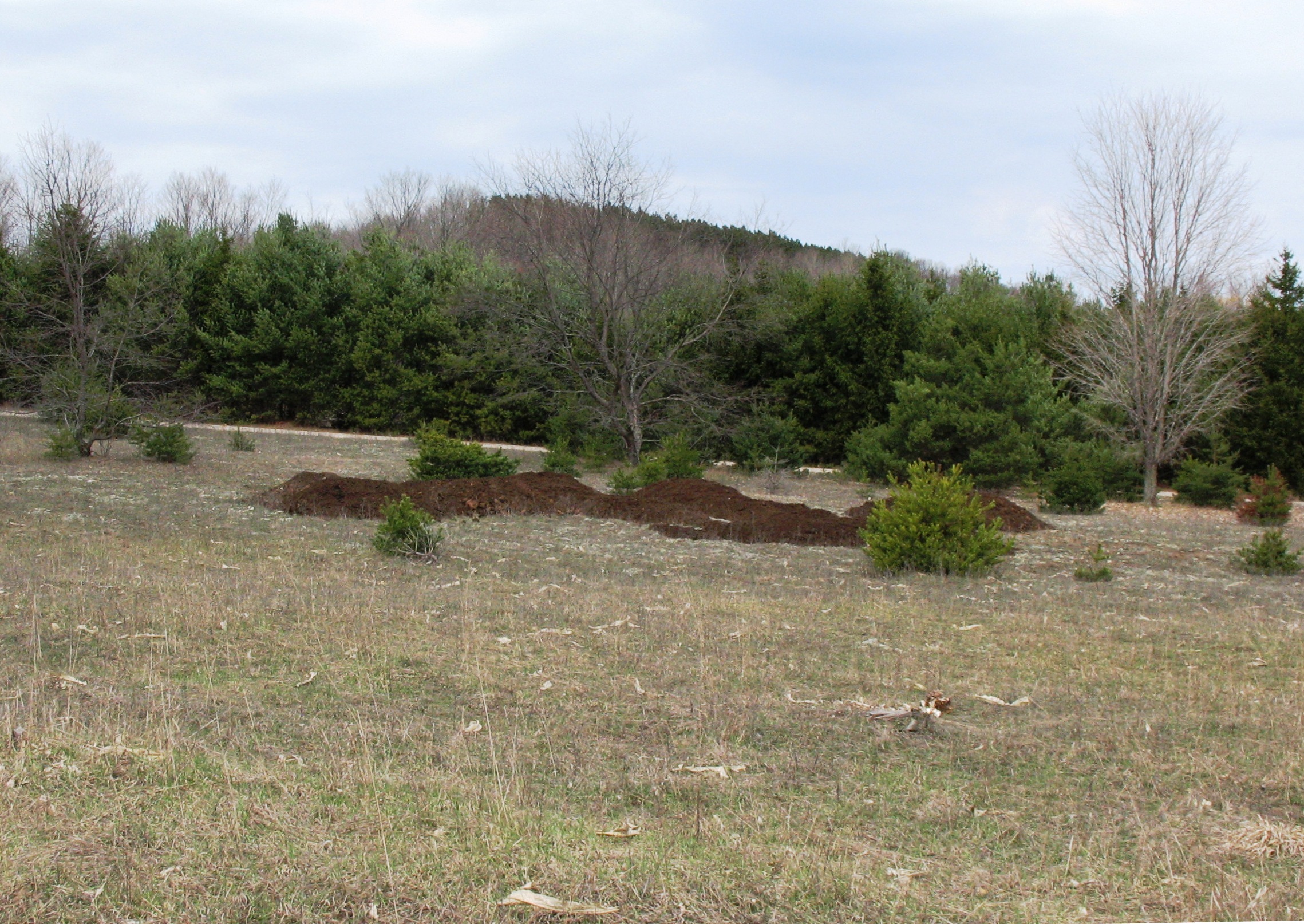
Last week we had 45 yards of compost delivered. It sounds like a lot, but it isn’t. It looks like we have a really bad case of gophers. We’ll be digging it in deep to prep for the orchard trees (which should arrive next week.) The rest will be for the garden. We are on the threshold of gardening, but for that snow thing.

Spindly

Spindly

But growing by the day.

But growing by the day.

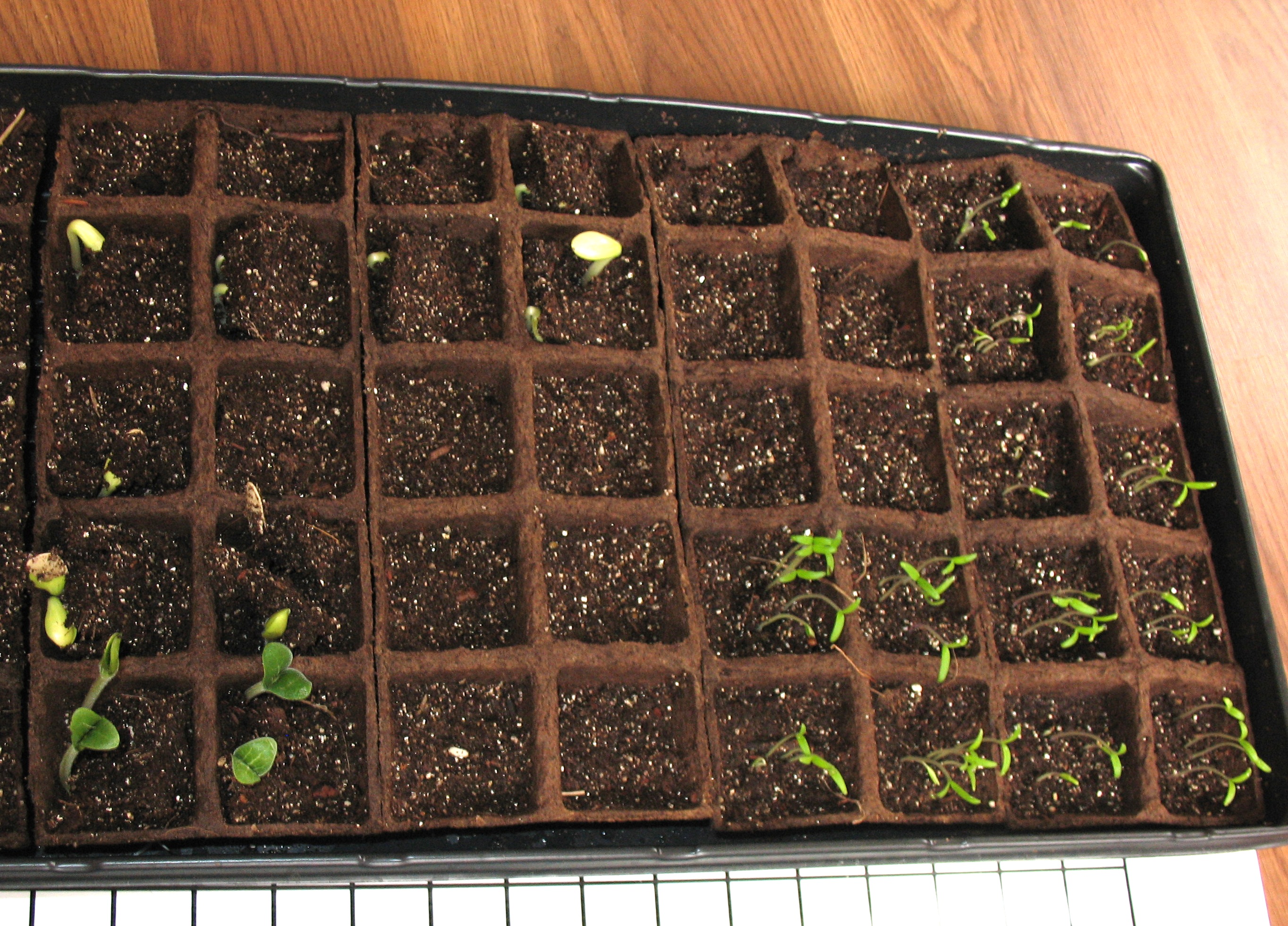
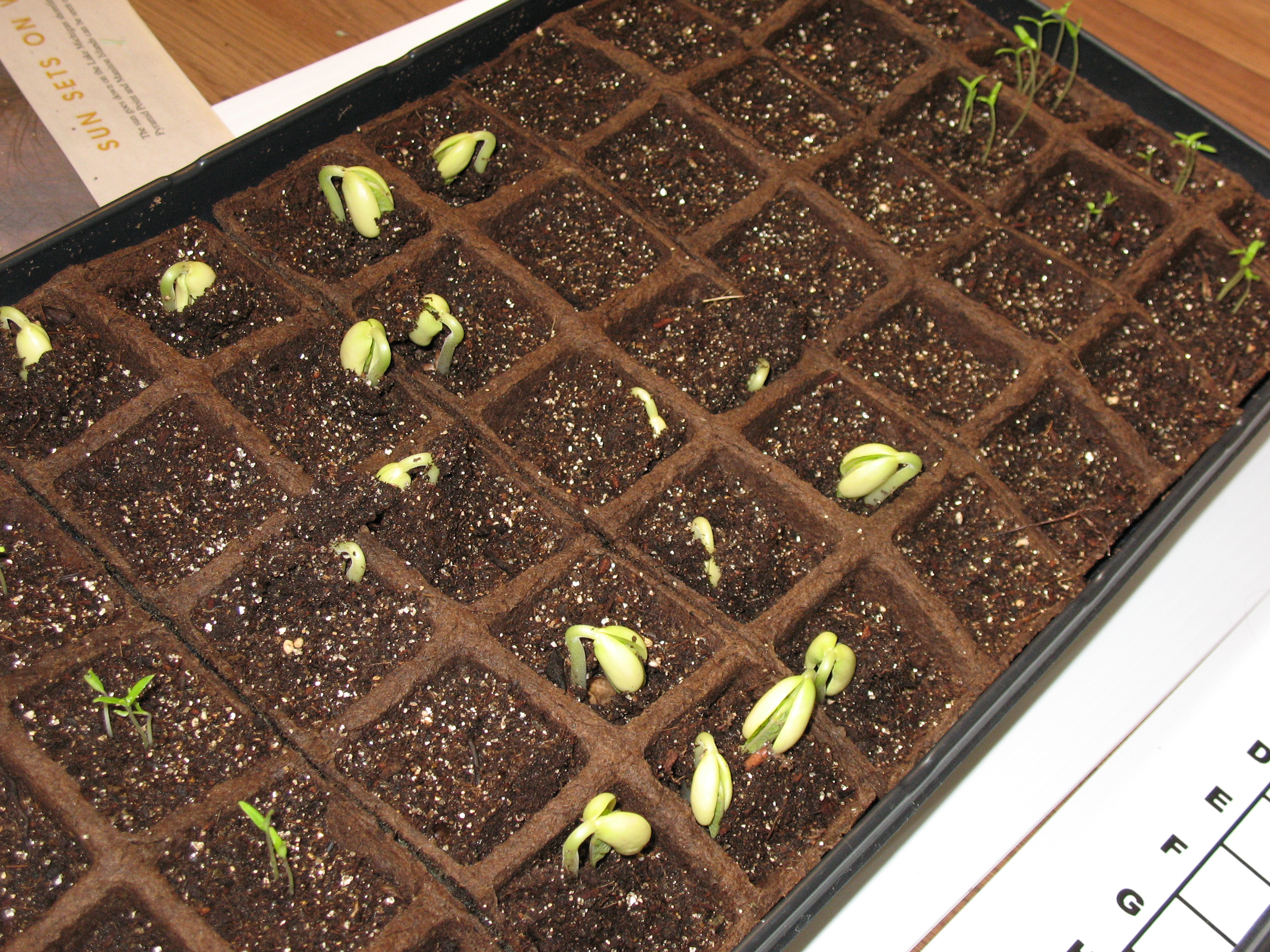
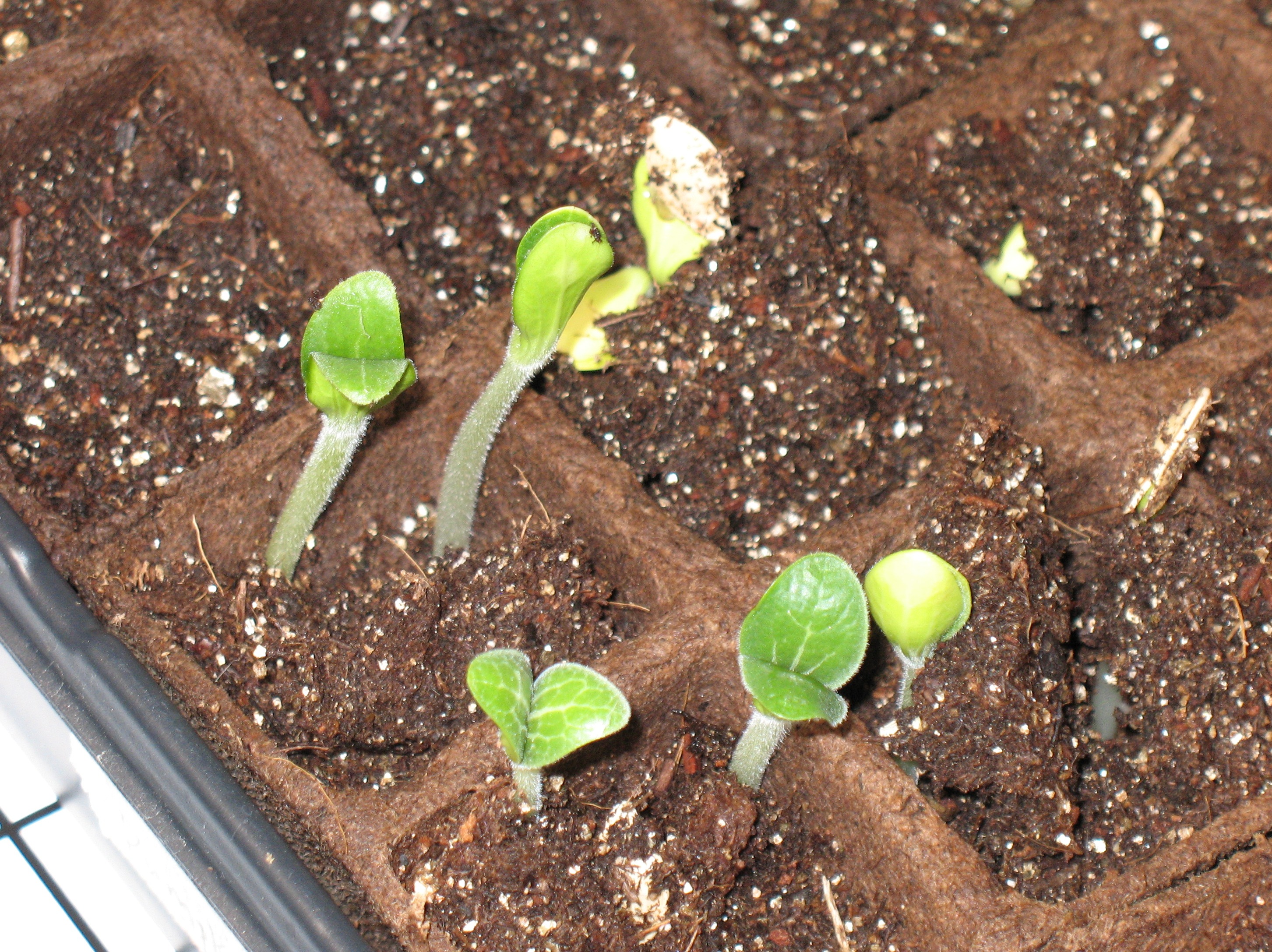
We’re still perched in a tiny apartment, across from our new digs. There are space and light issues here, mostly because we’re now sharing space with building materials and with hundreds of seedlings in peat pots. We used our seed favorites from Two Rock and have been pleased with a more than generous germination rate. (Oh, no! I’ll have to cull!) The only things that haven’t come poking up through the soil yet are the peppers (and, some questionable crook-neck squash seeds.) Peppers are notoriously picky about seedling temperatures–they like it warmer than we keep the house! I hope they’ll pop up soon. Everything else is up and growing. I certainly hope we didn’t start them too early. Like comedy, in gardening, timing is everything. Hopefully the joke’s not on us.

seedlings1

seedlings2

It’s snowing out there, right now. There’s a little anxiety, and a lot of hope, in the mix.

A Storm’s A-Brewin’

A.V. Walters

IMG_2113

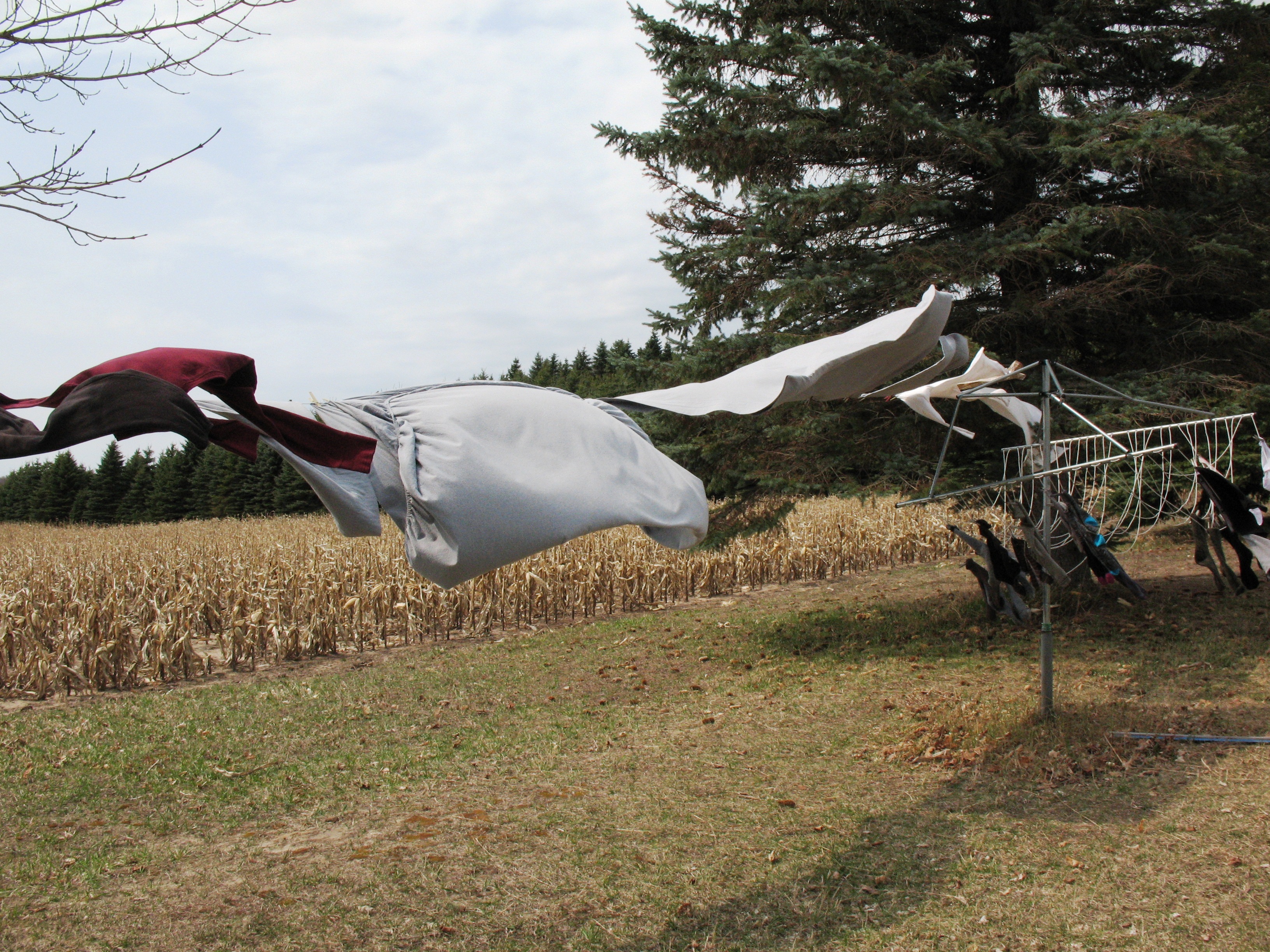
There’s a storm on its way, so I woke at first light, for chores. I wanted to wash and line-dry three loads before the rains came. I don’t think it’s going to be a problem. There’s a fierce wind—the one that will bring the storm, and the laundry is hanging horizontal. I don’t think they even make a clothes dryer that works as fast as this. A wind this strong actually shakes out the lint, and leaves even line-dried clothes as soft as a machine-tumbled load. As soon as my basket was empty, even while I was still wrestling to pin the last item, off it went, rolling in the wind. Last year’s standing corn plants, in the field next to our clothesline, make quite a racket, rustling in a wind like that.

There it goes in the wind!

There it goes in the wind!

I’m glad for the weather, though. A good wind can blow out the cobwebs, literally and figuratively. Admittedly, I’ve been in a funk. We’ve been hiking in the woods quite a bit of late, and doing some unexpected detective work. You see, we’ve been finding cut logs and stumps. Someone has been cutting wood on our property. This breaks all the rules.

In the world of making wood, there is no need to cut live trees for firewood. With weather and wind and blights, there’s always plenty of dead wood (or “deadfall”) to forage. Gathering deadfall cleans up the forest—and gives you a head start on seasoning the wood, for burning. Cutting live trees is reserved for timber cutting, either as a harvest, or to thin the forest. We did a “thinning” harvest 11 years ago. Now, with the emerald ash borer damage, we have no further need to thin the forest.

This property has been without stewards for a couple decades. Vacant land is often considered ‘fair game’ in rural areas—at least for gathering. Last Spring we politely disinvited some locals from morel mushroom hunting on our hills. There’s a longer story there, but basically, they were put out that we’d returned to the land—a gathering zone that they’d considered theirs, for decades. I do understand; I have my own secret berry patches in the woods where I grew up. I don’t own them, but I am proprietary about not revealing my sources. Had these ‘locals’ not been outright abusive in years past, I might have invited them to keep up their tradition.

Vacant land is also a source of deadfall gathering. I know that, in our absence, at least three neighbors had fuelled their winter heat from our slopes. It was fine. They kept trails clear and didn’t (for the most part) abuse the privilege. But, we’re here now. A few faces fell when, otherwise friendly neighbors, realized what our return meant. You see, they follow the code. One might gather from vacant land, but you don’t harvest from your neighbor’s land. Even without fences, there are boundaries.

We’d been finding cut logs for several weeks. They were pretty consistent, six to eight feet long, saw cut, top and bottom, five to six inches in diameter. An easy size to carry, and one that can be burned later, needing only to be cut to stove size, but not split. They littered our walking paths. In total, I’ve tallied (and collected) well over thirty such logs. And I’m sure I’ll find more. It seems that ‘they’ cut each year, and then the following year, when hunting season came, they’d collect the seasoned logs for burning. This annoys me, no end. We assume that these logs were left by the same “locals,” who were collecting the mushrooms last spring. They used to own the parcel behind us and had a deer-camp cabin there. It seems likely that they used our firewood to heat the cabin in deer season. As they’ve since sold the property, we figured that the wood-cutting would end, too. There’s no sense in being angry at a theft that’s past, and incomplete at that.

Lest you think that I’m just a wood miser, I’m angry mostly because of the way that this was done. With a forest rife with available deadfall, these jokers saw fit to cut living, young trees—for their convenience. Whether they wanted them for firewood, or for posts, doesn’t matter. And, they’ve cut slow growing hardwoods—maples and eastern hophornbeam. The hophornbeam is a tall, elegant tree of the understory of the forest. They have thin, shaggy-barked trunks; a hophornbeam’s trunk is rarely thicker than 9 inches. They like the shade of north-facing slopes. The thieves are stealing wood and damaging the forest. It’s like killing a generation of children. How can that gap be filled? Rick and I are already buying and planting trees from the Conservation District—an effort to fill in and diversify the forest following the Ash Borers’ losses. We expect to plant 50 to 80 trees per year and that’s just the beginning. There are right ways and wrong ways to manage a woodlot. What they have done is wrong in so many ways… in every way.

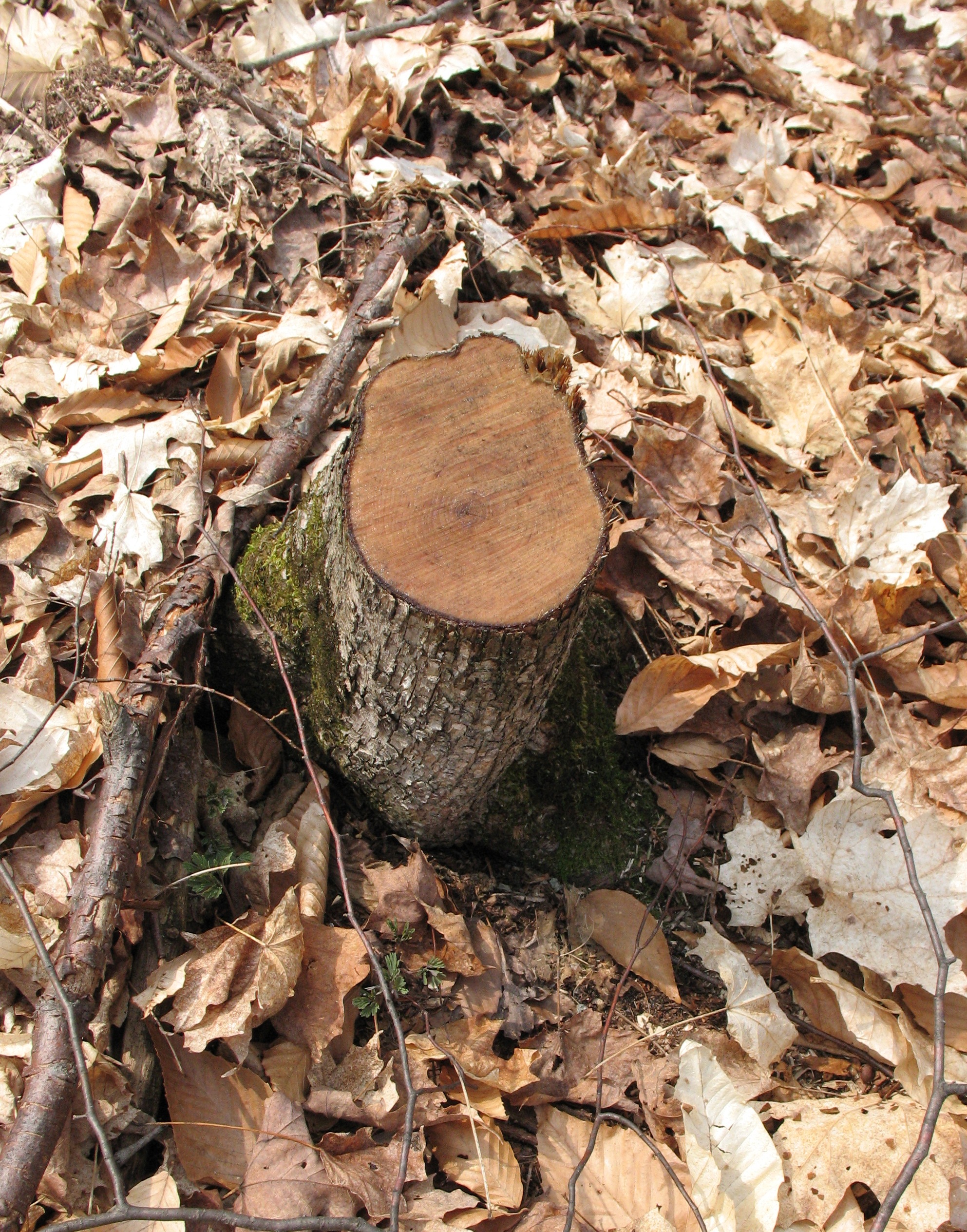
A weeping stump.

A weeping stump.

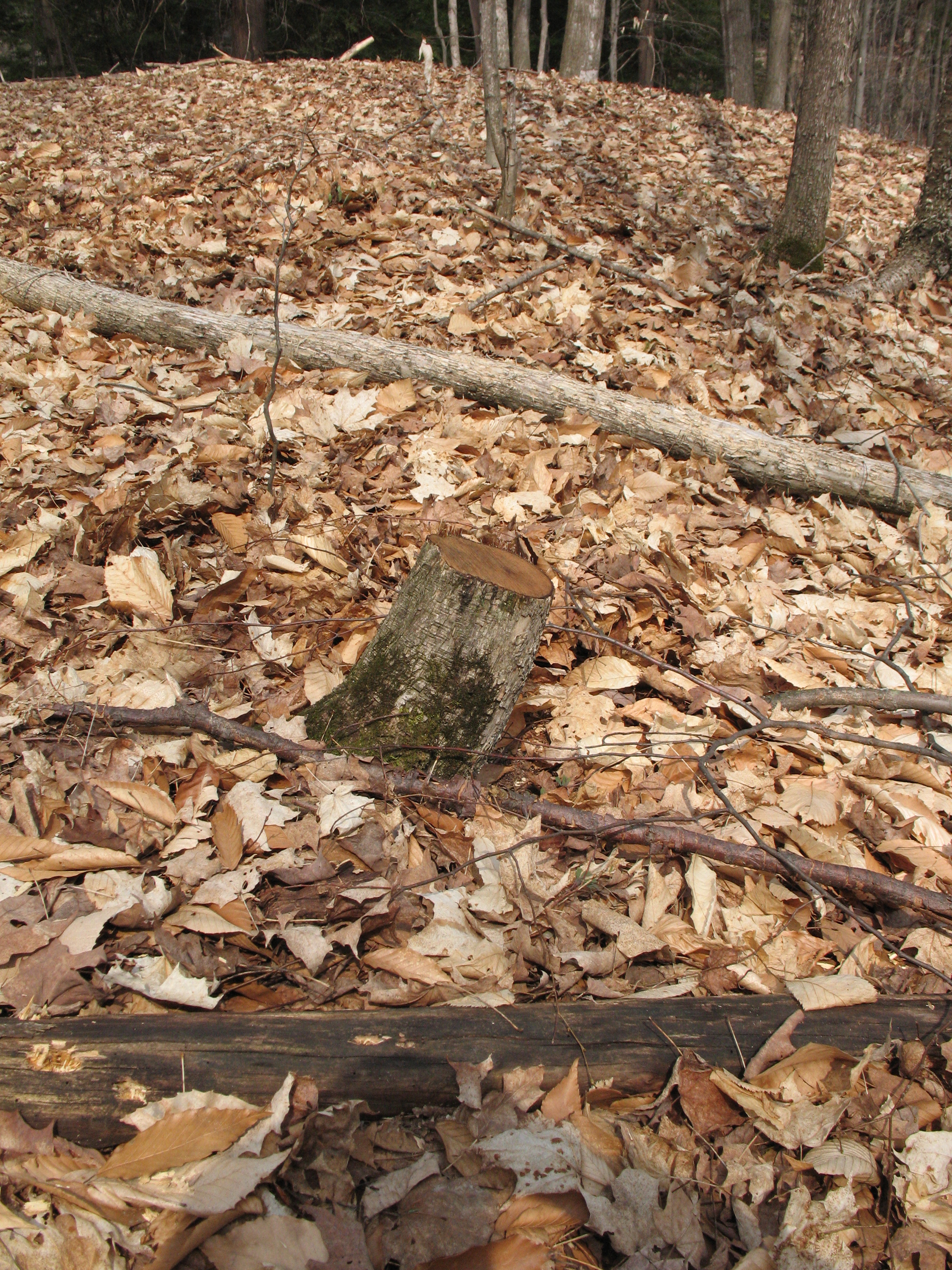
Yesterday we were out for a walk and I saw yet another stump. This one was weeping, literally. It means that it’s a recent cut. We dug about in the leaf litter, and, sure enough, found fresh chips and sawdust. The tree was cut last fall, we guess—just before the leaves fell. Now, with the spring sap running, the tree’s roots are trying to feed the treetop that has been taken. So, our problem is ongoing. I am sick about it. It was an eastern hophornbeam (also known as ironwood because it’s so hard.) They are very slow growing—they don’t even flower or make seeds for the first twenty-five years. Though I’m happy to harvest their deadfall, (because they’ll burn all night) I would never cut a living hophornbeam.

And right next to it, a deadfall tree of the exact same type.

And right next to it, a deadfall tree of the exact same type.

Rick and I don’t know what to do. We don’t want to post “No Trespassing” signs on the property. We have a number of neighbors who hike, snowshoe and ski its trails. We have no issue with respectful use. We like sharing its beauty. But, if I catch someone in the act of cutting, I will see to it that they are fully prosecuted. Michigan is a logging state, and they take timber theft seriously. When I say this, Rick raises his brow at me, wondering at my vehemence. We both hope that this is not one of our neighbors, but the chances are high that it is.

This evening, we’re waiting for the storm. It may clear my head. The whole week is expected to be unsettled—cool weather with the possibility of snow. Right now, the only rustlin’ I want to hear about, is the wind in the trees.

Ibuprofen Monday

A.V. Walters

Spring Peeking Through

Spring Peeking Through

It was a glorious weekend. Temperatures in the 60s and sunshine! Almost all of the snow is gone—except in a few spots in the shade (north facing slopes) or where Rick piled it with the blower during the winter.

There are a thousand things we should be doing. But the ground is not yet thawed, and … well, we rationalized why the highest and best use of our time would be to open up the trails to the “back forty.” The property has a slightly graded panhandle (for road access) and then a chunk of steep hills and valleys leading to an upper meadow. On foot, it’s a heavy breathing hike. Until now, we’ve only been able to access it with a vehicle by going on an old logging road through the neighbors’ back yard. The neighbors have been good about it, but not enthusiastic. So, really it was about getting access and keeping good neighborly relations. It had nothing to do with the outrageous weather.

We need the access because back there is where we harvest the deadfall for our firewood heating supply. The hills are heavily forested and, especially with the Emerald Ash Borer losses, they are littered with standing and dropped dead trees.

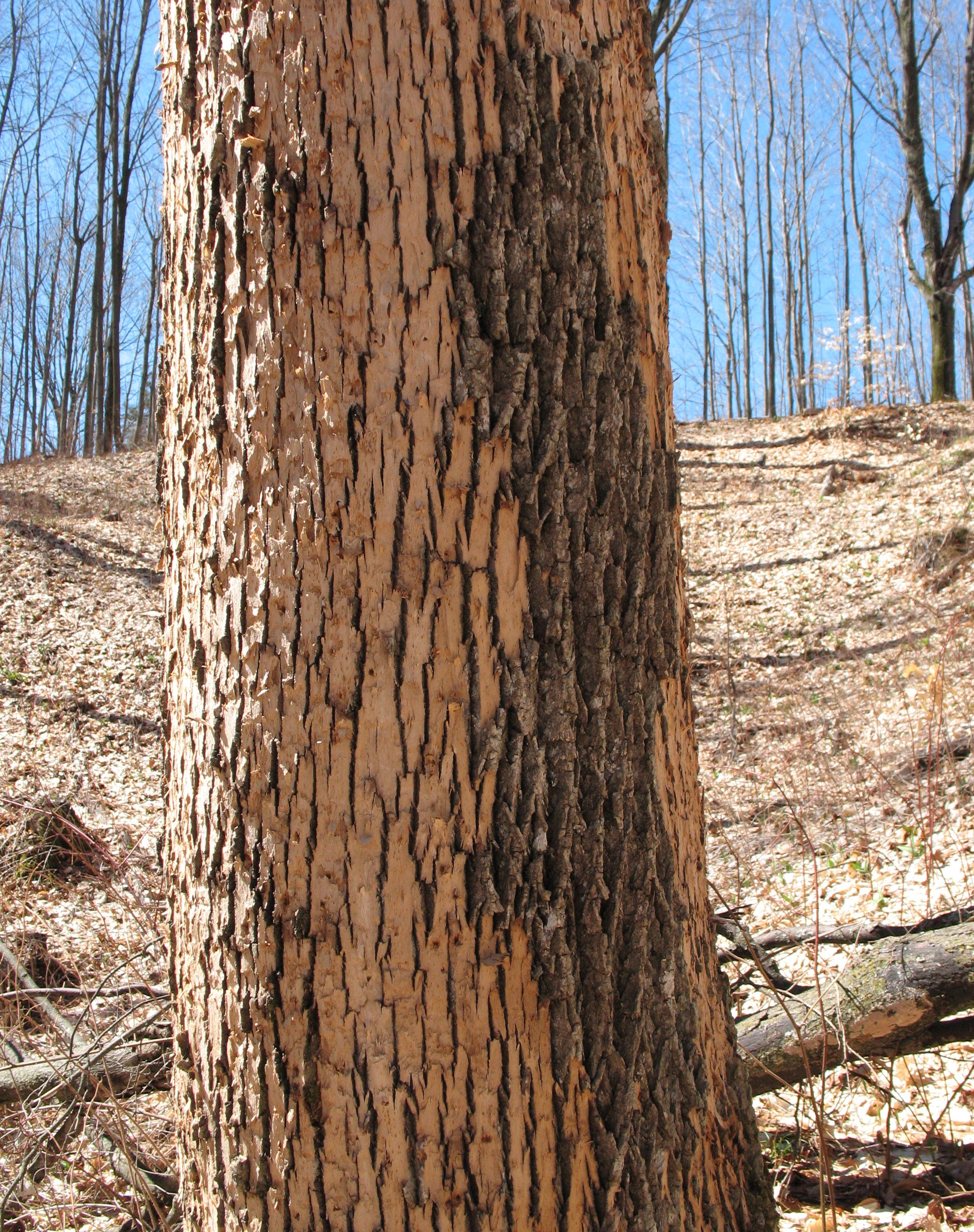
This ash is doomed. Pileated woodpeckers have  chipped off the bark surface to get at the borers, below.

This ash is doomed. Pileated woodpeckers have chipped off the bark surface to get at the borers, below.

It breaks our hearts, to see these dead any dying trees but we’d be fools to let the wood go to waste. The property is criss-crossed with old (and pretty steep) logging roads, many of them blocked with fallen trees. The weekend would be a trail clearing exercise. It was not to be a harvesting foray.

It started like this, just to clear the trail:

IMG_2101

But one thing led to another…and there was this:

IMG_2106

And then, when we made it over the ridge and down the trail on the Kubota, we could hardly contain ourselves. So there was this:

IMG_2103

IMG_2105

And then, a couple of stragglers on the way home yielded this:

IMG_2102

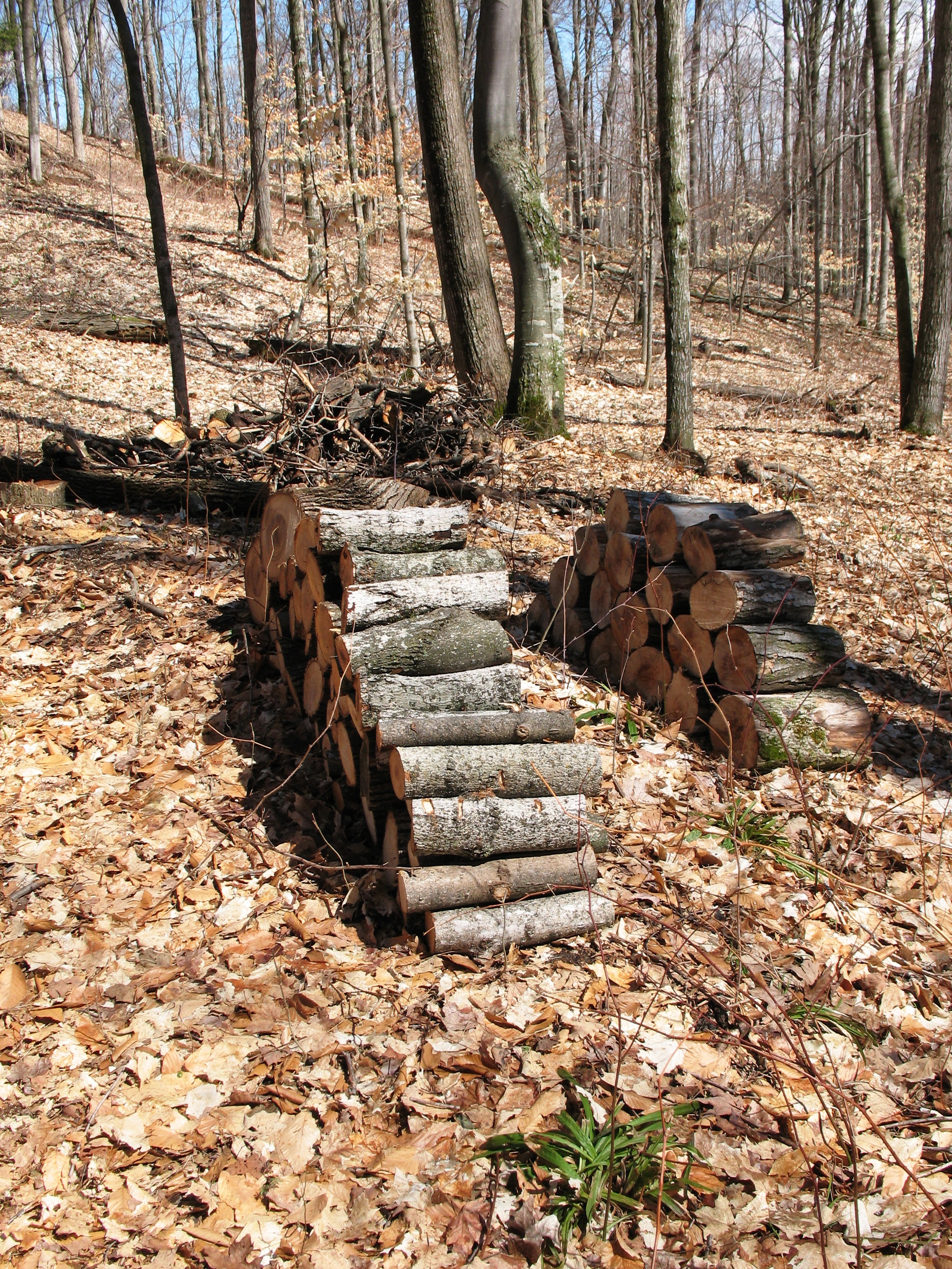
We are agog over how much safer and easier the firewood harvest can be with Kubota assist. You can chain lift logs for safer sawing access, or just drag them down the slopes to cut where there’s no danger of rolling. Even with that, it’s heavy work. We came home each night achy and sweaty, but elated. We’re naming the “new roads” as we open them up.

Believe it or not, that's the "road."

Believe it or not, that’s the “road.”

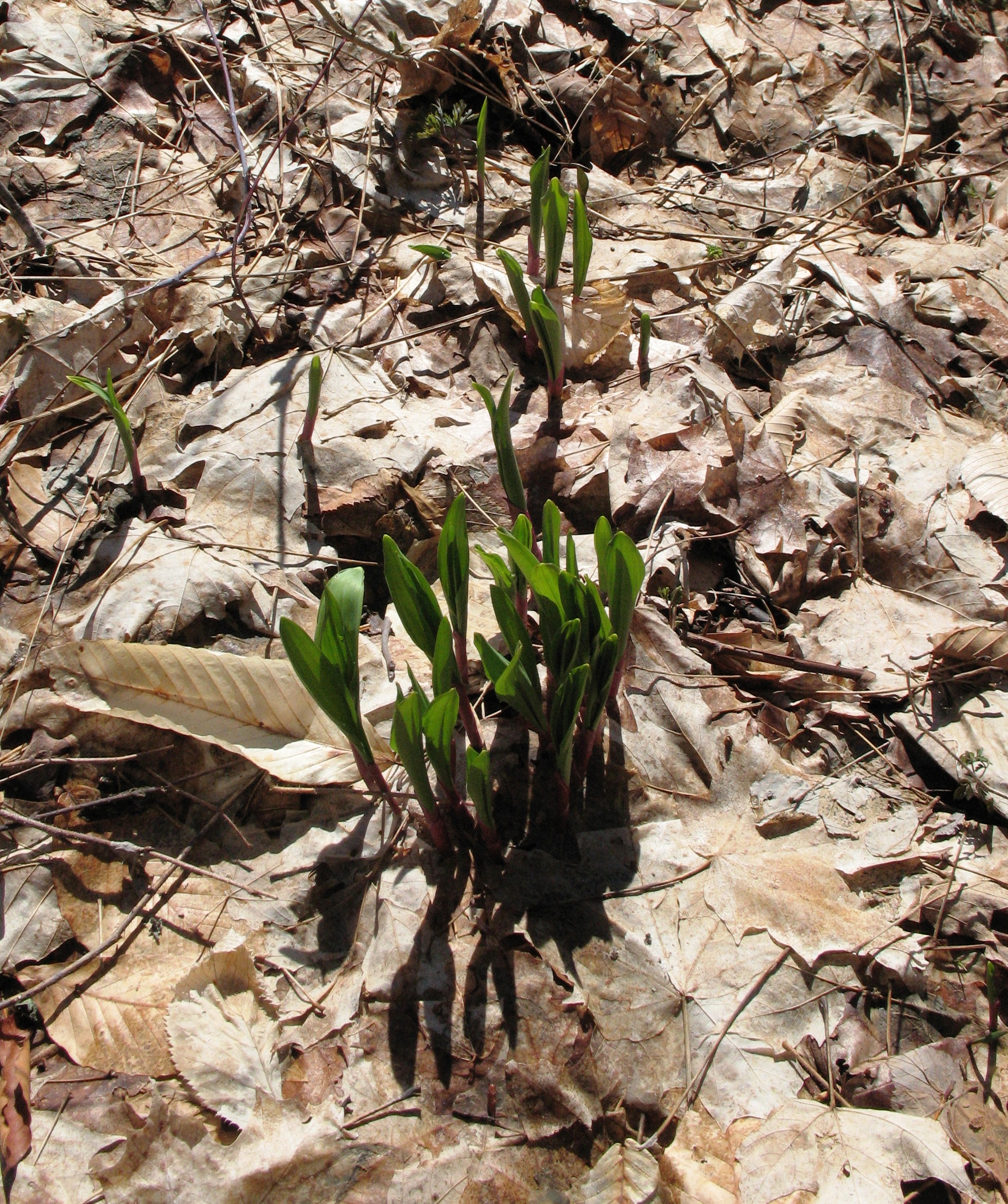
The woods are lovely this early in the year. There’s the carpet of leaves, and just the tips of the wild leeks and Dutchman’s Breeches peeking through.

There’s only one hitch. Now there’s no doubt that we need a little trailer. Our lovely circuitous trails can get us in to make wood—but that’s where the wood will stay until we can wrangle a trailer in. It’s too much wood to try to remove with just the loader.

IMG_2107

And like many in the Midwest, after the first incredible weekend of spring, we’re stiff and sore.

Start Here

A.V. Walters

Orchard Dreams

Orchard Dreams

Though the ground is still frozen, we’re planning our “dooryard” orchard. It’s not a big orchard—enough mostly for our own eating and canning use. Fruit trees require some work and planning—and are often done wrong. Most nurseries have the same one-size-fits-all approach as big-box stores. They sell the fruit tree that’s “in” this year. To do it right, first you have to do your homework. Keep in mind that planting a fruit tree is a long-term investment—it will be three years before you see a serious harvest, and a fruit tree can live twenty-five to even hundreds of years

What kind of fruit do you want, and why do you want it? It’s probably not good to save this decision for the time when, cart full of other stuff, you’re standing in the gardening department at the big-box store, squinting at the little, fruit description labels tethered to spindly saplings in tubs. What kind of fruit do you like? What do you eat now? Don’t fixate (yet) on any specific cultivar (tree variety.) Just figure generally what you’d like. Then you can work on specifics and, more importantly, the realities. If you don’t eat fruit now, what makes you think that, three years from now, if this poor tree survives, you’ll want to eat its fruit then?

Let’s throw some other factors into the mix. How much land do you have for fruit trees? (As a general rule-of-thumb, you’ll need to have an area around each tree that is as big as the tree will be tall. And no, you cannot overlap the root space for trees.) Do you have good light? What kind of soil do you have? Are you on a slope—and if so, top or bottom of the slope? (For air movement.) Are you planting in a space where you can water (or are you depending on rain?) Can the tree survive in this area?

This is the big one. Where do you live? Start here.

http://planthardiness.ars.usda.gov/PHZMWeb/#

Find your state and click on it. (My deepest apologies to my non-American readers, but your location will have similar information available.) Yes, the garden department at the big-box store will sell you a banana tree, but should you buy one? Figure out what climate zone you’re in and start from there. (Californians may prefer to use the more detailed microclimate Sunset Magazine zones.) Your temperature range is the single biggest factor in tree choice success. Armed with that, you could go online to find a fruit cultivar that will live in your location.

But wait, there’s more. Go online, armed with your zone and your fruit type, and you’ll find dozens of candidates. Maybe you want an apple that was your favorite as a kid? Maybe an all-around workhorse apple? How will you be using it? There are fruit that are bred for “eating” or market purposes, there are baking and culinary fruit and there are canning fruit. You might be considering drying it. Well, the same apple you use for lunches might not be the one for pie, and not the one for sauce. Especially, if you’re dealing with limited space, you’ll need to make some compromises and choices.

Now that you have a specific fruit type selected (say eating and baking apple,) look at your options and select for size, soil suitability (light or heavy, well draining or clay—though you can amend the soil some at the outset) pH, and disease resistance. Many of the newer hybrids are bred specifically for hardiness and that’s not a bad choice for a beginning gardener. Heirloom varieties are wonderful (and often “open pollinated,” but we’ll get to that) but if grandma’s Spartan is blight susceptible, you’re taking on a long-term project to grow it. I don’t advise against such a selection, only that you do so with your eyes open. Otherwise, several years down the road, you may find yourself opting to remove the tree you chose—losing money and time, in the process. Pick the tree for your conditions. (Note to my sister: If you’re a gypsy, don’t bother planting fruit trees. By the time they’re ready to bear, you’ll be long gone.)

In your selection, make sure you check whether your choice is self-pollinating, or whether you’ll require a companion variety in order to get fruit. Nurseries aren’t very good about warning you about this. (Even my own Mum planted a lovely, exotic French Gage plum, which has never given fruit because it’s not self-fertile and it doesn’t have a compatible pollinating partner.) The catalogs and online listings all look so lush and delicious—who’d think there are so many things to decide? When in doubt, Google your variety, with the words “pollinating partner.” Another fun feature, in today’s nurseries, is that they sell grafted dwarf varieties that solve the pollination issue for you. I used to think this was a gimmick—but it works well for the backyard gardener, and it has the added novelty of producing multiple types of fruit on a single tree.

Taking the time to pick the right tree(s) is more than half the battle, in growing happy fruit. We have a lot of space, and we’ve decided to grow four kinds of fruit trees: apples, pears, cherries and plums (and, probably a hazelnut hedge/windbreak, down the road.) We want them for eating, baking, canning and dehydrating, which we’ve taken into consideration in the types selected. Although there are some heirlooms in our picks, we also have some new, more disease-resistant cultivars in the mix, and we have researched the compatibility of our choices for their pollination partners. We’ve picked a total of fifteen trees—which is a lot for most, but we’ll have local, market outlets for any excess. We’ve even chosen varieties that spread our anticipated harvests throughout the season, so we aren’t overwhelmed at any given time with too much fruit. Now, we just have to wait for them to arrive (after all, the ground is still frozen solid.) Then there’s planting, watering, pruning and worrying, and then waiting again—several years—until we have fruit.

Of course, there’s the easy way. Just go to the farmer’s market (if you’re lucky enough to have one) for fresh and delicious fare, from your area.

March of the In-Betweens

A.V. Walters

Critter calling cards on our stoop.

Critter calling cards on our stoop.

T.S. Eliot was dead wrong. April is not the cruelest month. March is. One day it’s warm and lovely, the next, snow is falling and the ground is white, again. For those of us waiting to build, to plant, to get a jump on the season… it’s agony. Those nice days—just teasers—don’t let them fool you into starting your seeds early. It’s March, the season of the lions and the lambs.

My years in Northern California, where daffodils come up in February and (if you’re lucky) March will deliver a seasonal, finale rainstorm, have confused me as to the truly transitional nature of March. March, in Northern Michigan, is here to teach patience.

I’m trying to find transitional, spring-readiness things to do. I’ve hung my laundry on the line in the snow. (Yes, it works.) We’ve assembled, primed and painted the bee boxes. I’m pulling nails out of some recycled flooring we bought on craigslist. It’s a time of enforced waiting. Today we’ve seen light snow and temperatures in the teens, again. By midday, we may see twenties—what’s spring-like about that? Those stellar 40s and 50s of several weeks back, spoiled us. Now, temperatures in the 20s and 30s feel cold. We’d spent February hiking in single digits and teens, without complaint but now, we turn up our collars on much nicer days.

We’ve been tempted to take the snow-blower off of the Kubota (and maybe replace it with the backhoe, for building) but for the fear that we’d trigger one of those late-March snowstorms. Maybe that’s the origin of the term ‘March Madness.’ (Basketball may have nothing to do with it.)

There are things that need this on-again-off-again season. Warm days and cold nights wake up the trees. Sap begins to run. March is the sugaring season. Without the stuttering warm-cold cycles, the sap production would go straight to manufacturing leaves—and we’d have no maple syrup. I’m a little in awe of the sugaring process. Who thought that up, all those eons ago? The whole thing is an exercise in patience; collecting the sap, literally, drop by drop; boiling it down, for syrup it takes forty gallons of sap to get one gallon of syrup; and bottling it up. Sugar-maple candy boils down even further, and then gets instantly crystalized, ladled into the snow. Around here, it’s mostly the old timers who still tap the trees. Our neighbors do, using new-fangled drip collection bags, (if you’re patient, you can watch the steady dripping that turns the season.) We’ve talked about it; we certainly have the maples. It goes into our ‘maybe someday’ list.

maple

The critters are out. We’re in a walk-out, basement apartment, so we see them almost eye-to-eye as they wander about, unfettered by deep snow. There’s a herd of deer who happen by everyday at dusk. Just before the deer show up, there’s a small parade of turkeys. The bunnies come out just as the last light fades. If we miss them, we can take attendance by the tracks left in the thin spring snow. Two days ago, the robins arrived. I was sitting by the window and suddenly the yard was full of them. To the impatient among us, they are a sure sign of Spring.

Timing the Jump.

Timing the Jump–

A.V. Walters

great lakes

When I was little, there was no better escapade than when my brother would deign to include me on one of his adventures. Not that I was dull, but usually his idea of fun included trouble, maybe even… danger. The only time I was ever picked up by the cops, was with him. Not that he was a bad kid, he just had the ability to put normal, kid adventures together with opportunity, in his own unique way. He was the one who taught me how to “safely” jump off the roof—to scare my mother. She’d be parked on the couch, or doing dishes, and we’d launch off the roof from just above where she was—with a blood-curdling scream. It usually had the desired affect.

One winter, Lake St. Clair froze over smooth. That is, the chill that froze its surface came when there was no wind, and it looked as though the whole lake was one big skating rink. My brother and I went out skating time after time, even on bitter cold days, to take advantage of that open, clear span of ice. On windy days, we’d sneak out towels, or even bed sheets, and skate like demons, upwind. We’d turn around, after what seemed like miles from our start, just before Pike Creek dumped into the lake and the ice thinned out. Then, we’d unfurl our makeshift sails, gripping tight to the corners, and ride the wind at breakneck speeds on skinny blades and wobbly ankles, all the way back to the public beach where we’d left our boots. Exhilarated, we’d roll up the sheets, tuck them under our coats and do it all again.

After the second run, we noted a small crack in the ice. You couldn’t miss it, though it wasn’t big—only an inch or so wide. From time to time it spurted water as the lake’s smooth cover heaved in the wind. We got down on our knees to explore it, measuring the ice depth with our fingers; it was easily five or six inches thick. More than safe for skaters. But, each time we returned to that spot, we saw the crack had gotten wider. Our skating rink had become a huge slab of lake ice pushed by the increasing winds. My brother shrugged, seeing no need for this to get in the way of our fun.

And fun it was, we skated till our toes were frozen and our cheeks were wind-burned and ruddy. On the returns, our wind filled sheets carried us, flying, bobble-kneed over the ice, as fast as ice-boats, or so my brother claimed. Our eyes streamed from the speed of it, a pace we’d never experienced under our own power. Our fingers would go numb, wrapped tightly around the corners of the sheets. Only the low slanting light of the short winter day convinced us it was time to wrap it up. But when we reached the crack, it wasn’t little anymore. It was now a yawning three-and-a-half-foot gap, with the frigid dark waters of Lake St. Clair lapping up over its edges. My jaw dropped as I turned and realized that our side of the ice was headed out, across the lake.

“What do we do now?” I asked. After all, he was older; he would know. Though the ice was thick and solid enough, we both knew there’d be hell to pay if we had to be rescued from our floating island by the Coast Guard.

My brother didn’t hesitate for a minute. “We jump.” I stared at the gap. It was nearly as wide as I was tall. “Really, it’s not so bad, we’ll make a run at it, at high speed. We’ll have the wind at our backs.”

I wasn’t so convinced. He unwrapped his scarf from around his neck and wrapped it around his hand, “I’ll go first. You watch me. If I fall in, you pull me up with your scarf. If you fall in, I’ll pull you out with my scarf. Watch me.”

I nodded… without conviction.

He skated back some forty or fifty feet and, curled like a speed-skater, let fly. When he reached the edge he launched himself, horizontal, like a swimmer’s dive, landing on his belly, skidding and sliding on the safe side of the gap.

He rolled over smiling, triumphant. “Piece of cake. Come on, it’s easy.”

I wasn’t so sure. I took several practice runs. I tried some small, test jumps. All the while, the gap was steadily growing.

“Hurry up, it’s getting bigger!” He was standing safely on his side. And, he was right—every minute I waited, the jump would only get harder. I wanted to cry. I skated back to get a good run up to it and skated my fastest, pumping my legs nearly to the very edge before I finally jumped.

But, I wasn’t horizontal enough. I was afraid to dive head first, so I flailed, legs peddling through the air. After what felt like forever, I hit the opposite edge, a little short. Landing on my knees, my lower legs slapped into the water, while the top of me hit the wet ice with a thump. True to his word, he grabbed me and dragged me away from the dark abyss. Without another word we hustled to the beach to change out of our skates and into boots for the walk home. Tying the last of his laces, he looked over, “We probably shouldn’t mention this when we get home.” Right, like he needed to say it.

Rick and I moved to Michigan about eighteen months ago. It was a big jump, fueled by a number of issues. For a start, I already had property here and, I’m originally from here. We’d tried several times to buy in Sonoma, but our offers seemed to always be just behind the curve of the real estate recovery. Some properties we rejected because of water issues. The wells were either marginal, or contaminated. Mostly, though, we left California, because my mother was here. We pulled up stakes with a sigh of relief and we’ve continued on that momentum. My mum is thrilled.

Back in California, there’s news that the state is on its last legs in water supply. A year’s worth left in the reservoirs they say, and the annual snow-pack needed to replenish them, at only 15% of normal. And still, they have yet to enact any serious or mandatory conservation measures. It’s as though Californians still expect the next miraculous rainfall to save them. There have always been droughts in California; they’ve always pulled through before, somehow.

When we first arrived and people would ask why, I’d jokingly say, “Michigan has water.” Some of our friends think we left only for that reason—as though in the months and years before we actually did it, we had some secret knowledge about the worsening drought. Believe me, I’m no oracle. (Though, I didn’t need to be one to see that coming.) But I’m glad to be here. I grew up with Great Lakes and seasons, and it’s good to be home. I’m happy to have found a sense of place that fits me. Easy for me to say, but Rick seems to have settled in nicely, too.

It’s what I wish for everyone—that they find that sense of place and comfort. I worry that, if nothing is done about our climate upheavals, many will be uprooted from the kind of comfort that knowing one’s way in geography brings. Maybe we’ll all suffer, when the place we know changes around us, bringing new challenges. What will Californians do, without water? What will become of the Sonoma county farms and vineyards? California, the state that fed the world–what will come of its desert agriculture? And, what about the emus we left behind?

In my heart, I hope that everyone who loves where they are will stay right where they are. Stay and fight. We need enough of a commitment to place to make people adjust their ways to save it, and hopefully, in the process, save the planet. Some friends have asked me if I think things are really that bad. I’m afraid that the science says yes, and our species refuses to accept that answer. They’ve asked me to tell them when to bail; when to max-out on their California real estate and escape with top dollar in their pockets. As if I knew. And, as if that very attitude isn’t what dooms us to start with—the concept of disposable landscapes. Stay. Fight. Change. Make it better.

This situation isn’t like my brother, leaning over to help me with my frozen laces, and grinning, “See, it’s okay. It’s all about timing the jump.”

Character and Compromise

A.V. Walters–

IMG_2086

I’ve been sanding, again. Sanding seems to be a big part of my contribution to this project. And, there’s plenty more of it in my future. This time, I’ve just completed sanding the interior of the log walls. The cedar logs come rough-milled. Maybe it’s me, but rough-milled doesn’t meet my needs when it comes to interior walls. Rustic shouldn’t mean slivers. And, I’ll have to keep this place clean in the future and rough milled sounds to me like a haven for dirt and dust. So I donned my sanding uniform—mask, ear-protection and grubby clothes, and set to it.

In no time, Rick and I were headed for trouble. “Whoa there! Don’t sand so much. It’s a log cabin. We want to keep the character of the logs.” I stepped down from the ladder. “Not if ‘character’ means slivers, we don’t.” “Well, we don’t want them with a completely smooth finish, they’ll look faux.” That’s a man that knows my weak spots. Really I don’t want them to look faux-finished. I don’t like anything faux. I went into my spiel, you know, slivers, cleaning, all of my justifications for over-sanding.

He pointed to a lovely spot on a log that revealed its craggy whorls and texture, “We don’t want to lose that.”

I winced. “Maybe, just a little… to take off the sharp edges.”

Usually, Rick and I are very much of one mind aesthetically. We’re also both very practical and rational—common sense sort of folk. We negotiated a truce. The top sides of logs (where dust will accumulate) could take more sanding, as can areas where hands will contact the wall (like on the wall up the stairs.) The general objective is to keep things as natural as possible (without being sharp or slivery!) I had to relax my normal super-smooth sanding standards. He had to let go of the complete au naturel look.

From time to time, he’d look up from his work (installing windows)—to keep tabs on my progress. He said little. I know that I probably sanded a little more than he’d like. It seems fair, since I sanded less than I’d like. Maybe, seeing my needs, he compromised more than I did. Not too much, I hope.

We’re hiring our old friends, the Flanagin Brothers, to help put up the roof framing. I told Fred I was eager, what with the warmer weather, to get things moving. He asked what we were doing in the interim. I told him Rick was working on windows and on the post and beam supports for the front porch.

“Yeah, what about you?” he egged.

“I’ve been sanding.”

“What are you sanding?”

“The interior of the logs.” There was a long pause. I checked to see if the call had disconnected.

“You’re sanding the logs?” “Yeah, just to take down the slivers.”

“Most folks just call that rustic, you know.” I sighed. I didn’t try to explain. Later, when I went back to my sanding, I kept it to a light touch—well within the compromise. And, I wondered about just who was the character in this scenario.

Important for everyone. What is Spring for, if not for the renewal of hope.

It’s Later Than You Think

A.V. Walters

I suppose I’ll settle into it and adjust; I do every year. But I suffer from Daylight Savings Time confusion. If I’m saving daylight, do I earn interest? If so, how can I collect? Yes, I know there’s supposedly increased productivity, but it’s robbing Peter to pay Paul. In exchange for dark mornings and extended evenings, I get to feel tired and, when I look at the clock, confused. In a week or so, I’ll be fine. When did daylight savings kick in so early? I thought it was a summer deal, and there’s still a foot of snow on the ground.

The biggest insult in it is the semi-annual adjusting of the clocks. Some of them do it automatically, some need to be nudged. One year I manually changed all the clocks, and then ended up an hour early to appointments. How was I to know that my devices were automatic, and maybe smarter than me? Better, I suppose, than doing it in the fall and showing up late.

I’m trying to get beyond the artificial construct of time. That’s not surprising, given that I already feel so far behind. I’d wanted to get a roof on the cabin before spring rains, but the guys I wanted to hire decided to sit out the winter, this year. We need help, because, after I broke my rib last fall, Rick doesn’t want me working up high— (too clumsy) and he cannot do it alone. And the guys we want to hire? They say they’re getting too old to work in the deep cold. Hey, they’re a decade younger than me—what is that saying?

I lie awake nights, running through all the steps needed to build. Do we have tar-paper? Should we use Tyvek instead? (What we’ve always called Yooper siding.) Did I get enough cedar shakes to do a chicken coop, too? With all of this pending, when will I find time for the garden? I’ve spent the winter locating good deals on building materials. I have to stop though, because, until we attach some of this stuff, we’re running out of places to put it. It’s amazing how much volume goes into the construction of a house. Worry doesn’t help. Logistically, Rick really has a handle on this, so why am I awake at night?

The alarm went off this morning and I had to lie there and ponder; does my cell phone update to DST, automatically, or is it really later than I think?

What’s the Buzz?

A.V. Walters–

IMG_2078

I read all the science on it, and I find it frustrating that there is no consensus about just what is up with the bees. I’ve been a bee fancier for decades. My grandfather was a beekeeper and my interest was piqued as a little kid. However, my urban life didn’t favor beekeeping. When I finally moved to the country, in Two Rock, I was more than ready to keep bees. Then, I learned that my landlord was wildly allergic to bee stings. I liked the landlord—so, no bees.

Even going back two decades, the bees were in trouble. The culprits then were tracheal mites and varroa mites. These mites are still a problem for the bees but, in an otherwise healthy hive, a manageable problem. Now we have what’s called Colony Collapse Disorder, with bee losses ranging from 25 to 50%, per year. They just fly away and abandon the hive, en masse. Science has yet to find the reason that the bees lose their sense of direction and wander off to die. In fact, it’s likely there are several reasons. We really are at a point where bees are at risk—and with them a substantial percentage of our food supply. One-third of what we eat requires bee involvement.
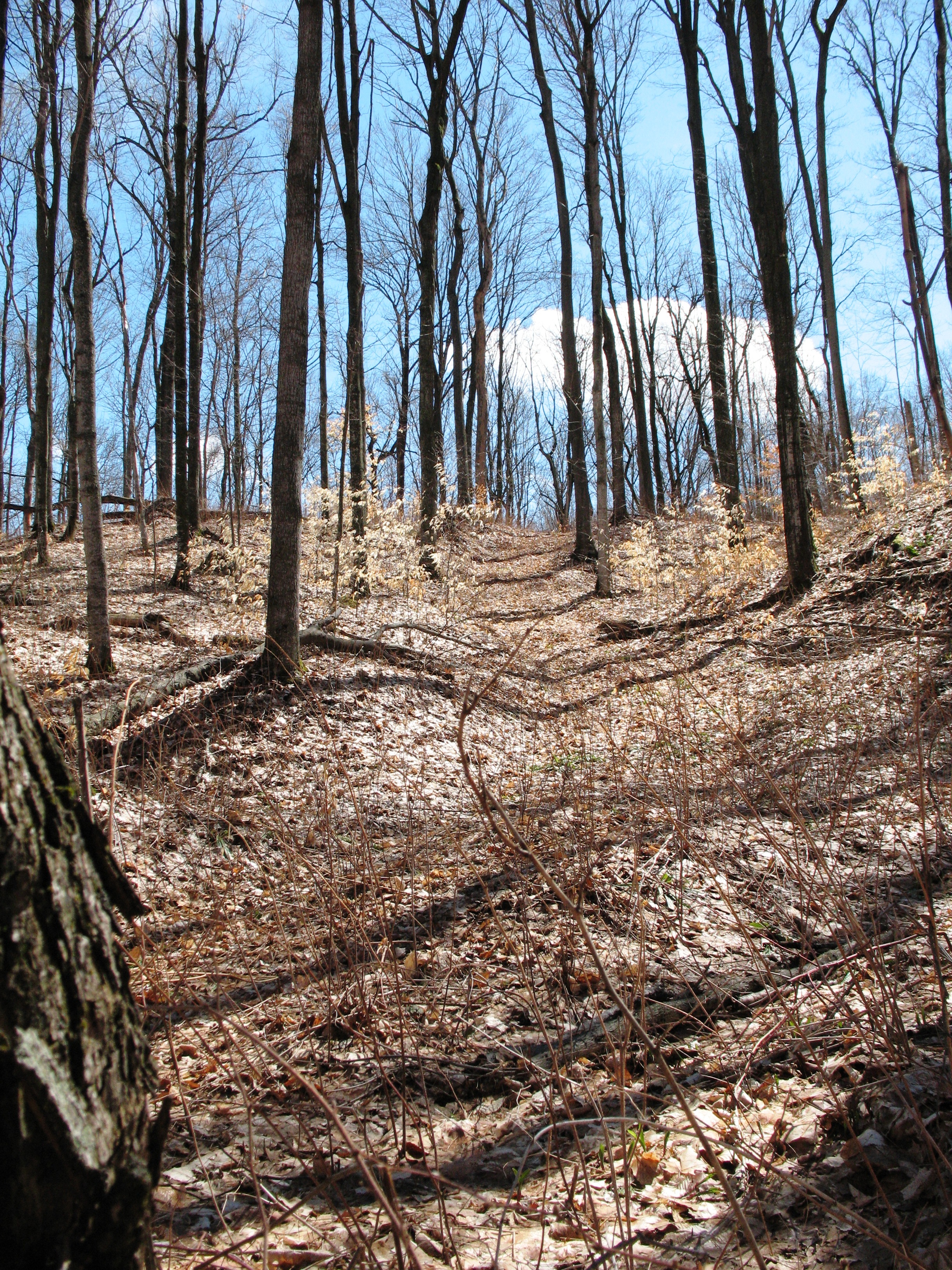
When North Americans think of our bees, they are generally European honeybees. They have been domesticated for thousands of years—and we brought them with us to America. They are not “natural” to our North American biome, but they are a vital component of our agriculture. There are plenty of native pollinators, but they’re not a big part of the way America produces food. And, that’s a very big part of the problem.

It seems to be lost on Big Ag that bees are insects, just like many of the other agricultural “pests.” Our industrial agricultural model—based on monoculture, is hostile to most insects and weeds. The dominant approach is to saturate the crops, and the fields, with poisons. There is an enormous “collateral damage” quotient in the dominant approach. Our foods are coated in pesticide residues, our soil and groundwater are being contaminated, our agricultural workers suffer from chronic exposure syndromes and we poison the bees, our pollinators. Some newer pesticides, neonicitinoids, appear to be particularly damaging to bee populations. Unfortunately, while the bees are dying, the “debate” continues whether the neonicitinoids are legitimate suspects. The makers of these toxins, Bayer and Syngenta, claim that proper use will not result in bee losses—taking a page from the tobacco companies’ old playbook on what does or doesn’t cause lung cancer. Denial can hold truth at bay for decades. After all, there are a great many factors at work.

Included in the mix are issues of proper beekeeping. The emphasis for professional beekeepers tends to fall into one of two camps—the pollinators and the honey producers—though the pollinators produce honey, and the honey folks’ bees are obviously out there pollinating, too. Both camps are guilty of not taking great care of their bees. Here, the big issues seem to be food and travel.

Like most of us, bees are healthiest if they have a diverse diet and a low stress lifestyle. Left to their own devices, bees will collect the nectar and pollen from of a variety of plants and will produce more than enough honey to feed the hive through the winter. The pollination industry interferes with the natural order by trucking the bees from place to place to pollinate specific crops. There is no diet diversity, the bees are exposed to high levels of insecticides on the crops they pollinate, and living on the road is hard on the bees’ navigation skills.

The honey industry is no better. In the quest for high honey production, the beekeepers strip the hives of honey and then winter-feed the bees with high fructose corn syrup or sugar—the bee version of junk food. (Not that the pollinators don’t use sugar diets, they do, too!) In both cases, bees are weakened, and then at risk for the various bee hazards, including the tracheal and varroa mites and pesticide exposure. There’s so much finger-pointing going on in the bee tragedy that the bees will be all gone before any coherent science can catch up. Indeed, I heard one beekeeper justify his poor practices on the grounds that everyone else does it, and the bees will soon be dead, anyway! (I wonder if he has the same attitude when it comes to raising his kids.)

Every single day I am solicited online for donations to “save the bees.” Most of these are seeking funds to fight the use of neonicitinoids which really are a big problem, but only a part of the problem. The challenges of beekeeping are a microcosm of the challenges we have in agriculture, anyway. It’s a problem of scale—diversity equals strength—monoculture equals weakness. The solution isn’t to pour on chemicals; the solution is to grow our crops and our bees in ways mindful of, and taking full advantage of, the rhythms and ways of nature. Organics. It can be done.

So this week, Rick and I have started to make our contribution to save the bees. A month ago, I took a beekeeping class. And we’ve invested in hives and beekeeping gear. Ours will be pampered bees. They will live in one place. They will have a natural and diverse diet—and in the winter, they’ll eat their honey, like bees should. We’ll enjoy smaller yields in the spring—after the bees have had the chance to overwinter. Small scale, “bees first”, management is the solution. We’ll do our bit to save the bees, while the bees earn their keep by pollinating our gardens and giving up a bit of honey. Win-win. And now, if we could just get these hives assembled….


Let's see, Tab A....goes into....

Let’s see, Tab A….goes into….


Snow or Blow?

A.V. Walters

It’s been an adjustment, moving from California back to the land of winter. Winter is not just a season; it’s a culture. It’s been cold this last week, single digits and below. And, it’s not a joke—people really say it, wherever you go, “Cold enough for you?”

In the past few days, we’ve seen about nine inches of new snow–the dry, powdery, fine stuff that you see in really cold weather. It doesn’t stick. It won’t pack for snowballs or snowmen. It’s tough to walk on. It blows every which way, with even a puff of wind. When Rick is out with the snow-blower, he looks like his own mini-blizzard. Everyone has their own little microclimate, depending on how close you are to the lake, how frozen the lake is, or isn’t, and whether you’re in hills, woods or cleared areas. Driving into town, today, put us through three distinct climate changes. Even people who live a scant few miles from each other compare constantly. And, it’s competitive.

If you look on the weather map, where we live is a funny little comma-shaped blotch, where we get the most snow in the “Mitt” of Lower Michigan. When I visit my brother, 180 miles south of here, I am always surprised at how little snow he gets. I try not to be belittling. Where my mother lives, in Keweenaw County on the Upper Peninsula, gets the most snow in the state. With that guaranteed advantage, you wouldn’t expect that she’d be competitive, but she is. We talk every day.

“Snowing down there?”

“Yeah. About six inches. Rick’s out clearing now.”

“Really, six inches? New Snow?”

‘New snow.’ That’s code for whether or not you get credit for it. It’s either snow or blow–old snow that’s just being whipped up and redistributed by the wind. Blown snow still needs to be plowed, still impairs visibility, still drifts up against your door in a wall that has to be shoveled before you can even step outside, but you don’t get credit for it. Snow or blow, though, it’s still beautiful.

This competition is harmless. It’s designed to give Northerners something to talk about through their dry, chapped lips. It’s a bonding experience. It masks the envy underlying the shtick of snow removal. Yesterday we met with a guy who has a Kubota with a front mounted snow-blower and a heated cab. The King of Kings. We’re a couple of rungs down from that– a Kubota with a 3 point, rear mount snow-blower and many layers of goose down and scarves. Because ours is a rear-mount, our snow-blowing has to be done in reverse gear. Rick has become pretty good at it. I tell him he’s the Ginger Rogers of snow-blowing—doing everything the King of Kings can do, only backwards. (And, in heels?) Below us there’s a whole field of snow removal–folks who use blades (or plows) (truck or tractor mount), walk-behind snow-blowers (with or without attached snow shields), snow fences, and a vast array of shovels and scoops. Snow removal is what Northerners do in the winter for exercise.

There’s strategy involved, too. We waited one season before we put in our driveway, so that we could chart a path less likely to drift over. Some folks plant trees or shrubs for snow breaks. Others place seasonal snow fencing to deflect the wind and discourage drifting in areas they have to clear, or they pile accumulated snow as a barrier. Farmers will leave sections of corn stalks standing–for the same reason. But the corn field next to us, left uncut last fall, is neck deep in snow. No help there. Of course none of this compares to last year, when we broke records for snowfall, fully double what we’re reporting this year. This year is colder though–if it keeps up we may break that record. The Great Lakes are well on their way to freezing over (and then it’ll really get cold.) The local weekly does a full column of weekly winter weather.

Things move slower in the winter. Drivers move more cautiously on slippery roads and schedules are buffered by the need for extra prep. If you have an appointment, you need to add extra time for shoveling and scraping beforehand. Depending on the weather, that could mean an extra hour. (Not including the extra ten to fifteen minutes it takes, just to suit up.)

There’s a funny running debate about whether it’s better to leave your windshield wipers up or down, in winter weather. I can see reason for putting them up if you expect freezing rain. A week ago I walked out to the car after sleet, only to find it encased entirely in a cocoon of clear ice. The wipers were stuck to the windshield. It took me ten minutes just to get into the car (where I keep the scraper.) It was another twenty minutes until I could see enough through the windshield to drive. As you drive around the North, you can see some cars parked with their wipers pointed up, like antenna. My dad opined that, like life preservers in chilly Lake Superior—it only makes the bodies easier to find. As far as I’m concerned, if the snow is up to your wipers, you’re not going anywhere, anyway. When he ribbed me about asking if I should leave the wipers up, I countered, demanding what strategy he favored.

“Me? I’d just keep the car in the garage.”


Single Digit Cuisine!

IMG_2070

A.V. Walters–

It’s nippy out there. We’re pretty winter hardy but low single digits, and lower, get our attention. That’s frostbite weather.  It’s also the range at which our minimally heated apartment begins to drop below 60. That’s the point where I take notice, and action. The cold front has been predicted for several days, and I made plans.

I started with a hearty, East Indian rice casserole. The aroma of turmeric, coriander, cumin, cinnamon, cloves and just a dash of cayenne is enough to warm anyone. So is the oven at 375. Then on to a batch of oatmeal cookies–Rick’s been asking for a couple of days and this seemed just the opportunity. Oven at 350 (and opening and closing between cookie sheet batches.) Finally, one of our regulars, a loaf of banana nut bread. It bakes for approximately an hour. By the end of it, we had goodies galore and the temperature was back up above 60.

We’ll see how we hold through the night (or, I see muffins in our morning!) This cold is expected to last the week. We’ll be portly by then.

Feed The Soil, Not the Plant!

A.V. Walters–

It’s the organic gardener’s mantra. If the soil is healthy, the plants will be healthy. If the soil isn’t healthy, there’s little you can do for the plants, that isn’t ultimately bad for the soil. Chemical fertilizers are the equivalent of an IV drip. Maybe it will do in a pinch, but it’s no solution to the nutrition issue. Do things that are good for the soil, and you will be rewarded with a healthy garden. It’s almost that simple.

I’ve been soil building for over thirty years. Trouble is, I keep moving on and leaving my efforts behind. This year we will have a garden. Last year we didn’t have our well in, so it wouldn’t have been responsible to put in a garden. Instead, I took soil samples and sent them in to the extension office for testing.

The results were grim. Our soils are largely glacial deposits. Sand, and lots of it. We’re deficient in most of nutrients for which they test. Most importantly, there’s not a lot of organic material to hold what’s there. With straight sand, it’ll take a good bit of soil building before we have something to hold the nutrients and to hold moisture.

That said, it’s not a disaster. Our delays have helped. We’ve changed the location for the garden–our first pick didn’t have as much sunlight as we thought. Being here has let us learn more about the location, the winds and how the sunlight falls. This land hasn’t been farmed (conventionally or otherwise) in at least thirty years, so the good news is that there are no bad things in the soil. We just need to build it up. The fastest way to get that process started is to add compost, or composted manure. And we’re lucky. It’s easier to amend sand than it is to lighten heavy clay.

I watched last winter as the Amish farmers spread manure on their fields in February and March–really in the middle of winter. At first I was surprised, but thinking more, it made sense. The fields are frozen, so their teams (they farm with draft horses) don’t get mired in the muck from early spring rains. The composted manure doesn’t care when it is spread, it’ll freeze now, but then “activate” when things thaw, and the early rains will carry the nutrients into the soil. It’s an efficient use of winter down time. I knew then that I’d need to watch for a supply of composted manure, come February.

And, this past weekend, there it was. A craigslist ad for 100 tons of composted cow manure. I forwarded it to Rick. He laughed. Meanwhile, I went to the internet to get the weight to volume conversions and I did the calculations.

I assured him, “No sweetie, we don’t need 100 tons.”

“What do you think we need? Says in the ad that there’s a ten ton minimum.”

“We need fifty tons.”

He could hardly believe me. But if we’re going to jump start this garden, and if we’re serious about it, that’s what we need. There’s the garden, and then more for our small orchard. We’ll need to amend deeply in the orchard. (Thank God for the Kubota and the backhoe! Maybe, if it’s a light enough mix, we could use the snowblower to spread it!) (I wonder what Rick will say about that.)

You can see where I get the idea.

You can see where I get the idea.

Rick is a nice boy from Southern California. I don’t think there’s any way in the world that he ever thought that he’d be the kind of guy to purchase fifty tons of composted manure. He’s shaking his head. I’ve negotiated with the dairy owner for a good price. So, now we just need to find a trucker to haul it. This isn’t a case where owning a pick up will help. This is easier said than done. I haven’t yet been able to find a hauler. The primary crop in these parts is cherries. Cherry farmers use flatbed trucks (with stacked bins.) A flatbed won’t work for manure. I’ve asked around, so far with little luck. Once I disclose what I want hauled, I’ve detected a near-immediate, and serious lack of interest.

It may take a while or so to get this all arranged. That’s good, because in the interim, I’d like to haul all of the trees we cleared last summer over to the new garden site to do a burn. Nothing helps a new garden like bio-char. Winter isn’t just about seed catalogs and dreaming. Sometimes there are garden chores that are best saved for the dead of winter.


Second-Hand Blues…

A.V. Walters–

There it is, in all it's blue glory. (Rick calls it the Blubaru.)

There it is, in all it’s blue glory. (Rick calls it the Blubaru.)

If you have followed this blog, you may have gleaned that I’m a bit of a Craigslist maven. Indeed, I have been accused of being the Queen of Scrounge—and I’m not sure if it was meant to be a slur or a profound compliment. It follows from my environmental efforts, to live a little more lightly on the planet. We have become a disposable culture. Most Americans would prefer to have new rather than making what you already have, better. I enjoy the challenge of finding that which others discard and transforming it into a head-turning success. I can’t help it; I am a middle child. Generally, Rick shares my view, though occasionally he looks at one of my schemes and shakes his head. He is a magician in the world of rehab alchemy. He can make a silk purse out of a sow’s ear, in part because he has a discriminating eye for sow’s ears.

My sister rolls her eyes and says, “Admit it, you’re just cheap!” I laugh. She is a Craigslister, too. She just thinks she’s more honest than I am. Somewhere, in all of this, you can triangulate to find the truth.

January has been a tough month. My car died. A friend died. My computer went on the fritz. And, so did the back-up laptop.

The car was a high-end, performance machine—a relic from my former life. It could have been saved, but it had reached that tipping point where the repairs were more than its Bluebook value. After 15 years, it was about to get expensive. Its low-slung elegance did not fit our country lifestyle, or country roads. It was time.

My sister was so excited that I’d be getting a new car. She knew that I’d get a Subaru, like hers, for the all-wheel drive, good mileage and high clearance. “Get an orange one, like mine.”

“Not so fast, sister. I won’t be buying new. I don’t get to pick the color when I’m scouting for a good, used deal.” The deal came quick. Within days I’d located the very low-mileage car I wanted, at a good price. The color—twilight blue.

Let me be perfectly clear—I loathe blue. The color only gave me a moment’s hesitation. A good deal on a good used car is enough to ask of the universe. Buying a blue car made me walk my talk. That sister hates blue, too. So does my mother. It must be in the genes. (My sister howled when I told her.) But, beggars can’t be choosers.

Learning I’d bought it, one friend emailed,

“OMG!!!!! … a BLUE car. (That’s a lovely blue.) Will the world change its axis? Sun spots. Will they explode? The Mississippi flow backwards? It’s a lovely car.”

Some folks can’t resist rubbing it in.

With a few trips to the local Mac store, (in my blue car) I was finally able to iron out the computer problems. (That’s a whole story by itself.) I’m back up to speed, on the net, and on the roads.

I’ve met some great people on craigslist. A $25.00 set of curtain rods sealed the deal on what became one of my closest friendships. But, you can’t replace a friend on craigslist. Some things don’t come cheap and they take time. January closes, more resolved and more unresolved, all at the same time. My condolences to all who have suffered January’s losses.

At this time of year, a car's color doesn't much matter. The coat? Blue. A hand-me-down from another sister. The jeans? A special on ebay. The high cost of blue.

At this time of year, a car’s color doesn’t much matter. The coat? Blue. A hand-me-down from another sister. The jeans? A special on ebay. The high cost of blue.

The Tyranny of Round Numbers

A.V. Walters

This is my 200th blog. Next week, I’m coming up on my third anniversary of blogging. I’ve been stuck on this momentous event. Somehow, it felt like I was supposed to be profound, or something. Oh well, what you see is what you get.

I was a conscripted blogger. “They” said that indie writers and publishers needed to blog. Apparently, we need an online presence in order to sell books. Ha!

I bellied up to the bar, and started blogging. What does a fiction writer blog about? Everything, and nothing. I followed my nose, tried to stay away from politics (a stretch for me) and focused on chronicling the rich parts of the everyday. I cannot honestly say that the blog has ever sold a book. And then, after about eighteen months, they said, “Oh, never mind the blogging, it doesn’t work for fiction.”

But, by then, it was too late. Like most writers, I live in my head. I am probably most comfortable in writing. In this funny, online world, I have made friends. Political friends (even when I pledged not to go there,) artist friends, gardeners, organic farmers, people who keep bees, people who can vegetables, celiacs, funny people, other writers, editors, ne’er-do-wells and goody-two-shoes. In short, I have found community.

They are everywhere. My “regulars” are as far flung as Australia, Singapore, France, United Kingdom, Brazil, Canada, Germany, India, New Zealand, and all corners of these United States. In the blogosphere, I travel all over, too. Over the course of three years, I’ve been visited by over seventy countries. I am continually amazed that we can connect across the ether. These connections give me hope. Even as governments fail us, and corporations sell us, we can all be ambassadors of civility, humor and peace.

Not that I’d be considered a “successful” blogger. My numbers remain relatively low. I refuse to play SEO games. I refuse to do internet marketing or advertising. (Aren’t these scams?) I refuse to amend how I title my blogs, just to capture more “hits.” Indeed, learning that the blog wasn’t going to sell books, anyway, was liberating. I am free to be stubborn! I can do whatever I want in this forum; it is my world! (And welcome, by the way.) Despite what my trusty editor, Rick, says, I am even free to use semi-colons.

Our most popular topics are about season and gardening (oh, yeah, and emus.) The single most enduring blog is still Naming Emus. Stories about living on the chicken farm in Two Rock are popular, too. The shock of relocation is wearing off; we’re comfortable in Northern Michigan and revel in seasons (and snow removal.) It’s been an adventure. And you’ve been there, all the way.

We’re hovering on many exciting new ventures for the next year. We’ll finish the cabin and move in (gypsies, no more)—we’ll get the garden started (already I’m up to my ears in seed catalogs), I’ll finally try my hand at beekeeping (after wanting and waiting for five decades!) and, if there’s time and energy, we’ll get chickens. I’ll keep blogging, and sharing, though I may slow down just a bit this spring. I’m trying to get my head back into writing—I have an unfinished novel haunting me.

So, thank you all for following, sharing, commenting and enriching my life. Raise a glass—Happy 200!
(Next time, pictures, I promise.)


ooops, here’s the link to the most visited blog, https://two-rock-chronicles.com/2013/03/10/naming-emus/

Banking on Winter…

A.V. Walters–

After several false starts, I think we can finally say that it’s winter. The last eighteen hours have dropped six inches on us, with another five or six expected over the next two days. More than that, the temperatures are dropping. The next week promises single digits and lower, if you count the wind chill factor. It’s not last year’s record breaking snows and recurring ‘polar vortex,’ but it is winter.

We’re a bit concerned about the heat in our little basement apartment. So far we’ve been fine—interior temperatures in the low sixties, which works for us. When we did the remodel, we did connect the apartment to the heating and cooling for the house—then we promptly blocked it. The landlord keeps it way too cold in the summer and way too hot in the winter. In addition, she has dogs—lots of dogs. I’m allergic to dogs, so a shared HVAC system isn’t going to work for me. I’m a mess when I visit my mum, with just the one dog, so blowing three dogs’ worth of winter dander into my living space is a non-starter.

Up until now, we’ve done fine with a little plug-in baseboard heater. After all, it’s a (walk-out) basement apartment. Nearly two sides are imbedded in the ground. As a baseline, underground keeps things warmer than at the surface.

Our landlord’s heat ducts run above us, and that warms us up a little more. The furnace is in the basement—two rooms away; it’s collateral heat. Still, we start to worry when our interior temperature drops into the fifties, a tad chilly, even for us. At that point, I begin baking. While Rick loves the goodies, it’s not exactly a heating strategy (and threatens to send us both into spring portly.)

With the snow drifting around the house, and with silent thanks to my dear departed dad, I finished up our regular snow removal chores by ‘banking’ the foundation. It’s an old-fashioned insulation strategy. I piled the snow up about four feet against the cinder-block foundation walls that are also our exterior walls.

My dad grew up in the far northern reaches of Michigan’s Upper Peninsula. When we returned there, he had a local-yokel solution to most of the problems posed by extreme weather. To be really effective, my dad used to make us bank the house two or three feet thick, cautioning us not to pack it against wood or other surfaces that could be damaged. We don’t have quite that much snow yet, but today was a good start. In the next few days, with the snow we’re expecting, I’ll finish, and bank the foundation anywhere that there aren’t windows. Rick smirked a little at my efforts, but I noticed that he packed snow over areas of shallow or exposed pipes. He’s not eager for a repeat of last winter’s pipes freezing.

It’s “cold snow,” light and fluffy. With a grin, Ricks tells me that it’s snow—but that it’s a dry snow.

Observing the New Year

A.V. Walters

There must be near as many ways to bring in the New Year as there are people. My mother thinks it’s bad luck to start the year with any of her ironing left undone. That’s not a problem for me. My current life style doesn’t include ironing. I don’t even know where my iron is—somewhere in storage, I hope. My sister’s New Year superstition is about what you can eat on New Year’s Day. No poultry for her. (Apparently, if you eat chicken, or birds that scratch, you’ll spend the entire year scratching for a living.) She hasn’t indicated whether or not that eliminates eggs for breakfast. What does that say about pork? After all, pigs root around for food. Does that bode ill for the traditional New Year’s ham? (or bacon with those questionable eggs?)

I don’t do resolutions, either. Sure, I could lose a little weight, or be more regular in my sleep habits. I’ve already cut way back on sugar. I figure if there’s improving that needs doing, one ought not wait for the New Year over it.

I’m not one much for observing holidays, except Thanksgiving, which I like so much that some years I celebrate it twice—Canadian and American. I do like to have all the laundry done, not because of my mother, but it seems a shame to bring last year’s dirty laundry into the New Year. So, I guess my New Year’s observance includes tidying up a bit. We don’t go out. We don’t watch any “balls drop” on television. That would be boring and impossible, since we don’t have a television. Yesterday, though, we took the tidying to a new level.

We’ve been gathering wood. We won’t need it this winter, since we’re behind in the building schedule and the house isn’t ready. But we’ve been cutting, hauling and splitting deadfall off and on since the summer. It’s been piling up, waiting to be stacked. So we decided to finish splitting what we have and to stack it all as a fitting close for 2014. It was easier said than done.

We estimate that we’ll need four cords of wood to heat for winter. My sister uses just over five, but hers is a much bigger house—and three hundred miles north of us. They get a longer, colder season. We don’t keep the house as warm as some do—65 degrees is about as warm as we can stand. We figure that we have about four cords cut now—though we’ll know for sure by the end of the day. Yesterday we stacked two cords, snug up against the cord I stacked this past summer.

The aim is to have two year’s worth of wood cut and stacked. That way it’ll “season,” which just means that it’ll get good and dry for a clean, long burn. My sister (the show off) is working on being three years ahead. We’re continuing to clean up the deadfall in the forest through the winter and, as long as the snow doesn’t get too deep, we’ll likely have our two year supply cut and stacked by spring. When we start the “regular” firewood season, next fall, we’ll be working on three years, too. I’d feel pretty smug about that. A good store of firewood, now that is rich.

When I was a kid, my dad made me stack wood crisscrossed, the old way—so that it would be stable. I started like that for the first cord. I suppose that it’s the best way but it takes me forever. I get caught up in it and spend forever selecting the perfect piece to go in each spot. Rick rolls his eyes. So yesterday we started the day at our local hardware store, picking up some metal fence posts to hammer in at the end of the stacked rows. That way I can just stack without getting too finicky. We store our firewood stacked on wooden pallets and then tarped to keep it dry. At some point we’ll build a woodshed—after the rest of the house, and the pole barn, and the chicken coop, and the…, well, you get the point.

It took forever today to stack two cords. The wood pile has been a loose trip hazard, logs just tossed over after splitting. Part of it was covered, but we ran out of tarps during October’s constant rains, so as the pile grew, a good bit of it was open to the elements. It rained over Christmas, while we were away, and then the temperature dropped. By the time we were ready to move the pile and stack—much of it was frozen in place. It looked fine but when you tried to pick it up, it wouldn’t budge. So we had to first break it up with the sledge. Two steps forward, one step back. In the future, I’ll try to stack after splitting. (That’s a common sense plan, not a resolution.) And with that, we should ring in the New Year, just fine.

Asking For It? A.V. Walters–

Billy and I were assigned for the same two days off, a near miracle in our heavy summer schedule at the restaurant where we both worked. We planned it all, hiking and fishing, evenings with friends. Since I had pulled the late shift for our “Friday,” we agreed to meet at his place after I finished. He lived in a little studio in the upstairs of his sister’s summer cottage. I arrived just after our 9:30 meeting time but there was nobody there. I waited outside on the porch for a while, but the mosquitoes were biting. The short sleeves of my little German dirndl waitress outfit, didn’t offer much protection in the cooling summer evening, so I let myself in and went upstairs.

His room was sparsely furnished, a daybed that served both as a sofa and for sleeping, an end table with a alarm clock and a small table with a couple of chairs. I sat down at the table to wait. After about twenty minutes of clock watching, I got up and flipped through the books on his end table. I selected an anthology of sci-fi short stories and settled onto the daybed to read. After a couple of chapters, I dozed.

I heard him stumbling up the stairs, and could smell him, even before I opened my eyes. He was wildly drunk. Even from across the room I couldn’t avoid the rank stench of sweat and stale beer. I glanced at the alarm-clock, radium hands glowed just past midnight. Billy flipped on the light and I flinched in the glare.

“Hey babe, there you are,” he slurred. “Been looking for ya.”

I’m right where I said I’d be. I guess you’ve been at the bar.” I was peeved, and my voice didn’t hide it.

“Aw, don’t be mad. It’s our weekend. Time to party.” He came over and sat next to me on the daybed. He didn’t smell any better close up.

“Jesus, Billy, what the hell have you been drinking? You smell like a brewery.”

“Beer and shots—I kept winning rounds at the pool table…” He stooped to kiss me, but I pushed him back, mostly because his breath was so rank. “Don’t be a party-pooper, it’s our weekend.”

“Jeez. Go brush your teeth.”

He swung his leg over me, straddling me. He leaned towards me and blew in my face, laughing. I turned my face away, nearly gagging, and put my hand up to ward him off. He slapped my hand away and resumed blowing. In no mood for his antics, I put my hand up again to deflect his breath. Rougher this time, Billy grabbed my arm and pinned it under his knee. He leaned right up to my face and huffed his stale breath my way.

“Billy!” I pushed him with my free hand, “Stop it.”

He laughed again, “Ya gonna make me?” He pushed his face into mine for a long slobbering kiss. Even with my face turned I couldn’t avoid it. Billy outweighed me by forty pounds and was a lot stronger. He grabbed my free hand and held it against the bed frame above my head. With his other hand, he grabbed my chin and pulled my face straight, then kissed me again, this time with his tongue in my mouth. I jerked my face free, gasping and he laughed.

He let go of my face and started rubbing his hand on my breast, “I missed you tonight.”

“Billy, stop, just stop.”

“We got big plans for the weekend, remember?” He unbuttoned and then unzipped his jeans, reaching in and stroking himself. He leaned over for another kiss, but again, I turned my head.

“Billy, let me go. You’re drunk.”

“Not too drunk. You’ll see.” He leaned in for another kiss. I felt his weight shift and squirmed, trying to throw him off of me.

Light flashed across my closed eye, as my cheekbone and brow exploded in pain. I screamed and opened my eyes to see him pull his fist back for another blow. I tried to roll my head out of its path, but his fist found my jaw. Pinned in, there was nothing I could do. This was going to happen. The third punch convinced me. It split my lip over my incisor. I was no match and he was just going to batter me into submission. I went completely limp—but took one final blow before he had registered my surrender.

“That’s a girl, there we go.” He pulled the skirt of my uniform up over my face and wrenched my panties to my knees. He wrestled me into position and took what he wanted. I stayed limp and unresponsive.

When the grunting and heavy breathing were over, he started giggling. “Where are you?” as he pulled the skirt down off my face. “There’s my girl. Not so bad, after all.” He kissed me and stroked my hair. I retched. Billy leaned his head in the crook of my shoulder and rocked. “There, there.” Soon, he relaxed and his full weight settled on me as he started to snore.

After several attempts to push him off, I rolled him towards the wall and extracted myself from under him. He never woke up. Shaking, I straightened my clothing and stole down the steps and out into the night. It was only a couple of blocks home.

I stayed up all night, icing my face and pondering what to do over cups of hot tea. I never wanted to see Billy again. I was clear on what had happened, and who was wrong. The only question was whether I should go to the police. I weighed the evidence. We were boyfriend and girlfriend. We’d had sex before. It happened in his studio, where I’d gone willingly to meet him. He was drunk. Neither of us was “local” and with the summer season winding down, we were both about to leave town. The only evidence of a crime was my swollen and bruised face. I knew it was my word against his, and that they’d never pursue charges.

At dawn, I showered and dressed for hiking. I didn’t want to be around when Billy came for the rest of “our weekend together.” I stayed away that day, and most of the rest. If I wasn’t going to press charges, I wanted away. I wanted peace. I didn’t want anyone to know. I was afraid that if my father discovered what had happened, he might kill Billy.

At the end of that second day, I covered my bruises with make-up and went down to the restaurant to quit. I kept my eyes down, the swollen side turned away, “I’ve decided to head downstate early, to get ready for school.”

The owner shook her head. “You know, we were kind of counting on you to work through color.”

“I’m sorry. I’m a transfer student this year. I think I need to get my bearings.”

She eyed me and put her hand on my forearm, “You know, we could just fire him.”

My eyes filled with tears and I waved my hands, “No, no, I’ve just got to leave, got to get out of here.” She nodded and I left.

From the moment the first blow landed, I knew that Billy was a monster. Drinking may have clouded his judgment, but it didn’t change who he was and what he could do. I never questioned myself. It was so clear whose fault it was, that I was relieved of any guilt or self-doubt. It wasn’t about me. I was lucky to get away. Mostly I felt unscathed by it. I didn’t dwell on it; I didn’t talk about it. It didn’t interfere with my sense of personal safety, or factor into my relationships. For almost two decades, I never even said the word out loud—raped. I knew that by most measures I was lucky that I didn’t carry baggage over it. That was, until June, when George Will wrote that column.

In his infinite wisdom, George Will criticized government actions to make college campuses safer. He opined that rape-victimhood had become a coveted status that confers privileges. How dare he? He, who has the ear of the nation, but knows nothing of the facts, how dare he malign the victims of rape? I am not a violent person. I’m not one given to the solace of revenge, but on that day in June, I desperately wanted someone to do to George Will what Billy had done to me. Rape is not a club. It’s not a coveted status on campus, or anywhere else.

We have a rape culture in this country, one that favors the perpetrators of the crime. It’s evident in the pointed questions that arise after a rape is reported— Was she drinking? What was she wearing? What was she thinking? Did she lead him on? Well, what did she expect? Blame the victim—Boys will be boys, after all. I guess she just changed her mind about having sex with him. She’s only trying to ruin his reputation. She’s just looking for attention.

No, you assholes. Given how victims are treated, it shouldn’t surprise anyone that most rapes remain unreported. Victims do the math, like I did, and know that the game is rigged against them. All you have to do is watch the news to know it’s easier, and less painful, to let it go. (Why would anyone want to be violated, twice?) I left town.

If I have any guilt, it’s survivor guilt. He got away with it. Did Billy go on to assault other women? Would a conviction have made a difference? I’ll never know. He was so drunk, I don’t even know if Billy knows that he’d raped me. I do know that nothing will change until the culture changes. We need a culture of respect and affirmative consent. We need to teach young men responsibility for their actions. I don’t laugh at rape jokes—but I see them telling them on the news.

It’s been nearly four decades, why bring it up now? Because nothing has changed! Yes, George back-pedaled later, admitting that he thinks recovery services are appropriate in cases of “real” rape. And we’re regaled by politicians and pundits who make exceptions for “legitimate” rape—in terms of victims’ rights. How is that helpful? Of course, any rape allegation will be challenged and have to be proven in court. It’s clear that the victims of sexual assault will be subjected to the same pre-screening, prosecutorial gauntlet that has always existed, and that prevents so many from speaking up. What exactly was the lesson of Steubenville?

So, yes, when more than one victim speaks up, it empowers others—not because their claims aren’t legitimate, but because victims have no expectation that their lone voices will be heard. So I add my voice in hopes that when our numbers are realized, society will be forced to rethink the gauntlet.

Meanwhile, the media idiots on Fox, in particular, are lining up to reinforce the women-hating status quo. I don’t understand it. I don’t understand it from men, who have mothers, wives, sisters and daughters, and still feel it’s simply about sex, about titillation and about keeping score. It’s not. It’s a depraved, violent crime against women. It’s about power and control and entitlement.

And, I certainly don’t understand the women who spew the same victim-blaming blather—and I mean you, Ann Coulter, you and your ilk. Go ahead, line right up with the rape apologists and media whores. You must live in a magic bubble where you’ve never had to deal with the unwelcome advances of men. You help to create the atmosphere of denial that lets men believe they’re not responsible. I guess we’ll all take comfort in knowing that if you’re ever confronted by a rapist, you must have asked for it and, if you have the gall to report it, you’re just looking for attention.

Good Night and Good Luck—

A.V. Walters—

There was a time when I recognized the gentle, diplomatic art of compromise, back when pragmatism seemed like a viable solution to the tensions inherent in any reasonable system. No longer. I’m afraid that, despite the fact that I’ve been unable to rid myself of this vestigial appendage, I’ve come to see reasonable as ridiculous.

You’d have to be naïve or foolhardy to think it was a rational strategy in today’s political environment. Compromise requires a willingness on both sides to surrender some, in exchange for the common good. It requires a measure of good faith, both in the negotiations and in the articulation of each side’s stated starting point. Good luck with that.

Civility is dead. And, it took any chance of an honest broker with it. We have entered the era of the stubborn stalemate, the sneak attack and the tantrum divide. We have become ungovernable.

The symptoms are unmistakable: Rogue Police Departments demanding apologies from Sports Figures, when the latter have deigned to speak truthiness; Law Schools dropping the instruction of rape laws, because it’s too sensitive; Corporations equating any criticism for their policies with Naziism; torture apologists threatening us with what the world would be without the use of their questionable talents; and, of course, the end of The Colbert Report, only in part, because extremism is so ubiquitous as to not be noticeably funny anymore.

Liberals stand, scratching their heads, impotent in negotiations because they foolishly started out with (OMG) the facts. There is no middle anymore. The raging tantrum of extreme politics has, in the name of compromise, pulled us so far to the wacko-right that the balance is forever skewed. I am at a loss for how we find the road back to civility and balance. I’m afraid that the distraction factor is the point, and that nobody is actually interested in governance anymore.

It’s too bad. Serious issues need to be addressed—Climate change; contamination of our food and water supply, the failure to address the peacetime nuclear threats of waste and operations, our disappearing civil rights. All of this stems from the death of our democratic ideals under the erosive influence of corporate money and its undermining disenfranchisement. In the wake of the collapse of our attention spans, corporations do what they will. I don’t know what to do about it. Help me here—I’m looking for a place to start.

A Long, Dark Winter–

A.V. Walters

Long time, no blog.

It’s not all dark. We had a wonderful Thanksgiving, up in Copper Harbor, driving into, and then, back out of winter. We enjoyed an initial, if unseasonable, winter blast early in November. I would have blogged about it, but then the news and photos came in from Buffalo. Really, we couldn’t compete with that. How could I even complain that the season had caught us unawares, when southeast of us the Lake Effect had dumped five feet of snow in two days? Then, it rained, taking all of our snow with it. We went to bed the evening of November 24th, with no snow in sight. We woke to five inches on the ground, and a long, white drive (over the river and through the woods) up to visit my mother for the holiday. The further north we drove, the deeper the snow. It was lovely, but then I wasn’t the driver.

After about a week of visits and goodies, we retraced our steps home, to a cold, but nearly snowless landscape. It’s been a roller coaster of a winter.

We’re losing our light as we tiptoe up to the solstice. But the real darkness in our lives lately has been the news. 2014 has brought repeated waves of senseless tragedies, the lather, rinse, repeat, of police violence against unarmed, young black men. And, even children.

I’ve always made a conscious effort to keep politics (other than about food issues) out of this blog. But, the last thing this country needs, right now, is for its citizens to go silent, to go dark.

I’ve always had a fierce belief in the Rule of Law, and so the recurring failure of the legal system to deliver a fair and reasoned response has been heart-rending. From my safe, middle-aged, white, woman’s perspective, I cannot even imagine how betrayed our African-American communities must feel. The Grand Jury system has been rigged, not only in its failure to deliver justice, but in the fact that its lack of transparency has repeatedly pre-empted our constitutional guarantee of an open trial by jury. We fail to deliver justice to the victims of these assaults and, in so doing, we compound the historical injustices to disadvantaged and minority communities. Even worse, it’s been done in secret. This is a clear abuse of the Grand Jury system—District Attorneys have a clear conflict of interest when they choose to use the Grand Jury process to investigate police abuses. It’s difficult to hold my head high. I am ashamed of the American Lie of fairness and (color) blind justice, in our legal system. The racist, Old-Boy network of mutual back scratching and “justice” with a wink and a nod remains. I feel sick about it. And the news has been full of revelations of deeply ingrained racism in our institutions of justice and public safety, not to mention the bias and propaganda we are seeing in the main-steam press. There is no “post-racial.”

Just when I wanted to throw up my hands in disgust, I read that a group of young people from the Ferguson community were working with the Department of Justice to find constructive solutions—a six point plan that, if implemented, would begin to restore faith in the system. I read of the flyers that Ferguson protesters tucked onto the windshields in the areas of the marches—reasoned, honorable statements against racial bias, seeking to step beyond the tragedies to solutions. And I saw huge crowds of peaceful protesters, people of all races, stepping up to bear witness that this, this is not our way. I am humbled that my angered paralysis was not as strong or as wise a response as those from the affected community who are reaching across to their tormentors to seek peace and fairness.

It gives me hope, even as the bodies line up and the scales of justice tilt wildly, the wrong way. This evil must not keep us from being our best selves. We cannot afford to be discouraged. Our dignity, our very humanity, is in the balance. We certainly cannot give up and turn away as small minds, full of hate, decide what kind of world we’ll live in.

Join protests. Write letters. Talk about it. Turn to it and face it, not away from it. Racism is our underground disease and collective shame. Our founders capitulated to it—and our worst war was fought over it. In the scrutiny of the light of day, its ugliness becomes increasingly apparent and perhaps that is our best hope to overcome it. It may be that we will never be free of racism. If constant vigilance is the price of a just society, I have to be willing to do my part.

The solstice is only a fortnight away. Two short weeks and we’ll begin to turn the tide of darkness. The promise of spring will lift my heart. Maybe the hope I see in the dreams of young people, earnestly opposing injustice, will bring peace to my anguished heart and to this troubled nation.

First Snows

A.V. Walters

snow days

I’ve been off for a couple of days of travel for the day job. It’s just as well. I’m not much use building right now because of a pesky little broken rib. It’s my own fault. We were moving a washing machine (a great craigslist deal) and, because I wasn’t communicating from my end, I got myself underneath it in a creative and unfortunate way. Sometimes I think I’m sturdier and stronger than I am, and that can lead to trouble.

There’s not much one can do for a broken rib. In days past, they used to immobilize patients, or tape them up. These approaches frequently led to pneumonia. We’re like sharks that way; stop moving and you don’t breathe. So I’m wandering around, doing what I can. With all the other delays, this one is just icing on the cake. A few days travel and work for a little recovery time is a good thing. Then, I’ll take advantage of my limited capacity to do Kubota work. Yay! I’ll get to use the tractor and backhoe!

We have a few weeks yet before the ground freezes. On the way to the airport, the other day, the road was so icy that we floated through a corner–where four other vehicles were stuck in the ditch! Our car has all-weather tires. (I think Rick decided that morning that it’s time to put the snow tires on the truck.) Still, the ground isn’t frozen. There’s still time to dig in the septic tank and maybe even the field.

Despite representations otherwise from the power company, our work site does not yet have power. Like us, they’ve experienced weather delays.  The most recent promise is for early this week. With it nippy, power would sure be nice. Running a generator indoors is not a good idea, even when your “indoors” is a breezy, windowless, roofless cabin. It’d be great to work with artificial light and power tools, without the drone, and stink, of the generator. Maybe, just maybe, this week will bring electricity.

We’ve already seen snow. When I returned from my work foray (48 hours, one seminar and seven flights) the season had changed. We’re ankle deep in the big white fluffy stuff. My mum, some distance to the north, is knee-deep. Being as it’s only mid-November, it’s a tough call whether this is “it,”—whether winter has arrived for good. The weather report for the week calls for snow, every single day, time to find that snowblower that I’ve been talking about.

Actually, I’m excited to see snow. It will bring a return to our snow-shoeing adventures. As soon as the rib is fully healed, I’ll get back to my plan to improve my generally spastic cross-country skiing. Here again, the delay is probably a good thing. Hunting season started yesterday, so it isn’t a good idea to go traipsing through the bush. In the meantime—just don’t make me laugh.


What doesn’t kill you…

A.V. Walters


The glow and promise of raku!

The glow and promise of raku!

Yeah, right. It’s raining, and we have to go purchase building materials, and go vote. That means we have a day off from working at the site. We bemoan this, though we really need it. We both ache. There are times, at the end of the day, that I’m so tired I want to roll into bed without so much as dinner. (Though, I’m not going without a glass of wine!)

I know that this adventure is both taking its toll, and building us up. We’ve both dropped weight (though Rick is downright skinny and I’m beginning to bake goodies, to fatten him up a bit.) I have forearms like Popeye. I guess it’s making us stronger.

Actually, I know it. We took a couple of days at Labor Day to go visit my Mum. She’s a potter and had weekend plans to participate in a raku firing event. For those who may not know, a raku firing is a fire-filled, fast, somewhat ceremonial, blast furnace of a ceramic kiln firing. It’s a blast. From my childhood as a potter’s daughter, raku meant party. It combined the best of everything—fire, good food, a soupçon of danger, and that ooh-aah factor every time you open a kiln. Anyway, though I said that she’d need help with the event, I really just wanted to be there—to help and to live the fun that is raku.

The fired pot--headed for reduction in wood chips.

The fired pot–headed for reduction in wood chips.

As we loaded up the truck (kiln, tongs, gloves, pots, and propane) I grabbed her two, small propane tanks. They felt empty.

“Mom, we’ll need to stop and get fuel—these are near empty.”

She gave me a funny look. “No, I exchanged them last week.”

I hefted them again, two tanks at arms length, and and shrugged.

Rick came over to resolve the debate. “The seals are still on those tanks—they’re full.”

I looked down. Lugging one tank is normally work—two tanks would not usually be within my capacity. So, I guess it’s true. What doesn’t kill you makes you stronger. It was a great firing and a great day.

It’s About Time

A.V. Walters–

IMG_2054

Lately, my job has been sanding. It gives me a lot of time to think. I work in a bubble—face mask, ear protection, hat and eye glasses—for safety, but it keeps me in my own head. Of course, there’s always the day job, so my attention is split, part to regular work and part to building. While I sand, Rick has been busy working the site, rough wiring, and building, installing the boards that I’ve finished sanding.

In the Zone

In the Zone

I learned sanding from my Dad. I think I earned that chore as a little kid because I was observant and, well, anal. I have a constitutional tolerance for the tedious. Now as I sand, I hear my Dad’s voice—and it’s a comfort.

“No, go with the grain. There, that’s it.”

The task of sanding is so integrated with my childhood memories that the sandpaper, the smell of sawdust, and the feel of sanding are enough to bring my Dad back. His voice and advice is a part of the physicality of the job. I’m using the sander he advised me to buy. I’d burned through two Black & Deckers, prepping my house for a paint job, when he said I needed better tools. So here I am, twenty-six years later, still using the Porter Cable he’d recommended.

We’ve had a lot of trouble with lumber on this project. We’ve rejected nearly a third of what we’ve ordered from local building supply houses. We even tried the local “specialty” builders’ outfit—and paid a significant premium for what was supposed to be custom picked lots. You can get quality lumber from the discount guys, but you’ll have to spend a ton of time picking through it. So, we swallowed hard and tried a “pro-builder custom order.”

It was a more than a disappointment. It was just as junky as if we’d picked from the top of the rejects pile at the discount stores. For this we paid an extra 25%? I called to complain. Rick and I sorted the pile into junk, usable and good. The sales guy lives not far away; he said he’d drop by. When he did, he looked at the pile and shook his head. “Yeah, that’s just not right.” Even then, it took two more deliveries to get it right. Another delay.

Every glitch just burns daylight. We’ve had snow flurries already so the delays are really a problem. We want to achieve a “defendable” enclosure before any serious snow accumulation. As for lumber, we’re back to hand picking on our own—it’s cheaper and, if you get junk, you know who to blame.

“Check your sand paper. See, if it clogs up like that, it’s time to change the paper.   Here, let me show you.”

“Daddy, how will I know when it’s done?”

“You’ll know, honey, your fingers will know.”

My dad had a belief that sometime, in our past, there was a Golden Age of Tools and Materials. Even when I was little he would curse the shoddy workmanship in building supplies. When materials fell short of the mark it was the fault of some national disgrace. I grew up to the litany of, “Goddamn Canadian nails!” or “How can they sell this shit!” He cursed like a trucker.

Rick shares this creed. He’ll eye a 2 X 6, shake his head and throw it back in the pile. “You just can’t get quality materials anymore!” (Another kind of echo from my Dad.) Picking up yet another bowed or twisted 2 X 10, he points out the wide soft wood between the growth rings, “See that, plantation lumber, grown fast and weak.”

Was there really ever a NeverNeverLand of strong nails and straight lumber?

I don’t believe it for a minute. It’s an argument about quality that’s been going on at least since the Industrial Revolution—and probably back beyond that—to the woodworking guilds of the Middle Ages. Wood is an agricultural product. Trees are not perfect. What makes lumber true, is time. Time and effort. Somewhere in the chain of commerce someone has to care enough, or make enough money, to make it worthwhile to spend the time to do it right. It’s the same for building and for any craft. In a world of mass production, suppliers will produce any product that will sell. Unfortunately that means that the quality will be as marginal as the market will bear.

As my father aged he became more and more of a fine craftsman. He complained less about milled lumber, not because it got any better, but because he bought raw, and milled and finished it himself. Towards the very end of his life the furniture he built was more art than craft. He was not fast. He certainly couldn’t have made a living at it. But he knew the work was good and it gave him great satisfaction. He reached the point where he’d select wood for its “flaws,” knots or whorls, and then fashion the piece to highlight these natural features.

In the months before he passed away he and I were enjoying morning coffee at a walnut table he’d made. “See this?” he tapped a spot where the grain swirled and rippled, catching the light. “That’s where I let the sun out.” He smiled and ran his hand along its smooth edge.

Rick and I are building a log cabin. The purveyors of the materials would prefer we call it a log home, but ours will be a modest dwelling that fits within the cannons of the design’s history. It’s suited to the simple lines of its primitive forebears. There is a lot of natural wood. Rick is taking the time to position the beams to their best advantage, even to straighten them with weird clamps and strapping devices of his own invention. I don’t think a builder could afford that level of care on a paying gig. This will be our home.

A traditional log cabin would have beams across the log perimeter, with a heavy plank ceiling that served as both the ceiling above and the floor for the second level. We searched for the right material that would work, and be in the spirit of a log cabin. We settled on kiln dried, southern yellow pine, beveled, tongue and groove, 2 X 6s. It was a special order so we had to take the quality on faith and wait several weeks for it to arrive.

IMG_2059

When it did, it was a huge disappointment. The wood was much more knotty than the catalogue description. It was not “finish-milled” and ready, as described. Rustic shouldn’t be synonymous with slivers. This wood bore the deep mill markings, chatter and the “tear-out” that you get when the mill’s blades are not sharp. Worse yet, the wood arrived moldy. And I’m not talking about the ubiquitous blue stain that comes with some pine. This wood was alive with green and orange colonies of mold. (Again, I can hear my Dad’s voice, “Kiln dried, my ass!”) Our expensive special order was a bust. We had to decide whether to reject it (and pay the chunky restocking fee AND wait for new wood) or whether to roll up our sleeves and solve the problem, which brings me to sanding.

IMG_2058

I am neither as strong, nor as skilled as Rick in building. I am really just a knowledgeable gopher, but I can sand. And that’s what we did. We bleach treated all the areas of mold and then sanded it all to remove any sign of mold or mill markings. All 150, 12-foot lengths, both sides. (There I was, sanding pine, a wood my father didn’t think was worth burning!) It took me an extra two weeks—while Rick worked on site grading and electrical. It’s up now, and looks really good. A silk purse from a sow’s ear.

I have my hands on my hips now. “Really Daddy, how will I know, how will my fingers know?”

“You’ll know it’s done, honey, when it’s as smooth as a baby’s ass. You just keep sanding ‘til then.”


My Dad's Sandpaper Box

My Dad’s Sandpaper Box


New Territory, New Toys…
A.V. Walters

In the early days...

In the early days…

No! Did I say toys? Tools, tools, really it’s new tools! It’s a whole new world of what one needs to do—snow, building, planting. First, after carefully reviewing the used market for almost a year, we got the Kubota tractor—which we we’ve needed for road grading, excavation, and will certainly need for snow clearing. Rick cut in the driveway and dug out the foundation for the cabin with it—it’s no toy.

Then, I saw a good deal on a log splitter, on craigslist. In Two Rock we heated with wood and we split it all by hand—both of us. Of course, Northern California doesn’t pack nearly as much of a winter punch as Michigan. We used to use about two cords of wood a year to keep toasty. Here we figure we’ll need about five. The log splitter was a good call. I used it, feeling like a bit of a traitor to my trusty maul and wedge. But in an afternoon, without breaking too much of a sweat, (though it is still work) I split about a cord. Wow. We already had chainsaws (when we met, Rick and I owned the same brand and model of chainsaw. Kismet!)

The generator/inverter was a no-brainer. So far, there still isn’t any power to the site. (Though it looks like next week the electric company will bring in the underground lines for power—with phone and internet piggybacking in the trench.) Everything needs power—nailers, sanders, lights, saws. So the generator can’t be considered a toy by any stretch of the imagination.

Back in the spring, we were looking at the costs of excavation—road, foundation, well line, septic. It was daunting. We’d already bought what’s called a back-blade (it’s like a big scraper) so, my next job was to look for a used backhoe attachment for the Kubota. It took awhile—It was my job to make it work financially—to make any purchase pay for itself with savings from what we’d otherwise be paying others. I also had to learn about what implements would fit on our tractor. There’s a whole culture of tractordom—sub-frames, hydraulic kits, three-point attachments and PTOs. Things need to match—and I’m not talking about accessorizing. I found one—and we finally hooked it up. It was quite a feat—first, installing a sub-frame, and then uniting two pieces of equipment that weigh tons. The conjoined parts look like a large, prehistoric insect. Usually, I’m not one much for mechanized things, but horsepower does have its advantages.

Rick immediately started digging the line for the well. He’s far more mechanically inclined than I am, within an hour, he had the levers and controls figured out, and he was trenching like a pro. I’m a little jealous. I want to dig, too. (Don’t worry, my turn will come.) In the meantime, I’ve become quite the craigslist maven. Hey, there’s still a snow-blower to consider. A 3 point snow-blower is a thing to behold—throwing a veritable fountain of snow 20-30 feet in the air. Winter is coming… they’re tools, after all, not toys.

It’s Canadian Thanksgiving!

Guylaine Claire Cover jpg

On Monday. And I forgot to send a card.

No, really, usually I celebrate Canadian Thanksgiving with a turkey and the whole traditional Thanksgiving dinner. Thanksgiving is my favorite of all holidays. What’s not to like, eh? A day in which we get to reflect on the good we have in our lives—and to share it with those around us. (Of course I do American Thanksgiving the very next month.)

This year there’s just no time. Rick and I are struggling to get as much building done as we can, while the weather holds. There’s an oversized helping of thanksgiving in that, too. So what is missed, is sharing.

So, to share the day, for Canadian Thanksgiving, I’m offering my most Canadian novel, The Gift of Guylaine Claire*, as a free Kindle download on Amazon. It’s available, Monday only at:

http://www.amazon.com/Gift-Guylaine-Claire-V-Walters-ebook/dp/B00CMYC8LG/ref=la_B008AL153M_1_2_title_1_kin?s=books&ie=UTF8&qid=1413081503&sr=1-2

You don’t have to be Canadian to enjoy this offer. Because everything is marketing, if you enjoy the book, please let me know, or post a review on Amazon or GoodReads. In the spirit of the day, feel free to share the link.

Thank you, and have a wonderful holiday.


*Readers’ alert, my sister says this is a two-box-of-Kleenex book, but maybe she’s just a sap.


Faux Foe

A.V. Walters

So kitch, they're okay

So kitch, they’re okay

We all have our pet peeves. My brother, for example, cannot endure the sounds of others eating. He has to play music. It just drives him crazy. My sister can’t stand the low hum of a truck idling. She once got up in the middle of the night, walked down the block and confronted a young man working on his truck. (Really, it was late…) When he laughed at her, she sealed his fate. After all, she owns the local general store, and she would no longer let him do business there. (Too bad for him. And, a smoker, too.)

My quirk is not so volatile. I’m annoyed by faux anachronism. It started young. As a kid, I would become peeved at the sight of a Landau top on a car. You may remember them, synthetic leather (don’t get me started), roof bonnets, designed to look like a convertible. Why on earth would one put a perishable surface on the enameled, steel roof of a car?! I gathered that the object was to imitate the upper class Sunday touring buggy of years gone by. (And in so doing, to create a vehicle that would age poorly and look trashy. Go figure.)

That was just the start. I’m a history buff. I like antiques and old architecture. I love the feel of old machines and their workings. I still sew with a 1906 era, treadle sewing machine. I don’t mind eclectic, as long as it’s authentic. I don’t mind reproduction, so long as it’s true to the original and as well made. And, I like things to be period appropriate. I remember that when old style stoves were popular one high-end manufacturer made a heavy reproduction nostalgia model—but it sported modern electric burner coils. For this, appearance over form or function, consumers could fork over thousands of dollars.

I could only have been nine or ten when a family in our neighborhood “updated” their 50s tract home with, of all things, plantation-style columns. I marched right to my mother to demand that she stop them. It just looked sooooo dumb! How could they! Just the sight of this tacked-on grandiosity embarrassed me. She laughed. Not that she disagreed with my aesthetic perspective but she was surprised, even alarmed, by my vehemence. It only got worse. As their remodel continued, they added fake shutters to their windows! (And, the shutters were mis-sized; were they to actually close them, they wouldn’t even meet in the middle—much less, protect the windows. Augh!)

The list of things that would trigger my peevishness grew—vinyl siding, faux brick or rock embellishments, wagon wheel yard art, lawn jockeys, you name it. (Oddly, I exempt plastic, pink, flamingoes, because they’re so off the chart as to be funny.)

We’re starting the building process and it’s bringing out the snob in me. Gladly, Rick and I are mostly on the same page. It’s about windows. Modern technology has given us beautiful windows, inviting light and air into our homes, without sacrificing energy efficiency. Historically, window glass was a major expense, and small panes made window glass transportable without too much breakage. And, they didn’t have the technology to produce large panes of quality glass. So our visual history of homes includes many-paned windows. Even though they interfere with the view, and the old single panes guaranteed a winter chill, the look does have a cottage feel. Even I admit that. But, believe me, the solution is not fake dividers. You can actually pay extra for grids to ruin your view! It irks me, just to see grids in windows. Rick just shakes his head. He is, after all, married to an aesthetic nut. Good thing he doesn’t like things artificial.


One Year Counting Blessings

A.V. Walters

It’s an anniversary of sorts. A year ago today, two exhausted ragtag souls arrived in Michigan, California cats in tow, truck, trailer and pick up. It was a hairy trip, with no clear home in sight. Here we are, a year later–under construction but with a light at the end of the tunnel. We’ve learned a lot, mostly that this still appears to be the most sane plan for what we want to do when we grow up. We’ve survived the fiercest Michigan winter in decades (with another on the way, they say.) We are not dissuaded. It’s been raining–and the forecast for at least the next week predicts the kinds of rainstorms that hold construction work at bay.

We sigh, we shrug. At least we have a solid plan. Our little cabin is wrapped in its raincoat. The well drillers came last week–113 feet to ample, clear, clean water. We’re digging–site drainage, water lines, and then we’ll get to the septic. You can almost always dig in the rain.

I was talking to a California friend today. He asked after our progress and listened for a minute or two while I bemoaned weather delays. Then he made me stop. “Remember, you’re talking to California, here. What we wouldn’t give for just a fraction of your rain. It’s 95 degrees out here today–in October. We look up and wonder when…. if, our rains will come.”

Water was one of the reasons we came. We also came because my mum wasn’t well. I’m happy to report that she is much improved. It’s good to see her with energy and plans again. She’s getting ready for winter, too.

I’m ready for it. We’ll keep on keeping on. We’re feeling lucky on this anniversary.With one eye on the sky, I’m looking at craigslist for a used 3 point snowblower for the tractor.


Autumn Olive…

A.V. Walters —

With olive-like leaves

With olive-like leaves

Also known as Russian Olive, the Autumn Olive is considered a pest species. In the want ads of our local newspaper, guys advertise that they’ll pull it up by its roots, for a fee. Apparently it arrived as a domestic landscaping plant—but escaped into the larger wilds. I don’t know why nobody likes it.

In the spring is has tiny, extremely fragrant, delicate yellow, trumpet–like blooms. Though you have to inspect to see how lovely they are, just walking by smells terrific—like you’d walked into a tropical bouquet. The plant itself is just a shrub, with foliage looking a lot like olive leaves—and so, the name. I suppose some object to the thorns. I haven’t had too much trouble with thorns—even pruning. You just need to be mindful of them to avoid being scratched.

The real surprise is the fruit. It’s ripe in the fall. The plant book describes it as tart, but edible, mostly for migrating birds. I guess I’ll have to leave some for them—I love it. It is a sweet/tart combo that I love. Rick just turns up his nose, thinks I’m crazy. Next year I’ll try making jelly out of it. I think that tartness would be lovely captured in a clear jar of scarlet. I haven’t seen any recipes. Could it be I’m the only one that likes them? (Other than the cedar waxwings.)

But I like the fruit

But I like the fruit

Progress

A.V. Walters

Things are looking up.

Things are looking up.

We’ve been fighting the weather. As you might imagine, we are not big agents of change in that fight. Mostly, the weather is winning. This is not about climate change (though today’s the big march and I wish you all well.) This is about construction.

We have made some great strides in our building—but there hasn’t been any “honeymoon” phase in which we’ve had the opportunity to revel in the progress. No sooner had the last lag been set in the first floor log walls, than the clouds rolled in for days of heavy rain. It’s not like the rain can really damage the cedar logs—but it can wreak havoc on the plywood subfloors, which, so far, are still open to the sky. (Not to mention that it will all drain into the basement, anyway.) So, as soon as the stacking crew packed up, we pulled out the tarps and heavy duty plastic to try to contain the damage. The good news is that we knew this could happen—so we used a deck sealer on the subfloor—which has helped to minimize the absorption.

That first night was crazy—there we were, trying to secure huge tarps in high winds, in the middle of the night. We had some lighting—you couldn’t even hear the generator over the howl of the wind. Finally we worked out a rhythm to the mechanics of it all. By 1:00 am, we’d lashed it down as much as possible, just in time for the rain to hit. Most critically, we’re trying to cover and keep the floor as dry as possible. Each day we (mostly Rick) run out in the dry spells, pull the tarps, sweep out the water (or pump the basement) and then we re-secure it all before the next wave. Last night a squall hit while we were re-tarping. We just climbed under it and waited for it to abate. When inside, Rick is glued to the weather service site—and the radar projections. We no longer have any dry shoes.

Wait, wait, there’s good news! Tomorrow it should clear and give us at least four days in which to get ourselves more battened down. There could be more, but the weather service doesn’t extend its local prognostications to specifics out of that 5 day window. (Though I’ve already seen internet projection for heavier than normal snowfall for 2014/15 season! Sheesh!) We just need to hang in there until we get the roof on—then we can finish from the relative comfort of a weather tight envelope. And having the first floor done is a step in the right direction.

Rick is a builder from California. They don’t build in foul weather in California. I once knew a fence builder in Oakland who’d pack up his truck if the wind picked up on a cloudy day! Here in Michigan, they’re not much for building in driving rain—but you’ll hear them extol the virtues of building in snow! Probably most Michigan builders would laugh at our tarping efforts; what’s a little wet? (Snow is much better for the materials—as long as your equipment will work, why not? One of our stackers was advising Rick that if, in the dead of winter, the oil in your equipment gets too cold, too viscous, you can use transmission fluid instead. I don’t think that he was kidding, but I also I don’t think Rick was contemplating building in sub-zero conditions.)

Yes, we’ve run late in the season—but it’s not yet color (though some trees are turning, harbingers of what’s to come.) There’s still plenty of time to get things “buttoned down” before snow flies. I told my sister if she uses that expression, (buttoned down) one more time, I would button her down. Most of my family is urging us to hire builders. What is it they think we’re doing? Soon we’ll even have power, propane, and even water somewhere on the horizon. (The well-drillers didn’t want to hear from us until all the heavy equipment was finished.)

But then we had to give it a raincoat.

But then we had to give it a raincoat.

In the meantime, we’re meeting lovely people (the stacking crew—the Flanagan brothers were a total hoot.) We’ve even found a couple of reputable suppliers—rare in this industry. We’re moving right along.

Thunderstorms

A.V. Walters

The good news is that our new basement has proved itself to be watertight. Good thing, too. We’ll be needing that. Michigan sees a lot of wild and wooly weather. I’ve been telling Rick about Great Lakes thunderstorms for years. Though we’ve been here near a year—the weather has not cooperated to show off its best thunderstorm stuff. That is, until yesterday and last night.

It was tremendous. We had dramatic, roiling clouds, winds, driving rain and amazing lightning. For hours! I timed it and the lightning flashes were about 30-40 per minute—and it lasted from late afternoon yesterday until the wee hours of the morning today. Finally he had the chance to see the full-blown spectacle of non-stop lightning, with its  rumbling and crashing soundtrack. Nothing like California. The cats are both CaliforniaCats, too. Kilo was cool; Bob was flipped out about it. Nothing in their experience prepared them for the noise. I’d attach a picture, but unless you’re really good with a camera, lightning isn’t easy to capture. I’m not that good.

Years ago, I visited my sister in Southern California. It was her birthday—a little wine and conversation got us on to the topic of thunderstorms. California is wimpy in that department. That’s a blessing, because with California’s dry summers, Michigan’s lightning would burn California to a crisp! The evening ran long; wine and nostalgia are a potent mix. Two weeks later she packed up and headed “home.” Afterwards, she acknowledged that the conversation made her family so homesick, they decided to abandon the dream of sunny California. I don’t know the statistics now, but then, Michigan had the highest “rate of return” for folks who’d moved on, but couldn’t stay away. Some folks just can’t settle in to a climate that lacks actual weather.

The not so good news was the rain. We got almost four inches overnight. I’m not really complaining, we needed it—but there’s no roof yet on that basement. It’s watertight, but in this case it held the water in. So we came to the site the next morning to a wading pool. We briefly considered having a small lap pool in the basement. Four inches is too much to bail—so Rick headed to the hardware for a pump. A couple of hours later—we were back in business.


Sundays and Making Wood…
A.V. Walters–

indian pipes1
We’re busy building. I suppose, given how late it is in the season, we could/should just power on through and build every day. But there are other priorities in the mix. Once built, we’ll need to heat our new home. Our plan is to heat as much as possible using wood from the property. One cannot wait until the snow is thigh-high to go out for firewood. “Making wood” is what the old Finns call it, back home. Mostly, we’re cutting deadfall. There’s plenty of it these days, because those damned (but beautiful) Emerald Ash Borers keep killing the ash trees. At least the wood will still make good fires, and keep us warm in the winter.
Anyway, we decided to take one day a week to cut firewood. Sundays. It’s a lovely change of pace, and brings us deep into the forest. It’s still backbreaking labor, especially on our steep hills but there’s always something new to see. Today it was Indian Pipes.

Indian Pipes are a rare form of plant. Also called “ghost plant,” they are a luminescent white—turning to a soft pink. They have no chlorophyll, and so cannot make their own food. Instead, they tap into certain kinds of fungus, which themselves have tapped into certain trees. The fungus-tree relationship is mutually beneficial, but the Indian Pipes are parasitic—they do not give back to either the fungus or the tree. They actually flower, like a regular plant—and are food for bees, both in nectar and pollen. Because they have no “plant” color, many think that the Indian Pipes are fungal. Without chlorophyll, they don’t need sunlight and can grow even in the densest of forests. No bigger than the spread of your hand, they’re easy to miss on the forest floor. They are often found in areas with beech trees or pines. We have both.

We’ve seen several patches of them this summer. When I was a kid we used to find them in the northwoods of Keweenaw County. We picked one once, from deep in the forest, to bring to a naturalist friend for identification. She chastised my parents, because the ghost plants are so rare. That got my attention—an adult wagging her finger at other grown-ups—my parents! No picking! I took the admonishment to heart and, to this day, I treat Indian Pipes with respect. indian pipes2

The Indian Pipes were our big score of the day. Of course, the firewood, too. All of it came from trees that had already fallen. Unfortunately, when the ash trees fall, they take prisoners—crashing to the forest floor, dragging their neighbors down with them. Today we gathered mostly ironwood (hophornbeam), beech and a little maple. We’re clearing trails for future access, so the day’s haul was moderate. Next Sunday, we’ll be at it again and who knows what we’ll find.
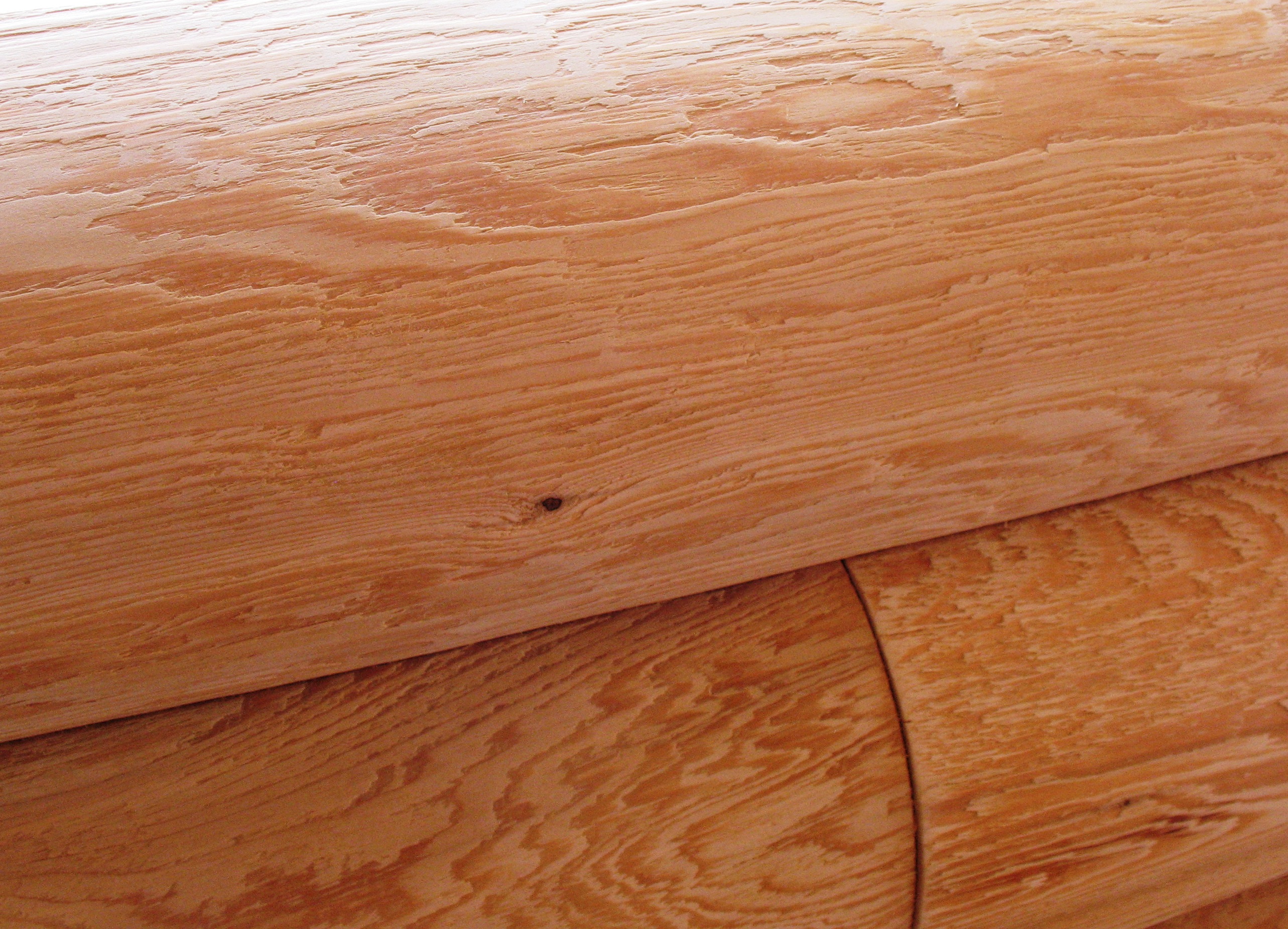
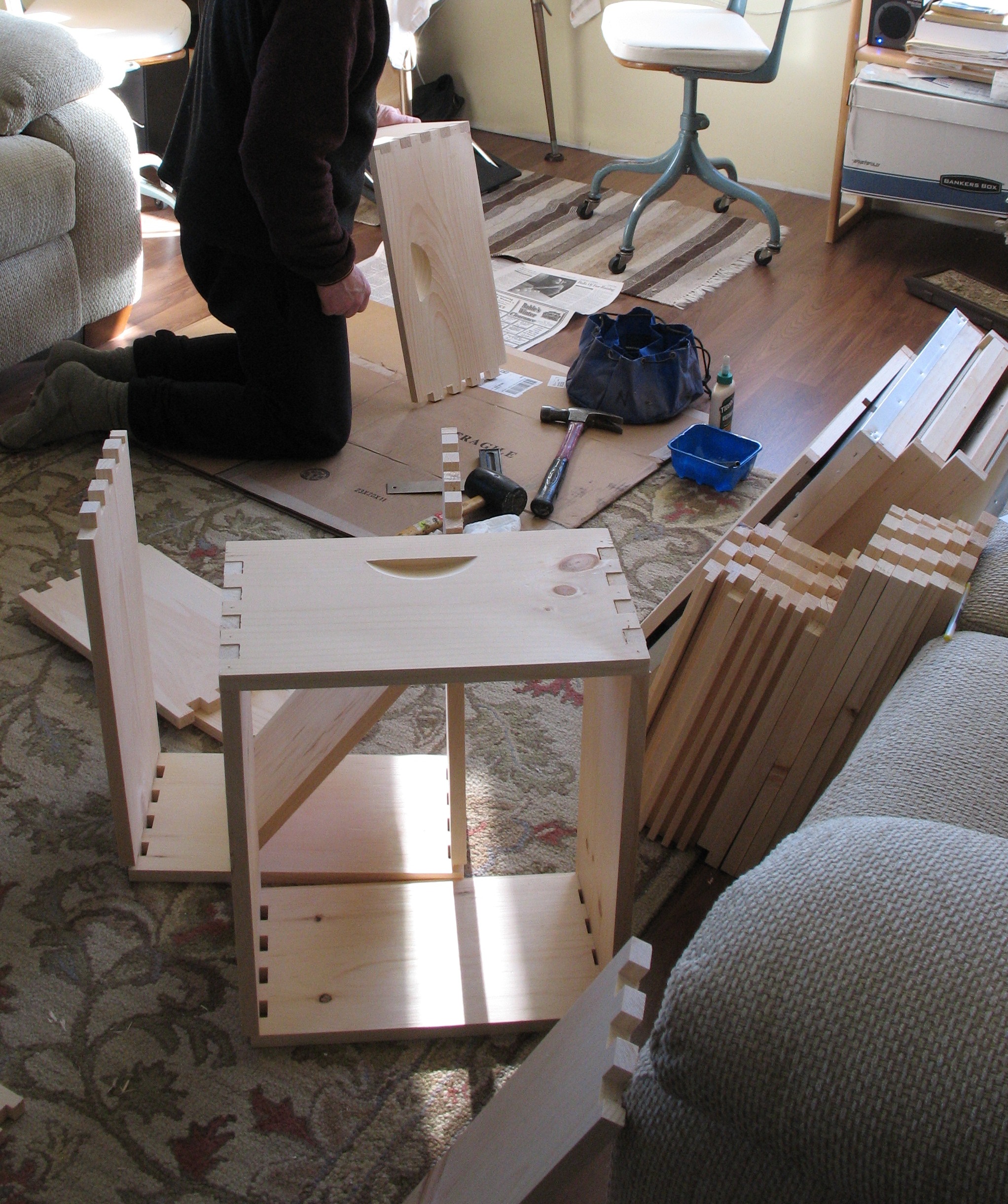
Bunker Mentality–

A.V. Walters–

IMG_1868

We’re building. It’s a small footprint, our cabin at the edge of the woods. We picked the site for its view across the valley, and so that we’d get sheltering shade in the summer. We are months behind schedule. If I were the type, I’d be getting close to panicky. On our walks, I note that we’re seeing the occasional flash of early color in the trees

Initially, we had weather delays—frost well into May, administrative delays—title and permitting problems and then, a comedy of errors on the foundation.

This county requires that building plans be prepared by an architect or a licensed “building designer.” Since we’d already drawn up our plans, we went with the building designer method—to check for technical and structural details, and to make the plans look professional. We informed the designer that there was a slope to the property—but he wasn’t concerned—I guess he figured it wasn’t his department.

When the approvals were finally complete, we hired a local mason to build the foundation. Though Rick is a builder, there are very good reasons to hire out parts of the job to those with greater experience. Most of our building proficiency is from California, where foundations are usually poured concrete (with lots of rebar reinforcement.) California has earthquakes, and they take their foundations seriously. Michigan foundations are often built with concrete block—especially for smaller buildings like our little cabin. It’s heavy work and we are not young.

The plans called for a crawlspace—just enough of a foundation to meet the frost requirements for local code. It’s a cabin, nestled into the gently sloping hillside, with a cozy, low profile. We knew we might have some adjustments because of the slope. We consulted with the mason. He didn’t see a problem, maybe a couple of extra courses of block. He instructed Rick on exactly how he wanted the excavation to be done. Rick did the digging, per instructions, with the Kubota. As he did so, it started to look like the back-side of the hole was a lot deeper than the mason had described.

IMG_1883

On the mason’s return, he too, was surprised by the depth of the hole. He accused Rick of not digging level and true. Measurement proved that it was almost perfect, (a little less than a half inch off, across a forty-foot run.) The mason shrugged. He’d have to go at least an extra two courses of block—and he submitted a revised bid. We nodded. The price seemed fair. After all, what do we know from masonry?

A day or so later, he advised that the wall sill wasn’t high enough, to address issues of drainage and slope, he’d have to go yet higher. This crawlspace was exceeding crawl (except in timing.) We’d gone past duck walk to homo-erectus—though still not a legal height basement. I ran down to the County permits department to advise of the change. The clerk asked me why we didn’t just go all the way, for a full basement. Oh no, it’s just a little cabin. That would be thousands of dollars more and we didn’t really need a basement. It’s a cabin—and with the extra height, we’d be giving up on that snuggled-into-the-hillside look.

It was a Friday night. I went into town for milk and beer. I ran into our buddy, Linus, from up the road. He was picking up a pizza. Linus works at one of the cherry farms, but used to be in heavy-equipment and construction. During cherry harvest he works long days—and pizza-to-go is part of the equation.

“How’s it going with the foundation?”

“Well, it’s a lot deeper than we thought. We’re up to ten courses.”

He nodded. “So you’ll be pouring a floor, then?”

I shook my head. “No, we’ll still keep it to a crawl space—now, it’s just a tall one.”

“No, you’ll be pouring a floor… a four-inch slab.” It wasn’t a question.

I looked up at him. “We really weren’t planning on a full basement, it’s too high.”

“I doesn’t matter. At ten courses, you pour a floor for stability.” He was nodding his head with certainty. He doesn’t talk much, and, for him, this was pushy.

“Yeah? You think so?”

“Four inches—no less.” His pizza was up. He nodded at me, “Tell Rick I said so.”

The weekend was a running debate. We had to have a serious discussion with the mason. Could this be true? Why hadn’t he said anything? Rick reconfigured the plans for a full basement, just in case. If you have to pour a floor, you might just as well go the full twelve courses for a legal basement. And, if you’re putting in a full basement on a slope, you should put in a door on the downslope for a walkout, and, yeah, maybe a window, for light. We tried to imagine our little cabin, perched up on an eight-foot high, block foundation. A bunker. An eyesore! “Don’t worry,” Rick assured me, “If we have to go this route, we’ll bury as much as we can. We’ll landscape it.”

IMG_1904

Monday morning was telling. Rick put it direct to the mason. “A friend said we should be pouring a four-inch, slab floor—for structural reasons—any truth to that?”

The mason didn’t meet his eyes. He scuffed his boot in the sand. After a long silence, he offered, “Well, it is a good idea.” Why hadn’t he said anything before? That made the decision. I zipped up to the county offices with Rick’s revised plans. The clerk nodded.

“You won’t regret it, a basement is really handy.” She smiled, a little smug. But, she’d been right.

For the next couple of days we watched as the courses of concrete block grew, towering above us. We looked for the bright side. You can always use extra storage… right? Rick could have a shop downstairs. We could move the laundry down there, too. And, we told ourselves, the added height gave us a hell of a view from the front porch. The foundation price was now double the original bid. We sighed and wrote progress payments.

During the foundation work the mason’s little daughter took ill. Really ill. She was hospitalized for over a week. Though we only lost one “official” day of work, the family’s trials cost in “attention” time. Who could blame him? If I had a little one at risk, I’d be glued to her. These are the important things in life. We were happy to accommodate.

We did have a little tiff over the details of the floor. We wanted a vapor barrier under the slab. The mason didn’t want to deal with it. We insisted. It wasn’t the norm, he said. He got more than a little grumpy about it. In the end, we’re the owners—we insisted and prevailed.

With the block work and floor complete, the only remaining thing was to insert the rebar and pour concrete into the wall cores. We were anxious for completion—because then the project would be ours again. With us at the helm, we could make up for some lost time. Rick asked the mason about the rebar placement. Given his California roots, Rick was concerned about what looked to be sparse reinforcement. After all, we’d doubled the wall height, so for structural reasons, now was not the time to go light on strength.

The mason threw a fit. Was Rick questioning his professional integrity? He was almost yelling now. The mason went to his truck and took out his copy of the Michigan Code Book. He shook it in Rick’s face. “It’s all in here. I don’t go by California code. I go by Michigan rules. We don’t have earthquakes here!” He threw the book back into the cab of his truck and left for the day.

Tired of being at a disadvantage, Rick came home, went online, and purchased his own copy of the Michigan Code book. But, in the meantime, we had little choice but to trust the mason. He came the next day for the “final pour.” It was a relief. After our inspection, scheduled for the following Monday, we’d finally be able to start our building process. I paid the mason.

Well, “we” failed the inspection. California, Michigan, it doesn’t matter. The code is pretty much the same, no matter, and the amount of rebar in our foundation didn’t meet code. (So much for “professional integrity.”)

I emailed the mason. He called, livid, like it was our fault—accused us of pissing-off the building inspector. We told him to speak to the Inspector, himself. Apparently, that conversation set him straight. We didn’t even have to say that he should read his own Code Book, instead of shaking it in our faces. He was whipped and compliant.

It took another week to get it finished. The inspector told him exactly what he expected in reinforcement—even more than what code would have required, but by this time, the mason was cowed and obedient. We helped with the final pour. Now we have the strongest foundation in the county, a literal bunker. If there’s ever a tornado or a hurricane, we know where to go. Oh yeah, and turns out the vapor barrier, we fought over, is Code, too!

IMG_1914

The foundation took a little over a month. Not too bad, considering all the changes and hiccoughs. It’ll be nice to have a basement, and there’ll be that incredible view from the front porch.

Ripples…

ripples

Cuyahoga Ripples–

A.V. Walters

I was the number-four kid. As is often the case in big families, the younger ones are eager to catch up to the big kids—We wanna do it, too, whatever it is. We walk earlier. We often talk earlier (when we can get a word in, edgewise.) Even as a munchkin, I wanted to read. My older siblings were reading. So, I asked my dad to teach me.

Never one for dumbing down, my dad agreed, but on his terms. I learned to read from the local newspaper, The Windsor Star. By the time I was four, I had a pretty good handle on the reading part, though sometimes the topic was above my head. As a result, my dad spent even more time explaining what the news was, rather than teaching me how to read about it. From then on, I would spread out the newspaper on the floor, everyday, and pore over it. I always saved the comics for last—like dessert. To this day, I’m a news junkie.

I think the hook was set in April, the spring I was ten-years old. That was when the Cuyahoga River caught fire. I was mesmerized by the photo images of something that wasn’t supposed to happen—a river, catching fire and burning, caused by pollution! I became an instant environmentalist. It informs most of my decisions, from where and how I live, to what brand of soap I buy. So, there it is, again, a crystalline defining moment, followed by ripples—only this time, by ripples in a river of fire.

river fire


Two-Legged Hazards…

A.V. Walters–

People just don’t walk. In Two Rock, Rick and I had a reputation. If we went to feed the emus, on the other side of the farm, we walked over. We walked when we visited Elmer, our friendly landlord. We walked to our favorite berry patch, only about a mile and a half away. We would have walked to more places, but there wasn’t much around. (The nearest market was about 5 miles away, and that’s a little far to be lugging groceries.) People noticed. Sometimes they’d roll down the window to ask if you needed a ride. Soon, folks in the area knew us—they’d wave. We heard that they’d asked Elmer about us—you know, what’s up with those two, always walking all over the place? Elmer would just shrug. The farmers in the area all drove pickups, or four-wheelers, wherever they went. It made sense if you carried tools and feed. But it was more than that, one day Elmer dropped by for one of our friendly conversations. In the middle of it, he was reminded of a newspaper article that he’d saved for me. He held up one finger, “Be right back,” and he hopped in the truck for the 500-foot trip to his house.

On his return, I asked why he drove that little hop, to his place. Granted, he had a bad knee, but it was more than that. Elmer and Don always drove everywhere on the farm.

“It’s habit, I guess, we can’t afford the time it takes to walk everywhere.”

I guess my face showed doubt.

“Really, a walk over to the sheep barn would take 20 minutes, the work-day is long enough, as it is. If we walked, we’d never finish what needs to be done.”

So, in part, it’s a habit. Once the workday is done, the habit remains, and you drive to visit the neighbor—if only yards away.

Our walking was noted by the livestock, too. We had a single lane driveway to our side of the farm, about half a mile long. On one side of the lane, there were two large pastures, for sheep and, opposite the sheep, there was a huge field for the dairy cows, next door. That dividing lane serviced the dairy trucks, hay haulers, feed trucks, egg trucks, tractors, numerous tenants, you name it—all manner of large and noisy, vehicular farm traffic. They moved along at quite a clip, too. The sheep and cows grazing mere feet from the hurtling trucks didn’t even flinch at the noisy invasions. But, pedestrians? You’d have thought we were wolves. We’d walk down the lane and the sheep would flee as though their lives depended on it, lambs galloping, followed by lumbering, milk-heavy ewes. The cows would stare, chewing, and as we approached, mosey on, away from the fence line. Of course, if you carried a feed-bucket, those same sheep would mob you.

We’re back to our walking ways, and our neighbors have noticed. They drive by and wave. Yesterday we walked into town, just over a mile, to check the mail. Like Two Rock, the roads here are not very pedestrian friendly. On the way, we spooked a doe and her fawn. They’d been poised at the road’s edge, readying to dash across. It’s a busy road. Michigan statistics show that every year over 60,000 of them don’t make it to the other side. Deer seem oblivious to two or three tons of fuel-injected steel, screaming towards them at 70 mph, and yet, when confronted by a couple of pedestrians, that deer bolted back into the swamp, along with her equally spooked, spotted fawn. Maybe I should check myself in the mirror. I’m a little afraid of traffic—but the deer are afraid of me.