Archives for category: Uncategorized

Five Stops

I have advantages. I work from home. Though we live rurally, it’s only twenty minutes from “town” –and only a mile from the little village that gives us our postal address. I am freed from any daily commute.

That’s not an accident. We have, for years now, been making concerted efforts to reduce our carbon footprint. We’re not just frugal; diminishing our fossil fuel usage may be essential to survival on the planet. Minimizing impact informs our daily choices.

We maximize any driving trip to town. Unless it’s an emergency (and I’m yet to have one) any town-run must include business at a minimum of five stops. That means we make lists and combine trips to reduce unneeded transport.

We try to keep carbon-footprint in mind with purchases–where possible, buy local. While we’re at it, we also pay the extra for organic. Though I’m mindful of our pennies, I can’t expect to save the planet if I subsidize its poisoning with pesticides; erosion with poor soil management; or support unfair wages and conditions at home, or abroad. This takes the Golden Rule at its word–treat others (and the planet) as you would like to be treated.

I’m not sure we can turn this juggernaut around in time to keep the planet habitable. I hope so. I have no children, but I still think we have a duty to the children of today, and tomorrow, not to kill the only world we know. We cannot shrug our shoulders and wonder “What’s a person to do?” The time for wondering has long since passed. It time to take individual action and responsibility. It adds up–if enough of us take the pledge.

And besides, even if the science is wrong, and we still change to reduce climate change, what could be the downside? If our air and water are cleaner for our efforts, where is the harm? If, to reduce the energy costs of transport, we support our local farmers and build sustainable communities, would that be bad? If, to save on wasted energy, we insulate our homes and change our ways to reduce unnecessary consumption, who could be hurt by this? If we pay our employees a living wage, and in so doing, build strong and sustainable local economies, won’t we all be stronger for it?

So, I plan and make the extra stops. We plant trees for a future we will never see but that we know, will be better for our efforts.

Where to Put the Wall

I suppose it depends upon what you perceive the threat to be. I am not threatened by the idea of people from the other side of a border. After all, most of those making the trip are hard-working, indigenous people of the land. Weren’t they here first?

Integrating a large number of outsiders can take a toll on a country. And I don’t mean non-citizens, or people who look different than you do. Think, for just a moment, how the folks of Oregon or Washington feel about newcomers from California. For that matter, how nicely did California treat the Okies during the dustbowl era? (A clear case of early environmental refugees.)

Maybe the better approach would be to look at the underlying reasons why people are on the move. That could better inform out decisions. Buried in the terrible news coming out of Syria, or Yemen, are the untold stories of failed crops, or wells run dry. The same is now true in Central America, where traditional sustenance farming is failing for lack of rainfall.

Look to the trouble spots in the world; behind many of them you will find the early fingerprints of climate change. I have friends who have been burned out in California. Should they rebuild in a community ravaged by fire–when predictions of an ever-drier future hang over their heads? Where should they go? Tens of thousands of Puerto Ricans have moved to Florida after being ravaged by hurricanes. No doubt they’ll be on the move again, along with their new neighbors, as the Gulf Coast continues to suffer from repeated, and ever more furious hurricane seasons.

We do not acknowledge climate change refugees, internal or external. We characterize those on the move as “economic refugees” without looking at underlying causes of their economic failures. I suppose that would require us to look at what we’re doing to the planet. That might be too painful of a view in the mirror. But, so long as we avoid the larger truths, we’ll compartmentalize human suffering into ‘us’ and ‘them.’

At some point, will those of us in the Mid-West bemoan the influx of water-seekers from Texas and California? Will climate winners and losers have us reconsidering the Mason-Dixon line? State lines? Our failure to consider long term policies may result in the kind of short term survival thinking that loads up the truck to look for ever-decreasing greener pastures.

In-box Exhaustion

Oh, will it ever end? I make excuses–oh it’s the end-of-quarter reporting period, or the end-of-the-month, but that’s really not it. In fact, the constant alarm, the never-ending solicitation for funds has become the new normal.

Not that there aren’t very real and important issues. There are. I am alarmed by the rapid and dramatic changes in our climate. I am overwhelmed by the abdication of civility and procedure in government. I am heart-broken at our nation’s apparent devolution into bigotry and racism. I am undone by the damage done to our democratic institutions. Sigh.

But, my inbox is overflowing. I often get upwards of two hundred emails a day, most bearing a plea for help and an “opportunity to give.” There is just not enough of me. I have to pick my battles.

Maybe, just maybe, it’s enough to walk my talk. I keep a low-carbon footprint. I minimize driving. We keep the house on the cool side, and eschew air-conditioning. We garden and seasonally grow much of what we consume. We recycle and, more importantly we exercise our buying power to match our values–minimal packaging and basic.

So many of our elected representatives have gone to the dark side. They serve the interests if the ‘donor class’ instead of their constituents. (Then they run against the very institutions they occupy!) We live in a constant state of faux-alarm. It’s exhausting. Meanwhile, in the brouhaha, we lose precious time to bring ourselves back into a sustainable equilibrium. And the emails just keep coming.

I am old-fashioned. I still write actual letters to my representatives. Like any good old hippy, I protest, standing shoulder to shoulder with other aging environmentalists, taking solace in the cold that we can still muster a crowd when it counts. I could pull the plug on my news. I have friends who have done just that. But it seems that removing thinking people from the mix just leaves us with a runaway train.

My primary coping mechanism is to spend time in the woods. I gather firewood, I forage–sometimes I just walk about noting what wildlife is active and leaving its mark. Beyond that, I do what I can, and take comfort in the fact that I am older. Caring is a young person’s sport. It’s some relief to see some of them step up to save the planet that they will inherit. Perhaps it’s enough to be a good steward to the things under my control and to enjoy the simple beauties of season and nature as I go about my day.

North By Degrees

kindling cracker

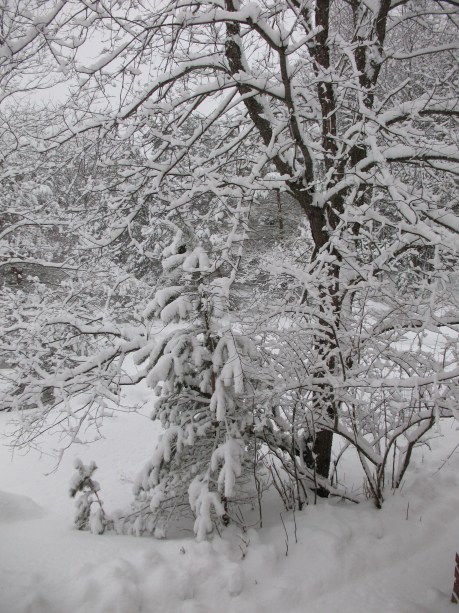
It’s winter. Though we’re not yet through with summer business, when I look out the window, that blanket of white is pretty convincing. Though temperatures have been pretty mild, there’s no doubt that the season is upon us.

We don’t mind winter. It slows things down. And we love the cozy-evenings-with-a-fire-in-the-woodstove part. We’ve not yet reached the coldest part of winter, where a fire is needed round the clock.

I’m largely responsible for keeping the woodbin stocked from the woodpile. And I chop most of the kindling. That’s the only part I don’t much like. Admittedly, I’m not what anyone would call graceful or coordinated. Swinging a sharp hatchet near my fingers and thumbs makes me nervous.

I’ve been eyeing those ads for a “kindling cracker,” a handy device for holding firewood whilst splitting it in a near-effortless, and finger-safe, procedure. They’re ingenious, and elegant, but not cheap. I’ve been considering it for a couple of years; it’s a woodburning accessory that I could almost convince myself is a safety necessity. As is often the case when it comes to Northern living, I thought I’d ask my sister—who’s several hundred miles north of me—and has heated with wood for her entire adult life.

My sister had never heard of it. “Kindling? Why are you cutting so much kindling?”

“To start fires, of course.”

“Well, how many fires do you need to start?” (I could tell that she wasn’t going to be much help with my rationalizing.)

“At this time of year, we start a fire every day.”

“Really?” (What? Is she just showing off?)

“Don’t you need to cut kindling for the season?”

She laughed. “Not ‘for the season.’ We start a fire in October. Then it burns until May, 24/7. And you?

“It’s not cold enough to burn round the clock. We’d roast.”

“Ah!”

And that, was that. Surely she’ll be of no help in my consumer decision. I’m not entirely sure if it was as cut and dried as all that. I could be the victim of Northern snobbery. But I’ll never know.

IMG_2470

Snow Forts for Chickens

I’m new to chickens. I did live on a chicken farm for seven years–but I was not responsible for the chickens. And, in Two Rock, they don’t really have winter. Here we have winter, and it’s a tad early this year. If not early, I’d suggest that it is earnest. We have a solid 6 inches–and that’s after the first two or three melted immediately upon landfall. It’s not when snow first falls that makes for winter; it’s when it sticks.

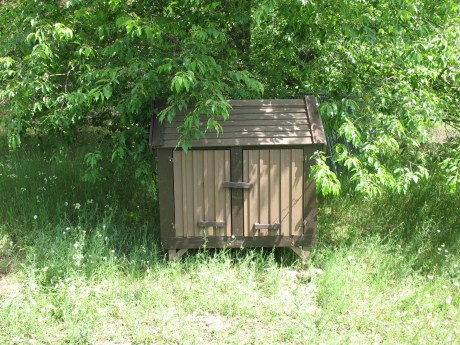
Anyway, three of the four chickens are reluctant in snow. The fourth has been roosting all over the chicken pen. We’re not sure if she’s a fan of winter, or if the other chickens are giving her the cold shoulder. The chicken coop stands up on legs. Before the snow fell, the chickens liked to hang out under the coop–out of the sun or rain. Without that breezeway, the chicken territory gets pretty small if the chickens won’t do snow.

So far, we haven’t heated the coop. We’re contemplating a low wattage bulb for heat and light (so as to encourage egg laying.) But when we open the coop doors for feeding, it’s not really cold in there. Or so it seems.

Today was the first day that the chickens’ water was frozen solid. I’ve ordered a thermostatically controlled water dish–and now I’m even more anxiously awaiting its arrival. In the meantime, I’ll have to be more dilligent about making sure they have fresh water.

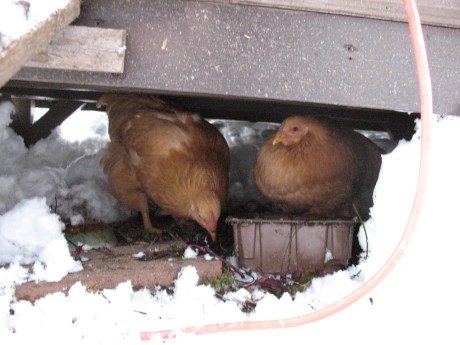
I’m not sure if this is a normal Northern chicken strategy, but today I built them a snow fort. The snow is the perfect consistency for snowmen, or fort building. So I built walls along the edge of the coop–essentially banking it in to create a snow wall. This will keep the area under the coop clear–and warmer. It’ll also help keep the coop itself warmer.

IMG_2471

Thus far, it’s a complete success. I put the chicken scraps under there and two chickens followed those treats into the fort. They haven’t left yet. The other two chickens, upstairs, are making a racket, redistributing their fresh bedding. Chicken Nirvana. I don’t think this will keep the water from freezing, but it seems to be making for happy chickens. Has anyone else out there built snow forts for chickens?

IMG_2472

What I saw was a dignified and credible woman, describing an event that had derailed her early life. She is a survivor; she took this frightening and indelible experience and used it to build a life to help others. Christine Blasey Ford is an American hero. And then it was Kavanaugh’s turn. Regardless of which of them you believe, Kavanaugh’s performance was an embarrassment. He was belligerent, angry and self-centered. It was an ugly little display of a temperment that has no place on the highest court in the land.

As for us, the voters, what you do with this information is critical to 2018 and beyond. As a sexual assault survivor, I take a great interest in whether Senators see fit to place an assailant on the Supreme Court. And not just any assailant, but one who has not, in any way, seen fit to admit his conduct or redeem himself. Of course, I don’t have all the facts, but I am highly suspicious of a process that refuses to ferret out the facts. The Supreme Court is the last arbiter of the balancing of rights. We cannot afford to give a position on the Court to a nominee who may not view women, or minorities, as citizens entitled to the full range of rights, responsibilities and protections of these United States. If there is any doubt, and there is, the nominee must be rejected.

If Senators view the advise and consent process as just another “pass” for the old boys’ club, if they do not fully explore a candidate’s qualifications and appoint the poster boy of white privilege, we will remember…and we will vote accordingly.

robber bees

Even well after the hive was removed, the mob refused to disperse!

The Plundering Season

It’s September, a time when beekeepers assess whether the season, and the bees, have produced enough honey to permit a harvest. It’s also a time when the bees themselves try to maximize their stores for the winter. Responsible beekeepers will leave enough honey in the hive to allow the hive to overwinter. Others will take all the honey, and feed the bees sugar water. (You can tell already where I fall on the spectrum.) I think that the perfect food for bees is honey, and that’s what my bees get.

September is also the time when you really need to be prepared for bear attacks on the apiary. Bears are readying for winter, too, and honey is a great (and tasty) source of calories to fatten up for winter. But bears aren’t the only predator.

September is the robbing season. The robbers? Other bees! Okay, so there are other flying robbers as well, wasps and yellow jackets, but bees are major culprits. If a hive is weak, queenless or disorganized, other bees can seize the opportunity to raid their stores of honey–or even wax. That hive that was limping along, but suddenly seems very active? Look again! That new activity might just be looting neighbors!

Not only is robbing devastating for the hive/victim. It can be a loss of resources for the beekeeper. Sometimes a less than thriving hive is kept for combination with another hive at the end of the season–or its resources can be used later–honey for overwintering stores or wax in the spring for splits or new bees. A robbing frenzy often kills the weaker hive’s defending bees. Sit close and you can watch the battles at the entry.

There’s another reason to discourage robbing. Why was that hive weak to begin with? If the reason the hive wasn’t thriving was because of mites or pathogens–robbers may well carry them home and spread disease*. Serves them right, eh? Well, consider that the culprits are often members of one of your other hives. Robbing only amplifies bee losses.

Recently, we lost a hive to robbing. As the home-bees were thoroughly beaten, we sealed the hive to reserve possible resources for later AND we put entrance restrictors on the remaining hives. Frenzied robbers deprived of their target often pick the next weakest hive…and so on. Like any mob, they’re not easily directed or dispersed.

Over the weekend we brought some “empty” boxes to a bee event, to use for demonstration purposes. Apparently there was some leftover honey in the empties. On our return, we left the demonstration hive in the back of the truck overnight. By morning, the robbers had found it and the truck was in a cloud of bees! They were so loud and so numerous, we wondered if we had caught a swarm. No such luck. We had to suit up, and then break down the hives (far from our bee yard) and let the bees disperse. We didn’t want to bring that robbing frenzy anywhere near our hives–even if it was our bees in the mob. It took hours before we could get back into the truck. It was a dramatic display of seasonal bee behavior.

We tend to think of our bees as docile and malleable. But they can be triggered to behave as a mob. We hear from other local beekeepers that this was not a good year for honey production. Our own bees seem not to have suffered, but apparently the word is out that resources are scarce–and regardless of actual hive conditions–the bees are listening to the rumor mill. We’re keeping an eye on the bee yard to jump on any indication of mob rule. Who knew that we’d end up as bee referees?


* If you suspect that a weak hive was diseased–you should thoroughly investigate and diagnose, before using its resources in other hives. Sometimes all you need to do is to let the hive “freeze over winter” and sometimes you need to treat the hive equipment–and sacrifice any resources. The good news is that often you can still harvest any honey for human consumption–so it’s not necessarily a total loss.

cheesecake

Holidays with the Family

It’s always interesting, getting together with family. Holidays spell festivity, good food and indulgence. By that, I specifically mean dessert–which is where it gets interesting.

My family is rife with allergies and food intolerances, and it only gets worse with age. Some cannot do sugar, some gluten, some dairy from cows. It’s like cooking in a straight jacket. I cannot complain, as I am one of the afflicted. So, while it’s a departure from my usual fare, I’ll share a delicious recipe, in time for Labor Day.

Cheesecake (well, sort of)

This is a simple, elegant temptation, that even normal people can enjoy.

Crust

one cup dried figs

one cup finely chopped pecans

one half cup boiling water

one quarter to one third of a cup gluten free flour

Chop the figs finely (about a quarter of an inch bits). Add the boiling water to the figs. Stir vigorously a couple of times as the mixture cools. Add the pecans and the GF flour and mix to a thick paste.

Lightly oil a pie tin and press the mixture into it so that it looks like a pie crust. It’ll be about a quarter inch thick–and a little thicker at the rim.

Pre-bake on a low oven (about 300 degrees) for ten minutes–just to the point where the mixture isn’t sticky.

Filling

Approximately 10 ounces creamy goat cheese. (my package from Costco is 10.5 oz., and I’ve used as much as 12.)

three eggs

generous teaspoon vanilla*

one quarter cup honey*

Beat the goat cheese and eggs together until smooth. (If using mechanical equipment, do NOT whip a lot of air into the mix. I use a wooden spoon and a hand whip.) Add the honey and vanilla and mix thoroughly.  Pour mixture into the pre-baked crust and bake, on a low oven (still 300 degrees) for about an hour–or until the center is firm. Remove and cool–then chill. The low oven is really important–it keeps the cheese mixture from becoming friable and dry–and it keeps the sugars in the figs from carmelizing and making the crust dark and brittle. If you plan on a topping, press the crust mixture a little taller above the line of the cheese mixture–just because it looks nice.

*Variations on a Theme

You can use sugar, instead of honey–but you must be sure to beat the mixture until the sugar has completely dissolved. Sometimes, we put a fresh berry topping over it, and if so, we stick to just the quarter cup of honey. If it’s to be eaten without a topping, we sometimes increase the honey/sugar to one third of a cup. We usually use vanilla, but have been known to play with this. For example, if you want to put strawberries on top, you may want to substitute the vanilla for Grand Marnier, or Cointreau (or, if you decide to throw some chocolate chips into the cheese mix–chocolate and orange are lovely together.) You could play games with this in many directions–Kahlua and some cardamum, or just the cardamum and a little cinnamon, if you wanted to put peaches on top.

Toppings

a cup and a half to two cups fresh fruit, (usually berries)

a third to a half cup sugar

(if the fruit mix is runny, add a teaspoon or so corn starch**)

spices to taste, depending upon fruit

Take half of your fruit and mash it up. On medium heat, add the mashed fruit ant the sugar/honey (and corn starch if used.) Stir over heat until the sugar is dissolved (and/ or mixture has begun to thicken). Add most of the rest of the fruit, and remove from heat. Allow it to cool before spooning over individual pieces of cheesecake.

Alternatively–with really great fruit, skip the sugar and just put fresh slices on top of each slice of cheesecake.

Possible combinations–strawberry or strawberry-rhubarb, blueberry, raspberry or blackberry, peaches, kiwis (alone or with strawberries). Consider serving with melon balls and a sprig of mint.

** if corn is a problem, you can thicken with tapioca, gelatin or even potato starch–but be careful with potato starch, a little goes a long way and it can make the mixture taste gummy.

IMG_2437

First, you have the place. You’ve looked at it, in all four seasons. You note the light, the winds, and the soil. You prepare it, deeply digging in nutrients and organic matter. Then you have to pick the candidate–what tree will grow there? An apple? To be ripe in what time frame? To be pollinated by what other apple? What kind of apple–eating, canning, cooking? An apple to withstand the season you know, an apple to withstand what the season may be in the future. An apple to be strong against pests and diseases. And you read the description of the taste of that apple. There is nothing so empty, so dry,  as a written description of the taste of something.

You do the process, over and over, for each tree in the orchard. It can take weeks of research. Not only do the selections have to meet your needs and your tastes, they have to work together in the orchard. You want to stretch your various harvests to match your available time. It wouldn’t do for everything to come ripe all at once. They have to be pollinating partners. They have to work as a team.

Then you plant. And feed. And water. And wait. Every year you tend and prune, until your trees become like pets. You love them for what they are, and in the meantime, you’ve almost forgotten the objective of raising fruit. You respond to their emergencies. You address their problems. You worry over them through the long winters. You admire their growth and ever-increasing sturdiness.

Then, one summer, there are apples. The first of the dooryard orchard trees to come to fruit. You watch all season, waiting for them to be ripe. Waiting to sample the results of all this effort, fearing that after all this, the fruit could be… somehow wanting.

Ah! It’s the birds who alert you that the fruit is ready! And if you don’t move fast–the birds will get them all! Still, it’s a good sign. The birds love the apples! You pick one and take a bite. Your first bite.

And it’s incredible. It bursts with flavor. It is a celebration of summer–this early season eating apple. Pristine! Who knew you could be so great?

It’s still a small tree, with not so many apples. Yet, every day you enjoy another, and another. Soon they’ll be all eaten. But we have the memory of this first success to carry us forward with confidence. This wonderful little apple tree will now become part of our every August. This is the earliest Thanksgiving I’ve ever celebrated.


We didn’t get much done Saturday. We’ve broken ground on the new barn, and we have digging to do. Still, the weather report called for heavy rains–it’s not a great idea to dig on slopes, in our sandy, fragile soils, when a deluge is expected. The air was heavy and the winds unsettling. As the day progressed, the prognosticators backed away from their initial forecasts. Maybe no thunder or lightning. Maybe just a little rain. Too bad, we very much need the rain.

In fact, I think we needed all of it–the rain for our parched fields and forests–and the wild and stormy part, for the release it offers. Everything, these days, feels pent up. Finally, during the night, we woke to rain, enough to slake the parch, but without fanfare. Normally, a soft steady rain would be enough to satisfy.

I once read an anthropological study that revealed that any society could be brought to its knees, through a fundamental challenge to its belief system. Indigenous cultures, defeated by superior technology, never rebounded after crushing defeats. The concept of “decimation” is important, in its original meaning–reduction by a factor of ten–because at that point a society becomes precarious. The same can be true with any fundamental change–loss of faith, environmental collapse, the battles in information technology–really, any breakdown of societal norms. I fear that when coping mechanisms become stretched, both the individual and societal glue begins to fail.

We have always had corruption. We have always suffered bullies and unfairness–be it in the school yard, the workplace or in governance. But we have been buoyed by our belief systems. Whether in a religious sense, or in the self-correction of societal rules, or in adherence to the Rule of Law, we have believed that something larger than ourselves would preserve fairness. Though there may be individual failures, justice itself is supposed to paint with a broad brush. When enough people lose faith in fundamental fairness, they lose the incentive to participate according to the rules. I fully recognize that our systemic protections have not been universally held. Folks at the bottom of the economic heap, minorities, oppressed people have long felt the sting of systemic unfairness and injustice. And there has always been privilege on the other end. But I have had faith that there was an inexorable path to improvement–an evolution of human spirit that would prevail, bringing fairness and prosperity to an ever-widening circle of humanity.

Now, I am not so certain. Sure, one has to expect the inevitable pendulum cycles. And our system is built with checks and balances…hopefully flexible enough to adjust to changing times. But, to be self-correcting, we need a core belief in fundamental principles, in the ideas that society is for the all, and not just for the few. By this I do not mean that we all have to adhere to one path; our strengths have always been in the interplay of our ideas. But we seem to have lost the decency of a belief in a level playing field. I do not see that ideal in our elected representatives. And I don’t see it playing out in popular culture. I am alarmed that bullying, mean-spirited selfishness and winning without regard to the rules seems to have infected our public square. Winner takes all never works in the long run.

There are supposed to be universal truths. Things on which one can rely. Now, not even the weather is assured. Isn’t anyone else alarmed? I saw a satellite photo yesterday that showed current wildfires–it was disconcerting. Fires driven by heat waves in Scandinavia? Fires over wide swaths of our Western lands? Heat domes and polar vortices play havoc with reliable patterns of weather and season. And yet, despite clear indications of human-induced change, people are unwilling to apply fact-based observations of cause and effect to the consequences of their actions. And why would they? If the rules are broken–if cheating becomes the norm–if a reality-based world has become victim to a selfish, slash-and-burn, tackle your way to the top mentality, what is the motivation for playing by the rules? Haven’t we been told that that’s for suckers? If you can’t rely on something as basic as climate, have we found ourselves in a relentless tug-of-war between our immediate interests and those of generations to come? If so, how will we explain to our grandchildren that we chose corruption, SUVs and single-use plastics over the habitability of the planet we leave to them?

Sunday’s gentle rain was good for the garden and the orchard trees. It’s been cool and cloudy since, with the promise of more rain in the air. But I’m not sure if that’s enough. I’m afraid we may really need the storm.


Last week was the hottest week in recorded history. This is no Chinese hoax. We’ve known for decades. Still most are unwilling to make “lifestyle” choices needed to avoid climate catastrophe. What can I say?
A friend of mine said it all, when she received the invoice for mandatory flood insurance for her business. FEMA had changed it’s flood maps–acknowledging new realities. She was shocked.
“What did you think was going to happen?” I countered. “We’ve been talking about this for years. This is climate change in action.”
She looked as though I’d slapped her…”Not in my lifetime!”
Not quite climate denial, but a difference without a distinction.

Just Us Chickens

A.V. Walters

IMG_2417

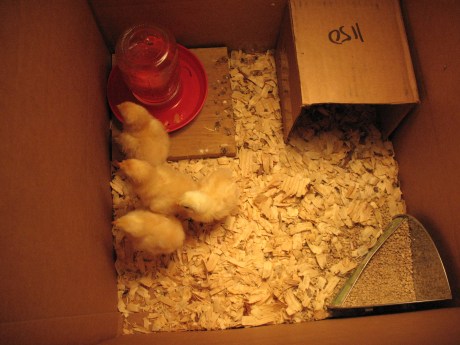
I’m not one much given to ‘cute.’ Never have been. We got chickens because we prefer the taste of fresh eggs, and we like to be able to ensure the quality of the food we eat. Our chicks eat organic.

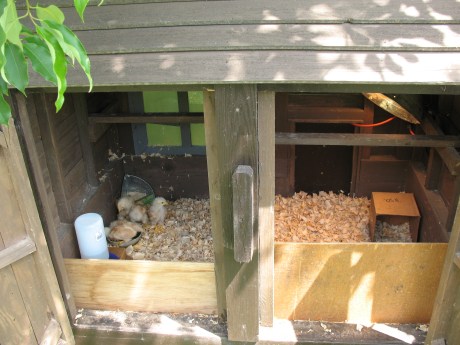
I resisted the idea of naming them. However, they have earned descriptives–if only because we need to be able to identify them in conversation. When they first arrived, there were two very small chicks and two larger chicks. Then, one of the small chicks (whom we identified as “Yellow-head”) had a burst of development. She is now the largest. The other smaller chick is still well behind all of the others, both in size and feather development. Despite being the runt, she’s no dummy, and has strategies for compensating for her size. I’ve been calling her Einstein. The middle two have been neck and neck in their growth–and sometimes it’s hard to tell them apart. One walks taller–and so I refer to her as ‘Upright,’ while the remaining mid-sized chick moves about with a sort of nervous, crouched, posture. Perhaps it’s wrong, but I call her ‘McNugget.”

My sister has chickens. They have them for the eggs–and because the spent chicken litter is a great way to speed your compost and build high quality soils. But her chickens are pets. They have proper names. She fully speaks chicken.

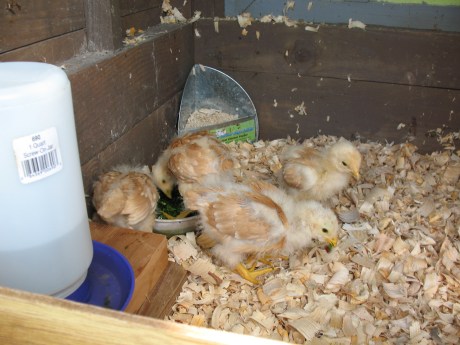
Chicks are a lot of work. They are filthy little creatures. I should have remembered from when we raised emu chicks, but I am at a loss to understand how an animal that will spend hours preening its feathers will also shit in its food bowl. Perhaps it’d be easier if the “cute” factor resonated for me. Oh well. After just two weeks, they’re looking moth-eaten, and teenage scruffy. They not fuzz-balls anymore, but neither do they have their full plumage. Only a mother hen (type) would find them attractive at this point. They are, however, psychologically interesting.

IMG_2418

Even at this stage, they clearly demonstrate the concept of “pecking order.” Yellow-head is the dominant and lets them all know that she’s in charge. After the first week we gave them a perch. It belongs to her, the queen of the roost. She won’t let anyone else on it. The others get it. They stay on the floor–except for the occasional hop up to try it out–when Yellow-head is asleep.

At first, the three larger birds would crowd Einstein out of food bowl access. Now she just pushes in between them. And if the rest are asleep, Einstein takes advantage and fills up when there’s no competition. I don’t know if this is intelligence, or just survival. Einstein does not challenge the pecking order. Nor does she spend much of her time socializing–grooming or cuddling together for naps. The two middle sycophants are forever nestling together, grooming each other or Yellow-head. That must be chicken bonding. So far I don’t see any outright pecking of the little one–though I’m watching for it. Chickens can be vicious. Maybe she can continue evasive maneuvers and avoid that particular bit of chicken ugly.

Yesterday we moved them from the basement to their coop. They’d outgrown their cardboard box. Seeing them in larger digs is a relief–they look much better. Relief from overcrowding seems to have minimized aggressive behaviors.

IMG_2420

Watching their interactions reminds me of our current social order. As a species, we need to move beyond bullying and ass-kissing. We need to foster resilience, independence and courage. As much as I’m impressed with little Einstein, it isn’t enough to keep your head down and mind your own affairs. We need to stand up for our convictions. Maybe we can find strength together. Otherwise, we’re just a bunch of chickens.

“Victorian Cool”

A.V. Walters–

And I don’t mean steampunk.

I’ve never lived in a home with air conditioning. Of course, that’s easy for me to say, most of my adult life was in Northern California, where there was no real need for it. Still, even with my memory of hot and humid childhood summers, we opted not to provide for summer air when we built here.

You cannot solve your climate change problems using fossil fuels. It’s as simple as that. At best, you can kick the can down the road to make the present more bearable–knowing that in so doing, you’re stealing from the next generation. When you build a home from the ground up, you cannot point the finger at the former owners; you need to walk your talk on your carbon footprint.

When we sited the house, we selected the location, in part for summer shade. And we insulated. Recently, following a Memorial weekend heat wave, we bought screens for the windows. This is Michigan. You cannot open a window without screens, unless you’re willing to donate all your blood for the cause. It was always our plan to use natural air movement to survive the summers.

North Americans are complacent about getting ready for climate change, as though our problems could be resolved with adjustments to the thermostat. But this wasn’t always the case. Historically and architecturally, we have had cooling solutions that preceded air conditioning. Tall ceilings, double hung windows, roof overhangs (and/or curtains), along with the occasional fan, kept the Victorians cool. It can work for us, too.

I’m continually amazed by my midwestern neighbors, houses perched wherever view is best, with no shade protection from the summer sun. Their air conditioners kick in before 10:00 am. What were they thinking?

Within a couple of hours of installing the screens and opening the windows, the temperature in our house dropped by eight degrees. By the next morning, it was a little chilly–a perfect prelude for the expected heat the following day. It looks like the house will perform according to plan.

You don’t need to start from the ground up to take advantage of Victorian wisdom. Just open up the house in the cool of the evening and close it up again in the morning, before the heat of the day. Draw the drapes. Install an attic fan. Invest in some extra insulation. Turn down the air conditioning a couple of degrees. Consider window awnings…remember them? And always, always, plant trees. Together, we can make our environment more habitable, inside and out.

It can be done. The Victorians did it. How else could they have endured the summers in all that silly clothing? Can you imagine corsets in the heat?

IMG_2416

I Win!
A.V. Walters–
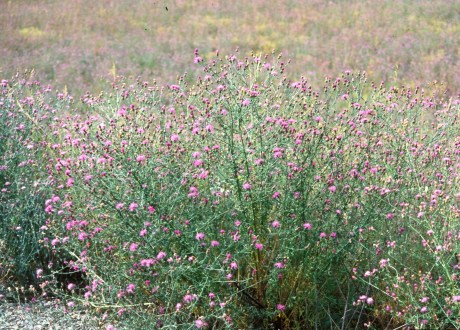
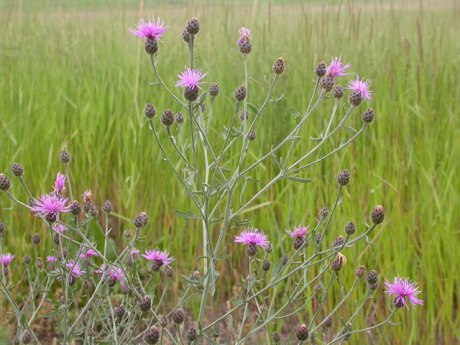
There’s been a running, albeit subliminal competition around here, regarding weeds. Rick and I each have a target-weed, a weed that, in our minds, is the worst weed. It won’t be a surprise to anyone following this blog that my nomination for the most evil weed is spotted knapweed. Rick, on the other hand, has long held out for a weed we’ve encountered before, one we’ve always called “choke weed.”
I am among the first to admit that choke weed is a worthy opponent. It is wildly invasive and opportunistic. But, you see, I’d done my research on the knapweed, aka knotweed, aka star thistle. Spotted knapweed is evil in so many ways: it out-competes the natives by poisoning the soil around it, for up to three years (both to seed germination and to neighboring plants): its water storing, tuberous roots steal all the available water; it propagates both via runners and seeds (and its seeds are viable in the ground for up to seven years); and, if you pull it, any part of the root left in the soil can re-develop into a new, healthy plant. It is so toxic, to other plants, you cannot safely compost its remains–or the resulting compost will carry the toxins back into the garden. As far as I can tell, nothing eats it. In my books, knapweed has a corner on evil plant hegemony.
Rick’s pick seems to run hand-in-hand with the knapweed. They manage to co-exist in some kind of evil pact — choke weed isn’t bothered too much by knapweed’s evil ways. I’d be talking conspiracy here, if I didn’t know that that would paint me as some kind of a weed nut. But, since we didn’t actually know the choke weed’s real name, and modus operandi, we had no way to actually judge which of the contenders was the worst.
Not that we don’t respect each other’s opinions in the garden, but we did have a bit of a schism in terms of weeding priorities. Schism is an ugly word, with an ugly history. And yet, there it was. While playing lip-service to the noxious qualities of each other’s weed of the day, really, we mostly spent our weeding energies on our own respective weeds.
Finally, I broke down and did the research. Rick’s choke weed is commonly known as red sorel. It’s an invasive in it’s own right — again, spreading aggressively both by runner and seed. Like knapweed, it is deceptively attractive in its own way. And, left in the ground, any part of its runner-like rhizome will generate new red sorel plants. And it will out-compete and choke out native plants or garden plants. But it doesn’t hold a candle to knapweed’s toxic legacy. 
I win.
Lucky me, eh?
I suppose the good news is that this information has re-animated both of us in our eradication quests. Both of these invasive weeds are worthy of our directed intentions. At least on this, we can both agree. We will prevail. (Well, at least in our dreams.)

“Conventional Wisdom”

A.V. Walters–

IMG_2415

Conventional wisdom says that bees located in the shade will be cranky. Conventional wisdom says that bees that get too hot in the full sun, will be unproductive and may tend to swarm. We’ve seen hot bees in the sun. They “beard” on the outside of the hive. Once the sun is up–and the heat–they return to the hive and quit foraging. What’s the point? The nectar dries up. Back at the hive, it’s too hot to go in. Other bees are busy, cooling the hive with the wind from myriad wings. What would conventional wisdom have us do?

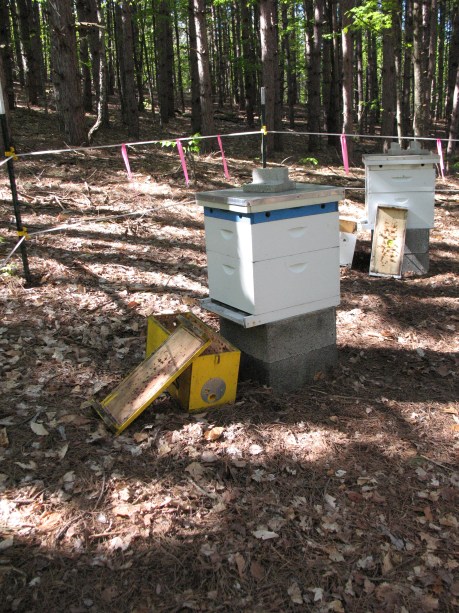
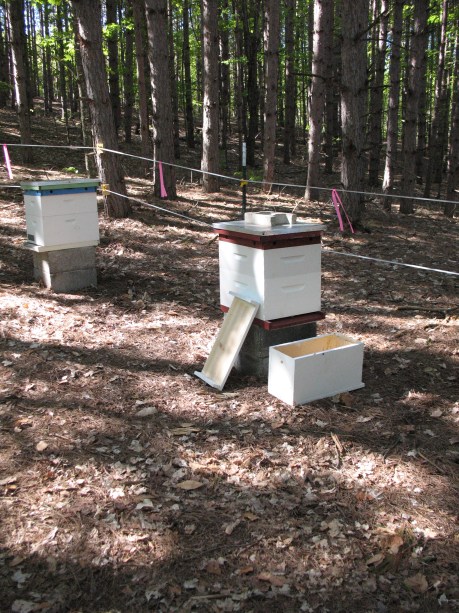
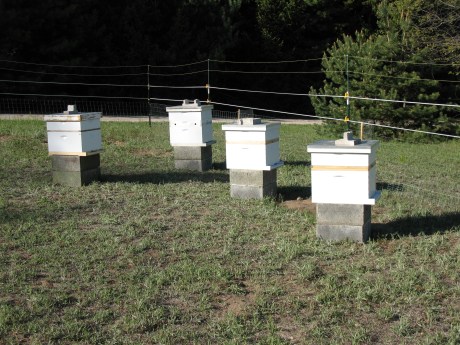
We have relocated the bee yard up the hill and into the pines. There were plenty of reasons to do it: to avoid wind blown pesticide contamination from the adjacent farmer down at the bottom of the hill; to put more distance between the bees and any neighbors; so that the bees would not be visible from the road (some of our beekeeping friends have experienced thefts!); to get the bees out of the direct sun during the hottest part of the summer; and to reduce bee “issues” in the garden, that can lead to gardeners being inadvertently stung.

I’ll miss being able to see them from the house. Bee hives have a way of saying, “here we are, and we belong.” This is the first year that the orchard really looks like an orchard–and that, along with the garden, will have to satisfy our visual boundaries. The bees’ new digs enjoy the dappled light of the pines–and a regular refreshing breeze. It’s only a few minutes walk, one that will pull us into the forest with more regularity. And it’ll be cooler for us, too, during the dog days of summer. Often beekeeping requires suiting up–and those extra layers can be really stifling in the heat.

Rick put up the new fence. Then he marked it with ribbon tape to alert the deer. Not that they’d have any reason to invade, but we’ve had problems with deer colliding into fences and tree cages, if they weren’t marked. You’d think the fence would be enough… but those deer aren’t looking. A deer can really mangle a tree cage. The fence is really for the bear, and it’ll deliver quite the jolt. I hope it’s enough to dissuade them. There are three hives, now. By mid-season, we hope to split them–for six, going into winter.

IMG_2414

We moved the bees in, this morning. They were a little crabby at first. But by the end of the day they had settled nicely. I’m sure there will be some adjustments as we all adjust to new routines. It’s beautiful up there. I hope the bees enjoy it. By my estimation, they have nothing to be cranky about.

IMG_2413

(Really, only three hives. That tall stack is extra honey supers for when the nectar flow really starts.)

Spring, Not for the Faint of Heart–

A.V. Walters–

We celebrated today. The trees are in. It’s a little late, but then, spring was late. My hands are rough and raw and I ache, but all 100 trees are happily in their new homes. Once the trees arrive, we drop nearly everything to get them in the ground. The hurry is twofold; to minimize the stress on the baby trees, and to get them in the ground before the bugs arrive. I’d post a picture, but 100 baby trees spread over many acres doesn’t present well.

We put 50 bass trees into the forest, this season. The ash are almost all dead now–victims of the Emerald Ash Borer–though many remain standing. The beech trees are dying, too–beech bark disease. Beech Bark Disease is the result of an introduced insect, beech scale, combined with one of two native fungal infections. It takes both the insect, and the fungus to kill the trees. In the past few years the disease has been making its way west, and it’s estimated that Michigan will lose over 90 per cent of its beech trees. Rick and I have forest panic. We are desperate to plant our way ahead of the devastation. Though the insect involved in beech bark disease was introduced into Nova Scotia almost a hundred years ago, its impact here is recent. And fast. We feel we have no choice but to keep planting. The bass trees are a favorite of the bees, so it was an easy choice.

This year, spring came so late that the sellers (catalog and the Soil Conservation District) all had to delay their tree deliveries. You cannot plant in the snow. We had two major snow storms in April, leaving us knee deep in the white stuff at mid-month. It was the first time I saw people angry about the snow. Our local police blotter told of a woman  who reported a man on her block who was yelling and cursing. When the police arrived, the guy was surprised, and embarrassed. He’d been shoveling, yet again, and he was just venting. A lot of people felt that way.

I had a trip planned–to go downstate with my mum. Rick and I planted as many trees as we could–about seventy of them, before I had to leave. Rick heeled in the rest until my return, and now those are planted, too. Though Spring is late, the bugs are on time–and the past two days of planting were challenging. Black flies don’t care that the trees must be planted…they just want a bite of you, swarms of them all want a bite of you.

Now that the trees are in, we can concentrate on getting the bees ready. We are moving our bee yard up the hill, into the pines. That way they’ll be far from incidental human contact and out of sight. It’ll be cooler in the summer. There’s always a light breeze up there, and they’ll be partially shaded. Hot bees are not happy bees. Rick has already put the new fence up, and tomorrow I’ll sort through all the bee stuff and ready the hives. By the weekend the bees will be installed in their new digs.

In the meantime, we are starting to get the garden ready. That’ll be another few weeks of work. It will be interrupted, though, because I found a great craigslist deal–on blackberries. We want to put in a long hedge of blackberries to shield us from the cornfield on our south side. Blackberries grow fast (sometimes too fast) and they’ll give us a good wind break. So, next Monday we’ll pick up 200 blackberry plants and get those in, before returning to the garden project. The bees will love them.

It’s Spring. What can I say? It’s not for the faint of heart.

Earth Day Sale

A.V. Walters

Don’t get me wrong, I don’t want to rain on anybody’s parade. But really? I have a little trouble with the whole concept of ethical consumerism. Consumerism is the problem. I cannot celebrate it by putting a positive spin on it.

Sure, when you shop, buy smart. Do your research. Reuse, reduce, recycle. (And don’t forget repair!) I’ve never seen shopping as a leisure activity. I have a nice lifestyle–most of what I buy is food. My main purveyor of non-food items is craigslist. Nothing pleases me more than to find someone else’s cast-offs, repair them and give them new life.

I haven’t seen it yet, but I know it’s coming. I’m bracing myself for the Earth Day Sale–or a two-fer-one, or all-you-can-eat Earth Day restaurant coupon.

In the meantime, it’s Earth Day. Go outside. Pick up some litter–and make sure that you recycle it. I’m getting ready for our annual tree planting extravaganza. But today I’m doing bee events. Let’s all raise awareness of our precarious place on the planet and our individual, and singular role is setting things right.

Save the bees.

My Favorite Kind of Snow–

A.V. Walters–

It was my favorite kind of snow, when I was a kid. Most kids like the sticky stuff, good for snowballs and snowmen. I loved the wind driven dry snow–small flakes pressure blasted into elaborate drifts. You could use the edge of your mittened hand as a saw, and cut blocks of snow, that you could then stack, carefully, as bricks for building forts. Sometimes, only the surface of the snow would have the necessary rigidity. But a really stiff wind could provide almost igloo-like blocks. Sure, you could build a snow fort out of the sticky stuff, but that was too easy. It yielded a rounded, lumpy wall, not the crisp, architectural look of a snow block wall. Of course, you could always take the snow shovel to a sticky-snow wall, and scrape it into a smooth surface. You could even spray it–and turn it to an ice wall. These are the ideas that kids have about permanence. Your fort could last weeks, or longer. It could be impervious to attack, from other kids–a true fortress.

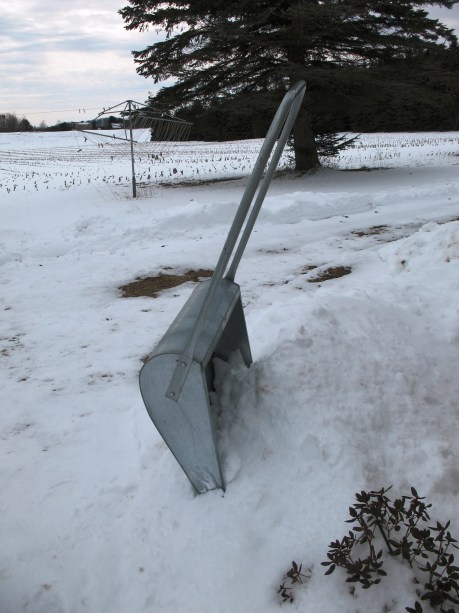
We are having a late season blizzard. Yesterday, after hours and hours of a howling wind and driving snow, we had a break in the storm. The day was like a survey course in types of snow–from pea-sized snow chunks, to quarter-sized soft, lofty flakes–with every configuration in between. The forecast promised a warming trend and freezing rain today, so we took advantage of yesterday’s respite to clear the entries, the driveway and some of the paths. It was eight inches of lovely, wind-driven snow. If we waited, we risked having a driveway and walking paths of eight inches of iced, wind-driven snow.

Rick fired up the Kubota for the driveway and I used the snow shovel around the car, and for the narrower paths and entry areas. If I’d had more time, I’d have built a fort. As it was, I could cut large blocks of relatively light, but rigid snow, which I could then scoop up, and toss some distance. It was fun. Of course, that method entails a lot more lifting than just scooping, but there is a certain satisfaction in those carved-out, crisp and orderly edges. In just under two hours, we’d finished up nicely–not bad, considering that the driveway is 400 feet. Thank god for the snowblower.

After we’d dusted off and come in to warm up in front of the fire, the storm resumed in full force. The winds, screaming through the trees, commanded our attention. We’d wander from window to window, peeking out, to watch the driving winds filling in our neatly carved perimeter. The oil lamps were set out; we expected outages.

It has not warmed up. The forecast was wrong about the winter-mix and freezing rain. What we have today is wind, with more snow and dry sleet. I’d go shovel again, but that sleet looks painful. Even if it would be cool to see how that new snow carves up under the edge of the shovel blade, I value my creature comforts. It can wait.

My father, my snow-shoveling mentor, would not have approved. Though he’d wait out a squall, his snow-shoveling principles required that access, and a clear vehicle, had to be maintained. What if there were an emergency? I fall short of that mark. But then, he had a short driveway and a garage.

Even the critters are hunkering down for the storm. Lately, we’ve been amazed at the variety–deer (of course), squirrels, chipmunks, turkeys, blue jays, robins, eagles, sandhill cranes, raccoons–all either directly visible, or leaving easily identifiable tracks. They’re gone now. The only animals to brave the storm have been the grouse. Even in sleet and strong winds, the grouse are clinging to the thin branches of the Black Cherry trees, swinging in the wind, and nibbling at the buds. They are either very hardy, or very hungry.

I’m getting old. Too often now, my favorite kind of snow, is the stuff that makes up the view out the window. Maybe it’s just been a long winter.

Spring? A.V. Walters–

Don’t get me wrong, I love winter. But we’re nearly halfway through April. We’re having a blizzard. There’s no point in posting a picture–it’s all just white. In less than a week, 100 or so trees will arrive for planting. They ship on a schedule rooted in season. Sigh.

I’m ready for sunshine, and the smell of fresh dirt, and bees, and watching the tiny new leaves on the trees.

I’m eternally grateful for a snug new home, and a lovely fire in the wood stove. But Spring! Is it too much to hope for?

Break out the snow shoes. Who said anything about Spring? It is beautiful, though.

IMG_2406

We woke up to another six inches. It’s spring snow, sticky and heavy.

IMG_2405

And still falling…

It changes how you look at the day. (And makes adjustments to your schedule.) No gardening today!

IMG_2404

Our work is cut out for us. Oops—forgot to cover the tractor after clearing yesterday. I guess that’s where we start.

IMG_2407

It’s almost as though those guests, after a lovely visit, had their car break down in the driveway on their way out. Back in, they lumber–hauling in their baggage. And then the wait–after everything worth saying was already said in the visit-in-chief.

Winter has returned. Just when I was about to start cleaning up the garden. Just when I was about to start digging, and prepping, the holes for the hundred or so trees I’ve ordered. Spring has a short window when the big eyes of winter have been ordering from the nurseries. We went off for a visit “up north” for Easter and when we came back, winter followed us home. Now, with a fresh coat of eight inches of white on the landscape and a polar vortex at the door, I’m having to re-think my Spring schedule.

It’s not that I don’t like winter. I revel in it. It’s beautiful. I don’t mind the cold and I don’t even mind shoveling snow. But, everything has its time, and it’s time for Winter to move along.

Once again, it’s that unstable-climate-change-thing to blame. Erratic warm temperatures in the arctic have destabilized the jet stream again, sending frigid air down to invade our Spring. It’s supposed to hit Washington D.C. hard.

Good.

Maybe a dose of sub-zero in April is just the ticket to wake up all those politicos. How’s that for your cherry festival, eh?

It won’t disrupt our cherries, or most anything else. Our orchards hadn’t yet made strides into Spring. The ground is still frozen–and will be, now, for another couple of weeks. (Though, I’m sure the cherry farmers will find cause to whine.) It’s time to count our blessings. We’ll just throw another log on the fire and revise our plans. I just hope things thaw by mid-April, when my five score trees are scheduled to arrive.

I am so behind the curve. I saw the ads, but didn’t realize it was a new thing. In the world of gadgets with plugs, I am oblivious. I do own a crock pot–but we use it exclusively for processing honey and beeswax. So when my friends all began to rave over insta-pots, I had no idea what that was about.

Turns out it braises, simmers, boils, even pressure cooks. And it’s programmable. Who knew?

You still have to chop and stir. You still have to plan the meal and have the ingredients. I just don’t see its charms.

I have one of these.

IMG_2390

It braises, simmers, boils, bakes and even pressure cooks. It has timers and other gadgets. It is not, to my knowledge, programmable. But I am.

Tangents…

A.V. Walters–

IMG_2387

I am trying to return to writing. I have at least two novels to finish, and ideas for several more. Finally, we have moved into our home, and though there’s plenty left to do, our energies are not completely devoted to the building project. Tangents are the problem.

I’m currently working on a Prohibition era tale based, in part, on my grandfather’s rum-running days. I try to be historically accurate–which leads me constantly down the rabbit hole. In the current chapter, Trudy, our protagonist, hands a sheaf of papers outlining liquor distribution channels, to Red, who’s an overly ambitious rumrunner. Those papers, how are they attached to each other, physically?

A quick foray to the internet reveals that, though the stapler had already been invented in ’31, (the novel’s setting) it was still not a common household item. So, it’s not likely that these papers would’ve been stapled together. I suppose they could be folded, or rolled, and tied neatly with grosgrain ribbon, but that seems a bit precious in the context of this exchange. Paper clips. Hmmm, another not-so-quick trip to the internet… Yes, by all means, the paperclip was already in wide use at the time.

But, that lead me to the myth of Norwegian invention. Norwegian, Johan Vaaler, filed paperclip patents in both Germany and the United States in 1901 (Norway had no Patent Office then) for a similar but less workable product than the unpatented Gem paper clips already in common use in England since the 1870s. Vaaler’s patent described a single wire loop–a design that never made it to common usage. Other paperclip patents were filed in the United States, one as early as 1867–but none of these early patents describe the common Gem design still used today. And then there’s the role of the paperclip as a symbol of anti-fascist resistance.

Several countries had identifying pins which became symbols of national pride during the WW2 occupation of Europe, notably: some pins of national flags; a pin showing exiled Norwegian King Haakon VII’s cipher; and the Danish King’s Mark. The Germans made such displays of national unity illegal. In France, a simple paperclip worn on a collar, cuff or lapel, became a symbol of “unity” and resistance. The innocuous paperclip as a symbol of resistance spread across the occupied countries until, predictably, this too became illegal.

Learning this, it only took me a minute to locate a paperclip and to affix it to my jacket collar. It seems to me that we could use a simple unifying symbol for our own resistance to the current racist, fascist and anti-democratic trends in governments, everywhere. At least, we could use it to project our own disavowal for hate, and fear driven policies: We Do Not Agree!

There is a sculpture of a giant paperclip in Sandvika, Norway, celebrating Norwegian ingenuity in the invention. Unfortunately, that sculpture is of a Gem clip–and not Vaaler’s patented version. Sometimes “story” eclipses reality.

Except, of course, at my house, where the tangents of history lead me far from my intent to get on with the story. In this one, at least I’ll have the paperclip right.


Connecting the Dots…

A.V. Walters–

Jan Blog Pix

As I washed the dishes this morning, I glanced out and was taken aback at the sudden increase in bunny scat, dotting the landscape. Was there some kind of a bunny event? Then it dawned on me. We’re experiencing a winter heat wave. Everything is melting. This is not an overnight accumulation; this is a mid-winter exposé. By observing the accumulated droppings, we can actually map the bunnies’ trails and activities. Funny how a turn in the weather can reveal what’s been going on, all along.

Like yesterday, today will reach 50 degrees Fahrenheit, before a wave of unseasonable rain and fog heralds in the next cold front, dropping us back into the low double digits tonight. Then, Winter, having taken a breather, will return in full force. Tomorrow will be an icy, slippery mess.

Jan Blog Pix 2

We took the opportunity to check on the bees. The snowy caps on their hives, so pronounced just three days ago, are gone. When winter temperatures reach the high forties, bees will fly. I doesn’t matter that there’s nothing to eat or gather. Supposedly, bees are loathe to soil their hives, so the warm weather gives them the opportunity to take a “cleansing flight.” Often it doesn’t go so well…it really isn’t warm enough for them. The snow around our hives is dotted with dead bees. It’s a good news/bad news conundrum—proof that our hives are still alive, but learning that came at a cost. I wish those intrepid bees would stay put in their clusters. This erratic weather, glimpses of climate change, is really hard on the bees.

Tomorrow it will snow again, covering the bunny scat and the unlucky bees. We’ll descend back into winter, a little wiser for having connected the dots.


A.V. Walters–

IMG_2380

Did anyone else see that outrageous fly-by video of Jupiter? With it’s colorful swirling storms and regional color differences, it made you think. This isn’t the Jupiter we learned about in school, way back when Pluto was still a planet. This was intense and visceral. It’s a whole new way of looking at something you didn’t think about, much.

Winter can do the same thing for your otherwise familiar landscape. Snow can drift and mold, add cornices and caps, and erase features (like the driveway) that you take as a given. The country’s recent sub-zero plunge caught peoples’ attention. Even here, where it mostly was just winter, we sat back and took notice.

IMG_2378

Finding Rhythms

Any time you make a major change, it takes a while before you find your “sea legs.” We’ve been here just over a fortnight, and certain things are falling into place. Granted many of our new patterns are as much about season, as they are about location.

I’m one to dally in the morning, enjoying the warmth of the covers and planning my day. Rick is up and about, almost as soon as his eyes are open. He’s taken to grinding and making the coffee–a pattern that started even before we moved. Now though, he uses the time it takes for the water to boil to tidy the woodstove and start the fire. Somedays that requires a full shoveling of ashes and cleaning the glass. And sometimes, he just stacks the kindling on the embers still left from the night before.

We do not build roaring fires. So far we haven’t had weather cold enough to warrant more than a solid ember bed and a log or two. If we pushed this stove to capacity, we’d have to open the windows. It’s nice to know that all that insulating was for good purpose. It’s easy to heat this little house with wood. We have back-up heat–both propane and electric, but mostly that’s reserved for if we are not at home.

By the time I get up, the fire has started and there’s coffee in the carafe. I am spoiled.

Our days are ordered by the weather. A light snow you can ignore. A medium accumulation will require some hand shoveling of the paths and parking area. There are paths to the garden, the compost, the woodpile and around the house and parking area. And then, somedays you get up and the biggest task of the day will be snow removal. Rick does the bulk of it. He’s the one on the tractor with the snowblower–after all, it is 400 feet of driveway. For a heavy snow, I’ll suit up and do the hand shoveling. It’s a workout that we both enjoy. We have a lifestyle that includes a regular upper body workout, as a matter of course.

About once a week, a little more often if it’s cold, I fill the wood crib from the wood pile out back. The crib is a brick enclosure built into the retaining wall at the basement level. It lets us keep our firewood stock just a step out the door. The area is sheltered by the front porch, and keeps the wood dry and at hand. The larger wood pile is about forty feet behind the house, back up in the pines, generously covered with tarps to keep the wood dry. It takes four heaping wheel barrows to fill the wood crib. At some point in the future, we’ll build a wood shed to keep our heating supply dry and snow-free.

IMG_2371

We enjoy being out in the snow. We watch the tracks to see who else is enjoying our home. Rabbits (of course), and deer (more than we first thought) are the most frequent visitors. There are squirrels, chipmunks, and a couple of kinds of ground squirrels–mostly we see their tracks. In the New Year, we’ll resume our regular walks. They fell by the wayside in the past few months of building. It’s time to get back into it.

By mid-day, most of the maintenance chores are complete and we can turn our attentions to working on the house, or, for me, sitting at the computer and working. Evenings, we read, write, play Scrabble, or grouse about current events. Things will be much busier once Spring rolls around. For now we are enjoying the peace and quiet of the season.

IMG_2372

And the next morning, we can start, all over again.

Creatures of Habit–

A.V. Walters

IMG_2370

I’ve been away from the internet for some time. There are major changes in our lives which have required adjustments.

Once, at a bee meeting, one of our members was bemoaning how stupid bees could be. You see, while bees can navigate a vast range of flowers and local geography, if you shift their hives just a couple of feet, they may well be lost. They will fly to the spot where their entry was…and hover, lost. I am one to defend the bees. We are all creatures of habit. So I posed the question to our members, “Was that really evidence of stupidity? Did you ever reorganize and change the location of your cutlery drawer?”

My comment was met with silence, and nervous laughter.

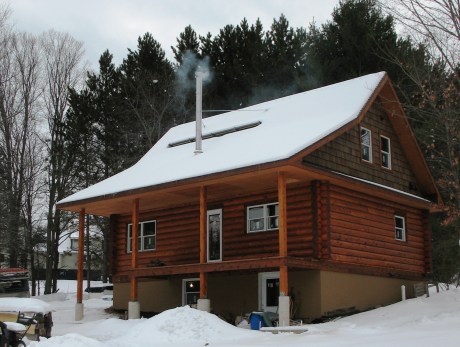
We have moved into our new house. It’s not finished, but in the eyes of the permitting authorities, it is “habitable.” It’s mostly finished, except for the upstairs bath, interior doors and trim. The move was lucky–we were in by the full moon–and just before it began to snow in earnest. Within days, the landscape completely changed and our days were preoccupied with snow removal and creating routines for stocking firewood. Our view has changed, from the taupes and browns of November to winter’s white, punctuated with evergreens. After years of this being a work site, it’s both a surprise and a relief to settle in.

We’re in that awkward stage in which you try to envision a new life and put things where you think you’ll need them–and wondering why you ever bought some of this crap in the first place. I’ve redone the pantry cupboards twice, still without any real comfort zone. It wasn’t a big move, just across the road from our little basement rental. Our walls are still lined with boxes whose contents await placement. I try to address a box or two everyday, but I’m remembering that even the bees can be discombobulated by a minor relocation.

IMG_2369

We also are enjoying the settling in and discovery process. It is a very quiet home– heated with wood there are very few “house noises.” Except for the occasional hum of the refrigerator, mostly we are learning the noises of the neighborhood from a new perspective. We can hear the snowplow from the main road, but very few of the other sounds from across the street interrupt our lives here. No dogs. We have a neighbor up the road with a bad muffler, and we can still hear his truck. With the shift in season, we can hear the (now more distant) whine of snowmobiles.

With the snow, we can see who our regular visitors are. Bunny prints cover the paths Rick has cleared. They like the convenience, too, but, Oh, My! How many of them are there? If the tracks are any indication, we live in Bunnyopolis. Alarmed, Rick has cleared all around the fenced garden area. The snow had reached the point where the bunnies would be able to hop right over the bunny-proof part of the fencing. We see the deer tracks, too. And we’ll spend the rest of the winter learning to recognize the footprints of rest of the visitors. Or maybe…it’s their home…and we are the visitors.


Just Past Peak.

A.V. Walters–

IMG_2362

With color so late this year, everyone was trying to pinpoint exactly when we’d experience “peak color.” Folks want to snap a picture at the exact epitome of the season, as if you could really capture the experience in a photo. I’m guilty of that, too. I think peak was last Saturday. I missed it. Saturday was a little grey, so I decided to wait a day to capture some sunshine in the photo. That night, the wind picked up—stripping vulnerable leaves from their moorings and removing swaths of color from the landscape. The next morning, sun came out, briefly, revealing an entirely different palette from the day before.

I snapped a few pics, even knowing that I’d called it wrong. Later in the day, the winds howled, and the rain kicked in–the double-whammy of color loss. Yesterday’s magnificent landscape was skittering across the road in the wind and rain. Now, near a week later, frosts have hit and we’re talking about the start of winter instead of the peak of fall.

It’s not as easy to call the color as it was when I was a kid. I think that climate change is delivering us mild autumn temperatures, slowing the turn of the season. Instead of one blast of outrageous display, the trees start their transition, and lose leaves along the way, through an extended autumn. A local headline read, “Color Season Takes its Own Sweet Time.” Not that it’s not beautiful—it’s just not as intense.

IMG_2363

Rick and I take a moment, everyday, to observe the changes. That may be the best anyway. Too often in our busy lives, we forget to take a moment to appreciate the beauty around us. It’s a shame, because “everyday beauty” is considerable salve to the challenges of everyday life. So what if it’s a little past peak? Come to think of it, so am I.

IMG_2361

IMG_2359IMG_2360

Author Readings?

A.V. Walters–

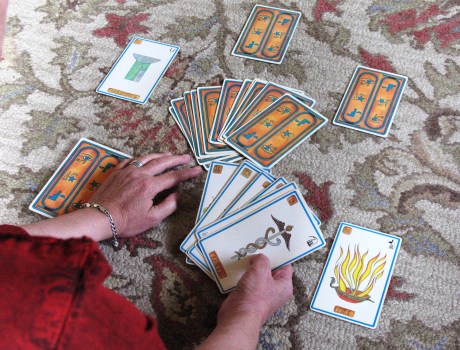
In a twist on the usual book store fare, author A.V. Walters will be giving author readings at Horizons Bookstore, Friday the 13th, in Traverse City. She’ll be reading cards–fortune telling–in a “Local Color” celebration of authors expressing other talents,IMG_2358 doing non-typical author activities.


Long Live the Queen…Part 2

(What Were We Thinking?)

A.V. Walters–

IMG_2306

And, finally home in their hives.

We know better. There is no shortcut to proper procedure.

This pulls together a number of wayward thoughts, please bear with me.


Some months ago, one of the leaders of our bee group reported that she had a “hot hive” and had been stung over forty times when she tried to work it. “Forty Times!” I thought, “I’d quit bees in a heartbeat.” Shortly after that, I was visiting Garth, a bee-buddy of mine and I was stung. No big deal, it’s a part of beekeeping. Knowing that I react to stings, Garth grabbed my arm and sprayed it with his homemade “aphid spray.” He’d discovered that it helped to lessen the impact of a bee sting. Surprisingly, it worked—though I still swelled up, the large local reaction was half of what I usually suffer. We debated what the active ingredient might be—was it the mint? (peppermint and spearmint) The dish soap? The garlic oil? Garth wasn’t willing to experiment. After all, when it works, why bother?

Many years ago, my then-husband came up a mysterious rash—related to his new fitness plan of regular swimming. We thought it might be the pool chemicals. He ended up seeing a dermatologist. The doctor was intrigued. He did an “ice cube test” and determined that the problem was a relatively rare condition called cold urticaria. My husband was allergic to the cold, and the rash was simply hives. “Not a problem, then… we surmised. The Doc was quick to correct, “Not if it’s just a few patches, but if you get those raised welts over large swaths, it puts you at risk for heart failure.”

Now, the prospect of heart failure steps things up a notch. The Doc advised to seek immediate medical attention if the rash spread to more than a quarter of a body’s surface. He suggested considering another form of exercise. My husband opted to continue swimming, and over time, the rash abated.


Back to our bee story… we were in a hurry to get our two queenless hives re-queened. I drove half-way across the state to collect our new royals, so the first thing the next morning, we were up for the task of installing them. A new queen isn’t just dumped into the waiting hive. She must be kept in a queen cage for several days, so her pheromones can work her magic on the hive. Otherwise, she risks rejection by the colony, and murder. Generally, one makes the effort to install the queen at or near the bottom level of the hive. This is especially true, late in the season, so that the brood and ball of bees will be below the honey storage. That way, during the winter the bees can travel up, through the column of warmth generated by the huddled bees, to their food supply. If they have to travel down, or sideways, they risk “cold starvation.” An entire colony can starve, within inches of their food stores, if it’s too cold to make that short trip.

There were several considerations. We knew the hives were hot. We knew that the installation should be as brief as possible. They’d been pretty well-behaved during the split, so we weren’t too concerned. Because we expected this to be quick, we just wore our bee jackets, instead of fully suiting up. That was our first mistake. To speed up the process, we also decided to lift up all the top boxes at once, so we could place the queen cage directly into the bottom deep box, supposedly minimizing disruption. That was our second mistake.

Together, the top, inner cover and two medium boxes of honey, were a little heavier than we expected. As a result, our entry into the hive was not as measured and smooth as usual. And, perhaps because we were opening directly into the bees’ home (and not just the honey storage) we may have alarmed them…

Nothing in our beekeeping experience could have prepared us for what happened next.

Instantly, the usual background hive hum raised to a fever pitch and bees poured out in a tsunami of bee defense. No warning. No raised abdomens or threatening thunks. It was a full-scale attack. They got me first, covering me with stinging bees. The bee jacket mostly worked—only a few stingers got past its tight weave. But one layer of denim is no defense against determined bees and my jeans were covered with the angry, stinging mob. Even as the words, “We’re in trouble,” left my lips, I heard Rick’s cursing reaction as the bees found his ankles. Somehow, he still managed to shove that queen cage into the maw, before we jammed that hive shut. And then I abandoned him.

From the hips down, every part of me was on fire. When a bee stings, it gives up its life in defense of the hive. It also releases an alarm pheromone that tells other bees, “Sting here!” They did. I was a cloud of alarmed bees. Nothing I could do dissuaded them. I ran. They followed. I tried rolling in the dirt; still, they came. I grabbed the garden hose and sprayed down my legs and the bee cloud around me. It didn’t slow them down at all. (Though the cool water was a bit of relief.) And then I ran again, to get as far away from the hive as I could. Peripherally, I was aware that Rick was in a similar dance. I don’t remember screaming, but he says I was. I distinctly remember his cursing.

Finally free of advancing bees, I started scraping away the bees that were sticking to my jeans and socks. I saw Rick flicking them away with his leather gloves and followed his lead. As soon as we were clear of bees, we ran for the apartment and peeled out of our clothing at the door. Even then, there were some bees stuck to our jeans and bee jackets.

Once inside, near naked, Rick said, “Now what?” There was no time to debate. I’d always thought that Garth’s “active ingredient” was the garlic. It was a gamble, but it was all we had. “Garlic!” I yelled, and Rick started peeling cloves as I ran for the anti-histamines. I pulled out my epi-pen and laid it on the table, just in case.

Rick’s ankles were beginning to balloon. For some reason, that was his most targeted zone. Everything below my hips was mine. The rising welts were beginning to merge—I counted 47 stings on the front of my left thigh, before giving up on the count. It was more important to rub in the garlic. I figure I was stung over a hundred times. Many of those stings were “minor,” such that they did not go deep or leave a stinger—in that, our jeans saved us.

Garlic. We grated it, cloves and cloves of it. And then rubbed it into our tortured skin. It stung a little—but in the wake of what we’d been through, we hardly noticed. I was well aware that one, or both of us, would likely end up in the ER. In the back of my mind, I was remembering the admonition—if over twenty-five percent of a body welts up, it’s time to seek medical attention! For nearly an hour we grated and spread the garlic. The kitchen smelled like an Italian restaurant. If we had to go to the hospital, there was going to be some explaining to do.

Finally, it began to work. The welts began to dissipate.

Then, Rick did the unthinkable. He suited up again to retrieve the second queen (left out in the bee yard) to insert her into the other queenless hive. Granted, he just put her in the top—but at that moment, nothing could have convinced me to go anywhere near the bees. He was the hero of the day.

Not that we weren’t still uncomfortable. The stings continued to itch. For me it took two days for the welts to completely disappear—but normally, on me, a sting can remain inflamed for up to a week. This was a phenomenal recovery.

And the bees recovered, too. Both hives have accepted their new queens and they are merrily back to work, in their orderly bee way. Would I quit beekeeping? Not on your life. We’ve learned a lot.

Mostly, though… Garlic.


A Multi-Part Saga of Succession: Part 1

A.V. Walters

Any population lacking authentic leadership is in trouble. Without authentic leadership, any group can fall for the antics of power hungry posers, whose influences, over time, can only disintegrate group cohesion and direction. You know the type, charismatic thugs capable of whipping up an excitable crowd. Don’t say, “It can’t happen here.” It has.

And such was the case with our largest bee hive. It’s been a productive year, ample rain has fueled a pollen and nectar bonanza. We’ve been doing regular hive splits, trying to avoid last year’s swarming losses. Those bees have been keeping us on our toes. But in early August, we ran out of woodenware, the boxes, bottoms and tops that make up a Langstroth hive. By then, we’d split all the hives, but one and we didn’t have time to build anew. Summer’s like that. We still had plenty of honey supers–so we just kept adding “up,” giving them space to grow, and to store all the honey they were producing. We needed the honey, because all those split hives were going to need resources, heading into winter.

Finally, we were able to catch our collective breath and assemble and paint new hive parts, to split the big hive. But we were too late. When we inspected, we could not find the queen–she and her entourage had already swarmed. There were still gazillions of bees, enough for at least two full hives, but there were signs of trouble.

A queen bee reigns by virtue of her hormonal influences. Not only are the bees connected and loyal because of pheromones, but all those female worker bees’ reproductive urges are suppressed by the queen’s control. When a hive goes “queenless,” either because of swarming, accident or mutiny (yes, mutiny), the bees will endeavor to create a new queen with one of the recent eggs or larvae. This takes a couple of weeks, and in the interim, you’re at risk of a “laying worker.” Without the constant hormonal suppression of the queen, a worker bee can begin laying eggs–and exert a similar hormonal control on the hive. The worker is unmated, so she can only lay drone eggs and she does not have the full complement of pheromones. A rogue hive like this can be mean and unpredictable.

Our inspection revealed problems, there were eggs–but no fresh larvae. The laying pattern was erratic–sometimes two eggs per cell and eggs laid on the sides of the cells, instead of the bottom. These are clear indications of a rogue, laying worker bee. The laying worker bee can interfere with normal royal succession. She may kill the larval queen–or kill her on hatch. After all, who wants to give up newfound power? To save the hive, we needed to re-queen it, and quickly.

Since the hive was still huge, even having swarmed, we opted to get two queens and to split the hive into two before we re-queened. As it was so late in the season, we wanted  already mated queens. We needed them to get in, and get to work, quickly. We wanted to find Michigan, winter-hardy queens, to maximize the chances of surviving the winter. We tried to see this as an opportunity to increase our genetic diversity, instead of just the loss of a truly productive queen.

Online, I found just what we needed–and I zoomed off to pick up our new royals. Though  we weren’t happy about having lost the swarm, we were confident that we could make the best of the situation.

What? Did you think I was carrying on about something other than bees?


I’ve been in contact with an outdoor shelters company called Sun Leisure, who designed the infographic below and asked if I would share it. The graphic originally featured some US stats on honey bees – I gave feedback suggesting that stats on bumbles and other bee species should be included too. To my surprise, they […]

via ‘Neonics: everything you need to know’ infographic — Adventuresinbeeland’s Blog

Star Thistle.

A.V. Walters–

spotted knapweed 2

“Star Thistle”

See the lovely fields of purple flowers, rippling in the wind. Taste the delicate flavors, the floral back-notes in the honey from these “local” fields.

The real name for this heralded bloom is spotted knapweed, and it’s no local. Conservationists call it an invasive species, originally from Eastern Europe. Once it gets its roots into your soils, it never lets go. Nobody talks about eradication; they only talk about “management.” There was spotted knapweed on our property before I bought it, decades ago, so I shouldn’t complain. Only recently, though, have I learned about its evil and pernicious ways.

In a riff on Irish luck, Rick and I used to joke that it weren’t for spotted knapweed, we’d have no weeds at all. Little did we know we had that backwards. Sure, we have poor glacial soils, but the more potent force of our limited landscape is spotted knapweed. You see, not only is it a vigorous invasive, but it has the admirably devious survival mechanism of poisoning the soils around it so little else will grow. It is an expert in plant hegemony.

So that would explain our spindly vegetable garden! We have acres of knapweed.

Knapweed has a multifold program of engagement. First, it is a vigorous competitor. It sports a thick absorbent taproot that quickly captures and stores any available water (leaving its neighbors thirsty.) It is a rampant reproducer, colonizing both via ample seed production and from runners from its rhizome root system. If you try to remove it, and leave any part of the rhizome in the soil, it will sprout and flourish, like the cursed broom in Fantasia. Knapweed avoids predation by being the most bitter plant in the field. (Even goats avoid it; though I understand that sheep will eat it.) Back in California we used goats to clear poison oak from the hillsides, but even the goats are too picky to mess with the spotted knapweed. If that weren’t enough, knapweed generates its own phytotoxins, literally poisoning the soil around it. The mechanism of its catechin toxins aren’t well understood, but they prevent germination of competing seeds and poison the root zone. When a knapweed root comes in contact with the root tips of another plant, it sends a cascade of chemical messages to its victim, triggering apoptosis, or programmed cell death, from the roots, on up.

Presumably, back in Eastern Europe, spotted knapweed needed these strategies to survive. Plants from there have immunities that can withstand its chemical onslaught. Here, though, our native plants and crops have few defenses. It’s a problem from coast to coast—but especially so in the dry rangelands of the west.

But the bees love it. It’s one of the few flowering plants that continues to bloom and provide nectar in the dog-days of August. I have beekeeper friends who react with open hostility when folks discuss ways to eradicate knapweed. The honey produced from knapweed blooms is so delicious that “Star Thistle” is treated as a premium appellation product, like Locust Honey, or Tupelo.

I’m a beekeeper, but I’m also a gardener. Would a rose, by any other name, smell as sweet? A pest is a pest is a pest is a… (my apologies to Gertrude Stein.)

Star Thistle, my ass.

spotted knapweed 1

A.V. Walters–

bob

Who, me?

And thank you for many years of a great temperament and good company. You will be missed.

bob emu

Bob, from a safe distance.


They’re Here!

A.V. Walters–

I don’t celebrate Earth Day. Don’t get me wrong, it’s a nice idea. But it annoys me no end when folks known for driving down the driveway to the mailbox “celebrate” Earth Day by buying “green” products they don’t need.

Perhaps it’s a meaningful reminder to people inclined to forget that the planet sits on the edge of the abyss.

Instead, we do our damnest, everyday, to live lightly on the planet. We’re not perfect. Our Spring tribute to the Earth usually involves planting trees. Many, many trees.

This year we backed off. It wasn’t that last year’s 203 tree extravaganza nearly killed us. That was last year. Annual memory lapse is normal. This year, though, we switched to pricey nursery trees. That puts a damper on how many we can plant.

When you pay the big bucks for pedigreed trees, you want to be sure you give them the very best opportunity to survive. We dig deep holes. No matter that the little bare-root sprig is less than a foot tall, our paltry soils must be amended deeply. We sprung for high end organic compost this year—horse manure may be fine for conservation trees, but only the best for these babies. That adds another $6.00 per tree. And, of course we’ll have to cage them, to protect them from the deer, the bunnies, and any other herbivore threats; add rabbit proof welded wire fencing, and a full day to manufacture their cages. We’ll have to extend water down to this newly planted area. There’s plenty of rain this time of year, but by August, I don’t want to have to carry water in buckets.

Needless to say, once the trees arrive, we drop all other activities. Some holes have to be dug by hand. Most though can be done with the backhoe. (You see, we are very serious about these trees.) I figure it’ll take about a week. Then, sore and weary, we’ll return to our regular overloaded lives knowing that we’ve done what we can to make the planet more green.

See you in about a week.

Authors + Card tables + Books =

A.V. Walters

Traverse City Authors

You’ve been there—a book fair, or an author-signing event. The author sits, with a forced smile, trying to engage. Normal people, who otherwise might manage a smile or a nod, drop their eyes and rush by. They’re too polite to intend to reject, but the result is the same. They avoid eye contact.

We love books. They entertain and inform. They take us to places, internal and external, that we otherwise would never experience. They make us think. Storytelling is probably the true oldest profession. It may be the real difference between man and the other animals. Forget tools—animals use tools.

But writing is very much an internal process. There’s not much to see. It is, for everyone except the author, pretty boring. And authors are often shy, living in the world from their side of the keyboard. It makes for a marketing conundrum. As the author, how do you sell books? As consumers, we want action—writing, by itself, isn’t dynamic.

The standard formula, the book fair, is death on cold toast. Uncomfortable for both the author and the consumer, it is Authors + Card Tables + Books = Boring. It’s like one of those sad little small town zoos, where the animals are housed in small, concrete cages. At best, you’re tempted to tap on the glass to elicit some response, or throw popcorn, even when the signs admonish you not to feed the animals. At worst, you scurry by, shoulders hunched, eyes averted.

I’ve joined an Author’s Group. We discussed at great length the challenge of the “author’s event.” We swapped horror stories of our collective experiences, trapped behind stacks of books in the entry of some otherwise kindly bookseller. We vowed not to repeat the equation.

Traverse City Authors announces its Celebration of Story. On June 14, at the Little Fleet, we’re holding a story slam benefit for Front Street Writers (a local nonprofit program for young writers.) After all, at its essence, what we do is tell stories. Come see the Authors, in their natural habitat, surrounded by good food and drink (because authors aren’t stupid), and yes, of course, books.

https://www.facebook.com/TraverseCityAuthors/?notif_t=page_fan&notif_id=1493079806456302


A.V. Walters

They’re hounding me to renew the registration of my hives. In theory, it’s a good idea. If beekeepers register their bees–how many hives and their location–farmers will know to alert them when they plan to spray. That way, I can close up the hives when they are most at risk. They’re emailing me to tell me that if I don’t renew, my listing will be dropped. So, why do I resist?

First, registration hasn’t done anything for me. Doesn’t that sound selfish? In fact, I reached out to my neighboring farmer on my own–we formed an understanding, and now he gives me 24 hour notice of any chemical spraying or application. My idiot neighbors to the west apparently are uninformed about the registry–and they spray, willy-nilly, without notice. Their property looks like the lunar landscape–nothing grows there, not even the things that they plant. The crop registry didn’t help me with my notification success, nor with the failure.

I suppose my resistance is rooted in principle. I don’t want to participate, or be complicit, with the powers that are killing the bees. Late last year the registry unveiled a “new look,” complete with corporate sponsorship. The primary sponsor? Bayer. Wow.

For those who don’t know, Bayer is the primary player in the neonicitinoids game. Neonicitinoids (or “neonics”) are a class of insecticides that science shows are a primary killer of our honeybees. Of course, the industry denies it, in the time-honored tradition of corporate denial (think DDT, Big Tobacco, Big Oil and Climate Change, or, soon at a theater near you, Fukushima!) The usual game plan is to float a disinformation campaign and to deny as long as possible, only to quietly acquiesce to the underlying science AFTER using influence to secure liability protection.) I don’t want my participation in such a program to provide “cover” to corporate malfeasance.

Bayer sponsoring a Bee Registry is like General Mills giving out free wildflower seeds to help the bees. (Oops, that’s a real thing, too!) Is it cynical greenwashing or brilliant PR? I can’t tell, and I don’t want anything to do with it. Am I tilting at windmillls? Should I cowtow and collaborate? I cannot tell anymore.


The Myth of Snow Removal

A.V. Walters

img_2349

For the traditionalist…

There is no such thing. When it is time for it to go, snow will go on its own. Until then, all we can do is push it around—out of our way. We should really call it snow relocation. “Snow Removal” is a big ticket item on many northern, rural budgets. For many, the face of government is one’s local township clerk, and the guy who drives the snow plow. For public road maintenance, the standard snow plow is the way to go.

Snow management for the homeowner, or small business, poses important questions. First and foremost is the basic question of egress and access—unless you manage snowfall, you simply cannot get from here, to there. Immediately behind egress and access is the question of safety. At what point does the danger of a slip-and-fall land on the shoulders of the pedestrian? What is the responsibility of a business for access safety? When in doubt, wear spikes. It’s an inexpensive measure of safety. (Just remember to remove them at the door.)

The farther north you go, the higher the level of social tolerance for snow inconvenience. We know how to drive and schlep in snow. Snow management falls into one of three categories—pushing it aside (plowing and shoveling), scattering (snow blowers) or compaction—the old fashioned method of just traveling on top of the damn stuff—making for layers and layers of slippery, which are the seasonal measure of geologic sedimentation. Snow-blowers and their ability to disperse the mess make modern snow management easier. You never have to have a place to store the season’s bounty. The biggest issues in determining your snow management method are amount, effort and space. How much are you willing to sweat for access, and where the hell will you put the stuff?

When I was a kid, snow was shoveled by hand. That’s what kids were for. Driveways were relatively short. (I’m sure you’ve driven by a lovely old farmhouse and sighed at how close it was to traffic. Roads have widened over the years, and old houses were built sensibly closer to the thoroughfare.) Mechanization has freed us from those old, utilitarian limitations. Now, it is not unusual to see the McMansion on the hill, with its thousand-foot driveway. Woe to them, should petroleum become scarce.

We have our own range of snow equipment. The snow-blower on the tractor can clear a five-foot swath in a heartbeat. We have a hand-push blower, which we almost never use, favoring the flexibility of the traditional snow scoop or the northern version (the yooper-scooper), which makes it easier to move the snow some distance. In the North, snow removal is the aging test of whether it’s time to move into town. At that point, either you move, family helps out, you pay for snow removal, or you rely on the kindness of strangers. Since my father passed, my brother-in-law has dutifully kept my mum’s driveway clear. Rick and I are young yet, and are nowhere near those kinds of considerations. But…

img_2347

The Yooper-scooper–available only in the far north, wherever premium snow implements are sold.

I never had children. I wonder if Rick’s California kids understand the mores of familial obligations in the North.


Winter Wonderland

A.V. Waltersimg_2343

It seemed like a no-brainer to me. We’ve been cooped up with winter for months, so the idea of fresh line-dried laundry was like a breath of fresh air. We’re having one of those wonderful February breaks with sunshine and temps in the 40s and 50s. Ah, sunshine!

Of course, it is a little odd to have to wear winter boots out to the clothesline. While I was out hanging laundry, a number of my neighbors drove by on their own busy Saturday mornings. Their reactions made me wonder. I could see them do the double-take when they spied me. Three of them slowed their cars to a crawl and stared in wonder at what I was doing. In the background, I could hear snowmobiles. The moment was rich with contrast.

I suppose they think I’m the crazy one. I wonder. At these temperatures, by tomorrow the snow may be gone.

Did I mention that it was sunny?

img_2339

Notice Anything New?

Can you see it? It’s transformational! It changes everything.

This isn’t smoke and mirrors. (Well, maybe smoke.)

I’ll give you a hint. It’s about heat.

img_2342


Be Prepared

A.V. Walters

girl-guide-pin

When I was just a kid, ten or eleven, “they” started a Girl Guide troop in my village. I was elated. The Boy Scouts—the male version of our Canadian youth organization—did all kinds of cool stuff. They hiked. They went camping. They learned sailing and essential survival skills. I wanted in.

But, Girl Guides was a major disappointment. We met regularly, paid our dues and stood around in formation. There was a lot of discussion about earning badges—and we all eagerly researched the requirements in our Guidebooks. There were no nature hikes, no tips on identifying wildlife, no talks on campfire safety (and, needless to say, no campfires.) Oddly enough, there were tips for the application of cosmetics. And, they emphasized the gentle arts of knitting, crochet, sewing, and swapping patterns. If I’d wanted that, I could’ve simply signed up for Home Ec, at school.

Just once, we had a promising project. We made camp stoves out of coffee cans, which were to be used with beeswax candles as fuel. Of course, when we’d finished with the tinsnips and wax, some of us decided to light the damn things. Our Girl Guide leader had a total fit. You’d have thought we were trying to burn down the building! “Who brought those matches?!!!”

I was a problem child. So, naturally, I complained. The organizers, a trio of women from our village, told me to be patient, that they were just getting started. But, I was bored. To amuse myself, I did handstands against the walls. My concerns (and restlessness) stirred up the other girls, inspiring them to look beyond handicrafts and sock-puppets in their expectations. We started practicing gymnastic moves when the meetings were slow or disorganized. Our leaders didn’t approve of gymnastics. (Admittedly, it’s difficult to keep your Girl Guide uniform neat and tidy while practicing gymnastics.) Consequently, I earned demerits, and was soon regarded as a disciplinary problem.

Meanwhile, the Boy Scouts continued their outings to neat locations, like the local Provincial Parks, and did nature hikes. Could we do that? The response was a “hike,” but not in a park. It was through our village, and down the local highway—marching. Marching In formation. We did about six miles. The other girls groaned. This wasn’t anyone’s idea of fun. Essentially, the entire troop was being punished because of my entreaties. I considered quitting.

Before giving up, I started asking the girls from next town over what they did in their Girl Guide meetings. Needless to say, their troop was far more active and interesting than ours. And, their dues were only a dime a week, while ours were a quarter. Of course, I pressed further, asking other girls, even farther afield what they paid in dues. Always, the answer was the same—a dime.

Finally, I brought it up at one of our meetings, pointing out that other troops paid a lot less and got more out of Girl Guides. Our leaders seemed a bit unnerved at my public questioning. They weakly explained that the excess was used to purchase their uniforms and to cover “incidental” costs. They were volunteers, after all! I retorted that we had to pay for our own uniforms—and we were just kids. I had done the math, and pointed out that uniforms for the three leaders could have been fully paid in three to six months—but that the imposed surcharge had gone on for nearly a year. (Obviously a young girl, like myself, had no appreciation of the cost of a used coffee can.) I knew it wasn’t like we were talking big money, but it was the principle of the thing.

At the end of the meeting, I was unceremoniously kicked out of Girl Guides. Gone. I should have, but I sure didn’t see that coming. I guess I wasn’t cut out to be a Girl Guide. Our motto was, after all, “Be Prepared.”

Needless to say, it was no real loss; it wasn’t much fun, anyway.


A couple of years ago, I joined Facebook. As an indie author, I was told that social media was an important part of our “branding.” So, I put my blog feed through Facebook and accumulated a wide variety of “friends.” Though I enjoyed it, my Facebook page never did much of anything from a marketing perspective.

In 2015 and 2016 my Facebook activities widened to include political expressions. I wrote on issues of food and agricultural policies, climate change and the upcoming elections. I joined groups and made even more “friends.” My topics of discussion included resistance politics, protests and, of course, the elections.

Occasionally, I was trolled, challenged on my positions. Some politicians and political organizations were using paid trolls in their programs of disinformation. In my posts, I was always civil and thorough. If you challenged me, you’d best have your facts straight, because I was ready with mine. I’d research the trolls and, in pretty short order, could tell who was a legitimate person, and who was there just to make trouble. Real people had real friends, and they had longtime Facebook accounts, populated by photos and comments and, well, lives. I attracted the trouble-makers.

One day, recently, I tried to log-in to my Facebook account and was greeted with this:

“HELP US IDENTIFY YOU-

We’re working hard to make sure everyone

on Facebook can be their authentic selves.

We don’t allow accounts that:

  • Pretend to be someone else
  • Don’t represent a real person

From time to time, we check to make sure

it’s really you with a few short questions

before you log into Facebook. It won’t take long

and it helps keep Facebook safe for everyone.”

What? I’ve been booted off Facebook?!

The successive security screens informed me that, in order to regain access to Facebook, I’d have to upload a copy of a government-issued, photo ID. Some troll (or trolls) had fingered me! Of course I’m a real person. My posts were always thoughtful, cogent and informative. While I’m shocked that the exotic Facebook Algorithms couldn’t recognize my obvious humanity, I’m equally appalled that it is so easy to silence the voice of someone with whom you might simply disagree. I have a “liberal’s” extreme distaste for Big Brother tactics and I’ll be damned if I’ll provide ID in exchange for access to cat videos, photos of restaurant food and trolls. Make the damned trolls show their ID. For no clearly articulated reason, I’ve been kicked off Facebook.

They talk about Facebook withdrawal. Admittedly, I spent too much time on the site. It’s a major mind-suck. And, like any junkie, I’d talked about cutting back, or quitting, altogether. (“I can quit anytime I want. I’ve done it a million times.”) Hell, a recent study even suggested that low doses of LSD can eliminate Facebook Addiction! But I didn’t see this coming, either. I’m out—cold turkey. I’ve completely disappeared from Facebook. It’s as though I’d never existed. Gone. And, there is no way to communicate with the minions of Facebook to question why I vanished, or to explore other options.

There’s a recurring theme, here. I guess that in my own way, I’m a born troublemaker.

So, I’m recovering my personal time and enjoying it. In any event, the lesson is clear: Be Prepared.

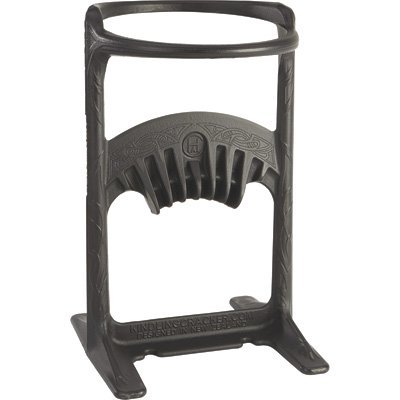


img_2250

Honey, Cooking, and The Science Behind The Sweet

A.V. Walters

Honey is a foodstuff of almost mythical proportions. It is one of a handful of foods that, left in its original form, never spoils. Honey has been known to last literally thousands of years—and still be edible and sweet. Honey will crystalize—a condition that may put off the uninformed consumer—but crystalized honey is still good. If it offends, you can simply warm it gently and it will resume its liquid amber loveliness.

Honey has three characteristics that, acting together, serve as its natural preservative. Despite being a liquid, honey has a very low water content of only 14 to 18 %. Bees will not “cap” honey in the comb until it has reached this low moisture threshold. Most bacteria cannot survive in such a low-moisture environment. Honey is also highly acidic, with a pH between 3.0 and 4.5. That acidity will kill off the few remaining things that might want to grow there. And, as we all know, honey is sweet. That natural sweetness also discourages bacterial growth. Archeologists have found sealed honey in ancient Egyptian tombs that was still preserved and unspoiled. Add to these three basic characteristics are the enzymes in honey that come from the bees’ stomachs. These enzymes combine with nectar sugars to produce gluconic acid and hydrogen peroxide—natural components of honey. Blended together all these characteristics make a super-food that keeps, nearly indefinitely.

Herbalists and healers of ancient times understood these qualities in honey. It was widely used to treat wounds, for skin ointments and to prevent infections. To retain its natural preservative qualities though, stored honey must be sealed. Because honey is hygroscopic (naturally low in water) it will absorb liquid from the air and eventually spoil if left uncovered. Though honey is naturally pure, it can contain trace amounts of bacteria, and while this is not a problem for healthy children and adults, raw honey is not recommended for infants or people with compromised immune systems.

What about cooked honey? Cooking honey poses two questions: Does cooking undermine honey’s otherwise beneficial qualities? And, is it actually toxic? Purists and practitioners of natural or ayurvedic medicine will tell you that cooked honey is poisonous, and should never be eaten. There’s a smidgeon of science that supports that position, technically, but most feel that’s a little extreme. At the end of the day, this is something you’ll have to decide for yourself. Honey is essentially a natural, supersaturated sugar solution. Added into that are enzymes, courtesy of our friends, the bees. Many of the purported health benefits of honey are connected to those enzymes. But, when you heat honey, the enzymes begin to break down, beginning at about 118 degrees, Fahrenheit. Over-heating may result in losing most of the beneficial properties, making honey just another sweetener. (A good reason to gently heat your crystalized honey. You can warm it in a bath of warm tap water or in a double-boiler, at very low heat, to protect its enzymes.) In cooking, you can preserve honey’s integrity by adjusting how and when you heat it. Whenever possible, wait and add the honey until later in the cooking process (this is especially true when sweetening sauces or glazes.) Or, you can also “dilute” any heated honey mixture with a larger quantity of unheated ingredients. Check your recipes to see if there might be ways to limit exposure to high temperatures. Needless to say, honey is always at its best when used in recipes that are never heated, like salad dressings, toppings, dips or icings.

But, is it toxic? When honey is heated, its fructose, in combination with its natural acidity, degrades and begins to form hydroxymethylfurfural (HMF), which is mildly toxic. The hotter it gets, the more HMF forms. The solution is dilution. Diluting the honey with other ingredients, (prior to heating) lowers the acid level of the honey, helping to prevent HMF formation. Even then, the actual HMF toxicity levels that result from normal cooking are very low. Our evolved human gut is fully capable of digesting cooked honey products, with no observable adverse affects. If you are a purist—don’t heat your honey. Otherwise, take reasonable efforts to preserve the maximum beneficial effects by keeping honey temperatures as low as practical. You can cook and bake with confidence, knowing that you are not putting yourself at risk.

There is one group that should never consume heated honey. That is your BEES! Bee guts and intestinal systems are relatively simple and cannot safely digest HMFs. Ingesting even a small amount of honey that has been heated can result in bees developing gut ulcerations. Many beekeepers use heat to separate wax from honey—and feed the resulting honey back to the bees. Don’t do it! Only give bees cold-processed, unadulterated, honey. Even adding water to honey, for bee feeding, must be done carefully because once water is added, the honey mixture is subject to bacterial spoilage, and fermentation. (Think mead!) If you use watered-down honey for bee feeding, make sure that it remains fresh. Remove any unconsumed honey blends within a day or so, replace with a fresh mixture, and periodically clean containers.

The very characteristics that give honey its extended shelf life can require some adjustments when cooking or baking with it. The most obvious is that honey is a liquid, so when substituted for sugar, you must adjust the balance of dry and wet ingredients to retain the desired texture. Every cup of honey used as sweetener contains about three extra tablespoons of liquid. So, you must reduce the other liquids in your recipe, increase the dry ingredients, or a combination of both. (The approach you take will depend on the recipe.)

It is often assumed that you can do a “cup for cup” substitution of honey for a recipe’s sweetener. Not so. In addition to increased moisture content, honey is sweeter than sugar when measured cup for cup. Depending upon the bees food source, and the seasonal time of production, honey can be anywhere from 1.25 to 1.5 times as sweet as sugar. You’ll have to substitute accordingly, and remember to taste as you go. Honey has a lower glycemic index rating than sugar (55 compared to sugar’s 61) so it’s a healthier option, with a slower impact on blood sugar. It’s easier to standardize baking with lighter honeys—the darker honeys come laden with their own native flavors. They can add depth and character to your baked goods, but darker honeys are a shifting exercise in taste exploration. Since the sugars in honey brown faster than regular sugar, you might have to lower your baking temperature by 25 degrees and cook your baked goods a little longer. Even if all your adjustments are correct, remember that baked goods made with honey are moister than sugar baking. If you’re looking for a drier finish—carefully bake longer, at a lower temperature.

Finally, honey’s natural acidity can play havoc with the leavening in baked goods. Most leavening agents (baking soda/baking powder) are “base” ingredients. The higher acidity in honey can act to neutralize your leavening agent—leaving an unadjusted recipe as heavy as a brick! You will need more leavening to achieve a proper rise, usually an additional 1/8 to 1/4 teaspoonful per cup of honey sweetening. There is no need to adjust if you’re using yeast. Yeast usually does well in the more acidic environment of honey. Add the honey to the bread dough mix, itself, to avoid interference with yeast performance. Do not “proof” your yeast in a honey mixture.

Honey as a food product has been with us for thousands of years. Whether you revere it for its mystical healing properties, or enjoy it as a healthy sweetener, it’s helpful to know how it behaves in cooking and baking. Following these tips, along with a little experimentation, will yield light and tasty results.

IMG_2289


Food Fight

A.V. Walters

It has come to the attention of Big Ag that the fastest growing sector of agriculture is organics. 2016 saw well over four million acres under organic cultivation. The total organic slice of the American food pie was over 35 billion dollars. You cannot boast that kind of success without attracting attention.

Big Ag wants in, in a big way. Organic produce and products are, after all, significantly more expensive than “conventional,” chemically infused crops. It’s a “value added” product, without the trouble of adding value. In fact, these are high-end consumers who’ll pay more, but want less. Less chemicals, less guilt, and less health impacts from fertilizers and pesticides. Of course, there are a lot of pesky regulations related to organic certification. But American Business knows it way around regulations.

Recently the industry group coordinating with government regulators, the National Organic Standards Board (NOSB), held its annual meeting. Not surprisingly, over the past decade the elected leadership of the group has been shifting towards large-scale, corporate producers, squeezing family farmers out of the mix. Organic products are regulated by the USDA, the agency in charge of enforcing our National Organic Program (NOP.) In decades past, nobody much cared about the definitional details of organic agriculture. The industry was the backwater of hippy back-to-the-earth folks. Conventional agriculture only cared that the program made production and certification expensive and burdensome—so it wouldn’t compete with their monoculture view of farming. In it’s early years, organic farmers debated earnestly just what “organic” meant.

It’s not merely the absence of pesticides that defines the heart of “organic.” It’s about creating a food and commodities system that is sustainable, humane and healthy for both consumers and for the planet. During the 1980s, those same hippy farmers debated long and hard about what practices could be included under the organic umbrella, and what methods did not measure up to “sustainable.” The old organic mantra, “Feed the soil, not the plant,” spoke to a holistic approach to farming, and to the planet, in stark contrast to modern, industrial and extractive farming methods. Organic farming promoted crop rotation, natural soil enhancement, composting, non-chemical pest management, antibiotic and cage free animal husbandry and regenerating the environment through gentle agricultural practices. By any definition, organic farming should build soil and animal health—leaving us with a more diverse and stronger ecosystem. It is a moral and philosophical rejection of the chemically saturated monoculture and confined livestock systems that dominate American food production.

Things went well, until organic became synonymous with money. The results of this year’s meeting illustrate where we’re headed. In the early days, when easing the burden for “transitional” farmers was important, some non-organic or synthetic practices were permitted, provisionally—to be “sunsetted” out of organic production within 5 years unless, by a margin of two thirds majority, the NOSB voted to reauthorize them. This year the Board voted that any 5 year exemption is automatically “rolled over,” unless the NOSB votes it down—creating a slippery slope of standards erosion.

One of the big debates this year was whether hydroponic growing systems could be classified as organic. Really? How could a “farming” system that grows produce entirely without soil (often completely indoors), fed exclusively on a mix of liquid fertilizers and nutrients, wholly outside of any natural system be considered organic? What happened to “feed the soil?” What happened to organic farming acting in concert with nature to make the planet healthier? The Board couldn’t agree on the hydroponic issue, and has kicked it over to the next meeting, when there will be an even larger majority of corporate board members on the Board. Can you see where this leads?

Just as troublesome is the failure of the USDA to enforce the standards of the National Organic Program. Large scale producers regularly break the rules, with no penalty from the government agency charged with protecting consumers. Small scale organic farmers are thus doubly burdened—with the high cost of certification, and then forced to compete in the marketplace by corporate farms that advertise organic, but don’t play by the rules. The little guys end up subsidizing the cheats. In the long run, failure to police the standards will only undermine the organic message—the cheats will kill the golden goose. Consumers, small scale organic farmers and the planet will pay the price.

I don’t have a solution. I recommend that you support your local organic farmer through farmers’ markets, cooperatives or CSAs, that you start your own garden, keep bees or even chickens. I think we need to get involved, not just in the politics of food production but in some hands-on action, to protect our health and the health of our soils, our water and our planet.


Ousted by Facebook

A.V. Walters

Some of my readers follow me through Facebook. My Facebook persona is a far more political animal than my WordPress presentation. I am, however, true to character. Even in the throes of a political rant, I am never foul or rude. I suppose I am pushy, since I often urge people to exercise their rights to free speech, or to seek redress with the government for infringements of our rights.

Today I have been blocked from my Facebook page. I suppose the keys to my relief are in my own hands. Facebook insists that I need merely upload a picture of government issued picture ID, in order to resume my Facebook privileges. Who is this, Big Brother? I’ll be damned (oops, slipping into profanity over this one) if I’ll tow the line on this, without some good explanation for why I should be treated differently than other Facebook members. What do they want, a tattoo on my arm? Is this someone’s attempt to silence me? Has there been some complaint? If so, say so. I’ve been trolled before, and if that’s the source, I can deal with that. But without some rationale or explanation, I won’t provide my personal identification information beyond that required of regular members. If you’ve followed me on Facebook, it’s possible that I won’t ever be able to post again. In fact, this post through WordPress may be silenced, too.


And So It Starts…

A.V. Walters–

This past weekend, in nearby Traverse City, a local off-duty police officer showed up to an anti-racist rally, in a pick-up truck decorated with what is commonly called the Confederate flag. He pulled into a no-parking zone, stepped out of his vehicle and proceeded to down a beer (openly, in a public place) while heckling the protesters.

Naturally, complaints were filed and the Police Department initiated an investigation. It wasn’t his first flag incident. The officer, an eighteen-year member of the force, resigned. The investigation continues. I read the story and did some of my own research.


Last night, as I came out of the grocery store, I passed a large man standing next to his pick-up truck, also adorned with a “Confederate” flag. A man was engaged in a quiet conversation with him; I caught the drift.

“It’s a symbol of racial hatred,” the smaller man was saying.

“No it’s not!” The flag-bearer puffed out his chest and then loudly proclaimed, “It’s about my heritage.” Shoppers averted their eyes and scurried off to their vehicles.

I put my groceries in the car and returned to join in the discussion, “I agree with this gentleman,” I said calmly, nodding in the man’s direction, “It is about racial hatred.”

“No,” the flag-bearer bellowed, “It’s about my proud heritage.”

“Then you’ve got the wrong flag.” I responded. The other man confronting him turned to me and mouthed the words, “Thank you.”

The “son-of-the-south” turned to me in a way that was only slightly menacing. “No, this is the right flag, alright. My ancestors died for this flag.” I wondered if I was going to get myself assaulted, for this.

“No, I don’t think so.” I answered.

“You calling me a liar?” (Often the refuge of a man short on facts.)

“I think that you are misinformed. Did any of your ancestors fight under Robert E. Lee?”

He looked a little stunned. “I doubt that, we’re from Texas.”

“Then you’ve got the wrong flag. That flag,” I said, pointing at his truck, “Was never the flag of the Confederacy.”

“Huh? Well, sure it was. It’s the Confederate flag.” A few people stopped to listen.

“No it’s not. That flag was the battle flag—sort of the regimental colors—for troops fighting under Robert E. Lee. It wasn’t the flag of the Confederacy. There were a number of different flags adopted by the Confederacy during the war, but that flag wasn’t one of them.”

He looked confused. “But… my people died for that flag.”

“I’m not questioning your heritage, but you’ve got your flags wrong. The flag you’re displaying didn’t become popular until the 1950s, when racists started to use it to oppose the Civil Rights movement and the Brown vs. Board of Education case that integrated the schools. That flag,” and again I pointed, “Was never the flag of the Confederacy and was used specifically to show racial hatred and intolerance.”

“Well, I don’t know anything about those other flags.” Now, he wouldn’t even look at me.

“I can’t help you, there. But, the one you’re flying is a symbol of racial hate and intolerance, not the flag of the Confederacy.” Some of the people around us were nodding, almost imperceptibly.

The other gentleman in the conversation added, “That’s what I was trying to tell him.”

The flag-bearer wouldn’t look at any of us. He turned and stalked away. The small crowd began to disperse without a word. My co-conspirator and I looked at each other, and nodded, before going our separate ways.


And that is the danger of having a bigoted bully as President. It emboldens ignorance and hatred. It normalizes bad behavior in ways that make violence and social unrest more and more likely. If we want to live in a civilized society, the rest of us need to step up and stop it, nip it in the bud, whenever we see it. This is going to be an exhausting presidential term.


Signs of the Times

A.V. Walters

It’s almost over, thank god. I can hardly wait for the end of this election season. My inbox is overflowing with solicitations for money, for support, or just for the opportunity to wallow in righteous indignation.

I admit it, I’m a wonk. I research the various races and candidates on the ballot. I spend the time on the internet checking the records and policies of all the candidates. It isn’t a straight party ticket for me; I don’t vote tribal. My choices will be on principle and on the issues. I don’t reward bad behavior.

Though it’s no substitute for research, I confess I enjoy the rough and tumble world of yard-signs. We’re relatively new to the community and nothing is as revealing as what folks post on their front lawns. I chuckle when the lawn signs advocate for inconsistent candidates—is it marital schism, ignorance or some more primal form of loyalty dictating those screaming confessionals?

For the first time in my life I have posted a yard sign. It’s for a minor local position. I like this woman, I like her policies and she’s the wife of the family that owns the local hardware. I get a lot of my local information from the characters who hang out at the hardware. Like many candidates in the area, she boasts roots in the area that go back generations. I see that as a warning to uppity folks, like me, who’d consider a run for office on principle. Around here, who “your people are” matters a lot more than your positions. Local is tribe, too. As a newbie, if I ran for office, I wouldn’t stand a chance.

This has been a particularly hard fought election year. The local paper reports that there’s been a serious spate of yard-sign shenanigans. People are stealing yard-signs. People are posting yard signs in yards, other than their own. I’m not sure which is more offensive, silencing free speech or trying to pawn off support where there is none. I see it all as a form of dastardly contagion, direct from the top down. It’s been an ugly contest season, in which the two-party system has failed us. The major candidates at the top of the ticket have failed to behave, failed to follow the conventional rules of decorum.

Call me old fashioned, but I like civil discourse, honesty and issues-based debate. It goes to my deep belief in deliberation through the marketplace of ideas. It ought not be about personalities, but about weighing the value of the candidates’ ideas and records. Indeed, it’s clear that both of the Presidential contenders have done their utmost to conceal just who they are from the voters. This is not a good way to start a relationship.

This kerfuffle of a contest has brought out the brute in everyone. Further down the food chain, that same childish ugliness plays out, stealing signs and undermining democracy. What’s missing in all this is that on the morning of November 9th, we’re going to have to get up, get back to business, and figure out a way to move forward in the world—or are we doomed to this new fashion of obstruction for its own sake?

house-sept-16-2

Taking the Sting Out of It–

A.V. Walters–

IMG_2306

We keep bees. People respond to that with raised eyebrows—and usually some positive acknowledgement. The raised eyebrows are about the dark side of beekeeping. Most people think of beekeeping in terms of being stung.

Yes, we get stung from time to time. It comes with the territory. Usually, when it happens, you can point to some mistake you made—you moved too quickly, you inadvertently crushed some bees while stacking hive boxes, you didn’t use smoke (or enough smoke, or too much smoke) when performing an invasive activity. There are rules and rhythms that protect you from being stung. Bees only sting when provoked, and often give plenty of warning.

I react to stings, so I take every precaution. I only handle the bees when wearing “the suit.” I listen to the tone of the bees during hive work—you can hear it if their level of alarm amps up. Rick and I agree that it isn’t worth it to work on agitated bees. It’s not good for them, and we’re not happy to be stung out of our own stupidity. We can always close up a hive, and come back to it on another, better day. We plan ahead of time what it is we hope to accomplish, in a hive, and endeavor to do it in the least disruptive way. The hive is their home. They have every right to defend it.

Bees demonstrate stages of annoyance. First, you should take note if the bees are looking at you. I laughed when I first heard that—except that it’s true. Usually, when you work in a hive, the bees go about their business and ignore you. But, if they’re lined up, looking at you, it’s a warning. (It’s funny looking, the first time you notice it—as though they were spectators at a circus and you’re the main attraction!) Then, if they raise their back ends—you’ve crossed another warning threshold. Listen closely to the tone of the bee’s constant hum. In an irritated hive the background hum raises in volume and pitch. Time for more smoke, or to close it up. Guard bees may “thunk” you, that is, fly right into your chest or face—to make impact, but not sting. Again, we’re talking serious, threat-level warnings here. Bees do not want to sting. A stinging bee is a dead bee—they lose their stinger and innards in the process, so it’s a KIA hero’s defense. Move slowly and deliberately. Try not to breath on the bees (certainly don’t blow on them.) Do not wave your arms in a swatting defense. It only makes things worse.

Timing is everything. Happy bees are less likely to rise to alarm. What makes for happy bees? Good weather, ample food and available water. We try not to open the hives in bad weather—the bees are stuck inside and as crabby as school kids denied recess. We do our bee work midday, so most of the bees are out in the fields. And we make our disruptions as short and productive as possible.

There are three physical levels of reaction to stings. A normal reaction includes the initial pain of the sting, some level of swelling and discomfort at the point of sting, usually resolving overnight. The worst reaction is life-threatening anaphylactic shock. If you respond to stings this way, you probably shouldn’t be keeping bees. I don’t have that problem, but I have an Epipen, just in case. I fall into the middle category, what’s called a “large, local reaction.” After the initial sting, the site swells well beyond the actual sting—often a painful raised welt up to eight inches across, that is painful, itchy and lasts up to a week. It makes me a little sick, too. I have to keep taking antihistamines until the swelling starts to abate. Things can get ugly if I am multiply stung.

There’s some good advice about how to handle a sting. First, get away from the hive. A stinging bee releases an alarm pheromone that attaches to the site of the sting. Other bees may zero in on it, and continue in a defensive attack. Rick and I work as a team, but if one of us is stung, the other closes up the hive for the day. Second—waste no time removing the stinger. Even unattached to the bee, the stinger continues to pump venom. Use a dull bladed object to scrape across the site of the sting. Do not use tweezers, as squeezing the whole assembly can result in injecting more venom. After the stinger is removed, you can gently squeeze the sting site to eject any venom still near the surface of the wound. Ice it, as soon as you can. Take an antihistamine—Benadryl or similar, to stave off any excess reaction. I use an herbal antihistamine called Hista Block, that doesn’t make me so drowsy. Depending upon the level of swelling (and discomfort) you can also take an analgesic. Some sources suggest using a topical spray, but others warn of possible cross-reactivity at the wound site, so I don’t. Most importantly, take these steps as quickly as you can. Time is critical in warding off the body’s defense to the venom—our defenses are the biggest problem. Depending upon your level of reaction, you may consider medical intervention if you have multiple stings. Afterwards, make sure you launder the clothing in which you were stung because the pheromone on your clothes can inspire later hostile actions by the bees. (Nobody told them not to respond to the outdated alarm.)

This is how I cope with the sting potential when keeping bees. I have beekeeping friends who do not react as I do, who handle their bees without suiting up, without even wearing gloves or a veil. I envy them. One friend actually welcomes beestings, because he claims they alleviate the arthritis in his hands!

Work smart and bee prepared. That’s my motto.
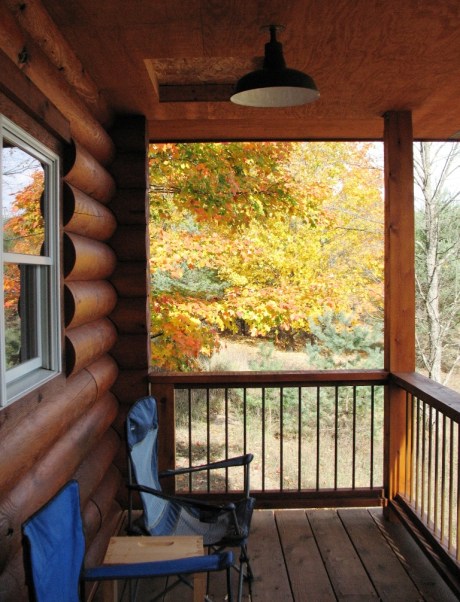
Of course none of this helped over the weekend when I was rescuing some tiger lilies from a construction site. Really, it wasn’t theft; they’d been bulldozed and would have died but for our valiant efforts to rescue them. Unfortunately for me, the bulldozer had disturbed a nest of Yellow Jackets.

Yellow Jackets are a whole different story, than bees. They are just rude! They sting, without warning—and a single yellow jacket can sting repeatedly! (Which it did, as I ran a quarter of a mile down the road, to escape it.)

Days later, I’m just recovering. The good news is that we got the tiger lilies planted, so there’s some reward for my experience.